“The sprinkled blood…speaks more eloquently than that of Abel.”

For today’s Mass, the second reading is an excerpt from the Book of Hebrews (12:18-19, 22-24a).  The author contrasts the Old Testament and the New Testament by discussing how one approached Mount Sinai (think Moses and the Ten Commandments) versus how one is to approach Mount Zion (think Jesus and the Paschal Mystery).  Being “terrified and trembling” (v. 21 — not included in the reading) is replaced by a “festal gathering” (v. 22).

The reading and the section culminate with the words in the headline.  Why the joy then?  Because Jesus has redeemed us through His blood.  The author of Hebrews is reminded of the first murder of an innocent — Cain killing Abel out of jealousy.  Recall God’s reaction to this killing:

Your brother’s blood cries out to me from the ground! (Gen 4:10)

https://upload.wikimedia.org/wikipedia/commons/b/bd/Peter_Paul_Rubens_-_Cain_slaying_Abel,_1608-1609.jpg


Peter Paul Rubens – Cain slaying Abel, 1608-1609


So Abel is a type of Jesus. That is, he prefigures the coming Messiah. The Bible is full of typology.  But no type perfectly anticipates its antitype:

Whereas Abel’s blood called for retribution, the blood of Jesus. innocent victim of a worse crime, cries out for mercy and forgiveness.  Instead of bringing a curse (see Gen 4:11), it brings the blessing of eternal redemption (Heb 9:12) and victory over death. [Mary Healy, Hebrews (Catholic Commentary of Sacred Scripture), (Grand Rapids, MI: Baker Academic, 2016), 278]

Nevertheless, just as Abel honored the Father God by his life, so did Jesus honor His Father by His life.  Both were martyrs.  Because of jealous rage evil forces sought to eliminate both of these men thinking that God would favor the perpetrators then.  Cain learned nothing from his parents Fall or the admonitions of God (Gen 4:7) and the religious leaders in Jesus’ day learned nothing from the reproaches of Isaiah or Jesus:

Ah! Those who call evil good, and good evil. (Is 5:20)

This is the heir. Let us kill him that the inheritance may become ours.
(Lk 20:14 — see The Parable of the Tenant Farmers at Lk 20:9-19 especially the last verse)

Let us be reminded of this Precious Blood, spilled at so great a cost and with so great a love, in our devotions and particularly in our receiving that same Blood in the Eucharist.  May we allow It to speak eloquently to our hearts so that we live as though we believe It is flowing through our very own veins and heart.

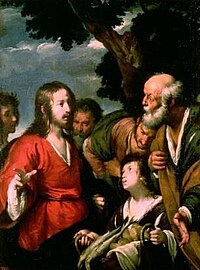
Image result for receiving the precious blood


“Much will be required of the person entrusted with much, and still more will be demanded of the person entrusted with more.”

(Submitted by me for last week’s bulletin as a member of my parish’s Spiritual Life Committee.)

In today’s gospel reading (Lk 12:32-48), after strongly emphasizing the need for preparation on our part for His return, Jesus concludes with these words: “Much will be required of the person entrusted with much, and still more will be demanded of the person entrusted with more.”

Do we consider ourselves among those “entrusted with more”? We should. The Catechism of the Catholic Church (CCC) says: “the fullness of grace and truth…Christ has entrusted to the Catholic Church” (no. 819).

Regarding grace, what immediately comes to mind are the seven sacraments. Some of us recall the Baltimore Catechism definition: “A Sacrament is an outward sign instituted by Christ to give grace.” Jesus Christ established all the sacraments because we need all of them. In particular, we are blessed to have the Holy Eucharist available to us weekly, even daily. This “Sacrament of sacraments” (CCC 1211) sustains us and helps us to grow in virtue if we are open to its graces. Remember Jesus’ words: “Amen, amen, I say to you, unless you eat the flesh of the Son of Man and drink his blood, you do not have life within you” (John 6:53).

Regarding truth, we have Divine Revelation in Sacred Scripture and Sacred Tradition handed down since the time of Christ and safeguarded by the teaching authority of the Church, the Magisterium. We are the servants in the parable who are to know the master’s will and follow it to the letter. We have no excuse not to know God’s will for us. We should continue to learn our Faith, all the while praying to the Holy Spirit that He will pour out on us His gifts of wisdom, understanding, counsel, fortitude, knowledge, piety, and fear of the Lord (see Isaiah 11:2-3).

A final word, this regarding Jesus’ coming. We tend to read this gospel in light of Jesus’ second coming. And we know that Jesus will come again on the last day, affirming this every time we recite the Creed. But, regardless of when that day comes, we know that we will meet the Lord face to face to give an account of our lives the day we take our last breath. The saying goes, “Live each day as if it were your last, someday you’ll be right.” Let us prepare for that day by using to the fullest those gifts graciously given by God to us this day and every day.

What will you do this week with what has been entrusted to you?

“They all ate and were satisfied.”

“They all ate and were satisfied.”

Today’s gospel reading relates the feeding of the five thousand as told by Matthew (14:13-21).  This episode in Jesus’ ministry is one of the rare ones that appears in all four gospels (Mk 6:3244; Lk 9:1017; Jn 6:113).  The story is a familiar one: multitudes come to listen to Jesus and, after a long day, as opposed to the suggestion of some disciples that the crowd should be dismissed to get food, Jesus wants His closest companions to feed the group; with only a few loaves and fish, Jesus blesses the food and then feeds the entire gathering of thousands.  As the headline says, all consumed their fill.

     Bernardo Strozzi, early 17th century

Not so much directly here, but certainly in John’s account, considering how it leads into the Bread of Life discourse (John 6), the tie-in between this episode and the Eucharist is clear.  The heading to this post struck me today in a particular way in this vein.  When we partake of Holy Communion do we feel satisfied?  We should.  An infinite amount of grace is available in each Host.  The more we are open to this grace the better we will be satisfied.  If our “appetite” is “spoiled” by sin, vice, bad habits, worldly concerns, “junk food” if you will, how can we approach true and total satisfaction in the Bread of Life?  Our consumer culture has us imbibing a lot of unhealthy influences.  Turning off, simplifying, and praying are good ways to scrape off the dross of our lives and be open to God’s gifts.  Frequent recourse to Confession is an excellent way to “clean house” and receive the strength to overcome those sinful ways that are barriers to fulfillment.

https://tomperna.files.wordpress.com/2012/06/jesus-eucharist-ewtn.jpg

May all Catholics, and all the world for that matter, come to find true contentment in the Eucharistic Lord!