“Lo, I am your servant, ready to obey you in all things; for I do not desire to live for myself but for You; oh, that I could do so, in a worthy and perfect manner!” (IC 3,15,2) | “[H]is mother kept all these things in her heart.” (Lk 2:51b)

|The Imitation of Christ by Thomas à Kempis, Book III Chapter XV: ”How We are to Regulate Ourselves, and What We are to Say in Every Desirable Thing” (third entry)

Above, find the closing words of Christ to the disciple. This is to be the attitude of the Christian: one of striving for “worthy and perfect” service to the Lord trumping any personal desire that would impede that mission.

|Today’s Gospel reading: Lk 2:41-51

For this Memorial of the Immaculate Heart of the Blessed Virgin Mary, it is fitting that we highlight the last words of the episode of the finding of Jesus in the temple at the age of twelve. This Gospel tells the familiar story of how, on the return trip from the Holy Family’s annual pilgrimage to Jerusalem for Passover, Jesus stayed behind in Jerusalem unbeknownst to His parents. Mary and Joseph search for Him for three days before finding Him interacting with the priestly class in the temple. In response to their expression of anxiety, Jesus responds as though they should have expected Him to be “in my Father’s house.” He then obediently goes with them. All this prompts Mary’s response above.

|Reflection

Kempis’s Christ implores the disciple to serve Him well while bemoaning the fact that he is unable to serve his Master worthily and perfectly. The Christian disciple need only look to the Blessed Mother for the exemplar of worthiness and the epitome of perfection. From the moment of her conception she was the spotless instrument of God who would conceive and bear His only Son. Her “Fiat!” as a young teenager set her course for the rest of eternity. Yet she didn’t receive all at once a revelation of all that would happen to her and her Son in their earthly lives. She pondered events in her immaculate heart, a heart that, we are told just a few verses earlier. would be pierced (see Lk 2:35). A heart that the baby Jesus and, I wager, the child Jesus, the adolescent Jesus, and the adult Jesus, rested His head against often. Every beat was for Him.

This is what we should dare to approach in our lives. Every word honoring the Lord, every action according to God’s will, every heartbeat an expression of love. And perfect trust in Jesus. Holy Mary, Mother of God, pray for us!

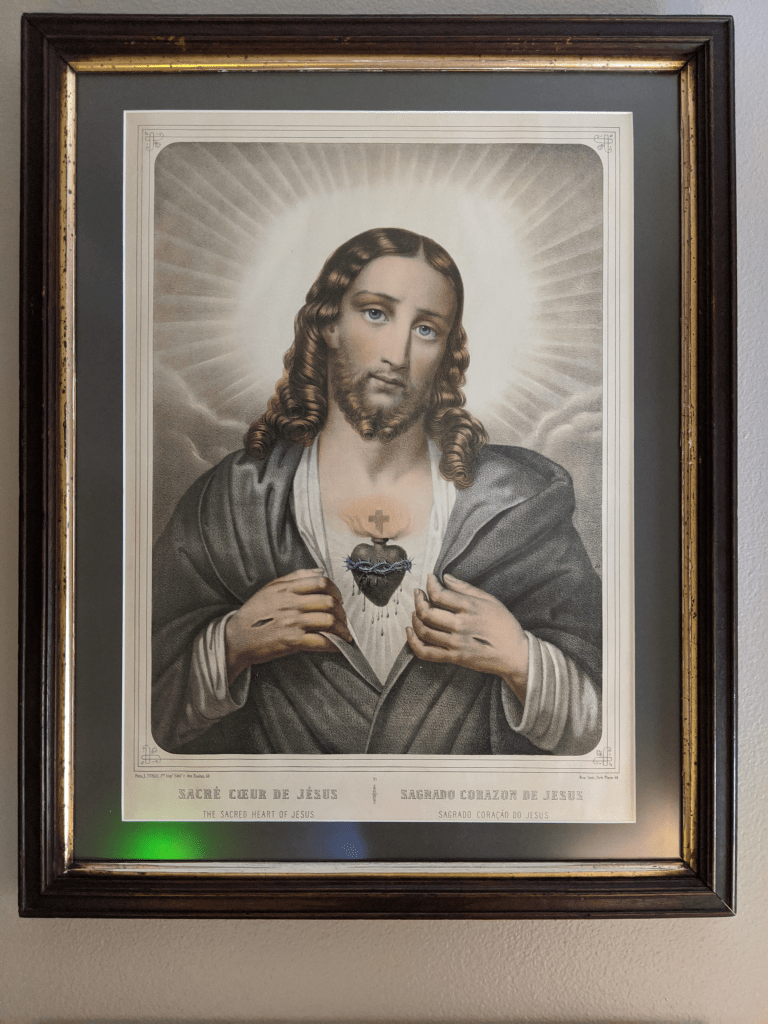
“Grant me the grace to rest in You above all desired things, and to pacify my heart in you.” (IC 3,15,4) | “Come to me, all you who labor and are burdened, and I will give you rest….for I am meek and humble of heart” (Mt 11:28,29)

|The Imitation of Christ by Thomas à Kempis, Book III Chapter XV: ”How We are to Regulate Ourselves, and What We are to Say in Every Desirable Thing” (second entry)

Kempis’ disciple says these words near the end of this chapter, after disavowing worldly pleasures and gladly accepting being “despised and ignored in this world.” True rest from the cares of this passing life,and a peaceful heart come only in taking refuge in the Sacred Heart.

|Today’s Gospel reading: Mt 11:25-30

This beautiful little passage for the Solemnity of the Most Sacred Heart of Jesus first highlights the greatness of the Father. Then the Lord consoles His disciples by telling them that true rest can be found in Him. Whatever burdens they have, they will find assistance and consolation in Christ.

|Reflection

When we speak of the Church as the Body of Christ, we say that Jesus is the Head and the rest of us believers are the various parts. But I submit that Jesus is not only the Head, but the Heart, as well. The Solemnity we celebrate today, instituted formally by,Pope Pius IX in 1856 serves as a reminder of this comforting fact. Life’s burdens and trials can weigh us down, it is true. Jesus understands. He is there to help us shoulder the burden, of course, but we can also set it down in Him, and find peace and rest in what is most important: being close to the Lord in this life so that we can be with Him forever in the next. Remember:

For here we have no lasting city, but we seek the one that is to come.
(Heb 13:14)

(Find the Twelve Promises to the Sacred Heart of Jesus to St. Margaret Mary Alacoque here.)

“Let Your will be mine and let my will always follow Yours and be in perfect accord with it.” (IC 3,15,3) | “[T]hy will be done, on earth as it is in heaven.” (Mt 6:10)

|The Imitation of Christ by Thomas à Kempis, Book III Chapter XV: ”How We are to Regulate Ourselves, and What We are to Say in Every Desirable Thing” (first entry)

This chapter contains a dialogue between Christ and the disciple. The Lord implores him to seek to do His will only, and to have Him take away all desire to do that which is not in the mind of God. The words above succinctly summarize the disciple’s response.

|Today’s Gospel reading: Mt 6:7-15

The Lord’s Prayer, in the form familiar to us today, is given by Jesus in the Sermon on the Mount as an example of how one is to pray (as opposed to pagan babbling). This may have been prompted by the Lord’s hearers per Luke (11:1-4). Jesus has them calling God familiarly as Abba (that is, Papa) and asking seven petitions. The Father is a loving parent, close to them, desiring only what is good for His children.

|Reflection

God, our creator, knows what’s best for us. He has our “owner’s manual.” We find that “it is hard for you to kick against the goad” (that is, the divine influence) (Acts 26:14). When we do go our own way, contrary to the Lord, we only ask for trouble. May God be merciful to not permit us to wallow in sin but rather may we come to think clearly out of this stupor, repent, and return to God’s good graces.

Remember, we also pray in the Our Father, “thy Kingdom come.” God wants to build up His kingdom here and now. The Gospels tell us how to live and Jesus shows us the way to a better world in this life and eternal happiness in the next. When we turn away from Truth we get the culture that surrounds us today: degenerate, defiant, decadent, divisive. We are called to change the world not to have the world change us. Let us pray unceasingly for the courage and the fortitude to remain steadfast and make a difference against the forces of the lord of this world, the evil one, Satan.

thy will | Tumblr

“[T]hey who speak are all nothing; for they will vanish with the sound of their words, but the Truth of the Lord remains forever.” (IC 3,14,4) | “When you pray, do not be like the hypocrites, who love to stand and pray in the synagogues and on street corners so that others may see them. Amen, I say to you, they have received their reward.” (Mt 6:5)

|The Imitation of Christ by Thomas à Kempis, Book III Chapter XIV: ”On the Consideration of God’s Secret Judgments so that We be Not Proud of Our Own Good” (third entry)

Kempis closes this chapter with the words above, aptly. Keeping with the theme of humility, he cautions against being puffed up by “the praises of men” which come and go; rather, remain steadfast in Eternal Truth.

|Today’s Gospel reading: Mt 6:1-8, 16-18

The Sermon on the Mount continues in chapter six. The proper attitude in prayer, almsgiving, and fasting is conveyed by our Lord. The intention of these acts must be appropriate to gain favor with God. The focus must be on God and others, not on accolades for oneself. The scribes and Pharisees “reward” is the admiration of the people. The disciple’s reward is the approval of the heavenly Father first and foremost.

|Reflection

Gone unsaid in today’s Gospel, but strongly implied in my view, is that the only reward that the hypocrites will receive is the praise of other persons who are taken in by their outward appearances of piety. They better enjoy it now because it will be an entirely different reception from what they will receive on the day of judgment. But, regardless of our motivations, we are not to get caught up in the good opinions of others toward us. As I posted yesterday, these are fine, and can be accepted, but the glory must always go to the One who has provided the gifts we share. The key is to always remember that this life is passing but eternal life is inevitable and we will be accountable for how we behaved in our mortal existence. We eschew the passing “rewards” that puff us up for the truth that God is God and we are not and all that we have and any good that we have done is thanks to Him. If we keep this always front of mind things will go well for us here and hereafter.

https://i0.wp.com/www.fountainoflife-givingwater.com/wp-content/uploads/2014/10/Praying.jpg

“Neither will he be moved by the words and by the praises of men, who has established all his hope in God.” (IC 3,14,4) | “[I]f you love those who love you, what recompense will you have?” (Mt 5:46a)

|The Imitation of Christ by Thomas à Kempis, Book III Chapter XIV: ”On the Consideration of God’s Secret Judgments so that We be Not Proud of Our Own Good” (second entry)

The last section of this chapter deals once again with vainglory or pride and its opposition to submissiveness to God who is the exemplar of humility in Jesus Christ. Praises will fade in this short life, but the truth of God, and our eternal destiny, remain forever.

|Today’s Gospel reading: Mt 5:43-48

The next section of the Sermon on the Mount gives us two more famous (and famously difficult) entreaties of the Lord: “Love your enemies” and ‘Be perfect, just as your heavenly Father is perfect.” Jesus emphasizes the importance of being God-like: love everyone as God loves them — not as they love you.

|Reflection

It is easy to get caught up in accolades of our fellow men, especially if we have special talents that we share that are particularly appreciated by others. And in this day and age, with the pervasiveness of social media, we can all too easily get caught up in “likes” and page views and comboxes to judge our worth. Now, receiving kind words is not a bad thing (and giving them generously is even better). Appreciation expressed for others’ gifts can provide an important confirmation of one’s work or ministry; it can give a much needed affirmation for their continued efforts. But it should never make the recipient proud in himself. We don’t deny the gift, we just shift the thanks to the Giver of the gifts. Denying the gift is false humility. Acknowledging the Gift-giver is true humility. And when the harsh reviews come in — and they will — we do not love those critics any less; in fact, maybe we love them more, being unfailingly gracious and praying to the Lord that we might be better instruments to move their hearts closer to Eternal Truth.

Église Saint-Martin de Castelnau-d'Estrétefonds - Le Sermon sur la montagne par Robert Arsène IM31000073.jpg
The Sermon on the Mountain (1870) by Arsène Robert

“For we are…inconstant, but through You we become strong; we are tepid, but you inflame us.” (IC 3,14,2) | “Give to the one who asks of you, and do not turn your back on one who wants to borrow.” (Mt 5:42)

|The Imitation of Christ by Thomas à Kempis, Book III Chapter XIV: ”On the Consideration of God’s Secret Judgments so that We be Not Proud of Our Own Good” (first entry)

If one word could be used to encapsulate this entire work it is “humility.” In this chapter, it is emphasized that God is everything and that man is nothing. He gives us everything, sustains us in everything, and the little good we think we do is nothing in the immenseness of God.

|Today’s Gospel reading: Mt 5:38-42

As we slowly continue our journey through the Sermon on the Mount, we find here the Lord giving us a tremendous challenge: the famous “turn the other cheek,” give your cloak as well as your tunic, “go the extra mile,” and give to all who ask something of you.

|Reflection

The heading in the link for today’s Gospel calls this section “Teaching about Retaliation.” What is Christ’s teaching on retaliation? In a word: don’t. How does this work? Is it not against every instinct of ours to not only be treated unfairly but then to do nothing about it (and, in fact, invite even more abuse)? We need the Lord to strengthen us in our inconstancy and inflame us in our tepidness in order to have any chance to do these difficult things. Even so, it hardly makes sense to us. Erasmo Leiva-Merikakis provides insight:

The willingness to *surpirse* our adversary with compassion, with love, with forgiveness — with justice according to the Heart of Christ, in other words — performs a far more efficient and constructive task [than revenge]. It puts evildoers at the risk of being converted, and it dynamizes the whole of society by introducing into it the most divine of all principles: self-giving at all costs….Perhaps my open hands and silent mouth become the most eloquent of teachers, and I will have won a brother in the Lord.

Perhaps, perhaps. I must run the risk that my apparent weakness will be construed as an added invitation to even greater violence and that my enemy will move on to slap the next man’s cheeks….Is this not, however, the very risk our Lord took in coming into our midst, in handing himself over to us, in opening his arms on the Cross? Generosity of the sort practiced by Christ is incompatible with any kind of calculation. We must act as he taught and as he acted.

Fire or Mercy, Heart of the Word (Volume One), p. 235

Enemies of religion sometimes deride believers by asserting that people of faith have made up their beliefs in order to find comfort or escapism in them. After reading Gospel passages like this one and taking them seriously…really?

“I became the most humble and abject of all, so that you might overcome your pride through my humility.” (IC 3,13,2) | “Jesus said to them, ‘Amen, amen, I say to you, unless you eat the flesh of the Son of Man and drink his blood, you do not have life within you.'” (Jn 6:53)

|The Imitation of Christ by Thomas à Kempis, Book III Chapter XIII: ”The Obedience of a Humble Subject Following the Example of Jesus Christ” (third entry)

Kempis has Christ making the point to the disciple that if He, who is God, could take the humble form of a man and be subject to other men, then we followers of Him certainly should be willing to obey our superiors and submit our wills to theirs. Jesus set the example.

|Today’s Gospel reading: Jn 6:51-58

Appropriate for the Solemnity of Corpus Christi, we hear proclaimed today the heart of the Bread of Life Discourse. Jesus is emphatic and earthy in His declaration that His Body and Blood must be consumed (“gnawed”) to gain eternal life. Scandalous to His hearers, we find out in the next few verses that, “As a result of this, many [of] his disciples returned to their former way of life and no longer accompanied him” (Jn 6:66).

|Reflection

When we consider Jesus’ humility, we generally think of it in terms of the Second Person of the Trinity becoming man — God stooping very low, allowing Himself to be subject to creatures to the point of even being derided, mocked, and killed by them. This is true, of course:

[T]hough he was in the form of God, did not regard equality with God something to be grasped. (Phil 2:6)

But this does not go far enough in appreciating Christ’s humility. Jesus promised in His last words in Matthew:

I am with you always, until the end of the age. (Mt 28:20)

Of course, Jesus is with us in many ways, to this day and until the end of time: in the Church, in Scripture, in our hearts, and in others. But in no way is He with us more profoundly than in the Eucharist. He takes the form of food prepared by the hands of human persons to give Himself to us in an unprecedented, miraculous way. He desires that we always have Him, really and truly present, in our midst and even inside of us, so that He might transform us into Himself.

In so doing, He once more, and for all time, subjects Himself to us once again. For reverence, true, but for humiliation as well. While some hearts are well-prepared to receive Jesus into them in Holy Communion, many are not, even to the point of receiving this awesome gift in the state of mortal sin, adding sacrilege to their separated state. Some have even gone so far to desecrate the Sacred Species in defiance of God or even to be used in demonic rituals. The Lord knew all this would occur and yet still, out of His great love, gave Himself to us in this manner “par excellence.”

Do we have any excuse for pride when our Master, our Exemplar, shows us the way of true meekness, a way nearly incomprehensible to us? Let us often contemplate the lowliness that Christ asked us to imitate and offer many penances for the outrages committed against Him in the Blessed Sacrament. And may we never be party to such debasement (and if we have, get to sacramental Confession as soon as possible).

Take my yoke upon you and learn from me, for I am meek and humble of heart; and you will find rest for yourselves. (Mt 11:29)

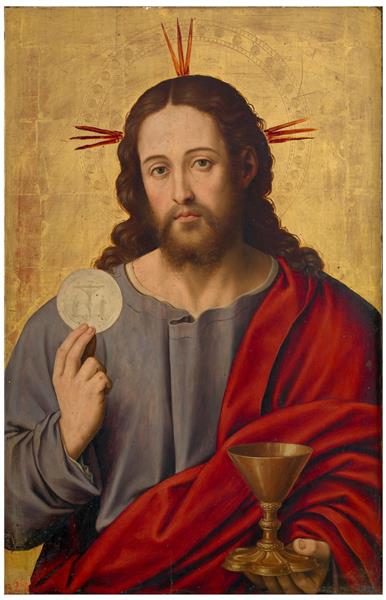
El Salvador Con La Eucaristía, 1545 - 1550 - Vicente Juan Masip
El Salvador Con La Eucaristía (1545-1550) by Vicente Juan Masip

“Learn…to submit yourself promptly to your Superior” (IC 3,13,1) | “Elijah went over to [Elisha] and threw his cloak over him….Then he left and followed Elijah as his attendant.” (1 Kgs 19:19b,21b)

|The Imitation of Christ by Thomas à Kempis, Book III Chapter XIII: ”The Obedience of a Humble Subject Following the Example of Jesus Christ” (second entry)

Again, Kempis is concerned here with perfect obedience of clerics to their religious superior, but this directive is widely applicable. In the religious realm, for the layperson, it should be our disposition toward God: immediate and total submission to the Lord and His will is required.

|Today’s first reading: 1 Kgs 19:19-21

The call of Elisha, directed by God just three verses earlier, is documented here in a few short verses. Elisha makes quick work of his possessions before following Elijah as his attendant and eventually a great prophet in his own right.

|Reflection

Elisha delayed a bit before following Elijah, but in dramatic fashion, killing his animals and cooking them on his personally smashed farm equipment to make a fine feast before bidding his farewell. Elijah was not pleased with the delay, but took him under his wing, anyway, and Elisha turned out be a fine protege and a worthy bearer of the prophetic mantle. It seems quite likely that Jesus had this episode in mind when He said to certain would-be disciples:

And another said, “I will follow you, Lord, but first let me say farewell to my family at home.” [To him] Jesus said, “No one who sets a hand to the plow and looks to what was left behind is fit for the kingdom of God.” (Lk 9:61-62)

Jesus demands an even more prompt response and a total donation of oneself to Him. “Time’s a-wastin,'” as they say. We must be completely dedicated to the cause of advancing the Kingdom of God by being zealous disciples of Christ. The authentic call of Jesus requires letting go of times past and things passing in favor of the Eternal Word.

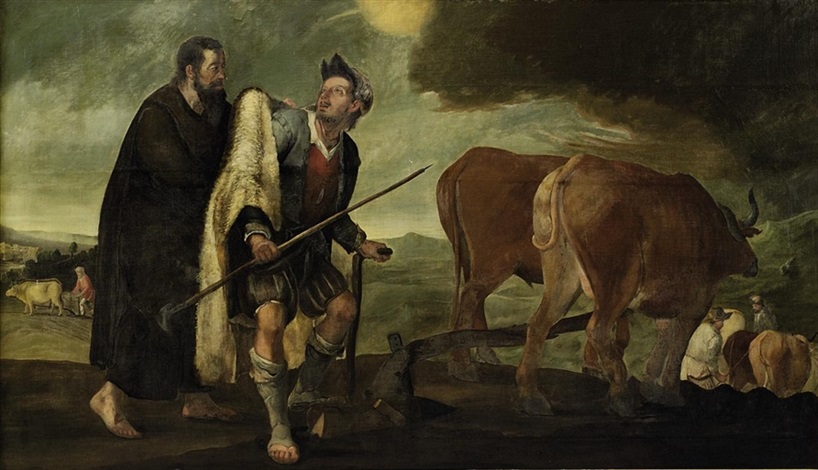
Elijah and Elisha by Abraham Bloemaert on artnet
Elijah and Elisha by Circle of Abraham Bloemaert (b. ca. 1564–1651)

“It is necessary that you conceive a true contempt of yourself if you want to triumph over flesh and blood.” (IC 3,13,1) | “It is better for you to lose one of your members than to have your whole body thrown into Gehenna.” (Mt 5:29b)

|The Imitation of Christ by Thomas à Kempis, Book III Chapter XIII: ”The Obedience of a Humble Subject Following the Example of Jesus Christ” (first entry)

While this chapter deals specifically with the proper attitude toward and relationship with an earthly religious superior, it applies to us all, since there is no one who doesn’t have a heavenly religious superior: Jesus. Radical humility. perfect obedience, and detachment from the world are keys to assuming the role of a simple sister or brother in Christ. In the passage above, Kempis emphasizes the need to keep the flesh in line in order to do our God-given duties well.

|Today’s Gospel reading: Mt 5:27-32

The Sermon on the Mount continues with a stern warning from Jesus:regarding adultery: it is not simply the physical act that incurs guilt, but even looking lustfully at another or committing other indecent acts convicts one as well. The penalty for obstinate sin: Gehenna (Hell); if necessary. one must take drastic measures to put the flesh into submission, as the headline states. In this chapter, the Lord takes the opportunity to more broadly apply the precepts of the Law, looking not just at outward actions but also what is in the heart and mind.

|Reflection

If we do not have “true contempt” of ourselves, it can be very difficult to avoid the lure of temptation to sin and impurity that we find, in our concupiscence, immensely appealing. Now Jesus does not mean that we should mutilate ourselves physically (He is using classic overstatement to drill in a point); rather, He wants to clearly and emphatically raise awareness of the scourge of sin in our lives, and the seriousness with which we must deal with it. One unrepented mortal sin cuts off a person from God for all eternity. Mortifying ourselves here and now and maintaining constant vigilance of the lure of “flesh and blood” help to keep us on the straight and narrow, give us the ultimate freedom, and prepare us for eternal bliss.

“[H]old that you have found peace, when you are exercised by various tribulations and tried in many adversities” (IC 3,12,2) | “[Barnabas] rejoiced and encouraged them all to remain faithful to the Lord in firmness of heart” (Acts 11:23)

|The Imitation of Christ by Thomas à Kempis, Book III Chapter XII: ”Of Learning to Acquire Patience and to Fight Against Concupiscence” (third entry)

Why be at peace in difficulties? Kempis’s Christ goes on to say.that one should “try willingly to bear present evils for God’s love.” If God permits it, that should be good enough for us. How will our faith be strengthened if not exercised by trials? Better than we bear with these well in this life than handle them poorly and pay for our complaints in the next.

|Today’s first reading: Acts 11:21b-26; 13:1-3

Barnabas was a powerful evangelist who brought many persons to Christian faith. Here he encourages the flock in Antioch. We are told “he was a good man, filled with the Holy Spirit and faith.” He then goes to Tarsus to bring Paul back and they stay on a year teaching the people of Antioch where the adherents to this new sect were first called Christians. It goes on to say that the Holy Spirit later set aside Paul and Barnabas for special work.

|Reflection

Barnabas knew that these new Christians were going to face tribulations and adversities, sooner rather than later, due to their newfound faith, thus he encourages them to stay resolute in the Lord. They will need to come to terms with that and find peace despite the turmoil sure to come.

Can we vow to hold this conviction as well? When things go badly, when the whole world seems to be crashing around us, whether in the culture or in our personal lives, are we able to confidently declare that God is in control and find true peace in that reality? It can be difficult. This is why we must draw ever closer to God through prayer, Scripture, and the sacraments. We need the sustaining power of grace to help us and guide us through all of the challenges of this life. Let us end by contemplating two powerful statements:

God, grant me the serenity to accept the things I cannot change,
courage to change the things I can,
and wisdom to know the difference. — Reinhold Niebuhr (1892-1971)

Fear is useless; what is needed is trust. (Mark 5:36)

Jacob Jordaens, detail of �Apostles Paul and Barnabas in Lystra� (1645), oil on canvas, Akademie der bildenden Künste, Vienna.
Apostles Paul and Barnabas in Lystra (detail) (1645) by Jacob Jordaens