Trinitarians R Us; Benedict on the brain; Lent cont.

ARE WE WITNESSES?

I’m so glad that today’s first reading (Acts 2:14, 22-33) immediately jumps to Pentecost after yesterday’s joy-filled Resurrection. As astounded as the apostles were to see Jesus alive and in the flesh after abandoning him during the Passion (although John hung around and ultimately was found at the foot of the Cross), it wasn’t until the Holy Spirit was sent to them that they finally could confidently and fearlessly exclaim “God raised this Jesus; of this we are all witnesses” (v. 32).

It is sometimes said that the Holy Spirit is the “forgotten” or “neglected” person of the Trinity. Maybe it’s because He is not as easy to personalize as the Father and the Son. After all, a dove, or fire, or wind, as Scripture variously describes the Spirit, are admittedly challenging to relate to. Or maybe, because He is not quoted in Scripture, we don’t feel so connected with Him. But, Luke makes it plain through Jesus’ own words (see Lk 24:49 and Acts 1:4 not to mention repeatedly in John 14-16 – see here for a splendid overview of the Spirit in the Gospels) and the non-action of the Lord’s closest disciples for fifty days after Jesus’ rising, that the Holy Spirit was indispensable to them and is indispensable to us.

“We are witnesses,” Peter exclaims to the crowd after receiving the gift of the Holy Spirit. Well, where were they the past seven weeks? Mainly in hiding or going back to their old jobs. Don’t you think they might have immediately been just a wee bit more enthusiastic to get the word out about the extraordinary (this seems to tame a word) event that brought their Master back to them? Wasn’t Christ’s appearance enough?

This is why, although we are Christians, we are not Christarians. We are Trinitarians. God, from all eternity, is three Persons. We need all three, must call on all three, and worship Him in all three. Creator, Redeemer, Sanctifier. It is a great mystery, “the central mystery of Christian faith and life” (CCC 234). We will never get our minds around it (those great intellects who have attempted know better than to think they could; see St. Augustine and also here for a digestible primer), although I pray that all of us reading this will spend all eternity contemplating it and diving into its unfathomable depths.

The slogan, “We are Witnesses” has been used secularly to highlight important matters and to sell shoes. Regardless, are we witnesses in word and deed to what should be most important to us as Christians — our Lord and Savior Jesus Christ? Without the Holy Spirit we cannot be, at least not with power. Let us not forget or neglect the Spirit of Truth who, in our witness, “will teach you at that moment what you should say” (Lk 12:12).

Come Holy Spirit into our broken lives and broken world!

EASTER STILL

Easter Monday is a holiday in many countries. We don’t want Easter to end yet, anyway, so we! Check out this review of yesterday’s readings from Hahn and Bergsma.

BENEDICT BIO

I was eager to finally get into the second volume of Peter Seewald’s massive and definitive biography of Benedict XVI. I began this volume on the pope’s birthday a couple of days ago and have made it to page 88 (of 539). Maybe it’s the nerd in me, but I find it hard to put down. More so, I suspect my eagerness to devour this work is due to my reverence for the man. He is simply amazing. Astounding intellectual gifts and complete faithfulness to the Lord and His Church wrapped in a simplicity and humility that is a shining example for the rest of us who don’t approach his erudition or sanctity.

LENT NEVER ENDS

From time to time, I have incorporated certain Lenten practices year-round. Many years ago that was to not eat meat on any Friday throughout the year (setting aside Friday has never gone away). Later I extended that to Wednesdays. I treat these days each week as if were a Friday in Lent — so, aside from going meatless, any other practices I take up during Lent I apply to those two days a week for all fifty-two weeks of the year.

I challenge you to take at least one thing you did special during Lent and continue it for the rest of your life. We know the power of abstinence and fasting: and that is detachment from material goods to make us more open to spiritual goods. This is only day one post-Easter so consider beginning today for the good of your soul and the good of the world.
No Saturday in the Park; Benedict at 95; Odds and Ends

JESUS SLEEPS, BUT NO REST FOR THE WEARY

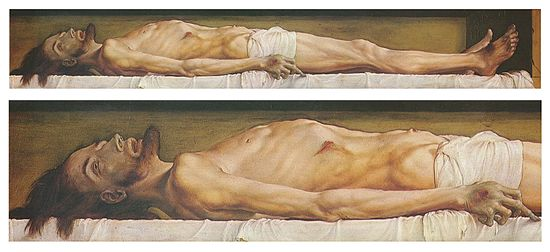
With Our Lord in the tomb, and everyone (save His mother, no doubt) believing this to be His permanent residence, I am reminded of Jesus’ own words to another group mourning the death of a loved one:

The girl is not dead but sleeping.

MT 9:24

And another time with threats all around Him:

I lay down my life in order to take it up again. No one takes it from me, but I lay it down on my own. I have power to lay it down, and power to take it up again.

Jn 10:17b-18a

Jesus was ridiculed for the first statement and nearly stoned to death shortly after exclaiming the second. Just these two instances, never mind the many other raisings, healings, and exorcisms recorded (plus the undoubtedly countless that were not), in addition to the many proclamations of His ultimate fate from His own lips, should have been more than enough to make Jesus’ closest collaborators wait joyfully for their Master’s imminent return after His ignominious death.

Yet, we only see fear and cowardice from the apostles and mourning from the women coming to the tomb. Were they not paying attention all those days and nights with him week in and week out for three years? After escaping death several times, did they think He just ran out of luck? No miracles left in His repertoire?

Nevertheless, Jesus was pretty busy in those thirty-six hours or so in the tomb. We confess in the Apostles Creed that “He descended into Hell.” I encourage you to read the seven short paragraphs in the Catechism on this matter and to look up all the Bible passages referenced therein to realize the biblical warrant for this claim. These are not found directly in the Passion narratives, but elsewhere. The most prominent:

What does “he ascended” mean except that he also descended into the lower [regions] of the earth? The one who descended is also the one who ascended far above all the heavens, that he might fill all things.

Eph 4:9-10

Jesus had a human soul and thus, as is the way for all of us eventually, when He breathed His last that soul left His Body and went to the abode of the dead (Sheol, not the hell of the damned). There He proclaimed the good news to all the saints that came before and freed them for heaven.

In His life, His ministry, His suffering, and even His death, Jesus would not be deterred in the mission given to Him by the Father. Eventually, the apostles and many other followers of His day and all the days up to the present, through the power of the Holy Spirit, were to courageously follow in His footsteps. Let us be counted in that number who stayed faithful until the end.

It is good to make Holy Saturday a day of increased silence, remembering Jesus’ entombment two thousand years ago and ours yet to come. Jesus was prepared, so must we be. Meanwhile, will we live and preach the Gospel “in season and out” until our dying breath as Our Savior did? Will even our time in the grave be used to help others to eternal bliss? Let us have the attitude of St. Therese of Lisieux, the Little Flower:

I wish to spend my heaven in doing good upon the earth.

(And, I would add, any time in purgatory as well.)

BENEDICT AT 95

Pope Emeritus Benedict continues to break records as he today achieved 95 full years on earth, longer than any other pope. In 1927, April 16 also fell on the day after Good Friday. He writes:

To be sure, it was not Easter Sunday but Holy Saturday, but, the more I reflect on it, the more this seems fitting for the nature of our human life: we are still awaiting Easter; we are not yet standing in the full light but walking toward it full of trust.

Joseph cardinal Ratzinger. Milestones: Memoirs 1927-1977 (San Francisco: Ignatius, 1977), 8.

This great man is now very frail, and I suspect he will not have to wait long to “stand[] in the full light.” But as long as the good Lord wills to leave him with us, we will be happy to have him.

Do yourself a favor and read about his life (the new two volume tome [one and two] is magnificent) and read his work, most popular among the myriad titles being the Jesus of Nazareth trilogy he wrote while occupying the chair of Peter.

While you’re waiting for those books, check out this fine article from today on Benedict and the pope emeritus’s own reflections on Holy Saturday.

ODDS AND ENDS

A heart-wrenching story told splendidly by a woman born in the 1880’s about a woman she knew born near the turn of the 19th century. Worth twenty minutes of your time, particularly in our cancel culture.

Per my “clever” title to this post, my favorite Chicago song: https://youtu.be/HjylD7esXDo

The Body of the Dead Christ in the Tomb (and detail, lower) (1520-22) by Hans Holbein the Younger

God bless.

Necessary Friday

MAMA’S PASSION

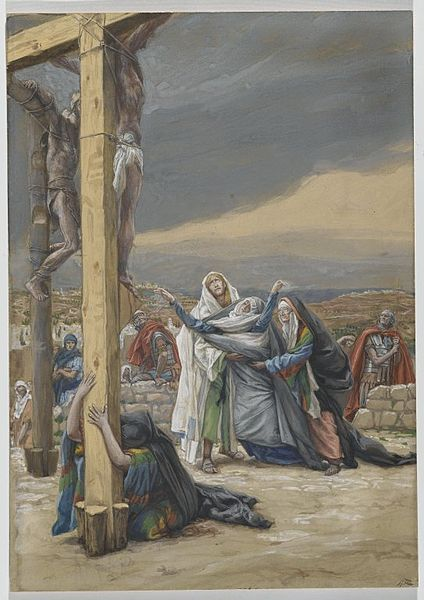
In pondering the Passion Narrative and listening to some reflections on it, what came to mind for special consideration is Mary’s attitude at the Cross. Her whole life, her whole raison d’etre, from an eternal perspective, was leading to this event. Jesus’ mother spent an entire lifetime pondering her God (it certainly did not begin with her encounter with an angel). Scripture tells us explicitly of this in two places: at the Annunciation (“she was greatly troubled at what was said and pondered what sort of greeting this might be” — Lk 1:29) and during the Finding in the Temple (“his mother kept all these things in her heart” — Lk 2:51b). She also knew, from blessed Simeon, that she would be well-acquainted with suffering (“and you yourself a sword will pierce” — Lk 2:35a). Whatever she thought of precisely the way the last thirty-four years of her life unfolded, her disposition at the foot of her Son’s altar of sacrifice (sadness, silence, resignation) indicate that her Fiat to the Archangel Gabriel remained in effect, as it had been all her days: “Let it be done to me according to your word,” Lord.

In fact, the Theotokos, the Christ-bearer, would no doubt have had it, if the Father would allow it, to let it be done to her instead of to the Word. Like any good mother, not content to just be present for her child, she would have desired to, empathetically. take it all upon herself — to bear His pain just as she bore Him. The great mystics tell us that, in fact, she did experience in her person all the suffering of her Son. We know that certain personages throughout history have experienced interiorly (and some exteriorly) the Passion of Christ — so why not the one who gave flesh to the God-Man?

In all this, she becomes a model for all ages. She anticipates Paul’s words,

Now I rejoice in my sufferings for your sake, and in my flesh I am filling up what is lacking* in the afflictions of Christ on behalf of his body, which is the church

Col 1:24

Except she was there, at least according to some, at the institution of the Church, as she saw and felt the lance pierce Christ’s side issuing the Blood of the Eucharist and the waters of Baptism.

A frequent prayer of mine is that all will come to know Jesus Christ more intimately in illness and suffering and that — since it must be endured in any case — none of it will go to waste. Let us all lift up that petition so that in any current and/or future distress, this disposition will be ours. This will help to assure us that, having passed through this valley of tears well, we can look forward to the day when “He will wipe every tear from their eyes, and there shall be no more death or mourning, wailing or pain” (Rev 21:4)

GOOD GOOD FRIDAY MEDITATIONS

The always superb Bishop Barron recorded a Stations of the Cross three years back. It runs nearly an hour, but it is worth your prayerful and attentive listening: https://youtu.be/pJNjtA-Awb4

This article on Jesus’ suffering, considered from a medical perspective, with the author of a recent book (definitive and highly recommended by me as it was last year’s Lenten reading) on the subject is fruit for contemplation on the horror of Jesus’ Passion, and thus the horror of sin and its effects.

A CURE FOR OUR ILLS

It was a blessing that my parish offered quite a number of opportunities for Confession the last few days. I was finally able to complete my First Saturday devotion just two days ago (it’s complicated). Lines were very long for our two priests (beautiful!). Wonderfully, as well, there was Eucharistic Adoration going on simultaneously with Confession. I do not recall experiencing that before — during Mass, yes, but not with Jesus exposed in a monstrance.

Upon doing my penance prayers on my knees, it struck me that what the world needs now as much as ever is encompassed in the scene before me. Jesus, contrition, penance, reparation, reconciliation — and mercy. The Real Presence needs to be proclaimed and upheld with a renewed fervor. My annoyance (to put it mildly) with those “Reformers” who separated Christians from this fount of life a half a millennium and more ago, with those Catholics who don’t believe that “This is my Body…This is my Blood,” and the scandal of Catholics not living up to their calling (this is where I come in) was impressed on me deeply in this moment.

Let us pray more fervently than ever that Jesus will become much more widely known in the gift of the Eucharist and that we will take seriously this admonition of our Lord:

Amen, amen, I say to you, unless you eat the flesh of the Son of Man and drink his blood, you do not have life within you.

Jn 6:53
Mater Dolorosa (The Sorrowful Mother) (between 1886 and 1894) by James Tissot

Palm Sunday reads; a reflection on Malchus; Lenten reading

PALM SUNDAY READS

A few years back, my parish asked me to do a presentation for its young adult group on “Palm Sunday in History and Scripture.” I provide it here for your edification.

Also, check out this article for a brief primer on Palm Sunday.

Finally, the always interesting Bp. Barron shares his reflection for the day: https://youtu.be/Jvi9Hmvki0k

WHAT MUST MALCHUS HAVE THOUGHT AND DONE?

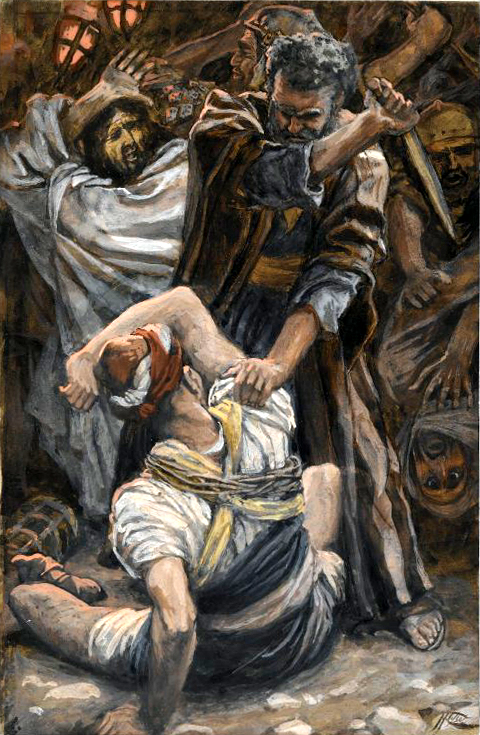
And behold, one of those who accompanied Jesus put his hand to his sword, drew it, and struck the high priest’s servant, cutting off his ear. (Mt 26:51)

One of the bystanders drew his sword, struck the high priest’s servant, and cut off his ear. (Mk 14:47)

And one of them struck the high priest’s servant and cut off his right ear. But Jesus said in reply, “Stop, no more of this!” Then he touched the servant’s ear and healed him. (Lk 22:50-51)

Then Simon Peter, who had a sword, drew it, struck the high priest’s slave, and cut off his right ear. The slave’s name was Malchus. (Jn 18:10)

Each Gospel mentions Malchus, albeit briefly. Only John spills the beans on who committed the act and who the victim was. Only Luke (why only the good doctor, I wonder) mentions Jesus healing the casualty of Peter’s apparently haphazard attempt at defense of his Lord.

I’m endlessly fascinated with characters introduced in the Gospels in one episode never to be heard from again. Thing of Simeon, Anna, the widow dropping her last pennies in the temple treasury, the rich young man, the Samaritan cured of leprosy, the woman at the well, the woman caught in adultery, Simon of Cyrene … I could go on and on. Whatever happened to them? How did their encounter with Jesus change their lives? If they were around and heard of Jesus’ death (and Resurrection) what did they make of it all? Even though we will likely not know the answers this side of eternity, such reflection and meditation can be a worthwhile endeavor.

When the person with the cameo in Scripture is named, it is usually presumed that the reason for identification is that that person was well-known to the Christian community being exposed to the evangelists’ writings and maybe even a leader in one of those communities. Was this the case with Malchus? We don’t know. But it is not difficult to imagine this was a life-changing event for this slave of the high priest Caiaphas. Some questions to consider surrounding the incident and its recent aftermath:

What was Malchus’s disposition coming into the Garden of Gethsemane? Did he know of Jesus? If so, even though he was following orders, did he believe it was just to arrest Him? Was the slave surprised by the attack on him and did he try to defend himself? What was his reaction to the healing? Did he make others aware of it? Did he try to defend Jesus or at least question the whole process? Did he stay on the scene and go with the captive Jesus as He was marched out of the garden? What was his involvement in the subsequent trials and the Way of the Cross? What did he think of Jesus’ death and stories of His Resurrection?

Again, we don’t know any of this. I would hope that he would immediately have made others aware of the miracle (after all, it would be quite difficult not to acknowledge the pain of the attack and the shock of the healing, although we can imagine there was quite a tumult at that moment), but that would have required more than a bit of courage with this mob thirsting for blood. I would guess that at least some of them would have witnessed past miracles Jesus performed so maybe they would have not been very moved by the most recent one. But, whatever Malchus did or did not do that fateful evening or the following day, I believe it is a good bet that he eventually grew bold in sharing his unique story as a follower of “the way.” He would have been one of many eyewitnesses (consider my partial list above) who certainly would have been “celebrities” (so to speak) in those early gatherings of Christians, asking to repeat endlessly his encounter with Christ and undoubtedly never tiring to relate his story.

We also must not fail to consider Jesus’ lesson for us at the beginning of these events and all the way to the cross and beyond. He always focused on others, even though we weak and fallen humans would not blame Him if he were self-absorbed as this unjust arrest and subsequent farcical trials unfolded. He heals an aggressor, He focuses on the crying women on the way to Calvary, he acknowledges the “good thief” on the cross next to Him and ushers him t heaven, he forgives his tormentors, he takes care of the future needs of His mother. All this done in humility. What a (difficult) example to follow, but one we must strive to emulate.

BOOK RECOMMENDATION FOR LENT OR ANYTIME

The Passion and Death of Our Lord Jesus Christ by Alban Goodier. Lenten reading just finished yesterday. Superb. See my review here.

The Ear of Malchus (L’oreille de Malchus) (c. 1886-1894) by James Tissot

Have a blessed Holy Week.