
TODAY’S READINGS
The Gospel reading is from Mt 1:18-25. Joseph’s reaction to Mary’s pregnancy follows. To find out how it turns out, just click on the link above.
Joseph her husband, since he was a righteous man,
yet unwilling to expose her to shame,
decided to divorce her quietly. (v. 19)
Mitch and Hahn succinctly give us the three prominent theories that could explain Joseph’s reaction to finding Mary, his betrothed and beloved, pregnant. Let’s read what they say about this verse.
“just: Or, “righteous”. Joseph is a man of sterling moral character, committed to living by the Mosaic Law (Deut 6:25; Lk 1:6). put her to shame: The Greek verb does not necessarily have a negative connotation. It simply means “to expose” or “to exhibit”. send her away: Catholic tradition proposes three main interpretations to explain why Joseph resolved to end his betrothal with Mary.
(1) The Suspicion Theory. Some hold that Joseph suspected Mary of adultery when he discovered her pregnancy. Joseph thus intended to pursue a divorce in accord with Deut 24:1–4 until the angel revealed to him the miraculous cause of the conception (1:20). Joseph is said to be righteous because he shuns immorality and directs his life by the Law of God. Proponents of this view include St. Justin Martyr, St. John Chrysostom, and St. Augustine.
(2) The Perplexity Theory. Others hold that Joseph found the situation of Mary’s pregnancy inexplicable. Divorce seemed to be his only option, and yet he wished to do this quietly, for he could not bring himself to believe that Mary had been unfaithful. Joseph is said to be righteous because he lives by the Law of God and judges Mary’s situation with the utmost charity. The main proponent of this view is St. Jerome, whose exegesis was adopted into the notes of the medieval Bible.
(3) The Reverence Theory. Still others hold that Joseph knew the miraculous cause of Mary’s pregnancy from the beginning, i.e., he was made aware that the child was conceived “of the Holy Spirit” (1:18). Faced with this, Joseph considered himself unworthy to be involved in the Lord’s work, and his decision to separate quietly from Mary was a discretionary measure to keep secret the mystery within her. On this reading, the angel confirms what Joseph had already known and urges him to set aside pious fears that would lead him away from his vocation to be the legal father of the Messiah (1:20). Joseph is said to be righteous because of his deep humility and reverence for the miraculous works of God. Proponents of this view include St. Bernard of Clairvaux and St. Thomas Aquinas.”
Curtis Mitch, “Introduction to the Gospels,” in The Ignatius Catholic Study Bible: The New Testament (San Francisco: Ignatius Press, 2010), 8.
As we see, there are great saints supporting each of these theories. All are certainly plausible. But I would like to think that it was out of reverence that Joseph had initially decided to take his leave of Mary. I’m not sure he could have ever forgiven himself, or looked Mary in the eye, if he had suspected the worst.
May we be as reverent as Joseph when we assess situations we find unfathomable.
God bless.
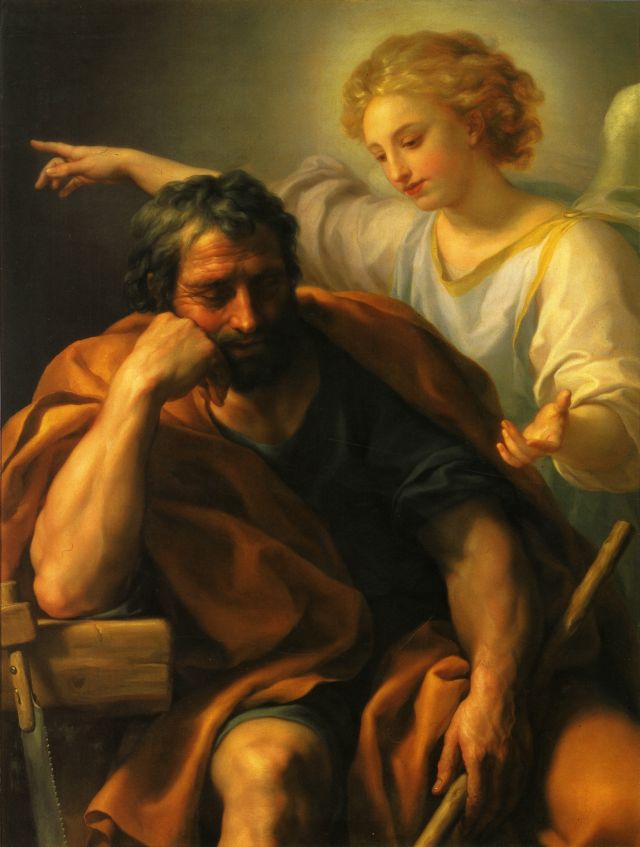
The Dream of St. Joseph by Anton Raphael Mengs (1773-74)
 Unworthy Servant