
TODAY’S READINGS
Today’s Gospel (Mt 5:43-48), again from the Sermon on the Mount, ends with these challenging (to say the least) words of Jesus:
“So be perfect, just as your heavenly Father is perfect.” (v. 48)
“Strictly speaking, it is quite impossible for a created being to be as perfect as God. What our Lord means here is that God’s own perfection should be the model which every Christian tries to follow, even though he realizes that there is an infinite distance between himself and his Creator. However, this does not reduce the force of this commandment; it sheds more light on it. It is a difficult commandment to live up to, but along with this we must take into account the enormous help grace gives us to go so far as to tend towards divine perfection. Certainly, the perfection which we should imitate does not refer to the power and wisdom of God, which are totally beyond our scope; here the context seems to refer primarily to love and mercy. Along the same lines, St Luke quotes these words of our Lord: “Be merciful. even as your Father is merciful” (Lk 6:36).
“Clearly, the ‘universal call to holiness’ is not a recommendation but a commandment of Jesus Christ.” (The Navarre Bible: St Matthew, 69-70)
“Jesus advocates moral righteousness higher than the Old Covenant—it is a standard of mercy. Just as Israel was to imitate God in being ‘holy’ (Lev 19:2), so Jesus calls the Church to imitate God’s perfect compassion (Lk 6:36). The Father is kind and merciful to the good and evil alike, so his children must extend mercy even to their enemies (5:7; Lk 10:29–37; Jas 2:13). See note on Lk 6:36 (CCC 1968, 2842).” (Ignatius Catholic Study Bible: The Gospel of Matthew, 27)
“There is an insurmountable problem in our Lord’s solemn injunction, which concludes this whole section as its summary, as long as we insist on an abstract, essentialist definition of the term ‘perfect’. The being of man, in this sense, can never be perfect in the same way God’s is, and the Lord seems to be enjoining the impossible. Persons have been known to wreck their psychic, physical, and spiritual lives trying to apply this command in an erroneous way. If we apply the literal Greek meaning of the word for ‘perfect; as noted (τέλειος from τέλος = ‘goal’, ‘end’), we will see that what the command intends is, rather. ‘Guide your actions and attitudes by the same intention, the same finality, as your heavenly Father’s.’ Far from implying a head-braking striving for the unattainable, we should rise from our immersion in the business of self-survival and focus our outlook from the divine point of view. (Fire of Mercy, Heart of the Word, Volume I, 241)
“This ‘as’ is not unique in Jesus’ teaching: ‘You, therefore, must be perfect, as your heavenly Father is perfect’; “Be merciful, even as your Father is merciful’; ‘A new commandment I give to you, that you love one another, even as I have loved you, that you also love one another.’ It is impossible to keep the Lord’s commandment by imitating the divine model from outside; there has to be a vital participation, coming from the depths of the heart, in the holiness and the mercy and the love of our God. Only the Spirit by whom we live can make ‘ours’ the same mind that was in Christ Jesus. Then the unity of forgiveness becomes possible and we find ourselves ‘forgiving one another, as God in Christ forgave’ us.” (CCC 2842)
Feel better? I’m reminded of the famous quote attributed to Mark Twain, “Some people are troubled by the things in the Bible they can’t understand. The things that trouble me are the things I can understand.” Well, if the call to perfection does not trouble the hearer, I’m not sure what else in Scripture would. Any even mildly engaged Christian with an ounce of honest introspection, need only a moment, at most, to realize we all are far from perfect. But this declaration of Jesus should compel us to examine our conscience, pray fervently for help, and then frequent the sacraments to get that help.
Hearkening back to yesterday’s post, “You can pay me now or pay me later.” A person does not get into heaven with any imperfections. Best to clean up our act here, discipline ourselves here, detach ourselves here. It’s easy to understand but very difficult to do.
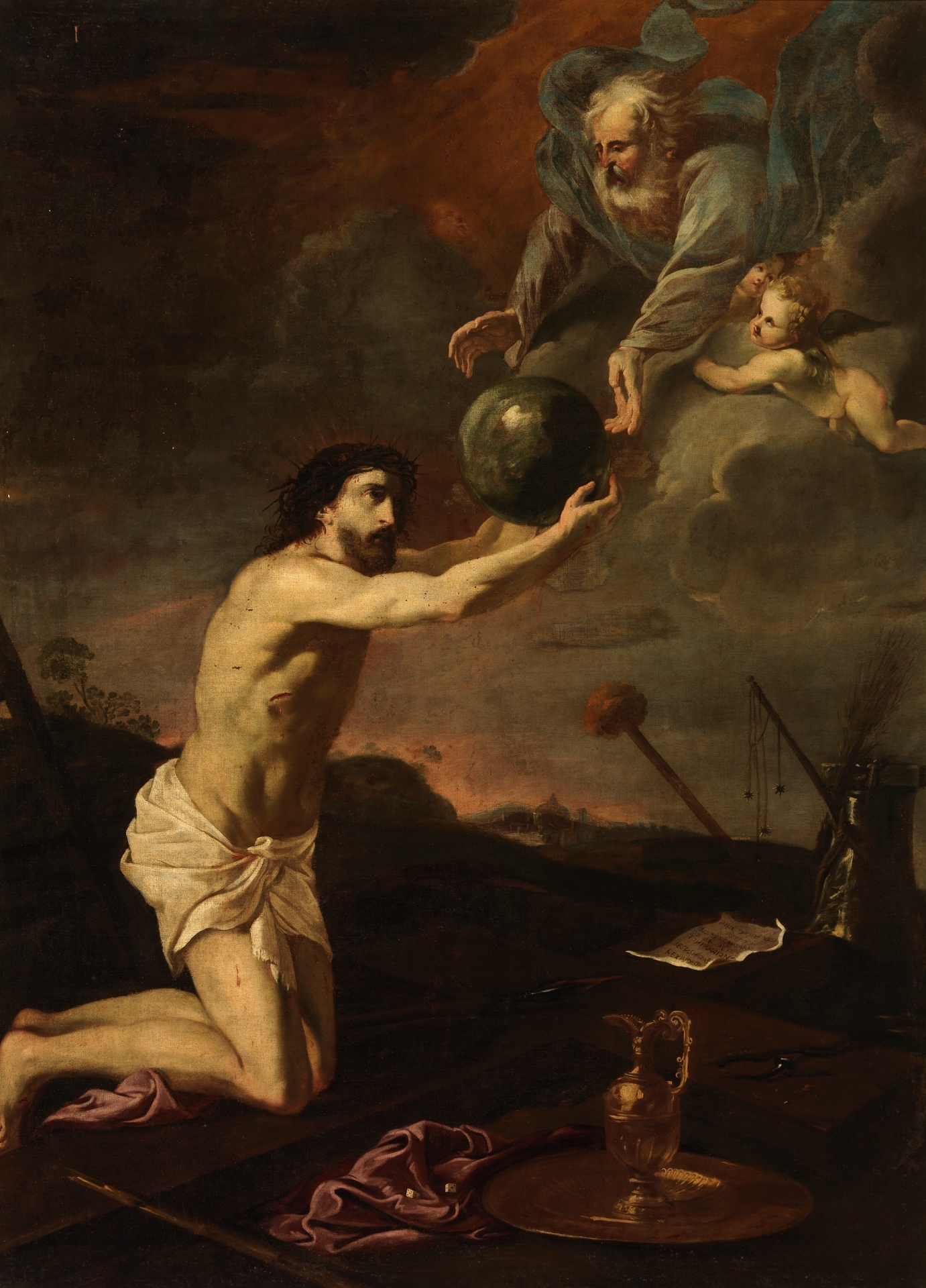
Jesus Receiving the World from God the Father (c. 1657) by Antonio Arnas Fernández
God bless.
 Unworthy Servant