
TODAY’S READINGS
Today’s Gospel reading (Jn 12:1-11) continues our journey through John as we near the time of the Last Supper. Famously, Mary, the sister of Lazarus and Martha, slathers Jesus feet with costly perfume. Judas objects and Jesus responds :
Jesus said, “Leave her alone.
Let her keep this for the day of my burial.
You always have the poor with you, but you do not always have me.” (vv. 7-8)
“The poor: Jesus is not indifferent toward the poor. Elsewhere he promotes almsgiving in no uncertain terms (Mt 6:2–4; Lk 6:30; 12:33). ● The words of Jesus echo the words of Deut 15:11, which states that the unceasing presence of the poor offers countless opportunities to give generously to less fortunate neighbors. The disciples, too, will have plenty of chances to give alms, but only a brief time remains to be generous toward Jesus while he remains among them (CCC 2449).” (The Gospel of John [Ignatius Catholic Study Bible], 41)
“Jesus takes priority over every other concern — and little time remains before his mortal life ends.” (The Gospel of John [Catholic Commentary on Sacred Scripture] ,218)
“A literal translation of Jesus’ words is, ‘in order that she may keep it for the day of preparation for my burial,’ with ‘in order that’ indicating purpose. The interpretation which makes the most sense is that the purpose of the nard was that it was to be kept for the day of preparation for Jesus’ burial, which was that very day…Mary has symbolically prepared the body of Jesus for burial. anointing it as a corpse was anointed before being buried. Jesus does not say that Mary understood this deeper significance of her act; she may have simply anointed him out of love and gratitude. But Jesus knows that the hour for his going to his father is near. His raising of Lazarus to life — the cause of Mary’s gratitude — means that he lives under a sentence of death (11:53). Mary’s anointing has prepared him for the sentence being carried out.” (Bringing the Gospel of John to Life, 347)
What strikes me first and foremost about this passage is that, while true that Jesus will soon be dead, buried, rise, and ascend, He is still with us. Of course, He remains with us in a real and substantial way in the Eucharist. But that’s not the only way. Here’s Mother Teresa tying together the Eucharist and the poor:
“If we recognize [Jesus] under the appearance of bread, we will have no difficulty recognizing him in the disguise of the suffering poor.” (see article here)
Which invokes Jesus’ own words about the downtrodden, that He spoke immediately before the woman anoints His feet in Matthew, and how we should view them:
“For I was hungry and you gave me food, I was thirsty and you gave me drink, a stranger and you welcomed me, naked and you clothed me, ill and you cared for me, in prison and you visited me.” (Mt 26:35-36)
Yes, Jesus left us in the familiar form the apostles came to know. But He invites us to see Him and serve Him in everyone we meet, particularly the poor. Being faithful in this way we prepare ourselves for the day of our burial.
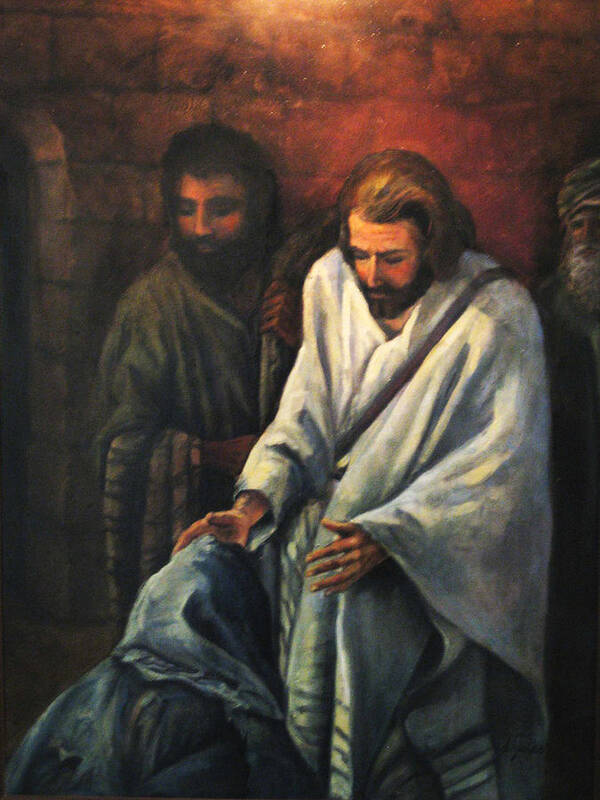
Jesus Healing Beggar (2011) by Donna Tucker
God bless.
 Unworthy Servant