
TODAY’S GOSPEL (Lk 1:5-25)
From Luke 1:19b-20:
“I was sent to speak to you and to announce to you this good news.
But now you will be speechless and unable to talk
until the day these things take place,
because you did not believe my words,
which will be fulfilled at their proper time.”
From Catholic Commentary on Sacred Scripture: The Gospel of Luke, page 39
“Gabriel was sent precisely to announce to Zechariah this good news about John. For the first time Luke uses the very euangelizō (‘to announce good news’), which refers throughout Luke-Acts to the preaching of the gospel message (e.g., 4:18; Acts 5:42). The proper response to ‘good news’ is to ‘believe’ (see Acts 8:12). However, Zechariah did not believe and so is punished by becoming temporarily speechless (literally, ‘silent’).”
From Opening the Scriptures: Bringing the Gospel of Luke to Life, page 15-16
“Gabriel has told Zechariah the gospel truth, as it were, but Zechariah would not accept it.
…
“Zechariah did not understand how he and Elizabeth could have a child in their old age, and he limited what he thought God could do to what he could understand. Nevertheless, the things that Gabriel said would happen ‘will be fulfilled at their proper time’ — in God’s timing. God’s word is always fulfilled. Zechariah will be ‘unable to talk until the day these things take place.’ It is not apparent what ‘day’ Gabriel is referring to, since he has not only spoken of Elizabeth bearing a son who is to be named John (verse 13) but of John carrying on a ministry as an adult (verses 15-17). Zechariah must have been left wondering how long his speechlessness would last and what would have to be fulfilled for him to talk again.”
My take
It is hard to blame Zechariah for being incredulous regarding this whole episode. How many times did he enter the sanctuary previously with nothing unusual happening? Now, out of the blue, so to speak, this awesome figure tells him news he wasn’t expecting and that he finds difficult to believe. Maybe he thought he was hallucinating. How long must he and his wife have prayed for a child before giving up due to biology. Their prayers seemed to go unheeded.
We know that Zechariah and Elizabeth “were righteous in the eyes of God, observing all the commandments and ordinances of the Lord blamelessly” (v. 6), so their faithfulness was finally rewarded. Here is where Zechariah drops the ball. Having conceded that it was not meant for him and his wife to have children, it is no longer on his radar. In the surprise of the presence of the angel, he apparently did not recall episodes in the history of the Chosen People that were comparable, for example, Abraham and Sarah, and, from today’s first reading, Manoah and his barren wife. He pays a price for his doubt, but the end result is glorious.
It occurs to me that it would be wonderful if doubters of God’s Revelation would be struck mute today. Instead of spreading ignorance, criticism, lies, or heresy, they would be taught a lesson for them to consider (silently) and for the rest of the world to see until they came around to the truth. Then, like Zechariah, they would bless God (cf. v. 64) and bring the fear of God to others (cf. v. 65).
May we all be struck dumb instead of speaking ignorantly, falsely, or irreverently about the word of God.
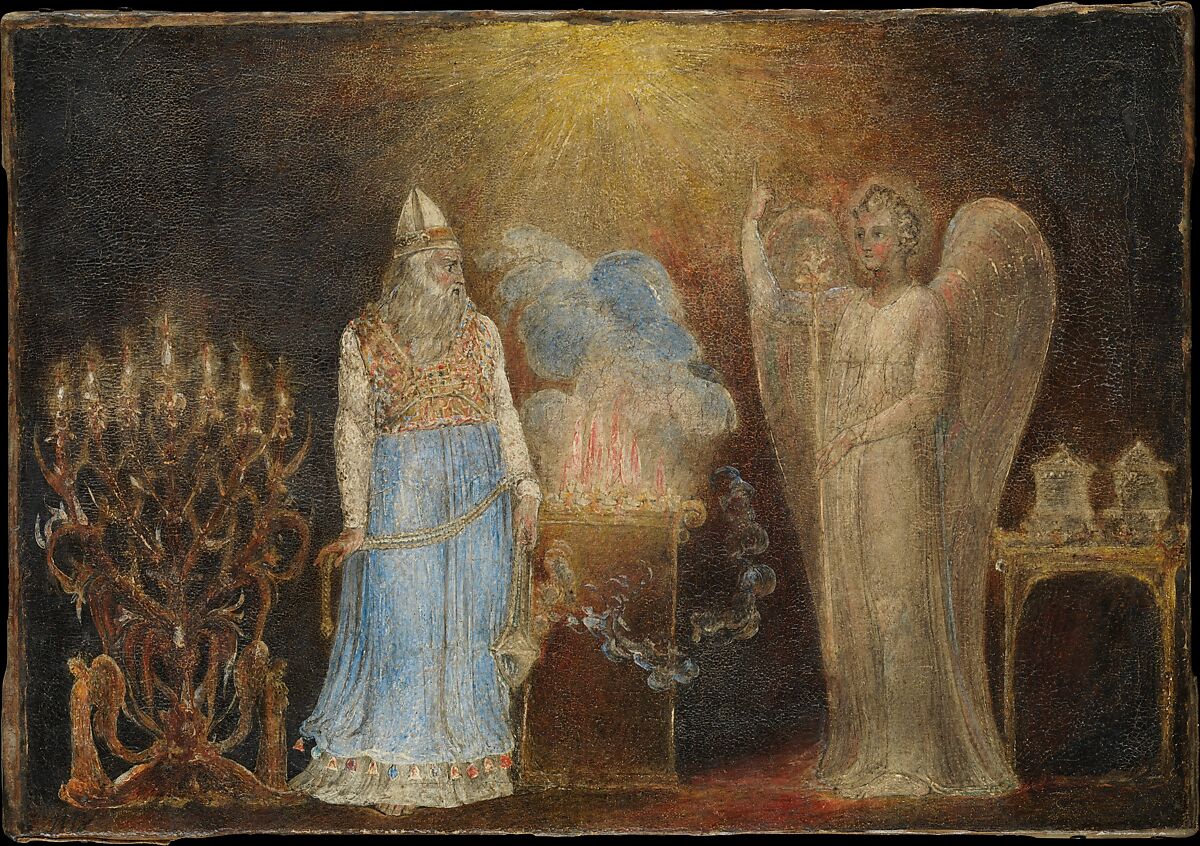
The Angel Appearing to Zacharias (1799–1800) by William Blake
God bless!
 Unworthy Servant