Christmas Day: The amazement never ceases

TODAY’S READINGS (MASS AT DAWN)

FROM Isaiah 62:11 (the full passage is Is 62:11-12):

See, the LORD proclaims
to the ends of the earth:
say to daughter Zion,
your savior comes!

From Ignatius Catholic Study Bible: The Old and New Testament, page 1254

“The coming salvation is announced to Jerusalem. Matthew cites these words in Mt 21:5, coupling them with the prophecy of Zech 9:9, to say that Jesus’ entry into Jerusalem on a donkey fulfills prophetic expectations that salvation will come to the city in the form of a humble king.”

FROM Psalms 97:1a (the full passage is Ps 97:1, 6, 11-12):

The LORD is king; let the earth rejoice

From Ignatius Catholic Study Bible: The Old and New Testament, page 914

“‘The Lord reigns’ as the divine King over all creation (47:7; 96:10). The same declaration opens Pss 93 and 99.”

FROM Titus 3:5b (the full passage is Ti 3:4-7)

He saved us through the bath of rebirth
and renewal by the Holy Spirit

From Ignatius Catholic Study Bible: The Old and New Testament, page 2147

he saved us: Salvation springs entirely from the mercy and grace of God. It is not an achievement on our part or a payment rendered for services. Apart from grace, even our most heroic efforts to please God fall short of his glory and his plan for our lives (Rom 3:23). Both the faith to believe in Christ and grace to live the gospel are undeserved gifts (Eph 2:8; Phil 1:29). Only after God has bestowed these gifts can we begin to please our heavenly Father through a lifetime of service and good works (Tit 2:14; Eph 2:10; Heb 11:6) (CCC 1996–2002).

Word Study
Regeneration

Palingenesia (Gk.): refers to a ‘rebirth’, ‘restoration’, or ‘renewal’. The term is used only twice in the Bible, here and in Mt 19:28, though it appears several times in non-biblical writings. Stoic philosophers, for instance, believed that a renewed world order would emerge after a fiery purgation of the cosmos. The Jewish philosopher Philo of Alexandria spoke in a similar way about the rebirth of the world after the flood in Noah’s day (Life of Moses 2, 65). The Jewish historian Josephus employs the term for the restoration of Israel after the tragedy of exile (Antiquities 11, 66). In Titus, Paul links the idea of regeneration with a baptismal washing that cleanses us of sin and gives us a new birth into the family of God (cf. Jn 3:5; Eph 5:26). He is saying that the washing of the body is an efficacious sign of the invisible work of the Spirit, whose action in the sacrament renews and renovates our souls with divine grace (Acts 2:38; 1 Pet 3:21) (CCC 1215, 1265).

FROM Luke 2:18 (the full passage is Lk 2:15-20)

All who heard it were amazed
by what had been told them by the shepherds.

From Opening the Scriptures: Bringing the Gospel of Luke to Life, page 64

“Those whom [the shepherds] told — presumably people in Bethlehem and the vicinity — were ‘amazed’, astonished by what they heard. But that seems to have been the extent of their reaction. Luke gives no indication that any of those told about the birth of Jesus sought him out. Their response is like someone being told, ‘God is offering you eternal life’ and saying ‘Wow!’ but doing nothing to take up God’s offer.”

MY TAKE

Isaiah’s long awaited savior has come! The Psalm telling us the Lord is King has been fulfilled on earth in the tiny infant from Nazareth! What is our part? Accepting the gift of grace Jesus the Christ won for us through baptismal regeneration and living a life pleasing to God by doing what His Son commanded. If the author quoted immediately above is correct, amazement was not widespread in the area of Bethlehem, but with two thousand years to contemplate all that the Messiah has done for us, should our amazement ever come to an end? Let us not grow lukewarm about a story with which we may be very familiar but is ever ancient, ever new.

Indeed, the word of God is living and effective, sharper than any two-edged sword, penetrating even between soul and spirit, joints and marrow, and able to discern reflections and thoughts of the heart. (Heb 4:12)

Christianity is the religion of the “Word” of God, a word which is “not a written and mute word, but the Word which is incarnate and living” (St. Bernard, S. missus est hom. 4, 11: PL 183, 86). If the Scriptures are not to remain a dead letter, Christ, the eternal Word of the living God, must, through the Holy Spirit, “open [our] minds to understand the Scriptures” (Cf. Lk 24:45). (CCC 108)

SEASONAL VIDEOS

I know there are many fine Catholic apps available through which one can find many excelletn resources. But as far as video content for study and learning, nothing beats YouTube. I encourage everyone to go to Shameless Popery Podcast, from Joe Heschmeyer of Catholic Answers, and watch his videos at every opportunity. You will soon be in the top one percent of Catholics in your knowledge of the faith and your ability to defend it. Two entries particularly appropriate for the season:

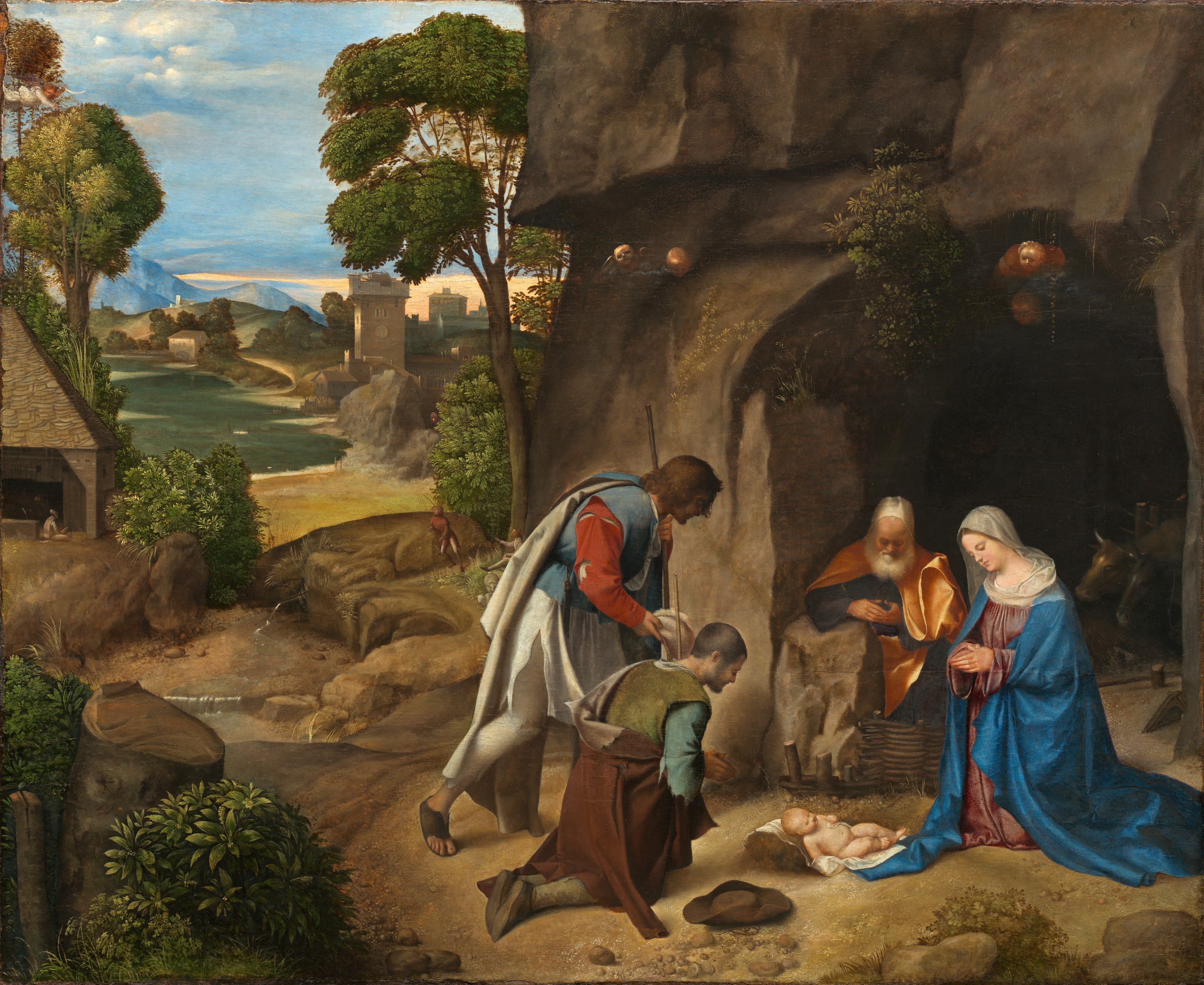
The Adoration of the Shepherds (1505/1510) by Giorgione

Merry Christmas and God bless!
Advent Day 24: The Davidic Covenant

TODAY’S FIRST READING (2 Sm 7:1-5, 8b-12, 14a, 16)

FROM 2 Samuel 11b-12, 14a, 16:

“‘The LORD also reveals to you
that he will establish a house for you.
And when your time comes and you rest with your ancestors,
I will raise up your heir after you, sprung from your loins,
and I will make his Kingdom firm.
I will be a father to him,
and he shall be a son to me.
Your house and your Kingdom shall endure forever before me;
your throne shall stand firm forever.'”

From Ignatius Catholic Study Bible: Old and New Testament, page 474

The Davidic Covenant

The Davidic covenant is the latest and greatest of the Old Testament covenants. Following the steady buildup of covenants between God and his people over the centuries, beginning with Adam and continuing with Noah, Abraham, and Moses, the divine covenant with David brings the biblical story to a theological highpoint. Each of these ancient covenants helps to prepare the way for messianic times, but Jewish and ­Christian traditions agree that hopes for a coming Messiah are anchored most explicitly in the Lord’s covenant with David.

Nathan’s Oracle

The foundation of the Davidic covenant is Nathan’s oracle in 2 Sam 7.8-16, which responds to David intention to build a sanctuary for Yahweh. Nathan reveals that the king’s desire, although noble, is not part of God’s plan for his life. Instead, something more wonderful is envisioned. What David wants to do for the Lord hardly compares to what the Lord wants to do for David. This divine plan can be summarized under four headings.

1. Dynasty. Yahweh first pledges to build David a “house” (2 Sam 7:11). By this he means a dynasty, a hereditary line of royal successors, so that his kingdom and his throne will be “established for ever” (2 Sam 7:16). The house of David may have to be disciplined as times and circumstances demand, but the house of David will never be fully disowned like the house of Saul was when the Lord abandoned it on account of Saul’s failings (2 Sam 7:14-15). David’s dynasty will exercise an everlasting rule that is guaranteed by God.

2. Temple. Yahweh’s second pledge responds directly to David’s desire to build a Temple (2 Sam 7:2). The king wishes to begin construction on a worthy sanctuary, but, according to Nathan, the privilege a building a “house” for the Lord will fall to David’s royal “offspring” (2 Sam 7:12-13). This is an allusion to David’s son and successor, King Solomon, who pulls together a massive workforce to construct the Jerusalem Temple after his father’s death (1 Kings 6-8). The Temple thus serves as an architectural sign of the Davidic covenant.

3. Adoption. Yahweh’s third pledge is to create a father-son relationship between himself and David’s royal offspring (2 Sam 7:14). It is a promise that the kings of David’s line will be made sons of God by divine adoption. In this way, the covenant of kingship creates an especially close relationship between Yahweh and the anointed successors of David. It is implied in Ps 2:7 that the royal adoption of each king take place on the day of his coronation.

4. Law for Mankind. In response to the oracle, David senses that God, in pledging himself to these grandiose commitments, is initializing a plan to extend his blessings to the human race beyond Israel. What the Lord has revealed to him is nothing less than torat ha-adam, “the law of mankind” (see note on 2 Sam 7:19). The Law of Moses was a gift for Israel alone; but the covenant arrangement promised to David is a gift for Israel and other nations alike. This becomes visible in the days of Solomon, who recruits Gentiles from Phoenicia to assist with building the Temple (1 Kings 5:6, 18), who implores Yahweh to answer the prayers of the Gentiles who direct their pleas toward his Temple (1 Kings 8:41-43), and who instructs inquiring Gentiles from many nations in the fundamentals of godly “wisdom” (1 Kings 4:3- 10:1-10, 24).

Nathan’s oracle is worded as a divine promise, but its terms are guaranteed by divine oath. Whether a formal pledge is made on this occasion or afterward makes little difference. It is clear from other texts that Yahweh makes his commitments to David into a covenant (2 Sam 23:5; Sir 45:25; 47:11) by swearing an oath to David (Ps 89:3-4, 35-37; 132:11-12). And since God alone swears the oath, he alone assumes responsibility for its fulfillment. The Davidic covenant of kingship is an unconditional “grant”, meaning that Yahweh takes upon himself the unilateral obligation to make good on his pledges, regardless of whether or not David’s future line of successors proves worthy of this honor.

New Testament Fulfillment

The pledges made to David are provisionally realized in Solomon during the golden age of the united monarchy and, to a lesser extent, in the centuries that the Davidic dynasty ruled in Jerusalem. But definitive fulfillment awaits the coming of Jesus Christ. He is the Messiah grafted into David’s dynastic line (Mt 1:1-16) and the one chosen by God to sit on David’s throne “for ever” (Lk 1:32-33). Like David, Jesus is anointed by the Spirit (1 Sam 16:13; Acts 10:38), and, like Solomon, he offers the wisdom of God to the world (1 Kings 10:1-10; Mt 12:42). The Temple he builds is not a stone-and-cedar sanctuary in Jerusalem but his body, the Church of living believers indwelt by the Spirit (Mt 16:18; Eph 2:19-22; 1 Pet 2:4-5). In the Resurrection, Jesus’ humanity attains the royal adoption promised to David’s offspring (Acts 13:33-3 Rom 1:3-4), and, at his Ascension, he commences his everlasting reign (Lk 1 :33) as David’s messianic Lord (Mk 12:35-37). Even now, he holds the key to the kingdom of David (Rev 3:7) and bears the distinction of being “King of Israel” (Jn 1 :49) as well as “he who rises to rule the Gentiles” (Rom 15:12). According to the very first Christian sermon, all of this is the fulfillment of Yahweh’s oath to David (Acts 2:29-35).

My take

There is a lot wrapped up in the Davidic covenant, as explicated in the excerpt above from the Ignatius Catholic Study Bible, is there not? It took about one thousand years for this solemn agreement to find its ultimate fulfillment in Jesus Christ. This is why we should pay particular attention to those incidents in the Gospels when Jesus is called Son of David. The persons saying this are not simply calling the Lord by any title — there is a whole depth of meaning behind it. Another word study, this time of “Son of David”:

The term is used eight times in the Old Testament, seven times referring to David’s biological son, Solomon, the other time to David’s son Jerimoth. For Solomon’s story (consider how he is a type [check out here and here] of Jesus — and how he’s not) see 1 Kgs 1-11 and 2 Chr 1-9.

The term is used sixteen times in the New Testament in eight different episodes or contexts, one of those being genealogies, one time referring to Joseph, Jesus’ foster father, one time used by Jesus in referring to David, and the other five times being addressed to Jesus. Note carefully (and use a good commentary), those contexts, especially the last five.

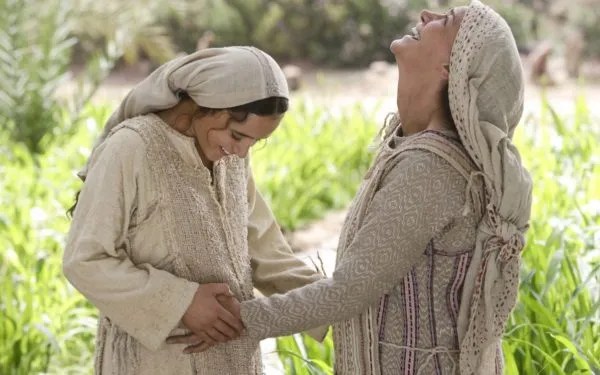
A last note, this on the Gospel reading (Lk 1:67-79). It seems to me that one major takeaway from Zechariah’s exuberant prayer is the value of silence. Zechariah had a lot of time to think, not knowing when — or if — he would ever get his voice back. Silent contemplation, without distraction, can yield great results. Let us take a lesson from this episode by spending much more time listening to the Lord and his mother (I imagine Zechariah heard Mary’s Magnificat and sat by while his wife Elizabeth and Mary were chatting in those three months leading up to the birth of his son) and much less time in idle conversation (yikes!). The results just might be amazing.

Blessed be the Lord, the God of Israel;
for he has come to his people and set them free.
He has raised up for us a mighty Savior,
born of the house of his servant David. (Lk 1:68-69)

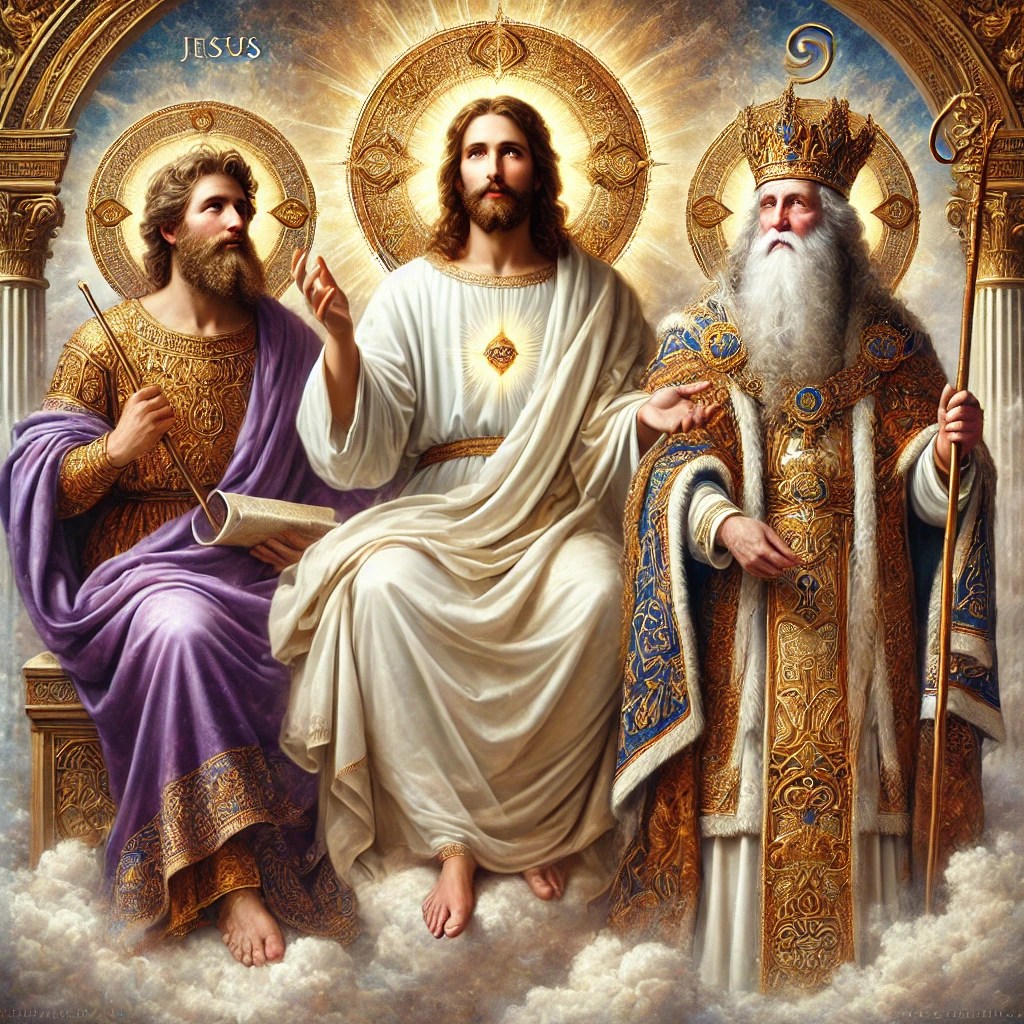
AI generated — I could not find an image with all three figures that wasn’t licensable.

God bless!

Advent Day 23: No greater man

TODAY’S GOSPEL (Lk 1:57-66)

From Luke 1:66b:

“What, then, will this child be?
For surely the hand of the Lord was with him.”

From Opening the Scriptures: Bringing the Gospel of Luke to Life, page 41

“Luke concludes his account of the birth and naming of John with his own comment: “For surely the hand of the Lord was with him.” The Old Testament uses the expression “hand of the Lord” to convey the power of God (Joshua 4:24; see Exod 7:4; 13:3; 15:6); the hand of the Lord being with or upon someone means that he is empowered and guided by God (1 Kings 18:46; 1 Chron 28:19; Ezra 7:28; Ezek 1:3; 3:14, 22)/ Surely someone born to a previously barren woman in fulfillment of an angel’s words has been sent by God to carry out a special work, and surely God will empower and guide him to accomplish his mission/ By adding that final comment, Luke invites his readers to join those pondering what this child will be and to share their sense of anticipation.”

My take

“Amen, I say to you, among those born of women there has been none greater than John the Baptist; yet the least in the kingdom of heaven is greater than he.” (Mt 11:11)

We think much of and revere deeply the greatest woman to be born of woman, the Blessed Virgin Mary, but how much do we consider the greatest man born of woman, as declared by Jesus Himself!, John the Baptist? Fittingly, he is the only person in Heaven, aside from Jesus and His mother, whom we honor by celebrating his earthly birth on the liturgical calendar (June 24, appropriately, six months before Christmas).

This man was repeatedly asked if he was the Messiah. How powerful must his preaching have been? Herod wondered if Jesus might be John reincarnated. What sort of impact must John have had on all of Judea? People flocked to him from miles around, confessing their sins and seeking a baptism of repentance. How much weight must his words have carried with the general population? The wife of Herod wanted John shut up for good. What weight must his words have carried with the commonfolk?

My suggestion is to read everything in Scripture about John the Baptist in one sitting (it won’t take very long). I have listed and linked below, all Gospel passages pertaining to John:

  • Lk 1:5-25 (annunciation and conception of John)
  • Lk 3:1-22 (John’s public ministry, his future arrest by Herod, Jesus’ baptism)
  • Mt 3:1-16 (John introduced and the baptism of Jesus)
  • Mk 1:2-11 (John introduced and the baptism of Jesus)
  • Jn 1:6-8, 15 (from the Prologue)
  • Jn 1:19-37, 40 (John’s public ministry, his prophesying about Jesus and the retelling of the Spirit coming upon Jesus, his encouraging his disciples to follow Jesus)
  • Lk 7:18–23 (John sends disciples to Jesus to ask if He is the Messiah)
  • Jn 3:23-30, 4:1-2 (John baptizing and commenting on Jesus baptizing; Jesus’ disciples baptizing)
  • Jn 5:31-36 (Jesus extolling John as a precursor to Him)
  • Lk 7:24-35 (Jesus extolling John to the crowds)
  • Mk 1:14-15 (indicates John’s arrest)
  • Mk 3:18-22 (John’s disciples; on fasting)
  • Mk 6:14-29 (Herod’s suspicions about Jesus; the recounting of John’s imprisonment and death)
  • Lk 9:7-9: (Herod’s suspicions about Jesus and his speaking of John’s death)
  • Mk 8:27-30 (speculation that Jesus is John)
  • Lk 9:18-22 (speculation that Jesus is John)
  • Jn 10:40-41 (the crowds compare Jesus and John)
  • Lk 11:1 (Jesus asked to teach His disciples how to pray as John taught them)
  • Mk 11:27-33 (Jesus’ authority questioned and He invokes John)
  • Lk 16:1 (John invoked by Jesus as the last prophet)
  • Lk 20:1-8 (Jesus’ authority questioned and He invokes John

John’s baptism is also referred to in Acts 1, 10, 11, 13, 18, 19.

John the Baptist, pray for us, that we may join you in the kingdom, even as the “least.”

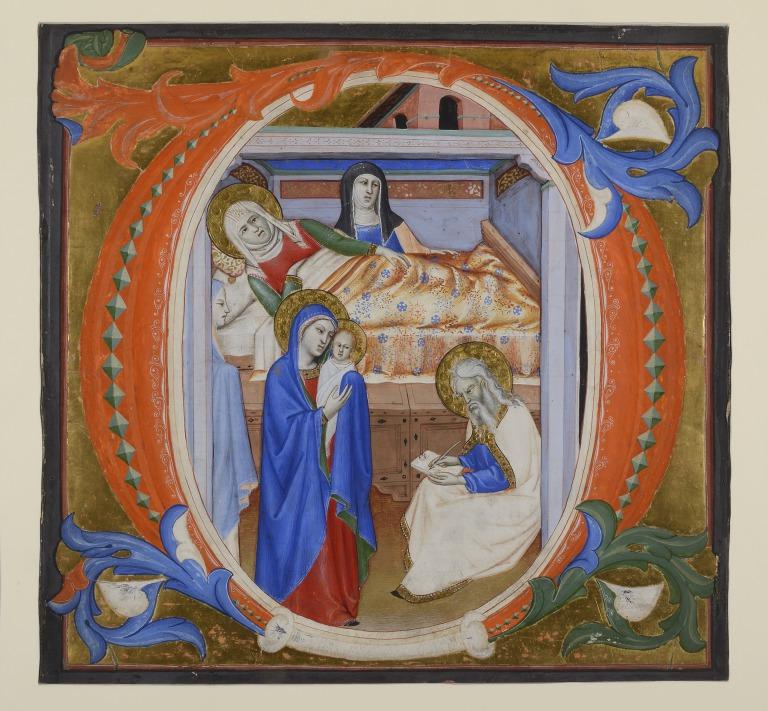
The Birth of St. John the Baptist (1370 – 1371 probably) by Don Silvestro dei Gherarducci

God bless!

Advent Day 22: Eternity starts small

TODAY’S READINGS

FROM Micah 5:1 (the full passage is Mi 5:1-4a):

You, Bethlehem-Ephrathah
too small to be among the clans of Judah,
from you shall come forth for me
one who is to be ruler in Israel;
whose origin is from of old,
from ancient times.

From The Word of the Lord (Year C), page 30

“The language of a ‘ruler’ who ‘comes forth’ from ‘Behlehem-Ephrathah’ is a poetic way of describing an heir to the throne of David, a new king who has the Davidic bloodline. This rules is described in provocative ways that suggest divinity. His origin is miqqedem in Hebrew, which can mean both ‘from the east’ and ‘from antiquity.’ Both are suggestive because the east was associated with the abode of the arrival of God — the temple, for example faced east. Likewise, an ancient origin was a divine attribute — that, God the Father, is called ‘the Ancient of Days’ (Dan 7:22 RSV2CE). This concept of ancient origin is reinforced in the next verse of our Micah passage, translated ‘whose origin is from of old,’ but which literally reads ‘his origin is from days of eternity.’ This language of a Davidic ruler who has ‘eternal’ origins could be just poetic hyperbole, but let us note that, much like Isaiah 9:6. the literal sens of this text of Micah describes a king who is both human and divine.”

FROM Psalms 80:2 (the full passage is Ps 80:2-3, 15-16, 18-19):

O shepherd of Israel, hearken,
from your throne upon the cherubim, shine forth.
Rouse your power,
and come to save us.

From The Navarre Bible: The Psalms and the Song of Solomon, page 278

“God, as Shepherd of his people, has his dwelling-place in the temple, above the ark, ‘enthroned upon the cherubim’ (cf. Ex 25:18-22).”

FROM Hebrews 10:10 (the full passage is Heb 10:5-10

[W]e have been consecrated 
through the offering of the body of Jesus Christ once for all.

From Catholic Commentary on Sacred Scripture: Hebrews, page 199

“The Greek word for ‘consecrated’ (hagiazō) would be better translated as ‘sanctified’ or ‘made holy,’ since here it connotes not only being ‘set apart’ for God but coming to share in god’s own holiness. The reason Jesus’ sacrifice has power to sanctify is that he offered no mere substitute but himself, his own human life wholly given over in love. His sacrifice therefore transforms human nature from within; it heals the self-will, pride, rebellion, and unbelief that have deeply wounded human nature ever since the fall. Hebrews emphatically declares that this sanctification is already an accomplished fact, ‘once for all.’ Christ’s passion is the fulcrum of human history, the act that has definitively reconciled humanity to God and given access to God’s own holiness, Yet paradoxically, Hebrews will say in verse 14 that we who believe in Christ ‘are being sanctified’; the accomplished fact must be personally appropriated and lived by every believer (see also 12:10, 14).”

FROM Luke 1:42-43 (the full passage is Lk 1:39-45)

“Blessed are you among women, 
and blessed is the fruit of your womb.
And how does this happen to me, 
that the mother of my Lord should come to me?”

From Ignatius Catholic Study Bible: The Gospel of Luke, page 20

Blessed are you: Elizabeth blesses Mary with words once spoken to Jael and Judith in the OT (Judg 5:24–27; Jud 13:18). ● These women were blessed for their heroic faith and courage in warding off enemy armies hostile to Israel. Victory was assured when both Jael and Judith assassinated the opposing military commanders with a mortal blow to the head. Mary will follow in their footsteps, yet in her case both the enemy destroyed and the victory won will be greater, for she will bear the Savior who crushes the head of sin, death, and the devil underfoot (Gen 3:15; 1 Jn 3:8) (CCC 64, 489).
mother of my Lord: This title reveals the twin mysteries of Jesus’ divinity and Mary’s divine maternity (CCC 449, 495). Note that every occurrence of the word Lord in the immediate (1:45) and surrounding context refers to God (1:28, 32, 38, 46, 58, 68). ● Mary’s divine motherhood was the first Marian dogma expounded by the Church. The Ecumenical Council of Ephesus (A.D. 431) defined her unique relationship to Christ and honored her with the title ‘Mother of God’ (Gk. Theotokos). This was reaffirmed in 1964 at Vatican II (Lumen Gentium, 53).”

From Opening the Scriptures: Bringing the Gospel of Luke to Life, page 29

“In the culture in which Mary lived, a woman’s greatness came from the children she bore (see 11:27). Elizabeth, inspired by the Holy Spirit, perceives the greatness of the child whom Mary is carrying and Mary’s resulting greatness.”

From The Word of the Lord (Year C), page 35

“Elizabeth is a wise woman, learned in history and culture of Israel and Judah. Through the Holy Spirit, she recognizes our Mother Mary as the Queen Mother, as the ‘First Lady’ of the kingdom of Israel, and she treats her as such, showing her all deference and veneration. So if we are ever challenged by non-Catholics concerning the biblical nature of the honor we show Mary within the Church, we should point to this passage of Luke as indication that the custom of venerating the Blessed Mother began in her lifetime, in the very pages of Scripture.”

MY TAKE

The same Gospel two days in a row! Boring? No way! We should be glad this is proclaimed to us again and we could stand to hear it every day. The acknowledgement by Elizabeth of the zygote inside Mary as the Lord of the universe, the one God, is a cause for celebration — the Redeemer promised in Gen 3:15 has finally come. And what a powerful pro-life message, to boot. The developing child is now, a few days after conception, the Messiah. Elizabeth knows that what Micah prophesied, that a ruler whose “origin is from days of eternity,” is finally Emmanuel, that is, God with us (see Is 8:8-10). Her son, John, is to be the precursor to the one who has “come to save us” as the Psalmist tells us today. Just imagine the conversations Mary and Elizabeth had the next three months regarding their two special children. Finally, per Hebrews, Jesus came to consecrate us with that same developing body in the Paschal Mystery and continues to consecrate us until today and on till the end of time in the most Blessed Sacrament.

Is there any question why we call this Good News?

BP BARRON SERMON

FR MIKE SCHMITZ HOMILY

God bless!

Advent Day 21: The ‘ark’ of (salvation) history

TODAY’S GOSPEL (Lk 1:39-45)

From Luke 1:41:

When Elizabeth heard Mary’s greeting,
the infant leaped in her womb,
and Elizabeth, filled with the Holy Spirit…

From Catholic Commentary on Sacred Scripture: The Gospel of Luke, page 48

“Mary’s greeting provokes a reaction as Gabriel’s greeting did before (1:29). The infant John leaped in his mother’s womb, and Elizabeth herself was filled with the holy Spirit. the angel’s words to Zechariah are being fulfilled , as the child is ‘filled with the holy Spirit even from his mother’s womb’ (1:15). the verb ‘leap’ is used in the Septuagint to describe how Esau and Jacob leaped or ‘jostled each other’ in he womb of Rebekah, another once-barren woman (Gen 25:22). She was told that ‘the older will serve the younger’ (Gen 25:22). She was told that ‘the older will serve the younger’ (Gen 25:23), which is the case here as well, as the older John already signal;s his role as precursor of the younger Jesus.”

From Ignatius Catholic Study Bible: The Gospel of Luke, page 21

Mary, Ark of the Covenant

“Luke’s Gospel tells us more about the Mother of Jesus than any other book in the New Testament. Most of this information is packed within his first two chapters, where Luke strings together some of the most beautiful traditions we have about her life and mission. The deeper we delve into Luke’s narrative, the more we appreciate the way in which Luke tells us the story of Mary. One example of this is found in the story of the Visitation. On one level, it tells of a joyous encounter between two expectant mothers; on another, it recalls memorable stories told in the Old Testament about the Ark of the Covenant. By alluding to these ancient traditions, Luke expands the vision of the careful reader considerably. For he leads us to see Mary as the Ark of God’s New Covenant and implies that the sacred Ark of the Old Covenant merely prefigured a more wonderful Ark to come: the Mother of the divine Messiah.
“One tradition that Luke draws upon is from 2 Samuel. He intentionally sets up the subtle but significant parallels between Mary’s Visitation with Elizabeth and David’s effort to bring the Ark of the Covenant to Jerusalem narrated in 2 Sam 6. When Luke tells us that Mary “arose and went” into the Judean hill country to visit her kinswoman (Lk 1:39), he reminds us of how David ‘arose and went’ into the same region centuries earlier to retrieve the Ark (2 Sam 6:2). Upon Mary’s arrival, Elizabeth is struck by the same sense of awe and unworthiness before Mary (Lk 1:43) that David felt standing before the Ark of the Covenant (2 Sam 6:9). Parallels continue as the joy surrounding this great encounter causes the infant John to leap with excitement (Lk 1:41), much as David danced with excitement before the Ark (2 Sam 6:16). Finally, Luke adds that Mary stayed in the ‘house of Zechariah’ for ‘three months’ (Lk 1:40, 56), recalling how the Ark of Covenant was temporarily stationed in the ‘house of Obed-edom’ for a waiting period of ‘three months’ (2 Sam 6:11). Taken together, these parallels show us that Mary now assumes a role in salvation history that was once played by the Ark of the Covenant. Like this golden chest, she is a sacred vessel where the Lord’s presence dwells intimately with his people.
“Luke also draws upon a second tradition from the Books of Chronicles. This time he brings into his story a highly significant expression once connected with the Ark. The term shows up in Lk 1:42, where Elizabeth bursts out with an exuberant cry at the arrival of Mary and her Child. Although the Greek verb translated as ‘exclaimed’ seems ordinary enough, it is hardly ever used in the Bible. In fact, it is found only here in the entire New Testament. Its presence in the Greek Old Testament is likewise sparse, appearing only five times. Why is this important? Because every time the expression is used in the Old Testament, it forms part of the stories surrounding the Ark of the Covenant. In particular, it refers to the melodic sounds made by Levitical singers and musicians when they glorify the Lord in song. It thus describes the ‘exulting’ voice of instruments that were played before the Ark as David carried it in procession to Jerusalem (1 Chron 15:28; 16:4–5) and as Solomon transferred the Ark to its final resting place in the Temple (2 Chron 5:13). Alluding to these episodes, Luke connects this same expression with the melodic cry of another Levitical descendant, the aged Elizabeth (Lk 1:5). She too lifts up her voice in liturgical praise, not before the golden chest, but before Mary. Luke’s remarkable familiarity with these ancient stories enables him to select even a single word that will whisper to his readers that this young Mother of the Messiah is the new Ark of the Covenant.
“For the reader with eyes to see and ears to hear, Luke has given us a vision of the Virgin Mary that becomes ever more glorious the deeper we dig into the Scriptures. Our ability to see Mary as he did depends in part on our knowledge of the Old Testament and in part on our sensitivity to Luke’s skillful use of it. By choosing his words and phrases carefully, he is able to weave various strands of biblical tradition into his narrative, adding beauty and depth to his already elegant prose. Little wonder the Church’s liturgical and theological traditions have so often described Mary as the Ark of the New Covenant. This vision is not merely the fruit of mystical speculation from a later age. It is already embedded within the Infancy Narrative of Luke’s Gospel.”

My take

I could have just extracted the third paragraph above, but, because my favorite title for Mary is “Ark of the Covenant,” I wanted to provide the entire topical essay from the Ignatius Catholic Study Bible. I have little to add, but I would point out how important typology is in the Bible. St. Augustine famously said, per the Catechism of the Catholic Church, 129,

The New Testament lies hidden in the Old and the Old Testament is unveiled in the New.

We can’t fully understand Christ without the entire Bible. An early heresy wanted to discard the Old Testament as inconsistent with its understanding of God and Jesus. With this episode in the Gospel of Luke, not only Mary as Ark, but what is highlighted by the Catholic Commentary regarding Esau and Jacob, we have just one example of many of the unity and importance of the entire Scripture handed down to us faithfully by the Church.

I’ve had the self-published Mary the Ark of the Covenant on my shelf for some time now. I must read it.

God bless!

Advent Day 20: With God all things are possible

TODAY’S GOSPEL (Lk 1:26-38)

From Luke 1:34:

But Mary said to the angel,
“How can this be,
since I have no relations with a man?”

From Catholic Commentary on Sacred Scripture: The Gospel of Luke, page 44

“Like Zechariah, Mary asks a question of the angel regarding the fulfillment of the message: ‘How can this be?’ A more literal rendering is ‘How will this be?’ At first glance, it seems similar to Zechariah’s question, ‘How shall I know this?’ (Luke 1:18). Beneath the similarity in form, however, lies a greater dissimilarity in attitude. While Zechariah ‘did not believe’ the words of the angel (1:20), Mary instead will be called ‘blessed’ precisely for believing ‘what was spoken’ by the angel (1:45). The difference is that whereas Zechariah ‘wanted proof,’ Mary ‘wants instructions.’
The reason for Mary’s question is that she has ‘no relations with a man.’ Mary’s response is puzzling, since a betrothed woman would normally expect to begin sexual relations after the celebration of the second stage of marriage, when she moved into the home of her husband. One would think that after this delay the angel’s words would be fulfilled, as they were for Zechariah following the delay of his remaining days of ministry (1:23-24). Some interpreters have therefore explained Mary’s response as due to her interpreting the promise as having an immediate fulfillment, while she was still a virgin, although Gabriel’s words do not say this. Another explanation, offered by Church Fathers such as Gregory of Nyssa and Augustine, is that Mary did not plan to have relations with Joseph, but had already dedicated herself to God as a virgin. This idea is often dismissed as anachronistic, imposing a Christian ideal onto a Jewish context, since mainstream Jewish groups such as the Pharisees emphasized marriage. However, this possibility cannot be excluded, given the diversity of views in Judaism at the time (e.g., some Essenes practiced celibacy).”

From The Navarre Bible: St Luke, page 39

“The Blessed Virgin, who received a very special inspiration of the Holy Spirit to practise virginity, is a first-fruit of the New Testament, which will establish the excellence of virginity over marriage while not taking from the holiness of the married state, which it raises to the level of a sacrament (cf. Gaudium et spes, 48).”

From Ignatius Catholic Study Bible: The Gospel of Luke, page 19

“How can this be: Or, better, ‘How will this be …?’”’ Mary is not questioning God’s ability to give her a son, but she is inquiring as to how such a plan will unfold. I have no husband: The Greek text literally reads ‘I do not know man’, which refers to Mary’s virginal status rather than her marital status. Her concern is not that she is unmarried but that she is a virgin at present and that she intends to remain one in the future. The announcement of a miraculous conception (1:31) thus causes Mary to wonder aloud how God will bless her with a son and yet preserve her virginal purity. Her words are inexplicable otherwise. For nothing about the angel’s announcement should have perplexed Mary—whose betrothal to Joseph was already a legally binding marriage—unless she intended to forego ordinary sexual relations even as a married woman. See note on Mt 1:18. ● According to certain Church Fathers, such as St. Gregory of Nyssa and St. Augustine, Mary had previously taken a vow of lifelong virginity.”

My take

We celebrate the Annunciation on March 25, exactly nine months before the birth of Jesus. But it is good to be reminded of that episode just five days before Christmas.

I focused on Mary’s initial response to the angel because it is a source of controversy, particularly between Catholics and Protestants. It is Catholic dogma that Mary was a virgin before, during, and after the birth of Jesus. Protestants, generally, dispute this idea. I find it disappointing they are so invested in the notion that Mary had other children. As detailed in the commentaries presented above, it is simply “inexplicable,” as the Ignatius commentary, specifically, states, that Mary ever intended to remain anything else but a virgin. (For those who have trouble with the “brothers” of Jesus, see here. For those who have trouble with “no relations…until she bore a son,” see here. For those who have trouble with Jesus as “firstborn son,” see here.)

God blessed our Queen Mother and He blessed us by giving her to us. You might say that Mary really does have many children! When I contemplate the last Glorious Mystery, I imagine Jesus saying to His mom, “I’ve got a special mission for you,” and her replying, as echoed by St. Thérèse of Lisieux, the Little Flower:

Yes, I want to spend my heaven in doing good on earth.

And she does.

The Annunciation (1898) by Henry Ossawa Tanner

God bless!

Advent Day 19: Speechless is not so bad

TODAY’S GOSPEL (Lk 1:5-25)

From Luke 1:19b-20:

“I was sent to speak to you and to announce to you this good news.
But now you will be speechless and unable to talk
until the day these things take place,
because you did not believe my words,
which will be fulfilled at their proper time.”

From Catholic Commentary on Sacred Scripture: The Gospel of Luke, page 39

“Gabriel was sent precisely to announce to Zechariah this good news about John. For the first time Luke uses the very euangelizō (‘to announce good news’), which refers throughout Luke-Acts to the preaching of the gospel message (e.g., 4:18; Acts 5:42). The proper response to ‘good news’ is to ‘believe’ (see Acts 8:12). However, Zechariah did not believe and so is punished by becoming temporarily speechless (literally, ‘silent’).”

From Opening the Scriptures: Bringing the Gospel of Luke to Life, page 15-16

“Gabriel has told Zechariah the gospel truth, as it were, but Zechariah would not accept it.

“Zechariah did not understand how he and Elizabeth could have a child in their old age, and he limited what he thought God could do to what he could understand. Nevertheless, the things that Gabriel said would happen ‘will be fulfilled at their proper time’ — in God’s timing. God’s word is always fulfilled. Zechariah will be ‘unable to talk until the day these things take place.’ It is not apparent what ‘day’ Gabriel is referring to, since he has not only spoken of Elizabeth bearing a son who is to be named John (verse 13) but of John carrying on a ministry as an adult (verses 15-17). Zechariah must have been left wondering how long his speechlessness would last and what would have to be fulfilled for him to talk again.”

My take

It is hard to blame Zechariah for being incredulous regarding this whole episode. How many times did he enter the sanctuary previously with nothing unusual happening? Now, out of the blue, so to speak, this awesome figure tells him news he wasn’t expecting and that he finds difficult to believe. Maybe he thought he was hallucinating. How long must he and his wife have prayed for a child before giving up due to biology. Their prayers seemed to go unheeded.

We know that Zechariah and Elizabeth “were righteous in the eyes of God, observing all the commandments and ordinances of the Lord blamelessly” (v. 6), so their faithfulness was finally rewarded. Here is where Zechariah drops the ball. Having conceded that it was not meant for him and his wife to have children, it is no longer on his radar. In the surprise of the presence of the angel, he apparently did not recall episodes in the history of the Chosen People that were comparable, for example, Abraham and Sarah, and, from today’s first reading, Manoah and his barren wife. He pays a price for his doubt, but the end result is glorious.

It occurs to me that it would be wonderful if doubters of God’s Revelation would be struck mute today. Instead of spreading ignorance, criticism, lies, or heresy, they would be taught a lesson for them to consider (silently) and for the rest of the world to see until they came around to the truth. Then, like Zechariah, they would bless God (cf. v. 64) and bring the fear of God to others (cf. v. 65).

May we all be struck dumb instead of speaking ignorantly, falsely, or irreverently about the word of God.

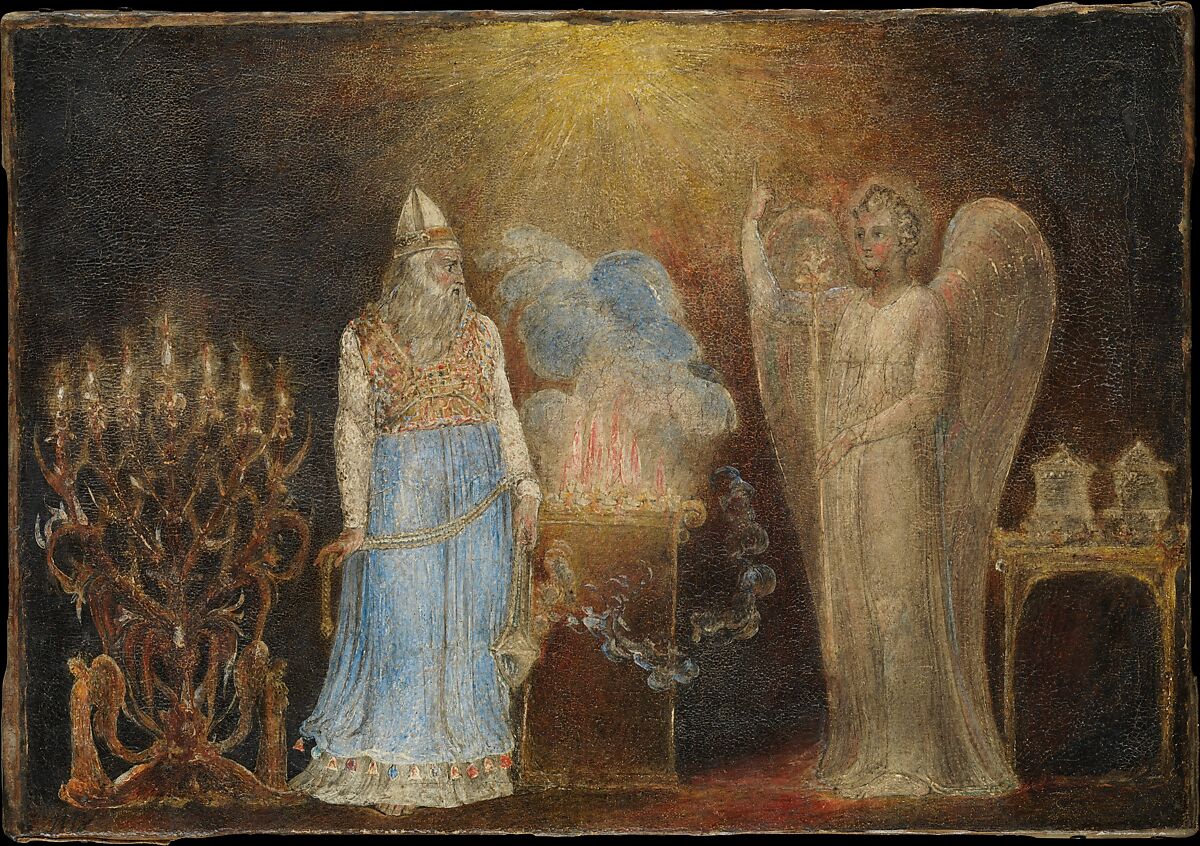
The Angel Appearing to Zacharias (1799–1800) by William Blake

God bless!

Advent Day 18: Righteous Joseph

TODAY’S GOSPEL (Mt 1:18-25)

From Matthew 1:19:

Joseph her husband, since he was a righteous man,
yet unwilling to expose [Mary] to shame,
decided to divorce her quietly.

From Ignatius Catholic Study Bible: Old and New Testament, pages 1726

just: Or, “righteous”. Joseph is a man of sterling moral character, committed to living by the Mosaic Law (Deut 6:25; Lk 1:6). put her to shame: The Greek verb does not necessarily have a negative connotation. It simply means “to expose” or “to exhibit”. send her away: Catholic tradition proposes three main interpretations to explain why Joseph resolved to end his betrothal with Mary. (1) The Suspicion Theory. Some hold that Joseph suspected Mary of adultery when he discovered her pregnancy. Joseph thus intended to pursue a divorce in accord with Deut 24:1–4 until the angel revealed to him the miraculous cause of the conception (1:20). Joseph is said to be righteous because he shuns immorality and directs his life by the Law of God. Proponents of this view include St. Justin Martyr,St. John Chrysostom, and St. Augustine. (2) The Perplexity Theory. Others hold that Joseph found the situation of Mary’s pregnancy inexplicable. Divorce seemed to be his only option, and yet he wished to do this quietly, for he could not bring himself to believe that Mary had been unfaithful. Joseph is said to be righteous because he lives by the Law of God and judges Mary’s situation with the utmost charity. The main proponent of this view is St. Jerome, whose exegesis was adopted into the notes of the medieval Bible. (3) The Reverence Theory. Still others hold that Joseph knew the miraculous cause of Mary’s pregnancy from the beginning, i.e., he was made aware that the child was conceived “of the Holy Spirit” (1:18). Faced with this, Joseph considered himself unworthy to be involved in the Lord’s work, and his decision to separate quietly from Mary was a discretionary measure to keep secret the mystery within her. On this reading, the angel confirms what Joseph had already known and urges him to set aside pious fears that would lead him away from his vocation to be the legal father of the Messiah (1:20). Joseph is said to be righteous because of his deep humility and reverence for the miraculous works of God. Proponents of this view include St. Bernard of Clairvaux and St. Thomas Aquinas.

From The Navarre Bible: St Matthew, page 30

“Mary’s silence is admirable. Her perfect surrender to God even leads her to the extreme of not defending her honour or innocence. She prefers to suffer suspicion and shame rather than reveal the work of grace in her. Faced with a fact which was inexplicable in human terms she abandons herself confidently to the love and providence of God. God certainly submitted the holy souls of Joseph and Mary to a severe trial. We ought not be surprised if we also undergo difficult trials in the course of our lives. We ought to trust in God during them, and remain faithful to him, following the example they gave us.”

My take

Whenever blogging or speaking about Joseph’s perspective on Mary’s pregnancy (Luke gives us Mary’s perspective of the events surrounding this miraculous conception), I like to highlight different theories on Joseph’s reaction to his betrothed’s pregnancy. I suspect Joseph went from perplexity to reverence. I can’t imagine he could ever entertain suspicion about Mary. Did she convey the message of the angel to Joseph? If so, was this before or after Joseph noticed her condition? How long from his awareness did the dream finally occur? All worth contemplating, to be sure, but we can be confident that this “righteous man” was fully onboard with the will of God in his life. No better husband or father ever walked this earth.

As a side note, Mary was not an unwed mother, as she is often portrayed. Betrothal was a contractual arrangement, thus the need to seek a divorce if the relationship was to end.

Additional resources

Please check out day “18: Silent Knight, Holy Knight” as Dr. Scott Hahn expands on the Reverence Theory. See here for a related video by Dr. Hahn.

No better book on Joseph is there than Fr. Donald Calloway’s Consecration to St. Joseph. I encourage you to obtain this book and keep it handy — absolutely phenomenal (my review).

The Dream of St. Joseph (c. 1700) Luca Giordano

God bless!

Advent Day 17: Generations

TODAY’S GOSPEL (Mt 1:1-17)

From Matthew 1:17:

[T]he total number of generations
from Abraham to David
is fourteen generations;
from David to the Babylonian exile, fourteen generations;
from the Babylonian exile to the Christ,
fourteen generations.

From Ignatius Catholic Study Bible: Old and New Testament, pages 1725-26

fourteen generations: Matthew divides the genealogy into three units of 14. It is not exhaustive, since several OT names are omitted and the divisions cover unequal periods of time. Matthew stresses the number 14 to show Jesus as the new Davidic king: (1) David and Jesus are the only names listed with their respective titles (king, 1:6; Christ, 1:16); (2) David is the 14th name in the list; (3) the numerical value of David’s name (three consonants) in Hebrew equals 14 (D = 4 + V = 6 + D = 4). ● The 42 generations from Abraham to Jesus correspond to the 42 encampments of Israel during its wilderness journey to the Promised Land (cf. Num 33:1–49). These generations bring us to the Messiah, through whom we arrive at the land of promise in heaven (St. Jerome, Letters 78). deportation to Babylon: The Exile of the Jews starting in 586 B.C. under the Babylonian king Nebuchadnezzar. After that time, Israel’s Davidic kingdom collapsed, and no legitimate heir assumed David’s throne. Jesus comes as the awaited Messiah-king (21:4–5; Jn 1:49) to fulfill God’s covenant oath to perfect and establish the Davidic dynasty for all time (cf. Ps 132:11–12; Lk 1:32–33).”

From Opening The Scriptures: Bringing the Gospel of Matthew to Life, page 19

“Matthew sees a pattern in the genealogy, with turning points coming every fourteen generations. God began something new with Abraham, calling him to be the father of a people. The kingship of David was a turning point: descendants of David were to rule over God’s people forever. Yet this seemed to end with the catastrophe of the Babylonian exile, another major turning point. Now, fourteen generations after the last major turning point, God sends the Messiah to his people. Jesus is a new turning point in God’s unfolding plan.
“If a person’s genealogy tells us who a person is, then Jesus is a Jew descended from Abraham and David. Jesus’ past is Israel’s past; Jesus marks the next stage in God’s plan for his people.”

From Fire of Mercy, Heart of the Word (Volume I), page 60

“[I]f the Word of God waited for forty-two generations in order to come ‘when time had taken a downward plunge’ (cursu declivi temporis), as the Advent hymn has it, it is because God, like a good physician, comes when he is most needed: somehow, to be fully rejuvenated, the world first had to grow old utterly and come to the limit of its own foolish hopes. Christ is sent by the Father into the world ‘to liberate the human race from its state of decrepitude’ (Collect, first Saturday of Advent).”

My take

The world waited in breathless anticipation for the promised Messiah. Generation after generation after generation came and went, with some good, but by no means perfect, men, but with more questionable characters (not only the gents, but get a load of the women mentioned in this line). What good can come from these ancestors? A greater Good than could be imagined!

This “anointed one,” explodes all categories. We can certainly call Him a New Abraham: finally the blessing to all nations has arrived (cf. Gen 12:2). We can also call Him the New David, the ultimate Son of David and the real King of Kings. But Christ is so much more. Who knew that God Himself would have to come down to clean up the mess begun with Adam and Eve and exacerbated by their descendants (i.e., all of us)? The experts in the Law, for the most part, didn’t see it (although they should have — the entire Hebrew Scriptures ultimately points toward Christ). But those with open hearts embraced the Lord when He became incarnate. We are invited to open our hearts ever wider to the miracle of the conception of the Son of God in the womb of a humble Jewish girl and its culmination nine months later at Christmas. The First Coming should make us long for the Second Coming (“thy Kingdom come”!) and for His coming into our souls at each Mass.

Maranatha! Come, O Lord!

God bless!

Advent Day 16: Wise and gentle

TODAY’S GOSPEL (Mt 21:23-27)

From Matthew 21:24-25a:

Jesus said to them in reply,
“I shall ask you one question, and if you answer it for me,
then I shall tell you by what authority I do these things.
Where was John’s baptism from?
Was it of heavenly or of human origin?”

From The Navarre Bible: St Matthew, page 183

“Jesus knows that [the chief priests and the elders] are not well-intentioned and he declines to give them a direct answer; he prefers to put a question to them that forces them to make their own attitude clear. He seeks to provoke them into examining their consciences and changing their whole approach.”

From Catholic Commentary on Sacred Scripture: The Gospel of Matthew, page 274-5:

“This counterquestion is not a change of topic. In this question Jesus implies continuity between John’s ministry and his own: just as John’s authority came from God, so does his. At the same time, Jesus’ counterquestion puts the temple authorities in an awkward position. They can either (a) say what they think — that John’s baptism was not from God — and face the anger of the crowds that ‘regard John as a prophet.’ or (b) admit that John’s baptism was from heaven, in which case they would be put to shame for not believing him. To try to save face, they answer, ‘We do not know.'”

From Opening The Scriptures: Bringing the Gospel of Matthew to Life, page 451

“Responding to a question with a counter question was a common debating tactic of the time. If Jesus is to tell the chief priests and elders by what authority he does these things, he will first ask a question to lay the groundwork for his response.”

From Fire of Mercy, Heart of the Word (Volume III), page 448

“[Jesus] responds to [the chief priests and the elders] two questions with one loaded question of his own, a question that induces a crisis in those interrogated by exposing their ‘faith’ as nothing but sly political pragmatism. Jesus’ tactic challenges them to demonstrate by what authority they dare to question his authority in the first place. He has already shown in word and action that his mere presence transforms the world around him into a better place. What has been the fruit of their alleged religious zeal, he wonders? What exactly are their own deepest motivations in relentlessly persecuting him at every turn?

“This move is brilliant because, by his reference to the Baptist, Jesus is suggesting that he himself is not an isolated figure calling for radical reform in contemporary Palestine. He hints that there exists a vibrant , effervescent spirit at present among the Jews in general that is operating outside the establishment and bearing a truly prophetic witness to God’s urgent activity in human hearts.”

My take

This is another case where I’m looking for answers to what, on the face of it, may seem like a diversionary tactic on Jesus’ part. But, it should go without saying that Jesus has no need for such stunts. His words always have purpose. He may be shrewd as a serpent and gentle as a dove, as He urges His apostles to be (cf. Mt 10:16), but He always makes His point, always to the dismay of those who oppose Him.

As always when it comes to Jesus, we should take a lesson from Jesus’ approach. This debate tactic is just as valid today as it was two thousand years ago. Responding to a question with a question can help clarify in your mind, and in your interlocutor’s mind, what he is driving at. We want to make sure we are on the same page — not talking past each other, arguing points our discussion partner is not making. This approach can also help to defuse someone coming in “hot.” When this happens, we must resist the urge to respond in kind, but rather look to dig deeper to (hopefully) discover the root issue.

Christ and the Pharisees (ca. 1880) by Lawrence W. Ladd

God bless!