The Gospel reading is from Lk 5:17-26. It is the famous episode of a paralyzed man whose friends tear open a roof to in order to lower him down to Jesus hoping for a healing.
When Jesus saw their faith, he said, “As for you, your sins are forgiven.” (v. 20)
“Jesus sees their faith manifest in their actions. The paralyzed man and those carrying him have come to Jesus so that he may be healed. They refused to let anything keep them away from Jesus — not the crowd, not even a solid roof. Their determination is a reflection of their faith, their confidence that Jesus will heal the paralyzed man. Jesus responds to those who come to him in faith. He said, ‘As for you, your sins are forgiven.‘ He addresses the paralyzed man, but instead of healing him of his paralysis, he pronounces that his sins have been forgiven.
“Jesus’ words raise questions. Are the man’s sins the cause of his paralysis? Sin can lead to sickness or infirmity (see 1 Cor 11:29-30). but sickness or afflictions are not infallible indicators of sin (see 13:1-5; John 9:2-3). By granting the man forgiveness rather than healing. Jesus indicates that the man’s greatest need is release from the paralysis of sin, but Jesus does not indicate that the man’s sins are the cause of his physical paralysis.” (George Martin, Bringing the Gospel of Luke to Life: Insight & Inspiration, 145)
I am reminded in this episode of Jesus’ talking about faith to move mountains (see Mt 17:20). Well, these guys may not have moved a mountain, but they certainly engaged in a difficult and unorthodox measure to help their friend due to their faith in what the believed Jesus; could do for him. It is edifying what they were willing and able to do to be with Jesus.
Nevertheless, today, so many Catholics cannot be bothered to go in their cozy cars to Mass once a week. And Confession, to hear those glorious words of absolution from a priest who (by God’s grace and due to their ordination, has the charism to act in the person of Christ) “has authority on earth to forgive sins” (see v. 24)? Perish the thought! We are able to encounter Jesus in all the sacraments, yet the faith of many is so weak, that they won’t take advantage of these great gifts, simple, easy, and accessible as they are. Let us pray for their return to the practice of the Faith, so that we all would have this attitude at Mass and in the confessional:
Then astonishment seized them all and they glorified God, and, struck with awe, they said, “We have seen incredible things today.” (v. 26)
God bless.
The Palsied Man Let Down through the Roof (Le paralytique descendu du toit) by James Tissot (1886-1896)
The second reading is from 2 Pt 3:8-14. “Repentance” is the key word today.
The Lord does not delay his promise, as some regard “delay,” but he is patient with you, not wishing that any should perish but that all should come to repentance. (v. 9)
“The purpose of this ‘delay’ is salvation: the Lord is showing great patience, postponing the day of judgment, because he desires that all should repent and that none should perish. We can hear an echo of John 3:17 here: ‘For God did not send his Son into the world to condemn the world, but that the world might be save through him.’
“What is the Lord’s disposition toward the human race? He is being ‘patient.’ The verb is in the present active tense, indicating ongoing, active patience by the Lord. He is giving space for all to come to repentance, Along with 1 Tim 2:4, this is one of the strongest biblical assertions of God’s universal desire that all come to salvation. The Lord takes no pleasure in the death of he wicked, but desires repentance (Ezek 18:23); his kindness is meant to lead to repentance (Rom 2:4), and he waits to have mercy on all (Rom 11:32).” (Daniel Keating, First and Second Peter, Jude [Catholic Commentary on Sacred Scripture], 180-181)
Today’s Gospel gives us the opening verses of Mark (1:1-8). Continuing our repentance theme:
John the Baptist appeared in the desert proclaiming a baptism of repentance for the forgiveness of sins. (v. 4)
“Repentance (Greek metanoia) means literally ‘a change of mind.’ Like the prophets of old (see Isa 55:7; Jer 18:11; Zech 1:4) John was calling Israel to a wholehearted return to the Lord, a deep interior conversion through the acknowledgment of their sinful state and their need for forgiveness. The time of complacency and human self-sufficiency was over; the time to turn back to God in humble contrition had arrived. Although John’s message was hardly a soothing one, it met a spiritual hunger in the people, attracting crowds throughout Judea.” (Mary Healy, The Gospel of Mark [Catholic Commentary on Sacred Scripture], 32)
“The Greek word for repentance that is used here means a changing of one’s mind. It also means a feeling of remorse, an undergoing of conversion, or a changing of one’s behavior. We often focus on the aspects of remorse and behavioral change when we think of repentance. Sometimes what is needed is a change of thinking and fundamental outlook if our remorse and changed behavior are to have lasting results.” (George Martin, Bringing the Gospel of Mark to Life: Insight & Inspiration, 7)
“The baptism given by the Precursor was not Christian Baptism; it was a penitential rite; but it prefigured the dispositions needed for Christian baptism — faith in Christ, the Messiah, the source of grace, and voluntary detachment from sin.” (The Navarre Bible: St. Mark, 66)
Thank God that He doesn’t have my patience or many of us would be doomed. Our task is not to try His patience until our end so that in the end we well be welcomed home.
The Gospel reading is from Mt 9:35–10:1, 5a, 6-8. The verses for our consideration today contain these words of Jesus:
The harvest is abundant but the laborers are few; so ask the master of the harvest to send out laborers for his harvest.(v. 37-38)
“After contemplating the crowds neglected by their shepherds, Jesus uses the image of the harvest to show us that the same crowd is ready to receive the effects of the Redemption: ‘I tell you, lift up your eyes, and see now the fields are already white for harvest’ (Jn 4:35)…In this connexion Paul VI reminds us: ‘the responsibility for spreading the Gospel that saves belongs to everyone — to all those who have received it! The missionary duty concerns the whole body of the Church; in different ways and to different degrees, it is true, but we must all of us be united in carrying out this duty. Now let the conscience of every believer ask himself: Have I carried out my missionary duty? Prayer for the Missions is the first way of fulfilling this duty (Angelus Address, 3 October 1977). (The Navarre Bible: St Matthew, 101)
“Jesus is surely the Worker par excellence whom the Father has sent out. In a real sense there is no other. Unless a man do what Jesus does, as he does it and by virtue of the power that is Jesus’, all human effort and planning are vain daydreams and a useless squandering of energy. Jesus the Worker in the Harvest must, therefore, first communicate to his followers his Heart (his compassion) and his mind (the vision whereby he is able to imagine what he sees in all its deep compelling truth). He invites us to see what he sees as he sees it, and now and then he checks to see if we are still following the logic of his mind and Her by addressing us obliquely: ‘Pray for workers!’ Which is another way of saying: ‘Pray that you yourselves may be transformed into workers!” (Erasmo Leiva-Merikakis, Fire of Mercy, Heart of the Word, Vol. I, 518-519)
The highlighted verses are often invoked in praying for religious vocations — and rightfully so. But both Pope St. Paul VI and Leiva-Merikakis raise awareness to the fact that we are all called to the task of evangelization. We are to prepare ourselves for this mission by prayer, study, reading of Scripture, and above all through a constant conversion of heart that leads to living a radically Christian life — one so radical that others will take notice and long to have what we have.
OUR LADY OF GUADALUPE AND ST. JUAN DIEGO
A great day to ask for Mary’s intercession under the title of Our Lady of Guadalupe and also to invoke poor little Juan Diego. Nearly five hundred years ago, through this nondescript peasant, the Blessed Virgin effected the conversion of millions to the true Faith while the same number of the faithful were being ripped away across the Atlantic through the Protestant Revolt.
The Gospel reading is from Lk 1:26-38, which closes out the Sermon on the Mount. The key verse contains these words of Jesus:
But Mary said to the angel, “How can this be, since I have no relations with a man?” (v. 34)
“Mary believed the archangel’s words absolutely; she did not doubt as Zechariah had done (cf. 1:18). Her question, ‘How can this be?’, expresses her readiness to obey the will of God even thought at first sight it implied a contradiction: on the one hand, she was convinced that god wished her to remain a virgin; on the other, here was God also announcing that she would become a mother. The archangel announces God’s mysterious design, and what had seemed impossible, according to the laws of nature, is explained by a unique intervention on the part of God…The Blessed Virgin, who received a very special inspiration of the Holy Spirit to practise virginity, is a first-fruit of the New Testament, which will establish the excellence of virginity over marriage while not taking from the holiness of the married state, which it raises to the level of a sacrament (cf. Gaudium et spes, 48). (The Navarre Bible: St Luke, 84)
“The reason for Mary’s question is that she has no relations with a man. Mary’s response is puzzling, since a betrothed woman would normally expect to begin sexual relations after the celebration of the second stage of marriage, when she moved into the home of her husband. One would think that after this delay the angel’s words to her would be fulfilled, as they were for Zechariah following the delay of his remaining days of ministry (1:23-24). Some interpreters have therefore explained Mary’s response as due to her interpreting the promise as having an immediate fulfillment, while she was still a virgin, although Gabriel’s words do not say this. Another explanation, offered by Church Fathers such as Gregory of Nyssa and Augustine, is that Mary did not plan to have relations with Joseph, but had already dedicated herself to God as a virgin. This idea is often dismissed as anachronistic, imposing a Christian ideal onto a Jewish context, since mainstream Jewish groups such as the Pharisees emphasized marriage. However, this possibility cannot be excluded, given the diversity of views in Judaism at the time (e.g., some Essenes practiced celibacy).” (Pablo Gadenz, Catholic Commentary on Sacred Scripture: The Gospel of Luke, 44)
There is no question in my mind that Gregory and Augustine were on to something — it seems quite clear from the text. This is backed up by the dogma of Mary’s perpetual virginity (a dogma of the Church is something a Catholic is bound to believe). Her womb was holy, that is, set aside. The new Ark of the Covenant. No other child was worthy to enter this space.
Finally, check out one of my previous posts for more.
THE IMMACULATE CONCEPTION
Did you know that the United States was dedicated to Mary under her title of the Immaculate Conception? Read all about it here or listen to it detailed in a great series here! It shows how far away we’ve gotten from God and His mother that the scourge of abortion and the anger and vehemence of its proponents are so pronounced.
Read the full dogma itself here. Read it all or scroll down to “The Definition.”
And check out this famous scene from one of my all-time fave flicks, The Song of Bernadette.
God bless.
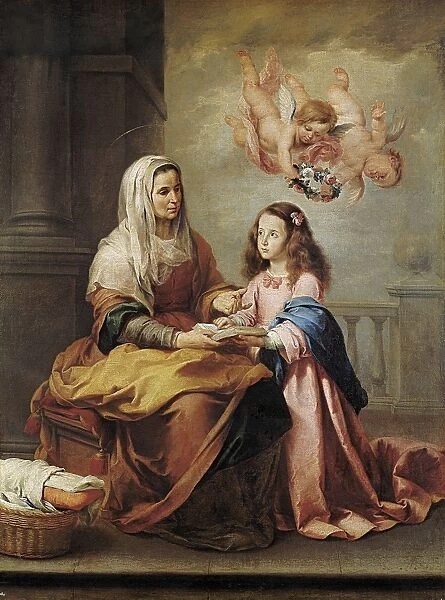
The Virgin and St. Anne. Bartolome Esteban Murillo (1617-1682). Oil on canvas. ca. 1674
The Gospel reading is from Mt 7:21, 24-27, which closes out the Sermon on the Mount. The key verse contains these words of Jesus:
Not everyone who says to me, ‘Lord, Lord,’ will enter the Kingdom of heaven, but only the one who does the will of my Father in heaven. (v. 21)
“To be genuine, prayer must be accompanied by a persevering effort to do God’s will. Similarly, in order to do his will it is not enough to speak about the things of God: there must be a consistency between what one preaches — what one says — and what one does: ‘”‘The kingdom of God does not consist in talk but in power’ (1 Cor 4:20); ‘”‘Be doers of the word, and not hearers only, deceiving yourselves'”‘ (Jas 1:22)…To enter the Kingdom of heaven, to be holy, it is not enough, then, to speak eloquently about holiness. One has to practise what one preaches, to produce fruit which accords with one’s words.” (The Navarre Bible: St Matthew, 84)
“The wishful repetition of the formulaic appeal ‘Lord, Lord!’ here corresponds to the broad and easy way to salvation that in fact leads to perdition. All the hope of such implorers is predicated on the goodwill of the Lord to save them, whereas Jesus says that those will be saved who do God’s goodwill and not merely appeal to it.” (Erasmo Leiva-Merikakis, Fire of Mercy, Heart of the Word. 311)
I can’t conceive how any Christian reading the words in this Gospel passage, particularly considering the emphatic and vivid verses that follow in the reading (inexplicably two verses were excluded that make the message stark and abundantly clear [vv. 22-23]), can possibly espouse “once saved, always saved” or “faith alone” with no works absolutely required. Over and over, Christ emphasizes that what we do here on earth determines our eternal fate (for starters, the sheep and the goats, the wheat and the tares, and the narrow gate and the wide gate). The last example comes just a few verses before today’s reading. The Sermon on the Mount begins with the Beatitudes. It is as if Jesus is providing the capstone to all His teaching in the last three chapters: “Have you been listening? Let me drive it home!”
Peter takes on those who misread Paul, but also those who do the same with the rest of the Bible:
In them there are some things hard to understand that the ignorant and unstable distort to their own destruction, just as they do the other scriptures. (1 Pt 3:16)
Thank God for the Spirit-protected Catholic Church!
SAINT OF THE DAY: AMBROSE
The man who had such an impact on St. Augustine, bringing him into the fullness of the Faith, ultimately giving us one of the greatest theologians of the Christian era. Read him and read all about him here.
PEARL HARBOR DAY
Please pray for the over two thousand Americans who died this day eighty-two years ago on the southern coast of Oahu. Eternal rest grant unto them, O Lord…
The Gospel reading is from Mt 15:29-37. It ends this way:
They all ate and were satisfied. They picked up the fragments left over–seven baskets full. (v. 37)
“It is interesting to note that in both miracles of multiplication of loaves and fish Jesus provides food in abundance but does not allow anything to go to waste. All Jesus’ miracles, in addition to being concrete historical events, are also symbols of supernatural realities. Here abundance of material food also signifies abundance of divine gifts on the level of grace and glory: it refers to spiritual resources and eternal rewards; God gives people more graces than are strictly necessary. This is borne out by Christian experience throughout history. St Paul tells us that ‘where sin increased, grace abounded all the more’ (Rom 5:20); he speaks of ‘the riches of his grace which he lavished upon us’ (Eph 1:8) and tells his disciple Timothy that ‘the grace of our Lord overflowed for me with the faith and love that are in Christ Jesus’ (1 Tim 1:14).” (The Navarre Bible: St Matthew, 148)
It should be difficult for Catholics to not think about the Eucharist with the miracle of the loaves. The insight above reinforces this connection. The ‘supersubstantial‘ bread of the Eucharist presents to us the supernatural gift of grace in superabundance — if we are open and disposed to receive it and digest it.
The first reading is from Is 11:1-10, the famous passage that gives us the Gifts of the Holy Spirit.
The Spirit of the LORD shall rest upon him: a Spirit of wisdom and of understanding, A Spirit of counsel and of strength, a Spirit of knowledge and of fear of the LORD, and his delight shall be the fear of the LORD. (vv. 2-3a)
Refer to this helpful article for Aquinas’s breakdown of these gifts and some additional interesting commentary. Also worth checking out is this video by the good Dominicans at the Thomistic Institute.
“This text is important for the whole pneumatology of the Old Testament, because it constitutes a kind of bridge between the ancient biblical concept of ‘spirit,’ understood primarily as a ‘charismatic breath of wind,’ and the ‘Spirit” as a person and as a gift, a gift for the person. The Messiah of the lineage of David (‘from the stump of Jesse’) is precisely that person upon whom the Spirit of the Lord ‘shall rest.’ It is obvious that in this case one cannot speak of a revelation of the Paraclete. However, with this veiled reference to the figure of the future Messiah there begins, so to speak, the path towards the full revelation of the Holy Spirit in the unity of the Trinitarian mystery, a mystery which will finally be manifested in the New Covenant. (Dominum et Vivificantem, 15)” (The Navarre Bible: Major Prophets, 88-89)
“The way to heaven is opened by the sevenfold grace of the Spirit. Isaiah speaks from the viewpoint of heaven, numbering the steps in descending order: wisdom and understanding, counsel and might, knowledge and piety, and fear of the Lord. Since it is written ‘the fear of the Lord is the beginning of wisdom,’ it is clear that the way ascends from fear to wisdom instead of going down from wisdom to fear. The prophet thus reasons from heavenly things to humbler things. (St Gregory the Great, Homilies on Ezekiel 2, 7, 7).” (Ignatius Catholic Study Bible: Isaiah, 36)
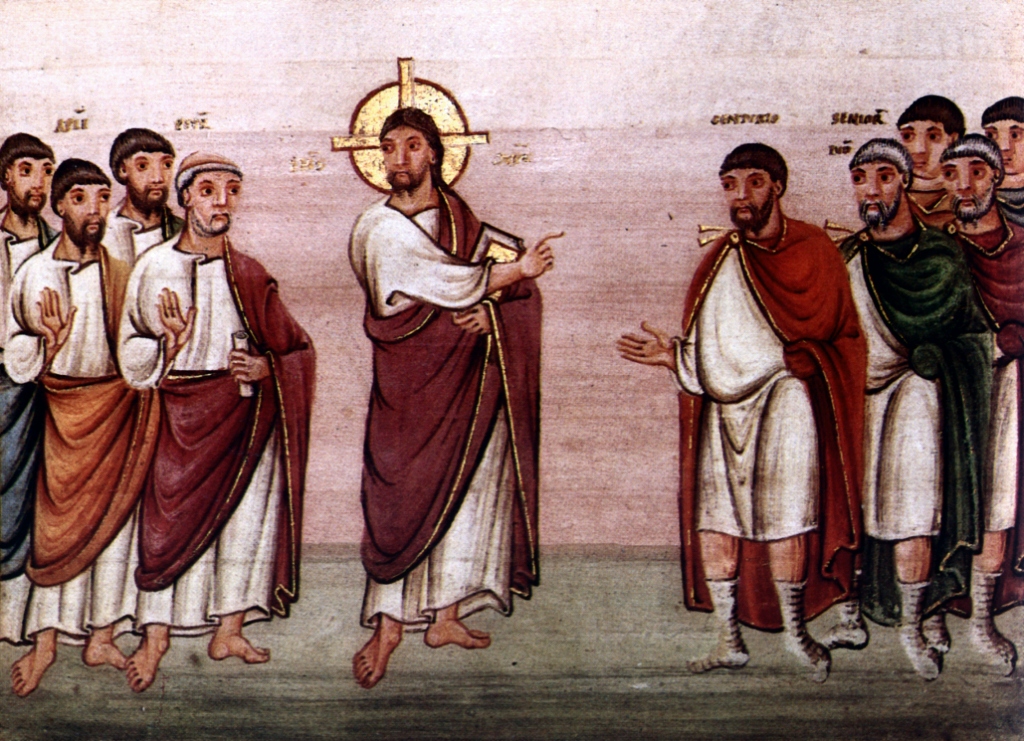
The Gospel is from Mt 8:5-11, the famous passage in which a Roman centurion comes to ask a big favor of Jesus.
Lord, I am not worthy to have you enter under my roof; only say the word and my servant will be healed. (v. 8)
“The Jews of this time regarded any Jew who entered a Gentile’s house as contracting legal impurity (cf. Jn 19:28; Acts 11:2-3). This centurion has the deference not to place Jesus in an embarrassing position in the eyes of his fellow Israelites. He shows that he is convinced that Jesus has power over disease and illness; he suggests that if Jesus just says the word, he will do what is needed without having to visit the house; he is reasoning, in a simple, logical way, on the basis of his own professional experience. Jesus avails of this meeting with a Gentile believer to make a solemn prophecy to the effect that his Gospel is addressed to the world at large; all men, of every nation and race, of every age and condition, are called to follow Christ.” (The Navarre Bible: St. Matthew, 88)
“The Son of Man does not have a material resting place. Jesus lays his head instead on the pillow of the centurion’s confession, which has opened wide the doors of his life to the divine presence and activity. The crowds had been listening to Jesus all through the Sermon on the Mount. But this man now offers to Jesus’ ears the balm that alone soothes the stress of all his labor, the response that is the greatest act of thanksgiving possible on the part of man. The Lord does not add a single word to what the centurion says: even the Word cannot improve on those words of faith.” (Leiva-Merikakis, Fire of Mercy, Heart of the Word, Vol. I, 333)
“The centurion who asked Jesus to heal his servant showed great trust in him. To trust is to have hope, to turn one’s heart to God. It means to root one’s life, to ground and center one’s concerns, in God.” (Bp Barron in The Word on Fire Bible: The Gospels, 63)
To close, I would like you to check out my previous posts on this episode, one of very favorites in all of Scripture. Follow the link (and all embedded links and video) below for my past insights:
Happy Advent! I’m going to give this a shot again this year. High hopes for working through Advent and Christmas with daily blogs quickly petered out in 2022. Pray that I stay the course this time around — I need it.
TODAY’S READINGS
For these upcoming posts, I plan to use Catholic commentaries and other resources generously to bring light to each day’s readings.
You, LORD, are our father, our redeemer you are named forever. (v. 16b)
“God is rarely addressed this way in the OT, although the appellation occurs three times in this prayer alone…The language of divine paternity in the OT is based on the covenant of kinship that the Lord forged with Israel, his first son.” (Ignatius Catholic Study Bible: Isaiah, 105)
Why do you make us wander, LORD, from your ways, and harden our hearts so that we do not fear you? (v. 17a)
“Divine hardening is not an action of God that causes people to sin but a form of judgment in which the Lord allows brazen sinners to defy his will without the restraint of his mercy. This response to sin was first revealed at the time of the Exodus, when god hardened the heart of pharaoh (Ex 9:12; 10:1; 11:10; 14:8). Divine hardening is likewise mentioned in the NT as a spiritual condition of unbelieving Israel that will endure until God’s plan of salvation for the Gentiles is accomplished (Rom 11:25-26). Divine hardening remains a mystery because Scripture also insists on human free choice (Sir 15:11-17) as well as God’s universal desire that all people repent of their sins and be save (1 Tim 2:4; 2 Pet 3:9). Within the broader framework of biblical teaching , then, divine hardening does not override human free will or destroy human responsibility for sin; rather, it is a disciplinary measure \that seeks the conversion of the sinner.” (Ignatius Catholic Study Bible: Isaiah, 105-106)
No ear has ever heard, no eye ever seen, any God but you doing such deeds for those who wait for him. (v. 4)
“St. Paul quotes from this verse when writing about the wisdom of God, and his love for those who love him, and the gifts he has in store for man…(1 Cor 2:9). because these gifts will not be fully bestowed until the next life, the verse is often quoted in Christian spirituality to describe the happiness enjoyed in heaven.” (Navarre Bible: Major Prophets, 273)
Finally, a certain line jumped out at me as one frequently used by Protestants against the Catholic understanding of the role and necessity of good works in our lives:
…all our good deeds are like polluted rags… (v. 5a)
Catholic Answers is helpful here: “It does not say that all acts of righteousness are as filthy rags to God, but that those being rendered to him in Isaiah‘s day were…This pertains to a particular historical situation, not to a general condition.” (The whole response is worth reading. Also, check out one of my previous posts.)
The St. Louis Jesuits get a lot of flack in some circles, but I like a lot of their stuff (setting aside whether it is appropriate for Mass or simply for worship). Here is a one of my favorites based on this psalm.
I give thanks to my God always on your account for the grace of God bestowed on you in Christ Jesus… (v. 4)
Corinth was a pagan town known for all manner of sin and debauchery. About five years earlier Paul established a church there and made significant evangelistic inroads. Hearing rumblings of problems in the Church there, he penned this letter until he could return. Considering all that, these words are a wonderful way to start his letter. Would it be that we would begin all our correspondence this way, even with those persons or situations that challenge us, giving thanks to God in all things, even those that are testing us in order to make us saints.
Watch, therefore; you do not know when the lord of the house is coming, whether in the evening, or at midnight, or at cockcrow, or in the morning. May he not come suddenly and find you sleeping. (vv. 35-36)
“Jesus is speaking of his sudden and unexpected coming at the end of time, when he will judge his disciples for how they have exercised their authority in the Church. But Mark also links this warning to Jesus’ passion by structuring the passion narrative precisely in terms of these four night watches: evening (Mark 14l17), midnight (implied in 14:32-65_, cockcrow (14:72), and morning (15;1). Jesus warns that he may come suddenly and find them sleeping — which is just what will happen during his agony in Gethsemane (14:37-41). To be asleep signifies spiritual torpor and self-indulgence (Rom 11:9; 1 Thess 5:6-8); to be awake is to be alive in faith (Rm 13:11; Eph 5:14). The trial in Gethsemane is the beginning of the trial that will last throughout the whole age of the Church, in which Jesus’ followers are called to be constantly alert and attentive to the presence of the Lord.” (Catholic Commentary on Sacred Scripture: The Gospel of Mark, 273)
For my part, the following words of Jesus have always been sufficient for me:
But of that day and hour no one knows, neither the angels of heaven, nor the Son,* but the Father alone. (Mt 24:36)
As I heard a wise preacher say once: We don’t know when the last day is coming but we know for sure our last day is coming.
A great way to take a deep dive into the Sunday readings every week — I try to never miss it. And the companion books are a treasure that will stay on my shelf (I’ve already worked through Year A and Solemnities and Feasts and began Year B today — outstanding!).
Next, the always prescient Bp. Robert Barron’s weekly homily.
Finally, a free episode of Bergsma and Hahn discussing The Word of the Lord as given to us by today’s lectionary readings.
What better way to be inspired to begin, continue, or restart reading Scripture. I read some of the Bible each day. I encourage everyone to do the same. Remember, “ignorance of Scripture is ignorance of Christ.” Just like I don’t want to hear Jesus tell me “I do not know you,” I don’t want to tell Him that either.
ZEBULUN AND NAPHTALI
The following articles give some detail about these regions prominent in today’s readings:
Aside from the episode that aired this evening, I am caught up on the streaming series, The Chosen. I am reminded of it today because the Gospel gives us the calling of the first four chosen by Christ.
But, may I recommend the episode that aired two weeks ago (found on YouTube here). No episode moved me as much as this one. Even if you have not seen an episode yet, or you have not found the series of interest, or you are skeptical of the approach, I urge you to watch this one. Maybe, then, you will watch the first two and a half seasons, or at least be blessed.
PREPARATION FOR DEATH
My devotional reading to begin 2023 is this book by St. Alphonsus Liguori (full text). It will scare the hell out of you, so to speak. A worthwhile read and meditation that will shake you to the core. And just imagine the conversations you will have if caught reading this work!
LIGHT
Tying this last thought with another prominent theme in today’s readings:
I saw no temple in the city, for its temple is the Lord God almighty and the Lamb.
The city had no need of sun or moon to shine on it,o for the glory of God gave it light, and its lamp was the Lamb.
The nations will walk by its light,* and to it the kings of the earth will bring their treasure.
During the day its gates will never be shut, and there will be no night there.
The treasure and wealth of the nations will be brought there,
but nothing unclean will enter it, nor any[one] who does abominable things or tells lies. Only those will enter whose names are written in the Lamb’s book of life.
REv 21:22-27
I want to be in that number, by the grace of God.
DEI VERBUM
Vatican II’s Dogmatic Constitution on Divine Revelation is a must-read before starting any Bible study. It is short and accessible. Find it here as well as in the front of many Catholic Bibles.
And if you want a much deeper dive, check out our dear late Pope Benedict the Great’s fine Apostolic Exhortation on his great love.






 Unworthy Servant