Advent Day 15: The Savior in our midst

TODAY’S READINGS

FROM Zephaniah 3:17-18a (the full passage is Zep 3:14-18a):

   The LORD, your God, is in your midst,
        a mighty savior;
    he will rejoice over you with gladness,
        and renew you in his love,
    he will sing joyfully because of you,
        as one sings at festivals.

From The Word of the Lord (Year C), page 22

“[T]he Lord is described as a bridegroom. The words ‘rejoice over you,’ ‘renew you in his love,’ ‘sing joyfully because of you,’ describe the behavior of a bridegroom. Many Advent/Christmas texts have nuptial themes because the Incarnation of Christ is the ‘wedding’ of two natures, human and divine. God weds his nature to ours in Christ. Furthermore, Jesus is the promised ‘Bridegroom King’ from the line of David, fulfilling many texts which describe the king from the line of David as the ideal spouse.”

FROM Isaiah 12:2 (the full passage is Is 12:2-3, 4, 5-6):

God indeed is my savior;
I am confident and unafraid.
My strength and my courage is the LORD,
and he has been my savior.

From The Word of the Lord (Year C), page 23

“The joyful theme of this doxology fits the mood of this Mass and ties with the First Reading through the motif of God being ‘in [the] midst’ of his people.”

FROM Philippians 4:5b-6 (the full passage is Phil 4:4-7)

The Lord is near.
Have no anxiety at all, but in everything,
by prayer and petition, with thanksgiving,
make your requests known to God

From The Word of the Lord (Year C), page 24

“St. Paul’s advice in this reading is some of his most intensely practical teaching. He gives some keys to lifestyle of rejoicing: (1) not being anxious, through abandonment to God’s providence, (2) showing kindness to everyone, (3) making constant practice of prayer as an antidote to worry, including intercession, supplication, and especially thanksgiving in our prayer. How often we forget to include thanksgiving, and how important it is for the maintenance of joy on both a psychological and spiritual level!”

FROM Luke 3:18 (the full passage is Lk 3:10-18)

Exhorting them in many other ways,
he preached good news to the people.

From The Word of the Lord (Year C), page 26

“We need to keep reminding ourselves that the good news is not a plan for temporal comfort in this life because it is our tendency to revert to thinking that it is And when we look around and see that things are not comfortable, even after two thousand years, we mistakenly think the good news has not worked.
“The good news is about eternal life with God through Jesus Christ, which starts now but won’t be directly seen until the life in the world to come! The good news really is about heaven and what lies beyond the grave.

“The exhortation to rejoice in the first two readings and psalm are not based on some external reality, but on an interior and eternal reality: that Christ has come and taken up residence in our hearts, giving us communion with God even now and in the life to come. This is truly good news!”

MY TAKE

The Lord is near! The Lord is my savior! The first three Scripture passages pound home these themes. How do we know these proclamations to be true? Because, starting with John the Baptist, the Church has “preached good news to the people” — the news of the Savior in our midst: Jesus Christ.

I can’t help but think of the two primary ways Jesus is tangibly present to us today. In the Eucharist and in the Bible. Jesus, the Word, gives us Himself for our digestion, in Sacrament and in Scripture. Both should be consumed ravenously at every opportunity. But unlike food we eat that we assimilate to sustain us physically, the Food that is Jesus is meant to assimilate us into Him. Let us have frequent recourse to the Holy Spirit, the Lord and giver of life, to breathe life into us through consuming the Word.

BP BARRON SERMON

FR MIKE SCHMITZ HOMILY
God bless!

Advent Day 14: Elijah the Prophet

TODAY’S GOSPEL (Mt 17:9a, 10-13)

As they were coming down from the mountain,
the disciples asked Jesus,
“Why do the scribes say that Elijah must come first?”
He said in reply, “Elijah will indeed come and restore all things;
but I tell you that Elijah has already come,
and they did not recognize him but did to him whatever they pleased.
So also will the Son of Man suffer at their hands.”
Then the disciples understood
that he was speaking to them of John the Baptist.

My take

For today, I will simply invite you to get to know Elijah’s story and, while doing so, encourage you to be mindful of John the Baptist as you read through it: 1 Kings 17-19, 21; 2 Kings 1-2. Afterward, use this to examine all New Testament passages referring to the prophet and then dive into the context.

Elijah in the Desert (1543-1547) by Daniele da Volterra

God bless!

Advent Day 13: Wallflowers

TODAY’S GOSPEL (Mt 11:16-19)

From Matthew 11:16-17:

“To what shall I compare this generation?
It is like children who sit in marketplaces and call to one another,
‘We played the flute for you, but you did not dance,
we sang a dirge but you did not mourn.'”

From Ignatius Catholic Study Bible: The Gospel of Matthew, page 36

“Jesus exposes the excuses of his contemporaries. The children’s song highlights both the joyousness of a wedding (‘We piped’) reflected in Jesus’ ministry (11:19; 9:15), and the solemnity of a funeral (‘we wailed’) reflected in John’s ministry of penance. The unbelievers of Jesus’ generation (11:16) refuse invitations to embrace the kingdom.”

From Catholic Commentary on Sacred Scripture: The Gospel of Matthew, page 156:

“[A] proverb that alludes to village life in Palestine. According to customs among children, boys invited their companions to dance at weddings and girls sang laments at funerals and invited friends to mourn…[T]he disagreeable playmates who refuse to dance or mourn — these are the crowds that declined both the festive invitation of Jesus as well as the penitential summons of John.”

From Opening The Scriptures: Bringing the Gospel of Matthew to Life, page 217

“There’s no pleasing you; you just don’t want to play with us!”

From Fire of Mercy, Heart of the Word (Volume I), page 666

“[T]his stresses the inseparability of the ministries of Jesus and his Forerunner as constituting but one ministry with two modes: lamentation (penance) and exultation (life in the Kingdom)…most contemporaries gave the same response of utter indifference. Like the children in the comparison, they simply continued sitting idly in the marketplace, whiling away the afternoon and refusing to either ‘dance’ with rejoicing or ‘beat their breast’ in mourning. Sorrow and joy, the deepest emotions known to man are surely the gates of wisdom, are equally closed to them.”

My take

This quote is quite obscure in its meaning. Thus, I just wanted to learn and share with you what some smart commentators had to say about it. I will only add one of my favorite Bible verses, Christ speaking to John on Patmos, for its jarring imagery and biting message for the Pharisees of Jesus’ time and the indifferent today:

[B]ecause you are lukewarm, neither hot nor cold, I will spit you out of my mouth. (Rev 3:16)

God bless!

Advent Day 12: Spoken to and spoken for

TODAY’S GOSPEL (Lk 1:39-47)

From Luke 1:45:

“Blessed are you who believed
that what was spoken to you by the Lord
would be fulfilled.”

From The Navarre Bible: St Luke, page 43

“Joining the chorus of all future generations, Elizabeth, moved by the Holy Spirit, declares the Lord’s Mother to be blessed and praised her faith. No one has ever had faith to compare with Mary’s; she is the model of the attitude a creature should have towards its Creator — complete submission, total attachment. Through her faith, Mary is the instrument chosen by God to bring about the redemptive work of her Son.”

From Catholic Commentary on Sacred Scripture: The Gospel of Luke, page 50:

“Elizabeth concludes her Spirit-filled words by pronouncing the first beatitude in the Gospel: ‘Blessed are you who believed’…Mary ‘believed’ that God’s word ‘spoken’ to her ‘would be fulfilled.’ In this way, she received the privilege of being the mother of the Son of God. She also became a model for all those who ‘hear’ God’s word and accept it (8:21; 11:28). Throughout the Gospel, not only God’s words spoken through an angel but also those written in Scripture will be fulfilled (4:21; 18:31; 22:37; 24:44).”

From Opening The Scriptures: Bringing the Gospel of Luke to Life, page 30

“She is blessed because of her faith that what God said ‘would be fulfilled’ — that she would conceive through the Holy Spirit and bear a son who would be called Son of God and rule over God’s people forever (1:31-33). That is a lot for a young woman to believe!…Mary is a model for hearing the word of God and acting on it (see 8:21; 11:28).”

My take

Mary is very much a model for us. The reason I chose this quote from today’s readings is that the word “spoken” struck me. God speaks to us in myriad ways: in our heart, in our conscience, through others, through events, and, last but not least, through Scripture, which is the Word of God, who is Jesus (cf. John 1:1-18). The Bible is the inerrant revelation of God through the inspiration of the Holy Spirit (I highly recommend reading Vatican II’s Dogmatic Constitution on Divine Revelation [Dei Verbum] and CCC 101-141 to understand the proper approach to Scripture specifically and divine revelation in general).

St Jerome famously said, “Ignorance of Scripture is ignorance of Christ.” So, regular, ideally daily, reading of the Bible, particularly the Gospels, is necessary. But then we encounter this problem:

Some people are troubled by the things in the Bible they can’t understand.
The things that trouble me are the things I can understand. (Attributed to Mark Twain)

Do we hear the Word and accept it? Do we hear the Word and act on it? Are we completely submissive and totally attached to the Word? With apologies to JFK, do we choose to follow the Lord’s commands, not because they are easy, but because they are hard?

The gift of faith is ours through Baptism. Do we exercise it by complete submission to the will of God? Can we truly say we know the will of God for our lives? Mary likely did not know how it was going to all turn out, but she submitted to the Lord. She “let go and let God.”

Are we ready to believe that what the Lord speaks to us will be fulfilled? And are we completely open to being God’s instrument, without counting the cost, in fulfilling our mission?

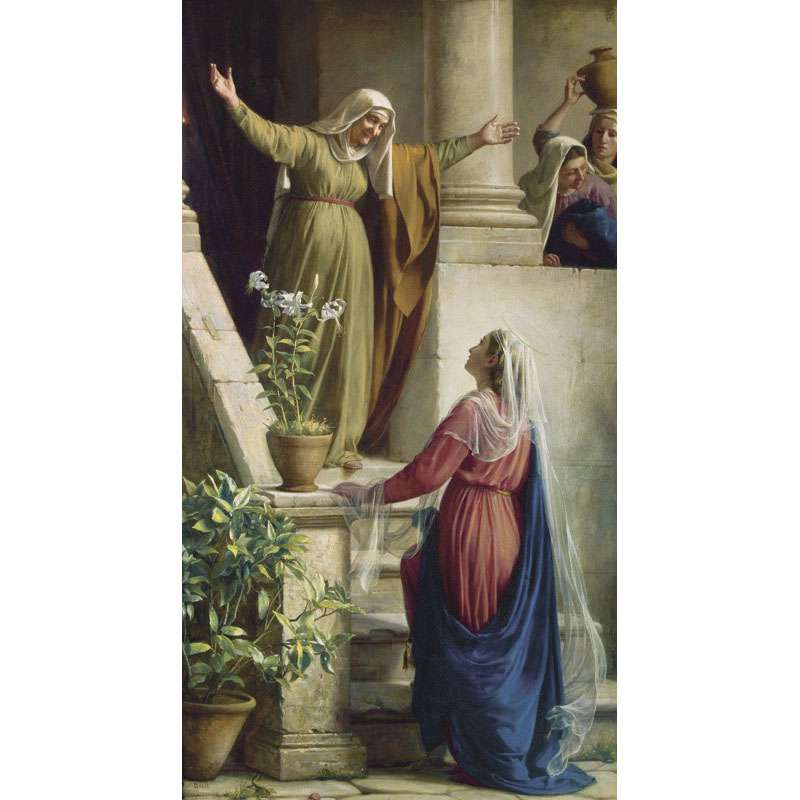
The Meeting of Mary and Elisabeth (1866) by Carl Heinrich Bloch

God bless!

Advent Day 11: Taking a load off

TODAY’S GOSPEL (Mt 11:28-30)

From Matthew 11:28:

“Come to me, all you who labor and are burdened,
and I will give you rest.

From Fire of Mercy, Heart of the Word (Volume I), pages 712, 714:

“[W]e are surely not to limit the scope of Jesus’ magnificent Venite ad me! only to those under the yoke of Pharisaism. For the love of Christ has a much more universal scope and, in Jesus, God is the absolute liberator of man from a legalistic conception of Torah as well as from every burden that keeps him back from fully becoming a child of the infinitely free Father.

“Jesus is the one who, by a divine ‘instinct’, himself bends down to share the lot of all who are burdened beyond their ability to bear it….Rather than denounce the source of the oppression — whether within or outside the person — Jesus simple extends an invitation: ‘Come to me!’ It is crucial that these words be seen as an invitation, because a person must respond to it with perfect freedom. One must oneself in some sense leave behind the oppressive situations and go to Jesus. Although elsewhere Jesus is portrayed as himself searching out the lost sheep, here the appeal is made to the exhausted person’s desire to change his life. He must take the first step himself toward the source of regeneration.”

My take

If you love Scripture, particularly Matthew’s Gospel, I encourage you to invest in Father Simeon’s (formerly Erasmo Leiva-Merikakis) four-volume Fire of Mercy, Heart of the Word series. Over 2,800 pages breaking down Matthew. What a treasure goring verse by verse, phrase by phrase, or word by word through the Gospel. Amazing spiritual insights from these “meditations” will be much food for thought, prayer, and contemplation. The excerpt above is only a tiny portion of the several pages devoted to just this one verse.

Don’t we all need rest from our many burdens? And Jesus offers to be that resting place. He already took the cross off our shoulders. Just as we must freely accept this gift of redemption, so must we freely come to Jesus in our difficulties and challenges. He is always waiting for us.

So, please join me as I endeavor to put my cares and troubles into Jesus’ hands so that I may finally true rest.

Then the peace of God that surpasses all understanding will guard your hearts and minds in Christ Jesus. (Phil 4:7)

The Hard Job of Living… (1922) by Georges Rouault

God bless!

Advent Day 10: Lost and Found

TODAY’S GOSPEL (Mt 18:12-14)

From Matthew 18:14:

“[I]t is not the will of your heavenly Father
that one of these little ones be lost.”

From Fire of Mercy, Heart of the Word (Volume II), page 628:

“‘It is not the will in the sight of your Father who is in heaven that one of these little ones should perish’: The ever-watchful eye of God’s love tirelessly scans the whole horizon of human existence with only one concern: Are all being saved? Are all being brought into life? Are any being lost, even one? For God’s joy is not complete until all are saved! The newness of life that comes about as a result of conversion to Christ — my turning and clinging ardently to Christ after having been sought and found by Christ — is an event that makes the Heart of God dance with joy. Can we not see the Face of the eternal Father glowing with exultation at the recovery of one of his dear children? And that tidal wave of divine joy then reverberates through his creation, since no act of God is without effect in the whole of the created order. Just as the angels of the little one, forever contemplating the face of the heavenly Father, build a bridge connecting childlike innocent and divine glory, so too the greatest exultation among the choirs of angels is reserved for the occasion of a single sinner’s conversion (Lk 15:7, 10).”

My take

Father Simeon’s exposition of the highlighted verse brought to mind immediately two other New Testament passages:

God our savior…wills everyone to be saved and to come to knowledge of the truth. (1 Tim 2:3-4)

“Whoever causes one of these little ones who believe in me to sin, it would be better for him to have a great millstone hung around his neck and to be drowned in the depths of the sea.” (Mt 18:6)

What a stark warning: If we oppose the will of God for all of mankind by leading others into sin directly or by bad example, we would be better off dead. We have an obligation, by virtue of our Baptism, to bring others to Christ, not lure them away or drive them away. If only we were constantly mindful of that. If only we saw the world through the eyes of God we too would desire salvation for all. We are God’s chosen instruments to effect God’s will — what an awesome gift and what an awesome responsibility! We must get close to the Lord and stay close to the Lord through prayer, penance, the Sacraments, and Scripture. Vigilance!

God bless!

Advent Day 9: Mary and Eve

TODAY’S FIRST READING (Gn 3:9-15, 20)

From Genesis 3:15:

I will put enmity between you and the woman,
and between your offspring and hers;
he will strike at your head,
while you strike at his heel.”

From The Navarre Bible: Pentateuch, page 54:

“The punishment God imposes on the serpent includes confrontation between woman and the serpent, between mankind and evil, with the promise that man will come out on top. That is why this passage is called the ‘Proto-gospel’: it is the first announcement to mankind of the good news of the Redeemer-Messiah. Clearly, a bruise to the head is deadly, whereas a bruise to the heel is curable.

“Victory over the devil will be brought about by a descendant of the woman, the Messiah. The Church has always read these verses as being messianic, referring to Jesus Christ; and it has seen in the woman the mother of the promised Saviour: the Virgin Mary is the new Eve.”

My take

Is it any wonder that the angels’ resounding song rent the heavens when Jesus was born (Luke 2:13-14)? The world had been groaning for tens of thousands of years as it waited in great expectation for God’s promise in Genesis 3:15 — that God would fix what man could not — to be fulfilled.

I so love the image at bottom, so much so that I purchased a print now hanging on my classroom wall. I find it a great catechetical tool in teaching about the first Eve and the new Eve. Look at it carefully — it is truly inspired.

Eve looking downcast, still holding the gnawed apple, still in the grip of her tempter.

Mary looking with pity and love on Eve, caressing her cheek gently with compassion, bringing Eve’s had on to her pregnant belly as if to say, “This child is the promised Messiah — your Savior and mine — who will take care of your mistake once and for all.”

Note the last fine detail: Mary and Jesus are crushing the head of the serpent with Mary’s heel (in Hebrew, “he will” in verse 15 above can be rendered “they will”).

O happy fault, O necessary sin of Adam, which gained for us so great a Redeemer!

Mary and Eve (2005) by Sr. Grace Remington

God bless!

Advent Day 8: Straightening up

TODAY’S READINGS

FROM Baruch 5:7 (the full passage is Bar 5:1-9):

God has commanded
that every lofty mountain be made low,
and that the age-old depths and gorges
be filled to level ground

FROM Psalms 126:5 (the full passage is Ps 126:1-2, 2-3, 4-5, 6):

Those who sow in tears
shall reap rejoicing.

From The Navarre Bible: The Psalms and the Song of Solomon, page 422

“[This] simile seems to be built around a popular proverb. ‘The pain of suffering gives rise to holy tears. But the time of weeping is also the time of sowing, because the works of charity that are performed to ease the burden of men’s sins are the seeds of eternal happiness’ (Prosper of Aquitaine, Expositio Psalmorum, 125, 6).”

FROM Philippians 1:4-5 (the full passage is Phil 1:4-6, 8-11)

I pray always with joy in my every prayer for all of you,
because of your partnership for the gospel

From Catholic Commentary on Sacred Scripture: Philippians, Colossians, Philemon, pages 75-76

“‘your partnership for the gospel’: That phrase may seem at first to refer simply to their common faith in the gospel. But for Paul the partnership is more concrete and practical than that. As Paul uses the word, ‘gospel’ can sometimes mean the message of the good news itself (God has definitely entered into history to save us through the death and resurrection of his Son), but at other times ‘gospel’ means the project of sharing that good news. Here, the ‘partnership in the gospel’ for which Paul is grateful seems to refer especially to the financial aid that the Philippians have sent to him through Epaphroditus (see 4:10-20). This aid in partnership in the sense that it is a real contribution to the advance of the gospel.”

FROM Luke 3:4b-5 (the full passage is Lk 3:1-6)

 Every valley shall be filled
        and every mountain and hill shall be made low.
    The winding roads shall be made straight,
        and the rough ways made smooth

From The Word of the Lord (Year C), page 18

“‘Every valley shall be filled’ refers to hope, encouragement, and new life being granted to the poor, the oppressed, the lowly — people who fell they have been forgotten by God or are not worthy of God’s attention.
“‘Every mountain and hill shall be made low’ refers to the humbling of the proud, the repentance that the strong and arrogant must undergo in order to receive God’s salvation.
“The ‘winding roads’ and ‘rough ways’ refer to the twists and turns of the human heart, contorted by sin (Jer 19:9). The human heart needs to be ‘simplified’ or ‘straightened’ by honest and truthful confession of sin.”

MY TAKE

Not only is John the Baptist’s message echoed in Isaiah (Is 40:35), but also in Jeremiah’s scribe, Baruch, as seen in today’s first reading. I can do nothing to improve on Dr. Bergsma’s reflection above in his The Word of the Lord series (a must have — I’m working through the last of the four volumes, as I did the first three, this year), but I will add a thought that came to me as I heard the Gospel proclaimed at Mass.

“Mountains made low” certainly evokes images of the proud being “put in their place.” So, then, if the lofty peak represents the proud, maybe those in a deep valley are folks who are mired in sin and despairing of salvation. The only way out is up and it’s a struggle that may seem overwhelming (or impossible) to undertake. And how easy it is to get to the bottom! I’m a bicyclist so it is impressed upon me what an easy journey it is when going down hill and what a challenge it is to go back up that same hill. Sin can be that way for us, as well. Our transgressions may start out small, but the slippery slope is there to carry us rapidly down if we are not careful and vigilant. Sometimes it is only when a person in the throes of sin or addiction hits “rock bottom” that he comes to his senses and makes the decision to climb out of the abyss. Can we not say that what was “sowed in tears” (the descent into the darkness of sin) can ultimately lead to “rejoicing in the reaping” (in ascending to righteousness)?

Finally, a word on the second reading. By virtue of our Baptism, we are partners in sharing the Gospel. We should do so in word and action at all times. But, as the Catholic Commentary lays out, we should also support ministries, as Paul’s followers did for him, that authentically and faithfully get out the Word. Some of my favorites are my home parish, the St Paul Center, Catholic Answers, and EWTN.

BP BARRON SERMON

FR MIKE SCHMITZ HOMILY

Hurricane Ridge in Olympic National Park

God bless!

Advent Day 7: We’re all to be farmers

TODAY’S GOSPEL READING (Mt 9:35–10:1, 5a, 6-8)

From Matthew 9:37-38:

[Jesus] said to his disciples,
“The harvest is abundant but the laborers are few;
so ask the master of the harvest
to send out laborers for his harvest.”

From The Navarre Bible: St Matthew, page 101

“Paul VI reminds us: ‘the responsibility for spreading the Gospel that saves belongs to everyone — to all those who have received it! the missionary duty concerns the whole body of the Church; in different ways and to different degrees, it is true, but we must all of us be united in carrying out this duty. Now let the conscience of every believer ask himself: Have I carried out my missionary duty? Prayer for the Missions is the first way of fulfilling this duty’) Angelus Address, 23 October 1977).”

From Opening the Scriptures: Bringing the Gospel of Matthew to Life, page 180:

“This request [v. 38] will be the prayer of the church when Matthew writes his gospel, and it is the prayer of the church today. It is a prayer offered out of compassion for those who are troubled and helpless: laborers are needed to lift their burdens and bring them ‘the gospel of the kingdom’ (verse 35).”

From Fire of Mercy, Heart of the Word (Volume I), page 520:

“Jesus’ movement of mercy in verse 36 and his densely imaged reflection, which in a flash of lightning transforms the landscape before him, are conveyed by the evangelist not as a direct quite of anything said by Jesus, but rather as an unveiling of the interior thoughts of the His Heart. For one precious instant, Matthew makes us privy to the emotive and mental processes of the Son of God. This means that the prayer Jesus teaches his disciples a moment later is a communication to them of his own Heart, mind, and prayer. In teaching them to pray in that way, there is an undertone of high pathos as God turns to man expectantly, seeing if he might convey to him the desires of his own Heart. On seeing and assuming human misery, the Son of God turns to his brother men — to those who he has chosen and who have given him some token of reciprocal affection — in order to share with them the common burden of the Persons of the Trinity. e does not at once inform them of some efficient plan of action to solve the problem before them. Rather, he admonishes them to see as he sees and to run to his and their Father with their pressing desire. In this way, the friends and followers of the Bridegroom are on the point of becoming fellow workers with the Bridegroom…’Disciple’ becomes indistinguishable from ‘worker’.”

My take

Just a month ago we marked National Vocation Awareness Week. It was billed as “an annual week-long celebration of the Catholic Church in the United States dedicated to promoting vocations to the priesthood, diaconate, and consecrated life through prayer and education, and to renew our prayers and support for those who are considering one of these particular vocations.” This is a wonderful thing! No bishops, no priests. No priests, no Mass. No Mass, no Eucharist. So let us continue to fervently pray for our clergy and for those being called by God to be ordained.

But even with a vocations boom, the number of clergy would be minuscule in relation to the general population. This is where we, the laity, come in. By virtue of our Baptism, we are called to be harvesters — wherever the Lord has placed us. The vast majority of us are the laborers in fields like: the office, the school, the construction site, the homestead, the club, and the public square. If we truly interiorize the Good News of Jesus, becoming possessed by the Holy Spirit, even if we are resistant to expressing this outwardly, we would be like Jeremiah (20:9 — read vv. 7-18 for inspiration from his struggle and ours):

I say I will not mention him,
I will no longer speak in his name.
But then it is as if fire is burning in my heart,
imprisoned in my bones;
I grow weary holding back,
I cannot!

And like the disciples on the road to Emmaus (Luke 24:32):

Then they said to each other, “Were not our hearts burning [within us] while he spoke to us on the way and opened the scriptures to us?”

Jesus, the Word of God, known to us by the Scriptures the Church has given to us, should light a fire (cf. Acts 2:3) within us.

How can I repay the LORD
for all the great good done for me? (Psalms 116:12)

How about fulfilling His desire to be a farmer? Let us pray incessantly for others (and ourselves) with Ezekiel (36:26):

I will give you a new heart, and a new spirit I will put within you. I will remove the heart of stone from your flesh and give you a heart of flesh.

ADVENT RESOURCES

ADVENT/CHRISTMAS READING

The Harvesters (1565) by Pieter Bruegel the Elder

God bless!

Advent Day 6: I see (or do I?)

TODAY’S GOSPEL READING (Mt 9:27-31)

From Matthew 9:28-29:

When he entered the house,
the blind men approached him and Jesus said to them,
“Do you believe that I can do this?”
“Yes, Lord,” they said to him.
Then he touched their eyes and said,
“Let it be done for you according to your faith.”

From Opening the Scriptures: Bringing the Gospel of Matthew to Life, page 175:

“The men want to be able to see and Jesus knows that this is what they want. He asks them whether they believe he can do this. This is the only time in Matthew’s gospel (or in any gospel) that Jesus asks anyone whether they believe that he is able to heal them. ‘”Yes, Lord,” they said to him.’ Calling Jesus ‘Lord” is an acknowledgment of his authority and power to give them sight. Their faith has been demonstrated by their following Jesus and crying out to him, even though he seemed to ignore them.”

From Catholic Commentary on Sacred Scripture: The Gospel of Matthew, page 137:

“[The blind men] call Jesus Son of David — the first time someone addresses him with the royal title that has messianic overtones. ‘Son of David’ also brings to mind David’s heir, King Solomon, who was known in Jewish tradition as a great healer and exorcist.”

From Fire of Mercy, Heart of the Word (Volume I), pages 493-494:

“In the end, this faith [of the blind men] proves to be omnipotent, because it is a whole-hearted embracing of the full reality of the presence of the incarnate Word. Faith rejoices in a natural blindness that is the precondition for the vision of God….Our own native lights need to be extinguished if Jesus is to light his lamp in our souls….Whatever empties itself out of itself in order to receive omnipotence, itself becomes omnipotent, just as only total darkness can receive the uncreated Light (St. John of the Cross, Dark Night of the Soul)….The blind men set no condition to God but rather open themselves up wholly and actively to the divine action.”

My take

Amen, I say to you, if you have faith the size of a mustard seed, you will say to this mountain, ‘Move from here to there,’ and it will move. Nothing will be impossible for you. (Mt 17:20)

Jesus’ words to the blind men in today’s Gospel and His words above, further along in the same Gospel, should be a wake-up call to us, encouraging driving us to deep prayer and contemplation. What can Jesus not do if we place ourselves totally in His hands? Jesus can do any good thing. It is we who dampen or even short-circuit His healing power.

I have for months now been reading, as a spiritual exercise, Abandonment to Divine Providence by Jean-Pierre de Caussade. At first, the radical nature of the good Father’s advice took me aback (and sometimes still does, over 300 pages in). But his admonition to give up our own will and self-concern in favor of whatever the Lord ordains or permits for us, makes total sense. What peace we would have if we simply, “Let go and let God,” as the popular saying goes. Emptying out ourselves, as Father Simeon says in Fire of Mercy, allows in God.

What if we “set no condition to God but rather open [our]selves up wholly and actively to the divine action”? What a radical difference that would make! Lord, make me blind to worldly concerns so that I can be open to truly seeing You.

ADVENT RESOURCES

ADVENT/CHRISTMAS READING

Jesus Healing Two Blind Men (undated) by Patriarchate of Peć by School Serbian

God bless!