The Imitation of Christ by Thomas à Kempis, Book III Chapter XXVI: ”The Eminence of a Free Mind, which is Acquired by Humble Prayer Rather than with Much Reading” (third entry)
The disciple begs Christ to preserve him from worldly desires and glories and from the devil’s temptations (in another translation: let not “the devil trip me by his craftiness”). He goes on to ask the Lord in the next sentence: “Give me strength to resist, patience to suffer, and constancy to persevere.”
Here the evangelist explains the Parable of the Sower to His disciples. Seed scattered on the path is the Word heard but not understood. Seed sown on rocky ground is the Word happily received but, with no root (overcome by worldly trials and tribulations), quickly withers. Seed that falls among thorns is the Word choked (by riches and anxieties). Finally, seed embedded in rich soil is the Word cultivated (that is. heard, understood, and taken to heart) yielding a great harvest.
|Reflection
The allure of the world can be enticing. The anxieties of the world can be consuming. This is why we should have frequent recourse to the Word of God. Keep the Bible handy! Dip into it often! Read it from cover to cover or go back again and again to a favorite book. Read the familiar scenes and stories with a fresh eye. Do not overlook even what seem to be the most inconsequential details. Find good Catholic commentaries to help with understanding.
The world need not choke us off from Jesus, the Eternal Word. He knows us better than we know ourselves; and He knows what we are experiencing because He lived with us for thirty-odd years experiencing the joys and sorrows, pleasures and sufferings of life. On top of that, He took the full brunt of every sin ever committed upon Himself. He knows. Thus, we have the gift of Him in Word and Sacrament until the end of time. Have recourse to Jesus often.
The Imitation of Christ by Thomas à Kempis, Book III Chapter XXVI: ”The Eminence of a Free Mind, which is Acquired by Humble Prayer Rather than with Much Reading” (second entry)
The disciple begs Christ for His assistance in overcoming carnal desires. The pull of this world is strong but His faith in the Lord’s grace is stronger.
This reading gives us the first words uttered by the reluctant prophet Jeremiah after being appointed by God “To uproot and to tear down, to destroy and to demolish, to build and to plant” (Jer 1:10). Jeremiah, writing in the late seventh century B.C., warns Jerusalem and the Israelites of coming disaster due to their sinfulness (Jerusalem would fall soon to the Babylonians in 587 B.C.). Here the prophet conveys the message that God bemoans the fact that His once faithful people, whom He cared for and protected, have turned to idolatry and rebellion and have forsaken Him. The “cisterns” refer to worldliness that cannot satisfy.
|Reflection
“Flesh and blood” prevailed over the Chosen People time and time again. They would go astray, be punished, declare their guilt and sorrow, be forgiven,, only to quickly forget their promise to be faithful. We should not be judgmental, though. Is this pattern of living not so often the case with us? We stumble, seek forgiveness, vow to not commit the same sins, and then quickly fall back into the trap. It is the fallen human condition. It makes us realize that without grace we can do nothing. What we must hold just as firmly is that “for God all things are possible” (Mt 19:26) and that the Lord’s “power is made perfect in weakness” (2 Cor 12:9). Thank God for His bottomless mercy. But we must want it, have a firm purpose of amendment, and ever strive to open ourselves more widely to accept His grace.
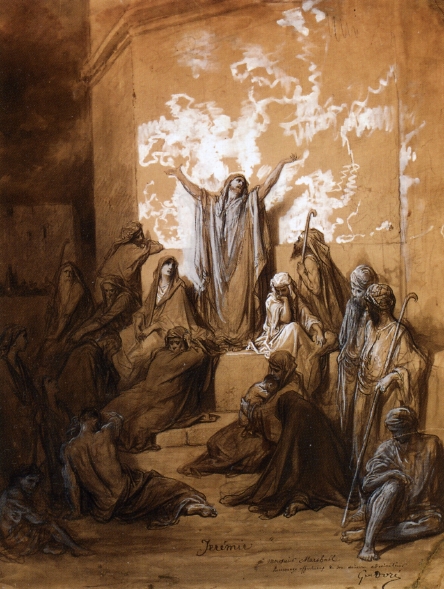
Jeremiah Preaching to His Followers by Gustave Dore (1832-1883)
The Imitation of Christ by Thomas à Kempis, Book III Chapter XXVI: ”The Eminence of a Free Mind, which is Acquired by Humble Prayer Rather than with Much Reading” (first entry)
The title given to this chapter seems misapplied as it does not pertain to its contents. The reflection in my version of the book contains two sentences that much better summarize the content of the disciple’s words: “Perfection consists in keeping ourselves applied to heavenly things. We must make use of all things solely to please God, to serve God and to bring us closer to Him.” The medicine (anointing) of the Spirit and the love of God are indispensable for this.
One commentary entitles this short section, “Christ’s Compelling Love.” How apt. The Paschal Mystery of Jesus, freely taken on by the Son in perfectly obeying the Father’s will, opened up the possibility that we are able to become a “new creation,” a child of God, through baptism, leading to the lifelong hope that this earthly existence ends with our entrance into eternal bliss with the Trinity.
|Reflection
I will “borrow” an excellent explication of the Bible verse in the headline from the Catholic Commentary on Sacred Scripture series:
What does it mean to “live for” the crucified and risen Christ? Living for Christ means, in the first place, to commit our lives wholeheartedly to his service. Even more, because we have been incorporated into Christ through baptism, it means living as Jesus, the new Adam lived — in faithful obedience to God and in giving himself in love for others. Elsewhere, Paul describes this self-giving love as “not seeking my own benefit but that of the many” (1 Cor 10:33) and as striving to “please our neighbor for the good, for building up” (Rom 15:2). Indeed, he insists through his writings that love for Christ cannot be separated from loving and serving the members of his body (e.g., Rom 14:1-15:13). Notice how Paul marks out a circle of love: Jesus’ love, revealed most powerfully in his dying for us, has created the possibility of our walking in the way of self-giving love for the sake of others, and it is through such loving service to others that we express our love for him.
Thomas D. Stegman, SJ. Second Corinthians (Grand Rapids, MI: Baker Academic, 2009), 137.
The verse before this one states “the love of Christ impels us.” Kempis’s disciple asks for an infusion of “the love of Your Name.” So we are impelled to love the Lord which should, as a consequence, impel us to despise worldly things and consolations in favor of heavenly considerations and the love of others. Jesus died for us, yes, but for every other person we encounter as well. We do well to remember this, no matter how we experience those encounters, in our response to them.
The Imitation of Christ by Thomas à Kempis, Book III Chapter XXV: ”In What Stable Peace of Heart and True Profit Consists” (third entry)
Here we find another response from Christ to the disciple, this time querying what he must do to find true peace. The constant refrain in this book: seek the will of the Lord and then let nothing stand in the way of implementing it.
This little passage gives some folks the audacity to posit that Jesus is somehow denigrating His mother by ignoring her and then lumping her in with the rest of us. Certainly, this is not the case. His mother is our exemplar in perfectly doing the will of God. Her entire life was dedicated to the Lord, and her acceptance of being His mother led to a path of joy and suffering that we cannot fathom. But every moment of her life, from conception until her reunion with her Son in heaven, was all for God. Jesus asks us to imitate her.
|Reflection
This is an opportunity to reflect on Our Lady, the Blessed Virgin Mary. No one more perfectly did God’s will than she did. Destined from all eternity to be the mother of the Incarnate Word, the Second Person of the Trinity become man, she humbly accepted this awesome gift and dedicated the remainder of her life to Jesus and then His Church. In the passage above, do we not think that the followers of Jesus knew His mother well? She was undoubtedly no stranger to His ministry. The disciples Jesus addresses here were likely in awe of His words, considering what they knew of this lovely woman who raised Jesus. now supported Him in His ministry, and would continue to be with Him, even unto torture and death. A tall order? In our fallen state, yes. Mary was “full of grace.” And so, we should strive to be like her: disposed to be open to the graces with which the Spirit desires to fill us to help us to be the persons we were created to be.
Jesus and his Disciples on the Sea of Galilee (1833) by Carl Wilhelm Friedrich Oesterley
The Imitation of Christ by Thomas à Kempis, Book III Chapter XXV: ”In What Stable Peace of Heart and True Profit Consists” (second entry)
Prior to this passage, Christ has told the disciple how peace is not found: by judging rashly, by feeling no burden or opposition, or by “experiencing great devotion and sweetness of spirit.” Here, the Lord says that what must be one’s disposition is simply looking to please Him without any ulterior motive outside of pure, unadulterated love.
The prophet Micah here begins an oracle of judgment on Israel. Micah lived in the late eight century/early seventh century B.C., although scholars debate whether he is speaking of those times in which he lived or prophesying about the later Babylonian exile (beginning in 587 B.C.). In any case, we have a heartsick God asking the Chosen People why they have turned against Him (as they so often did) who has done such mighty deeds throughout His association with them. Does He demand burnt offerings, or even human sacrifice as penance? No! Goodness and humility are all that is required.
|Reflection
The message of God has not changed over the eons. Nothing extravagant needs to be done to please Him. His simple mantra: Love Him above all else and love others as ourselves. The first requires humility (recognizing our status compared to His), the second requires goodness (treat others as we wish to be treated). Both fulfill the will of God in our lives. A “whole-hearted” offering that is sure to fill the hole in our hearts that can only be filled by the Lord.
The Imitation of Christ by Thomas à Kempis, Book III Chapter XXV: ”In What Stable Peace of Heart and True Profit Consists” (first entry)
Christ says that humility, meekness, and patience bring peace. This is effected through desiring only Jesus and what pleases Him. Peace is not found when all is going well and consolations abound; rather, “offering yourself with your whole heart to the will of God” with “a perfect contempt of yourself,” whatever comes of it, will lead to the enjoyment of “an abundance of peace.”
This passage from Wisdom responds to concerns about God’s actions in the Promised Land when Joshua led the Israelites in its brutal takeover. God is master of all things, and can dispose of anything or anyone as He wills. Yet He is merciful and just — model for us in our treatment of others while providing the hope that repentance for our sins is possible.
|Reflection
It is a simple (if not easy) matter of doing unto others as we would have them do to us. It is wise for us to remember a line from that greatest of prayers, the Our Father:
Forgive us our trespasses as we forgive those who trespass against us.
The Lord tempers justice with mercy toward our many and repeated failings that are much more grievous to Him than anything another person can do to us. We can forgive the small amount others owe us if God can forgive the unfathomable amount we owe Him (see Mt 18:21-35).
The Imitation of Christ by Thomas à Kempis, Book III Chapter XXIV: ”That We Should Avoid Curious Inquiry into the Affairs of Others” (third entry)
Just prior to this line, Kempis has Christ speaking of “distractions and great darkness in the spirit” that come from being too involved in worldly affairs and being overly concerned with what others think of us. Our hearts must not be cluttered with these sorts of things but rather we must endeavor to prepare ourselves for the Lord entering more deeply into our beings by clearing out the dross of illicit or unhelpful carnal affections.
This reading begins with the Pharisees’ reaction to another healing on the Sabbath. They had determined that enough was enough, thus they put into high gear their plot to have Jesus executed. Jesus, learning of this, flees from there, curing all who followed Him, but warning them not to let anyone know of His whereabouts. Then, Matthew presents a quote from the beginning of Isaiah 42 that Jesus is said to fulfill with this action.
|Reflection
Jesus had plenty of run-ins, and sometimes very harsh words, for His seemingly constant adversaries, the Pharisees. He would no doubt have been overjoyed to have these religious leaders ultimately join His ministry from their very powerful and influential positions, It seems that, in the end, few did become disciples. They, presumably “were diligent in awaiting My coming” but would not “open to Me the door of your heart.” Their hearts remained stony.
The Pharisees believed things would go better for them if Jesus were no longer in their lives. May not the same be said of us! Jesus challenged the perceptions and understanding of God and His Word of these men. Few were up to the challenge. Are we up to the challenge of the “hard sayings” of Jesus? Mark Twain famously said, “It ain’t the parts of the Bible that I can’t understand that bother me, it’s the parts that I do understand.” It’s okay if parts bother us — if they compel us to change for the better. Let us welcome Jesus to “bother” us whenever we need it.
The Imitation of Christ by Thomas à Kempis, Book III Chapter XXIV: ”That We Should Avoid Curious Inquiry into the Affairs of Others” (second entry)
Kempis has Christ encouraging introspection here. He goes on to say that He well knows what each person has done and the state of souls — He will not be deceived. As for the true follower of Jesus, He declares: find peace by not being a “busy-body.”
Here, Jesus and His disciples are confronted by Pharisees who find them picking and eating grain on the Sabbath, forbidden in their law. The Lord retorts immediately with the story of David and his followers who “ate the bread of offering” that only the priests could eat lawfully and then also mentioning other tasks the priests are allowed on the Sabbath without incurring guilt. Finally, Jesus declares Himself greater than any of these (“the Son of Man”) as He is “Lord of the Sabbath.”
|Reflection
Kempis’s words here apply perfectly to the self-righteous Pharisees who seemed constantly on the lookout for any infraction, real or perceived, among the people and especially upon this upstart preacher. In this case, we have a classic example of the “wall” these religious leaders built around the Torah (the law). The book of Exodus does forbid harvesting grain on the Sabbath but Deuteronomy differentiates harvesting from plucking. Nevertheless, the Pharisees add their own restrictions to what is in Scripture, much to the dismay of the people (no wonder His winning arguments against these men were so well received by the masses). Jesus does not hesitate to call them out for their hypocrisy time and again.
In this excerpt, in correcting the Pharisees, Jesus asks them, “Have you not read…” They certainly must have felt insulted. These were the teachers, the exemplars, of the Jewish faith! And Jesus has the temerity to ask them such a question? Well, of course, Jesus knew they had read the Scriptures many times. But going through the God’s word is far different from that same Word going through the reader. These accusers missed the loving God of mercy in focusing on the demanding God of sacrifice (they are one and the same, to be clear). In their rush to judgment they betray their lack of knowledge of Scripture (both letter and spirit) and their haughty attitude.
(As an aside, I have this humorous mental picture of Pharisees popping up from a crouch in the middle of a field to the surprise of the whole of Jesus’ band. One would think these guys would have something better to do. But it just goes to show you to what lengths they were willing to go to get “dirt” on Jesus, or to trap Him, or to try to put Him in a bad light with the people. Their time would have been put to much better use listening, praying, and revisiting the law and the prophets in light of Jesus’ teaching.)
So what about us today? Jesus’ question, “Have you not read”?, is a good starting point, I think. Like the Pharisees, we should be dedicated to reading the Bible. Unlike Jesus’ adversaries here and throughout the Gospels, we should be even more dedicated to interiorizing (a change of heart) and exteriorizing (a change of behavior) based on what we learn. When Jesus was asked what was the greatest commandment He said that we are to love God with all our being and love others as ourselves. We don’t do either by busying ourselves with others for the wrong reasons. From illicit curiosity regarding others’ private lives to casting judgment on their internal motivations and disposition of their souls, we should have no part in this. Calling out immoral behavior is legitimate, imputing motives is not. What is called for is mercy, Jesus tells us today. As for us, we much more productively spend our time remembering that mortal life is short and that each of us “will have to render an account of yourself.” Let that be our focus — it requires a lifetime of prayer, penance, and diligence that will keep us well occupied until the Lord comes calling.
Jesus Among the Wheat Fields (1900) by Johannes Raphael Wehle
|The Imitation of Christ by Thomas à Kempis, Book III Chapter XXIV: ”That We Should Avoid Curious Inquiry into the Affairs of Others” (first entry)
In this short chapter, Kempis’s thrust, as the title indicates, is that we should not be concerned about what others are doing or even what they think of us (good or bad). Even being “familiar with many” is to be frowned upon as it can lead to “distractions and great darkness in the spirit.” Let God be concerned with others and ultimately judge them. As for us, we are to keep the focus on our own status in the eyes of the Lord; this will keep us busy enough for a lifetime.
Isaiah speaks on behalf of the besieged southern kingdom of Judah that is exalting the Lord’s judgment on them, harsh as it is, as just recompense for its sins. Finally, Isaiah acknowledges that they cannot bring about their own salvation but it is only through the Lord that “the dead shall live.”
|Reflection
True peace is found in Jesus. Witness:
Peace I leave with you; my peace I give to you. Not as the world gives do I give it to you. Do not let your hearts be troubled or afraid. (Jn 14:27)
Kempis’s Christ says to keep the focus on Him to “keep yourself in true peace.” The Israelites also come to realize that peace comes from the Lord — it is He who has really “accomplished all we have done” (a burgeoning understanding of grace in the Chosen People). Jesus Himself, in the quote above, explicitly tells His apostles that it is He, the Prince of Peace (see Is 9:5), metes out the peace that Isaiah speaks of, that tranquility that cannot be found in worldly affairs.
The lesson for us? In a world of increasing turmoil we have a refuge. We must take the time to pray, to read Scripture, to learn the Faith, and to do the good works Jesus commanded of us. When we are able, we should spend time in front of the Blessed Sacrament (you can even do it virtually, if necessary), to connect or reconnect with our Savior. Trust in the Lord and “[d]o not let your hearts be troubled or afraid.” Let us commit everything to Jesus: our joys, our sorrows, our consolations, and our worries. “Offer it up,” as the nuns told us — our efforts will not be in vain.
|The Imitation of Christ by Thomas à Kempis, Book III Chapter XXIII: ”Four Things Which Bring Great Peace” (fourth entry)
The words of the disciple above are part of his prayer for enlightenment to “dissipate al darkness from the habitation of my heart.” Concupiscence and sin weaken the will and darken the intellect. The disciple begs Christ for light and truth to overcome these enemies of the soul.
This excerpt (that we also heard the Sunday before last) comes on the heels of yesterday’s reading in which Jesus condemns several towns in which He preached. “These things” that He taught are meant for all hearers, but only some have the openness, the “childlike” disposition, to accept them through grace in faith. Then Jesus emphasizes His special relationship with God the Father, as His Son and messenger.
|Reflection
Jesus said, “Let the children come to me, and do not prevent them; for the kingdom of heaven belongs to such as these.” (Mt 19:14)
For the wisdom of this world is foolishness in the eyes of God, for it is written:
“He catches the wise in their own ruses,”
and again:
“The Lord knows the thoughts of the wise, that they are vain.” (1 Cor 3:19-20)
This first verse above is often used to emphasize the importance of catechesis of the young. But are we not all called to exhibit the beautiful openness of children to the wonders of truth, beauty, and goodness? The march of time and the onslaught of worldly cares can well see us become “a sterile and desert land,” but Jesus our “light” (Jn 8:12) and “truth” (see Jn 14:6) wishes to water us with the Spirit’s graces (let us here recall our baptism). In order to receive the full benefits of God’s grace, we must revert to a childlike state, an interior disposition of receptivity, that places the Lord above all priorities, interests, and concerns. Being “worldly wise” leads only to eternal foolishness.
As a related side note, I wish to emphasize here the importance of teaching our children well, and the necessity of continuing our learning of the Faith all life long. Developing a properly formed conscience is the duty of the faithful toward our young people. And how are we to do this well if we ourselves are not steeped in Scripture and Church teaching that provide light and truth, forming our own consciences well? We are blessed with an embarrassment of orthodox Catholic riches at our fingertips, literally. Let us make a daily habit of informing our faith so that we may help build up the Kingdom in ourselves and others.









 Unworthy Servant