“Let this be my consolation, to be willing to be deprived of all human comfort.” (IC 3,16,2) | “Though I thought I had toiled in vain, and for nothing, uselessly, spent my strength, yet my reward is with the LORD, my recompense is with my God.” (Is 49:4)

|The Imitation of Christ by Thomas à Kempis, Book III Chapter XVI: ”How True Comfort must be Sought in God Alone” (third entry)

Kempis wraps up this chapter by emphasizing the importance of finding consolation In God alone and His will for us, even if there is not a sensible or spiritual consolation. Simply conforming to God must be enough for us..

|Today’s first reading: Is 49:1-6

For this Solemnity of the Nativity of Saint John the Baptist we hear proclaimed one of Isaiah’s beautiful servant songs. How appropriate! There was no better prophet or servant of the Lord than Jesus’ cousin (see Mt 11:11). Isaiah prophesies a man called from his mother’s womb to be a “sharp edged sword…a polished arrow…a light to the nations.” He was to experience sorrow and difficulties (see the headline) but he received reward, glory, and strength from God. This could be said of all the prophets, but John, the immediate precursor of Christ, fulfills this in spades through his lifestyle (ascetic), preaching (uncompromising), suffering (intense), and death (vengeful)

|Reflection

From the womb John the Baptist received his mission. Even at that time he was inspired to leap when he first encountered Jesus, then just a few days in Mary’s womb (see Lk 1:41). Even his father, Zechariah, was moved to declare him “prophet of the Most High” who “will go before the Lord to prepare his ways” (see Lk 1:76). The die was cast; John had the most special mission of any prophet — to prepare the way for the imminent coming of the Messiah. It would not be easy, ultimately costing him his life.

John must have experienced many frustrations in his ministry. He could certainly draw a crowd, but he was not making a lot of friends of the religious class with his outspoken and harsh opinions of them (see Mt 3:7-10). He was a sharp sword, attempting to move hearts with truth that sometimes hurts. He certainly did not enjoy creature comforts with his chosen way of life, and he likely knew where his ministry was headed (all he had to do was consider the fate of the prophets in the Scriptures). His greatest consolation was knowing that he was being a faithful servant. What joy he must have felt when his cousin finally began His public ministry! He knew then that his mission was winding down and the end was likely near (see Jn 3:30).

Like John, we are called to prepare hearts for the Messiah (including our own!). In what we say and do, we are to see Jesus in others and be Jesus to others. Will we experience rejection? Guaranteed. Will the truth cause some to go away? Certainly. Will we be tempted to discouragement? Of course. But we must fulfill our mission. We are not called to a comfortable life, a lukewarm existence, here on earth. We are to toil, even if it sometimes seems in vain, knowing that our reward will be great in heaven.

File:Raphael - Saint John the Baptist Preaching.JPG
Saint John the Baptist Preaching (1505) by Raphael

“If you desire these present goods too inordinately, you will lose the heavenly and eternal goods.” (IC 3,16,1) | “How narrow the gate and constricted the road that leads to life. And those who find it are few.” (Mt 7:14)

|The Imitation of Christ by Thomas à Kempis, Book III Chapter XVI: ”How True Comfort must be Sought in God Alone” (second entry)

After this line, Kempis goes on to say that our attitude toward temporal things must be utility, while eternal considerations are what are to be desired. How we handle worldly matters determines the extent to which we desire and will attain unending happiness.

|Today’s Gospel reading: Mt 7:6, 12-14

As we draw near to the end of the Sermon on the Mount, we recall the great challenges to living the life of a Christian disciple that Jesus has already presented in this extended lesson. Here, the Lord provides one of His most ominous warnings: deviation from the path to holiness is easy and most folks take these dangerous side routes endangering their eternal fate. How does this happen? By not heeding what Jesus says immediately before His discussion of the two paths: “Do to others whatever you would have them do to you.”

|Reflection

Jesus tells us in no uncertain terms how easy it is to “desire these present goods too inordinately” thus “los[ing] the heavenly and eternal goods.” There are few passages in all of Scripture that should give us pause like this one. The Lord was a radical — there is no room for compromise for the true disciple. One must be detached from this world while fully embracing God’s will for us so that we may have joy in the next world. The Messiah is not messing around here. Neither should we.

Der breite und der schmale Weg 2008.jpg
The broad and the narrow path (original: 1866 / this version: late 20th or early 21st century)
by Charlotte Reihlen (idea) and Paul Beckmann (execution)

“Although you should possess all created goods, nevertheless you would not be happy, but in God, Who created all things, is found your beatitude and your happiness.” (IC 3,16,2) | “They followed the rites of the nations whom the LORD had cleared out of the way of the children of Israel and the kings of Israel whom they set up.” (2 Kgs 17:8)

|The Imitation of Christ by Thomas à Kempis, Book III Chapter XVI: ”How True Comfort must be Sought in God Alone” (first entry)

This chapter of Kempis once again emphasizes the need for detachment from worldly goods and pleasures in favor of Eternal Truth, who is Jesus. He is to be our only consolation, whether we feel consoled or not. As the quote above says, all the world’s possessions do not come close to providing what God provides here and hereafter.

|Today’s first reading: 2 Kgs 17:5-8, 13-15a, 18

This reading from 2 Kings chronicles the fall of the Northern Kingdom (Israel) to the Assyrians and the deportation of many of its inhabitants around 721 BC. It goes on to give the reasons why this bad outcome occurred to them: chasing after other gods and participating in their rites, disobeying the commandments, rejecting statutes, and dismissing the many prophets sent to warn the people of impending destruction. Thus, “in his great anger against Israel, the LORD put them away out of his sight.”

|Reflection

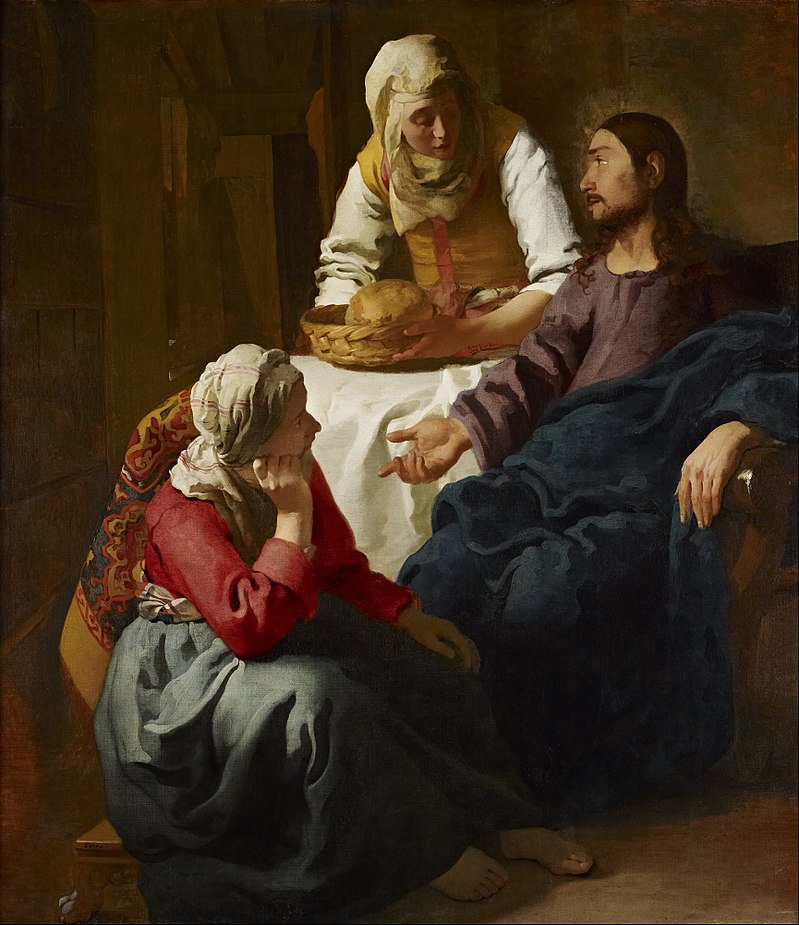
The Israelians (the Israelites of the Northern Kingdom) believed they would find contentment and favor by following other nations’ worship of false gods. This is an ongoing problem for the Chosen People even these five hundred or more years after the Exodus. And it’s a problem even today, growing even greater still. Consider the “created goods” we hold to indispensable status: smart phones, extra and/or fancy cars, TVs and video, expensive vacations, certain food and drink,…the list goes on. Our striving for these and the next “must have” consumer item or “must see TV (or YouTube or TikTok)” can’t but take our eyes off of the ultimate prize: our Heavenly Father. And I am not just referring to eternal happiness with Him in Heaven, but also the necessary help He gives us here below to fill the God-sized space inside of us with which He designed us. How many times have we heard the sad stories of the rich and famous who ultimately found only trouble and heartache with their fortunes? Let us learn our lesson here from the sister of Lazarus and Martha and not be consumed with or distracted from what is most important:

Mary sat beside the Lord at his feet listening to him speak. Martha, burdened with much serving, came to him and said, “Lord, do you not care that my sister has left me by myself to do the serving? Tell her to help me.” The Lord said to her in reply, “Martha, Martha, you are anxious and worried about many things. There is need of only one thing. Mary has chosen the better part and it will not be taken from her.” (Lk 10:39-42)

Johannes (Jan) Vermeer - Christ in the House of Martha and Mary - Google Art Project.jpg
Christ in the House of Martha and Mary (1655) by Johannes (Jan) Vermeer

“Grant that I may die to all things that are in the world, and for your sake, may I love to be despised and ignored in this world.” (IC 3,15,4) | “[D]o not be afraid of those who kill the body but cannot kill the soul; rather, be afraid of the one who can destroy both soul and body in Gehenna.” (Mt 10:28)

|The Imitation of Christ by Thomas à Kempis, Book III Chapter XV: ”How We are to Regulate Ourselves, and What We are to Say in Every Desirable Thing” (fourth entry)

We close out this chapter with another message of mortification and submission to God’s will. Kempis knows well the Gospel and the call to discipleship that necessarily entails rejection and suffering. This is to be embraced, though, while creature comforts and personal adulation are to be shunned.

|Today’s Gospel reading: Mt 10:26-33

What we have in today’s Gospel are some of the instructions from Jesus to the twelve apostles after commissioning them to go out and preach, heal, and exorcise demons. The Lord makes no bones about the fact that they will be persecuted. They must be courageous in the face of this, though, and not hold back on the complete message of the Good News. “Do not be afraid”!, He says. Fear and compromise have eternal consequences for those who persist in these ways.

|Reflection

Fully embracing Christ and the Truth He is and taught is ever more vehemently opposed by the culture of our day. Jesus warns against giving in to the prevailing antagonism despite the promise of persecution (see also Mk 10:29-30). These few moments we spend on earth are nothing in comparison to eternity but this time fully determines our eternal disposition. Kempis suggests that our response must be more than tolerating the abuse that is sure to come for living and proclaiming the Gospel; actually, we are to “love to be despised and ignored.” One way to prepare ourselves for these difficulties is to “die to all things that are in the world.” That is, not only material things, but also to compliments, accolades, good wishes, and so on. Not that we shouldn’t gratefully accept these (always remembering Who gets the credit), but we are not to become attached to them, count on them, or regret when they are not forthcoming. Like Paul, we must keep our eyes on the prize, come what may in this life:

I even consider everything as a loss because of the supreme good of knowing Christ Jesus my Lord. For his sake I have accepted the loss of all things and I consider them so much rubbish, that I may gain Christ. (Phil 3:8)

I consider life of no importance to me, if only I may finish my course and the ministry that I received from the Lord Jesus, to bear witness to the gospel of God’s grace. (Acts 20:24)

Twelve Apostles male men
Jesus and his disciples (A scene from the movie Son of God.)

“Lo, I am your servant, ready to obey you in all things; for I do not desire to live for myself but for You; oh, that I could do so, in a worthy and perfect manner!” (IC 3,15,2) | “[H]is mother kept all these things in her heart.” (Lk 2:51b)

|The Imitation of Christ by Thomas à Kempis, Book III Chapter XV: ”How We are to Regulate Ourselves, and What We are to Say in Every Desirable Thing” (third entry)

Above, find the closing words of Christ to the disciple. This is to be the attitude of the Christian: one of striving for “worthy and perfect” service to the Lord trumping any personal desire that would impede that mission.

|Today’s Gospel reading: Lk 2:41-51

For this Memorial of the Immaculate Heart of the Blessed Virgin Mary, it is fitting that we highlight the last words of the episode of the finding of Jesus in the temple at the age of twelve. This Gospel tells the familiar story of how, on the return trip from the Holy Family’s annual pilgrimage to Jerusalem for Passover, Jesus stayed behind in Jerusalem unbeknownst to His parents. Mary and Joseph search for Him for three days before finding Him interacting with the priestly class in the temple. In response to their expression of anxiety, Jesus responds as though they should have expected Him to be “in my Father’s house.” He then obediently goes with them. All this prompts Mary’s response above.

|Reflection

Kempis’s Christ implores the disciple to serve Him well while bemoaning the fact that he is unable to serve his Master worthily and perfectly. The Christian disciple need only look to the Blessed Mother for the exemplar of worthiness and the epitome of perfection. From the moment of her conception she was the spotless instrument of God who would conceive and bear His only Son. Her “Fiat!” as a young teenager set her course for the rest of eternity. Yet she didn’t receive all at once a revelation of all that would happen to her and her Son in their earthly lives. She pondered events in her immaculate heart, a heart that, we are told just a few verses earlier. would be pierced (see Lk 2:35). A heart that the baby Jesus and, I wager, the child Jesus, the adolescent Jesus, and the adult Jesus, rested His head against often. Every beat was for Him.

This is what we should dare to approach in our lives. Every word honoring the Lord, every action according to God’s will, every heartbeat an expression of love. And perfect trust in Jesus. Holy Mary, Mother of God, pray for us!

“Grant me the grace to rest in You above all desired things, and to pacify my heart in you.” (IC 3,15,4) | “Come to me, all you who labor and are burdened, and I will give you rest….for I am meek and humble of heart” (Mt 11:28,29)

|The Imitation of Christ by Thomas à Kempis, Book III Chapter XV: ”How We are to Regulate Ourselves, and What We are to Say in Every Desirable Thing” (second entry)

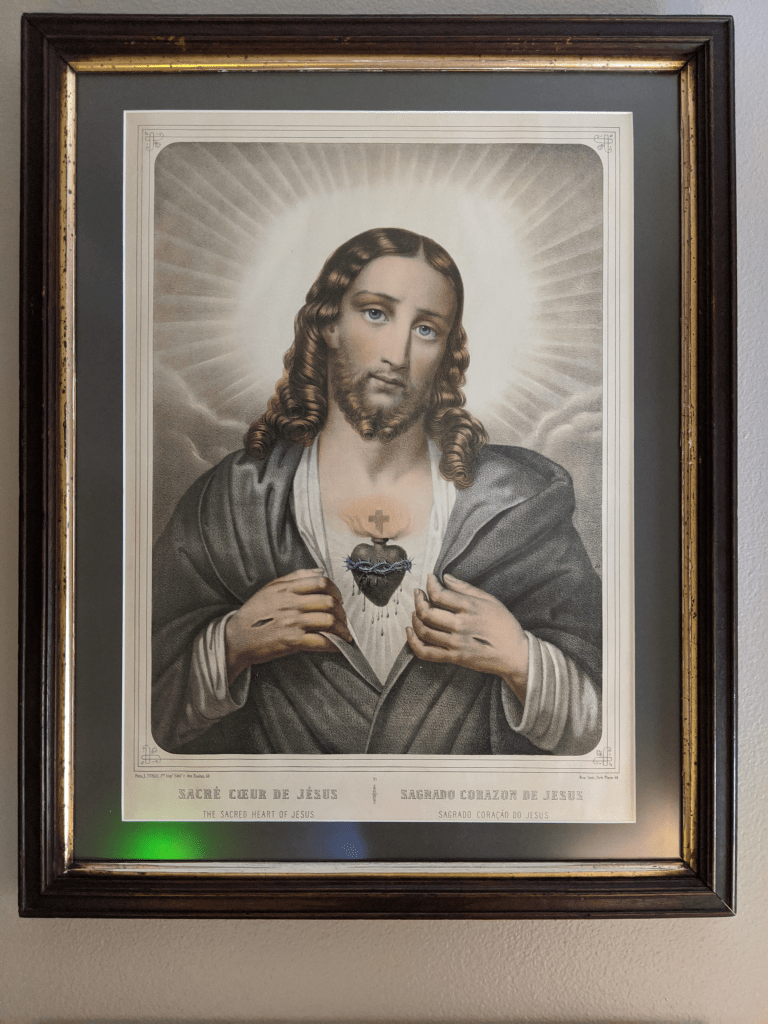
Kempis’ disciple says these words near the end of this chapter, after disavowing worldly pleasures and gladly accepting being “despised and ignored in this world.” True rest from the cares of this passing life,and a peaceful heart come only in taking refuge in the Sacred Heart.

|Today’s Gospel reading: Mt 11:25-30

This beautiful little passage for the Solemnity of the Most Sacred Heart of Jesus first highlights the greatness of the Father. Then the Lord consoles His disciples by telling them that true rest can be found in Him. Whatever burdens they have, they will find assistance and consolation in Christ.

|Reflection

When we speak of the Church as the Body of Christ, we say that Jesus is the Head and the rest of us believers are the various parts. But I submit that Jesus is not only the Head, but the Heart, as well. The Solemnity we celebrate today, instituted formally by,Pope Pius IX in 1856 serves as a reminder of this comforting fact. Life’s burdens and trials can weigh us down, it is true. Jesus understands. He is there to help us shoulder the burden, of course, but we can also set it down in Him, and find peace and rest in what is most important: being close to the Lord in this life so that we can be with Him forever in the next. Remember:

For here we have no lasting city, but we seek the one that is to come.
(Heb 13:14)

(Find the Twelve Promises to the Sacred Heart of Jesus to St. Margaret Mary Alacoque here.)

“Let Your will be mine and let my will always follow Yours and be in perfect accord with it.” (IC 3,15,3) | “[T]hy will be done, on earth as it is in heaven.” (Mt 6:10)

|The Imitation of Christ by Thomas à Kempis, Book III Chapter XV: ”How We are to Regulate Ourselves, and What We are to Say in Every Desirable Thing” (first entry)

This chapter contains a dialogue between Christ and the disciple. The Lord implores him to seek to do His will only, and to have Him take away all desire to do that which is not in the mind of God. The words above succinctly summarize the disciple’s response.

|Today’s Gospel reading: Mt 6:7-15

The Lord’s Prayer, in the form familiar to us today, is given by Jesus in the Sermon on the Mount as an example of how one is to pray (as opposed to pagan babbling). This may have been prompted by the Lord’s hearers per Luke (11:1-4). Jesus has them calling God familiarly as Abba (that is, Papa) and asking seven petitions. The Father is a loving parent, close to them, desiring only what is good for His children.

|Reflection

God, our creator, knows what’s best for us. He has our “owner’s manual.” We find that “it is hard for you to kick against the goad” (that is, the divine influence) (Acts 26:14). When we do go our own way, contrary to the Lord, we only ask for trouble. May God be merciful to not permit us to wallow in sin but rather may we come to think clearly out of this stupor, repent, and return to God’s good graces.

Remember, we also pray in the Our Father, “thy Kingdom come.” God wants to build up His kingdom here and now. The Gospels tell us how to live and Jesus shows us the way to a better world in this life and eternal happiness in the next. When we turn away from Truth we get the culture that surrounds us today: degenerate, defiant, decadent, divisive. We are called to change the world not to have the world change us. Let us pray unceasingly for the courage and the fortitude to remain steadfast and make a difference against the forces of the lord of this world, the evil one, Satan.

thy will | Tumblr

“[T]hey who speak are all nothing; for they will vanish with the sound of their words, but the Truth of the Lord remains forever.” (IC 3,14,4) | “When you pray, do not be like the hypocrites, who love to stand and pray in the synagogues and on street corners so that others may see them. Amen, I say to you, they have received their reward.” (Mt 6:5)

|The Imitation of Christ by Thomas à Kempis, Book III Chapter XIV: ”On the Consideration of God’s Secret Judgments so that We be Not Proud of Our Own Good” (third entry)

Kempis closes this chapter with the words above, aptly. Keeping with the theme of humility, he cautions against being puffed up by “the praises of men” which come and go; rather, remain steadfast in Eternal Truth.

|Today’s Gospel reading: Mt 6:1-8, 16-18

The Sermon on the Mount continues in chapter six. The proper attitude in prayer, almsgiving, and fasting is conveyed by our Lord. The intention of these acts must be appropriate to gain favor with God. The focus must be on God and others, not on accolades for oneself. The scribes and Pharisees “reward” is the admiration of the people. The disciple’s reward is the approval of the heavenly Father first and foremost.

|Reflection

Gone unsaid in today’s Gospel, but strongly implied in my view, is that the only reward that the hypocrites will receive is the praise of other persons who are taken in by their outward appearances of piety. They better enjoy it now because it will be an entirely different reception from what they will receive on the day of judgment. But, regardless of our motivations, we are not to get caught up in the good opinions of others toward us. As I posted yesterday, these are fine, and can be accepted, but the glory must always go to the One who has provided the gifts we share. The key is to always remember that this life is passing but eternal life is inevitable and we will be accountable for how we behaved in our mortal existence. We eschew the passing “rewards” that puff us up for the truth that God is God and we are not and all that we have and any good that we have done is thanks to Him. If we keep this always front of mind things will go well for us here and hereafter.

https://i0.wp.com/www.fountainoflife-givingwater.com/wp-content/uploads/2014/10/Praying.jpg

“Neither will he be moved by the words and by the praises of men, who has established all his hope in God.” (IC 3,14,4) | “[I]f you love those who love you, what recompense will you have?” (Mt 5:46a)

|The Imitation of Christ by Thomas à Kempis, Book III Chapter XIV: ”On the Consideration of God’s Secret Judgments so that We be Not Proud of Our Own Good” (second entry)

The last section of this chapter deals once again with vainglory or pride and its opposition to submissiveness to God who is the exemplar of humility in Jesus Christ. Praises will fade in this short life, but the truth of God, and our eternal destiny, remain forever.

|Today’s Gospel reading: Mt 5:43-48

The next section of the Sermon on the Mount gives us two more famous (and famously difficult) entreaties of the Lord: “Love your enemies” and ‘Be perfect, just as your heavenly Father is perfect.” Jesus emphasizes the importance of being God-like: love everyone as God loves them — not as they love you.

|Reflection

It is easy to get caught up in accolades of our fellow men, especially if we have special talents that we share that are particularly appreciated by others. And in this day and age, with the pervasiveness of social media, we can all too easily get caught up in “likes” and page views and comboxes to judge our worth. Now, receiving kind words is not a bad thing (and giving them generously is even better). Appreciation expressed for others’ gifts can provide an important confirmation of one’s work or ministry; it can give a much needed affirmation for their continued efforts. But it should never make the recipient proud in himself. We don’t deny the gift, we just shift the thanks to the Giver of the gifts. Denying the gift is false humility. Acknowledging the Gift-giver is true humility. And when the harsh reviews come in — and they will — we do not love those critics any less; in fact, maybe we love them more, being unfailingly gracious and praying to the Lord that we might be better instruments to move their hearts closer to Eternal Truth.

Église Saint-Martin de Castelnau-d'Estrétefonds - Le Sermon sur la montagne par Robert Arsène IM31000073.jpg
The Sermon on the Mountain (1870) by Arsène Robert

“For we are…inconstant, but through You we become strong; we are tepid, but you inflame us.” (IC 3,14,2) | “Give to the one who asks of you, and do not turn your back on one who wants to borrow.” (Mt 5:42)

|The Imitation of Christ by Thomas à Kempis, Book III Chapter XIV: ”On the Consideration of God’s Secret Judgments so that We be Not Proud of Our Own Good” (first entry)

If one word could be used to encapsulate this entire work it is “humility.” In this chapter, it is emphasized that God is everything and that man is nothing. He gives us everything, sustains us in everything, and the little good we think we do is nothing in the immenseness of God.

|Today’s Gospel reading: Mt 5:38-42

As we slowly continue our journey through the Sermon on the Mount, we find here the Lord giving us a tremendous challenge: the famous “turn the other cheek,” give your cloak as well as your tunic, “go the extra mile,” and give to all who ask something of you.

|Reflection

The heading in the link for today’s Gospel calls this section “Teaching about Retaliation.” What is Christ’s teaching on retaliation? In a word: don’t. How does this work? Is it not against every instinct of ours to not only be treated unfairly but then to do nothing about it (and, in fact, invite even more abuse)? We need the Lord to strengthen us in our inconstancy and inflame us in our tepidness in order to have any chance to do these difficult things. Even so, it hardly makes sense to us. Erasmo Leiva-Merikakis provides insight:

The willingness to *surpirse* our adversary with compassion, with love, with forgiveness — with justice according to the Heart of Christ, in other words — performs a far more efficient and constructive task [than revenge]. It puts evildoers at the risk of being converted, and it dynamizes the whole of society by introducing into it the most divine of all principles: self-giving at all costs….Perhaps my open hands and silent mouth become the most eloquent of teachers, and I will have won a brother in the Lord.

Perhaps, perhaps. I must run the risk that my apparent weakness will be construed as an added invitation to even greater violence and that my enemy will move on to slap the next man’s cheeks….Is this not, however, the very risk our Lord took in coming into our midst, in handing himself over to us, in opening his arms on the Cross? Generosity of the sort practiced by Christ is incompatible with any kind of calculation. We must act as he taught and as he acted.

Fire or Mercy, Heart of the Word (Volume One), p. 235

Enemies of religion sometimes deride believers by asserting that people of faith have made up their beliefs in order to find comfort or escapism in them. After reading Gospel passages like this one and taking them seriously…really?