“I became the most humble and abject of all, so that you might overcome your pride through my humility.” (IC 3,13,2) | “Jesus said to them, ‘Amen, amen, I say to you, unless you eat the flesh of the Son of Man and drink his blood, you do not have life within you.'” (Jn 6:53)

|The Imitation of Christ by Thomas à Kempis, Book III Chapter XIII: ”The Obedience of a Humble Subject Following the Example of Jesus Christ” (third entry)

Kempis has Christ making the point to the disciple that if He, who is God, could take the humble form of a man and be subject to other men, then we followers of Him certainly should be willing to obey our superiors and submit our wills to theirs. Jesus set the example.

|Today’s Gospel reading: Jn 6:51-58

Appropriate for the Solemnity of Corpus Christi, we hear proclaimed today the heart of the Bread of Life Discourse. Jesus is emphatic and earthy in His declaration that His Body and Blood must be consumed (“gnawed”) to gain eternal life. Scandalous to His hearers, we find out in the next few verses that, “As a result of this, many [of] his disciples returned to their former way of life and no longer accompanied him” (Jn 6:66).

|Reflection

When we consider Jesus’ humility, we generally think of it in terms of the Second Person of the Trinity becoming man — God stooping very low, allowing Himself to be subject to creatures to the point of even being derided, mocked, and killed by them. This is true, of course:

[T]hough he was in the form of God, did not regard equality with God something to be grasped. (Phil 2:6)

But this does not go far enough in appreciating Christ’s humility. Jesus promised in His last words in Matthew:

I am with you always, until the end of the age. (Mt 28:20)

Of course, Jesus is with us in many ways, to this day and until the end of time: in the Church, in Scripture, in our hearts, and in others. But in no way is He with us more profoundly than in the Eucharist. He takes the form of food prepared by the hands of human persons to give Himself to us in an unprecedented, miraculous way. He desires that we always have Him, really and truly present, in our midst and even inside of us, so that He might transform us into Himself.

In so doing, He once more, and for all time, subjects Himself to us once again. For reverence, true, but for humiliation as well. While some hearts are well-prepared to receive Jesus into them in Holy Communion, many are not, even to the point of receiving this awesome gift in the state of mortal sin, adding sacrilege to their separated state. Some have even gone so far to desecrate the Sacred Species in defiance of God or even to be used in demonic rituals. The Lord knew all this would occur and yet still, out of His great love, gave Himself to us in this manner “par excellence.”

Do we have any excuse for pride when our Master, our Exemplar, shows us the way of true meekness, a way nearly incomprehensible to us? Let us often contemplate the lowliness that Christ asked us to imitate and offer many penances for the outrages committed against Him in the Blessed Sacrament. And may we never be party to such debasement (and if we have, get to sacramental Confession as soon as possible).

Take my yoke upon you and learn from me, for I am meek and humble of heart; and you will find rest for yourselves. (Mt 11:29)

El Salvador Con La Eucaristía, 1545 - 1550 - Vicente Juan Masip
El Salvador Con La Eucaristía (1545-1550) by Vicente Juan Masip

“Learn…to submit yourself promptly to your Superior” (IC 3,13,1) | “Elijah went over to [Elisha] and threw his cloak over him….Then he left and followed Elijah as his attendant.” (1 Kgs 19:19b,21b)

|The Imitation of Christ by Thomas à Kempis, Book III Chapter XIII: ”The Obedience of a Humble Subject Following the Example of Jesus Christ” (second entry)

Again, Kempis is concerned here with perfect obedience of clerics to their religious superior, but this directive is widely applicable. In the religious realm, for the layperson, it should be our disposition toward God: immediate and total submission to the Lord and His will is required.

|Today’s first reading: 1 Kgs 19:19-21

The call of Elisha, directed by God just three verses earlier, is documented here in a few short verses. Elisha makes quick work of his possessions before following Elijah as his attendant and eventually a great prophet in his own right.

|Reflection

Elisha delayed a bit before following Elijah, but in dramatic fashion, killing his animals and cooking them on his personally smashed farm equipment to make a fine feast before bidding his farewell. Elijah was not pleased with the delay, but took him under his wing, anyway, and Elisha turned out be a fine protege and a worthy bearer of the prophetic mantle. It seems quite likely that Jesus had this episode in mind when He said to certain would-be disciples:

And another said, “I will follow you, Lord, but first let me say farewell to my family at home.” [To him] Jesus said, “No one who sets a hand to the plow and looks to what was left behind is fit for the kingdom of God.” (Lk 9:61-62)

Jesus demands an even more prompt response and a total donation of oneself to Him. “Time’s a-wastin,'” as they say. We must be completely dedicated to the cause of advancing the Kingdom of God by being zealous disciples of Christ. The authentic call of Jesus requires letting go of times past and things passing in favor of the Eternal Word.

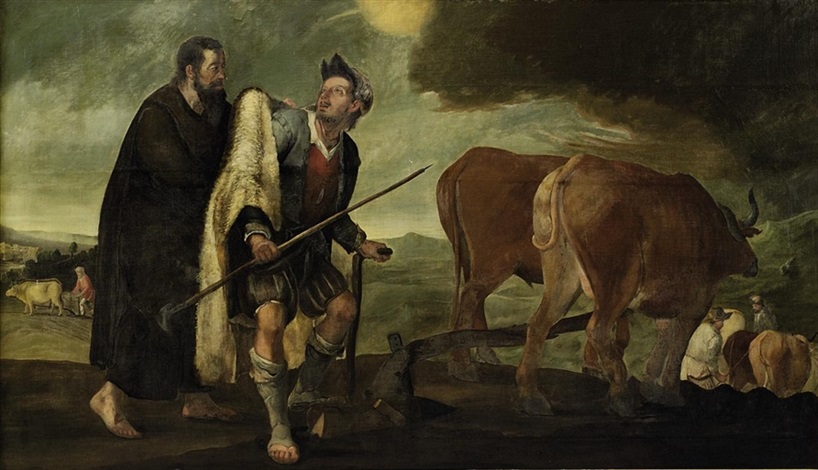
Elijah and Elisha by Abraham Bloemaert on artnet
Elijah and Elisha by Circle of Abraham Bloemaert (b. ca. 1564–1651)

“It is necessary that you conceive a true contempt of yourself if you want to triumph over flesh and blood.” (IC 3,13,1) | “It is better for you to lose one of your members than to have your whole body thrown into Gehenna.” (Mt 5:29b)

|The Imitation of Christ by Thomas à Kempis, Book III Chapter XIII: ”The Obedience of a Humble Subject Following the Example of Jesus Christ” (first entry)

While this chapter deals specifically with the proper attitude toward and relationship with an earthly religious superior, it applies to us all, since there is no one who doesn’t have a heavenly religious superior: Jesus. Radical humility. perfect obedience, and detachment from the world are keys to assuming the role of a simple sister or brother in Christ. In the passage above, Kempis emphasizes the need to keep the flesh in line in order to do our God-given duties well.

|Today’s Gospel reading: Mt 5:27-32

The Sermon on the Mount continues with a stern warning from Jesus:regarding adultery: it is not simply the physical act that incurs guilt, but even looking lustfully at another or committing other indecent acts convicts one as well. The penalty for obstinate sin: Gehenna (Hell); if necessary. one must take drastic measures to put the flesh into submission, as the headline states. In this chapter, the Lord takes the opportunity to more broadly apply the precepts of the Law, looking not just at outward actions but also what is in the heart and mind.

|Reflection

If we do not have “true contempt” of ourselves, it can be very difficult to avoid the lure of temptation to sin and impurity that we find, in our concupiscence, immensely appealing. Now Jesus does not mean that we should mutilate ourselves physically (He is using classic overstatement to drill in a point); rather, He wants to clearly and emphatically raise awareness of the scourge of sin in our lives, and the seriousness with which we must deal with it. One unrepented mortal sin cuts off a person from God for all eternity. Mortifying ourselves here and now and maintaining constant vigilance of the lure of “flesh and blood” help to keep us on the straight and narrow, give us the ultimate freedom, and prepare us for eternal bliss.

“[H]old that you have found peace, when you are exercised by various tribulations and tried in many adversities” (IC 3,12,2) | “[Barnabas] rejoiced and encouraged them all to remain faithful to the Lord in firmness of heart” (Acts 11:23)

|The Imitation of Christ by Thomas à Kempis, Book III Chapter XII: ”Of Learning to Acquire Patience and to Fight Against Concupiscence” (third entry)

Why be at peace in difficulties? Kempis’s Christ goes on to say.that one should “try willingly to bear present evils for God’s love.” If God permits it, that should be good enough for us. How will our faith be strengthened if not exercised by trials? Better than we bear with these well in this life than handle them poorly and pay for our complaints in the next.

|Today’s first reading: Acts 11:21b-26; 13:1-3

Barnabas was a powerful evangelist who brought many persons to Christian faith. Here he encourages the flock in Antioch. We are told “he was a good man, filled with the Holy Spirit and faith.” He then goes to Tarsus to bring Paul back and they stay on a year teaching the people of Antioch where the adherents to this new sect were first called Christians. It goes on to say that the Holy Spirit later set aside Paul and Barnabas for special work.

|Reflection

Barnabas knew that these new Christians were going to face tribulations and adversities, sooner rather than later, due to their newfound faith, thus he encourages them to stay resolute in the Lord. They will need to come to terms with that and find peace despite the turmoil sure to come.

Can we vow to hold this conviction as well? When things go badly, when the whole world seems to be crashing around us, whether in the culture or in our personal lives, are we able to confidently declare that God is in control and find true peace in that reality? It can be difficult. This is why we must draw ever closer to God through prayer, Scripture, and the sacraments. We need the sustaining power of grace to help us and guide us through all of the challenges of this life. Let us end by contemplating two powerful statements:

God, grant me the serenity to accept the things I cannot change,
courage to change the things I can,
and wisdom to know the difference. — Reinhold Niebuhr (1892-1971)

Fear is useless; what is needed is trust. (Mark 5:36)

Jacob Jordaens, detail of �Apostles Paul and Barnabas in Lystra� (1645), oil on canvas, Akademie der bildenden Künste, Vienna.
Apostles Paul and Barnabas in Lystra (detail) (1645) by Jacob Jordaens

“[F]or a small delight in this passing life, [men] incur the death of their soul.” (IC 3,12,4) | “[W]hoever breaks one of the least of these commandments and teaches others to do so will be called least in the Kingdom of heaven.” (Mt 5:19a)

|The Imitation of Christ by Thomas à Kempis, Book III Chapter XII: ”Of Learning to Acquire Patience and to Fight Against Concupiscence” (second entry)

Kempis’s Christ admonishes the disciple to turn from drunkenness, blindness, lust, and carnal pleasures toward the Lord by delighting in Him and doing His will.

|Today’s Gospel reading: Mt 5:17-19

The Sermon on the Mount continues with this pithy selection. Jesus urges His listeners to keep the commandments and to encourage others to do the same. Failure to do so causes a great diminishment in one’s status in the next life.

|Reflection

Jesus speaks of “the least of these commandments” when addressing the crowd. Disobeying God’s law in even minor matters is wrong and offensive to Him, and it is made worse by actively encouraging others to do the same or by causing scandal just by example. Such a “small delight,” as Kempis puts it, is not worth the price of one’s soul. Yes, Jesus says that the person breaking a least commandment still may gain the Kingdom. But we know that for the unrepentant mortal sinner, such grave matter will “incur the death of their soul” and put others in danger of the same fate by involving them in the transgression or encouraging them to follow your lead.

Our call is to build up the Kingdom here on earth. Our example in word and deed indicates how important we consider this calling of ours. May we be ever vigilant to eschew sin and encourage others to do the same. Consider the words of Jesus that came immediately before today’s reading:

[Y]our light must shine before others, that they may see your good deeds and glorify your heavenly Father. (Mt 5:16)

“It is just what they deserve: that they who inordinately seek and follow pleasures, should not enjoy them without confusion and bitterness.” (IC 3,12,3) | “Men of rank, how long will you be dull of heart? Why do you love what is vain and seek after falsehood?” (Ps 4:3)

|The Imitation of Christ by Thomas à Kempis, Book III Chapter XII: ”Of Learning to Acquire Patience and to Fight Against Concupiscence” (first entry)

In this chapter, Kempis has Christ advising the disciple on patience in adversity. The Lord does not wish to take away our challenges and difficulties but wants us to grow spiritually stronger through them so we can endure the trials of this life and even the fires of Purgatory that may await us in the next life. In the quote above, Christ tells of what befalls the worldly person who may seem to have it easy but ultimately finds no peace in the passing fancies of this life.

|Today’s Responsorial Psalm: Ps 4:2-3, 4-5, 7B-8

This short song has the Psalmist imploring God’s help in times of trouble while urging God’s people to repent of sin. This is the formula for peace of heart — not vanity and lies.

|Reflection

Is it not so often the case that those possessions or activities that we think will satisfy us, ultimately do not? Yes! we finally got that fancy automobile for which we have been working long and hard. But it still just gets us from point A to point B. Beside, my neighbor just got a newer, better model — blast him! Or what of the lottery winner who becomes miserable due to all the unwanted fame, unending requests, and foolish investments; more than a few have committed suicide ultimately. The examples are countless. St. Augustine had it right:

Our hearts are restless until they rest in thee, O God.

Of course “confusion and bitterness” are the result when “you love what is vain and seek after falsehood.” When the focus is on satisfying ourselves in this mortal coil, we do not have peace. We are bound to wonder, “Is this all there is to life?” The lie that, “It’s all about number one” is quickly dispelled in our drive for “stuff.” How many family members, friends, colleagues, clients, neighbors, citizens, are to be ground underfoot due to a pursuit of the “golden goose”?

We are warned of a self-centered, worldly perspective in Scripture:

They exchanged the truth of God for a lie and revered and worshiped the creature rather than the creator (Rom 1:25)

From God alone comes the fullness of truth. God is Truth. May our worship be of Him alone and reverence of Him be above all else. May we never set Him aside for anything in the world.

Christ and the Rich Young Ruler (1889) by Heinrich Hofmann

“[T]o not murmur at any adversity whatsover.” (IC 3,11,5) | “Blessed are you when they insult you and persecute you and utter every kind of evil against you falsely because of me. Rejoice and be glad, for your reward will be great in heaven.” (Mt 5:11-12a)

|The Imitation of Christ by Thomas à Kempis, Book III Chapter XI: ”How We Must Examine and Moderate the Desires of Our Heart” (third entry)

Kempis closes this chapter on moderating the desires of our heart with the words above. Fitting it is since our tendency is to become annoyed and voice complaint when things don’t go precisely they way we want them to, often in the most minor matters. By controlling these earthly, passing desires, we mortify ourselves and become more open to the Lord’s voice and more like Jesus in humility in order to face much more significant adversities as we ought.

|Today’s First Reading: Mt 5:1-12

Today begins our slow and steady journey through the Sermon on the Mount, beginning with the famous Beatitudes. Jesus sure knows how to get a crowd’s attention when beginning to teach. All the points He makes are challenging to bear with or live out, particularly the final one which, after being stated, is emphasized in the quote above. The people must have been astonished in this heretofore unheard of program from a man of God. There must have been a lot of mouths agape and glances shot as Jesus fired off each blessing. Undoubtedly His listeners were eager to find out where He was going with all of this. We will find out in the coming days.

|Reflection

This long slate of blessings in the Beatitudes come when we persevere through sadness, difficulties, and challenges, keeping our eyes on the ultimate goal: union with God in His Kingdom. Whether or not we receive material benefits or even spiritual comfort from doing what is right, we know that through our faithfulness, we will be rewarded.

By not “murmuring” at the little personal adversities we work on steeling ourselves against the greater insults, persecutions, and calumnies that are sure to come when we boldly live the Christian life in word and action. Kempis is wise to emphasize, time and again, self-discipline. As much as the wiles of the enemy can hurt, whether in mind, body, or spirit, we know that if we faithfully defend Christ, we are on the right side of (salvation) history. Take courage!

What then shall we say to this? If God is for us, who can be against us? He who did not spare his own Son but handed him over for us all, how will he not also give us everything else along with him? Who will bring a charge against God’s chosen ones? It is God who acquits us. Who will condemn? It is Christ [Jesus] who died, rather, was raised, who also is at the right hand of God, who indeed intercedes for us. What will separate us from the love of Christ? Will anguish, or distress, or persecution, or famine, or nakedness, or peril, or the sword? As it is written:

“For your sake we are being slain all the day; we are looked upon as sheep to be slaughtered.”

No, in all these things we conquer overwhelmingly through him who loved us. For I am convinced that neither death, nor life, nor angels, nor principalities, nor present things, nor future things, nor powers, nor height, nor depth, nor any other creature will be able to separate us from the love of God in Christ Jesus our Lord. (Rom 8:31-39)

Christian preacher Phillip Blair of Torch of Christ confronted by ...

“[T]otally conform your desires to My good pleasure, and…be not a lover of yourself, but the fervent executor of My will.” (IC 3,11,3) | “Whoever believes in him will not be condemned, but whoever does not believe has already been condemned” (Jn 3:18)

|The Imitation of Christ by Thomas à Kempis, Book III Chapter XI: ”How We Must Examine and Moderate the Desires of Our Heart” (second entry)

Kempis has Christ begin with these words as He tells the disciple that “you still have to learn many things, which you have not yet learned well.” Focusing on Jesus and His will for us covers it. Total conformity to God’s will takes care of everything if we can attain it. As the rest of the chapter tells us, as if we need any outside source to raise awareness of this, it is not easy to overcome fallen desires that conflict with the Lord’s designs.

|Today’s First Reading: Jn 3:16-18

Today we hear the famous John 3:16 verse (made prominent at many football games). Jesus goes on to expound upon this message, with the follow-up declaration to Nicodemus in the headline. In this short reading we have Jesus declaring Himself the Son of God and the only Savior of the world. Belief in Him is required for salvation.

|Reflection

The reason I put these Kempis and John quotes together is to emphasize a point that I never tire of making because I believe it is much misunderstood, even in certain Christian circles. “Belief” in Christ is not merely a verbal, emotional, or even intellectual, assent; all these are good as far as they go, but they are insufficient. True belief does not stoop to an “easy-believism” (that is, I can’t lose my salvation no matter how I behave now that I have declared allegiance to Jesus). No, we are required to conform our hearts and minds to God and live this out accordingly. Paul’s words to the Romans are instructive:

Do not conform yourselves to this age but be transformed by the renewal of your mind, that you may discern what is the will of God, what is good and pleasing and perfect. (Rom 12:2)

I hear a lot of Kempis in this important passage. I also hear a lot of Jesus here (see Mt 5:48 for starters).

“Belief” requires a radical change from our fallen desires that constantly tempt us away from God. The world, the flesh, and the devil are powerful forces (see Eph 2:1-3; some also see these challenges in the Parable of the Sower in vv. 4-7). But they don’t stand a chance against grace. Grace does not necessarily make conforming to God’s will, and ultimately salvation, easy. But it does make it possible (see Mt 19:26 and 2 Cor 12:9).

Let us pray daily that the Father and Son send the Holy Spirit to dispense the graces that we would be lost without to aid us in our struggles to meet His demanding standards..

File:Henry Ossawa Tanner - Nicodemus coming to Christ.jpg
Nicodemus coming to Christ (between 1924-1927) by Henry Ossawa Tanner

“If you are inspired by Me, you will find yourself contented in any manner I shall dispose; but if your self-interest enters in, behold, this is that which hinders you and burdens you.” (IC 3,11,3) | “[B]e persistent whether it is convenient or inconvenient” (2 Tim 4:2a)

|The Imitation of Christ by Thomas à Kempis, Book III Chapter XI: ”How We Must Examine and Moderate the Desires of Our Heart” (first entry)

Kempis spends this entire short chapter speaking of the need to moderate our own desires in favor of God’s will for us. In today’s key quote from this chapter, the author has Christ telling the disciple that self-interest must not trump what He desires of us. Focusing on self only leads to distraction, scandal, and losing heart.

|Today’s First Reading: 2 Tm 4:1-8

Today we continue to read Paul’s instruction to his disciple Timothy. The Apostle urges him to be persistent in his ministry even thought it will be challenging, since “people will not tolerate sound doctrine…and will stop listening to the truth.” Paul concludes by saying that his time on this earth is just about up (“I have competed well; I have finished the race; I have kept the faith”).

|Reflection

Paul’s encouragement to the disciple to be persistent in ministry (and all the baptized have a God-given ministry) “whether convenient or inconvenient” bolsters the point Kempis’s Christ is making. Self-interest will often render giving Christian witness in word and deed “inconvenient” in a world where “people will not tolerate sound doctrine…and will stop listening to the truth” (also see Rom 1:25). What will people think? Do I really want to make waves? Is it worth the risk? Can I deal with the backlash sure to come?

Well, being “convenient” was not a hallmark of Jesus’ ministry. He made plenty of people uncomfortable — that double-edged sword can cut deep in the most sensitive areas (see Heb 4;12). Sometimes (often?) it was tough love. But it was out of love that Jesus taught what He taught, lived how He lived, and died how He died. St. Augustine is helpful here:

Once for all, then, a short precept is given thee: Love, and do what thou wilt: whether thou hold thy peace, through love hold thy peace; whether thou cry out, through love cry out; whether thou correct, through love correct; whether thou spare, through love do thou spare: let the root of love be within, of this root can nothing spring but what is good. (Seventh Homily on 1 John 4:4-12 [#8])

So, with the Doctor of Grace, let us always remember that Love comes first. If we love with the love of God, then all we do will be in accord with His will. “whether it is convenient or inconvenient” for our worldly status.

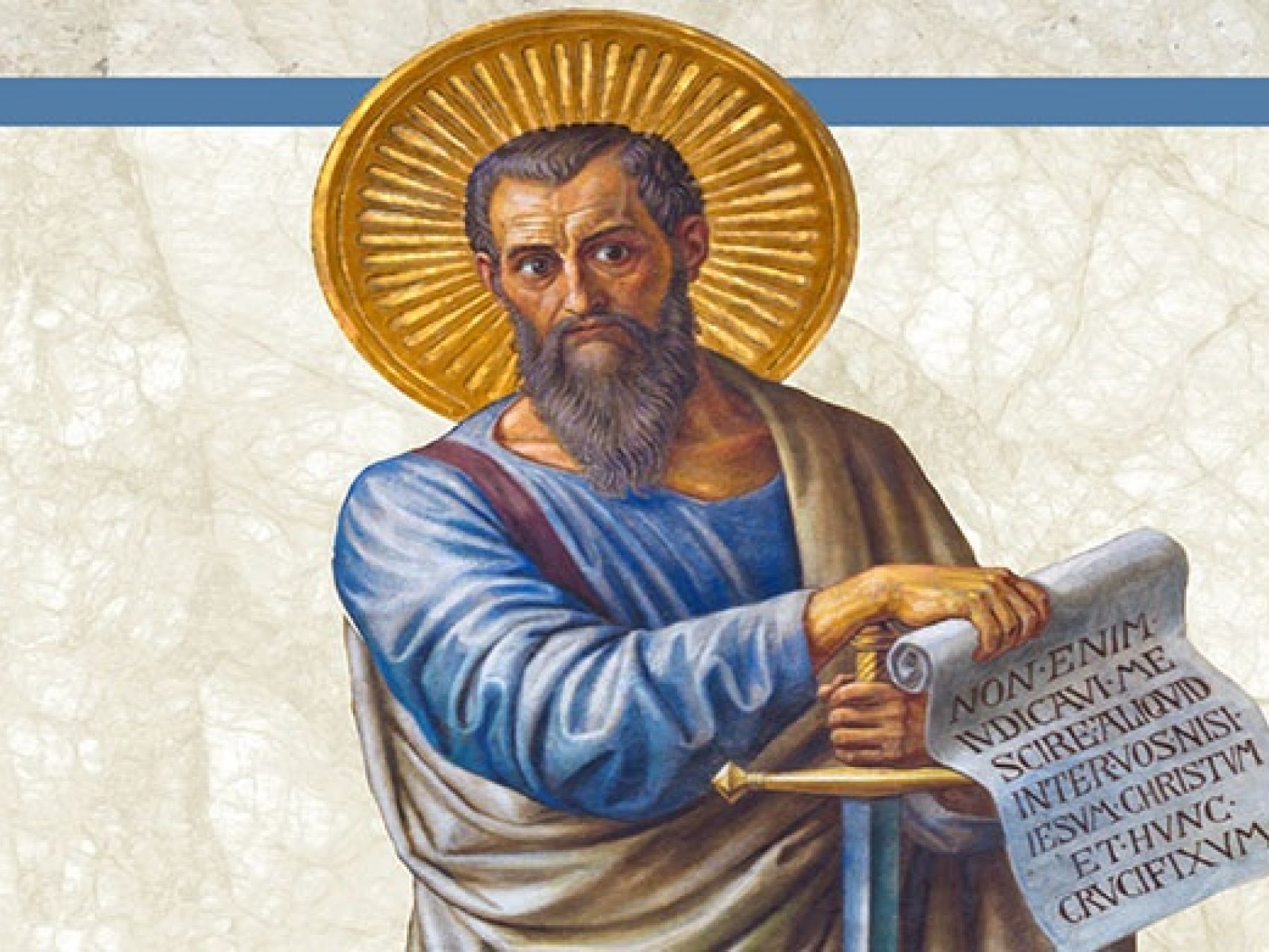
Painting : "St. Timothy" (Original art by Brenda J. Fox )
St. Timothy (contemporary) by Brenda J. Fox

“O service worthy of being embraced and desired, by which one merits the supreme good and acquires the joy that will never end.” (IC 3,10,6) | “You have followed my teaching, way of life, purpose, faith, patience, love, endurance, persecutions, and sufferings … Yet from all these things the Lord delivered me.” (2 Tim 3:10-11)

|The Imitation of Christ by Thomas à Kempis, Book III Chapter X: ”How it is Sweet to Serve God by Despising the World” (fourth entry)

Kempis closes this chapter on the sweetness of serving God with the fitting words above. This way of life that he exalts, when followed faithfully, leads to “the joy that will never end.” Thus, he espouses here, as he has many times before, despising worldly things in order to gain heavenly glory.

|Today’s First Reading: 2 Tm 3:10-17

We once again dip into Paul’s words to Timothy where he again encourages faithfulness through trials (he lists his experiences above) so that they will be delivered as he has been. He also warns of the machinations of those who are out to deceive the people of God. Then he goes on to famously convey the importance of the knowledge of Scripture that is “for teaching, for refutation, for correction, and for training in righteousness.”

|Reflection

The good Lord promised that faithfulness and discipleship will come with trials and suffering. He also promised that those who endure till the end will be eternally rewarded. So, while Kempis looks forward to the “supreme good” and “joy that will never end,” he makes no bones often throughout the book about the challenges that come with attaining this end. The emphasis, though, is that this glorious outcome far outweighs even the worst that this life can throw at us. We are here for just a moment in the timelessness of eternity, yet our everlasting fate depends on how we use that moment. Paul asks his friends to call to mind how he spent his moment in his: “teaching, way of life, purpose, faith, patience, love, endurance, persecutions, and sufferings.” Through insatiable zeal and patient endurance he can say that from the persecutions “the Lord delivered me.” We need to have this same confidence that we will be delivered by Jesus in this life and in the next if we endure in faith, hope, and love.