Lent Day 43: Annihilation is preferable

TODAY’S READINGS

Today’s Gospel reading (Mt 26:14-25) again has us at the table with Jesus and His Apostles at the Last Supper. The focus again is on the betrayer, Judas, on the day we call in his “honor,” Spy Wednesday. Jesus says of the traitor:

“The Son of Man indeed goes, as it is written of him,
but woe to that man by whom the Son of Man is betrayed.
It would be better for that man if he had never been born.”
(v. 24)

“Jesus is referring to the fact that he will give himself up freely to suffering and death. In so doing he would fulfill the will of God, as proclaimed centuries before (cf. Ps 41:10; Is 53:7). Although our Lord goes to his death voluntarily, this does not reduce the seriousness of Judas’ treachery.” (The Navarre Bible: St Matthew, 219)

“Instead of identifying the man, Jesus warns of the dreadful fate that the betrayer is choosing for himself. For what is about to transpire is a concurrence of divine will and human decision. The destiny of the Son of Man is determined by God and announced in the writings of the Old Testament. But the actions of the “man by whom the Son of Man is betrayed” are fully and freely his own. Judas is not a puppet with someone else pulling the strings. He has chosen to misuse his free will, and should he follow through with this treachery, he will come to wish “he had never been born.” (The Gospel of Matthew [Catholic Commentary on Sacred Scripture], 335)

“Jesus does not spell out what fate awaits [Judas] but indicates that it will be horrible…Jesus is now giving Judas a last-minute warning. Even though Jesus knows what will happen, Judas is nevertheless free to change his mind and take a different course.” (Bringing the Gospel of Matthew to Life, 578)

While the Church canonizes many persons as saints, it never declares anyone definitively in Hell. This spurs many conversations regarding the population of Hell. But the verse under consideration has long convinced me that there is one inhabitant of Gehenna (and I think, many, many more). The only persons who could possibly wish they’d never been born must be those in Hell. Heaven is what we were made for. Hell is the complete, utter, total, and permanent state of existing where we were never meant to be (remember: God desires all men to be saved [1 Tim 2:4]). I imagine souls in Hell cursing God, cursing their parents, and wishing they had never come into existence while knowing they can never go out of existence.

God forbid that any of us hear the words said to Judas being said to us on our judgment day because we betrayed our Savior

A wonderful talk supporting (and, frankly, influencing) my position on Judas’ ultimate fate can be found here.

Judas Iscariot, Saint Peter, John the Apostle, The Last Supper (c. 1520) by Giampietrino
after Leonardo da Vinci

God bless.

Lent Day 42: Judas at night

TODAY’S READINGS

Today’s Gospel reading (Jn 13:21-33, 36-38) puts us at the table with Jesus and His Apostles at the Last Supper. Judas, the traitor, rears his ugly head at the distribution of the Eucharist.

So Judas took the morsel and left at once. And it was night. (v. 30)

“Judas goes out into the darkness, turning away from the light of the world (8:12). Earlier in his Gospel the author observed that ‘the light came into the world, but people preferred darkness to light, because their works were evil’ (3:19). Judas chose darkness.” (Bringing the Gospel of John to Life, 396)

“The indication that ‘it was night’ is not just a reference to the time of day but to darkness as an image of sin, an image of the powers of darkness whose hour was beginning at that very moment (cf. Lk 22:53). The contrast between light and darkness, the opposition of good and evil, is frequently met with in the Bible, especially in the Fourth Gospel: even in the prologue we are told that Christ is the true Light and the darkness has not overcome it (cf. Jn 1:5).” (The Navarre Bible: St John, 180)

A cowardly act from a cowardly man. He had problems with Jesus at least going back to the Bread of Life discourse (Jn 6:70-71), but did not have the guts to leave then or anytime else before this sacred moment. His receiving the Eucharist in a state of grave sin did not sanctify Him but made him more prone to the devil’s wiles. Maybe he believed the dark obscures him from God, but the light of the Lord overpowers not only physical darkness but spiritual darkness — but Judas did not allow it to move him. This soon leads to despair and suicide. With repentance in his heart who could have witnessed the Resurrection, yet he chose eternal death. A stark example for all times and places on how not to treat the Lord

Judas Leaves the Cenacle (Judas quitte le Cénacle) (1886-1894) by James Tissot

God bless.

Lent Day 41: The poor and Jesus

TODAY’S READINGS

Today’s Gospel reading (Jn 12:1-11) continues our journey through John as we near the time of the Last Supper. Famously, Mary, the sister of Lazarus and Martha, slathers Jesus feet with costly perfume. Judas objects and Jesus responds :

Jesus said, “Leave her alone.
Let her keep this for the day of my burial.
You always have the poor with you, but you do not always have me.”
(vv. 7-8)

The poor: Jesus is not indifferent toward the poor. Elsewhere he promotes almsgiving in no uncertain terms (Mt 6:2–4; Lk 6:30; 12:33). ● The words of Jesus echo the words of Deut 15:11, which states that the unceasing presence of the poor offers countless opportunities to give generously to less fortunate neighbors. The disciples, too, will have plenty of chances to give alms, but only a brief time remains to be generous toward Jesus while he remains among them (CCC 2449).” (The Gospel of John [Ignatius Catholic Study Bible], 41)

“Jesus takes priority over every other concern — and little time remains before his mortal life ends.” (The Gospel of John [Catholic Commentary on Sacred Scripture] ,218)

“A literal translation of Jesus’ words is, ‘in order that she may keep it for the day of preparation for my burial,’ with ‘in order that’ indicating purpose. The interpretation which makes the most sense is that the purpose of the nard was that it was to be kept for the day of preparation for Jesus’ burial, which was that very day…Mary has symbolically prepared the body of Jesus for burial. anointing it as a corpse was anointed before being buried. Jesus does not say that Mary understood this deeper significance of her act; she may have simply anointed him out of love and gratitude. But Jesus knows that the hour for his going to his father is near. His raising of Lazarus to life — the cause of Mary’s gratitude — means that he lives under a sentence of death (11:53). Mary’s anointing has prepared him for the sentence being carried out.” (Bringing the Gospel of John to Life, 347)

What strikes me first and foremost about this passage is that, while true that Jesus will soon be dead, buried, rise, and ascend, He is still with us. Of course, He remains with us in a real and substantial way in the Eucharist. But that’s not the only way. Here’s Mother Teresa tying together the Eucharist and the poor:

“If we recognize [Jesus] under the appearance of bread, we will have no difficulty recognizing him in the disguise of the suffering poor.” (see article here)

Which invokes Jesus’ own words about the downtrodden, that He spoke immediately before the woman anoints His feet in Matthew, and how we should view them:

“For I was hungry and you gave me food, I was thirsty and you gave me drink, a stranger and you welcomed me, naked and you clothed me, ill and you cared for me, in prison and you visited me.” (Mt 26:35-36)

Yes, Jesus left us in the familiar form the apostles came to know. But He invites us to see Him and serve Him in everyone we meet, particularly the poor. Being faithful in this way we prepare ourselves for the day of our burial.

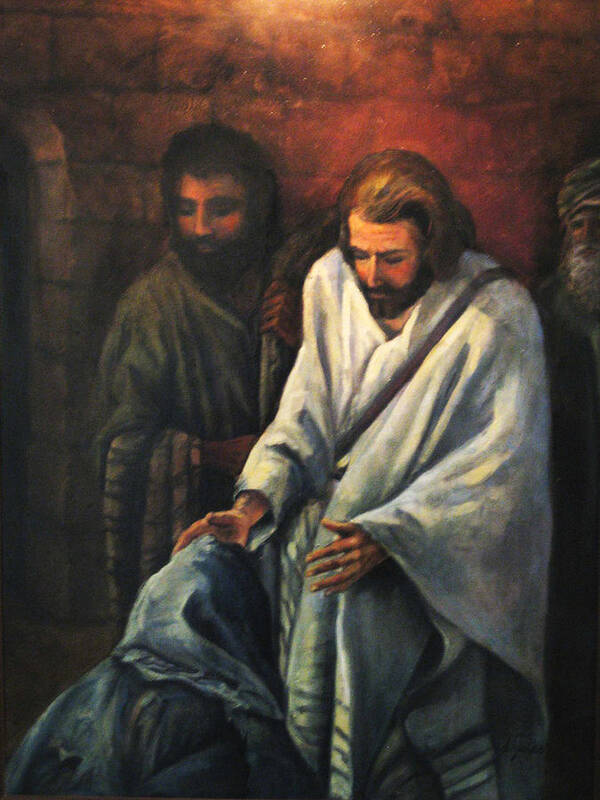
Jesus Healing Beggar (2011) by Donna Tucker

God bless.

Lent Day 40: Speaking, listening, enduring, persevering

TODAY’S READINGS

Today’s Old Testament reading (Is 50:4-7), as we begin Holy Week is Isaiah’s third servant song, vividly prophesying what the future Messiah would endure. The commentary following deals with the entire reading and beyond (through v. 11). The passage starts off this way:

The Lord GOD has given me
a well-trained tongue…”

“The third ‘Servant Song’ in Isaiah. Here the Servant is a prophet who speaks God’s word, even as he suffers at the hands of his persecutors. Again, he represents the people of Israel and yet is distinct from them: unlike Israel in exile, whose ‘ear has not been opened’ and who continues to be a ‘rebel’ ()48:8), the servant says that ‘God has opened my ear, and I was not rebellious (50:5).

“Christian tradition sees these verses fulfilled in the Passion of Jesus…When the savior was struck, he endured it patiently; when he was reviled, he did not revile; when he suffered, he did not threaten. Instead, he gave his back to those who beat him, his cheeks to their blows, and his face he did not turn from their spitting. Finally, he accepted death, giving us an image of virtue and an example for conducting ourselves (St. Athanasius of Alexandria, Festal Epistles 10, 7).” (Isaiah [Ignatius Catholic Study Bible], 87-88)

This short passage is a wonderful model for the evangelist (that should be all of us). The Lord gives each of us certain talents.to “rouse” the weary (including us, if applicable) from a slumber of indifference, doubt, despair, or unbelief. We are to listen daily for God’s voice, that our hearts will be moved and our mission will be clear (dialogue with God in prayer and by reading Scripture to hear Him speaking to you and to help train that tongue).

In responding to the Lord’s call in this way, we can count on persecution. Maybe not physically, as Isaiah has it, but certainly psychologically and emotionally. Do we humbly and patiently endure the blows, the slaps, the shame, the spitting that come our way? If we are like Christ (and no servant is greater than his Master then we may well find it necessary to deal with all these difficulties and more.

Our response? We are to be resolute in being convicted of the truth and making sure that we persevere in spreading it far and wide. Counting on the Lord God to help us, as he promises, we will not be put to shame with the One who matters, despite what the world thinks. Jesus constantly has us looking above and beyond this mortal coil for true fulfillment and happiness. We can count on it for eternity if we stay faithful.

Let us then go to him outside the camp, bearing the reproach that he bore.
For here we have no lasting city, but we seek the one that is to come.
(Heb 13:13-14)

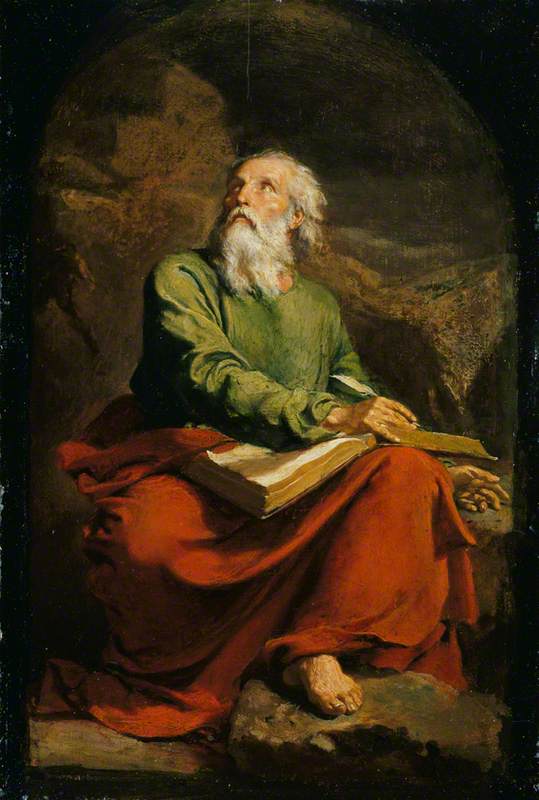
Isaiah (1838) by Jean Louis Ernest Meissonier

God bless.

Lent Day 39: None for one and one for all

TODAY’S READINGS

Today’s Gospel reading (Jn 11:45-56), coming immediately after the astonishing event of Jesus resuscitating Lazarus, shows the extremely heightened concerns of the Jewish religious leaders about Jesus and His popularity are significantly ramping up, so much so that the whole Sanhedrin convenes to discuss what to do about the situation. The high priest, Caiaphas, speaks:

“You know nothing,
nor do you consider that it is better for you
that one man should die instead of the people,
so that the whole nation may not perish.”
(vv. 49-50)

“Caiaphas unwittingly announces that Jesus will die for the salvation of the nation. This is not his own insight, but the grace of prophecy speaking through him in virtue of his priestly office and position as chief teacher of Israel.” (The Gospel of John [Ignatius Catholic Study Bible], 40)

“Here Caiaphas’ words have a dual meaning: one, Caiaphas’ meaning, is that he wants to put Christ to death, on the pretext that that will ensure the political peace and survival of Israel; the other, the meaning intended by the Holy Spirit, is the announcement of the foundation of the new Israel, the Church, through the death of Christ on the cross (Caiaphas is unaware of this meaning). And so it happens that the last high priest of the Old Alliance prophesies the investiture of the High Priest of the New Alliance, which will be sealed in his own blood.” (The Navarre Bible: St John. 160)

Caiaphas did not realize the half of it. In his position as high priest, given to him by God, he could declare prophetic utterances, even if he did not understand their full import. Recall Jesus saying:

Therefore, do and observe all things whatsoever they tell you, but do not follow their example. (Mt 23:3b)

I wonder if Caiaphas realized how soon they would meet again (see Jn 18:14, 24, 28) and how he will be instrumental in seeing through his prophetic words (Mt 26: 57-68).

Yes, one man would die for the nation…and all nations and peoples for all time. Even a despicable man like this high priest can be used by God for good (Friday).

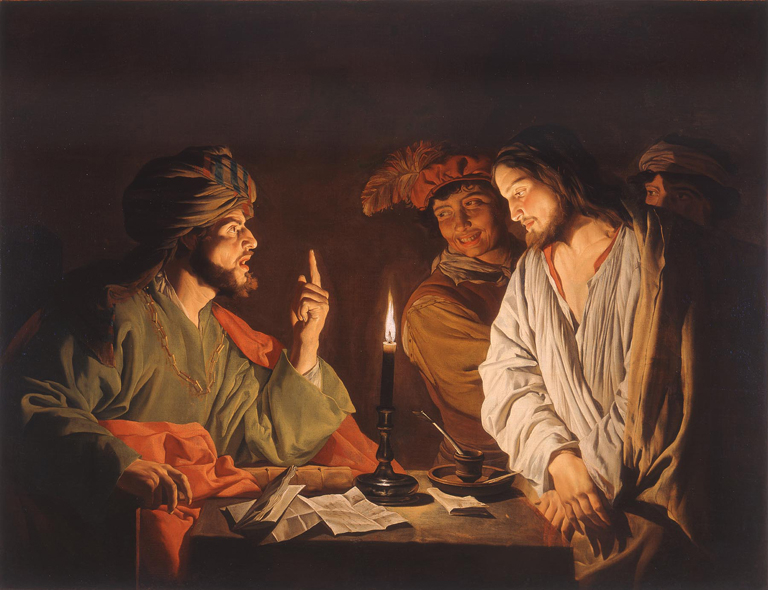
Christ Before Caiaphas (1630) by Matthias Stom

God bless.

Lent Day 38: “You are gods”

TODAY’S READINGS

Today’s Gospel reading (Jn 10:31-42) continues Jesus ongoing contentious interaction with with the Jewish religious leaders. They wish to kill Him:

“The Jews answered him,
“We are not stoning you for a good work but for blasphemy.
You, a man, are making yourself God.”
Jesus answered them,
“Is it not written in your law, ‘I said, ‘You are gods”‘?
If it calls them gods to whom the word of God came,
and Scripture cannot be set aside,
can you say that the one
whom the Father has consecrated and sent into the world
blasphemes because I said, ‘I am the Son of God’?
(vv. 33-36)

your law: Sometimes this expression refers to the OT in general and not just to the Pentateuch (12:34; 15:25; 1 Cor 14:34). I said, you are gods: A citation from Ps 82:6. ● The psalm is a prayer for Yahweh to punish the corrupt shepherds of Israel. These leaders, who are charged with teaching and enforcing divine Law, are called ‘gods’ by the Psalmist because of the divine authority they wield over the people. The abuse of this power makes their corruption all the more insidious. Jesus reasons that if sinful authorities are given a divine title because of their duties, how much more is he entitled to it who is guiltless and who speaks the words of God (8:45–47).
Scripture cannot be nullified: Three implications can be drawn from this statement. (1) Scripture cannot be set aside, since its teaching is as trustworthy and true as God himself (17:17). (2) The OT, represented in this context by a psalm, has permanent authority even under the New Covenant (Mt 5:17). (3) The authority of Scripture extends even to individual words, as in this context where Jesus’ whole argument rests on the import of a single word (‘gods’) from Ps 82:6.
“consecrated: The Greek means to be ‘sanctified’ or ‘set apart as holy’. Christ is set apart by the Father to consecrate the world in truth (17:19). ● Jesus’ words resonate against the background of the Feast of the Dedication, which celebrates the consecration of the Second Temple by the Maccabees (1 Mac 4:48), just as its predecessors, the wilderness Tabernacle (Num 7:1) and the Solomonic Temple, had been consecrated (1 Kings 9:3). These sanctuaries of old are replaced by the new and consecrated temple of Jesus’ body (2:20–21).” (The Gospel of John [Ignatius Catholic Study Bible], 38)

I’m just happy to share some wonderful exegesis (above) on this passage that I have long found perplexing. The Jews were not wielding their God-given authority faithfully. The one who comes from God, who is the Son of God, thus God, has the authority and is recognized as such (see Mt 7:28-29 which concludes the Sermon on the Mount).

They wish to kill Him for His declaration “I and the Father are one” (v. 30) It was not His time yet. But His confirmation that He is the Son of God will bring upon Him a death sentence, appropriately, under the cover of darkness (Mt 26:63-66). Less than a day later, He will be dead.

God bless.

Lent Day 37: “I AM”

TODAY’S READINGS

Today’s Gospel reading (Jn 8:51-59) continues Jesus dialogue with the Jewish religious leaders. Jesus makes a startling claim to the Jews inquiry:

“So the Jews said to him…
‘Who do you make yourself out to be?”
Jesus answered,…“Amen, amen, I say to you,
before Abraham came to be, I AM.”
(v. 53b-54a, 58)

“Jesus takes for himself the divine name of Yahweh, ‘I AM’ (Ex 3:14). He thus claims to be one with God (10:30), whose life in eternity has neither beginning nor end. The Pharisees hear this claim loud and clear and, thinking it outrageous, stand ready to stone him for blasphemy (8:59; Lev 24:16) (CCC 590).” (The Gospel of John [Ignatius Catholic Study Bible], 36)

Jesus makes no bones about who He is. It eventually gets Him killed. But He backs up His claim by raising Himself from the dead proving that He is God, having the power over life and death.

Check out this article that does a fine job of running through the many times Jesus uses “I am” to refer to Himself. We hearken back to the burning bush episode (Ex 3) when Moses asks the name of the voice of his interlocutor emanating from this wondrous site.

Are you a believer? I am.

God bless.

Lent Day 36: What is truth? And can you handle it?

TODAY’S READINGS

Today’s Gospel reading (Jn 8:31-42) continues Jesus dialogue with the Jewish religious leaders. It begins this way:

“If you remain in my word, you will truly be my disciples,
and you will know the truth, and the truth will set you free.”
(vv. 31b-32)

“Jesus embodies divine truth (14:6) and has come to bear witness to the truth (18:37). Acceptance of him liberates us from the slavery of sin, ignorance, and deception (8:12; CCC 2466).” (The Gospel of John [Ignatius Catholic Study Bible], 34)

“In Jesus Christ, the whole of God’s truth has been made manifest. ‘Full of grace and truth,’ he came as the ‘light of the world,’ he is the Truth. ‘Whoever believes in me may not remain in darkness.’ The disciple of Jesus continues in his word so as to know ‘the truth [that] will make you free’ and that sanctifies. To follow Jesus is to live in ‘the Spirit of truth,’ whom the Father sends in his name and who leads ‘into all the truth.’ To his disciples Jesus teaches the unconditional love of truth: ‘Let what you say be simply “Yes or No.”” (CCC 2466)

“The knowledge of the truth which Christ is speaking about is not just intellectual knowledge; it is rather the maturing in the soul of the seed of divine Revelation. That Revelation’s climax is to be found in Christ’s teaching, and it constitutes a genuine communication of supernatural life (cf. Jn 5;24): he who believes in Jesus, and through him in the Father, receives the wonderful gift of eternal life. Knowing the truth is, in the last analysis, knowing Christ himself, God become man to save us; it means realizing that the inaccessible God has become man, our Friend, our Life.

“This is the only kind of knowledge which really sets us free, because it removes us from a position of alienation from God — the state of sin and therefore of slavery to the devil and to all the attachments of our fallen nature — and puts us on the path of friendship with God, the path of grace, of the Kingdom of God. Therefore, the liberation we obtain is not just light which shows the way; it is grace, which empowers us to keep to that way despite our limitations.” (The Navarre Bible: St John, 127-28)

“[N]otice how Jesus says that human freedom follows upon and presupposes knowledge of the truth. In order to be truly free, a person must first know what is true.” (The Gospel of John [Catholic Commentary on Sacred Scripture] , 161)

Two lines come to mind, as I reflect on the highlighted verses of this passage:

1. “What is truth?” (Jn 18:38)

Pilate’s famous words while looking Truth right in the eyes. Echoed today by seemingly millions. Can we really know the truth? Cardinal Ratzinger bemoaned the “dictatorship of relativism” today. Most clear thinking folks nodded their heads in agreement in that homily nearly twenty years ago. Not so many folks would have believed that it didn’t even take twenty years till concepts like “mother,” “marriage,” and “gender” were up for grabs. This twisting of truth and reality itself is the work of the devil, as Jesus tells the Pharisees a little further on in the same interaction we heard proclaimed today:

“You belong to your father the devil and you willingly carry out your father’s desires. He was a murderer from the beginning and does not stand in truth, because there is no truth in him. When he tells a lie, he speaks in character, because he is a liar and the father of lies.” (Jn 8:44)

And what does Satan “inspire” people to do?

They exchanged the truth of God for a lie and revered and worshiped the creature rather than the creator. (Rom 1:25)

Wow. Doesn’t that encapsulate perfectly the state of our world today? With no eternal anchor, the crashing waves of self-focus toss us about. When anything goes, nothing stays firm.

Let us cling to the Rock that is Peter and the Church Christ founded as if our life depended on it (and it does, here and hereafter). A sure “light”house in the stormy weather of our modern confused age.

2. “You can’t handle the truth!” — Col. Nathan R. Jessup

Certainly, the Gospel message is a challenging one. Hearing the truth and living it out can be painful at times. But it is the antidote to what ails us in a time of cultural sickness and even death. It seems that in our day, maybe more than ever, we can’t handle the Truth that is Jesus and His message, preferring “my truth.” To be fully and authentically human, stick with “the Truth.”

God bless.

Lent Day 35: Joseph the Just

TODAY’S READINGS

Today’s Gospel reading (Mt 1:16, 18-21, 24a) gives us the story of Joseph discovering Mary’s pregnancy. Joseph’s initial reaction:

Joseph her husband, since he was a righteous man,
yet unwilling to expose her to shame,
decided to divorce her quietly.
(v. 19)

just: Or, “righteous”. Joseph is a man of sterling moral character, committed to living by the Mosaic Law (Deut 6:25; Lk 1:6).
put her to shame: The Greek verb does not necessarily have a negative connotation. It simply means “to expose” or “to exhibit”.
“send her away: Catholic tradition proposes three main interpretations to explain why Joseph resolved to end his betrothal with Mary:
“(1) The Suspicion Theory. Some hold that Joseph suspected Mary of adultery when he discovered her pregnancy. Joseph thus intended to pursue a divorce in accord with Deut 24:1–4 until the angel revealed to him the miraculous cause of the conception (1:20). Joseph is said to be righteous because he shuns immorality and directs his life by the Law of God. Proponents of this view include St. Justin Martyr,St. John Chrysostom, and St. Augustine.
“(2) The Perplexity Theory. Others hold that Joseph found the situation of Mary’s pregnancy inexplicable. Divorce seemed to be his only option, and yet he wished to do this quietly, for he could not bring himself to believe that Mary had been unfaithful. Joseph is said to be righteous because he lives by the Law of God and judges Mary’s situation with the utmost charity. The main proponent of this view is St. Jerome, whose exegesis was adopted into the notes of the medieval Bible.
“(3) The Reverence Theory. Still others hold that Joseph knew the miraculous cause of Mary’s pregnancy from the beginning, i.e., he was made aware that the child was conceived “of the Holy Spirit” (1:18). Faced with this, Joseph considered himself unworthy to be involved in the Lord’s work, and his decision to separate quietly from Mary was a discretionary measure to keep secret the mystery within her. On this reading, the angel confirms what Joseph had already known and urges him to set aside pious fears that would lead him away from his vocation to be the legal father of the Messiah (1:20). Joseph is said to be righteous because of his deep humility and reverence for the miraculous works of God. Proponents of this view include St. Bernard of Clairvaux and St. Thomas Aquinas.” (The Gospel of Matthew [Ignatius Catholic Study Bible], 18)

It seems to be commonly held that Joseph was suspicious of Mary, or at least confused, but rarely does one hear about the reverence theory. Thus, I wanted to lay out above a concise but clear explanation of each approach. The more I hear about and consider the last one, the more convinced I am that this is the case. Joseph must have known Mary’s character intimately, so ther seems to be no way he could have even conceived of her sinning. Perplexity makes more sense, especially as it is approached by Jerome, but here I suspect Joseph would have had a deeper insight, especially if, as tradition holds, he never committed a personal sin.

Joseph is a great saint. Let us honor him in a special way today for his faithfulness to Mary and her Child. Let us ask his intercession, so that we may we approach that same faithfulness to the Lord and His mother.

MY FAVORITE ST. JOSEPH BOOK

Combines fascinating insights into the man with a beautiful 33-day consecration to him. Check out the website for more info. Pick it up soon so you can start the consecration!

PRAYER FOR A HAPPY DEATH

Who better to pray to for a happy death than Joseph who died with Jesus and Mary assisting him on his final earthly journey? I pray to him often for this cause. Find several prayers here.

ZAGREB, CROATIA – DECEMBER 28: Holy Family, stained glass window in the Parish Church of the Visitation of the Virgin Mary in Zagreb, Croatia on December 28, 2015.

God bless.

Lent Day 34: Forgiving and Challenging Jesus

TODAY’S READINGS

Today’s Gospel reading (Jn 8:1-11) is the famous episode in which Jesus is brought the woman caught in the act of adultery. It ends with consoling words and a warning:

“Has no one condemned you?”
She replied, “No one, sir.”
Then Jesus said, “Neither do I condemn you.
Go, and from now on do not sin any more.”
(vv. 10b-11)

“Jesus, who is the Just One, does not condemn the woman; whereas these people are sinners, yet they pass sentence of death. God’s infinite mercy should move us always to have compassion on those who commit sins, because we ourselves are sinners and in need of God’s forgiveness.” (The Navarre Bible: St John, 122)

“Jesus strikes a balance, being merciful to a sinner while abhorring the sin. He gives the woman an opportunity to make a new start, not condemned for her past and free to behave differently in the future.” (Bringing the Gospel of John to Life, 229)

“Jesus offers this woman a fresh start by turning her away from her sins and opening her up to God’s infinite mercy.” (The Gospel of John [Catholic Commentary on Sacred Scripture], 153)

“Jesus’ attitude is striking: we do not hear words of scorn, we do not hear words of condemnation, but only words of love, of mercy, which are an invitation to conversion. ‘Neither do I condemn you; go, and do not sin again’ (v. 11). Ah! Brothers and Sisters, God’s face is the face of a merciful father who is always patient. Have you thought about God’s patience, the patience he has with each one of us? That is his mercy. He always has patience, patience with us, he understands us, he waits for us, he does not tire of forgiving us if we are able to return to him with a contrite heart.” (Pope Francis, “Angelus,” 17 March 2013)

Imagine the relief of this poor sinner when Jesus saved her life and then showed such mercy! Why had she indulged in this sin? Why did she keep indulging in it (I’m guessing her indiscretion was widely known since the Pharisees conveniently found her in the act in order to try to trap Jesus). She was being used twice: first by her illicit lover, then by the Pharisees. Now she escapes the death sentence scot-free. But wait. The ongoing condition is now placed upon her: “do not sin anymore” or maybe a better translation is “stop sinning.”

We don’t know what happened to this woman. One thing for sure: her encounter with the Lord changed her forever. Is she one of the many unnamed saints? I like to think so. Imagine the story she could have told, must have told, of this, in turn, harrowing and blessed encounter, if not immediately then in her golden years.

Jesus provides challenges to us constantly. We all love the forgiveness part — we get it and do nothing to deserve it. Harder is the stop sinning part. Yes, we may have very good intentions, even a firm resolution, to mend our ways — until we try to get out of the crowded parking lot, or when following the slowpoke on the road, or when checking our emails or texts, or when dealing with a family member, or during a tough day at work. The list goes on.

The answer: frequent prayer, regular recourse to the sacraments, self-discipline. Stop sinning? Grace does not make it easy but it does make it possible. Let us open our hearts to the grace God is so willing and desiring to give us in the sacraments and we will see progress.

Christ and the Adulterous Woman (1881) by Rodolpho Bernardelli

God bless.