“God speaks to us in many ways without respect to persons.” (IC 1,5,2) “[T]he LORD came and revealed his presence, calling out as before, ‘Samuel, Samuel!’ Samuel answered, ‘Speak, for your servant is listening.'”

We know that “God speaks to us in many ways” (1,5): in prayer, in Scripture, in holy books, through others, through events.  No one is too good to hear from God; neither is anyone too bad.  No one is too lofty for God; neither is anyone to lowly.  In fact, explicit personal divine revelation is almost always granted to the humblest and most nondescript persons in the Bible and since, it seems.

So, Samuel was also of humble origins.  His mother prayed endlessly that her barrenness end and the first child that was an answer to that prayer was Samuel, whom she promptly dedicated to the Lord.  Today’s first reading (1 Sam 3:1-10, 19-20) indicates, “At that time Samuel was not familiar with the LORD, because the LORD had not revealed anything to him as yet” (v. 7).  Now the Lord reveals Himself with several audible “taps on the shoulder,” so to speak. in the middle of the night.  Thus begins an amazing life in service to the Lord.

Samuel did not recognize the Lord’s calling.  Maybe he did not think it could happen to him (it certainly took his mentor Eli a while to figure out what was going on — as the reading says, in those days “the word of the LORD was scarce and vision infrequent” [v. 1], so maybe we can understand his obtuseness).

Do we recognize God calling us?  Certainly, it is a rare occurrence indeed to have the Lord personally and audibly make Himself known to us.  But no one is above or below God’s interest in him (see Mt 10:29-31, for example).

We must take quiet time with the Lord and listen closely for the help and guidance of His “still, small voice” (1 Kgs 19:11-13).  Additionally, reading Scripture, taking up spiritual reading, seeking the counsel of a spiritual adviser, and paying attention to persons and events that seem to be giving indication of the Lord’s presence, are all means that God uses to speak to us.

In a day and age in which there are more distractions and noise than ever, we must give God, ever the gentleman who does not impose Himself on us, the opportunity to reach us.

Image result for hannah and samuel

Hannah presenting Samuel to the priest Eli by Albert Valentin (b. after 1908–d. after 1968)


“Men pass away; ‘but the truth of the Lord remains forever.'” (IC 1,5,2) “The people were astonished at [Jesus] teaching, for he taught them as one having authority and not as the scribes.” (Mk 1:22)

In today’s Gospel (Mk 1:21-28), Jesus continues in earnest His proclamation of the Kingdom (as St. John Paul so aptly named the Third Luminous Mystery) in the synagogue in the town that was His base of operations, Capernaum.  Those in attendance were “astonished at his teaching” because of its authoritativeness.  Jesus did not have to appeal to any other teacher, living or dead, as other religious leaders did.  He taught on His own authority.  As if to add an exclamation mark, Jesus caps off this episode by exorcising a demon with five words, adding to the onlookers amazement.

Kempis writes: “the truth of  the Lord remains forever” (1,5).  These blog posts have already emphasized Jesus as truth incarnate (see Jn 14:6) and will undoubtedly continue to do so.  He is also the Word of God (see Jn 1:1, 14), so when He speaks, He not only refers to Himself in quoting the Hebrew Scriptures, He is relaying to us new Divine Revelation in his exposition of existing Scripture — Jesus is the perfect exegete.  This is why we are to pay particular attention when Jesus appeals to the Old Testament regarding His mission.  (As an aside, selfishly, I’m disappointed that we don’t have a transcript of His exposition of the Scriptures on the road to Emmaus (see Lk 24:27); but I  know that the Holy Spirit, the one who inspired the entire Bible, knows what He’s doing, and needs no advice from me.)

In an age in which truth, for some, has become flexible to the point of breaking or even inverting (see Is 5:20), we should share the astonishment of Jesus’ first hearers in receiving the Truth with open minds and open hearts, living it from moment to moment and sharing it unalloyed with our neighbor.

Exorcism at the Synagogue in Capernaum (eleventh century)
from Stift Lambach in Oberösterreich

“We should rather seek for profit in the Scriptures than for subtlety of speech.” (IC 1,5,1) “This is the time of fulfillment. The Kingdom of God is at hand. Repent, and believe in the Gospel.” (Mk 1:15)

Kempis, in chapter five (1,5), argues for “humility, simplicity, and faith” in reading the Bible and, more broadly, in living our lives.

I pair his quote (in the headline) with Jesus’ first recorded words in Mark (from today’s Gospel reading [Mk 1:14-20]) to show that this was Jesus’ approach, as well.  He comes out with a blunt message meant to strike at the heart.  Brief, straightforward, and memorable.  His time was short and he wasted neither this time, nor His words, getting about His Father’s business (see Lk 2:49).

While it is true that evaluation of one’s audience and consideration of pastoral concerns play important roles in how to formulate and deliver the Gospel message, being too subtle, as Kempis warns, so that the truth of the message is obscured, or worse yet, confused, is no way to approach evangelization.  I’m reminded of Jesus’ admonition: “Let your ‘Yes’ mean ‘Yes,’ and your ‘No’ mean ‘No.’ Anything more is from the evil one” (Mt 5:37) from the Sermon on the Mount.  I heard a preacher once say, “The devil’s favorite color is grey”; there is much truth to this.  Bishop Barron speaks of a “beige Catholicism” which, in his words, “‘is the dominance of the prevailing culture over Catholicism,’ where Catholics are ‘too culturally accommodating’ and ‘excessively apologetic.'”

We should all make a habit to pray to the Holy Spirit, especially when engaging others in discussions regarding the Faith.  The Spirit, who proceeds from the Son (see Jn 14:26) who is the Truth (see Jn 14:6), “will teach you at that moment what you should say” (Lk 12:12).

File:Sankt Matthaeus Kirke Copenhagen altarpiece detail1.jpgAltarpiece – “Sermon on the Mount” – detail
(Sankt Matthæus Kirke, Copenhagen, Denmark)
by Henrik Olrik (1830–1890)

“A good life makes a man wise according to God” (IC 1,4,2) “[I]n every nation whoever fears [God] and acts uprightly is acceptable to him.” (Acts 10:35)

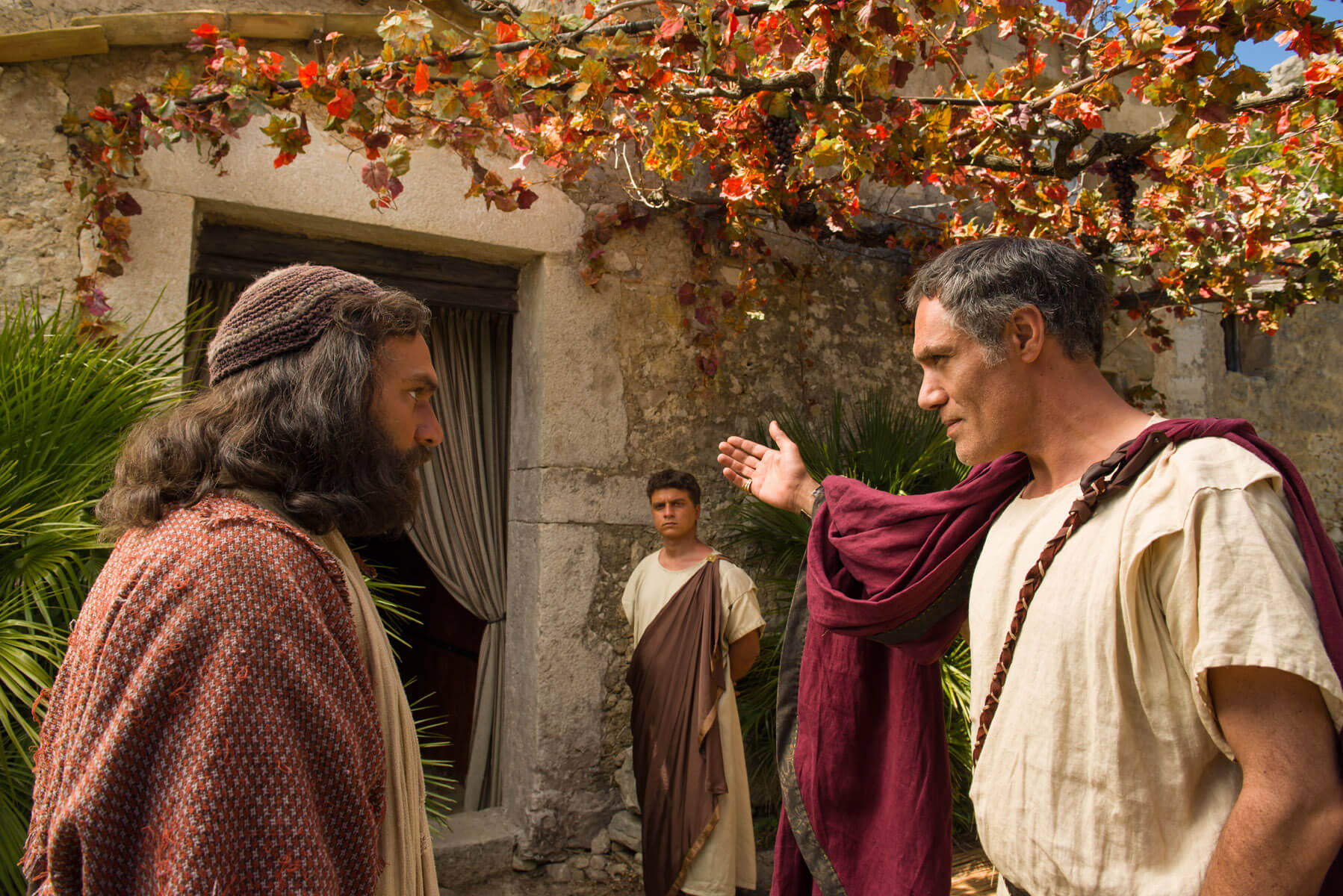
Today’s second reading (Acts 10:34-38) is the beginning of Peter’s speech in the home of Cornelius, a centurion well-respected by the Jewish people, in which Peter preaches Christ to these pagans of good will.  He lets them know that the true God is God of all and that Jesus came to save all mankind (i.e., “every nation”).  But they must fear God and act uprightly if they truly believe.

So, what Kempis says on the matter (1,4) is eminently true: wisdom comes from a good life.  Why?  Because what can show sagacity more eloquently than following God’s command to lead a good life by loving one another?  Not only does our faith in and obedience to God’s revelation put us in good standing regarding our eternal destiny but it serves to fulfill the petition in the Lord’s Prayer to make His kingdom present here and now (“thy kingdom come on earth”).

Solomon, famous for his wisdom, received this gift of the Holy Spirit (see Is 11:2) and more, in addition, than he could ever imagine, because he asked for wisdom in all humility, with no concern for self, but rather mindful only of the proper governance of God’s Chosen People (see 1 Kgs 3:1-15).  This is the model for us.  “[S]eek first the kingdom [of God] and his righteousness, and all these things will be given you besides.” (Mt 6:33)

Image result for peter and cornelius

“The more humble a man is and the more subject to God…the more at peace [he will be].” (IC 1,4,2) “[T]he best man, who stands and listens for him, rejoices greatly at the bridegroom’s voice. So this joy of mine has been made complete.” (Jn 3:29)

A regular theme of Kempis, as we have already seen and will continue to see, is humility.  Humility results in many good things, including peace of mind and heart (1,4).

John the Baptist’s words above (Jn 3:22-30) come after his disciples have a dispute and then express concern (and maybe some envy) that Jesus is baptizing nearby and “everyone is coming to him.”  John responds that he has already publicly proclaimed that he, himself, is not the Christ, but is preparing the way for Him — the best man to the groom.

We know that Jesus said that no greater man was born than John (see Mt 11:11), and we know that a hallmark of canonized saints is radical humility.  So, what human person in all of history could have been more self-effacing than John (aside from Jesus’ mother)?  He understood his mission, fulfilled it perfectly, and now it was his time to exit the scene (and soon, this life).

It seems to me that one major thing lacking in the world and in individual lives is peace.  Even in the midst of chaos, a holy soul finds tranquility in the trust in God that comes with humility: God is God, I’m not, so I will follow His will, not mine, whether ordained by Him or permitted by Him.  One finds much more peace in faith.  A lesson for us in the turbulence of these times.

There is a little book I love, somewhat hard to find, called Confidence in God written in the early 20th century by an English Jesuit.  On page after page it addresses this very issue is a unique and heartening way.  Pick it up if you can.

Jesus of Nazareth photo by Pat York

“Consult a wise and conscientious man” (IC 1,4,2) “[G]reat crowds assembled to listen to [Jesus]” (Lk 5:15)

The very brief chapter four of Kempis is entitled “Of Prudence in Acting” (1,4), which focuses on the problem of speaking ill of others and being quick to believe when someone speaks badly to you of another person.  The remedy is found in the headline.  And what wiser or more conscientious man was there ever than Jesus?

In today’s Gospel (Lk 5:12-16), Jesus draws crowds partly because of His power of physical healing, in this case, of a leper.  But note that the first reason given by Luke of Jesus’ popularity is the second part of the headline: to listen to Jesus.

What a dynamic and compelling figure Jesus must have been in person!  Surely, not because He was ostentatious, but rather because His words are “spirit and life” (Jn 6:63)  Yet, they are also “sharper than any two-edged sword” (Heb 4:12) — maybe not comfortable words, but ones they (and we) needed to hear.  The skillful Surgeon targets the disease of sin if only we are open to the treatment and rehabilitation.

Jesus is the One to model ourselves after in speaking of others.  It is true that He was not reticent to call out the religious leaders whose bad example discouraged or led astray the people entrusted to them.  But he also looked with kindness and spoke words of encouragement to sinners (e.g., Mary Magdalene and the woman caught in adultery) and tax collectors (e.g., Matthew and Zacchaeus), lifting them up, not putting them down, gaining lifetime followers.

We are to go and do likewise.Image result for jesus curing the leper

“[H]e is very learned indeed, who does the will of God, and renounces his own will.” (IC 1,3,6) “For the love of God is this, that we keep his commandments.” (1 Jn 5:3)

The closing words of Chapter Three of Imitation (1,3) hold the key to the Christian life: aligning our wills to God’s will.  How else can we legitimately say we love God but by keeping His commandments.  This is what John is telling us as we continue to hear from him at Mass (1 Jn 4:19-5:4).

John does not subscribe to an easy-believism (this approach is nowhere to be found in Scripture).  If we say we believe in God, but don’t strive to follow the Divine Will, what are we saying?  We believe God exists?  But if God is who He says He is, much more is required.  It is not always easy, and we often fall, but the Lord, like the father of the prodigal son, anxiously awaits our return.

John then heartens us in the next verse:

And his commandments are not burdensome,
for whoever is begotten by God conquers the world.
And the victory that conquers the world is our faith.

We may at times think God’s commandments are burdensome, because our fallen nature is attracted to sin, especially pride (“I know what’s best for me!”).  But the One who made us, who has our “owner’s manual,” truly knows what’s best for us.  And “conquering the world” is a pretty nice reward , is it not?  An overstatement for effect?  No.  Whether it’s conquering the world in the sense of the world, the flesh, and the devil in our own lives, or conquering the world in the sense of John Paul II, Mother Teresa, or Mother Angelica, faith, even if the size of a mustard seed, can move mountains (see Mt 17:20).

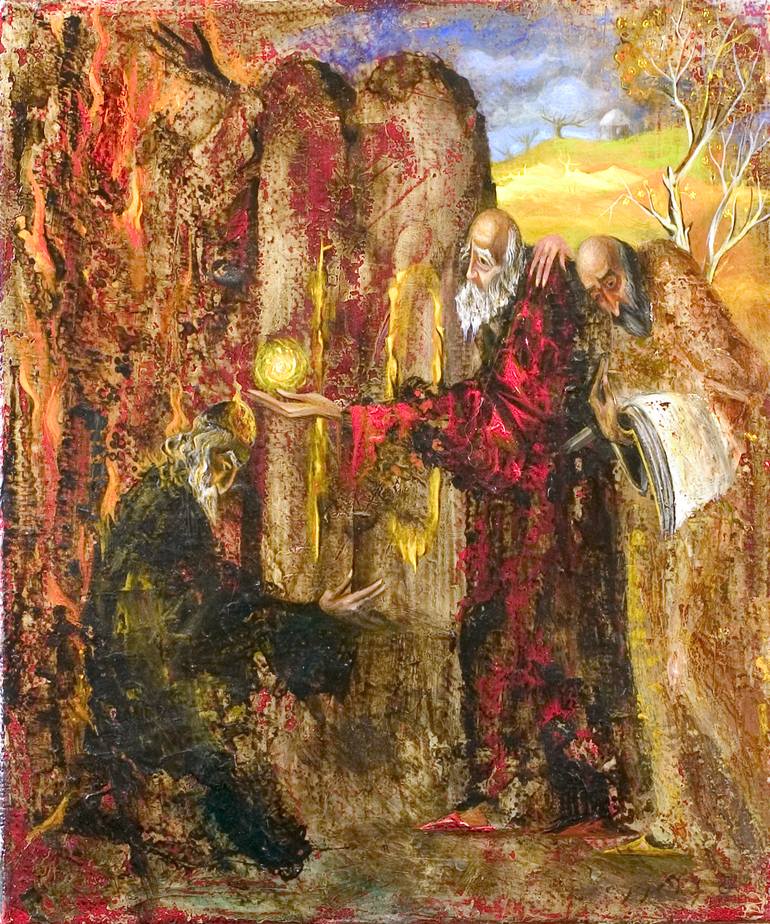
Image result for the ten commandments in artThe Ten Commandments (Moses) by Teimuraz Gagnidze (contemporary)

“He is truly great, who has great charity.” (IC 1,3,6) “[W]hoever remains in love remains in God and God in him.” (1 Jn 4:16)

With these words, Kempis (1,3) is countering those who puff themselves up through vain learning but know little or nothing of God and who are quickly forgotten after death despite receiving great esteem in life.  What is needed for true greatness, everlasting greatness, is charity or love.

Today’s first reading (1 Jn 4:11-18) is again from John’s first epistle on the love of God who Himself IS Love.  What does it mean to “remain in love”?  And how does one “remain in love”?  John explains in the previous verse: “Whoever acknowledges that Jesus is the Son of God.”

This is a call to evangelization, is it not?  First, by living the message in loving everyone (John takes that on tomorrow in the continuation of this passage).  Then by sharing the Good News of Jesus Christ.  We should desire with all of our hearts to make the Lord known to all persons through our lives, our actions, and our words.  We are His chosen instruments in spreading the Word.

The recent theme that the school at which I work (St. Thomas University, Houston) has been promoting is, “Be your bold self.”  This is not more true than in our call to “make disciples of all” (Mt 28:19).  If I may borrow another line, this time from Matthew Kelly: “Be bold. Be Catholic.”

beyourboldself

“Without Him [‘the eternal Word,’ i.e., Jesus], no one understands or judges rightly.” (IC 1,3,2) “When Jesus saw the vast crowd, his heart was moved with pity for them, for they were like sheep without a shepherd; and he began to teach them many things.” (Mk 6:34)

Chapter Three of Book One of Imitation (1,3) continues Kempis’s focus on the uselessness of secular knowledge without knowledge of Christ.  Undoubtedly, there were many in the “vast crowd” of today’s Gospel (Mk 6:34-44) who were well-learned.  Yet Jesus pities them because they are lost.  Their darkened intellect, as St. Thomas Aquinas called it, makes their understanding difficult and their judgment unreliable.  They are looking for something beyond this transitory existence on earth.  They yearned for the divine.  They hungered for truth.  They were drawn to Jesus.  Why?

Listen to the guards who were later sent by the religious leaders to arrest Jesus: “Never before has anyone spoken like this one.”  (Jn 7:46)

Listen to the Lord’s closest collaborator, Simon Peter: “You have the words of eternal life.” (Jn 6:68)

Listen to Jesus Himself: “The words I have spoken to you are spirit and life.” (Jn 6:63)

The chapter of The Imitation of Christ on which we are now focused is entitled “The Doctrine of Truth.”  From whom else might we get the unadulterated truth but the One who told us “I am the way and the truth and the life” (Jn 14:6)?

Are we humble enough to count ourselves among the pitiable sheep that need the Good Shepherd’s guidance?  Are we driven to come to know all the Lord has revealed to us?  Are we willing to live the doctrine completely?  And are we courageous enough to bring the fullness of the message to others?

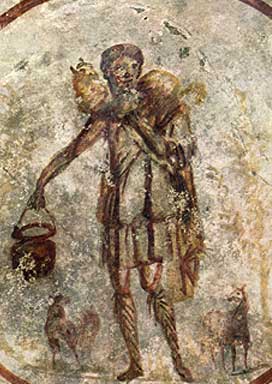
Allegory of Christ as the Good Shepherd, 3rd century.

“This is the highest and most profitable lesson: Truly to know and despise ourselves.” (IC 1,2,4) “Jesus began to preach and say, ‘Repent, for the Kingdom of heaven is at hand.'” (Mt 4:17)

In this final lesson from chapter two of The Imitation of Christ (1,2), the author concludes the chapter by telling us to despise ourselves.  Harsh?  Kempis goes on to explain that we are not to esteem ourselves, that we are frail, and that, essentially, when witnessing grave sin in others, there, but for the grace of God, go we.

Is is any wonder, then, that Jesus’ first words recorded in Matthew (heard in today’s Gospel – Mt 4:12-17, 23-25) are (echoing the Baptist’s first words in the previous chapter): “Repent!”  The most humble person who ever existed commands us to imitate that humility in recognizing our faults and being truly sorry for offending God and neighbor.

Have you ever heard someone say something to this effect: “I don’t need to go to Confession.  What would I tell the priest?  I haven’t killed anyone or robbed a bank!  I’m basically a good person.”  For anyone tempted to think along these lines, consider the words that we say at Mass each weekend and then reevaluate:

I confess to almighty God
and to you, my brothers and sisters,
that I have greatly sinned
in my thoughts and in my words,
in what I have done
and in what I have failed to do

Are we to think that Holy Mother Church made a mistake when requiring us to say these words at Mass?  We are weak in so many ways.  Even if our explicit deeds aren’t sinful, a thought, a word, an action not taken, all can create separation between us and God.

And if our standard for sinning is grievous transgressions like murder and armed robbery, I refer you to Fr. Mitch Pacwa who said that if you are comparing yourself to Al Capone, you are doing pretty well, but if you are comparing yourself to Jesus Christ, you are falling far short.  There is no one else to compare to in our behavior but the Lord.  Remember, it is not “only human” to sin; it is inhumane.  Adam and Eve, before the Fall, were created in the image and likeness of God (they were created “very good” — Gen 1:31) but they lost that life of God in themselves in sinning mortally.  The New Adam and New Eve (Jesus and His mother) showed us again what it means to be fully human (although Jesus was a divine person He had a human nature and was like us in all things but sin [cf. Heb 4:15]).

It seems to me so many TV shows over the last few decades (but even more so in recent years with the boom in “reality shows”), play on the idea that, if you think you’re not doing so great, look at these folks.  Avoid these kind of shows at all cost.  Exalting oneself by looking at the failings of others is not to be our measuring stick.  Keeping our eyes fixed on Jesus and imitation of Him is our salvation.

Image result for jesus preaching