Lent Day 33: Lifted Jesus

TODAY’S READINGS

Today’s Gospel reading (Jn 12:20-33) has Jesus approached by Gentiles interested in Him. Now Jesus’ hour has come. He ends His short discourse on this matter this way, with an explanation from John:

“And when I am lifted up from the earth,
I will draw everyone to myself.”
He said this indicating the kind of death he would die.
(vv. 32-33)

“Like the crowds who are ‘amazed’ at Jesus’ teaching (7:15) and miracles (7:21), the guards are awed at his teaching: there is something unprecedented about Jesus.” (The Gospel of John [Catholic Commentary on Sacred Scripture], 45)

when I am lifted up: Refers primarily to the Crucifixion of Christ, as indicated in the next verse, but also hints at his Resurrection and Ascension (CCC 662). See note on Jn 3:14. ● The expression recalls the opening line of Isaiah’s fourth Servant Song, which runs from Is 52:13 to 53:12. The whole song is a prophetic depiction of the suffering of the Messiah, who will be exalted and lifted up in the sight of the nations, but only after he is cast down by his own people. Isaiah interprets the humiliation and death of this Servant as a redemptive sacrifice for sin. draw all men to myself: Points to the worldwide acceptance of the gospel (Mt 28:18–20; Acts 1:8). ● As Isaiah envisioned the Davidic Messiah as an “ensign” posted for the ingathering of the “nations” and the “outcasts of Israel” (Is 11:10–12), so Jesus sees the world gathering around the “sign” of the Cross (CCC 542). (The Gospel of John [Ignatius Catholic Study Bible], 42)

“‘And I, when I am lifted up from the earth, will draw all men to myself.’ The lifting up of Jesus on the cross signifies and announces his lifting up by his Ascension into heaven, and indeed begins it. Jesus Christ, the one priest of the new and eternal Covenant, ‘entered, not into a sanctuary made by human hands. . . but into heaven itself, now to appear in the presence of God on our behalf.’ There Christ permanently exercises his priesthood, for he ‘always lives to make intercession’ for ‘those who draw near to God through him’. As ‘high priest of the good things to come’ he is the center and the principal actor of the liturgy that honors the Father in heaven. (CCC 662)

Christ stands at the heart of this gathering of men into the ‘family of God’. By his word, through signs that manifest the reign of God, and by sending out his disciples, Jesus calls all people to come together around him. But above all in the great Paschal mystery – his death on the cross and his Resurrection – he would accomplish the coming of his kingdom. ‘And I, when I am lifted up from the earth, will draw all men to myself.’ Into this union with Christ all men are called. (CCC 542)

Knowing how the story ends, or might I rather say, how the story continues, we might think that Jesus is referring to His Ascension when He speaks about being “lifted up.” John quickly disabuses us of this notion. While, as the commentary above says, we can see hints of the Ascension, it is unmistakable that there is no Ascension, no Resurrection, without the Crucifixion. As Jesus says earlier in today’s reading, “it was for this purpose that I came to this hour” (v. 27). He calls us to “hate” our life here so that we “will preserve it for eternal life” (v. 25).

We, too, are called to be drawn to the Cross, that is, to suffering. Not wishing for it — we’re not called to be masochists — but accepting it when it comes (because it always does). I invite you to join me in praying that when pain and suffering come, large and small, that we will have the grace to offer it up for the forgiveness of sins (starting with our own) and the redemption of souls. I will mention, as have before in these posts, the blessing of our faith that informs us of the value of suffering when it is redemptive. For the faithful it is not only a promise, but a requirement:

Then Jesus said to his disciples, “Whoever wishes to come after me must deny himself,* take up his cross, and follow me.
For whoever wishes to save his life will lose it, but whoever loses his life for my sake will find it. (Mt 16:24-25)

The second verse echoes what Jesus says in today’s reading. So we ask ourselves: What wouldn’t you endure in the brief moment we traverse this valley of tears for eternal bliss?

Easy? No. Possible? “[F]or God all things are possible” (Mt 19:26). The Lord puts His stamp on this when speaking to Paul:

“My grace is sufficient for you, for power is made perfect in weakness.” (1 Cor 12:9)

Let us pray, and pray some more, for the grace of perseverance in trials and tribulation.

The painting below represents to me “everyone” coming to Jesus. We especially think of John, the loan apostle to return to Jesus in His moment of torture, as a representative for all of us when Jesus entrusts His mother to him. Ask for Blessed Mary’s intercession frequently, as she knows suffering as well as anyone.

BP BARRON’S SERMON

Check out today’s sermon from the good bishop who takes a deep dive into Jeremiah 31:31 — the promise of a New Covenant which Jesus gives us at the Last Supper. Super important to understand the New Covenant and the Old Covenant(s).
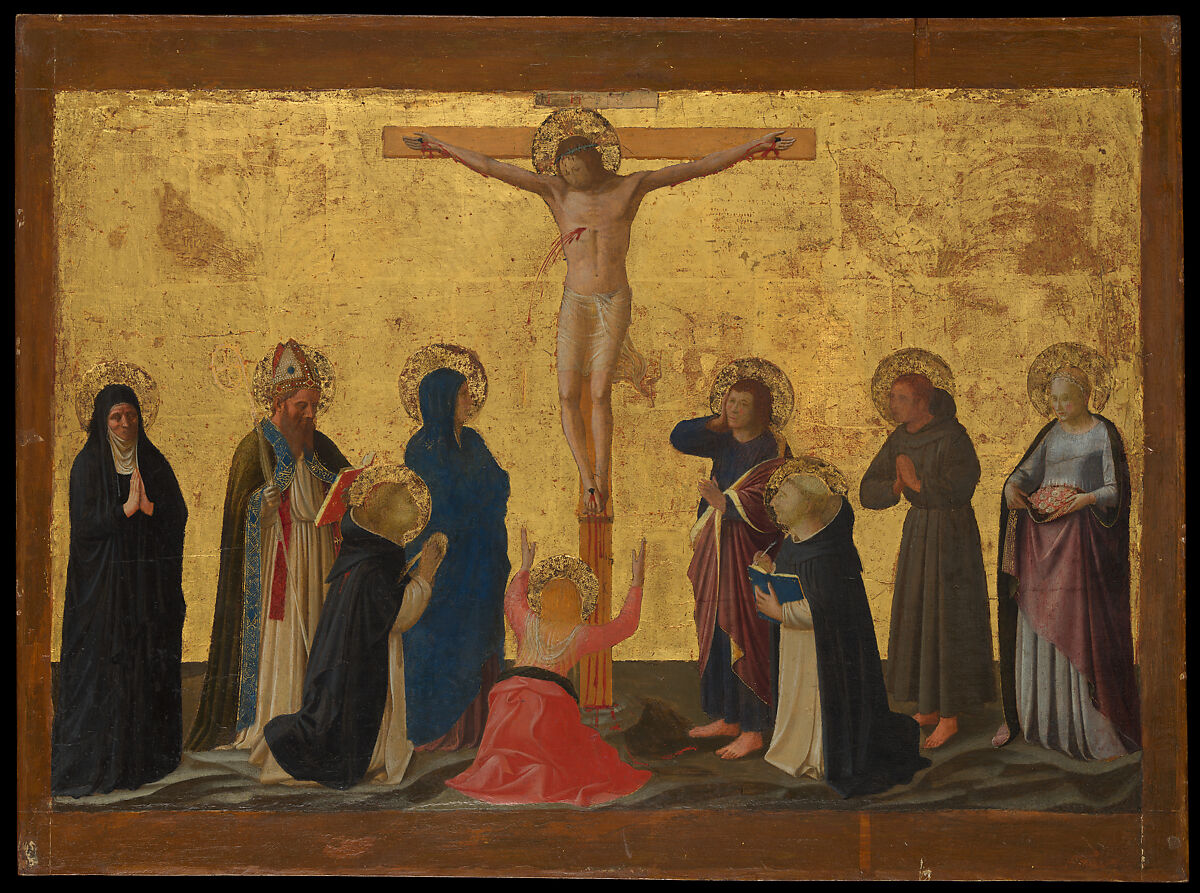
The Crucifixion (c. 1440) by Fra Angelico

God bless.

Lent Day 32: Impressive Jesus

TODAY’S READINGS

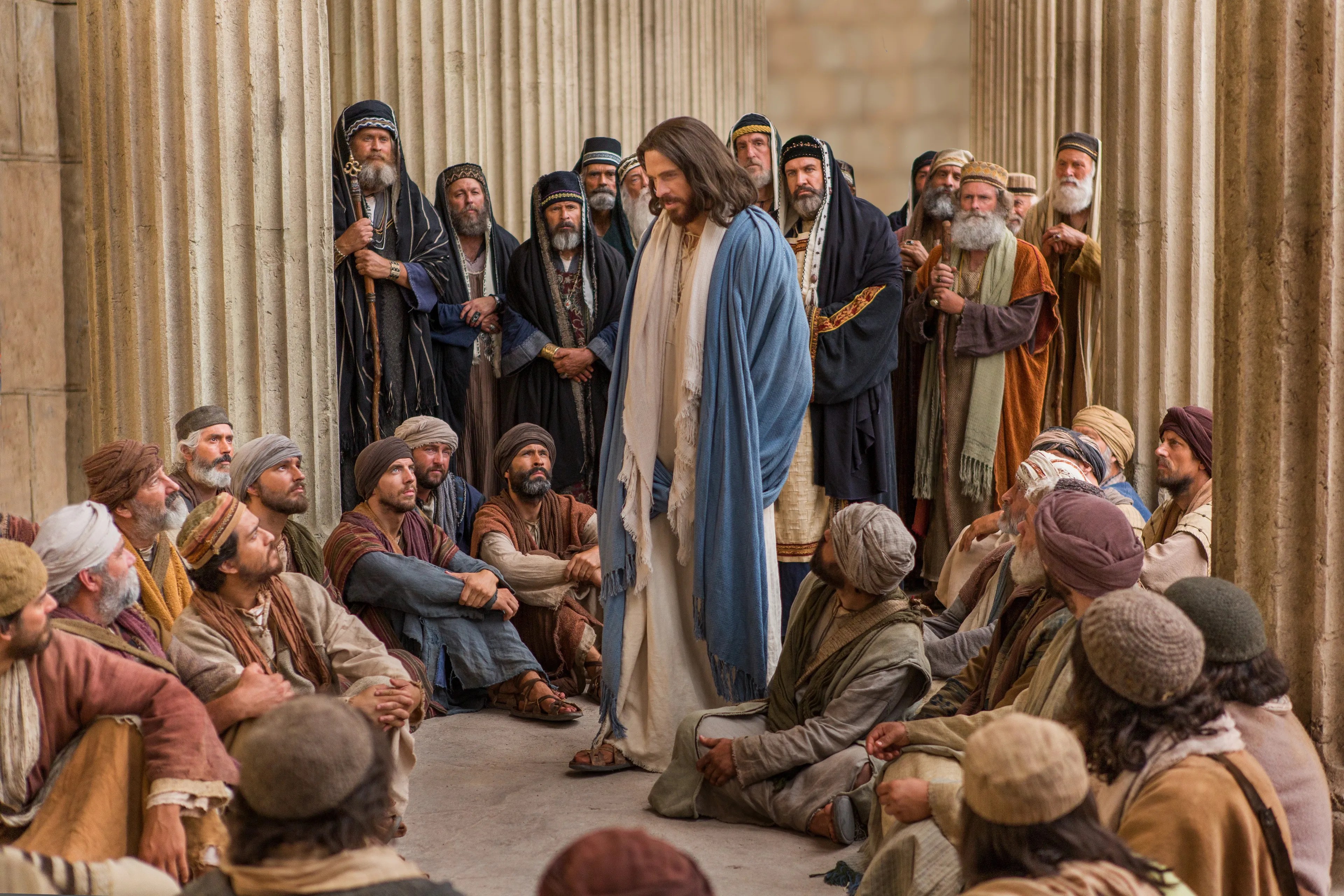
Today’s Gospel reading (Jn 7:40-53) has Jesus impressing the crowds and the Pharisees hoping to arrest Him. The guards sent to do the job came away impressed with this Galilean:

“Never before has anyone spoken like this man.” (v. 46)

“Like the crowds who are ‘amazed’ at Jesus’ teaching (7:15) and miracles (7:21), the guards are awed at his teaching: there is something unprecedented about Jesus.” (The Gospel of John [Catholic Commentary on Sacred Scripture], 45)

“The truth begins to influence the straightforward souls of the servants of the Sanhedrin but it cannot make headway against the obstinacy of the Pharisees. ‘Notice that the Pharisees and scribe derive no benefit either from witnessing miracles or reading the Scriptures; whereas their servants, without these helps, were captivated by a single discourse, and those who set out to arrest Jesus went back under the influence of hi authority,. And they did not say, “We cannot arrest him, the people will not let us’; instead they extolled Christ’s wisdom. Not only is the their prudence admirable, for they did not need signs; it is also impressive that they were won over by his teaching on its own; they did not say, in effect, “No man has ever worked such miracles,” but “No man ever spoke like this man.” Their conviction also is worthy of admiration: they go to the Pharisees, who were opposed to Christ, and address them in the way the do (St John Chrysostom, Hom. on St. John, 9).” (The Navarre Bible: St John, 119)

“Never before had anyone spoken the word of God as did the Word become flesh; never before did God reveal himself as he does in Jesus.” (Bringing the Gospel of John to Life, 221)

Anyone who takes the Gospel seriously must come to the same conclusion as the guards. Anyone who takes the Gospel seriously must come away feeling either as the guards do or as the Pharisees do. There can be no fence-sitters when dealing with the message of Jesus. Jesus said:

“Do you think that I have come to establish peace on the earth? No, I tell you, but rather division.” (Lk 12:51)

Scripture also says:

Indeed, the word of God is living and effective, sharper than any two-edged sword, penetrating even between soul and spirit, joints and marrow, and able to discern reflections and thoughts of the heart. (Heb 4:12)

In what follows, woe to those who do not take the Word (that is, Jesus) seriously:

No creature is concealed from him, but everything is naked and exposed to the eyes of him to whom we must render an account. (Heb 4:13)

The Catechism of the Catholic Church drives home the message:

“Christianity is the religion of the ‘Word’ of God, a word which is ‘not a written and mute word, but the Word which is incarnate and living’ (St. Bernard, S. missus est hom. 4,11:PL 183,86.) (CCC 108)

If it has been a while since Jesus’ words have moved you, or if you have been away awhile, I encourage you to make Bible reading a daily part of your life. A chapter a day is a good practice. Or you may follow the Church’s daily readings (ideally, hearing them proclaimed at Mass on weekdays and certainly on Sundays) here.

Which side of the divide are you on?

The Pharisees (1912) by Karl Schmidt-Rottluf

God bless.

Lent Day 31: Obnoxious Jesus

TODAY’S READINGS

Today’s first reading (Wis 2:1a, 12-22) gives us a striking prophecy of the ultimate and perfect “just one,” Jesus Christ. It begins with these troubling words:

“Let us beset the just one, because he is obnoxious to us;
he sets himself against our doings,
Reproaches us for transgressions of the law
and charges us with violations of our training.”
(v. 12)

“The reasoning of the ungodly has progressed from a reflection of the finality of death, to an embrace of hedonism, to a rejection of the weak, and now finally to active persecution of the righteous man precisely because of his righteousness. He is inconvenient because he opposes, reproaches, and accuses the wayward for their sins. While the author is not drawing a direct line of connection, one cannot avoid thinking of the biblical prophets here. Isaiah, Jeremiah, and the other prophets consistently rebuke the nation for their disobedience to God’s law and their straying from his ways. Here, Wisdom highlights two types of moral error: ‘sins against the law’ and ‘sins against our training,’ which perfectly match the priorities of Hellenistic Judaism. On the one hand, ‘sins against the law’ refers to transgressions of the law of Moses, the ancient ancestral law of the Jews. On the other hand, ‘sins against out training [paideia]’ refers to rejecting the lessons learned in the context of family and, more precisely, Greek education. The erring ones have strayed from both the Jewish ideal of law observance and from the Greek educational idea of paideia.” (Wisdom of Solomon [Catholic Commentary on Sacred Scripture], 45)

“Their words are echoed in the insults offered by the scribes and Pharisees to Jesus when he was on the cross (cf. Mt 27:40-43; Mk 15:31-32; Lk 23:35-37). (The Navarre Bible: Wisdom Books , 312)

I immediately think how Jesus is found so “obnoxious” to so many today (even self-proclaimed Christians, including Catholics — some in very high positions in society). The Word of God, who is Jesus, is ignored, spurned, or even deemed “hate speech” when it (He) goes against the “enlightened” “progress” we have purportedly made now well into the twenty-first century. And Scripture says:

“[I]f the light in you is darkness, how great will the darkness be.” (Mt 6:23)

The devil is the black light. We surely can know that when a culture of death predominates and every manner of perversion is hailed as good and proper and normal that the prince of this world is delighting in his influence over weak and stupid mortals.

Let us all work to exorcise Satan and his minions by standing up for the Truth no matter the cost and, above all, praying to Jesus through Mary for deliverance from this pervasive and growing evil. We were promised by the Lord from the very beginning of their ultimate triumph:

“I will put enmity between you and the woman,
and between your offspring and hers;
They will strike at your head,
while you strike at their heel.
” (Gen 3:15)

May it occur soon. Thy kingdom come!

NEW BOOK IN THE CATHOLIC COMMENTARY ON SACRED SCRIPTURE SERIES!

I’m excited to quote above from the first entry in the Old Testament series from the Catholic Commentary on Sacred Scripture series. Check it out!

God bless.

Lent Day 30: Moses and Jesus

TODAY’S READINGS

Today’s Gospel (Jn 5:31-47) picks up where yesterday’s left off. Jesus here provides deep theology and a pointed accusation at the Pharisees. He closes with these devastating words:

“Do not think that I will accuse you before the Father:
the one who will accuse you is Moses,
in whom you have placed your hope.
For if you had believed Moses,
you would have believed me,
because he wrote about me.
But if you do not believe his writings,
how will you believe my words?”
(vv. 45-47)

he wrote of me: Jesus follows the Jewish tradition that Moses authored the Pentateuch (Gen-Deut). Moses thus described the Messiah as a Redeemer (Gen 3:15), a universal King (Gen 49:10), and a Prophet like himself (Deut 18:15–19).” (The Gospel of John [Ignatius Catholic Study Bible], 28)

“The authorities appealed to the authority of Moses (‘in whom you have placed your hope’) and the Torah to accuse Jesus (see 5:11-18). Yet since the Scriptures are a witness to Jesus (Moses ‘wrote about me’), both the Scriptures and Moses stand on Jesus’ side against his accusers. Scripture bears witness to Jesus, and faith in Jesus opens the way to see this testimony. But on account of their unbelief, the authorities do not fully understand Moses and the Scriptures because they do no see how they bear witness to Jesus. Thus, Jesus concludes, ‘If you do not believe his writings, how will you believe my words?'” (The Gospel of John [Catholic Commentary on Sacred Scripture], 111-12)

“Failure to understand the true import of Scripture is an obstacle to believing in Jesus and coming to him to have life (5:40).” (Bringing the Gospel of John to Life, 150)

I think of typology and the importance of the entire Bible here. It is true, as St. Augustine said, that, “In the Old Testament the New is concealed, in the New the Old is revealed.” We miss so much if we read the New Testament, especially the Gospels, in isolation. Jesus berates the self-described experts in the Law, as missing all the Torah was pointing to: namely Him. Had they seen Jesus as the New Moses, the fulfillment of the Mosaic (and all Old Testament) covenants, they would have put Him on a throne of gold instead of a throne of wood.

God bless.

Lent Day 29: Hear, believe, and live

TODAY’S READINGS

Today’s Gospel (Jn 5:17-30) picks up where yesterday’s left off. Jesus reveals much about Himself and His Father, much to the chagrin of the Pharisees:

“Amen, amen, I say to you, whoever hears my word
and believes in the one who sent me
has eternal life and will not come to condemnation,
but has passed from death to life.”
(v. 24)

“The Father has placed judging and giving life in the hands of his Son, and now Jesus speaks about his carrying out these divine prerogatives. He again prefaces his words with a solemn ‘Amen, amen, I say to you,’ assuring his listeners (and readers of John’s Gospel) of the importance of what he is saying. He proclaims that ‘whoever hears my word and believes in the one who sent me has eternal life.’ The ‘word’ of Jesus is the word of God: ‘the one whom God sent speaks the words of God” (3:34; see also 12:49-50; 14:24; 17:8). When Jesus says ‘hears my word,’ he uses ‘hears’ in its biblical sense of accepting and heeding (see Deut 6:4). We might have expected Jesus to say ‘Whoever hears my word and believes me,’ but he says whoever hears my word ‘and believes in the one who sent me’ — literally, ‘believes the one who sent me.’ Since Jesus speaks the word of God, to accept his word is to believe God (see 12:44).

“Jesus proclaims that whoever hears his word and believes the one who sent him ‘has eternal life.’ ‘Now this is eternal life, that they should know you , the only true God, and the one whom he sent, Jesus Christ’ (17:3). To know God is to experientially know him as Jesus reveals him; accepting his revelation brings union with God and ‘eternal life.’ The one who believes ‘has eternal life and will not come to condemnation, but has passed from death to life.’ For those drawn into union with God through Jesus, ‘eternal life’ begins now, even if its fullness lies in the future (see 6:54). Come to condemnation means being left in the perishable state of humanity, destined for death (see 3:16-18). Whoever receives eternal life ‘has passed from death to life’ — literally, ‘has been transferred out of death to life.’ These united with God through Jesus have been taken from the realm of death into the realm of eternal life. Even if they die physically , they live eternally (see 11:25-26).” (Bringing the Gospel of John to Life, 136-37)

I chose the particular passage I did because I love it when Jesus is very clear what we mortals are called to believe and live out. Martin, in the extended excerpt above, says, ‘When Jesus says ‘hears my word,’ he uses ‘hears’ in its biblical sense of accepting and heeding.’

Yes, we are to hear the Word of God. But more importantly, we must internalize it and live it

Woe unto You, Scribes and Pharisees (1850) by James Tissot

God bless.

Lent Day 28: Suffering is not the worst

TODAY’S READINGS

Today’s Gospel (Jn 5:1-16) picks up where yesterday’s left off. Jesus heals a man ill for thirty-eight years…on the sabbath. Jesus last words to the man:

“Look, you are well; do not sin any more,
so that nothing worse may happen to you.” (v. 14)

“Jesus’ remark here can mean that sin causes something worse to a person than physical illness: spiritual illness that can be eternally fatal.” (The Gospel of John [Catholic Commentary on Sacred Scripture], 100)

“The Bible reveals a link between sin and suffering, with the former being the cause of the latter (Ps 107:17). This general truth, however, does not extend to every individual case (9:3).” (The Gospel of John [The Ignatius Catholic Study Bible], 27

“The man may have come to the temple to thank God for his cure. Jesus goes over and reminds him that the health of the soul is more important physical health.

“Our Lord uses holy fear of God as motivation in the struggle against sin: ‘Sin no more, that nothing worse befall you’. This holy fear is born out of respect for God our Father; it is perfectly compatible with love. Just as children love and respect their parents and try to avoid annoying them partly because they are afraid of being punished, so we should fight against sin firstly because it is an offence against God, but also because we can be punished in this life and, above all, in the next.” (The Navarre Bible: St John, 89)

“This statement accomplishes three things. First, it teaches than bodily sickness is an image of sin in the soul. Second, it teaches that it is much more important to avoid sin than avoid sickness. Third, it tells us to look at the healing as a parable: the sick people lying under the porticoes stand for sinners; getting into the baths stands for baptism; getting cured from sickness stands for having sins washed away; the question of whether the man wanted to be cured stands for the question of whether we really want to be free from our sins. If the man had grasped all three of these things, he would have wanted to become a follower of Christ and asked to be baptized.” (Mary’s Voice in the Gospel According to John, 61-62)

Suffering is an interesting thing (maybe not so much so when one is in the midst of terrible pain, but…). Suffering may come out of the blue through no fault of our own. Suffering may come due to bad habits, carelessness, or recklessness. Suffering may come due to our sinful behavior. But, as terrible as it is to suffer, nobody deals with it better than the Catholic Church. The possibility of suffering being redemptive, no matter the reason it comes our way, has had the faithful endure the most horrible physical and mental torments that they united with Christ’s Passion for the forgiveness of sins and the redemption of souls. After all, Jesus said:

In the world you will have trouble, but take courage, I have conquered the world. (Jn 16:33)

The Greek for “trouble” (θλίψιν) has also been translated as “tribulation,” “affliction,” and “distress.” If the servant is no better than his Master, and God Himself suffered the pain and humiliation of the cross, do we sinful persons dare to think we should get off scot-free?

So, let no suffering go to waste. The Lord can use it to heal our souls and those of many others. Consider the greeting we will get in heaven from those who we helped by and through sufferings we laid at the foot of the Cross while on this mortal coil.

BOOK RECOMMENDATION

Note the last commentary I cite is the first time I’ve used it here. Michael Pakaluk’s Mary’s Voice in the Gospel According to John is an outstanding book that I can heartily recommend. He also has a commentary on Mark. Hopefully he will get to the other Gospels, as well. Clearly a man who loves the Lord and His word and has imbibed deeply of it.

God bless.

Lent Day 27: Homecoming

TODAY’S READINGS

Today’s Gospel (Jn 4:43-54) has us jumping to the next chapter in John. Here Jesus returns to Galilee with quite a reputation earned in Jerusalem:

Jesus himself testified
that a prophet has no honor in his native place.
(v. 44)

“The Gospel author makes a comment, and while its meaning is clear, the reason the author makes the comment is not immediately evident. It was proverbial in the ancient world that a prophet or other significant person ‘has no honor in his native place.’ Familiarity can breed disrespect, even contempt. In the other Gospels, Jesus makes this observation after he experiences rejection in Nazareth (Matt 13:54-57; Mark 6:1-4; Luke 4: 16-30). John’s Gospel, however, does not present the occasion on which Jesus made the observation; it only recounts what he at some point said, citing it as an explanation for why he went to Galilee (verse 43). As such, it is a puzzling explanation, for Jesus will be welcomed by Galileans upon his arrival (verse 45). Scholars suggest various explanations for the comment. One suggestion is that Jesus suspended his highly popular ministry in Judea (3:26) and went to Galilee in order to avoid confrontations with religious authorities (4:1-3), expecting to receive less attention in Galilee since ‘a prophet has no honor in his native place.’ In this interpretation, Jesus wished to keep a relatively lower profile for a while.” (Bringing the Gospel of John to Life, 114-15)

The last explanation above makes a lot of sense. “Hometown boy makes good” is acknowledged at first, but it likely won’t be long when Jesus becomes rather uninteresting, and folks are reminded that this is the same nondescript child of nondescript parents they had known for decades. Also, maybe they think he has become “too big for his britches” and they’ll knock Him down a peg or two. And we shouldn’t discount envy as a motivating factor either — who is this young ‘so-and-so’ to gain all these accolades while the rest of us live and toil in an obscure backwater with no hope for fame?

So, don’t feel too bad if at times it seems like the respect you get is only at the workplace or public gatherings while at home you are ignored, trampled on, and taken advantage of. Jesus has no pride, so this wasn’t an issue for Him. But humility, he has in spades. Just remember he knows through first-hand experience what it means to be humble (starting with the Incarnation). For our part, getting knocked down a few notches can be good for the soul.

Vocation of the Apostles (1481) by Domenico Ghirlandaio

God bless.

Lent Day 26: John 3:16

TODAY’S READINGS

Today’s Gospel (Jn 3:14-21) has a listen to the nocturnal encounter between Jesus and an interested Pharisee, Nicodemus. It yields one of the most referred to and quoted lines in all of Scripture:

“For God so loved the world that he gave his only Son,
so that everyone who believes in him might not perish
but might have eternal life.”
(v. 16)

gave his only-begotten Son: The earthly mission of Jesus is part of the heavenly plan of the Father, who displays the depth of his love through the sacrifice of his Son (Rom 5:8; 1 Jn 3:16; CCC 219). This verse marks a transition from the dialogue between Jesus and Nicodemus (3:1–15) to an extended monologue by either Jesus or the evangelist himself (3:16–21). eternal life: The expression refers both to the divine quality of new life in Christ as well as its duration. We receive this gift already on earth in the hope that we will possess it irrevocably in heaven (10:10; 1 Jn 5:13). (Ignatius Catholic Study Bible: The Gospel of John, 23)

“God’s love for Israel is compared to a father’s love for his son. His love for his people is stronger than a mother’s for her children. God loves his people more than a bridegroom his beloved; his love will be victorious over even the worst infidelities and will extend to his most precious gift: ‘God so loved the world that he gave his only Son.'” (CCC 219)

God loves the world. That’s something, isn’t it? We are reminded of Genesis 1 in which God finds all He created good and, culminating with humans, very good. Objectively, there is nothing wrong with the world — God don’t make junk, as used to be a popular saying. It’s humans who caused it to fall, but it is God, through His Son, who redeems it, and who promised a “new heavens and a new earth” at the end of time.

So, believe! And not the easy-believism that says, “I’ve accepted Jesus as my personal Lord and Savior” so now I can do what I want. It means to know Jesus and what He commanded and strive to follow it perfectly. Jesus gives far too many warnings about straying from the narrow path to think any differently.

BP BARRON’S SUNDAY SERMON

God bless.

Lent Day 25: ‘O God, be merciful to me a sinner.’

TODAY’S READINGS

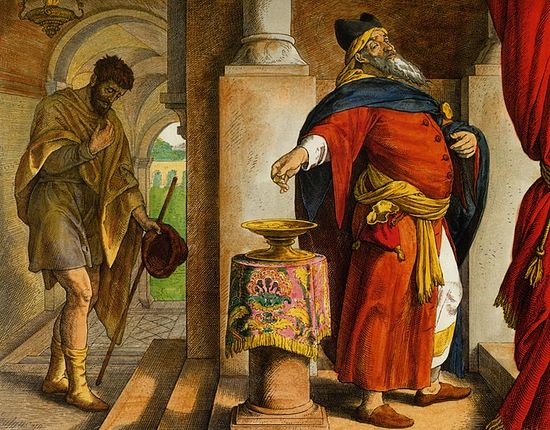
Today’s Gospel (Lk 18:9-14) gives us the Parable of the Pharisee and the Tax Collector. Jesus is making few friends with the former group but is giving hope to the latter. The words of the tax collector in prayer are extolled by Jesus:

“‘O God, be merciful to me a sinner.’” (v. 13b)

“[The tax collector] asked God to ‘be merciful’ (hilaskomai) to him. This verb…occurs only once elsewhere in the New Testament, where it means to ‘expiate’ or make atonement for sin (Heb 2:17). Such ‘sacrificial overtones’ fit the parable’s temple setting, all the more so if the prayer occurs at the time of the daily sacrifice.” (The Gospel of Luke [Catholic Commentary on Sacred Scripture], 304)

“‘Prayer is the raising of one’s mind and heart to God or the requesting of good things from God.’ But when we pray, do we speak from the height of our pride and will, or ‘out of the depths’ of a humble and contrite heart? He who humbles himself will be exalted; humility is the foundation of prayer, Only when we humbly acknowledge that ‘we do not know how to pray as we ought,’ are we ready to receive freely the gift of prayer. ‘Man is a beggar before God.'” (CCC 2559)

“With bold confidence, we began praying to our Father. In begging him that his name be hallowed, we were in fact asking him that we ourselves might be always made more holy. But though we are clothed with the baptismal garment, we do not cease to sin, to turn away from God. Now, in this new petition, we return to him like the prodigal son and, like the tax collector, recognize that we are sinners before him. Our petition begins with a ‘confession’ of our wretchedness and his mercy. Our hope is firm because, in his Son, ‘we have redemption, the forgiveness of sins.’ We find the efficacious and undoubted sign of his forgiveness in the sacraments of his Church.” (CCC 2839)

Humility is the gem-casket of all virtues. We are to put the onus on ourselves for our sins, faults, and shortcomings. It is easy to blame others for paving the way toward our own indiscretions, but keeping it simple is the way to go. Acknowledge we’re sinners and beg for the Almighty’s mercy. We know better and yet we fall so many times.

“What I do, I do not understand. For I do not do what I want, but I do what I hate. Now if I do what I do not want, I concur that the law is good. So now it is no longer I who do it, but sin that dwells in me. For I know that good does not dwell in me, that is, in my flesh. The willing is ready at hand, but doing the good is not. For I do not do the good I want, but I do the evil I do not want. Now if [I] do what I do not want, it is no longer I who do it, but sin that dwells in me.” (Rom 7:15-20)

Paul has the right attitude. While a sinner like all of us, he recognizes sin, its source, and its detrimental effects. Half the battle is acknowledging the wrongdoing we do; then resolve to overcome it (with God’s grace of course). I’m reminded of the AA 12-step program: admit our powerlessness and humbly ask God for help.

It seems to me that the words of the publican are worth incorporating into our daily prayer time. Let’s resolve to do so.

THE LITANY OF REPARATION IN THE BLESSED SACRAMENT

A beautiful prayer that acknowledges sins against the Eucharist and our sorrow for these outrages with a desire to make amends. Thanks to Dr. John Bergsma for sharing this in today’s Exodus & Exile episode.

God bless.

Lent Day 24: Questions?

TODAY’S READINGS

Today’s Gospel (Mk 12:28-34) has Jesus being questioned by a scribe about what His opinion is of the greatest commandment and the scribe’s affirming response. The episode closes this way:

“Jesus said to him,
‘You are not far from the Kingdom of God.’
And no one dared to ask him any more questions.”
(v. 34)

“Jesus was God’s agent in establishing the reign of God on earth. After announcing that the kingdom of God was at hand (1:15), Jesus began to call men and women to be his disciples (1:16-20). Those who became the new family of Jesus (3:34-35) were coming into the reign of God. This scribe was ‘not far from the kingdom of God’: he is not a disciple of Jesus, but he grasps what is at the heart of living under the reign of God. Jesus’ new family is made up of those who do the will of God (3:35); this scribe understands what God expects.

“Jesus has been challenged and questioned by various parties but he has met the challenges and answered the questions (11:27-12:31). His opponents have been reduced to silence but have hardly been eliminated as opponents.” (Bringing the Gospel of Mark to Life, 328-29)

The scribe does not actually realized how close to the Kingdom of God He is. Jesus embodies the Kingdom by bringing heaven to earth in the incarnation. Don’t forget Jesus’ first words of His public ministry:

“This is the time of fulfillment. The kingdom of God is at hand. Repent, and believe in the gospel.” (Mk 1:15)

Judgment comes upon the world and God judges it redeemable, but at what a cost! His own beloved Son. Yet, just before He died, anticipating the awful fate in store for Him in just a few hours, Jesus invited us to share in the Kingdom through the Eucharist instituted at the Last Supper. The Mass as Heaven on Earth, indeed. And we have the privilege in taking part in it every day if we are able.

As for the scribe who inquired, it seems to me that He was an honest seeker, based on a not unusual question from a rabbi or for a rabbi and an irenic and affirmative response. So why did no one “dare” to ask any more questions? It is true that prior to this episode, in the same chapter as well as earlier, the religious leaders’ attempt to trap Jesus using His own word fell flat, thus the growing vengeance that would soon consume them. Futility maybe caused abandonment of questioning by His enemies in favor of a more permanent solution to the Jesus Problem. But for the honest seeker, it seems Jesus would always be open to dialogue. Maybe Jesus was a bit intimidating here — not in demeanor but in His profundity and decisiveness (see Mt 7:28-29). A bit mysterious to me.

God bless.