“The seed sown on rich soil is the one who hears the word and understands it, who indeed bears fruit.”

(Submitted by me for today’s bulletin as a member of my parish’s Spiritual Life Committee.)

The first reading from Isaiah (55:10-11) gives us these words from the Lord:

my word shall not return to me void,
but shall do my will,
achieving the end for which I sent it.
(55:11)

In the gospel passage (Matthew 13:1-23), Jesus confides in the disciples this explanation of the last sentence of the Parable of the Sower:

the seed sown on rich soil
is the one who hears the word and understands it,
who indeed bears fruit
(Matthew 13:23)

https://ldsseminary.files.wordpress.com/2012/10/sower2.jpg

Prior to this closing verse, Christ tells us of the ways we can attempt to thwart God’s work: lack of understanding, tribulation, persecution, worldly anxiety, and the lure of riches.  All of these can prevent the Almighty’s will to be done in us and through us.

With all of these challenges Scripture helps us, though:

  • Lack of understanding: pray Psalm 119 for an increase of this gift of the Holy Spirit (I am thy servant; give me understanding, that I may know thy testimonies! – v. 125)
  • Tribulation: we know that life is full of trials, but they pale in comparison to the ultimate reward if we stay faithful (Jesus says: In the world you will have trouble, but take courage, I have conquered the world – John 16:33)
  • Persecution: being faithful to our religious convictions guarantees maltreatment but it can be endured when that faith has deep roots (all who want to live religiously in Christ Jesus will be persecuted – 2 Timothy 3:12)
  • Worldly anxiety: it is easy to be caught up in daily concerns that are passing so stay close to the Word of God (that is, Jesus) and nothing can shake you (Martha, Martha, you are anxious and worried about many things. There is need of only one thing. Mary has chosen the better part [listening to Jesus] and it will not be taken from her. – Luke 10:41-42)
  • Lure of riches: the gospels make it clear that attachment to temporary worldly possessions can have eternal consequences (Go, sell what you have, and give to [the] poor and you will have treasure in heaven; then come, follow me. – Mark 10:21 and What profit would there be for one to gain the whole world and forfeit his life? – Matthew 16:26)

So we must ask unceasingly the Lord’s help in eliminating those things that interfere with His will for us, listen attentively to His word, and seek understanding of that word through prayer and the Church, the latter to whom God has given the guarantee of the Holy Spirit.

What will you do today — and every day — to better hear Jesus and understand Him and thus bear much fruit?
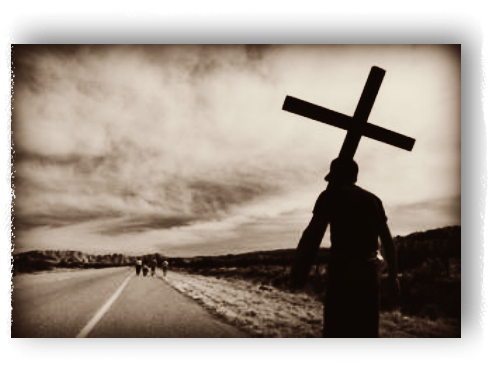


“Whoever does not take up his cross and follow after me is not worthy of me.”

(Submitted to my work parish as the bulletin letter for this weekend.  The quote above is from v. 38 of today’s Gospel reading [Mt 10:37-42])

The Gospel is challenging, isn’t it?  Life is full of trials.  We do not need to be seeking crosses – they will find us.  How we deal with the challenges that come our way is what is important.  Do we behave as Christ who silently and uncomplainingly bore scorn, abuse, and finally a brutal passion and death?  If it was good enough for the Son of God, then who are we to deny the difficulties that come our way?  Can we ask that our burden be relieved or lifted?  Of course!  Jesus did as much in the Garden of Gethsemane.  Let’s recall His words:

My Father, if it is possible, let this cup pass from me; yet, not as I will, but as you will. (Matt 26:39)

Here, Jesus echoes the words of the Lord’s Prayer, asking of the Father that “thy will be done” (Matt 6:10).  Take the cup of suffering away only if it is your will, Lord.  If you can incorporate this verse of Scripture into the prayers you can muster in the depths of your pain, you are doing well.  God does not leave us alone in our troubles but accompanies us the entire way.  A God who is Love (see 1 John 4:8) would never, could never, abandon us.

And if you say that even Jesus felt abandoned on the cross (“My God, my God, why have you forsaken me?” – Matt 27:46) just read the rest of Psalm 22 that He began quoting, especially noting verse 25:

For he has not spurned or disdained

the misery of this poor wretch,

Did not turn away from me,

but heard me when I cried out.

Taking up our crosses in imitation of Christ is a condition of being worthy of Jesus.  Let us not squander these opportunities, so that one day we will hear these glorious words:

Come, you who are blessed by my Father. Inherit the kingdom prepared for you from the foundation of the world.  (Matt 25:34)

https://richardgrebenc.com/wp-content/uploads/2017/07/b1801-pick_up_your_cross.png

Come, Holy Spirit!

(Submitted by me for yesterday’s bulletin as a member of my parish’s Spiritual Life Committee.)

The Catechism of the Catholic Church, in #688, tells us this about the Holy Spirit:

The Church, a communion living in the faith of the apostles which she transmits, is the place where we know the Holy Spirit:

– in the Scriptures he inspired;

– in the Tradition, to which the Church Fathers are always timely witnesses;

– in the Church’s Magisterium, which he assists;

– in the sacramental liturgy, through its words and symbols, in which the Holy Spirit puts us into communion with Christ;

– in prayer, wherein he intercedes for us;

– in the charisms and ministries by which the Church is built up;

– in the signs of apostolic and missionary life;

– in the witness of saints through whom he manifests his holiness and continues the work of salvation.

This is a pretty impressive list of what the Holy Spirit does.  Is it any wonder that Jesus said elsewhere, “But I tell you the truth, it is better for you that I go.  For if I do not go, the Advocate [the Holy Spirit] will not come to you.  But if I go, I will send him to you” (John 16:7)?

Sometimes, the Holy Spirit is called the “forgotten” person of the Holy Trinity.  It seems that we understand better the Father and the Son – they are easier to picture and we can relate to figures like these in our own lives.  The most familiar images of the Spirit are wind and fire, hardly things with which we can imagine having a relationship.  But we must develop that relationship with the one who inspires, assists, intercedes, builds up, and makes holy.

https://holyspiritchurch.us/wp-content/uploads/logos/hsp-logo.png

Let us deepen our relationship with the Holy Spirit by saying this prayer often:

Come, Holy Spirit, fill the hearts of Thy faithful and enkindle in them the fire of Thy love.

Send forth Thy Spirit and they shall be created.  And Thou shalt renew the face of the earth.

Let us pray. O God, Who didst instruct the hearts of the faithful by the light of the Holy Spirit, grant us in the same Spirit to be truly wise, and ever to rejoice in His consolation. Through Christ our Lord.  Amen.

Divine Mercy throughout Scripture.

(Submitted by me for today’s bulletin as a member of my parish’s Spiritual Life Committee.)

Being that it is Divine Mercy Sunday, it seems only appropriate that we look for themes of mercy in all of today’s readings (find them here) and say a few words about each.

In the first reading from Acts of the Apostles, we hear that in the early Christian communities “they would sell their property and possessions and divide them among all according to each one’s need” (2:45).  Here the people were performing a corporal work of mercy.  They realized, as we should, that all good things that we have come from God.  We are to use these gifts responsibly and share them with those less fortunate.  Here we should recall the Beatitude, “Blessed are the merciful, for they will be shown mercy” (Matthew 5:7).

In the Responsorial Psalm the words “His mercy endures forever” are repeated several times.  When the Israelites called out to the Lord He saved them and they couldn’t contain their gratitude.  Then, in the final verses of the psalm, we recognize that the psalmist is foreshadowing the Savior (“The stone which the builders rejected has become the cornerstone.” Psalm 118:22 and Matthew 21:42).  Trusting in God’s great mercy they could look forward to a Redeemer of the human race that could not redeem itself.

Peter continues this theme when he says that God the Father “in his great mercy gave us a new birth to a living hope through the resurrection of Jesus Christ from the dead” (1 Peter 1:3).  Why do we need this mercy?  Because “while we were still sinners Christ died for us” (Romans 5:8).

Finally, Jesus, shows incredible mercy throughout the Gospel reading.  First, on the day of His Resurrection, He appears to the apostles, cowering in a locked room, not with recriminations for their denials and abandonment of Him, but rather with a message of peace, entrusting them with a mission to spread the Gospel and the power to forgive sins.  A week later He confronts doubting Thomas, who was missing from the group the previous Sunday, to humbly convince Him of the truth of the Resurrection, drawing from it a lesson for all time (“blessed are those who have not seen and have believed” — John 20:29b).

How do we show our appreciation to God for the mercy He has shown us?  In turn, how do we show mercy to others?

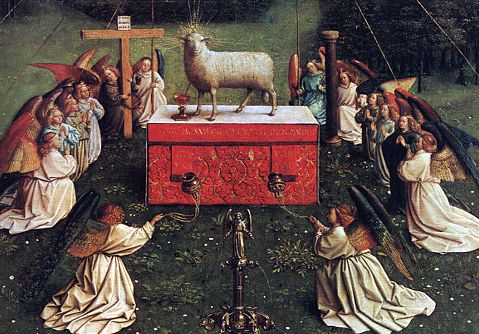
“Christ, our paschal lamb, has been sacrificed; let us feast with joy in the Lord.”

Today’s Alleluia verse is adapted from 1 Cor 5:7b-8a.  Having read the second reading, which contains those very verses, I appreciated the Eucharistic imagery that this reformulation contains — imagery that I did not pick up from that reading.

Jesus, “the Lamb of God, who takes away the sin of the world” (Jn 1:29) gave us His very flesh and blood to eat in instituting the Eucharist on that fateful Thursday, just hours before His death.  He would not leave us, rather He desired to “stay with us” (a promise He explicitly fulfilled the very day of His Resurrection — cf. Lk 24:29).

https://shmuelson.files.wordpress.com/2010/01/lamb1.jpg

“Adoration of the Lamb” (detail) by Jan van Eyck (1432)

So we should “feast with joy in the Lord” and on the Lord.  We do not confine this joy to this most joyous day, but we are to enter into this joy each time we receive the Eucharist and enter into the Paschal Mystery (the passion, death, and Resurrection of Jesus).  It is a great gift that the Lord gave us at such a tremendous cost.  And we reap all of the benefits!

Never let us miss an opportunity to approach the Lord worthily in this Most Blessed Sacrament of Sacraments!

A plan of life in six verses.

The New Testament optional reading for today’s Feast of the Holy Family of Jesus, Mary, and Joseph comes from Paul (Col 3:12-17).  Check out this lengthy list of traits included in this short dense passage to which Christians must aspire:

+ heartfelt compassion
+ kindness
+ humility
+ gentleness
+ patience
+ bear with one another
+ forgive one another
+ love (the bond of perfection)
+ let the peace of Christ control your hearts
+ be thankful
+ let the word of Christ dwell in you richly
+ in all wisdom teach and admonish one another
+ sing psalms, hymns, and spiritual songs with gratitude in your hearts to God.
+ whatever you do, in word or in deed, do everything in the name of the Lord Jesus,                    giving thanks to God the Father through him.

A finer set of resolutions (being that time of the year) you will not find.  This will keep us busy for the new year and for the rest of our lives.

Let our encounter with Christ shape us as it did Paul.

[Murillo - Conversion of St Paul, 1675]

Bartolome Esteban Murillo – Conversion of St Paul, 1675

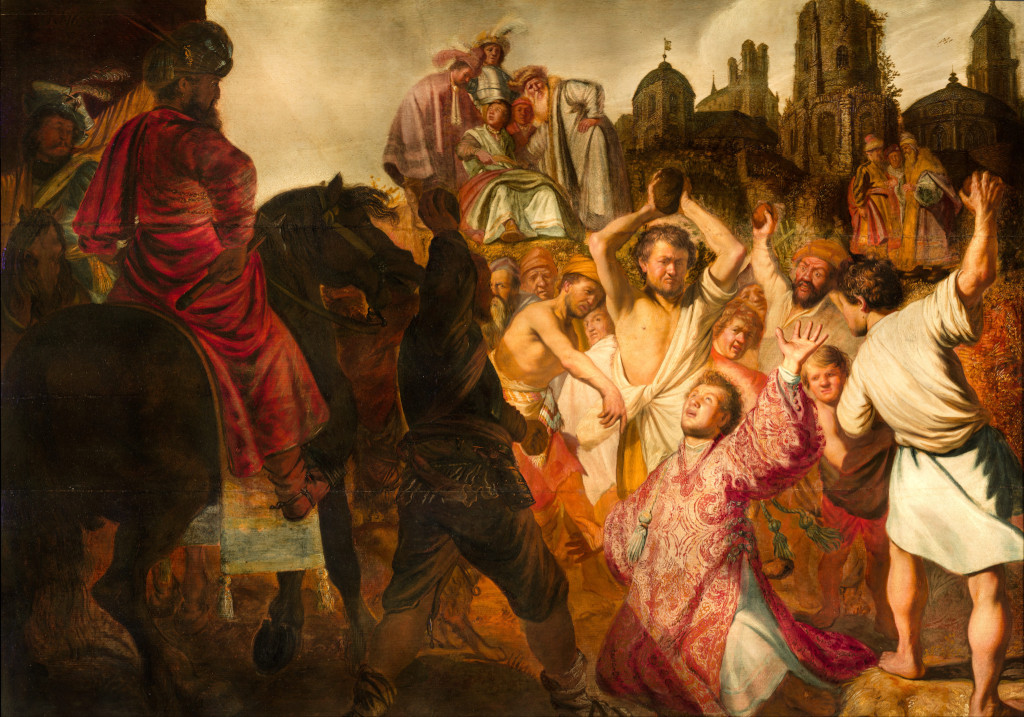
“Then he fell to his knees and cried out in a loud voice, ‘Lord, do not hold this sin against them’; and when he said this, he fell asleep.”

Inexplicably, this line is left off the end of today’s first reading (Acts 6:8-10; 7:54-59) on the Feast of St. Stephen, Deacon and First Martyr.  Also, left off, understandably because of its length, is his long sermon (definitely worth reading chapters six and seven of Acts today) immediately preceding and directly leading to Stephen’s murder.

https://i0.wp.com/www.artbible.info/images/rembrandt_steniging_stefanus_grt.jpg

Rembrandt Harmensz. van Rijn (1606 – 1669), The Stoning of St Stephen, oil on panel (90 × 124 cm) — 1625, Musée des beaux-arts, Lyon

But why this feast the day after Christmas?  Well, just as God Incarnate first entered our world over two thousand years ago yesterday, Stephen was the first Christian to enter heaven.  And how beautifully he did so!  Echoing Jesus on the cross (Lk 23:34), he forgives his killers and then “he fell asleep.”  What a wonderful image that evokes.  As brutal as his death is, he simply slips from this life in faith waiting to be awakened by Jesus (see Mt 9:18-19, 23-26 and Mark 5:21-24, 35-43) in the next life who will be welcoming him to His Father’s house (Jn 14:2).  What greater reward can we ask for after faithfully journeying through this “valley of tears” (see Ps 84:7 — “Baca” means “tears”)?  And what greater incentive could there be to remain steadfast in faith, hope and love (1 Cor 13:13)?

May we all emulate Stephen’s full trust in the Lord, like him never backing down from what we believe, whatever the cost.  And, in a special way, let us pray for all permanent deacons who find their exemplar in the first deacon.  Also, let us not forget those who are in formation for this ministry that they may discern well the vocation that God has chosen for them.

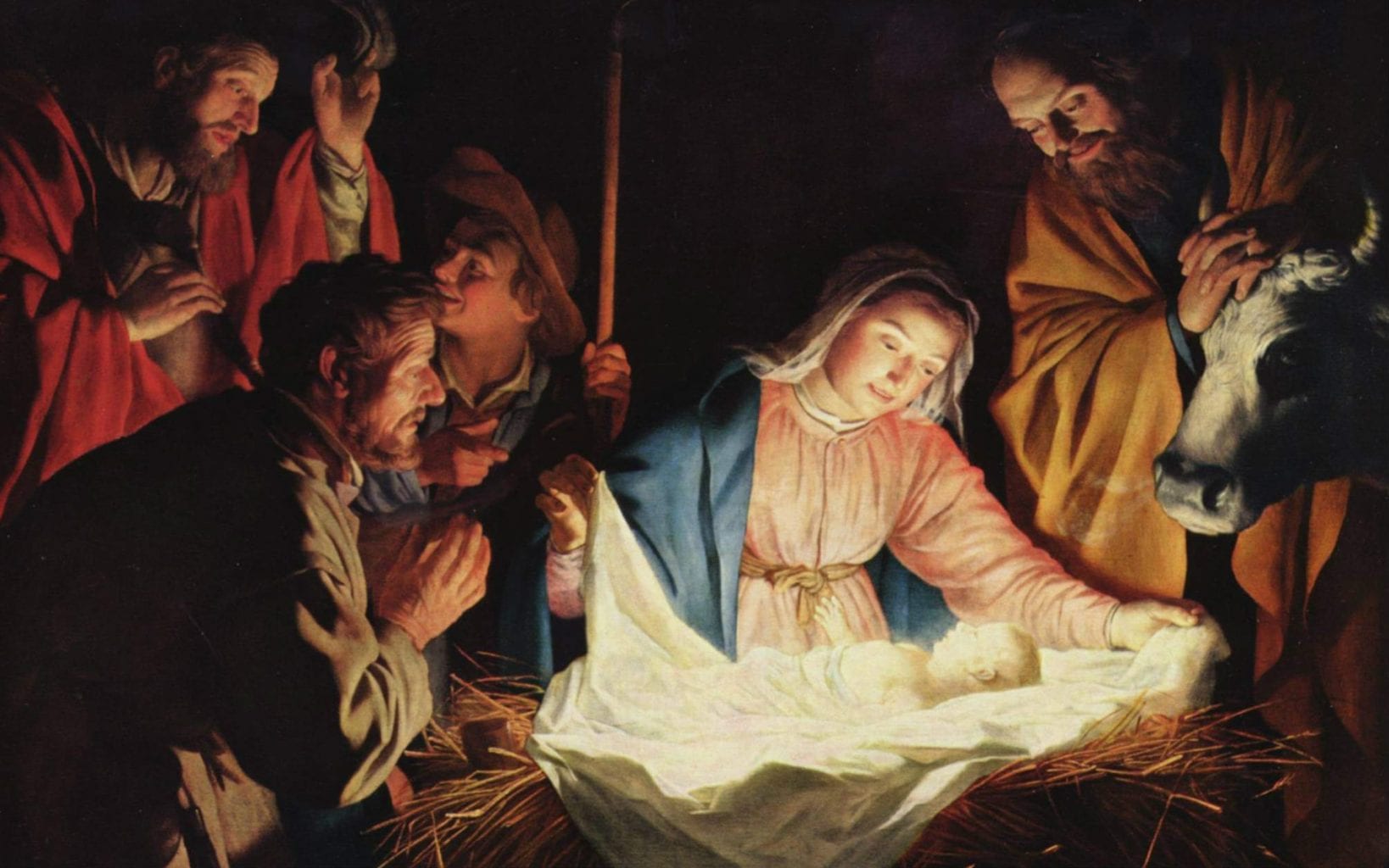
“The people who walked in darkness have seen a great light; upon those who dwelt in the land of gloom a light has shone.”

The first reading at midnight Mass (Isaiah 9:1:6) foretells a great event: a child to be born that will be a cause for rejoicing for He will set the people free and rule a vast dominion.  He will be a counselor, hero, father, and peacemaker.  Also, He will judge justly.  His reign will be everlasting.

And He will bring light, as the first verse highlighted at the top declares.  In the gospels Jesus tells us,

I am the light of the world.  Whoever follows me will not walk in darkness, but will have the light of life.  (John 8:12)

This is truly good news.  We need not stumble around in sin, confusion, sadness, or regret when we have a beacon such as Christ to guide us.  It can be difficult to follow the right path but we can work it out with the Lord’s help.

Bigger problems come when we don’t realize we are in darkness (I’m not a sinner so I have no need of grace and mercy) or when we are so enveloped in darkness that even Jesus does not seem to be able to lead us out (I’m too big a sinner and unworthy of grace and mercy).

For any of us that fall into one camp or the other, we are given the glorious opportunity with the celebration of Jesus’ birthday to embrace the light which is Christ.  For those who see little or no sin in their lives, the light will penetrate us bringing to the fore all the dirt and disarray that sin and vice deposits thus compelling us to begin to clean up.  For those who have sunk into the blackness of habitual sin or deep depression, this light will illuminate a way out thus setting us on the road (back) to the Lord.

May the Light of Christmas bring conversion and renewal to all of us.  God bless us everyone!

https://www.crossroadsinitiative.com/wp-content/uploads/2016/02/Various-Blessing-of-Christmas-Manger-or-Nativity-Scene.jpg


“But who will endure the day of his coming? And who can stand when he appears?”

“…For he is like the refiner’s fire, or like the fuller’s lye.” (Mal 3:2)

Refiner at work with his fire.

This excerpt from the first reading (Malachi 3:1-4, 23-24) provides a wake-up call for Christians.  In the last chapter of his book, the prophet speaks of the coming of God’s “messenger” (the message is the Word) and the preparation He will provide (a foretelling of John the Baptist — see Mt 11:1314; 17:1013; Mk 9:913; Lk 1:17).

The refiner purifies, gets rid of the dross, to produce a pure and beautiful product.  This is what Jesus does to those who embrace Him.  Troubles will come, regardless, but how we handle them makes all the difference.  “Offer it up” is easier said than done, but it is Christ-like since He offered up His life and death to the Father.  And when our own sin causes us distress, consider it a gift, a necessary corrective to get us back on the narrow path.

So, with Christmas just two days away, let us rejoice in the coming of the Savior into the world but, more importantly, let us let Him into our lives, in every aspect, so that He can refine us into His beautiful image.  Painful as it sometimes will be, the final product will be heavenly.


“He will rejoice over you with gladness, and renew you in his love.”

The Old Testament proclamation for this day could be taken either from Song of Songs or Zephaniah.  Song of Songs is very beautiful, of course, but the excerpt from Zephaniah (3:14-18a) is even more lovely, heart-warming, and hopeful still.

Writing a few decades before the fall of Jerusalem in 586 B.C., Zephaniah prophesies in stark terms the devastation and death that divine judgment will bring due to the sins of the people.  But he ends on the hope-filled note above.  These must have been heartening words to a people who suffered terribly in the days of the prophets; it should evoke the same sentiments in us today, especially in light of Christ’s Incarnation.  Consider this insight from The Navarre Bible: Minor Prophets:

The Christian, in reading these verses, cannot but be reminded of the scene of the Annunciation: Mary, too, the humble virgin (Lk 1:48), is invited to rejoice (Lk 1:28) and not to fear (Lk 1:20), because the Lord is with her (Lk 1:28).  And indeed, with the Incarnation of the Word, the Lord did come to dwell among his people, and the salvation that was promised came to pass. (270)

When reading the headlined verse, staying in the New Testament, I cannot help but be also reminded of Jesus’ words:

I tell you, in just the same way there will be more joy in heaven over one sinner who repents than over ninety-nine righteous people who have no need of repentance. (Luke 15:7)

This comes as a blow to those who would attempt to distinguish a supposed Old Testament “God of Wrath” from a New Testament “God of Love.”  No, God is unchanging.  But He does desire a change, a conversion, a renewal, in us.  And how He rejoices when we accept the graces and love He so longs to shower upon us!

For any person who thinks he is useless, of no account, despised, or irredeemable, this is the best news.  We can make the Lord, and all of heaven, rejoice!  He who does not need us wants us and would do (and has done — Christmas is four days away, remember) everything for us. God truly has a plan for each of us.  No matter how badly we’ve strayed from it, there is always time to reorient ourselves, even in our last moments.  But let’s not wait until then.  This is the time of conversion!  Let’s tarry no longer.

https://s-media-cache-ak0.pinimg.com/736x/15/f5/36/15f536471ad2e45f79e2142f8fc7128a.jpg