“They will see the glory of the LORD, the splendor of our God.”

The first reading yesterday gives us the entire 35th chapter of Isaiah (vv. 1-10).  It is a beautiful and uplifting passage which contains a promise of redemption for a devastated people.  The land will be healed, and the people too, both physically and spiritually, culminating in the final verse: “They will meet with joy and gladness, sorrow and mourning will flee.”

This provides great comfort for us today as well.  No matter what depths we reach physically, emotionally, or spiritually, we know that we have won through the triumph of the Son of God, the promised one, over sin, Satan, and eternal death.

This from St. Justin Martyr’s Dialogue with Trypho (69, 6) expands on Jesus as fulfiller of the promise in Isaiah (as referred to in The Navarre Bible: Major Prophets, 159):

https://upload.wikimedia.org/wikipedia/commons/thumb/4/46/Engraving_of_Justin_Martyr_-_2.jpg/220px-Engraving_of_Justin_Martyr_-_2.jpg

The spring of living water which gushed forth from God in the land destitute of the knowledge of God, namely the land of the Gentiles, was this Christ, who also appeared in your nation, and healed those who were maimed, and deaf, and lame in body from their birth, causing them to leap, to hear, and to see, by His word. And having raised the dead, and causing them to live, by His deeds He compelled the men who lived at that time to recognise Him. But though they saw such works, they asserted it was magical art. For they dared to call Him a magician, and a deceiver of the people. Yet He wrought such works, and persuaded those who were [destined to] believe in Him; for even if any one be labouring under a defect of body, yet be an observer of the doctrines delivered by Him, He shall raise him up at His second advent perfectly sound, after He has made him immortal, and incorruptible, and free from grief.

“The root of Jesse, set up as a signal for the nations.”

Today’s reading from the prophets again brings us the great Isaiah (11:1-10).  While the beginning of this chapter is most famous for giving us the classic Gifts of the Holy Spirit (or at least six of the seven — see verse 2), I wish to focus on the line that occurs in the last verse (in the headline) of the passage read this day.

What a “signal” this descendant of Jesse’s son David was and is!  Even the description of what this long-awaited messiah would be blessed with — wisdom, counsel, understanding, strength (fortitude), knowledge, and fear of the Lord — should be attractive to anyone.  And of course, the entire Gospel message of the New Testament should be compelling to anyone open to it.  So why is it that the world seems to be moving away from Christ?  Certainly one factor must be that the “signal” coming in is distorted for some and is entirely lost for others.

A “noisy” culture tries to do everything it can to distract us from what is most important.  The explosion of media over the last century has mainly worked to block out the message of Jesus or distract us from it (acknowledging that there have been many good efforts to use these media to spread the Gospel).  Conveniences of all kinds have not lessened the busyness of our lives; they have just provided more diversions or allowed us to pursue more activities that pull us away from time to quietly pray and contemplate.

Let not a storm of “interference” cause us to dampen Jesus’ signal or lose it altogether.  Rather, let us keep our “antenna” extended and in good working order so as to continually be “attuned” to Christ and His will and mission for us.


Image result for signal

“For over all, the LORD’s glory will be shelter and protection.”

Image result

Monday’s first reading, again from Isaiah (4:2-6), is a very short chapter with a very hopeful message after Jerusalem is warned in the previous chapter of impending calamity.  The passage for the day culminates in the consoling words above after the Lord reiterates news of the devastating judgment He is to bring about on Jerusalem for its unfaithfulness.

We should strive every day to increase our trust that the Lord is our “shelter and protection.”  Any good parent, at the very least, wants his children to have a home and to be safe.  Our good God is able to effect this perfectly.  In this reading, we are reminded of God’s care for His people after the Exodus.  It served as a reminder to the people of Isaiah’s time, as it should us today, that the Lord is never far away from those who are faithful to Him (even when they are less than faithful).

But this reading also looks forward to God’s greatest work: our redemption.  It begins this way:

The branch of the LORD will be luster and glory,
and the fruit of the earth will be honor and splendor…

From the Navarre Bible:

‘Isaiah speaks of this fruit [“fruit of your womb” in Lk 1:42] when he says: In that day…the fruit of the land shall be the pride and the glory of the survivors of Israel.  What can this fruit be, if not the Holy One of Israel, who is at the same time the seed of Abraham, the shoot of the Lord, the flower that springs from the root of Jesse, the life-giving fruit of which we all partake?’ (Baldwin of Canterbury, De salutatione angelica).

Let us not neglect to partake of the life-giving Jesus in Holy Communion and prepare well for this coming to us daily and at Christmas through prayer and Confession.

Amazing Jesus

Today’s gospel reminded me of the following post I submitted three years ago regarding this reading.  Worth mulling over again, I think.

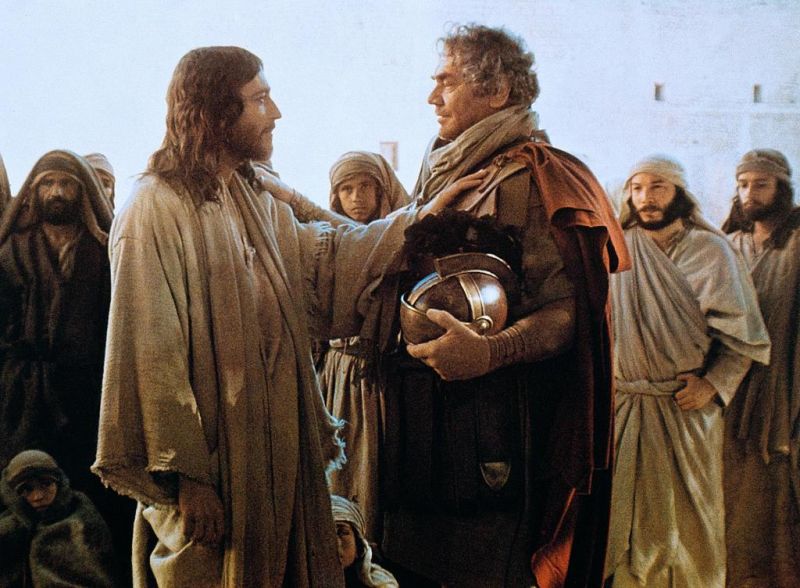
“When Jesus heard this, he was amazed.”

By the way, I fully expect Jesus and the centurion to look like these actors from my favorite movie about Christ:

Image result for ernest borgnine as the centurion

“Come, let us climb the LORD’s mountain…that he may instruct us in his ways, and we may walk in his paths.”

The great prophet Isaiah, very early on in his book (2:1-5), prophesies about Judah and Jerusalem.  He foresees a day when the people will climb a  mountain to the Lord to be instructed in truth and thus to be able to follow His will by staying on the straight and narrow.

Well, the centuries of longing ended with the advent of Jesus Christ.  How often do we hear in the Gospels about Jesus preaching and teaching from a high place (most famously the lengthy Sermon on the Mount)?  We are of course reminded of the Exodus story of Moses being summoned by God to work his way up Mt. Sinai to receive the Ten Commandments (Ex 20:1-17).  Just so, multitudes came to Jesus on mountains where they heard proclaimed the Good News from a man who claimed the right to give new commandments (Jn 13:34).

https://readingacts.files.wordpress.com/2014/10/sermon-on-the-mount1.jpg

Unfortunately, not unlike their forebears (particularly during the Golden Calf debacle, but all through history), most everyone who heard Jesus abandoned Him when difficulties arose.  Listening to God’s instructions and living them is much easier when we are not directly challenged about such matters, or when it means embarrassment or even danger to ourselves.

We ought not forget the eschatological aspect either.  The Navarre Bible commentary for this passage reminds us that the “Church uses this text in the liturgy of the firs Sunday in Advent, encouraging us to look forward to the second coming of Christ as we prepare for his first coming at Christmas.” (54)  We recall Jesus’ coming two thousand years ago, we anticipate His final coming in glory, all the meanwhile inviting Him to fill us more completely with His graces so that we can better tread the “constricted…road that leads to life” (Mt 7:14).

Dear Lord, please strengthen me for the battle against sin, Satan, and death.  May I walk the narrow road that leads to salvation by adhering to God’s laws more out of love for Him than in fear of what could happen to me.


“The Son of Man has come to seek and to save what was lost.”

(Submitted by me for the bulletin three Sundays ago as a member of my parish’s Spiritual Life Committee.  I suggest you click this link to review the readings before reading the rest of this post.)

Today we find a particularly wonderful example of how all four Scriptures proclaimed at Mass tie together to provide us a hopeful message.

You rebuke offenders little by little,

warn them and remind them of the sins they are committing,

that they may abandon their wickedness and believe in you, O LORD!  (Wisdom 11:26-12:1)

With these words from our first reading, we ought to find great comfort.  God is not content to leave us mired in sin but desires to bring us out of the muck to find fulfillment in Him.  His rebukes, warnings, and reminders may come in many forms: a tweak of conscience, a bad outcome, an embarrassment, a friendly intervention, or countless other ways.  We should heed these happenings in our lives by turning to the Lord and reforming our lives so as to live as He commands.

The LORD is gracious and merciful,

slow to anger and of great kindness.  (Psalms 145:8)

Today’s psalm then emphasizes the mercy shown by God.  He does not give us what we deserve but rather provides us opportunity after opportunity to be reconciled to Him.  In this Year of Mercy, let us not miss the chance to embrace the Divine Mercy that the Almighty wishes to pour out on each and every one of us.

We always pray for you…

that the name of our Lord Jesus may be glorified in you,

and you in him,

in accord with the grace of our God and Lord Jesus Christ.  (2 Thessalonians 1:11, 12)

How do we glorify God, as Paul insists upon?  By living as Christ taught us and showed us.  By working on eliminating sin and vice in our lives, and begging for Jesus’ assistance and mercy, we allow the Lord more room in our hearts and souls so He can fill us with His graces, helping us to live what we profess to believe.  And we have the whole Church, in heaven, in purgatory, and here on earth, praying for us!

“Today salvation has come to this house…

For the Son of Man has come to seek

and to save what was lost.”  (Luke 19:9, 10)

Image result for jesus carrying the lost sheep

Finally, these are the words we ultimately want to hear.  Having confessed our sins and repaid our debts, we, like Zacchaeus, are freed from the bondage of sin and become reconciled to the Jesus who saves.

A daily examination of conscience and regular recourse to the Sacrament of Reconciliation are great gifts to us.  How will you take advantage of these to draw close

“Anyone who is so ‘progressive’ as not to remain in the teaching of the Christ does not have God; whoever remains in the teaching has the Father and the Son.”

If you heard today’s first reading (2 Jn 4-13), you heard almost an entire book of the Bible.  2 John is the second shortest book (with the least amount of verses — thirteen; 3 John has two more verses but the least number of words) in Scripture.  Yet what a powerful message can be packed into just a few words of the Word.

We hear much these days about progressivism.  But what is true progress?  The answer comes a few verses before the headline:

I ask you,
not as though I were writing a new commandment
but the one we have had from the beginning:
let us love one another.
For this is love, that we walk according to his commandments;
this is the commandment, as you heard from the beginning,
in which you should walk.  (vv. 6-7)

There is no legitimate moving forward without authentic love as modeled by Christ.  Committing abortion is not loving or progressive.  Redefining marriage is not loving or progressive.  Eliminating God from the public square is not loving or progressive.  Violent protesting is not loving or progressive.

Without a return to Gospel values, without “remain[ing] in the teaching of the Christ” we only see regression.  John the Evangelist, in this letter, shows us a better way for ourselves (conversion starts here) and for our nation.

Image result for john the evangelist

Carlo Crivelli
Style: Early Renaissance
Lived: 1435 – 1495 (15th century)

My latest article: “The Year of Mercy and the Eucharist”

My latest piece for Homiletic & Pastoral Review. It is based on talks I gave in Indianapolis. The editor, Fr. Meconi, decided to run it as a wrap-up to the Year of Mercy, but I believe you will find its content of value well beyond the closing of this Jubilee Year.

It is rather lengthy but I hope you will read it and add any questions, comments, or conversation starters to the Comments section at the end of the article. I will check it regularly and will be happy to engage in a discussion with you.

I hope you enjoy it.

Thanks and God bless.

“When you have done all you have been commanded, say, ‘We are unprofitable servants; we have done what we were obliged to do.’”

The verse I share above comes from the end of today’s gospel reading (Lk 17:7-10).  It also happens to be the inspiration for the name of this blog and the “life verse” that I have used in the signature line of my emails for many years.

There is much that can be said of the central theme of this passage: humility.  First, let me say that in recent months it has been in short supply.  Not only from the candidates, particularly the ones at the top of their respective tickets, but also from their respective advocates.  It is good to express informed views, but only when these views are based on the truth of Jesus Christ (my favorite definition of humility: acknowledgement of the truth).  It is true wisdom to confess that, ultimately, God is in charge.  Then it is easy to remember that God is God and that we are not.  The Lord is the true King of our lives — something no earthly leader can ever honestly claim.

A worthwhile exercise is to find all instances of the word humble or humility in the Bible and then check out pride or proud.  Which of these habits do you wish to exhibit?

May God bless us and may He bless the United States of America.

“Bear your share of hardship for the gospel.”

The second reading today is from Paul’s Second Letter to Timothy (1:6-8, 13-14).  In this passage, Paul speaks to Timothy directly (and to all of us as well): cowardice and shame have no place in us who are called to proclaim and live the gospel regardless of the consequences knowing that the Holy Spirit dwells in us and helps us.

Happily, today we also heard Luke 17:5-10 which includes my life verse:

When you have done all you have been commanded,
say, “We are unprofitable servants;
we have done what we were obliged to do.”

I have put the reference to this verse in the signature line of my emails for many years now.  It also inspired the name of this blog.  In addition, it ties in well with the passage from Paul (above) that preceded it at Mass today.

It is our duty to live the values that God inspired in divine revelation.  Through our example and words we propagate the kingdom of God.  But do we deserve any special accolades for doing so?  No.  We have been commanded by the Father and Son, and empowered by the Holy Spirit, to live what we profess — regardless of the consequences.

Humility guards all other virtues.  It simply acknowledges the fact that God is God and we are not.  Let us be mindful of this status in all that we do so that we can fulfill the Lord’s will on earth so as to be happy with Him forever and heaven while helping along as many others as possible to that eternal banquet.

Image result for unworthy servant