“We are ambassadors for Christ.”

“We are ambassadors for Christ.”

For today’s optional memorial honoring the Capuchin Franciscan St. Lawrence of Brindisi, the Mass on EWTN used 2 Cor 5:14-20 for its reading.  Falling under the heading of “The Ministry of Reconciliation” the focus of this passage is how Christ’s death reconciled the entire world to Himself.

Particularly striking to me today in hearing this proclamation was the words in the headline.  It got me thinking: What does it mean to be an ambassador, anyway?
Merriam-Webster primarily defines ambassador this way:

:  an official envoy; especially :  a diplomatic agent of the highest rank accredited to a foreign government or sovereign as the resident representative of his or her own government or sovereign or appointed for a special and often temporary diplomatic assignment

Wow.  To be in Christ means to be an official envoy of the highest rank on His behalf.  What an extraordinary responsibility!  This is certainly a special assignment and most definitely temporary.  But when this brief stint is completed, and we meet the Lord face to face, will we be able to say we fulfilled this duty with honor?  That is, did we represent our sovereign well, particularly in his “entrusting to us the message of reconciliation” (v. 19) that is the diplomatic assignment given to all of us who are His “new creation” (v. 17)?

I have remarked often how, following the Lord’s Prayer in Matthew, Jesus emphasizes one part of that prayer (“forgive us our debts, as we forgive our debtors” — Mt 6:12) by doubling down on it immediately afterward (“If you forgive others their transgressions, your heavenly Father will forgive you.  But if you do not forgive others, neither will your Father forgive your transgressions.” — vv. 14-15).  This message of reconciliation has to be lived personally in order to convey it to others.  A difficult challenge to say the least.  Yet we must do this so that we can confidently — and with personal conviction sprouting from living the message ourselves — proclaim the good news that Christ has reconciled us to God, urge everyone to accept this message, and then live it by extending that same forgiveness and reconciliation to each other.

A better reading could not have been chosen for this day.  St. Lawrence, in the wake of the Reformation, learned many languages and preached thousands of sermons throughout central Europe, campaigned against the Turks, and was noted for his diplomatic skills.  He was eventually named a doctor of the Church (one of only 35 to date).  A true ambassador for Christ and His vicar, the message of reconciliation he conveyed surely was not lost on his hearers.  A model for us in our “diplomatic relations” no matter how large or small.

http://i0.wp.com/catholicism.org/wp-content/blogs.dir/1/files/2009/07/saint-lawrence.jpg?w=300

St. Lawrence of Brindisi, pray for us.
Prayer for Those Who Will Die Today

Prayer for Those Who Will Die Today

May those who die today who, through strict justice, deserve condemnation, beg for the divine mercy at the Lord’s feet, even in their last breath, and thus be saved.


I try to remember each day to say this prayer I developed.  We can recall three Scripture passages that will help us here:

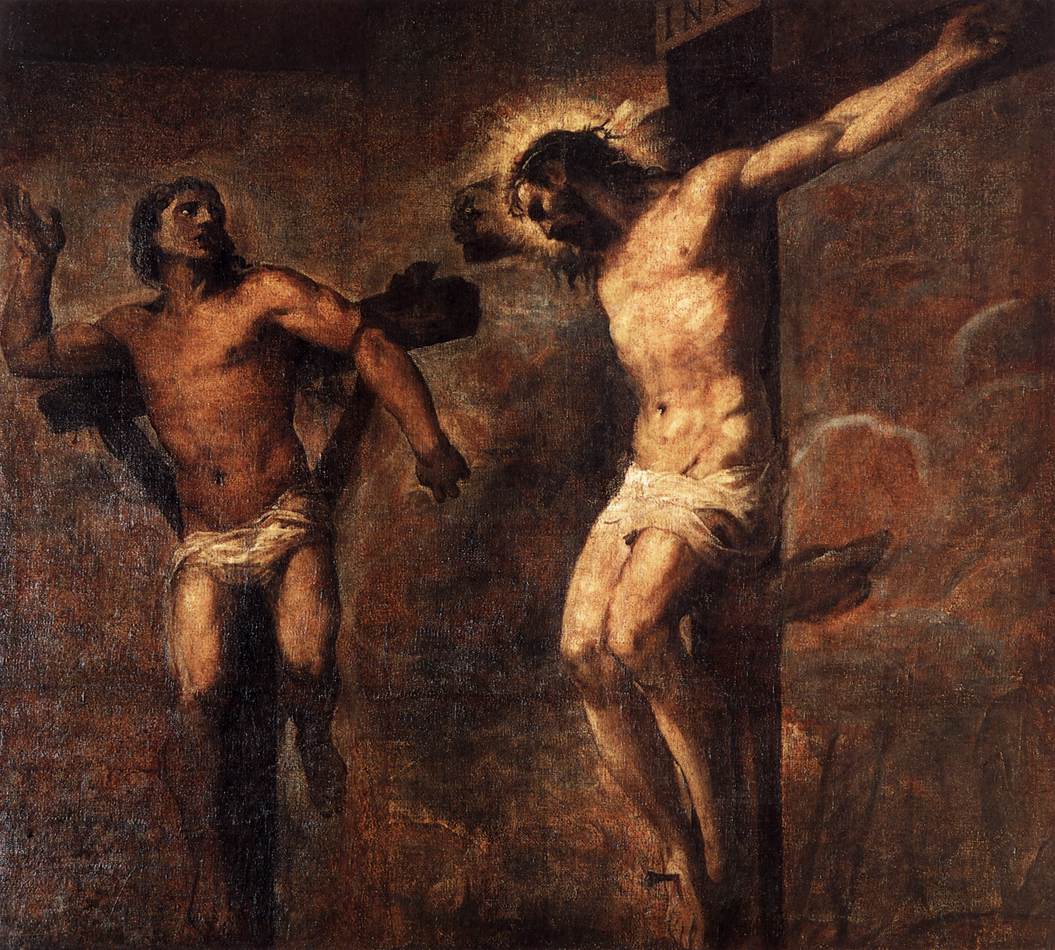
1. “Amen, I say to you, today you will be with me in Paradise.” (Lk 23:43)

Jesus’ words to the criminal, maybe moments before they both expired, gives us hope that it is never too late to sincerely repent regardless of our sins.  Invoking the intercession of this so called Good Thief, traditionally known as St. Dismas, is surely powerful here.

https://i0.wp.com/www.jesuswalk.com/kingdom/images/titian-christ-and-the-good-thief.jpg

Titian, Christ and the Good Thief, c. 1556

2. “Going out about five o’clock, he found others standing around, and said to them…’You too go into my vineyard.'” (Mt 20:6-7)

In the parable of the Workers in the Vineyard (Mt 20:1-16) Jesus’ lesson is that all are welcome into the Kingdom no matter how late they come on board.  The landowner in the story cautions us thus: “Are you envious because I am generous?”  We are to work with the landowner (God) to bring souls to salvation, even those (especially those) furthest away.

3. “First of all, then, I ask that supplications, prayers, petitions, and thanksgivings be offered for everyone …This is good and pleasing to God our savior,  who wills everyone to be saved and to come to knowledge of the truth.” (1 Tm 2:1, 3-4)

God “wills everyone to be saved.”  Again, who are we to not cooperate with the Lord as we read His words in the Bible.  Paul writes to Timothy about a spiritual good work that is “good and pleasing” to God.  We must not neglect this task of mercy.


“They stripped and beat him and went off leaving him half-dead.”

The familiar parable of the Good Samaritan graces us in today’s gospel (Lk 10:25-37).  Jesus, responding to a scholar who wished to justify his good standing in the eyes of God (and, quite possibly, in the eyes of Jesus and those who were listening in), expounds on the meaning of being a good neighbor through the use of a story to which all present could relate.

Augustin Théodule Ribot, The Good Samaritan, before 1870

The focus of discussion on this passage usually is the kind Samaritan who helps an injured man while others avoid that same man; certainly this can give us much to ponder in how we relate to others.  But here let us turn to the victim instead.  Like the kindly stranger, this unfortunate man can be considered from at least two aspects: as Christ and as ourselves.

As Christ, who was unjustly persecuted, finally endured the Passion, but who ultimately had come to his aid only Simon of Cyrene (albeit by force) who aided Him physically and some women (including mom) who gave Him emotional support.

As ourselves, there are times that we can certainly relate to feeling beaten down and not receiving the help and support we expect from those close to us or from those in a position who should feel obligated to do so.  Just as Christ was undoubtedly grateful for the support He received in His times of trial, whether it be from angels (see Lk 22:43, Mk 1:13 and Mt 4:11) or men, so we should be thankful to all those who provide physical, emotional, and spiritual support to us, especially when assistance comes from unexpected corners.

Let us never fail to thank with words, deeds, and especially prayer, those Good Samaritans in our lives, whether in heaven or on earth.

“If they have called the master of the house Beelzebul, how much more those of his household!”

Yesterday’s gospel reading (Mt 10:24-33) continues relaying Jesus’ instructions to His apostles as He prepares to send them out to spread the Good News.  In this part of the discourse, Jesus emphasizes the need for courage under the persecution that is sure to come for all of them, Jesus in the first place.

This message was particularly powerful to early Christians, many of whom first hand were experiencing persecution, sometimes even to death, due to their faith.  And it has heartened numerous souls throughout the ages who have undergone similar trials.  So it is for us today, whether it be those of us in the west whose Christianity, more and more, is the subject of ridicule and scorn and whose religious freedom is being threatened and even violated, or, even worse, those the world over who suffer death through genocide for clinging to Christ.

A key verse in the passage, that which closes it, is the one highlighted in the heading of this post.  In considering this sentence, I cannot help but think of Jesus’ words earlier in Matthew (6:23; cf. Lk 11:35): “if the light in you is darkness, how great will the darkness be.”  When powerful persons or popular opinion makes good evil and evil good we are in deep trouble, existential trouble.  When Jesus is portrayed as a “hater” and His Word “hate speech” then God Himself is being defied.  This sacrilege is not going unnoticed and never has.  Just recall when the Israelites in the desert, who had recently miraculously won their freedom from oppression in Egypt, accused Yahweh of murderous intent.  They received a just punishment of venomous snakes in their midst (Num 21:4-9).

Fyodor Bruni, Moses and the Brazen Serpent (1840)

Today those snakes take the form of public figures (some calling themselves Christian) and mass movements advocating sin and denouncing virtue.

We must stay strong and uncompromising.  Take Jesus’ words in this same passage to heart:

You will be hated by all because of my name, but whoever endures to the end will be saved. (v. 22)

And what does it mean to be saved?

Whoever wishes to save his life will lose it, but whoever loses his life for my sake and that of the gospel will save it. (Mk 8:35; cf. Mt 16:25, Lk 9:24)


“Follow me.”

(Submitted by me for today’s bulletin as a member of my parish’s Spiritual Life Committee.)

In today’s gospel reading (Lk 9:51-62) Jesus utters words meant not only for His hearers on the way to Jerusalem but for all generations: “Follow me.”

What does this entail?  As we read on in the passage from Luke, Jesus wants no hesitation to this call.  Worldly obligations are not to get in the way of our following the Lord.  Throughout the ages persons have been, and continue to be, called by the Lord to do this radically. In the first reading, Elisha takes up Elijah’s prophetic mantle, only hesitating long enough to perform one last act of charity for his people at home and in so doing breaking ties with his former life by destroying his farming equipment; he shows that he is “all in” for God.  He puts into action the words from the Responsorial Psalm: “I set the LORD ever before me.”  Today, as in ages past, there are those who are called to dedicate their lives to God in a special way by embracing ordained or consecrated life, especially those in a cloister or those doing foreign mission work, where contact with family may be very limited.

But each of us is called to live radically this gospel message.  This does not mean that we forsake the duties inherent to our state in life.  We are to take seriously our family obligations: parents to children, children to parents, husbands to wives, and wives to husbands.  More broadly, we are to love our neighbor as ourselves, as Paul, quoting the Old Testament (Leviticus 19:18) and the New Testament (Matthew 22:39), tells us in today’s second reading.  Yet we must do all this keeping in mind the greatest commandment:  “You shall love the Lord, your God, with all your heart, with all your soul, and with all your mind” (Matthew 22:37).  The Holy Family is the ultimate example of a household in right relationship with God, each other, and everyone else.

What else does Jesus ask of us here?  “You, go and proclaim the kingdom of God.”  This, again, is a duty for each one of us.  It is not a task set aside for clergy and religious only.  Through our words and our deeds we are to make Christ present to everyone we encounter.

Is there anything holding you back from following Jesus wholeheartedly?

“Everyone who listens to these words of mine and acts on them will be like a wise man who built his house on rock.”

“…and everyone who listens to these words of mine but does not act on them will be like a fool who built his house on sand.”

Today’s gospel (Mt 7:21-29), which concludes the Sermon on the Mount, blows away the wishful thinking of the “once saved, always saved” crowd.  Matthew the Evangelist closes these three chapters — a veritable catalogue of Jesus’ teachings — with a paragraph containing the solemn words of the headline and the converse below it.

How seriously are we to take this?  “These words of mine” are not merely wise utterances of a simple sage.  “These words” are Jesus Himself, the Word of God (see the prologue to John’s gospel).  The very last line of this chapter in Matthew has the crowds declaring that Jesus “taught them as one having authority” (v. 29).  In His day, many of Christ’s hearers acknowledged His authority to teach in this way and took it seriously.  Today, an “easy believism” pervades Christianity, telling the adherent that it is simply “believe and be saved” (whatever “believe” means) or that no one goes to hell (if there even is a hell).  No consequences for sin to us personally.  Really?

Jesus words here should disabuse anyone holding those perspectives of their false notions.  Scripture is not designed to have its words cherry picked or selectively proof texted so that it aligns with one believes (or wishes).  An extraordinarily important concept for reading the Bible properly is something that has been mentioned more than once in these posts, but of which I never tire of repeating, and that is the “content and unity” of Scripture.  Let me quote from the Catechism of the Catholic Church (which gets this from the Vatican II document Dei Verbum):

Be especially attentive “to the content and unity of the whole Scripture”. Different as the books which compose it may be, Scripture is a unity by reason of the unity of God’s plan, of which Christ Jesus is the center and heart, open since his Passover.

Scripture is not pitted against itself.  Beware of any person, any article, or any book that tries to argue or convince you otherwise.  Any attempt to divide Scripture or set portions aside (whether through ignorance or deceit) marks an attempt to misconstrue the one Word.  Listen to St. John of the Cross:

In giving us his Son, his only Word (for he possesses no other), [God the Father] spoke everything to us at once in this sole Word – and he has no more to say. . . because what he spoke before to the prophets in parts, he has now spoken all at once by giving us the All Who is His Son. (see CCC 65)

This one Word is Jesus who tells us, in the inerrant gospels, “I am the way and the truth and the life” (Jn 14:6).  In this one reading, Jesus shows us the way to life through the authoritative, i.e., truthful, teaching that He gives because He is God.

So let us come to know the Word, the entire Word, better through the Mass, the Bible, and the Church (“the house…set solidly on rock” — v. 25), in order to be faithful to Jesus, thus becoming the wise person who acts on His word.


“How long will you straddle the issue? If the LORD is God, follow him; if Baal, follow him.”

The headline gives us the first words of Elijah in today’s famous Old Testament reading in the prophet’s showdown with the prophets of Baal at Mt. Carmel (1 Kgs 18:20-39).  Elijah, declaring himself the last prophet of Yahweh, challenges 450 prophets of Baal to a final test to determine, finally, who is the one true God.  He proposes that both he and the prophets each sacrifice a bull, but they are to call on their respective deities to consume it with fire.  The Baal worshipers spend hours gesticulating, calling out, and slashing themselves but “no one was listening.” (v. 29)  In one of my favorite lines, and one of the funniest in the Hebrew Scriptures, Elijah taunts them to spur them on: “Call louder, for he is a god and may be meditating, or may have retired, or may be on a journey.  Perhaps he is asleep and must be awakened.”  (v. 27)  Finally, probably exhausted from their efforts, the prophets yield to Elijah.  He prepares the bull by putting it in a trench and having it soaked with water time and time again.  Calling out to the one true God, fire consumes not only the bull, but the wood, stones, dust, and water around the altar as well.  All concede, proclaiming, “The LORD is God! The LORD is God!” (v. 39)

Elijah’s opening question is the question for us today: “How long will you straddle the issue?”  Do we follow the one true God or a false god or gods?  Recall the first commandment: “You shall not have other gods beside me” (Ex 20:3).  Jesus emphasizes this point and ups the ante, taking His cue from Deuteronomy (6:5): “You shall love the Lord your God with all your heart, with all your soul, with all your mind, and with all your strength.” (Mk 12:30; cf., Mt 22:37).

The time has come to get off the fence.  Even though modern culture militates heavily against us, and even though family and friends who profess the Faith often concede to these immoral times, we must remain strong in our convictions.  Elijah was one against a multitude, but his faith in the Almighty won the day and converted a nation.  This should be a great encouragement to us.  Jesus Himself said, “Amen, I say to you, if you have faith the size of a mustard seed, you will say to this mountain, ‘Move from here to there,’ and it will move. Nothing will be impossible for you.” (Mt. 17:20).  Do we completely trust Jesus?

Concession to sin is not an option for us.  And even though we can feel powerless and overwhelmed by the iniquity of these times and persecuted for standing with God, we can remain confident as long as we are on the Lord’s side.

The one verse that is skipped between today’s reading and tomorrow is this:

Then Elijah said to them, “Seize the prophets of Baal. Let none of them escape!” They seized them, and Elijah brought them down to the Wadi Kishon and there he slaughtered them. (v. 40)

Worse than physical death, this is the eternal fate of those who know better but do not repent of their evil ways.  Let us not be in that number with the goats, but be among the sheep (see Mt 25:31-46), not counting the cost here on earth, but always anticipating our heavenly reward for remaining faithful until the end.

https://shoebat.com/wp-content/uploads/2014/03/www-St-Takla-org-116-Elijah-Kills-Prophets-of-Baal-1.jpg

“‘Come over to Macedonia and help us.’ … we sought passage to Macedonia at once, concluding that God had called us to proclaim the Good News to them.”

As Paul and his companions continue their journey (today’s first reading: Acts 16:1-10), guided by the Holy Spirit and Jesus, they finally are allowed to continue their mission in Macedonia.  This is particularly striking and poignant to me as I will very soon become very familiar with a different Macedonia much closer to home.

But the message is quite clear: the Holy Spirit sends evangelizers to the places where they are most needed.  In the vision described in the headline, a Macedonian makes this plea to Paul.  Maybe the Macedonians themselves did not realize this need, but the Spirit of Jesus, interceding for them, knew best what was imperative for that place.

Really, though, what place does not need the Good News proclaimed to it?  This is an excellent reminder to all of us of our call to catechize and evangelize at all times and in all places.  As I consider my opportunity in Macedonia, I realize I need to be more fervent in my efforts (through prayer and much assistance from the Lord) to advance the kingdom whenever and wherever I am.

To bring the point home even more strongly, after Mass today, before the tabernacle, I opened up the Bible randomly and my eyes alighted on the beginning of Acts chapter 20:

Paul had the disciples summoned and, after encouraging them, he bade them farewell and set out on his journey to Macedonia. As he traveled throughout those regions, he provided many words of encouragement for them. (vv 1-2)

So I must encourage renewal and be encouraged in my mission to spread the Gospel.


“Brothers, select from among you seven reputable men, filled with the Spirit and wisdom, whom we shall appoint to [serve at table].”

In today’s first reading (Acts 6:1-7) we are introduced to the first deacons of the Church.  The apostles, finding that they were spreading themselves too thin, gathered their followers and laid hands on (i.e., ordained) seven men for ministry, the first chosen being Stephen (his fate will be made known the first two days of next week).  Consequently, we learn, that conversions, even among priests of one or more Jewish sects, increased dramatically.

The Greek word diakonia, used in verses one and four, means ministry or active service.  Without the help of dedicated men like the first deacons (and all faithful deacons since) our priests and bishops would not have enough time and energy to “devote ourselves to prayer and to the ministry [diakonia] of the word” (v. 4).  With the rapidly growing Christian movement in the first centuries anno Domini, it was necessary to have special helpers to take care of the needs of this growing community.

Since Vatican II re-introduced the permanent diaconate, many generous souls, married and not married, have discerned a call to this important vocation.  Deacons do so much more than assist at Mass and give a homily from time to time.  Yet few parishioners realize how much they do within and outside of the parish — and how much they sacrifice in so doing.  All this while not being dispensed from also devoting themselves to prayer and to the ministry of the word (it’s not just for priests).

So, give your deacon a hug or a hearty handshake the next time you see him (or at least give him a shout out on social media today).  Thank him for his ministry and his service.  Ask him about his vocation and how he arrived at it.  Pray for all such men regularly, especially today, that they will be strengthened by the grace of their ordination to serve well all those whom they encounter.  Meanwhile, be mindful to encourage Catholic men in your family, parish, workplace, study group, or elsewhere, that you feel would be a good fit for this life, to consider such a vocation (he can talk to the pastor or check out the diocesan website).

Let us not forget those in formation, as well.  I have been privileged to come to know many deacon candidates in the last several years.  I extend, and encourage you to do so as well, my prayers for them that they discern well as they work, study, and most importantly, pray, through their formation.  So let me send my best wishes to the men of Chicago (being ordained on June 4), Lafayette (IN), Indianapolis, Lexington, Louisville, Owensboro, Evansville, Wheeling-Charleston, and Springfield.  A great bunch of guys supported by a great bunch of gals.  Thank you for taking the journey.  God bless you all!


“So they left the presence of the Sanhedrin, rejoicing that they had been found worthy to suffer dishonor for the sake of the name.”

Since Easter, we have been privileged to hear proclaimed at Mass the immediate aftermath to the Resurrection as recorded by St. Luke in the Acts of the Apostles.  Today’s first reading (Acts 5:34-42) details the end of the trial of the apostles by the Sanhedrin.  It highlights the insight of the revered (to this day) Pharisee Gamaliel who, knowing that some of his colleagues wished to put the apostles to death for their preaching and miraculous acts, issues a warning to the assembly that they may be opposing God by opposing the apostles.  The gathering relents, flogging the men and ordering them not to preach in Jesus’ name.  The followers of the Nazarene rejoice in this humiliation and go on to continue “teaching and proclaiming the Christ, Jesus” (v.42).

The question for us today is: How well do we imitate the apostles?  In the United States and most of the western world, while we can surely acknowledge the growing antipathy toward religion, particularly Christianity, we certainly do not fear for our lives — as the earliest Christians did — because we hold to the Christian faith.  But are we willing to “suffer dishonor for the sake of the name”?  What price would we pay for extolling Jesus?  Being made fun of?  Ostracization?  Losing friends?  Losing a job?  And what do we have to gain?  Much more: Heaven.

We are commanded by Jesus in scripture to evangelize (see Mt 28:19-20); it is not simply a suggestion.  So sharing our faith is essential not optional.  It should be readily apparent in our words and actions.  But we are not to shy away from proclaiming the Good News as well.  How has Jesus made a difference in our lives?  How might He make a difference in the lives of those we encounter if they came to know Him through our witness?  How much do we know about Jesus and the Faith we claim to hold?  Are we interested in learning it more broadly and deeply?  Are we willing to share our knowledge with the uninstructed?  Are we reticent or even afraid to dialogue with those who do not share our beliefs?

Let us never concern ourselves with any earthly dishonor that we may suffer because we take our faith seriously and want to share it in some way with everyone we encounter.  Rather, like the apostles, may we rejoice to suffer something, even a very little thing, for the sake of “the name that is above every name” so “that at the name of Jesus every knee [will] bend, of those in heaven and on earth and under the earth, and every tongue [will] confess that Jesus Christ is Lord, to the glory of God the Father” (Phil 2:9-11).