Lent Day 23: For or Against?

TODAY’S READINGS

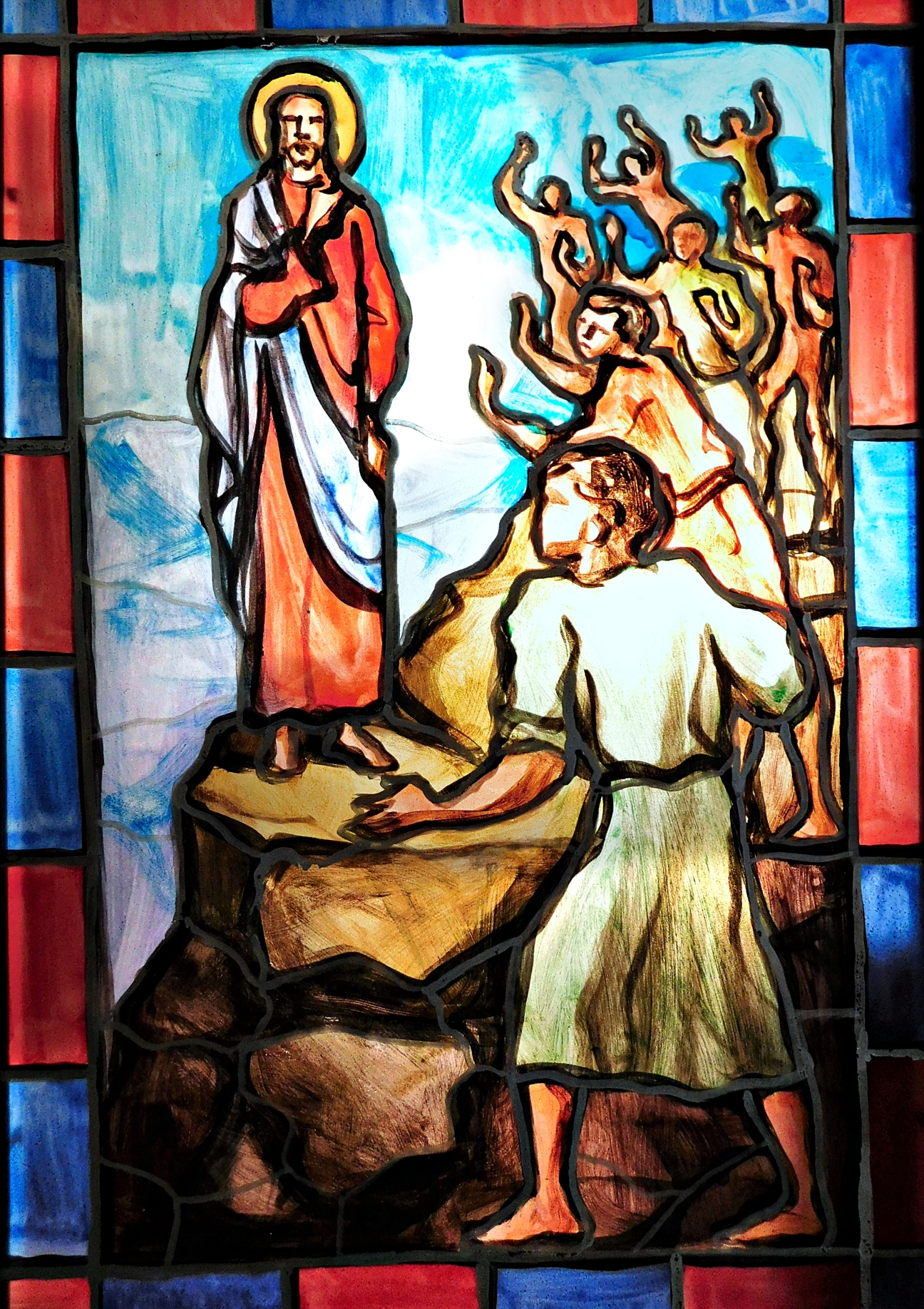
Today’s Gospel (Lk 11:14-23) has Jesus being calumniated even when exorcising demons. He concludes with this:

“Whoever is not with me is against me,
and whoever does not gather with me scatters.”
(v. 23)

“[E]ven if people do not want to recognize it, Jesus Christ has conquered and from now on no one can adopt an attitude of neutrality towards him: he who is not with him is against him.” (The Navarre Bible: St Luke, 147)

“There is no safe neutral corner in the front line of a war…Whoever is not with Jesus in his battle against Satan is by default against him…In the context of the clash between the kingdom of God and the kingdom of Satan each person must side with the one or the other: there are ultimately no other kingdoms…Ultimately one is either gathered to Jesus and brought into the kingdom of God, or cast out and scattered (see 13:28).” (Bringing the Gospel of Luke to Life, 322)

The time for fence sitting is over. In reality, there never has been a time for it. But now, the Lord needs to know where we stand. Will we defend Him, or shirk away? Are we going along to get along or are we counter-culture (of death)? Are we the disciples before Pentecost hiding away in anxiety and fear or are we compelled by tongues of fire to speak out fearlessly whatever may come?

I am reminded of the Book of Revelation’s admonition to a particular church that really is a message to all of us:

“I know your works; I know that you are neither cold nor hot.* I wish you were either cold or hot. So, because you are lukewarm, neither hot nor cold, I will spit you out of my mouth…Whoever has ears ought to hear what the Spirit says to the churches.” (Rev. 3:15-16, 22)

It is a striking image painted for John here in this vision. I certainly don’t want to make the Lord sick to His stomach, do you? Let us be bold and fervent in the Faith we profess, not counting the cost here on earth but building up treasure in heaven (see Mt 6:19-21).

God bless.

Lent Day 22: Old and New

TODAY’S READINGS

Today’s Gospel (Mt 5:17-19) coming almost immediately after Jesus proclaims the Beatitudes, has Him teaching about the Law:

Jesus said to his disciples:
“Do not think that I have come to abolish the law or the prophets.
I have come not to abolish but to fulfill.
Amen, I say to you, until heaven and earth pass away,
not the smallest letter or the smallest part of a letter
will pass from the law,
until all things have taken place.
Therefore, whoever breaks one of the least of these commandments
and teaches others to do so
will be called least in the Kingdom of heaven.
But whoever obeys and teaches these commandments
will be called greatest in the Kingdom of heaven.”
(17-19)

(vv. 21-22)

“In this passage Jesus stresses the perennial value of the Old Testament. It is the word of God; because it has a divine authority it deserves total respect. The Old Law enjoined precepts of a moral, legal and liturgical type. Its moral precepts still hold good in the New Testament because they are for the most part specific divine-positive promulgations of the natural law. However, our Lord gives them greater weight and meaning. But the legal an d liturgical precepts of the Old Law were laid down by God for a specific stage in salvation history, that is, up to the coming of Christ; Christians are not obliged to observe them (cf. Summa theologiae, I-II, q. 108, a. 3 ad 3).

“The law promulgated through Moses and explained by the prophets was God’s gift to his people, a kind of anticipation of the definitive Law which the Christ or Messiah would lay down. Thus as the Council of Trent defined, Jesus not only ‘was given to men as a redeemer in whom they are to trust, but also as a lawgiver whom they are to obey’ (De iustificatione, can. 21).” (The Navarre Bible: St Matthew, 61)

“Jesus completely fulfilled the Mosaic Law and OT prophecies (1:23; 2:6, 15; 4:15–16; Lk 24:44–47). The Greek word translated fulfil means ‘to make complete’. The New Covenant thus includes and concludes the Old Covenant; it both perfects it and transforms it. While sacrificial laws of the OT expired with the sacrifice of Jesus, the moral Law (Ten Commandments, etc.) was retained and refined (5:21, 27, 43; 19:17). In the Christian life, the power of God’s Spirit is necessary if we are to obey the Law and grow in holiness (cf. Rom 8:4; CCC 577–81, 1967).” (Ignatius Catholic Study Bible: The Gospel of Matthew, 25)

Reading this passage, I’m reminded of St. Augustine’s famous saying:

The New Testament lies hidden in the Old and the Old Testament is unveiled in the New.” (from CCC 129, Cf. St. Augustine, Quaest. in Hept. 2,73:PL 34,623; Cf. DV 16)

The Old Testament has many exciting stories and tells of some great adventures. Some of it can be a slog, making readers wonder of the relevancy of certain parts. This is why I always recommend good commentaries that provide both exegesis and theology to bring out the value of the most seemingly mundane, uninteresting, or confusing parts. An indispensable reference is Bergma and Pitre, Introduction to the Bible: Old Testament. Also, having the Navarre Bible is an invaluable resource; my recommendation is to use that Bible if planning to read the entire Old Testament. Finally, read the short but important Vatican II document, Dei Verbum, before beginning any significant Bible study.

By reading the Old Testament in light of the New, and recognizing it all as the God’s Word (that is, Jesus), there will be no danger we fall formally or informally into the heresy of Marcionism.

The Bible is a Great Adventure. Don’t miss out!

God bless.

Lent Day 21: 77x

TODAY’S READINGS

Today’s Gospel (Mt 18:21-35) gives us the chilling Parable of the Unforgiving Servant; it is prompted by the following interaction:

Peter approached Jesus and asked him,
“Lord, if my brother sins against me,
how often must I forgive him?
As many as seven times?”
Jesus answered, “I say to you, not seven times but seventy-seven times.”
(vv. 21-22)

“Some later rabbis considered three times to be a sufficient cap on forgiving someone for the same offense. If that view was prominent in Jesus’ day, Peter may have understood his suggestion of seven times to be quite generous, reflecting Christ’s emphasis on forgiveness (see 6:12, 14-15).

“Jesus’ response, however, is not seven times but seventy-seven times. This hyperbole is not meant to limit forgiveness to the high level of seventy-seven instances, but to express a boundless willingness to forgive one’s brother. The increase from seven to seventy-seven recalls Lamech, who appears last in the genealogy of Cain’s family, a family that was filled with immorality, murder, and vengeance. Lamech boasts, ‘If Cain is avenged sevenfold, then Lamech seventy-sevenfold’ (Gen 4:24). Just as Cain’s descendants responded to their enemies with unlimited vengeance, so Christians should respond to sins committed against them with limitless forgiveness.” (The Gospel of Matthew [Christian Commentary on Sacred Scripture], 234)

“What we human beings cannot possibly do on our own becomes possible because the incarnate Word infuses into our fallen nature the Father’s eternal capacity and desire to forgive. By his statement ‘I say to you seventy-seven times’, Jesus is communicating to Peter not so much an abstract moral truth as the actual capacity to live that truth. A brother must always be forgiven because he and I are children of the same Father and brothers of the same Jesus, and the children cannot fall beneath the level of the divine Father and Brother; for if they do, what is then the basis of the blood relationship and life they share?” (Fire of Mercy, Heart of the Word, Vol. II ,644)

Being a Christian is not easy! In fact, it is well nigh impossible…without God’s grace, “the capacity to live that truth.” Even one act of forgiveness may take all of our will power to muster. But seven, never mind seventy-seven. I am reminded of the Scripture:

For my thoughts are not your thoughts,

my thoughts higher than your thoughts.

For as the heavens are higher than the earth,

so are my ways higher than your ways,

my thoughts higher than your thoughts. (Is 55:8-9)

God bless.

Lent Day 20: Just passing through…

TODAY’S READINGS

Today’s Gospel (Lk 4:24-30) has Jesus stirring up the crowd in His home town of Nazareth so much so that they are ready to do this to Him:

They rose up, drove him out of the town,
and led him to the brow of the hill
on which their town had been built,
to hurl him down headlong.
But he passed through the midst of them and went away.
(vv. 29-30)

“Luke could have selected other incidents to present as the initial event in Jesus’ public ministry (see 4;15, 23) but chose to use Jesus’ visit to Nazareth with its unhappy ending. Luke probably intended it as an illustration of Jesus being ‘a sign that will be contradicted’ and the cause of ‘the fall and rise of many in Israel,’ as Simeon prophesied after his birth (2:34). Luke probably also presents the incident as a foreshadowing of what lies ahead: Jesus will be embraced by some but rejected by others, culminating in his death. Yet death will have no more hold over him than the mob in Nazareth: he will, as it were, pass through the midst of the earth, rising from his tomb.” (Bringing the Gospel of Luke to Life, 123)

The last verse has long fascinated me. What did this look like? I have often imagined it like Moses parting the Red Sea. Jesus stares down the crowd and starts walking and they separate like the waters. Was it Jesus’ demeanor? Did He exude a power that repelled them? Was the crowd’s bark worse than its bite? Did friends and neighbors have second thoughts? Remember, this was Jesus residence for over twenty years. He knew these people as well as anyone, but clearly they didn’t know Him. I’m reminded of yesterday’s Gospel:

Jesus would not trust himself to them because he knew them all,
and did not need anyone to testify about human nature.
He himself understood it well.
(Jn 2:24-25)

There are many scenes in Jesus’ life I wish I could have been present for, but this ranks near the top.

Mount Precipice near Nazareth, the site commemorating the Gospel story of
the attempt to throw Jesus off a cliff.

God bless.

Lent Day 19: Jesus understands…all too well

TODAY’S READINGS

Today’s Gospel (Jn 2:13-25) relates Jesus’ first cleansing of the Temple early in His ministry, just days after His “coming out” party: the Miracle at Cana.

Jesus would not trust himself to them because he knew them all,
and did not need anyone to testify about human nature.
He himself understood it well.
(v. 24-25)

“Jesus…has serious reservations about their belief in him…They believed in him, but he did not trust or believe in them: the Gospel uses the same word for ‘believe’ in the previous verse and for ‘trust’ in this verse. Jesus did not entrust himself to them because he knew them all. Jesus knew that Nathanael was a true Israelite , without duplicity (1:47); he has insight into what is in the hearts of others. He knew those who were impressed by the signs he worked, and he judged their belief to be insufficient for him to trust himself to them. the Gospel does not spell out why their belief falls short, but it implies that there are degrees of belief in Jesus, some of which are inadequate. Perhaps people were impressed by the signs Jesus worked but did not sufficiently perceive what the signs signified about the one who worked them; perhaps they were still on the first rung of the ladder of belief. Even though Nathanael believed in Jesus (1:49), Jesus called him to greater belief (1:50-51). this Gospel was written to call its readers to greater belief (1:50-51). this Gospel was written to call its readers to greater belief in Jesus and greater perception of who he is, even as it used the traditional titles of ‘Messiah’ and ‘Son of god’ t proclaim him (20:31).” (Bringing the Gospel of John to Life, 59)

“Jesus’ miracles moved many to recognize that he had extraordinary, divine powers. But that falls short of perfect theological faith. Jesus knew their faith was limited, and that they were not very deeply attached to him: they were interested in him as a miracle worker. this explains why he did not trust them (cf. Jn 6:15, 26) ‘Many people today are like that. they carry the name of faithful , but they are fickle and inconstant’, comments Chrysostom (Hom. on St John, 23,1).

“Jesus’ knowledge of men’s hearts is another sign of his divinity; for example, Nathanael and the Samaritan woman recognized him as the Messiah because they were convinced by the evidence of supernatural power he showed by reading their hearts (cf. Jn 11:49; 4:29). (The Navarre Bible: St John, 66)

Despite what it says in the immediately previous paragraph, I’m not sure Jesus had to call on His divinity (remember Philippians 2:6) to discern what’s in the heart. Two things come to mind:

  1. It seems to me we often forget that Jesus lived for thirty years a “hidden life.” Hidden does not mean hiding from the world, though. I suspect Jesus was a keen observer of His fellow man. How many nasty people came into His dad’s (and later His) workshop? How often did customers refuse to pay the full amount or pay at all? How did Jesus feel when He became the complaint department? How much gossip did he hear when in town or delivering goods? He saw plenty of human nature (which He shared with us) on display, maybe more so because He grew up in a small town and not a thriving metropolis — everybody knew each other’s business and some, undoubtedly nosed their way in.
  2. Jesus, being the perfect man, without concupiscence clouding His intellect, would have been particularly sensitive to others’ feelings, emotions, and masks. He knew sincerity or lack thereof when He encountered it.

Jesus reads hearts. What will His reaction be when He finishes our tome?

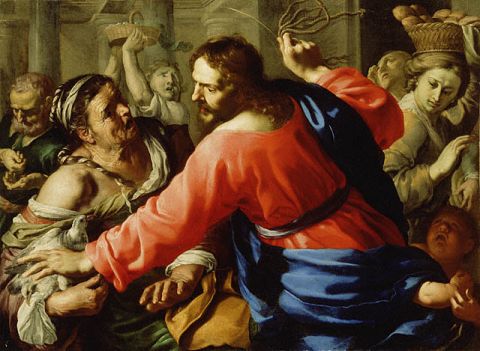
Jesus Cleansing the Temple (ca. 1655) by Bernardino Mei

God bless.

Lent Day 18: The robe of grace brings the dead to life

TODAY’S READINGS

Today’s Gospel (Lk 15:1-3, 11-32) is arguably the most famous parable in the Gospels, the Prodigal Son; it starts out this way:

“‘Quickly, bring the finest robe and put it on him;
put a ring on his finger and sandals on his feet.
Take the fattened calf and slaughter it.
Then let us celebrate with a feast,
because this son of mine was dead, and has come to life again…”
(v. 22-24a)

“Mercy – as Christ has presented it in the parable of the prodigal son – has the interior form of the love that in the New Testament is called agape. This love is able to reach down to every prodigal son, to every human misery, and above all to every form of moral misery, to sin. When this happens, the person who is the object of mercy does not feel humiliated, but rather found again and restored to value.

“The father first and foremost expresses to him his joy that he has been ‘found again’ and that he has ‘”‘returned to life.’ This joy indicates a good that has remained intact: even if he is a prodigal, a son does not cease to be truly his father’s son; it also indicates a good that has been found again, which in the case of the prodigal son was his return to the truth about himself…

“The parable of the prodigal son expresses in a simple but profound way the reality of conversion. Conversion is the most concrete expression of the working of love and of the presence of mercy in the human world. The true and proper meaning of mercy does not consist only in looking, however penetratingly and compassionately, at moral, physical or material evil: mercy is manifested in its true and proper aspect when it restores to value, promotes and draws good from all the forms of evil existing in the world and in man. Understood in this way, mercy constitutes the fundamental content of the messianic message of Christ and the constitutive power of His mission.” (Dives in Misericordia as quoted in The Word on Fire Bible: The Gospels, 389)

I chose the verses at top because the homilist at today’s Mass inspired me to think of the robe put on the son as a metaphor for God’s grace covering us, bringing us from death to life, when we confess serious sin. The Lord Jesus lived and died and rose so we may have an abundant life here and for all eternity. We must not discard the grace we receive at Baptism, but if we do through mortal sin, the Divine Doctor is ready, waiting, and eager to heal us through His priest in the confessional. No matter how prodigal we’ve been, the Father is always desiring to embrace us, constantly looking down the road to welcome us back into the fold. Remember, whether you are the prodigal or its your brother, Jesus says:

“[T]here will be more joy in heaven over one sinner who repents than over ninety-nine righteous people who have no need of repentance.” (Luke 15:7)

So, if its you, don’t hesitate to come back and make heaven rejoice. And, if its your fellow human, don’t begrudge the fact that he has made the angels sing.

Bp Barron has an extended commentary on this parable in the same book that was quotes above (pp. 392-400); you should know that you can count on excellent exegesis and splendid spiritual insights from His Excellency. I highly recommend The Word on Fire Bible. Three volumes have come out so far: The Pentateuch, The Gospels, and Acts, Letters, and Revelation. Four more volumes are planned.

Finally, several years ago I read Henri Nouwen’s The Return of the Prodigal Son. I highly recommend this book as it looks at the story through the eyes of all three characters in the parable. Very interesting with profound insights.

The Prodigal Son (1989) by Clark Kelley Price

God bless.

Lent Day 17: What about our tenancy?

TODAY’S READINGS

Today’s Gospel (Mt 21:33-43, 45-46) is the Parable of the Wicked Tenants; it starts out this way:

“There was a landowner who planted a vineyard,
put a hedge around it,
dug a wine press in it, and built a tower.
Then he leased it to tenants and went on a journey.”
(v. 33)

“Just before his Passion and death, Jesus tells the striking story of the landowner who planted a vineyard. The fertile vineyard stands for Israel, his chosen people. But it could be broadened out to include the world. What do we learn from this beautiful image? That God has made for his people a place where they can find rest, enjoyment, and good work.

“We — Israel, the Church, the world — are not the owners of this vineyard; we are tenants. One of the most fundamental spiritual mistakes we can make is to think that we own the world. We are tenants, entrusted with the responsibility of caring for it, but everything that we have and are is on loan. Our lives are not about us.

“Christ is God’s judgment. We are all under his judgment. In the measure that we reject him or refuse to listen to him, we place our tenancy in jeopardy. And so the great question that arises from this reading: How am I using the gifts that God gave me for God’s purposes? My money? My time? My talents? My creativity? My relationships? All is for God, and thus all is under God’s judgment.” (The Word on Fire Bible: The Gospels, 131)

Bishop Barron makes an excellent point: How good stewards are we of all that God has given us? We will be accountable for all we do (and all we neglect to do). What inheritance can we hope for if we abuse our free will time and again, ultimately killing the life of the Son within us?

Time, talent, and treasure. If we don’t have all three, we may have two, and certainly have one.

“[Y]our light must shine before others, that they may see your good deeds and glorify your heavenly Father.” (Mt 5:16)

Let us reflect the Light of the World (see John 8:12) in our own selves, thus bringing light and life to others.

A MILESTONE!

This is my 1000th post on WordPress! An auto-generated post when I signed up in 2009 is followed up by my first post in 2012, introducing myself. The third post is the first with substantial content. Links for all three allow for a dash into the past:

Thanks for reading!

God bless.

Lent Day 16: Raising Lazarus

TODAY’S READINGS

Today’s Gospel (Lk 16:19-31) is the famous story of the Rich Man and Lazarus; Abraham’s last words are depressing:

“If they will not listen to Moses and the prophets,
neither will they be persuaded
if someone should rise from the dead.”
(v. 31)

“Minds defiantly closed to God’s revelation will remain closed no matter what signs are given them or wonders performed for them…While the rich man spoke of someone from the dead going to his brothers, Abraham in his response used the phrase rise from the dead. Luke’s readers would naturally think of Jesus’ rising from the dead. the resurrection of Jesus will not convince everyone that he is God’s Son and Messiah, Lord and savior. In the Acts of the Apostles Luke will tell how the Gospel message is accepted by some and disbelieved bu others; Abraham’s words foreshadow such disbelief.” (Bringing the Gospel of Luke to Life, 449)

How sad it is that Jesus’ Resurrection was rejected by so many at the time and far more today. The Lord endures an unimaginable suffering for all humankind but emerges victorious over sin, Satan, and death. Heaven is opened up if only we are faithful enough to take advantage.

Jesus raised Lazarus from the dead and the religious leaders were angry:

So from that day on they planned to kill him. (John 11:53, but read Jn 11:45-53)

Jesus raised Himself from the dead and the religious leaders were angry.

While they were still speaking to the people, the priests, the captain of the temple guard, and the Sadducees* confronted them,

disturbed that they were teaching the people and proclaiming in Jesus the resurrection of the dead.a

They laid hands on them and put them in custody until the next day, since it was already evening. (Acts 4:1-3)

We declare Jesus, the God-Man raised from the dead, as we are required:

But if Christ is preached as raised from the dead, how can some among you say there is no resurrection of the dead?

If there is no resurrection of the dead, then neither has Christ been raised.f

And if Christ has not been raised, then empty [too] is our preaching; empty, too, your faith. (1 Cor 15:12-14)

This we are to do regardless of the consequences.

The Resurrection of Lazarus, Detail from Life and Passion of Christ (1303-1305)
by Giotto de Bondone

God bless.

Lent Day 15: Master and Servant

TODAY’S READINGS

In today’s Gospel (Mt 20:17-28), as Jesus death approaches, He really lays into the scribes and Pharisees. One verse that has caused controversy since the Protestant Revolt:

“[W]hoever wishes to be great among you shall be your servant;
whoever wishes to be first among you shall be your slave.”
(vv. 26-27)

“Jesus stresses that Christians ought to be servants and slaves to one another. This is, in practice, a more difficult proposition than being servants and slaves to God. once we have accepted the reality of God as Master of the Universe, it is easy to perform the gesture of self-subordination to him. In fact, in such a gesture there always lurks the temptation of a certain exhibitionism and even self-aggrandizement by my association with the Lord of all. Jesus’ invitation here, in fact, abolishes all verticality that could be construed as a ladder of social ascent, even with ‘God’ at the top.” (Fire of Mercy, Heart of the Word, Volume III, 289)

“Vatican II puts a marked emphasis on this service which the Church offers to the world and which Christians should show as proof of their Christian identity: ‘[T]his sacred synod, proclaiming the noble destiny of man and championing the Godlike seed which has been sown in him, offers to mankind the honest assistance of the Church in fostering that brotherhood of all men which corresponds to this destiny of theirs. Inspired by no earthly ambition, the Church seeks but a solitary goal: to carry forward the work of Christ under the lead of the befriending Spirit. And Christ entered this world to give witness to the truth, to rescue and not to sit in judgment, to serve and not to be served.’ [(Gaudium et spes, 3, taken from vatican.va)[” (The Navarre Bible: St Matthew, 177)

Jesus says this to James and John after their mother advocated for them to have a special place in the Lord’s kingdom, upsetting the other ten apostles. The takeaway for all the Twelve were the words of Jesus highlighted here. The idea of being a servant, and even more so, a slave, is repugnant to modern man, especially when the one we are asked to be subordinate to has a low standing in our eyes. And since we are to act this way toward everyone, the number of “undesirables” in our estimation will be a high number.

So, the thing for us to remember is this:

Jesus said, “Amen, amen, I say to you, no slave is greater than his master nor any messenger greater than the one who sent him.” (Jn 13:16)

God proves his love for us in that while we were still sinners Christ died for us. (Rom 5:8)

God bless.

Lent Day 14: Call no man father?

TODAY’S READINGS

In today’s Gospel (Mt 23:1-12), as Jesus death approaches, He really lays into the scribes and Pharisees. One verse that has caused controversy since the Protestant Revolt:

“Call no one on earth your father;
you have but one Father in heaven.”
(v. 9)

“Jesus is stressing that humility is essential for the ministry, lest those who area placed in authority over others think of themselves as superiors rather than servants. No one, after all can compare to the ‘Father’ in heaven…The disciples of Jesus will share in the mission of the Father..through their commission to teach the gospel (28:19-20), but theirs is a derivative participation in something divine. Hence, the title[] in questions appl[ies] absolutely only to the Lord.” (The Gospel of Matthew [Catholic Commentary on Sacred Scripture], 292)

“Jesus uses hyperbole to post a warning that no one should pridefully desire honorific titles. His words are not meant literally. The NT writers elsewhere use father for natural fathers (Heb 12:7–11) and spiritual fathers in the Church (1 Cor 4:15; Philem 10). ● The spiritual fatherhood of New Covenant priests is an extension of its application to Old Covenant priests (Judg 17:10; 18:19).” (Ignatius Catholic Study Bible: The Gospel of Matthew, 57)

Understood properly, using the Bible itself (not to mention Tradition), there can be no question that using “Father” to address our biological fathers and our priests, All these men must acknowledge they are not God — not even close. But, to the extent they emulate the first person of the Trinity, they are true Fathers.

Check here and here on one my favorite Catholic resources, that provides an apologetic for calling certain men “Father.” St. Paul Center (another of my fave organizations) helps with this question here.

Depiction of God the Father (detail) (1654) by Pieter de Grebber

God bless.