Advent Day 20: Blessed and never broken

TODAY’S READINGS

The Gospel reading is from Lk 1:46-56, picking up where we left off yesterday. It is her response to Elizabeth, a response for the ages. I will focus on a particular verse (in fact, just the second part):

[The Lord] has looked upon his lowly servant.
From this day all generations will call me blessed.
(v. 48)

“Elizabeth is the first to proclaim Mary blessed because of what God is doing through her and because of her response to God (1:42, 45), but she will not be the last. Mary realizes that ‘from now on will all ages call me blessed.’ Every future generation will look upon Mary as someone specially favored and blessed by God. The words from now on signal a turning point. The conception of Jesus inaugurates a new stage in human and divine history; God has take a decisive step that will affect all ages to come.” (The Gospel of Luke (Catholic Commentary on Sacred Scripture, 33)

“God rewards our Lady’s humility by mankind’s recognition of her greatness: ‘All generations will call me blessed.’ This prophecy is fulfilled every time someone says the Hail Mary, and indeed she is praised on earth continually, without interruption. ’From the earliest times the Blessed Virgin is honoured under the title of Mother of God, under whose protection the faithful take refuge together in prayer in all their perils and needs. Accordingly, following the Council of Ephesus, there was a remarkable growth int the cult of the people of God towards Mary, in veneration and love, in invocation and imitation, according to her own prophetic words: ‘all generations will call me blessed, for he who is mighty has done great things for me'” (Vatican II, Lumen gentium, 66) (The Navarre Bible: The Gospel of Luke, 44)

“Mary…prophesies that ‘all ages’ (literally ‘all generations’) wll pronounce a beatitude by calling here ‘blessed,’ recognizing god’s favor to her, as indeed Elizabeth has just done (Luke 1:45). thus, the person who says ‘Blessed Mary’ or ‘Blessed Virgin Mary’ (see 1:27) is fulfilling the inspired word of Scripture!” (The Gospel of Luke [Catholic Commentary on Sacred Scripture], 52)

This last quote makes a particular impact on me. I will try never to invoke Mary without prefacing that holy name (it means “”) with “Blessed.” The humble, perfect, sinless one, in true humility, acknowledges the favor she has found with God. It has been said, we can never honor Jesus’ mother more than He did (after all who kept all the commandments, including the fourth, better than the Son of God?). But, certainly, the least we can do is honor her in the way she declared she should be invoked.

It saddens me — and how it must sadden the Mother of God — that Blessed Mary is arguably the main point of contention between Catholics and Protestants. The Marian dogmas, so rich, so beautiful, of ancient heritage, and with plenty of scriptural support, are anathema to far too many Christians. 

One last note regarding the title of this post. ”Blessed and broken” is not an uncommon Christian theme. Of course we think of Jesus’ food miracles and the Last Supper. And we, who are broken, need Jesus the Divine Carpenter to fix us. In titling this post as I did, I considered Blessed Mary declaring herself blessed about a week into her pregnancy and thenk think of (as she certainly must have) all that she had to look forward to. Many joys, undoubtedly, along with much suffering, particularly as she observed her Son’s ministry culminating in the Cross. But none of these events were going to break her. I never like to see movie scenes in which Blessed Mary is wailing at the foot of the Cross. Pious tradition has her as Stabat Mater, standing firm while her heart (and His) was torn to shreds. (As an aside, here I’m reminded of how Jackie Kennedy was lauded in the dignified way she handled all the events surrounding her husband’s murder.)

May Our Lady of Unity intercede on behalf of this unbelieving world so that her Son’s prayer will be made manifest:

I pray not only for them, but also for those who will believe in me through their word, so that they may all be one, as you, Father, are in me and I in you, that they also may be in us, that the world may believe that you sent me. (Jn 17:20-21)

ON MARY’S PERPETUAL VIRGINITY

I have become a big fan of Shameless Popery, Catholic Answers apologist Joe Heschmeyer’s podcast. His thoroughgoing defense of Mary’s perpetual virginity on scriptural grounds is outstanding. I certainly have heard a number of these explanations previously, but Joe provides many more I had never been exposed to in an interesting, methodical, and devastating (to unbelievers) way. And he does this in the context of the Christmas Story, so it is timely, as well.

God bless.
Advent Day 19: Make haste!

TODAY’S READINGS

The Gospel reading is from Lk 1:39-45, Mary’s visit to Elizabeth after the joyous news of both their pregnancies. It is the first meeting of cousins John and Jesus. My focus is on the speed in which the Virgin went to visit her relative, as relayed in the very first verse.

Mary set out in those days
and traveled to the hill country in haste
to a town of Judah
(v. 39)

“The village of Ain Karim in the hill country near Jerusalem is the traditional site of the house of Zechariah and Elizabeth. It is located about five miles from the temple, a convenient distance for Zechariah’s trips for priestly duty. For Mary, however, the journey from Nazareth would be about ninety miles, depending on the route, taking several days. There is no mention of Joseph accompanying her, unlike the later journey together to Bethlehem (2:4-5). She goes in haste, indicating her earnestness in following God’s plan.” (The Gospel of Luke (Catholic Commentary on Sacred Scripture, 48)

Luke “notes that she travels ‘in haste’ but does not explain why she is in a hurry…we might speculate that Mary was eager to see this sign for herself. We might also speculate that she was eager to be with Elizabeth because of what they had in common: they were unexpectedly becoming mothers through the favor of God; their sons would play major roles in God’s unfolding plans.” (Bringing the Gospel of Luke to Life, 27-28)

“On learning from the angel that her cousin St Elizabeth is soon to give birth and is need of support, our Lady in her charity hastens to her aid. She has no regard for the difficulties this involves…

“From Mary’s visit to Elizabeth Christians should learn to be caring people. ’If we have filial contact with Mary, we won’t be able to think just about ourselves and our problems. Selfish personal problems will find no place in our mind’ (Bl. J. Escriva, Christ is passing by, 145).” (The Navarre Bible: The Gospel of Luke, 41-42)

“After the Annunciation, Mary could have focused on herself and her own worries and fears about her new condition. Instead, she entrusted herself completely to God. Her thoughts turned to Elizabeth. She got up and went forth, into the world of life and movement. Even though the astonishing message of the angel had caused a seismic shift in her plans, the young Mary did not remain paralyzed, for within her was Jesus, the power of resurrection and new life. Within herself, Mary already bore the Lamb that was slain and yet lives. She arises and sets out, for she is certain that God’s plan is the best plan for her life. Mary becomes a temple of God, an image of the pilgrim Church, a Church that goes forth for service, a Church that brings the good news to all!” (MESSAGE OF HIS HOLINESS POPE FRANCIS FOR THE XXXVII WORLD YOUTH DAY 2022-2023; the whole document is worth reading)

“I’ve always been fascinated by Mary’s ‘haste’ in this story of the Visitation. Upon hearing the message of Gabriel concerning her own pregnancy and that of her cousin, Mary ‘proceeded in haste into the hill country of Judah’ to see Elizabeth.

“Why did she go with such speed and purpose? Because she had found her mission, her role in the theo-drama. We are dominated today by the ego-drama in all of its ramifications and implications. The ego-drama is the play that I’m writing, I’m producing, I’m directing, and I’m starring in. We see this absolutely everywhere in our culture. Freedom of choice reigns supreme: I become the person that I choose to be.

“The theo-drama is the great story being told by God, the great play being directed by God. What makes life thrilling is to discover your role in it. This is precisely what has happened to Mary. She has found her role—indeed, a climactic role—in the theo-drama, and she wants to conspire with Elizabeth, who has also discovered her role in the same drama. Like Mary, we have to find our place in God’s story.” (Bp Robert Barron’s Advent Gospel Reflections [2017]; he also gives this same reflection in his Rosary)

Let us be ever mindful to make haste when doing the work of God, and pump the brakes when it is all about us. And pray that we will recognize and be mindful of the difference

Advent Day 16: A Righteous Man

TODAY’S READINGS

The Gospel reading is from Mt 1:18-25. Joseph’s reaction to Mary’s pregnancy follows. To find out how it turns out, just click on the link above.

Joseph her husband, since he was a righteous man,
yet unwilling to expose her to shame,
decided to divorce her quietly.
(v. 19)

Mitch and Hahn succinctly give us the three prominent theories that could explain Joseph’s reaction to finding Mary, his betrothed and beloved, pregnant. Let’s read what they say about this verse.

just: Or, “righteous”. Joseph is a man of sterling moral character, committed to living by the Mosaic Law (Deut 6:25; Lk 1:6). put her to shame: The Greek verb does not necessarily have a negative connotation. It simply means “to expose” or “to exhibit”. send her away: Catholic tradition proposes three main interpretations to explain why Joseph resolved to end his betrothal with Mary.

(1) The Suspicion Theory. Some hold that Joseph suspected Mary of adultery when he discovered her pregnancy. Joseph thus intended to pursue a divorce in accord with Deut 24:1–4 until the angel revealed to him the miraculous cause of the conception (1:20). Joseph is said to be righteous because he shuns immorality and directs his life by the Law of God. Proponents of this view include St. Justin Martyr, St. John Chrysostom, and St. Augustine.

(2) The Perplexity Theory. Others hold that Joseph found the situation of Mary’s pregnancy inexplicable. Divorce seemed to be his only option, and yet he wished to do this quietly, for he could not bring himself to believe that Mary had been unfaithful. Joseph is said to be righteous because he lives by the Law of God and judges Mary’s situation with the utmost charity. The main proponent of this view is St. Jerome, whose exegesis was adopted into the notes of the medieval Bible.

(3) The Reverence Theory. Still others hold that Joseph knew the miraculous cause of Mary’s pregnancy from the beginning, i.e., he was made aware that the child was conceived “of the Holy Spirit” (1:18). Faced with this, Joseph considered himself unworthy to be involved in the Lord’s work, and his decision to separate quietly from Mary was a discretionary measure to keep secret the mystery within her. On this reading, the angel confirms what Joseph had already known and urges him to set aside pious fears that would lead him away from his vocation to be the legal father of the Messiah (1:20). Joseph is said to be righteous because of his deep humility and reverence for the miraculous works of God. Proponents of this view include St. Bernard of Clairvaux and St. Thomas Aquinas.”

Curtis Mitch, “Introduction to the Gospels,” in The Ignatius Catholic Study Bible: The New Testament (San Francisco: Ignatius Press, 2010), 8.

As we see, there are great saints supporting each of these theories. All are certainly plausible. But I would like to think that it was out of reverence that Joseph had initially decided to take his leave of Mary. I’m not sure he could have ever forgiven himself, or looked Mary in the eye, if he had suspected the worst.

May we be as reverent as Joseph when we assess situations we find unfathomable.

God bless.

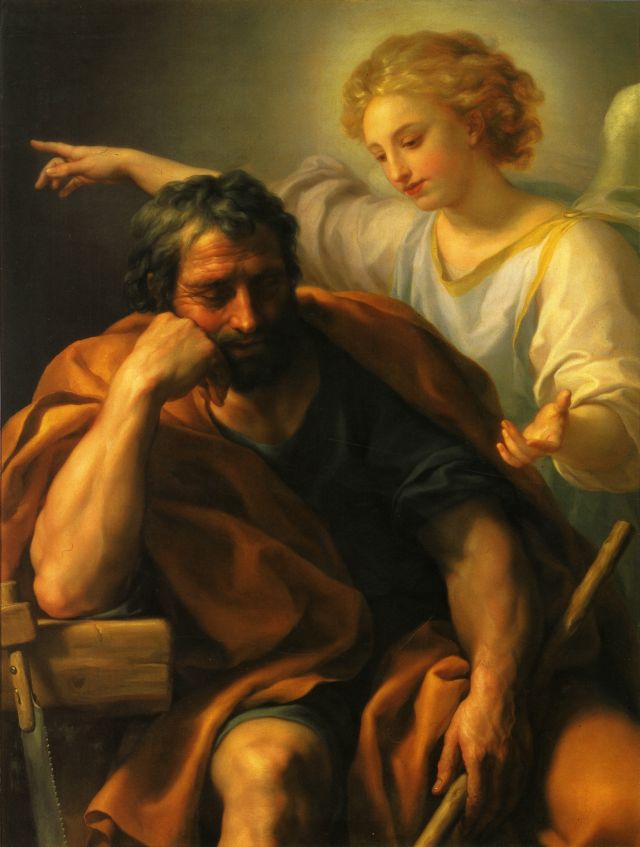
The Dream of St. Joseph by Anton Raphael Mengs (1773-74)

Advent Day 15: Much to rejoice about

TODAY’S READINGS

The first reading is from Is 61:1-2A, 10-11 . A Servant Song of the prophet in the first person.

The spirit of the Lord GOD is upon me,
because the LORD has anointed me
(v. 1a)

“Prophets, priests, and kings were anointed in ancient Israel. The Servant is probably all three. The combination of anointing and the reception of the Spirit calls to mind the figure of David, who was filled with the Spirit when Samuel anointed him in in 1 Samuel 16. David, too, was prophet (2 Sam 23:1-2), priest (Ps 110), and king.” (John Bergsma, The Word of the Lord: Reflections on the Sunday Mass Readings for Year B [Steubenville, OH: Emmaus Road, 2021], 22)

The Responsorial Psalm is from Lk 1:46-48, 49-50, 53-54. Not from the book of Psalms at all, but in the same spirit, the words of Our Lady to Elizabeth (and to the whole world for all time).

He has filled the hungry with good things,
and the rich he has sent away empty.
He has come to the help of his servant Israel
for he has remembered his promise of mercy.
(vv. 53-54)

“Here we see Mary is adopting the attitude and posture of the ‘Servant of the LORD’ in Isaiah 61:1-2. How can she do this? Isn’t the ‘servant of the Lord’ Jesus himself? Yes, but the Blessed Mother has Jesus in her womb. She is the first Christian, the first person to be united as one flesh with Jesus. What is true of Jesus is true of her by extension. She is taken up into the Messianic mission of Christ, to ‘proclaim good news…and liberty’ (Isa 61:1) and to find in God the ‘joy of her soul.’ (Isa 61:10). Mary speaks as if God has already established ‘justice’ (Isa 61:11) through his Messiah: filling the oppressed ‘hungry’ with good things (think of the feeding miracles) and sending the rich oppressors away empty (think of the rich young ruler in Matt 19:22). (ibid, 25)

The second reading is from 1 Thes 5:16-24. It directly addresses the theme for this Third Sunday of Advent: Gaudete! Rejoice!

May the God of peace make you perfectly holy
and may you entirely, spirit, soul, and body,
be preserved blameless for the coming of our Lord Jesus Christ.
(v. 23)

“Following Christ means not just believing but actually being transformed, becoming ‘blameless’ so we can stand at the final judgment. This calls to mind Advent’s dual focus on both the First and Second Coming of Jesus. We want to keep our sight on both horizons. Waiting for the liturgical coming of Christ (Christmas) recalls his First Coming and looks forward to his Second.” (ibid, 27)

Last, but certainly not least, is today’s Gospel. Our preparation for Christmas focuses on the ultimate preparer, John the Baptist.

[The priests and Levites] asked him,
“What are you then? Are you Elijah?”
And he said, “I am not.”
“Are you the Prophet?”
He answered, “No.”
So they said to him,
“Who are you, so we can give an answer to those who sent us?
What do you have to say for yourself?”
He said:
I am the voice of one crying out in the desert,
‘make straight the way of the Lord,’”
as Isaiah the prophet said.”
 (vv. 21-23)

“There were at least three figures the Judeans expected to come at the end of the age:

  1. The Messiah or ‘Anointed One’ predicted by the prophets (see Isa 61, Dan 9, etc.);
  2. Elijah himself, whom Malachi prophesied would return before the ‘day of the LORD’ (Mal 4:5, RSVCE; and
  3. ‘The Prophet,’ that is, the prophet like Moses, whom Moses predicted would come someday (see Deut 18:15-22)…

“‘I’m none of these,’ John says. Who is he, then? ’I am the voice of one crying out in the wilderness…’ This is a quote from Isaiah 40, a famous chapter that serves as an introduction to the long vision of the age of the Messiah that is Isaiah 40-66. So, John is an introduction incarnate, a prologue in person, a foreword in the flesh.” (ibid, 28-29)

You may have noticed that all commentary was taken from Dr. Bergsma’s outstanding series, The Word of the Lord. I worked through Year A for the liturgical year recently completed and am now keeping up with the readings for our current cycle. I have mentioned this set of books previously, here: the four-volume set contains commentary on every Sunday, solemnity, and feast day over the three year cycle of readings implemented after Vatican II. Certainly, this should be in every Christian rectory and religious house or institution. But, also, serious Catholics would do well to have these books handy for weekly preparation and/or follow-up to weekend and holy day Mass.

Today’s exposition was particularly outstanding, so I though it a great time to highlight some of his key insights (there is much more for this Sunday and every Sunday in the book). Yes, we are to rejoice in so great a savior. And we can also rejoice in the faithful witnesses, like John Bergsma, who cooperate with His grace to edify and enlighten the faithful.

Please check out his weekly conversation with Dr. Scott Hahn here (a small fee but definitely worth every penny and more).

BP BARRON SERMON

My big takeaway: Per Jesus, “among those born of women there has been none greater than John the Baptist” (Mt 11:11). Pious tradition has it that John was consecrated in the womb when he leaped there after he and his mother encountered Mary (and Jesus in her womb). Yet, John says in today’s Gospel, “the one who is coming after me [is one] whose sandal strap I am not worthy to untie” (Jn 1:27). If this greatest of human persons puts himself in that position, where does that leave us? Humility must be our default position.

BOOK RECOMMENDATION

Speaking of Dr. John Bergsma, I finally cracked open a book of his that’s been on my shelf probably since it came out four years ago: Jesus and the Dead Sea Scrolls: Revelating the Jewish Roots of Christianity. Bergsma is an expert on the Dead Sea Scrolls and often invokes his knowledge of these famous documents to enlighten his readers and listeners on now the knowledge we get from these works contemporaneous to Jesus give us a better understanding of the times, customs, and biblical figures of the New Testament, particularly John the Baptist. So I felt compelled to dive in today. I have found it difficult to put down. Endlessly fascinating and highly recommended. If our homilists were to consult works like this to enhance their preaching, they would have more than a few congregants riveted. The Bible is exciting and interesting! Would it be that more Christians of all stripes encounter the word of God in this way.

PODCAST RECOMMENDATION

My friend, Dr. Jim Papandrea, has recently taken over The Way of the Fathers from my friend Mike Aquilina. An interesting, informative, and fun way to dive into early Church history. Keep up and/or check out the archives here.

SUBSTACK RECOMMENDATION

I just discovered that my friend, Quanah Jeffries, has started a substack called “Living Theology.” A deeply faithful and erudite man, his insights are always interesting. Check it out here (you can subscribe to substack for free if not already a member).

God bless.

Baptism of Christ by Perugino (1482)

Advent Day 1: Watch!

Happy Advent! I’m going to give this a shot again this year. High hopes for working through Advent and Christmas with daily blogs quickly petered out in 2022. Pray that I stay the course this time around — I need it.

TODAY’S READINGS

For these upcoming posts, I plan to use Catholic commentaries and other resources generously to bring light to each day’s readings.

The first reading is from Is 63:16b-17, 19b; 64:2-7.

You, LORD, are our father,
our redeemer you are named forever.
(v. 16b)

“God is rarely addressed this way in the OT, although the appellation occurs three times in this prayer alone…The language of divine paternity in the OT is based on the covenant of kinship that the Lord forged with Israel, his first son.” (Ignatius Catholic Study Bible: Isaiah, 105)

Why do you make us wander, LORD, from your ways,
and harden our hearts so that we do not fear you?
(v. 17a)

“Divine hardening is not an action of God that causes people to sin but a form of judgment in which the Lord allows brazen sinners to defy his will without the restraint of his mercy. This response to sin was first revealed at the time of the Exodus, when god hardened the heart of pharaoh (Ex 9:12; 10:1; 11:10; 14:8). Divine hardening is likewise mentioned in the NT as a spiritual condition of unbelieving Israel that will endure until God’s plan of salvation for the Gentiles is accomplished (Rom 11:25-26). Divine hardening remains a mystery because Scripture also insists on human free choice (Sir 15:11-17) as well as God’s universal desire that all people repent of their sins and be save (1 Tim 2:4; 2 Pet 3:9). Within the broader framework of biblical teaching , then, divine hardening does not override human free will or destroy human responsibility for sin; rather, it is a disciplinary measure \that seeks the conversion of the sinner.” (Ignatius Catholic Study Bible: Isaiah, 105-106)

No ear has ever heard, no eye ever seen, any God but you
doing such deeds for those who wait for him.
(v. 4)

“St. Paul quotes from this verse when writing about the wisdom of God, and his love for those who love him, and the gifts he has in store for man…(1 Cor 2:9). because these gifts will not be fully bestowed until the next life, the verse is often quoted in Christian spirituality to describe the happiness enjoyed in heaven.” (Navarre Bible: Major Prophets, 273)

Finally, a certain line jumped out at me as one frequently used by Protestants against the Catholic understanding of the role and necessity of good works in our lives:

…all our good deeds are like polluted rags… (v. 5a)

Catholic Answers is helpful here: “It does not say that all acts of righteousness are as filthy rags to God, but that those being rendered to him in Isaiah‘s day were…This pertains to a particular historical situation, not to a general condition.” (The whole response is worth reading. Also, check out one of my previous posts.)

The Responsorial Psalm is from Ps 80:2-3, 15-16, 18-19.

The St. Louis Jesuits get a lot of flack in some circles, but I like a lot of their stuff (setting aside whether it is appropriate for Mass or simply for worship). Here is a one of my favorites based on this psalm.

The second reading is from 1 Cor 1:3-9.

I give thanks to my God always on your account
for the grace of God bestowed on you in Christ Jesus…
(v. 4)

Corinth was a pagan town known for all manner of sin and debauchery. About five years earlier Paul established a church there and made significant evangelistic inroads. Hearing rumblings of problems in the Church there, he penned this letter until he could return. Considering all that, these words are a wonderful way to start his letter. Would it be that we would begin all our correspondence this way, even with those persons or situations that challenge us, giving thanks to God in all things, even those that are testing us in order to make us saints.

The Gospel reading is from Mk 13:33-37.

Watch, therefore;
you do not know when the lord of the house is coming,
whether in the evening, or at midnight,
or at cockcrow, or in the morning.
May he not come suddenly and find you sleeping.
(vv. 35-36)

“Jesus is speaking of his sudden and unexpected coming at the end of time, when he will judge his disciples for how they have exercised their authority in the Church. But Mark also links this warning to Jesus’ passion by structuring the passion narrative precisely in terms of these four night watches: evening (Mark 14l17), midnight (implied in 14:32-65_, cockcrow (14:72), and morning (15;1). Jesus warns that he may come suddenly and find them sleeping — which is just what will happen during his agony in Gethsemane (14:37-41). To be asleep signifies spiritual torpor and self-indulgence (Rom 11:9; 1 Thess 5:6-8); to be awake is to be alive in faith (Rm 13:11; Eph 5:14). The trial in Gethsemane is the beginning of the trial that will last throughout the whole age of the Church, in which Jesus’ followers are called to be constantly alert and attentive to the presence of the Lord.” (Catholic Commentary on Sacred Scripture: The Gospel of Mark, 273)

For my part, the following words of Jesus have always been sufficient for me:

But of that day and hour no one knows, neither the angels of heaven, nor the Son,* but the Father alone. (Mt 24:36)

As I heard a wise preacher say once: We don’t know when the last day is coming but we know for sure our last day is coming.

BP BARRON’S SUNDAY SERMON

Always worth a listen: You Can’t Save Yourself

THE WORD OF THE LORD

Worth every penny and more: https://stpaulcenter.com/the-word-of-the-lord/

A great way to take a deep dive into the Sunday readings every week — I try to never miss it. And the companion books are a treasure that will stay on my shelf (I’ve already worked through Year A and Solemnities and Feasts and began Year B today — outstanding!).

ADVENT RESOURCES

ADVENT/CHRISTMAS READING

God bless!