
TODAY’S GOSPEL (Lk 1:39-45)
From Luke 1:41:
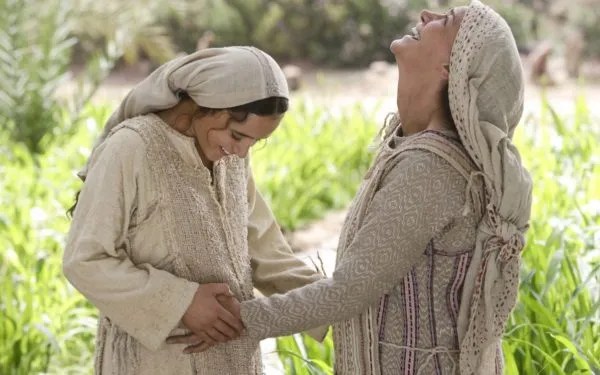
When Elizabeth heard Mary’s greeting,
the infant leaped in her womb,
and Elizabeth, filled with the Holy Spirit…
From Catholic Commentary on Sacred Scripture: The Gospel of Luke, page 48
“Mary’s greeting provokes a reaction as Gabriel’s greeting did before (1:29). The infant John leaped in his mother’s womb, and Elizabeth herself was filled with the holy Spirit. the angel’s words to Zechariah are being fulfilled , as the child is ‘filled with the holy Spirit even from his mother’s womb’ (1:15). the verb ‘leap’ is used in the Septuagint to describe how Esau and Jacob leaped or ‘jostled each other’ in he womb of Rebekah, another once-barren woman (Gen 25:22). She was told that ‘the older will serve the younger’ (Gen 25:22). She was told that ‘the older will serve the younger’ (Gen 25:23), which is the case here as well, as the older John already signal;s his role as precursor of the younger Jesus.”
From Ignatius Catholic Study Bible: The Gospel of Luke, page 21
Mary, Ark of the Covenant
“Luke’s Gospel tells us more about the Mother of Jesus than any other book in the New Testament. Most of this information is packed within his first two chapters, where Luke strings together some of the most beautiful traditions we have about her life and mission. The deeper we delve into Luke’s narrative, the more we appreciate the way in which Luke tells us the story of Mary. One example of this is found in the story of the Visitation. On one level, it tells of a joyous encounter between two expectant mothers; on another, it recalls memorable stories told in the Old Testament about the Ark of the Covenant. By alluding to these ancient traditions, Luke expands the vision of the careful reader considerably. For he leads us to see Mary as the Ark of God’s New Covenant and implies that the sacred Ark of the Old Covenant merely prefigured a more wonderful Ark to come: the Mother of the divine Messiah.
“One tradition that Luke draws upon is from 2 Samuel. He intentionally sets up the subtle but significant parallels between Mary’s Visitation with Elizabeth and David’s effort to bring the Ark of the Covenant to Jerusalem narrated in 2 Sam 6. When Luke tells us that Mary “arose and went” into the Judean hill country to visit her kinswoman (Lk 1:39), he reminds us of how David ‘arose and went’ into the same region centuries earlier to retrieve the Ark (2 Sam 6:2). Upon Mary’s arrival, Elizabeth is struck by the same sense of awe and unworthiness before Mary (Lk 1:43) that David felt standing before the Ark of the Covenant (2 Sam 6:9). Parallels continue as the joy surrounding this great encounter causes the infant John to leap with excitement (Lk 1:41), much as David danced with excitement before the Ark (2 Sam 6:16). Finally, Luke adds that Mary stayed in the ‘house of Zechariah’ for ‘three months’ (Lk 1:40, 56), recalling how the Ark of Covenant was temporarily stationed in the ‘house of Obed-edom’ for a waiting period of ‘three months’ (2 Sam 6:11). Taken together, these parallels show us that Mary now assumes a role in salvation history that was once played by the Ark of the Covenant. Like this golden chest, she is a sacred vessel where the Lord’s presence dwells intimately with his people.
“Luke also draws upon a second tradition from the Books of Chronicles. This time he brings into his story a highly significant expression once connected with the Ark. The term shows up in Lk 1:42, where Elizabeth bursts out with an exuberant cry at the arrival of Mary and her Child. Although the Greek verb translated as ‘exclaimed’ seems ordinary enough, it is hardly ever used in the Bible. In fact, it is found only here in the entire New Testament. Its presence in the Greek Old Testament is likewise sparse, appearing only five times. Why is this important? Because every time the expression is used in the Old Testament, it forms part of the stories surrounding the Ark of the Covenant. In particular, it refers to the melodic sounds made by Levitical singers and musicians when they glorify the Lord in song. It thus describes the ‘exulting’ voice of instruments that were played before the Ark as David carried it in procession to Jerusalem (1 Chron 15:28; 16:4–5) and as Solomon transferred the Ark to its final resting place in the Temple (2 Chron 5:13). Alluding to these episodes, Luke connects this same expression with the melodic cry of another Levitical descendant, the aged Elizabeth (Lk 1:5). She too lifts up her voice in liturgical praise, not before the golden chest, but before Mary. Luke’s remarkable familiarity with these ancient stories enables him to select even a single word that will whisper to his readers that this young Mother of the Messiah is the new Ark of the Covenant.
“For the reader with eyes to see and ears to hear, Luke has given us a vision of the Virgin Mary that becomes ever more glorious the deeper we dig into the Scriptures. Our ability to see Mary as he did depends in part on our knowledge of the Old Testament and in part on our sensitivity to Luke’s skillful use of it. By choosing his words and phrases carefully, he is able to weave various strands of biblical tradition into his narrative, adding beauty and depth to his already elegant prose. Little wonder the Church’s liturgical and theological traditions have so often described Mary as the Ark of the New Covenant. This vision is not merely the fruit of mystical speculation from a later age. It is already embedded within the Infancy Narrative of Luke’s Gospel.”
My take
I could have just extracted the third paragraph above, but, because my favorite title for Mary is “Ark of the Covenant,” I wanted to provide the entire topical essay from the Ignatius Catholic Study Bible. I have little to add, but I would point out how important typology is in the Bible. St. Augustine famously said, per the Catechism of the Catholic Church, 129,
The New Testament lies hidden in the Old and the Old Testament is unveiled in the New.
We can’t fully understand Christ without the entire Bible. An early heresy wanted to discard the Old Testament as inconsistent with its understanding of God and Jesus. With this episode in the Gospel of Luke, not only Mary as Ark, but what is highlighted by the Catholic Commentary regarding Esau and Jacob, we have just one example of many of the unity and importance of the entire Scripture handed down to us faithfully by the Church.
I’ve had the self-published Mary the Ark of the Covenant on my shelf for some time now. I must read it.
God bless!
 Unworthy Servant