Advent Day 23: No greater man

TODAY’S GOSPEL (Lk 1:57-66)

From Luke 1:66b:

“What, then, will this child be?
For surely the hand of the Lord was with him.”

From Opening the Scriptures: Bringing the Gospel of Luke to Life, page 41

“Luke concludes his account of the birth and naming of John with his own comment: “For surely the hand of the Lord was with him.” The Old Testament uses the expression “hand of the Lord” to convey the power of God (Joshua 4:24; see Exod 7:4; 13:3; 15:6); the hand of the Lord being with or upon someone means that he is empowered and guided by God (1 Kings 18:46; 1 Chron 28:19; Ezra 7:28; Ezek 1:3; 3:14, 22)/ Surely someone born to a previously barren woman in fulfillment of an angel’s words has been sent by God to carry out a special work, and surely God will empower and guide him to accomplish his mission/ By adding that final comment, Luke invites his readers to join those pondering what this child will be and to share their sense of anticipation.”

My take

“Amen, I say to you, among those born of women there has been none greater than John the Baptist; yet the least in the kingdom of heaven is greater than he.” (Mt 11:11)

We think much of and revere deeply the greatest woman to be born of woman, the Blessed Virgin Mary, but how much do we consider the greatest man born of woman, as declared by Jesus Himself!, John the Baptist? Fittingly, he is the only person in Heaven, aside from Jesus and His mother, whom we honor by celebrating his earthly birth on the liturgical calendar (June 24, appropriately, six months before Christmas).

This man was repeatedly asked if he was the Messiah. How powerful must his preaching have been? Herod wondered if Jesus might be John reincarnated. What sort of impact must John have had on all of Judea? People flocked to him from miles around, confessing their sins and seeking a baptism of repentance. How much weight must his words have carried with the general population? The wife of Herod wanted John shut up for good. What weight must his words have carried with the commonfolk?

My suggestion is to read everything in Scripture about John the Baptist in one sitting (it won’t take very long). I have listed and linked below, all Gospel passages pertaining to John:

  • Lk 1:5-25 (annunciation and conception of John)
  • Lk 3:1-22 (John’s public ministry, his future arrest by Herod, Jesus’ baptism)
  • Mt 3:1-16 (John introduced and the baptism of Jesus)
  • Mk 1:2-11 (John introduced and the baptism of Jesus)
  • Jn 1:6-8, 15 (from the Prologue)
  • Jn 1:19-37, 40 (John’s public ministry, his prophesying about Jesus and the retelling of the Spirit coming upon Jesus, his encouraging his disciples to follow Jesus)
  • Lk 7:18–23 (John sends disciples to Jesus to ask if He is the Messiah)
  • Jn 3:23-30, 4:1-2 (John baptizing and commenting on Jesus baptizing; Jesus’ disciples baptizing)
  • Jn 5:31-36 (Jesus extolling John as a precursor to Him)
  • Lk 7:24-35 (Jesus extolling John to the crowds)
  • Mk 1:14-15 (indicates John’s arrest)
  • Mk 3:18-22 (John’s disciples; on fasting)
  • Mk 6:14-29 (Herod’s suspicions about Jesus; the recounting of John’s imprisonment and death)
  • Lk 9:7-9: (Herod’s suspicions about Jesus and his speaking of John’s death)
  • Mk 8:27-30 (speculation that Jesus is John)
  • Lk 9:18-22 (speculation that Jesus is John)
  • Jn 10:40-41 (the crowds compare Jesus and John)
  • Lk 11:1 (Jesus asked to teach His disciples how to pray as John taught them)
  • Mk 11:27-33 (Jesus’ authority questioned and He invokes John)
  • Lk 16:1 (John invoked by Jesus as the last prophet)
  • Lk 20:1-8 (Jesus’ authority questioned and He invokes John

John’s baptism is also referred to in Acts 1, 10, 11, 13, 18, 19.

John the Baptist, pray for us, that we may join you in the kingdom, even as the “least.”
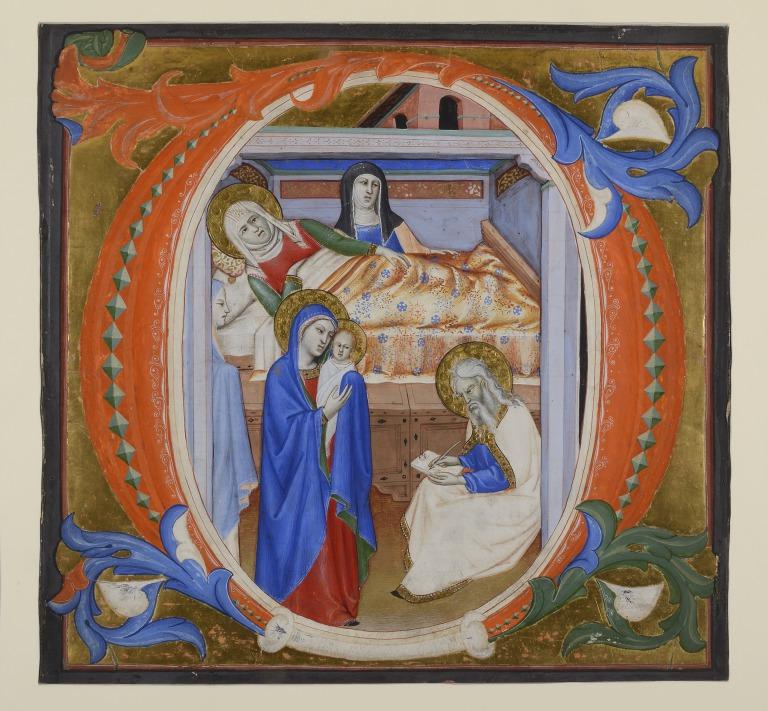
The Birth of St. John the Baptist (1370 – 1371 probably) by Don Silvestro dei Gherarducci

God bless!
Lent Day 40: Speaking, listening, enduring, persevering

TODAY’S READINGS

Today’s Old Testament reading (Is 50:4-7), as we begin Holy Week is Isaiah’s third servant song, vividly prophesying what the future Messiah would endure. The commentary following deals with the entire reading and beyond (through v. 11). The passage starts off this way:

The Lord GOD has given me
a well-trained tongue…”

“The third ‘Servant Song’ in Isaiah. Here the Servant is a prophet who speaks God’s word, even as he suffers at the hands of his persecutors. Again, he represents the people of Israel and yet is distinct from them: unlike Israel in exile, whose ‘ear has not been opened’ and who continues to be a ‘rebel’ ()48:8), the servant says that ‘God has opened my ear, and I was not rebellious (50:5).

“Christian tradition sees these verses fulfilled in the Passion of Jesus…When the savior was struck, he endured it patiently; when he was reviled, he did not revile; when he suffered, he did not threaten. Instead, he gave his back to those who beat him, his cheeks to their blows, and his face he did not turn from their spitting. Finally, he accepted death, giving us an image of virtue and an example for conducting ourselves (St. Athanasius of Alexandria, Festal Epistles 10, 7).” (Isaiah [Ignatius Catholic Study Bible], 87-88)

This short passage is a wonderful model for the evangelist (that should be all of us). The Lord gives each of us certain talents.to “rouse” the weary (including us, if applicable) from a slumber of indifference, doubt, despair, or unbelief. We are to listen daily for God’s voice, that our hearts will be moved and our mission will be clear (dialogue with God in prayer and by reading Scripture to hear Him speaking to you and to help train that tongue).

In responding to the Lord’s call in this way, we can count on persecution. Maybe not physically, as Isaiah has it, but certainly psychologically and emotionally. Do we humbly and patiently endure the blows, the slaps, the shame, the spitting that come our way? If we are like Christ (and no servant is greater than his Master then we may well find it necessary to deal with all these difficulties and more.

Our response? We are to be resolute in being convicted of the truth and making sure that we persevere in spreading it far and wide. Counting on the Lord God to help us, as he promises, we will not be put to shame with the One who matters, despite what the world thinks. Jesus constantly has us looking above and beyond this mortal coil for true fulfillment and happiness. We can count on it for eternity if we stay faithful.

Let us then go to him outside the camp, bearing the reproach that he bore.
For here we have no lasting city, but we seek the one that is to come.
(Heb 13:13-14)

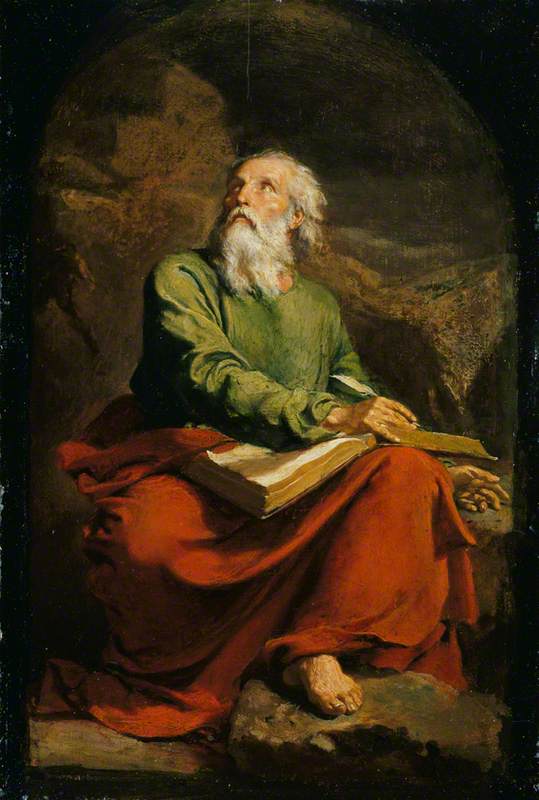
Isaiah (1838) by Jean Louis Ernest Meissonier

God bless.

Lent Day 30: Moses and Jesus

TODAY’S READINGS

Today’s Gospel (Jn 5:31-47) picks up where yesterday’s left off. Jesus here provides deep theology and a pointed accusation at the Pharisees. He closes with these devastating words:

“Do not think that I will accuse you before the Father:
the one who will accuse you is Moses,
in whom you have placed your hope.
For if you had believed Moses,
you would have believed me,
because he wrote about me.
But if you do not believe his writings,
how will you believe my words?”
(vv. 45-47)

he wrote of me: Jesus follows the Jewish tradition that Moses authored the Pentateuch (Gen-Deut). Moses thus described the Messiah as a Redeemer (Gen 3:15), a universal King (Gen 49:10), and a Prophet like himself (Deut 18:15–19).” (The Gospel of John [Ignatius Catholic Study Bible], 28)

“The authorities appealed to the authority of Moses (‘in whom you have placed your hope’) and the Torah to accuse Jesus (see 5:11-18). Yet since the Scriptures are a witness to Jesus (Moses ‘wrote about me’), both the Scriptures and Moses stand on Jesus’ side against his accusers. Scripture bears witness to Jesus, and faith in Jesus opens the way to see this testimony. But on account of their unbelief, the authorities do not fully understand Moses and the Scriptures because they do no see how they bear witness to Jesus. Thus, Jesus concludes, ‘If you do not believe his writings, how will you believe my words?'” (The Gospel of John [Catholic Commentary on Sacred Scripture], 111-12)

“Failure to understand the true import of Scripture is an obstacle to believing in Jesus and coming to him to have life (5:40).” (Bringing the Gospel of John to Life, 150)

I think of typology and the importance of the entire Bible here. It is true, as St. Augustine said, that, “In the Old Testament the New is concealed, in the New the Old is revealed.” We miss so much if we read the New Testament, especially the Gospels, in isolation. Jesus berates the self-described experts in the Law, as missing all the Torah was pointing to: namely Him. Had they seen Jesus as the New Moses, the fulfillment of the Mosaic (and all Old Testament) covenants, they would have put Him on a throne of gold instead of a throne of wood.

God bless.

Lent Day 23: For or Against?

TODAY’S READINGS

Today’s Gospel (Lk 11:14-23) has Jesus being calumniated even when exorcising demons. He concludes with this:

“Whoever is not with me is against me,
and whoever does not gather with me scatters.”
(v. 23)

“[E]ven if people do not want to recognize it, Jesus Christ has conquered and from now on no one can adopt an attitude of neutrality towards him: he who is not with him is against him.” (The Navarre Bible: St Luke, 147)

“There is no safe neutral corner in the front line of a war…Whoever is not with Jesus in his battle against Satan is by default against him…In the context of the clash between the kingdom of God and the kingdom of Satan each person must side with the one or the other: there are ultimately no other kingdoms…Ultimately one is either gathered to Jesus and brought into the kingdom of God, or cast out and scattered (see 13:28).” (Bringing the Gospel of Luke to Life, 322)

The time for fence sitting is over. In reality, there never has been a time for it. But now, the Lord needs to know where we stand. Will we defend Him, or shirk away? Are we going along to get along or are we counter-culture (of death)? Are we the disciples before Pentecost hiding away in anxiety and fear or are we compelled by tongues of fire to speak out fearlessly whatever may come?

I am reminded of the Book of Revelation’s admonition to a particular church that really is a message to all of us:

“I know your works; I know that you are neither cold nor hot.* I wish you were either cold or hot. So, because you are lukewarm, neither hot nor cold, I will spit you out of my mouth…Whoever has ears ought to hear what the Spirit says to the churches.” (Rev. 3:15-16, 22)

It is a striking image painted for John here in this vision. I certainly don’t want to make the Lord sick to His stomach, do you? Let us be bold and fervent in the Faith we profess, not counting the cost here on earth but building up treasure in heaven (see Mt 6:19-21).

God bless.

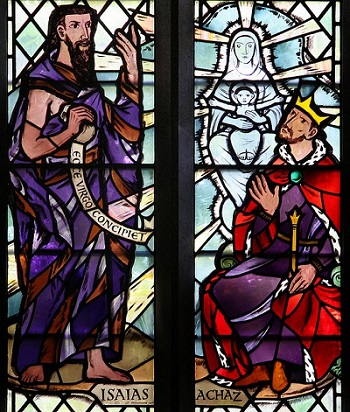
Advent Day 18: A “virgin”? “Emmanuel”?

TODAY’S READINGS

The first reading is from Is 7:10-14. I had hoped to focus on Ahaz’s seemingly humble rejection of the offer of a sign, but my limited resources said little except that, essentially, Ahaz was a scoundrel and his false piety was seen through by Isaiah. I did find, however, an article that expounds specifically on Ahaz’s response offering a contemporary example and a practical reflection.

Additionally, who would not be tempted to comment on the Annunciation, found in today’s Gospel reading? The number of resources I could refer to are legion, so that can be your homework (or prayerwork).

So, I went for the last verse of the first reading. A familiar one that, for Christians, unmistakably points toward Jesus. But is that all there is to it? This gives me the opportunity to highlight a phenomenal book that should be in the reference library of, not only every Catholic, but every person who is serious about knowing and appreciating better the Old Testament.

[T]he Lord himself will give you this sign:
the virgin shall conceive and bear a son,
and shall name him Emmanuel.
(v. 14)

“Theological Issues in Isaiah Is Immanuel

Conceived of a ‘Virgin’ or a ‘Young Woman’?

As is well known, this famous oracle is taken as a prophecy of the virginal conception of Christ in the New Testament (Mt 1:23). For centuries, however, there has been a debate over the original meaning of Isaiah’s oracle. On the one hand, most modern interpreters contend that Isaiah is not referring to a virginal conception, since the Hebrew word used by Isaiah is ‘almah, which many feel is best translated as ‘young woman’. Those who favor this position point out that the ordinary Hebrew word for ‘virgin’ (bethulah) is not used in Isaiah 7:14. From this point of view, then, the “sign” given to Ahaz is the birth of his son Hezekiah, who, by the time he reaches the age of reason, will witness the overthrow of the northern kingdom. Indeed, there are aspects of the oracle that seem indisputably to envision an immediate fulfillment in the ending of the Syro-Ephraimite crisis (Is 7:14-17), events that took place in the lifetime of King Hezekiah, son of Ahaz (ca. 732 B.C.).

“On the other hand, other interpreters contend that Isaiah is referring to a miraculous conception and birth. We determine the meaning of the Hebrew word ‘almah ultimately by analyzing the way it is used in the Hebrew text of the Bible: it occurs seven times, and in those cases it is never applied to a married woman: Genesis 24:43; Exodus 2:8; Isaiah 7:14; Psalm 68:26 MT; Proverbs 30:19; Song of Solomon 1:3; 6: 8. Indeed, in some cases ‘almah is used as a synonym for ‘virgin’ (bethulah}, as when Rebekah is referred to both as a ‘maiden/young woman’ (‘almah) and a ‘virgin (bethulah) whom no man had known’ (Gen 24:16, 43). Again, in Song of Solomon 6:8, the category ‘almah is distinguished from the categories ‘queen’ and ‘concubine’ — that is, from those who have already had relations with the king. Perhaps, then, the Hebrew word ‘almah does not denote virginity, but does connote it, like the English word ‘maiden’. Intriguingly, the Jewish translators of the Greek Septuagint usually translated ‘almah with the non-specific expression ‘young woman’ (Greek parthenos}, except in two cases, where the context seems to have implied virginity: the story of Rebekah the virgin (Gen 24:43) and the oracle of the ‘virgin’ (Greek parthenos) who conceives Immanuel (Is 7:14). In this view, the ‘sign’ (Hebrew ‘oth) — which Isaiah uses elsewhere to refer to a miracle of nature (Is 37:30; 38:7) — is the miraculous conception of the child by a virgin. .Again, it is important to remember that the decision to render ‘almah with the Greek parthenos, ‘virgin’, was made by Jewish translators themselves about two hundred years prior to the dawn of the Christian era (see Is 7:14 LXX).

“When evaluating this issue, it is also critical to remember that biblical prophecy can have more than one horizon of fulfillment. In other words, the same prophecy may have both preliminary as well as ultimate fulfillments. In the case of Isaiah 7:14, the preliminary fulfillment of the ‘Immanuel’ child may well have been Hezekiah son of Ahaz, and the ‘almah may have been Abijah, a young bride of Ahaz (2 Chron 29:1), who was probably not yet intimate with the king. Before Hezekiah was a young man, the Syro-Ephraimite threat had evaporated. Yet Hezekiah himself is an important type of the Messiah in the book of Isaiah. For example, in the pivotal historical chapters about the end of Isaiah’s life (Is 36-39), Hezekiah is the righteous yet suffering savior-king, reminiscent of David and anticipating the future Messiah. Indeed, Hezekiah may even have been the immediate referent of the other prophecies of a.royal child (Is 9:1-7 and 11:1-5). However, to the. extent. that these oracles point not only to a new king but to a new kingdom, a new exodus, and a new creation, the birth and life of Hezekiah by no means fulfill them (cf. Is 7:14-16; 9:1-7; 11:1-5}. Instead, Hezekiah’s life leaves these oracles as prophetic words “waiting” for ultimate fulfillment. Hezekiah was born of a: ‘maiden’ ( ‘almah) in the usual manner, but later one would be born of a. mother who remained a maiden before, during, and after his birth. Hezekiah was ‘Immanuel’ (‘God with us’) in a mediated sense: his righteous reign.was a sign of God’s closeness to his people. But later one would be born who was truly ‘God with us’ in a literal sense. Applied to Hezekiah, the poetry and language of these oracles is hyperbolic: complete fulfillment awaits another.” (John Bergsma and Brant Pitre, A Catholic Introduction to the Bible: The Old Testament (San Francisco: Ignatius Press, 2018), 747-749)

I have provided this extended excerpt on the first reading not only because it is particularly interesting, delving into several facets of the prophecy, but also to highlight the extraordinary depth and erudition of the text. And, considering the content (over one thousand pages of brilliant scholarship), not an expensive purchase at all.

O come, O come, Emmanuel!

God bless.