Advent Day 11: Taking a load off

TODAY’S GOSPEL (Mt 11:28-30)

From Matthew 11:28:

“Come to me, all you who labor and are burdened,
and I will give you rest.

From Fire of Mercy, Heart of the Word (Volume I), pages 712, 714:

“[W]e are surely not to limit the scope of Jesus’ magnificent Venite ad me! only to those under the yoke of Pharisaism. For the love of Christ has a much more universal scope and, in Jesus, God is the absolute liberator of man from a legalistic conception of Torah as well as from every burden that keeps him back from fully becoming a child of the infinitely free Father.

“Jesus is the one who, by a divine ‘instinct’, himself bends down to share the lot of all who are burdened beyond their ability to bear it….Rather than denounce the source of the oppression — whether within or outside the person — Jesus simple extends an invitation: ‘Come to me!’ It is crucial that these words be seen as an invitation, because a person must respond to it with perfect freedom. One must oneself in some sense leave behind the oppressive situations and go to Jesus. Although elsewhere Jesus is portrayed as himself searching out the lost sheep, here the appeal is made to the exhausted person’s desire to change his life. He must take the first step himself toward the source of regeneration.”

My take

If you love Scripture, particularly Matthew’s Gospel, I encourage you to invest in Father Simeon’s (formerly Erasmo Leiva-Merikakis) four-volume Fire of Mercy, Heart of the Word series. Over 2,800 pages breaking down Matthew. What a treasure goring verse by verse, phrase by phrase, or word by word through the Gospel. Amazing spiritual insights from these “meditations” will be much food for thought, prayer, and contemplation. The excerpt above is only a tiny portion of the several pages devoted to just this one verse.

Don’t we all need rest from our many burdens? And Jesus offers to be that resting place. He already took the cross off our shoulders. Just as we must freely accept this gift of redemption, so must we freely come to Jesus in our difficulties and challenges. He is always waiting for us.

So, please join me as I endeavor to put my cares and troubles into Jesus’ hands so that I may finally true rest.

Then the peace of God that surpasses all understanding will guard your hearts and minds in Christ Jesus. (Phil 4:7)

The Hard Job of Living… (1922) by Georges Rouault

God bless!

Advent Day 10: Lost and Found

TODAY’S GOSPEL (Mt 18:12-14)

From Matthew 18:14:

“[I]t is not the will of your heavenly Father
that one of these little ones be lost.”

From Fire of Mercy, Heart of the Word (Volume II), page 628:

“‘It is not the will in the sight of your Father who is in heaven that one of these little ones should perish’: The ever-watchful eye of God’s love tirelessly scans the whole horizon of human existence with only one concern: Are all being saved? Are all being brought into life? Are any being lost, even one? For God’s joy is not complete until all are saved! The newness of life that comes about as a result of conversion to Christ — my turning and clinging ardently to Christ after having been sought and found by Christ — is an event that makes the Heart of God dance with joy. Can we not see the Face of the eternal Father glowing with exultation at the recovery of one of his dear children? And that tidal wave of divine joy then reverberates through his creation, since no act of God is without effect in the whole of the created order. Just as the angels of the little one, forever contemplating the face of the heavenly Father, build a bridge connecting childlike innocent and divine glory, so too the greatest exultation among the choirs of angels is reserved for the occasion of a single sinner’s conversion (Lk 15:7, 10).”

My take

Father Simeon’s exposition of the highlighted verse brought to mind immediately two other New Testament passages:

God our savior…wills everyone to be saved and to come to knowledge of the truth. (1 Tim 2:3-4)

“Whoever causes one of these little ones who believe in me to sin, it would be better for him to have a great millstone hung around his neck and to be drowned in the depths of the sea.” (Mt 18:6)

What a stark warning: If we oppose the will of God for all of mankind by leading others into sin directly or by bad example, we would be better off dead. We have an obligation, by virtue of our Baptism, to bring others to Christ, not lure them away or drive them away. If only we were constantly mindful of that. If only we saw the world through the eyes of God we too would desire salvation for all. We are God’s chosen instruments to effect God’s will — what an awesome gift and what an awesome responsibility! We must get close to the Lord and stay close to the Lord through prayer, penance, the Sacraments, and Scripture. Vigilance!

God bless!

Advent Day 8: Straightening up

TODAY’S READINGS

FROM Baruch 5:7 (the full passage is Bar 5:1-9):

God has commanded
that every lofty mountain be made low,
and that the age-old depths and gorges
be filled to level ground

FROM Psalms 126:5 (the full passage is Ps 126:1-2, 2-3, 4-5, 6):

Those who sow in tears
shall reap rejoicing.

From The Navarre Bible: The Psalms and the Song of Solomon, page 422

“[This] simile seems to be built around a popular proverb. ‘The pain of suffering gives rise to holy tears. But the time of weeping is also the time of sowing, because the works of charity that are performed to ease the burden of men’s sins are the seeds of eternal happiness’ (Prosper of Aquitaine, Expositio Psalmorum, 125, 6).”

FROM Philippians 1:4-5 (the full passage is Phil 1:4-6, 8-11)

I pray always with joy in my every prayer for all of you,
because of your partnership for the gospel

From Catholic Commentary on Sacred Scripture: Philippians, Colossians, Philemon, pages 75-76

“‘your partnership for the gospel’: That phrase may seem at first to refer simply to their common faith in the gospel. But for Paul the partnership is more concrete and practical than that. As Paul uses the word, ‘gospel’ can sometimes mean the message of the good news itself (God has definitely entered into history to save us through the death and resurrection of his Son), but at other times ‘gospel’ means the project of sharing that good news. Here, the ‘partnership in the gospel’ for which Paul is grateful seems to refer especially to the financial aid that the Philippians have sent to him through Epaphroditus (see 4:10-20). This aid in partnership in the sense that it is a real contribution to the advance of the gospel.”

FROM Luke 3:4b-5 (the full passage is Lk 3:1-6)

 Every valley shall be filled
        and every mountain and hill shall be made low.
    The winding roads shall be made straight,
        and the rough ways made smooth

From The Word of the Lord (Year C), page 18

“‘Every valley shall be filled’ refers to hope, encouragement, and new life being granted to the poor, the oppressed, the lowly — people who fell they have been forgotten by God or are not worthy of God’s attention.
“‘Every mountain and hill shall be made low’ refers to the humbling of the proud, the repentance that the strong and arrogant must undergo in order to receive God’s salvation.
“The ‘winding roads’ and ‘rough ways’ refer to the twists and turns of the human heart, contorted by sin (Jer 19:9). The human heart needs to be ‘simplified’ or ‘straightened’ by honest and truthful confession of sin.”

MY TAKE

Not only is John the Baptist’s message echoed in Isaiah (Is 40:35), but also in Jeremiah’s scribe, Baruch, as seen in today’s first reading. I can do nothing to improve on Dr. Bergsma’s reflection above in his The Word of the Lord series (a must have — I’m working through the last of the four volumes, as I did the first three, this year), but I will add a thought that came to me as I heard the Gospel proclaimed at Mass.

“Mountains made low” certainly evokes images of the proud being “put in their place.” So, then, if the lofty peak represents the proud, maybe those in a deep valley are folks who are mired in sin and despairing of salvation. The only way out is up and it’s a struggle that may seem overwhelming (or impossible) to undertake. And how easy it is to get to the bottom! I’m a bicyclist so it is impressed upon me what an easy journey it is when going down hill and what a challenge it is to go back up that same hill. Sin can be that way for us, as well. Our transgressions may start out small, but the slippery slope is there to carry us rapidly down if we are not careful and vigilant. Sometimes it is only when a person in the throes of sin or addiction hits “rock bottom” that he comes to his senses and makes the decision to climb out of the abyss. Can we not say that what was “sowed in tears” (the descent into the darkness of sin) can ultimately lead to “rejoicing in the reaping” (in ascending to righteousness)?

Finally, a word on the second reading. By virtue of our Baptism, we are partners in sharing the Gospel. We should do so in word and action at all times. But, as the Catholic Commentary lays out, we should also support ministries, as Paul’s followers did for him, that authentically and faithfully get out the Word. Some of my favorites are my home parish, the St Paul Center, Catholic Answers, and EWTN.

BP BARRON SERMON

FR MIKE SCHMITZ HOMILY

Hurricane Ridge in Olympic National Park

God bless!

Advent Day 6: I see (or do I?)

TODAY’S GOSPEL READING (Mt 9:27-31)

From Matthew 9:28-29:

When he entered the house,
the blind men approached him and Jesus said to them,
“Do you believe that I can do this?”
“Yes, Lord,” they said to him.
Then he touched their eyes and said,
“Let it be done for you according to your faith.”

From Opening the Scriptures: Bringing the Gospel of Matthew to Life, page 175:

“The men want to be able to see and Jesus knows that this is what they want. He asks them whether they believe he can do this. This is the only time in Matthew’s gospel (or in any gospel) that Jesus asks anyone whether they believe that he is able to heal them. ‘”Yes, Lord,” they said to him.’ Calling Jesus ‘Lord” is an acknowledgment of his authority and power to give them sight. Their faith has been demonstrated by their following Jesus and crying out to him, even though he seemed to ignore them.”

From Catholic Commentary on Sacred Scripture: The Gospel of Matthew, page 137:

“[The blind men] call Jesus Son of David — the first time someone addresses him with the royal title that has messianic overtones. ‘Son of David’ also brings to mind David’s heir, King Solomon, who was known in Jewish tradition as a great healer and exorcist.”

From Fire of Mercy, Heart of the Word (Volume I), pages 493-494:

“In the end, this faith [of the blind men] proves to be omnipotent, because it is a whole-hearted embracing of the full reality of the presence of the incarnate Word. Faith rejoices in a natural blindness that is the precondition for the vision of God….Our own native lights need to be extinguished if Jesus is to light his lamp in our souls….Whatever empties itself out of itself in order to receive omnipotence, itself becomes omnipotent, just as only total darkness can receive the uncreated Light (St. John of the Cross, Dark Night of the Soul)….The blind men set no condition to God but rather open themselves up wholly and actively to the divine action.”

My take

Amen, I say to you, if you have faith the size of a mustard seed, you will say to this mountain, ‘Move from here to there,’ and it will move. Nothing will be impossible for you. (Mt 17:20)

Jesus’ words to the blind men in today’s Gospel and His words above, further along in the same Gospel, should be a wake-up call to us, encouraging driving us to deep prayer and contemplation. What can Jesus not do if we place ourselves totally in His hands? Jesus can do any good thing. It is we who dampen or even short-circuit His healing power.

I have for months now been reading, as a spiritual exercise, Abandonment to Divine Providence by Jean-Pierre de Caussade. At first, the radical nature of the good Father’s advice took me aback (and sometimes still does, over 300 pages in). But his admonition to give up our own will and self-concern in favor of whatever the Lord ordains or permits for us, makes total sense. What peace we would have if we simply, “Let go and let God,” as the popular saying goes. Emptying out ourselves, as Father Simeon says in Fire of Mercy, allows in God.

What if we “set no condition to God but rather open [our]selves up wholly and actively to the divine action”? What a radical difference that would make! Lord, make me blind to worldly concerns so that I can be open to truly seeing You.

ADVENT RESOURCES

ADVENT/CHRISTMAS READING

Jesus Healing Two Blind Men (undated) by Patriarchate of Peć by School Serbian

God bless!

Are you “incredulous for joy and…amazed” that “the author of life” is “expiation for our sins and..for those of the whole world”? “O Lord, you put gladness into my heart.”

TODAY’S READINGS

It struck me in hearing the readings proclaimed at Mass that, while Sunday readings are always purposeful in connecting the first reading and the Gospel reading, all four Scriptures fit together in a profound way. Let’s take a closer look at each reading, in particular the phrases in question.

Today’s first reading (Acts 3:13-15, 17-19) has Peter remonstrating his Jewish hearers for what they did to Jesus.

“The author of life you put to death,
but God raised him from the dead; of this we are witnesses.”
(v. 15)

We cooperate with this “author” to make new humans and He provides the soul. He gives the life of grace to that soul in Baptism, gives life back to that soul through Confessions, and strengthens the life of that soul through the Eucharist. This Author writes beautifully, don’t ever forget when you look around and when you look in the mirror.

The Responsorial Psalm (Ps 4:2, 4, 7-8, 9) is overwhelming in its delight of the Lord:

O LORD, let the light of your countenance shine upon us!
You put gladness into my heart.
(vv. 7b-8a)

Wow! When our heart is full in earthly matters, we never want to lose that feeling, but inevitably it fades or is jarred away. But the gladness God brings to the heart can never be taken away if we hold it close. Never let earthly distractions, no matter how severe, disturb your peace, knowing that God is with you when you stay in His good graces.

Then John (1 Jn 2:1-5a) tells us how we honor Jesus Christ for doing the following for us:

He is expiation for our sins,
and not for our sins only but for those of the whole world.
(v. 2)

Thank God! This is truly Good News! This great benefit we have received in knowing Christ and having been initiated into the Catholic faith should be made known to “the whole world.” There is no human that is not a beneficiary of Christ’s sacrifice. We are under obligation to make it known to every soul. What could ever stop us from winning over brothers and sisters to Christ? We must follow the Lord’s commandments and share this requirement with others.

The Gospel has Jesus appearing to the apostles and His Road to Emmaus companions in the Upper Room:

[Jesus] showed them his hands and his feet…
[T]hey were…incredulous for joy and were amazed
… (vv. 40-41a)

When was the last time you were “incredulous for joy and…amazed” at what Jesus has done for you and every person who ever has come into existence or who will be conceived? It is far too easy to become complacent in our faith. Let us renew ourselves in the Lord daily , finding joy and amazement in what He has done for us and for everyone. Let us exude the joy of knowing Jesus and share our amazement in how He saved wretches like us, so more wretches will come to the Faith..

BP BARRON SERMON

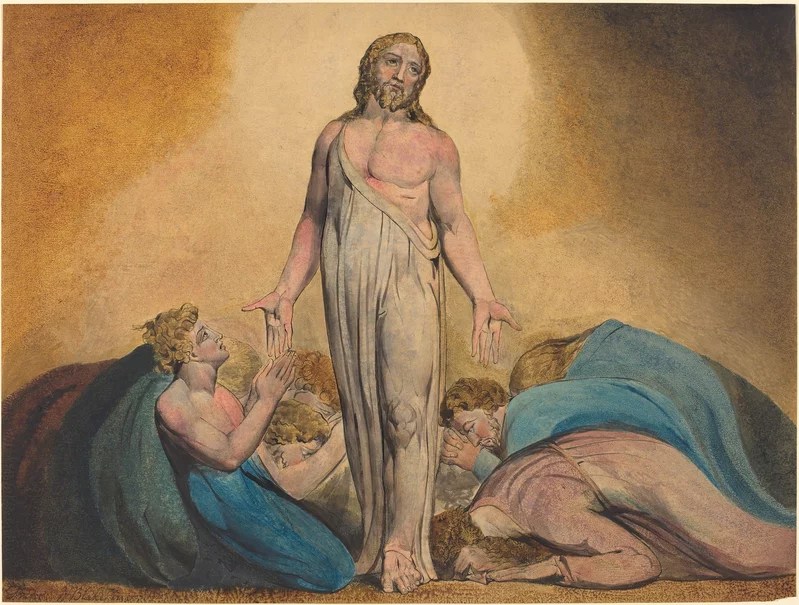
Christ Appearing to His Disciples After the Resurrection (c. 1795) by William Blake

God bless.

Lent Day 46: The Crucified One is not here (or is he?)

TODAY’S READINGS

Today’s Gospel reading for the Easter Vigil (Mark 16:1-7) gives us Mark’s version of the scene at Jesus’ tomb. An angel speaks to the women:

“You seek Jesus of Nazareth, the crucified.
He has been raised; he is not here.”
(v. 6)

“‘Jesus of Nazareth, who was crucified’: the same name as written on the inscription of the cross is used by the angel to proclaim the glorious victory of the resurrection. In this way St Mark bears witness explicitly to the crucified man and the resurrected man being one and the same. Jesus’ body, which was treated so cruelly, now has immortal life.

“‘He has risen: the glorious resurrection of Jesus is the central mystery of our faith. ‘If Christ has not been raised, then our preaching is in vain and your faith is in vain (1 Cor 15:14). It is also the basis of our hope: ‘if Christ has not been raised, your faith is futile and you are still in your sins…. If for this life only we have hoped in Christ, we are of all men most to be pitied’ (1 Cor 15:17 and 19). The Resurrection means that Jesus has overcome death, sin, pain and the power of the devil.” (The Navarre Bible: St Mark, 197)

Catholics are sometimes accused of keeping Christ on the cross because of our displaying crucifixes. I’ve never had a problem explaining the veneration of the crucifix using the apostle Paul’s words:

For I resolved to know nothing while I was with you except Jesus Christ, and him crucified. (1 Cor 2:2)

It seems to me a good thing to remember the brutality and ignominy Christ endured for my sake and the sake of all mankind from Adam till the end of time. Our sins do incalculable damage to the Body of Christ. It also helps us to realize that Jesus understands our suffering because He has been there.

But we also know now that suffering and death do not have the final word. Yes, there is no Easter Sunday without Good Friday. But for those faithful till the end, no amount of troubles in this life will compare to the glory the Lord won for us for the next life.

So, keep the faith. The Crucified One actually is here — and He retains the scars to prove it.

ARTICLE

An article I came across regarding Holy Saturday. The first two points are of most interest to me because they speak of what Jesus did on that first Holy Saturday when His Body was sealed in the tomb.

A FINAL NOTE

Holy Saturday is a good day to keep noise and talking to a minimum, it seems to me. Recall the silence of the tomb. I am looking forward to reading The Power of Silence which undoubtedly will be a good corrective for our noisy lives.

The Holy Women at the Tomb (1890) by William Bouguereau

God bless.

Lent Day 45: Joseph and Nicodemus

TODAY’S READINGS

Today’s Gospel reading for Good Friday of the Lord’s Passion (Jn 18:1—19:42) gives us John’s account of the Passion, death, and burial of Jesus. It ends featuring two members of the Sanhedrin:

“After this, Joseph of Arimathea,
secretly a disciple of Jesus for fear of the Jews,
asked Pilate if he could remove the body of Jesus.
And Pilate permitted it.
So he came and took his body.
Nicodemus, the one who had first come to him at night,
also came bringing a mixture of myrrh and aloes
weighing about one hundred pounds.
They took the body of Jesus
and bound it with burial cloths along with the spices,
according to the Jewish burial custom.
Now in the place where he had been crucified there was a garden,
and in the garden a new tomb, in which no one had yet been buried.
So they laid Jesus there because of the Jewish preparation day;
for the tomb was close by.”
(vv. 19:38-42)

“Our Lord’s sacrifice produces its firstfruits: people who were previously afraid now boldly confess themselves disciples of Christ and attend to his dead Body with exquisite refinement and generosity. The evangelist mentions that Joseph of Arimathea and Nicodemus used a mixture of myrrh and aloes in lavish amount. Myrrh is a very expensive aromatic resin, and aloes a juice extracted from the leaves of certain plants. They were used as an expression of veneration for the dead.” (The Navarre Bible: St John, 237)

“Up till now [Joseph of Arimathea and Nicodemus] had not made their discipleship public because they were afraid of the other religious authorities who strongly opposed Jesus (see 12:43-44)…By burying his body, Joseph and Nicodemus perform a culturally significant act of respect and faithfulness to Jesus. Burying the dead was an important service of love in Jewish piety (Tob 1;16-20; 4:3-4)…Through this public act of piety, Joseph and Nicodemus make known their relationship with Jesus.” (The Gospel of John [Catholic Commentary on Sacred Scripture], 329-30)

“The Gospel earlier noted that ‘even among the authorities’ many believed in Jesus, but out of fear for what would happen to them ‘they did not acknowledge it openly’ (12:42; see also 7:13; 9:22)…

“[Asking Pilate for Jesus’ body] would hardly remain a secret and would manifest that he was a follower of Jesus. He may have previously kept his discipleship a secret to maintain a good relationship with his fellow leaders (see 12:43), but he now casts that aside, identifying with Jesus in his death as had not during his life….

“Pilate may have known, or known of, Joseph of Arimathea as a member of the Sanhedrin; Pilate would not have known that he was a disciple of Jesus. Thus Pilate might have understood that Joseph was finishing off what other Jewish leaders wanted done…

“When [the leaders of the Sanhedrin] wanted Jesus arrested (7:32, 45), Nicodemus invoked the law of Moses to defend him: ‘Does our law condemn a person before it first hears him and finds out what he is doing?’ (7:51). This was hardly a profession of belief in Jesus, but it did indicate to other leaders tat Nicodemus was sympathetic to Jesus (see 7:52). Now by participating in the burial of Jesus, Nicodemus makes his allegiance public, as does Joseph of Arimathea. Jesus said, ‘When I am lifted up from the earth, I will draw everyone to myself’ (12:32). Joseph and Nicodemus are the first of them.” (Bringing the Gospel of John to Life, “544-45)

“Joseph figured in New Testament apocryphal writings (e.g., the apocryphal Aces of Pilate and Gospel of Nicodemus) and was later given a preeminent place in medieval legend as the first keeper of the Holy Grail. His feast day is March 17…

“Tradition says that Nicodemus eventually became a member of the Christian community.” (Catholic Bible Dictionary, 474, 649)

I find it interesting to speculate on minor characters, or those only briefly mentioned in encounters with Jesus. Thus, the research reflected above. As the last resource above mentions, tradition has these men to go on to be Christians. This makes perfect sense, particularly once the Resurrection came to light. How long did they remain in the Sanhedrin? Not long I imagine (whether voluntarily or involuntarily). Did they try to evangelize their fellows after the Resurrection? I wonder. Might they have been pillars of the early Christian community? Seems likely. Could they possibly have provided the Gospel writers with inside information on the workings of the Sanhedrin?. I believe there is no question. How powerful must have been their witness to all these events!

These men prove it is never too late to change and find courage in the truth. And that, instead of giving in to worldly status and demands or just plain despair, their minds and hearts turn to things of heaven and they become men of conviction and action.

Monastery Church: Altar of the crucifixion, Mecklenburg | Gaston Lenthe |
(Longinus, Joseph of Arimathea, and Nicodemus)

God bless.

Lent Day 44: “The spirit of the Lord God is upon me”

TODAY’S READINGS

Today’s Gospel reading for the Chrism Mass (Lk 4:16-21) has Jesus returning to His hometown of Nazareth. He stuns His synagogue listeners (undoubtedly including many friends, relatives, and acquaintances) by declaring Himself the fulfillment of Isaiah’s prophecy in chapter 61:

”“Today this Scripture passage is fulfilled in your hearing.” (v. 21)

“Christ’s words…show us the authenticity with which he preached and explained the Scriptures…Jesus teaches that this prophecy, like the other main prophecies of the Old Testament, refers to him and finds its fulfillment in him (cf. Luke 24:44ff). Thus, the Old Testament can be rightly understood only in the light of the New — as the risen Christ showed the Apostles when he opened their minds to understand the Scriptures (cf. Luke 24:45), an understanding which the Holy Spirit perfected on the day of Pentecost (cf. Acts 2:4).” (The Navarre Bible: St Luke, 78)

“Jesus make a bombshell announcement…With Jesus, the time of waiting for the fulfillment of God’s promises in Scriptures is over (see 24:27, 44). The messianic jubilee announced by Isaiah is at hand! ‘Behold, now is the acceptable time’ (2 Cor 6:2 RSV).” (The Gospel of Luke [Catholic Commentary on Sacred Scripture], 100)

“In the Greek of Luke’s Gospel, ‘today’ is emphatic. ‘Today,’ right now, even as you listen, ‘this scripture passage is fulfilled’…Isaiah’s prophecy serves as Jesus’ job description as he begins his ministry. Jesus is the fulfillment of God’s plans, bringing salvation to his people.” (Bringing the Gospel of Luke to Life, 118)

What is the job description, per Isaiah?

[T]o bring glad tidings to the lowly,
to heal the brokenhearted,
To proclaim liberty to the captives
and release to the prisoners,
To announce a year of favor from the LORD
and a day of vindication by our God,
to comfort all who mourn;
To place on those who mourn in Zion
a diadem instead of ashes,
To give them oil of gladness in place of mourning,
a glorious mantle instead of a listless spirit.
(vv. 61:1-3)

Who are the lowly? All of us sinners. The brokenhearted? All of us, at one time or another, sometimes for a long time? Prisoners? Those enslaved to habitual sin and all who place some created thing ahead of the Lord. Mourners? Those who have experienced loss, particularly loss of the grace of God through serious sin. How do these return to gladness? A return to God through Reconciliation.

Thank you Jesus for freeing us from slavery to sin and providing us the Church and the means of salvation through her, namely the Sacraments. Two we commemorate as being instituted today: Holy Orders and the Eucharist. Let us have recourse to the Eucharist and Reconciliation often and never let us spurn these great gifts.

For a dramatization of this episode in the synagogue, watch here.

God bless.

Lent Day 43: Annihilation is preferable

TODAY’S READINGS

Today’s Gospel reading (Mt 26:14-25) again has us at the table with Jesus and His Apostles at the Last Supper. The focus again is on the betrayer, Judas, on the day we call in his “honor,” Spy Wednesday. Jesus says of the traitor:

“The Son of Man indeed goes, as it is written of him,
but woe to that man by whom the Son of Man is betrayed.
It would be better for that man if he had never been born.”
(v. 24)

“Jesus is referring to the fact that he will give himself up freely to suffering and death. In so doing he would fulfill the will of God, as proclaimed centuries before (cf. Ps 41:10; Is 53:7). Although our Lord goes to his death voluntarily, this does not reduce the seriousness of Judas’ treachery.” (The Navarre Bible: St Matthew, 219)

“Instead of identifying the man, Jesus warns of the dreadful fate that the betrayer is choosing for himself. For what is about to transpire is a concurrence of divine will and human decision. The destiny of the Son of Man is determined by God and announced in the writings of the Old Testament. But the actions of the “man by whom the Son of Man is betrayed” are fully and freely his own. Judas is not a puppet with someone else pulling the strings. He has chosen to misuse his free will, and should he follow through with this treachery, he will come to wish “he had never been born.” (The Gospel of Matthew [Catholic Commentary on Sacred Scripture], 335)

“Jesus does not spell out what fate awaits [Judas] but indicates that it will be horrible…Jesus is now giving Judas a last-minute warning. Even though Jesus knows what will happen, Judas is nevertheless free to change his mind and take a different course.” (Bringing the Gospel of Matthew to Life, 578)

While the Church canonizes many persons as saints, it never declares anyone definitively in Hell. This spurs many conversations regarding the population of Hell. But the verse under consideration has long convinced me that there is one inhabitant of Gehenna (and I think, many, many more). The only persons who could possibly wish they’d never been born must be those in Hell. Heaven is what we were made for. Hell is the complete, utter, total, and permanent state of existing where we were never meant to be (remember: God desires all men to be saved [1 Tim 2:4]). I imagine souls in Hell cursing God, cursing their parents, and wishing they had never come into existence while knowing they can never go out of existence.

God forbid that any of us hear the words said to Judas being said to us on our judgment day because we betrayed our Savior

A wonderful talk supporting (and, frankly, influencing) my position on Judas’ ultimate fate can be found here.

Judas Iscariot, Saint Peter, John the Apostle, The Last Supper (c. 1520) by Giampietrino
after Leonardo da Vinci

God bless.

Lent Day 41: The poor and Jesus

TODAY’S READINGS

Today’s Gospel reading (Jn 12:1-11) continues our journey through John as we near the time of the Last Supper. Famously, Mary, the sister of Lazarus and Martha, slathers Jesus feet with costly perfume. Judas objects and Jesus responds :

Jesus said, “Leave her alone.
Let her keep this for the day of my burial.
You always have the poor with you, but you do not always have me.”
(vv. 7-8)

The poor: Jesus is not indifferent toward the poor. Elsewhere he promotes almsgiving in no uncertain terms (Mt 6:2–4; Lk 6:30; 12:33). ● The words of Jesus echo the words of Deut 15:11, which states that the unceasing presence of the poor offers countless opportunities to give generously to less fortunate neighbors. The disciples, too, will have plenty of chances to give alms, but only a brief time remains to be generous toward Jesus while he remains among them (CCC 2449).” (The Gospel of John [Ignatius Catholic Study Bible], 41)

“Jesus takes priority over every other concern — and little time remains before his mortal life ends.” (The Gospel of John [Catholic Commentary on Sacred Scripture] ,218)

“A literal translation of Jesus’ words is, ‘in order that she may keep it for the day of preparation for my burial,’ with ‘in order that’ indicating purpose. The interpretation which makes the most sense is that the purpose of the nard was that it was to be kept for the day of preparation for Jesus’ burial, which was that very day…Mary has symbolically prepared the body of Jesus for burial. anointing it as a corpse was anointed before being buried. Jesus does not say that Mary understood this deeper significance of her act; she may have simply anointed him out of love and gratitude. But Jesus knows that the hour for his going to his father is near. His raising of Lazarus to life — the cause of Mary’s gratitude — means that he lives under a sentence of death (11:53). Mary’s anointing has prepared him for the sentence being carried out.” (Bringing the Gospel of John to Life, 347)

What strikes me first and foremost about this passage is that, while true that Jesus will soon be dead, buried, rise, and ascend, He is still with us. Of course, He remains with us in a real and substantial way in the Eucharist. But that’s not the only way. Here’s Mother Teresa tying together the Eucharist and the poor:

“If we recognize [Jesus] under the appearance of bread, we will have no difficulty recognizing him in the disguise of the suffering poor.” (see article here)

Which invokes Jesus’ own words about the downtrodden, that He spoke immediately before the woman anoints His feet in Matthew, and how we should view them:

“For I was hungry and you gave me food, I was thirsty and you gave me drink, a stranger and you welcomed me, naked and you clothed me, ill and you cared for me, in prison and you visited me.” (Mt 26:35-36)

Yes, Jesus left us in the familiar form the apostles came to know. But He invites us to see Him and serve Him in everyone we meet, particularly the poor. Being faithful in this way we prepare ourselves for the day of our burial.

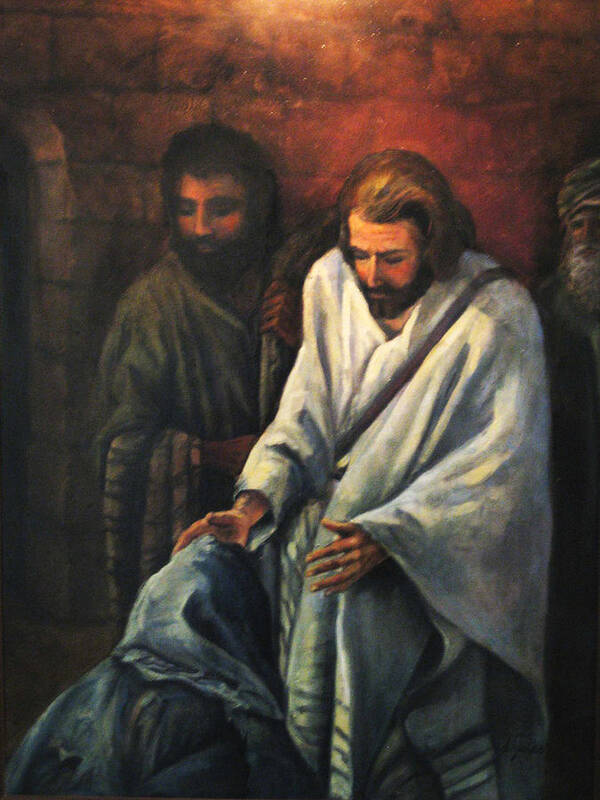
Jesus Healing Beggar (2011) by Donna Tucker

God bless.