Lent Day 40: Speaking, listening, enduring, persevering

TODAY’S READINGS

Today’s Old Testament reading (Is 50:4-7), as we begin Holy Week is Isaiah’s third servant song, vividly prophesying what the future Messiah would endure. The commentary following deals with the entire reading and beyond (through v. 11). The passage starts off this way:

The Lord GOD has given me
a well-trained tongue…”

“The third ‘Servant Song’ in Isaiah. Here the Servant is a prophet who speaks God’s word, even as he suffers at the hands of his persecutors. Again, he represents the people of Israel and yet is distinct from them: unlike Israel in exile, whose ‘ear has not been opened’ and who continues to be a ‘rebel’ ()48:8), the servant says that ‘God has opened my ear, and I was not rebellious (50:5).

“Christian tradition sees these verses fulfilled in the Passion of Jesus…When the savior was struck, he endured it patiently; when he was reviled, he did not revile; when he suffered, he did not threaten. Instead, he gave his back to those who beat him, his cheeks to their blows, and his face he did not turn from their spitting. Finally, he accepted death, giving us an image of virtue and an example for conducting ourselves (St. Athanasius of Alexandria, Festal Epistles 10, 7).” (Isaiah [Ignatius Catholic Study Bible], 87-88)

This short passage is a wonderful model for the evangelist (that should be all of us). The Lord gives each of us certain talents.to “rouse” the weary (including us, if applicable) from a slumber of indifference, doubt, despair, or unbelief. We are to listen daily for God’s voice, that our hearts will be moved and our mission will be clear (dialogue with God in prayer and by reading Scripture to hear Him speaking to you and to help train that tongue).

In responding to the Lord’s call in this way, we can count on persecution. Maybe not physically, as Isaiah has it, but certainly psychologically and emotionally. Do we humbly and patiently endure the blows, the slaps, the shame, the spitting that come our way? If we are like Christ (and no servant is greater than his Master then we may well find it necessary to deal with all these difficulties and more.

Our response? We are to be resolute in being convicted of the truth and making sure that we persevere in spreading it far and wide. Counting on the Lord God to help us, as he promises, we will not be put to shame with the One who matters, despite what the world thinks. Jesus constantly has us looking above and beyond this mortal coil for true fulfillment and happiness. We can count on it for eternity if we stay faithful.

Let us then go to him outside the camp, bearing the reproach that he bore.
For here we have no lasting city, but we seek the one that is to come.
(Heb 13:13-14)
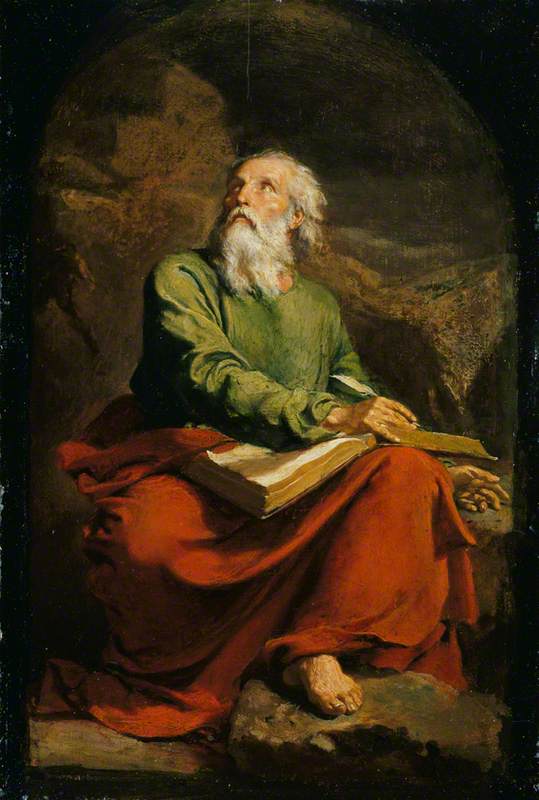
Isaiah (1838) by Jean Louis Ernest Meissonier

God bless.

Lent Day 39: None for one and one for all

TODAY’S READINGS

Today’s Gospel reading (Jn 11:45-56), coming immediately after the astonishing event of Jesus resuscitating Lazarus, shows the extremely heightened concerns of the Jewish religious leaders about Jesus and His popularity are significantly ramping up, so much so that the whole Sanhedrin convenes to discuss what to do about the situation. The high priest, Caiaphas, speaks:

“You know nothing,
nor do you consider that it is better for you
that one man should die instead of the people,
so that the whole nation may not perish.”
(vv. 49-50)

“Caiaphas unwittingly announces that Jesus will die for the salvation of the nation. This is not his own insight, but the grace of prophecy speaking through him in virtue of his priestly office and position as chief teacher of Israel.” (The Gospel of John [Ignatius Catholic Study Bible], 40)

“Here Caiaphas’ words have a dual meaning: one, Caiaphas’ meaning, is that he wants to put Christ to death, on the pretext that that will ensure the political peace and survival of Israel; the other, the meaning intended by the Holy Spirit, is the announcement of the foundation of the new Israel, the Church, through the death of Christ on the cross (Caiaphas is unaware of this meaning). And so it happens that the last high priest of the Old Alliance prophesies the investiture of the High Priest of the New Alliance, which will be sealed in his own blood.” (The Navarre Bible: St John. 160)

Caiaphas did not realize the half of it. In his position as high priest, given to him by God, he could declare prophetic utterances, even if he did not understand their full import. Recall Jesus saying:

Therefore, do and observe all things whatsoever they tell you, but do not follow their example. (Mt 23:3b)

I wonder if Caiaphas realized how soon they would meet again (see Jn 18:14, 24, 28) and how he will be instrumental in seeing through his prophetic words (Mt 26: 57-68).

Yes, one man would die for the nation…and all nations and peoples for all time. Even a despicable man like this high priest can be used by God for good (Friday).

Christ Before Caiaphas (1630) by Matthias Stom

God bless.

Lent Day 37: “I AM”

TODAY’S READINGS

Today’s Gospel reading (Jn 8:51-59) continues Jesus dialogue with the Jewish religious leaders. Jesus makes a startling claim to the Jews inquiry:

“So the Jews said to him…
‘Who do you make yourself out to be?”
Jesus answered,…“Amen, amen, I say to you,
before Abraham came to be, I AM.”
(v. 53b-54a, 58)

“Jesus takes for himself the divine name of Yahweh, ‘I AM’ (Ex 3:14). He thus claims to be one with God (10:30), whose life in eternity has neither beginning nor end. The Pharisees hear this claim loud and clear and, thinking it outrageous, stand ready to stone him for blasphemy (8:59; Lev 24:16) (CCC 590).” (The Gospel of John [Ignatius Catholic Study Bible], 36)

Jesus makes no bones about who He is. It eventually gets Him killed. But He backs up His claim by raising Himself from the dead proving that He is God, having the power over life and death.

Check out this article that does a fine job of running through the many times Jesus uses “I am” to refer to Himself. We hearken back to the burning bush episode (Ex 3) when Moses asks the name of the voice of his interlocutor emanating from this wondrous site.

Are you a believer? I am.

God bless.

Lent Day 36: What is truth? And can you handle it?

TODAY’S READINGS

Today’s Gospel reading (Jn 8:31-42) continues Jesus dialogue with the Jewish religious leaders. It begins this way:

“If you remain in my word, you will truly be my disciples,
and you will know the truth, and the truth will set you free.”
(vv. 31b-32)

“Jesus embodies divine truth (14:6) and has come to bear witness to the truth (18:37). Acceptance of him liberates us from the slavery of sin, ignorance, and deception (8:12; CCC 2466).” (The Gospel of John [Ignatius Catholic Study Bible], 34)

“In Jesus Christ, the whole of God’s truth has been made manifest. ‘Full of grace and truth,’ he came as the ‘light of the world,’ he is the Truth. ‘Whoever believes in me may not remain in darkness.’ The disciple of Jesus continues in his word so as to know ‘the truth [that] will make you free’ and that sanctifies. To follow Jesus is to live in ‘the Spirit of truth,’ whom the Father sends in his name and who leads ‘into all the truth.’ To his disciples Jesus teaches the unconditional love of truth: ‘Let what you say be simply “Yes or No.”” (CCC 2466)

“The knowledge of the truth which Christ is speaking about is not just intellectual knowledge; it is rather the maturing in the soul of the seed of divine Revelation. That Revelation’s climax is to be found in Christ’s teaching, and it constitutes a genuine communication of supernatural life (cf. Jn 5;24): he who believes in Jesus, and through him in the Father, receives the wonderful gift of eternal life. Knowing the truth is, in the last analysis, knowing Christ himself, God become man to save us; it means realizing that the inaccessible God has become man, our Friend, our Life.

“This is the only kind of knowledge which really sets us free, because it removes us from a position of alienation from God — the state of sin and therefore of slavery to the devil and to all the attachments of our fallen nature — and puts us on the path of friendship with God, the path of grace, of the Kingdom of God. Therefore, the liberation we obtain is not just light which shows the way; it is grace, which empowers us to keep to that way despite our limitations.” (The Navarre Bible: St John, 127-28)

“[N]otice how Jesus says that human freedom follows upon and presupposes knowledge of the truth. In order to be truly free, a person must first know what is true.” (The Gospel of John [Catholic Commentary on Sacred Scripture] , 161)

Two lines come to mind, as I reflect on the highlighted verses of this passage:

1. “What is truth?” (Jn 18:38)

Pilate’s famous words while looking Truth right in the eyes. Echoed today by seemingly millions. Can we really know the truth? Cardinal Ratzinger bemoaned the “dictatorship of relativism” today. Most clear thinking folks nodded their heads in agreement in that homily nearly twenty years ago. Not so many folks would have believed that it didn’t even take twenty years till concepts like “mother,” “marriage,” and “gender” were up for grabs. This twisting of truth and reality itself is the work of the devil, as Jesus tells the Pharisees a little further on in the same interaction we heard proclaimed today:

“You belong to your father the devil and you willingly carry out your father’s desires. He was a murderer from the beginning and does not stand in truth, because there is no truth in him. When he tells a lie, he speaks in character, because he is a liar and the father of lies.” (Jn 8:44)

And what does Satan “inspire” people to do?

They exchanged the truth of God for a lie and revered and worshiped the creature rather than the creator. (Rom 1:25)

Wow. Doesn’t that encapsulate perfectly the state of our world today? With no eternal anchor, the crashing waves of self-focus toss us about. When anything goes, nothing stays firm.

Let us cling to the Rock that is Peter and the Church Christ founded as if our life depended on it (and it does, here and hereafter). A sure “light”house in the stormy weather of our modern confused age.

2. “You can’t handle the truth!” — Col. Nathan R. Jessup

Certainly, the Gospel message is a challenging one. Hearing the truth and living it out can be painful at times. But it is the antidote to what ails us in a time of cultural sickness and even death. It seems that in our day, maybe more than ever, we can’t handle the Truth that is Jesus and His message, preferring “my truth.” To be fully and authentically human, stick with “the Truth.”

God bless.

Lent Day 34: Forgiving and Challenging Jesus

TODAY’S READINGS

Today’s Gospel reading (Jn 8:1-11) is the famous episode in which Jesus is brought the woman caught in the act of adultery. It ends with consoling words and a warning:

“Has no one condemned you?”
She replied, “No one, sir.”
Then Jesus said, “Neither do I condemn you.
Go, and from now on do not sin any more.”
(vv. 10b-11)

“Jesus, who is the Just One, does not condemn the woman; whereas these people are sinners, yet they pass sentence of death. God’s infinite mercy should move us always to have compassion on those who commit sins, because we ourselves are sinners and in need of God’s forgiveness.” (The Navarre Bible: St John, 122)

“Jesus strikes a balance, being merciful to a sinner while abhorring the sin. He gives the woman an opportunity to make a new start, not condemned for her past and free to behave differently in the future.” (Bringing the Gospel of John to Life, 229)

“Jesus offers this woman a fresh start by turning her away from her sins and opening her up to God’s infinite mercy.” (The Gospel of John [Catholic Commentary on Sacred Scripture], 153)

“Jesus’ attitude is striking: we do not hear words of scorn, we do not hear words of condemnation, but only words of love, of mercy, which are an invitation to conversion. ‘Neither do I condemn you; go, and do not sin again’ (v. 11). Ah! Brothers and Sisters, God’s face is the face of a merciful father who is always patient. Have you thought about God’s patience, the patience he has with each one of us? That is his mercy. He always has patience, patience with us, he understands us, he waits for us, he does not tire of forgiving us if we are able to return to him with a contrite heart.” (Pope Francis, “Angelus,” 17 March 2013)

Imagine the relief of this poor sinner when Jesus saved her life and then showed such mercy! Why had she indulged in this sin? Why did she keep indulging in it (I’m guessing her indiscretion was widely known since the Pharisees conveniently found her in the act in order to try to trap Jesus). She was being used twice: first by her illicit lover, then by the Pharisees. Now she escapes the death sentence scot-free. But wait. The ongoing condition is now placed upon her: “do not sin anymore” or maybe a better translation is “stop sinning.”

We don’t know what happened to this woman. One thing for sure: her encounter with the Lord changed her forever. Is she one of the many unnamed saints? I like to think so. Imagine the story she could have told, must have told, of this, in turn, harrowing and blessed encounter, if not immediately then in her golden years.

Jesus provides challenges to us constantly. We all love the forgiveness part — we get it and do nothing to deserve it. Harder is the stop sinning part. Yes, we may have very good intentions, even a firm resolution, to mend our ways — until we try to get out of the crowded parking lot, or when following the slowpoke on the road, or when checking our emails or texts, or when dealing with a family member, or during a tough day at work. The list goes on.

The answer: frequent prayer, regular recourse to the sacraments, self-discipline. Stop sinning? Grace does not make it easy but it does make it possible. Let us open our hearts to the grace God is so willing and desiring to give us in the sacraments and we will see progress.

Christ and the Adulterous Woman (1881) by Rodolpho Bernardelli

God bless.

Lent Day 33: Lifted Jesus

TODAY’S READINGS

Today’s Gospel reading (Jn 12:20-33) has Jesus approached by Gentiles interested in Him. Now Jesus’ hour has come. He ends His short discourse on this matter this way, with an explanation from John:

“And when I am lifted up from the earth,
I will draw everyone to myself.”
He said this indicating the kind of death he would die.
(vv. 32-33)

“Like the crowds who are ‘amazed’ at Jesus’ teaching (7:15) and miracles (7:21), the guards are awed at his teaching: there is something unprecedented about Jesus.” (The Gospel of John [Catholic Commentary on Sacred Scripture], 45)

when I am lifted up: Refers primarily to the Crucifixion of Christ, as indicated in the next verse, but also hints at his Resurrection and Ascension (CCC 662). See note on Jn 3:14. ● The expression recalls the opening line of Isaiah’s fourth Servant Song, which runs from Is 52:13 to 53:12. The whole song is a prophetic depiction of the suffering of the Messiah, who will be exalted and lifted up in the sight of the nations, but only after he is cast down by his own people. Isaiah interprets the humiliation and death of this Servant as a redemptive sacrifice for sin. draw all men to myself: Points to the worldwide acceptance of the gospel (Mt 28:18–20; Acts 1:8). ● As Isaiah envisioned the Davidic Messiah as an “ensign” posted for the ingathering of the “nations” and the “outcasts of Israel” (Is 11:10–12), so Jesus sees the world gathering around the “sign” of the Cross (CCC 542). (The Gospel of John [Ignatius Catholic Study Bible], 42)

“‘And I, when I am lifted up from the earth, will draw all men to myself.’ The lifting up of Jesus on the cross signifies and announces his lifting up by his Ascension into heaven, and indeed begins it. Jesus Christ, the one priest of the new and eternal Covenant, ‘entered, not into a sanctuary made by human hands. . . but into heaven itself, now to appear in the presence of God on our behalf.’ There Christ permanently exercises his priesthood, for he ‘always lives to make intercession’ for ‘those who draw near to God through him’. As ‘high priest of the good things to come’ he is the center and the principal actor of the liturgy that honors the Father in heaven. (CCC 662)

Christ stands at the heart of this gathering of men into the ‘family of God’. By his word, through signs that manifest the reign of God, and by sending out his disciples, Jesus calls all people to come together around him. But above all in the great Paschal mystery – his death on the cross and his Resurrection – he would accomplish the coming of his kingdom. ‘And I, when I am lifted up from the earth, will draw all men to myself.’ Into this union with Christ all men are called. (CCC 542)

Knowing how the story ends, or might I rather say, how the story continues, we might think that Jesus is referring to His Ascension when He speaks about being “lifted up.” John quickly disabuses us of this notion. While, as the commentary above says, we can see hints of the Ascension, it is unmistakable that there is no Ascension, no Resurrection, without the Crucifixion. As Jesus says earlier in today’s reading, “it was for this purpose that I came to this hour” (v. 27). He calls us to “hate” our life here so that we “will preserve it for eternal life” (v. 25).

We, too, are called to be drawn to the Cross, that is, to suffering. Not wishing for it — we’re not called to be masochists — but accepting it when it comes (because it always does). I invite you to join me in praying that when pain and suffering come, large and small, that we will have the grace to offer it up for the forgiveness of sins (starting with our own) and the redemption of souls. I will mention, as have before in these posts, the blessing of our faith that informs us of the value of suffering when it is redemptive. For the faithful it is not only a promise, but a requirement:

Then Jesus said to his disciples, “Whoever wishes to come after me must deny himself,* take up his cross, and follow me.
For whoever wishes to save his life will lose it, but whoever loses his life for my sake will find it. (Mt 16:24-25)

The second verse echoes what Jesus says in today’s reading. So we ask ourselves: What wouldn’t you endure in the brief moment we traverse this valley of tears for eternal bliss?

Easy? No. Possible? “[F]or God all things are possible” (Mt 19:26). The Lord puts His stamp on this when speaking to Paul:

“My grace is sufficient for you, for power is made perfect in weakness.” (1 Cor 12:9)

Let us pray, and pray some more, for the grace of perseverance in trials and tribulation.

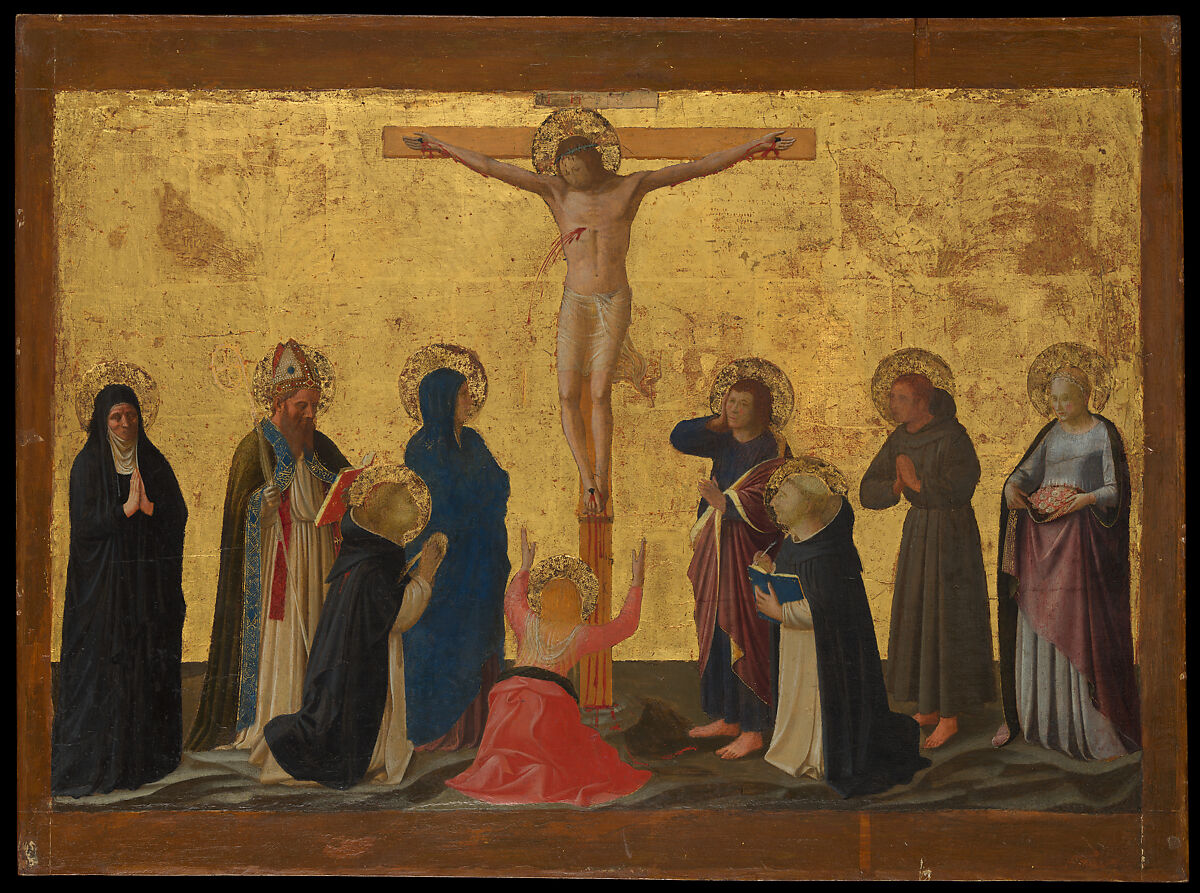
The painting below represents to me “everyone” coming to Jesus. We especially think of John, the loan apostle to return to Jesus in His moment of torture, as a representative for all of us when Jesus entrusts His mother to him. Ask for Blessed Mary’s intercession frequently, as she knows suffering as well as anyone.

BP BARRON’S SERMON

Check out today’s sermon from the good bishop who takes a deep dive into Jeremiah 31:31 — the promise of a New Covenant which Jesus gives us at the Last Supper. Super important to understand the New Covenant and the Old Covenant(s).

The Crucifixion (c. 1440) by Fra Angelico

God bless.

Lent Day 32: Impressive Jesus

TODAY’S READINGS

Today’s Gospel reading (Jn 7:40-53) has Jesus impressing the crowds and the Pharisees hoping to arrest Him. The guards sent to do the job came away impressed with this Galilean:

“Never before has anyone spoken like this man.” (v. 46)

“Like the crowds who are ‘amazed’ at Jesus’ teaching (7:15) and miracles (7:21), the guards are awed at his teaching: there is something unprecedented about Jesus.” (The Gospel of John [Catholic Commentary on Sacred Scripture], 45)

“The truth begins to influence the straightforward souls of the servants of the Sanhedrin but it cannot make headway against the obstinacy of the Pharisees. ‘Notice that the Pharisees and scribe derive no benefit either from witnessing miracles or reading the Scriptures; whereas their servants, without these helps, were captivated by a single discourse, and those who set out to arrest Jesus went back under the influence of hi authority,. And they did not say, “We cannot arrest him, the people will not let us’; instead they extolled Christ’s wisdom. Not only is the their prudence admirable, for they did not need signs; it is also impressive that they were won over by his teaching on its own; they did not say, in effect, “No man has ever worked such miracles,” but “No man ever spoke like this man.” Their conviction also is worthy of admiration: they go to the Pharisees, who were opposed to Christ, and address them in the way the do (St John Chrysostom, Hom. on St. John, 9).” (The Navarre Bible: St John, 119)

“Never before had anyone spoken the word of God as did the Word become flesh; never before did God reveal himself as he does in Jesus.” (Bringing the Gospel of John to Life, 221)

Anyone who takes the Gospel seriously must come to the same conclusion as the guards. Anyone who takes the Gospel seriously must come away feeling either as the guards do or as the Pharisees do. There can be no fence-sitters when dealing with the message of Jesus. Jesus said:

“Do you think that I have come to establish peace on the earth? No, I tell you, but rather division.” (Lk 12:51)

Scripture also says:

Indeed, the word of God is living and effective, sharper than any two-edged sword, penetrating even between soul and spirit, joints and marrow, and able to discern reflections and thoughts of the heart. (Heb 4:12)

In what follows, woe to those who do not take the Word (that is, Jesus) seriously:

No creature is concealed from him, but everything is naked and exposed to the eyes of him to whom we must render an account. (Heb 4:13)

The Catechism of the Catholic Church drives home the message:

“Christianity is the religion of the ‘Word’ of God, a word which is ‘not a written and mute word, but the Word which is incarnate and living’ (St. Bernard, S. missus est hom. 4,11:PL 183,86.) (CCC 108)

If it has been a while since Jesus’ words have moved you, or if you have been away awhile, I encourage you to make Bible reading a daily part of your life. A chapter a day is a good practice. Or you may follow the Church’s daily readings (ideally, hearing them proclaimed at Mass on weekdays and certainly on Sundays) here.

Which side of the divide are you on?

The Pharisees (1912) by Karl Schmidt-Rottluf

God bless.

Lent Day 31: Obnoxious Jesus

TODAY’S READINGS

Today’s first reading (Wis 2:1a, 12-22) gives us a striking prophecy of the ultimate and perfect “just one,” Jesus Christ. It begins with these troubling words:

“Let us beset the just one, because he is obnoxious to us;
he sets himself against our doings,
Reproaches us for transgressions of the law
and charges us with violations of our training.”
(v. 12)

“The reasoning of the ungodly has progressed from a reflection of the finality of death, to an embrace of hedonism, to a rejection of the weak, and now finally to active persecution of the righteous man precisely because of his righteousness. He is inconvenient because he opposes, reproaches, and accuses the wayward for their sins. While the author is not drawing a direct line of connection, one cannot avoid thinking of the biblical prophets here. Isaiah, Jeremiah, and the other prophets consistently rebuke the nation for their disobedience to God’s law and their straying from his ways. Here, Wisdom highlights two types of moral error: ‘sins against the law’ and ‘sins against our training,’ which perfectly match the priorities of Hellenistic Judaism. On the one hand, ‘sins against the law’ refers to transgressions of the law of Moses, the ancient ancestral law of the Jews. On the other hand, ‘sins against out training [paideia]’ refers to rejecting the lessons learned in the context of family and, more precisely, Greek education. The erring ones have strayed from both the Jewish ideal of law observance and from the Greek educational idea of paideia.” (Wisdom of Solomon [Catholic Commentary on Sacred Scripture], 45)

“Their words are echoed in the insults offered by the scribes and Pharisees to Jesus when he was on the cross (cf. Mt 27:40-43; Mk 15:31-32; Lk 23:35-37). (The Navarre Bible: Wisdom Books , 312)

I immediately think how Jesus is found so “obnoxious” to so many today (even self-proclaimed Christians, including Catholics — some in very high positions in society). The Word of God, who is Jesus, is ignored, spurned, or even deemed “hate speech” when it (He) goes against the “enlightened” “progress” we have purportedly made now well into the twenty-first century. And Scripture says:

“[I]f the light in you is darkness, how great will the darkness be.” (Mt 6:23)

The devil is the black light. We surely can know that when a culture of death predominates and every manner of perversion is hailed as good and proper and normal that the prince of this world is delighting in his influence over weak and stupid mortals.

Let us all work to exorcise Satan and his minions by standing up for the Truth no matter the cost and, above all, praying to Jesus through Mary for deliverance from this pervasive and growing evil. We were promised by the Lord from the very beginning of their ultimate triumph:

“I will put enmity between you and the woman,
and between your offspring and hers;
They will strike at your head,
while you strike at their heel.
” (Gen 3:15)

May it occur soon. Thy kingdom come!

NEW BOOK IN THE CATHOLIC COMMENTARY ON SACRED SCRIPTURE SERIES!

I’m excited to quote above from the first entry in the Old Testament series from the Catholic Commentary on Sacred Scripture series. Check it out!

God bless.

Lent Day 30: Moses and Jesus

TODAY’S READINGS

Today’s Gospel (Jn 5:31-47) picks up where yesterday’s left off. Jesus here provides deep theology and a pointed accusation at the Pharisees. He closes with these devastating words:

“Do not think that I will accuse you before the Father:
the one who will accuse you is Moses,
in whom you have placed your hope.
For if you had believed Moses,
you would have believed me,
because he wrote about me.
But if you do not believe his writings,
how will you believe my words?”
(vv. 45-47)

he wrote of me: Jesus follows the Jewish tradition that Moses authored the Pentateuch (Gen-Deut). Moses thus described the Messiah as a Redeemer (Gen 3:15), a universal King (Gen 49:10), and a Prophet like himself (Deut 18:15–19).” (The Gospel of John [Ignatius Catholic Study Bible], 28)

“The authorities appealed to the authority of Moses (‘in whom you have placed your hope’) and the Torah to accuse Jesus (see 5:11-18). Yet since the Scriptures are a witness to Jesus (Moses ‘wrote about me’), both the Scriptures and Moses stand on Jesus’ side against his accusers. Scripture bears witness to Jesus, and faith in Jesus opens the way to see this testimony. But on account of their unbelief, the authorities do not fully understand Moses and the Scriptures because they do no see how they bear witness to Jesus. Thus, Jesus concludes, ‘If you do not believe his writings, how will you believe my words?'” (The Gospel of John [Catholic Commentary on Sacred Scripture], 111-12)

“Failure to understand the true import of Scripture is an obstacle to believing in Jesus and coming to him to have life (5:40).” (Bringing the Gospel of John to Life, 150)

I think of typology and the importance of the entire Bible here. It is true, as St. Augustine said, that, “In the Old Testament the New is concealed, in the New the Old is revealed.” We miss so much if we read the New Testament, especially the Gospels, in isolation. Jesus berates the self-described experts in the Law, as missing all the Torah was pointing to: namely Him. Had they seen Jesus as the New Moses, the fulfillment of the Mosaic (and all Old Testament) covenants, they would have put Him on a throne of gold instead of a throne of wood.

God bless.

Lent Day 29: Hear, believe, and live

TODAY’S READINGS

Today’s Gospel (Jn 5:17-30) picks up where yesterday’s left off. Jesus reveals much about Himself and His Father, much to the chagrin of the Pharisees:

“Amen, amen, I say to you, whoever hears my word
and believes in the one who sent me
has eternal life and will not come to condemnation,
but has passed from death to life.”
(v. 24)

“The Father has placed judging and giving life in the hands of his Son, and now Jesus speaks about his carrying out these divine prerogatives. He again prefaces his words with a solemn ‘Amen, amen, I say to you,’ assuring his listeners (and readers of John’s Gospel) of the importance of what he is saying. He proclaims that ‘whoever hears my word and believes in the one who sent me has eternal life.’ The ‘word’ of Jesus is the word of God: ‘the one whom God sent speaks the words of God” (3:34; see also 12:49-50; 14:24; 17:8). When Jesus says ‘hears my word,’ he uses ‘hears’ in its biblical sense of accepting and heeding (see Deut 6:4). We might have expected Jesus to say ‘Whoever hears my word and believes me,’ but he says whoever hears my word ‘and believes in the one who sent me’ — literally, ‘believes the one who sent me.’ Since Jesus speaks the word of God, to accept his word is to believe God (see 12:44).

“Jesus proclaims that whoever hears his word and believes the one who sent him ‘has eternal life.’ ‘Now this is eternal life, that they should know you , the only true God, and the one whom he sent, Jesus Christ’ (17:3). To know God is to experientially know him as Jesus reveals him; accepting his revelation brings union with God and ‘eternal life.’ The one who believes ‘has eternal life and will not come to condemnation, but has passed from death to life.’ For those drawn into union with God through Jesus, ‘eternal life’ begins now, even if its fullness lies in the future (see 6:54). Come to condemnation means being left in the perishable state of humanity, destined for death (see 3:16-18). Whoever receives eternal life ‘has passed from death to life’ — literally, ‘has been transferred out of death to life.’ These united with God through Jesus have been taken from the realm of death into the realm of eternal life. Even if they die physically , they live eternally (see 11:25-26).” (Bringing the Gospel of John to Life, 136-37)

I chose the particular passage I did because I love it when Jesus is very clear what we mortals are called to believe and live out. Martin, in the extended excerpt above, says, ‘When Jesus says ‘hears my word,’ he uses ‘hears’ in its biblical sense of accepting and heeding.’

Yes, we are to hear the Word of God. But more importantly, we must internalize it and live it

Woe unto You, Scribes and Pharisees (1850) by James Tissot

God bless.