Lent Day 28: Suffering is not the worst

TODAY’S READINGS

Today’s Gospel (Jn 5:1-16) picks up where yesterday’s left off. Jesus heals a man ill for thirty-eight years…on the sabbath. Jesus last words to the man:

“Look, you are well; do not sin any more,
so that nothing worse may happen to you.” (v. 14)

“Jesus’ remark here can mean that sin causes something worse to a person than physical illness: spiritual illness that can be eternally fatal.” (The Gospel of John [Catholic Commentary on Sacred Scripture], 100)

“The Bible reveals a link between sin and suffering, with the former being the cause of the latter (Ps 107:17). This general truth, however, does not extend to every individual case (9:3).” (The Gospel of John [The Ignatius Catholic Study Bible], 27

“The man may have come to the temple to thank God for his cure. Jesus goes over and reminds him that the health of the soul is more important physical health.

“Our Lord uses holy fear of God as motivation in the struggle against sin: ‘Sin no more, that nothing worse befall you’. This holy fear is born out of respect for God our Father; it is perfectly compatible with love. Just as children love and respect their parents and try to avoid annoying them partly because they are afraid of being punished, so we should fight against sin firstly because it is an offence against God, but also because we can be punished in this life and, above all, in the next.” (The Navarre Bible: St John, 89)

“This statement accomplishes three things. First, it teaches than bodily sickness is an image of sin in the soul. Second, it teaches that it is much more important to avoid sin than avoid sickness. Third, it tells us to look at the healing as a parable: the sick people lying under the porticoes stand for sinners; getting into the baths stands for baptism; getting cured from sickness stands for having sins washed away; the question of whether the man wanted to be cured stands for the question of whether we really want to be free from our sins. If the man had grasped all three of these things, he would have wanted to become a follower of Christ and asked to be baptized.” (Mary’s Voice in the Gospel According to John, 61-62)

Suffering is an interesting thing (maybe not so much so when one is in the midst of terrible pain, but…). Suffering may come out of the blue through no fault of our own. Suffering may come due to bad habits, carelessness, or recklessness. Suffering may come due to our sinful behavior. But, as terrible as it is to suffer, nobody deals with it better than the Catholic Church. The possibility of suffering being redemptive, no matter the reason it comes our way, has had the faithful endure the most horrible physical and mental torments that they united with Christ’s Passion for the forgiveness of sins and the redemption of souls. After all, Jesus said:

In the world you will have trouble, but take courage, I have conquered the world. (Jn 16:33)

The Greek for “trouble” (θλίψιν) has also been translated as “tribulation,” “affliction,” and “distress.” If the servant is no better than his Master, and God Himself suffered the pain and humiliation of the cross, do we sinful persons dare to think we should get off scot-free?

So, let no suffering go to waste. The Lord can use it to heal our souls and those of many others. Consider the greeting we will get in heaven from those who we helped by and through sufferings we laid at the foot of the Cross while on this mortal coil.

BOOK RECOMMENDATION

Note the last commentary I cite is the first time I’ve used it here. Michael Pakaluk’s Mary’s Voice in the Gospel According to John is an outstanding book that I can heartily recommend. He also has a commentary on Mark. Hopefully he will get to the other Gospels, as well. Clearly a man who loves the Lord and His word and has imbibed deeply of it.

God bless.

Lent Day 27: Homecoming

TODAY’S READINGS

Today’s Gospel (Jn 4:43-54) has us jumping to the next chapter in John. Here Jesus returns to Galilee with quite a reputation earned in Jerusalem:

Jesus himself testified
that a prophet has no honor in his native place.
(v. 44)

“The Gospel author makes a comment, and while its meaning is clear, the reason the author makes the comment is not immediately evident. It was proverbial in the ancient world that a prophet or other significant person ‘has no honor in his native place.’ Familiarity can breed disrespect, even contempt. In the other Gospels, Jesus makes this observation after he experiences rejection in Nazareth (Matt 13:54-57; Mark 6:1-4; Luke 4: 16-30). John’s Gospel, however, does not present the occasion on which Jesus made the observation; it only recounts what he at some point said, citing it as an explanation for why he went to Galilee (verse 43). As such, it is a puzzling explanation, for Jesus will be welcomed by Galileans upon his arrival (verse 45). Scholars suggest various explanations for the comment. One suggestion is that Jesus suspended his highly popular ministry in Judea (3:26) and went to Galilee in order to avoid confrontations with religious authorities (4:1-3), expecting to receive less attention in Galilee since ‘a prophet has no honor in his native place.’ In this interpretation, Jesus wished to keep a relatively lower profile for a while.” (Bringing the Gospel of John to Life, 114-15)

The last explanation above makes a lot of sense. “Hometown boy makes good” is acknowledged at first, but it likely won’t be long when Jesus becomes rather uninteresting, and folks are reminded that this is the same nondescript child of nondescript parents they had known for decades. Also, maybe they think he has become “too big for his britches” and they’ll knock Him down a peg or two. And we shouldn’t discount envy as a motivating factor either — who is this young ‘so-and-so’ to gain all these accolades while the rest of us live and toil in an obscure backwater with no hope for fame?

So, don’t feel too bad if at times it seems like the respect you get is only at the workplace or public gatherings while at home you are ignored, trampled on, and taken advantage of. Jesus has no pride, so this wasn’t an issue for Him. But humility, he has in spades. Just remember he knows through first-hand experience what it means to be humble (starting with the Incarnation). For our part, getting knocked down a few notches can be good for the soul.

Vocation of the Apostles (1481) by Domenico Ghirlandaio

God bless.

Lent Day 25: ‘O God, be merciful to me a sinner.’

TODAY’S READINGS

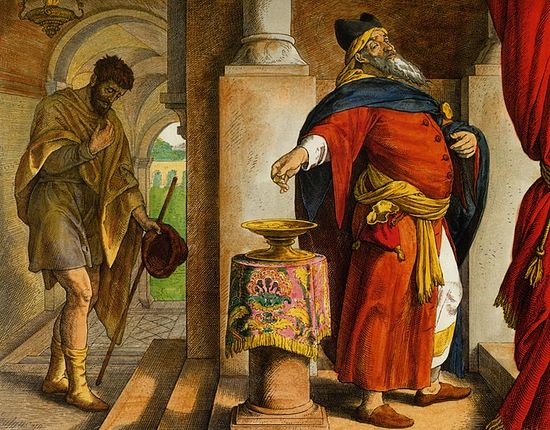
Today’s Gospel (Lk 18:9-14) gives us the Parable of the Pharisee and the Tax Collector. Jesus is making few friends with the former group but is giving hope to the latter. The words of the tax collector in prayer are extolled by Jesus:

“‘O God, be merciful to me a sinner.’” (v. 13b)

“[The tax collector] asked God to ‘be merciful’ (hilaskomai) to him. This verb…occurs only once elsewhere in the New Testament, where it means to ‘expiate’ or make atonement for sin (Heb 2:17). Such ‘sacrificial overtones’ fit the parable’s temple setting, all the more so if the prayer occurs at the time of the daily sacrifice.” (The Gospel of Luke [Catholic Commentary on Sacred Scripture], 304)

“‘Prayer is the raising of one’s mind and heart to God or the requesting of good things from God.’ But when we pray, do we speak from the height of our pride and will, or ‘out of the depths’ of a humble and contrite heart? He who humbles himself will be exalted; humility is the foundation of prayer, Only when we humbly acknowledge that ‘we do not know how to pray as we ought,’ are we ready to receive freely the gift of prayer. ‘Man is a beggar before God.'” (CCC 2559)

“With bold confidence, we began praying to our Father. In begging him that his name be hallowed, we were in fact asking him that we ourselves might be always made more holy. But though we are clothed with the baptismal garment, we do not cease to sin, to turn away from God. Now, in this new petition, we return to him like the prodigal son and, like the tax collector, recognize that we are sinners before him. Our petition begins with a ‘confession’ of our wretchedness and his mercy. Our hope is firm because, in his Son, ‘we have redemption, the forgiveness of sins.’ We find the efficacious and undoubted sign of his forgiveness in the sacraments of his Church.” (CCC 2839)

Humility is the gem-casket of all virtues. We are to put the onus on ourselves for our sins, faults, and shortcomings. It is easy to blame others for paving the way toward our own indiscretions, but keeping it simple is the way to go. Acknowledge we’re sinners and beg for the Almighty’s mercy. We know better and yet we fall so many times.

“What I do, I do not understand. For I do not do what I want, but I do what I hate. Now if I do what I do not want, I concur that the law is good. So now it is no longer I who do it, but sin that dwells in me. For I know that good does not dwell in me, that is, in my flesh. The willing is ready at hand, but doing the good is not. For I do not do the good I want, but I do the evil I do not want. Now if [I] do what I do not want, it is no longer I who do it, but sin that dwells in me.” (Rom 7:15-20)

Paul has the right attitude. While a sinner like all of us, he recognizes sin, its source, and its detrimental effects. Half the battle is acknowledging the wrongdoing we do; then resolve to overcome it (with God’s grace of course). I’m reminded of the AA 12-step program: admit our powerlessness and humbly ask God for help.

It seems to me that the words of the publican are worth incorporating into our daily prayer time. Let’s resolve to do so.

THE LITANY OF REPARATION IN THE BLESSED SACRAMENT

A beautiful prayer that acknowledges sins against the Eucharist and our sorrow for these outrages with a desire to make amends. Thanks to Dr. John Bergsma for sharing this in today’s Exodus & Exile episode.

God bless.

Lent Day 24: Questions?

TODAY’S READINGS

Today’s Gospel (Mk 12:28-34) has Jesus being questioned by a scribe about what His opinion is of the greatest commandment and the scribe’s affirming response. The episode closes this way:

“Jesus said to him,
‘You are not far from the Kingdom of God.’
And no one dared to ask him any more questions.”
(v. 34)

“Jesus was God’s agent in establishing the reign of God on earth. After announcing that the kingdom of God was at hand (1:15), Jesus began to call men and women to be his disciples (1:16-20). Those who became the new family of Jesus (3:34-35) were coming into the reign of God. This scribe was ‘not far from the kingdom of God’: he is not a disciple of Jesus, but he grasps what is at the heart of living under the reign of God. Jesus’ new family is made up of those who do the will of God (3:35); this scribe understands what God expects.

“Jesus has been challenged and questioned by various parties but he has met the challenges and answered the questions (11:27-12:31). His opponents have been reduced to silence but have hardly been eliminated as opponents.” (Bringing the Gospel of Mark to Life, 328-29)

The scribe does not actually realized how close to the Kingdom of God He is. Jesus embodies the Kingdom by bringing heaven to earth in the incarnation. Don’t forget Jesus’ first words of His public ministry:

“This is the time of fulfillment. The kingdom of God is at hand. Repent, and believe in the gospel.” (Mk 1:15)

Judgment comes upon the world and God judges it redeemable, but at what a cost! His own beloved Son. Yet, just before He died, anticipating the awful fate in store for Him in just a few hours, Jesus invited us to share in the Kingdom through the Eucharist instituted at the Last Supper. The Mass as Heaven on Earth, indeed. And we have the privilege in taking part in it every day if we are able.

As for the scribe who inquired, it seems to me that He was an honest seeker, based on a not unusual question from a rabbi or for a rabbi and an irenic and affirmative response. So why did no one “dare” to ask any more questions? It is true that prior to this episode, in the same chapter as well as earlier, the religious leaders’ attempt to trap Jesus using His own word fell flat, thus the growing vengeance that would soon consume them. Futility maybe caused abandonment of questioning by His enemies in favor of a more permanent solution to the Jesus Problem. But for the honest seeker, it seems Jesus would always be open to dialogue. Maybe Jesus was a bit intimidating here — not in demeanor but in His profundity and decisiveness (see Mt 7:28-29). A bit mysterious to me.

God bless.

Lent Day 23: For or Against?

TODAY’S READINGS

Today’s Gospel (Lk 11:14-23) has Jesus being calumniated even when exorcising demons. He concludes with this:

“Whoever is not with me is against me,
and whoever does not gather with me scatters.”
(v. 23)

“[E]ven if people do not want to recognize it, Jesus Christ has conquered and from now on no one can adopt an attitude of neutrality towards him: he who is not with him is against him.” (The Navarre Bible: St Luke, 147)

“There is no safe neutral corner in the front line of a war…Whoever is not with Jesus in his battle against Satan is by default against him…In the context of the clash between the kingdom of God and the kingdom of Satan each person must side with the one or the other: there are ultimately no other kingdoms…Ultimately one is either gathered to Jesus and brought into the kingdom of God, or cast out and scattered (see 13:28).” (Bringing the Gospel of Luke to Life, 322)

The time for fence sitting is over. In reality, there never has been a time for it. But now, the Lord needs to know where we stand. Will we defend Him, or shirk away? Are we going along to get along or are we counter-culture (of death)? Are we the disciples before Pentecost hiding away in anxiety and fear or are we compelled by tongues of fire to speak out fearlessly whatever may come?

I am reminded of the Book of Revelation’s admonition to a particular church that really is a message to all of us:

“I know your works; I know that you are neither cold nor hot.* I wish you were either cold or hot. So, because you are lukewarm, neither hot nor cold, I will spit you out of my mouth…Whoever has ears ought to hear what the Spirit says to the churches.” (Rev. 3:15-16, 22)

It is a striking image painted for John here in this vision. I certainly don’t want to make the Lord sick to His stomach, do you? Let us be bold and fervent in the Faith we profess, not counting the cost here on earth but building up treasure in heaven (see Mt 6:19-21).

God bless.

Lent Day 22: Old and New

TODAY’S READINGS

Today’s Gospel (Mt 5:17-19) coming almost immediately after Jesus proclaims the Beatitudes, has Him teaching about the Law:

Jesus said to his disciples:
“Do not think that I have come to abolish the law or the prophets.
I have come not to abolish but to fulfill.
Amen, I say to you, until heaven and earth pass away,
not the smallest letter or the smallest part of a letter
will pass from the law,
until all things have taken place.
Therefore, whoever breaks one of the least of these commandments
and teaches others to do so
will be called least in the Kingdom of heaven.
But whoever obeys and teaches these commandments
will be called greatest in the Kingdom of heaven.”
(17-19)

(vv. 21-22)

“In this passage Jesus stresses the perennial value of the Old Testament. It is the word of God; because it has a divine authority it deserves total respect. The Old Law enjoined precepts of a moral, legal and liturgical type. Its moral precepts still hold good in the New Testament because they are for the most part specific divine-positive promulgations of the natural law. However, our Lord gives them greater weight and meaning. But the legal an d liturgical precepts of the Old Law were laid down by God for a specific stage in salvation history, that is, up to the coming of Christ; Christians are not obliged to observe them (cf. Summa theologiae, I-II, q. 108, a. 3 ad 3).

“The law promulgated through Moses and explained by the prophets was God’s gift to his people, a kind of anticipation of the definitive Law which the Christ or Messiah would lay down. Thus as the Council of Trent defined, Jesus not only ‘was given to men as a redeemer in whom they are to trust, but also as a lawgiver whom they are to obey’ (De iustificatione, can. 21).” (The Navarre Bible: St Matthew, 61)

“Jesus completely fulfilled the Mosaic Law and OT prophecies (1:23; 2:6, 15; 4:15–16; Lk 24:44–47). The Greek word translated fulfil means ‘to make complete’. The New Covenant thus includes and concludes the Old Covenant; it both perfects it and transforms it. While sacrificial laws of the OT expired with the sacrifice of Jesus, the moral Law (Ten Commandments, etc.) was retained and refined (5:21, 27, 43; 19:17). In the Christian life, the power of God’s Spirit is necessary if we are to obey the Law and grow in holiness (cf. Rom 8:4; CCC 577–81, 1967).” (Ignatius Catholic Study Bible: The Gospel of Matthew, 25)

Reading this passage, I’m reminded of St. Augustine’s famous saying:

The New Testament lies hidden in the Old and the Old Testament is unveiled in the New.” (from CCC 129, Cf. St. Augustine, Quaest. in Hept. 2,73:PL 34,623; Cf. DV 16)

The Old Testament has many exciting stories and tells of some great adventures. Some of it can be a slog, making readers wonder of the relevancy of certain parts. This is why I always recommend good commentaries that provide both exegesis and theology to bring out the value of the most seemingly mundane, uninteresting, or confusing parts. An indispensable reference is Bergma and Pitre, Introduction to the Bible: Old Testament. Also, having the Navarre Bible is an invaluable resource; my recommendation is to use that Bible if planning to read the entire Old Testament. Finally, read the short but important Vatican II document, Dei Verbum, before beginning any significant Bible study.

By reading the Old Testament in light of the New, and recognizing it all as the God’s Word (that is, Jesus), there will be no danger we fall formally or informally into the heresy of Marcionism.

The Bible is a Great Adventure. Don’t miss out!

God bless.

Lent Day 21: 77x

TODAY’S READINGS

Today’s Gospel (Mt 18:21-35) gives us the chilling Parable of the Unforgiving Servant; it is prompted by the following interaction:

Peter approached Jesus and asked him,
“Lord, if my brother sins against me,
how often must I forgive him?
As many as seven times?”
Jesus answered, “I say to you, not seven times but seventy-seven times.”
(vv. 21-22)

“Some later rabbis considered three times to be a sufficient cap on forgiving someone for the same offense. If that view was prominent in Jesus’ day, Peter may have understood his suggestion of seven times to be quite generous, reflecting Christ’s emphasis on forgiveness (see 6:12, 14-15).

“Jesus’ response, however, is not seven times but seventy-seven times. This hyperbole is not meant to limit forgiveness to the high level of seventy-seven instances, but to express a boundless willingness to forgive one’s brother. The increase from seven to seventy-seven recalls Lamech, who appears last in the genealogy of Cain’s family, a family that was filled with immorality, murder, and vengeance. Lamech boasts, ‘If Cain is avenged sevenfold, then Lamech seventy-sevenfold’ (Gen 4:24). Just as Cain’s descendants responded to their enemies with unlimited vengeance, so Christians should respond to sins committed against them with limitless forgiveness.” (The Gospel of Matthew [Christian Commentary on Sacred Scripture], 234)

“What we human beings cannot possibly do on our own becomes possible because the incarnate Word infuses into our fallen nature the Father’s eternal capacity and desire to forgive. By his statement ‘I say to you seventy-seven times’, Jesus is communicating to Peter not so much an abstract moral truth as the actual capacity to live that truth. A brother must always be forgiven because he and I are children of the same Father and brothers of the same Jesus, and the children cannot fall beneath the level of the divine Father and Brother; for if they do, what is then the basis of the blood relationship and life they share?” (Fire of Mercy, Heart of the Word, Vol. II ,644)

Being a Christian is not easy! In fact, it is well nigh impossible…without God’s grace, “the capacity to live that truth.” Even one act of forgiveness may take all of our will power to muster. But seven, never mind seventy-seven. I am reminded of the Scripture:

For my thoughts are not your thoughts,

my thoughts higher than your thoughts.

For as the heavens are higher than the earth,

so are my ways higher than your ways,

my thoughts higher than your thoughts. (Is 55:8-9)

God bless.

Lent Day 20: Just passing through…

TODAY’S READINGS

Today’s Gospel (Lk 4:24-30) has Jesus stirring up the crowd in His home town of Nazareth so much so that they are ready to do this to Him:

They rose up, drove him out of the town,
and led him to the brow of the hill
on which their town had been built,
to hurl him down headlong.
But he passed through the midst of them and went away.
(vv. 29-30)

“Luke could have selected other incidents to present as the initial event in Jesus’ public ministry (see 4;15, 23) but chose to use Jesus’ visit to Nazareth with its unhappy ending. Luke probably intended it as an illustration of Jesus being ‘a sign that will be contradicted’ and the cause of ‘the fall and rise of many in Israel,’ as Simeon prophesied after his birth (2:34). Luke probably also presents the incident as a foreshadowing of what lies ahead: Jesus will be embraced by some but rejected by others, culminating in his death. Yet death will have no more hold over him than the mob in Nazareth: he will, as it were, pass through the midst of the earth, rising from his tomb.” (Bringing the Gospel of Luke to Life, 123)

The last verse has long fascinated me. What did this look like? I have often imagined it like Moses parting the Red Sea. Jesus stares down the crowd and starts walking and they separate like the waters. Was it Jesus’ demeanor? Did He exude a power that repelled them? Was the crowd’s bark worse than its bite? Did friends and neighbors have second thoughts? Remember, this was Jesus residence for over twenty years. He knew these people as well as anyone, but clearly they didn’t know Him. I’m reminded of yesterday’s Gospel:

Jesus would not trust himself to them because he knew them all,
and did not need anyone to testify about human nature.
He himself understood it well.
(Jn 2:24-25)

There are many scenes in Jesus’ life I wish I could have been present for, but this ranks near the top.

Mount Precipice near Nazareth, the site commemorating the Gospel story of
the attempt to throw Jesus off a cliff.

God bless.

Lent Day 19: Jesus understands…all too well

TODAY’S READINGS

Today’s Gospel (Jn 2:13-25) relates Jesus’ first cleansing of the Temple early in His ministry, just days after His “coming out” party: the Miracle at Cana.

Jesus would not trust himself to them because he knew them all,
and did not need anyone to testify about human nature.
He himself understood it well.
(v. 24-25)

“Jesus…has serious reservations about their belief in him…They believed in him, but he did not trust or believe in them: the Gospel uses the same word for ‘believe’ in the previous verse and for ‘trust’ in this verse. Jesus did not entrust himself to them because he knew them all. Jesus knew that Nathanael was a true Israelite , without duplicity (1:47); he has insight into what is in the hearts of others. He knew those who were impressed by the signs he worked, and he judged their belief to be insufficient for him to trust himself to them. the Gospel does not spell out why their belief falls short, but it implies that there are degrees of belief in Jesus, some of which are inadequate. Perhaps people were impressed by the signs Jesus worked but did not sufficiently perceive what the signs signified about the one who worked them; perhaps they were still on the first rung of the ladder of belief. Even though Nathanael believed in Jesus (1:49), Jesus called him to greater belief (1:50-51). this Gospel was written to call its readers to greater belief (1:50-51). this Gospel was written to call its readers to greater belief in Jesus and greater perception of who he is, even as it used the traditional titles of ‘Messiah’ and ‘Son of god’ t proclaim him (20:31).” (Bringing the Gospel of John to Life, 59)

“Jesus’ miracles moved many to recognize that he had extraordinary, divine powers. But that falls short of perfect theological faith. Jesus knew their faith was limited, and that they were not very deeply attached to him: they were interested in him as a miracle worker. this explains why he did not trust them (cf. Jn 6:15, 26) ‘Many people today are like that. they carry the name of faithful , but they are fickle and inconstant’, comments Chrysostom (Hom. on St John, 23,1).

“Jesus’ knowledge of men’s hearts is another sign of his divinity; for example, Nathanael and the Samaritan woman recognized him as the Messiah because they were convinced by the evidence of supernatural power he showed by reading their hearts (cf. Jn 11:49; 4:29). (The Navarre Bible: St John, 66)

Despite what it says in the immediately previous paragraph, I’m not sure Jesus had to call on His divinity (remember Philippians 2:6) to discern what’s in the heart. Two things come to mind:

  1. It seems to me we often forget that Jesus lived for thirty years a “hidden life.” Hidden does not mean hiding from the world, though. I suspect Jesus was a keen observer of His fellow man. How many nasty people came into His dad’s (and later His) workshop? How often did customers refuse to pay the full amount or pay at all? How did Jesus feel when He became the complaint department? How much gossip did he hear when in town or delivering goods? He saw plenty of human nature (which He shared with us) on display, maybe more so because He grew up in a small town and not a thriving metropolis — everybody knew each other’s business and some, undoubtedly nosed their way in.
  2. Jesus, being the perfect man, without concupiscence clouding His intellect, would have been particularly sensitive to others’ feelings, emotions, and masks. He knew sincerity or lack thereof when He encountered it.

Jesus reads hearts. What will His reaction be when He finishes our tome?

Jesus Cleansing the Temple (ca. 1655) by Bernardino Mei

God bless.

Lent Day 18: The robe of grace brings the dead to life

TODAY’S READINGS

Today’s Gospel (Lk 15:1-3, 11-32) is arguably the most famous parable in the Gospels, the Prodigal Son; it starts out this way:

“‘Quickly, bring the finest robe and put it on him;
put a ring on his finger and sandals on his feet.
Take the fattened calf and slaughter it.
Then let us celebrate with a feast,
because this son of mine was dead, and has come to life again…”
(v. 22-24a)

“Mercy – as Christ has presented it in the parable of the prodigal son – has the interior form of the love that in the New Testament is called agape. This love is able to reach down to every prodigal son, to every human misery, and above all to every form of moral misery, to sin. When this happens, the person who is the object of mercy does not feel humiliated, but rather found again and restored to value.

“The father first and foremost expresses to him his joy that he has been ‘found again’ and that he has ‘”‘returned to life.’ This joy indicates a good that has remained intact: even if he is a prodigal, a son does not cease to be truly his father’s son; it also indicates a good that has been found again, which in the case of the prodigal son was his return to the truth about himself…

“The parable of the prodigal son expresses in a simple but profound way the reality of conversion. Conversion is the most concrete expression of the working of love and of the presence of mercy in the human world. The true and proper meaning of mercy does not consist only in looking, however penetratingly and compassionately, at moral, physical or material evil: mercy is manifested in its true and proper aspect when it restores to value, promotes and draws good from all the forms of evil existing in the world and in man. Understood in this way, mercy constitutes the fundamental content of the messianic message of Christ and the constitutive power of His mission.” (Dives in Misericordia as quoted in The Word on Fire Bible: The Gospels, 389)

I chose the verses at top because the homilist at today’s Mass inspired me to think of the robe put on the son as a metaphor for God’s grace covering us, bringing us from death to life, when we confess serious sin. The Lord Jesus lived and died and rose so we may have an abundant life here and for all eternity. We must not discard the grace we receive at Baptism, but if we do through mortal sin, the Divine Doctor is ready, waiting, and eager to heal us through His priest in the confessional. No matter how prodigal we’ve been, the Father is always desiring to embrace us, constantly looking down the road to welcome us back into the fold. Remember, whether you are the prodigal or its your brother, Jesus says:

“[T]here will be more joy in heaven over one sinner who repents than over ninety-nine righteous people who have no need of repentance.” (Luke 15:7)

So, if its you, don’t hesitate to come back and make heaven rejoice. And, if its your fellow human, don’t begrudge the fact that he has made the angels sing.

Bp Barron has an extended commentary on this parable in the same book that was quotes above (pp. 392-400); you should know that you can count on excellent exegesis and splendid spiritual insights from His Excellency. I highly recommend The Word on Fire Bible. Three volumes have come out so far: The Pentateuch, The Gospels, and Acts, Letters, and Revelation. Four more volumes are planned.

Finally, several years ago I read Henri Nouwen’s The Return of the Prodigal Son. I highly recommend this book as it looks at the story through the eyes of all three characters in the parable. Very interesting with profound insights.

The Prodigal Son (1989) by Clark Kelley Price

God bless.