Christmas Day 7: The Righteous brothers

TODAY’S READINGS

The first reading I chose to explore (there are options for each of today’s first two readings and the responsorial psalm) is Gn 15:1-6; 21:1-3, where God’s promise of descendants for Abram and his elderly wife comes to fulfillment.

Abram put his faith in the LORD,
who credited it to him as an act of righteousness.
(v. 6)

“In the light of this passage, St. Paul sees Abraham as the model of how a person becomes righteous in God’s eyes — through faith in his word, the definitive word being the announcement that God saves us through the death and resurrection of Jesus. In this way, Abraham not only becomes the father of the Jewish people according to the flesh, but also the father of those who without being Jews have become members of the new people of God through faith in Jesus: ‘We say that faith was reckoned to Abraham as righteousness. How then was it reckoned to him? Was it before or after he had been circumcised? It was not after, but before he was circumcised. He received circumcision as a sign or seal of the righteousness which he had by faith while he was still uncircumcised. The purpose was to make him the father of all who believe without being circumcised and who thus have righteousness reckoned to them, and likewise the father of the circumcised who are not merely circumcised but also follow the example of the faith which our father Abraham had before he was circumcised’ (Rom 4:9-12).

“Abraham’s faith revealed itself in his obedience to God when he left his homeland (cf. 12:4), and later on when he was ready to sacrifice his son (cf. 22:1-4). This is the aspect of Abraham’s obedience which is given special emphasis in the letter of St. James, inviting Christians to prove the genuineness of their faith with obedience to God and good works: ‘Was not Abraham our father justified by works, when he offered his son Isaac upon the altar? You see that faith was active along with his works, and faith was completed by works, and the scripture was fulfilled which says, “Abraham believed God, and it was reckoned to him as righteousness”; and he was called the friend of God.’ (Jas 2:21-23).” (The Navarre Bible: Pentateuch, 95-96)

Sometimes, in discussions regarding righteousness, Protestants will refer to Romans 4 in defense of sola fide (“faith alone”). But James 2 cannot be ignored or reasoned away. And it certainly cannot be pitted against Paul, as some have tried to do. Here comes into play one of the beauties of Catholic teaching that I often fall back on: “serious attention must be given to the content and unity of the whole of Scripture if the meaning of the sacred texts is to be correctly worked out” (Dei verbum, 12). If anyone ever presents biblical authors contradicting each other on matters of faith and morals, run for the hills! Catholic Answers, as usual, is again helpful here.

The second reading I chose is Heb 11:8, 11-12, 17-19. This gives us another aspect of faithfulness from a different episode in Abraham’s life, at least a dozen or more years after Gen 15.

By faith Abraham, when put to the test, offered up Isaac,
and he who had received the promises was ready to offer
his only son,
of whom it was said,
“Through Isaac descendants shall bear your name.”
He reasoned that God was able to raise even from the dead,
and he received Isaac back as a symbol.
(vv. 17-19)

“That Abraham was willing to carry out this drastic demand, not knowing why or understanding how it could possibly be compatible with God’s sworn word, is the supreme biblical example of obedient faith. [See the James quote above.]

“Abraham ‘reasoned that God was able to raise even from the dead.’ Although Genesis does not say this directly, Hebrews may see it as implied in Abraham’s words to his servants, ‘The boy and I…will worship and then come back to you’ (Gen 22:5). Having experienced God’s faithfulness in the birth of Isaac, Abraham stretched his faith yet further, trusting that God somehow had a solution to this terrible ordeal. And in the very act of sacrifice, when Abraham had totally given up on his son, God intervened and gave back to him that which he surrendered. So ‘he received Isaac back as a symbol.’ Isaac’s restoration to his father is a figure pointing to Christ, the only-begotten Son who was sacrificed not only in intention but in reality, and who was restored in his resurrection from the dead.” (Hebrews [Catholic Commentary on Sacred Scripture], 242)

I recall some years back, a former classmate of mine posting on social media concerns about the Abraham-Isaac episode involving the sacrificing of the latter. He was struggling greatly with how God could demand such a sacrifice and how Abraham could even entertain it, much less carry it out. I related this passage from Hebrews to him. He seemed to find it helpful, although to what extent, I never learned. One other passage from the biblical incident itself I believe is telling: When asked by his son where the sacrifice is, Abraham answered, “God will provide himself the lamb for a burnt offering, my son.” (Gen 22:8, RSV-CE). When Abraham’s hand is stayed, a ram (not a lamb) is offered in his place. But God did provide Himself as a spotless lamb some two thousand years later when the sacrifice was actually carried out.

Finally, in the Gospel (Lk 2:22-40), we read of another righteous, trusting man of God:

This man was righteous and devout,
awaiting the consolation of Israel,
and the Holy Spirit was upon him.
It had been revealed to him by the Holy Spirit
that he should not see death
before he had seen the Christ of the Lord.
He came in the Spirit into the temple…
(vv. 25-27a)

“Being ‘righteous’ means obeying God’s laws (see 1:6); to be ‘devout’ means to revere God and carefully carry out religious duties. Simeon did what God required of him and he hoped for what God promised: he was ‘awaiting the consolation of Israel.’ Many Jews at the time of Jesus had hopes that God would act to restore his people, freeing them from evil and foreign rule, fulfilling promises made through the prophets. Simeon expresses these hopes as God’s ‘consolation of Israel,’ echoing prophecies of Isaiah that speak of God’s consolation, or comfort, for his people (Isaiah 40:1; 49:13; 51:3, 12; 52:9; 57:18; 66:13). Consolation has a note of intimacy, of God comforting his people ‘as a mother comforts her son’ (Isaiah 66:13). ’And the holy Spirit was upon him’; the Holy Spirit who filled Elizabeth and Zechariah and John (1:15, 41, 67) and overshadowed Mary to conceive Jesus (1:35) rests upon Simeon. The following verses tell how the Holy Spirit inspires and guides Simeon.” (Bringing the Gospel of Luke to Life, 69-70)

Two other men in the Gospels are referred to as “righteous”; Joseph and John the Baptist, both of whom pious tradition tells us never personally sinned. I don’t know if that was true for Simeon, but being righteous has its rewards, as Jesus tells us that these will go off to eternal life (see Mt 25:46).

POPE BENEDICT XVI: RIP

One year on, particularly considering the confusion and lack of clarity exacerbated over the intervening period, this holy man is missed more than ever. I hear his private sermons are being published — always good to get more of Benedict

A good website to bookmark: https://www.benedictusxvi.com/pope-em-benedict-xvi

A JOYFUL (AND FUNNY) BISHOP

This YouTube channel came to my attention recently. Check out this video interview (although it hardly is an interview as this prelate needs no prompting). You will be entertained and moved.

I never heard of this man before, and I know nothing else about him, but from what I see here, we need many more like him. Let us pray.

SCREWTAPE

Today I finished C.S. Lewis’s The Screwtape Letters, finally. I’ve been meaning to read if for years, and finally worked through it. A lot of great tidbits, but not as impressive (to me, at least) as I anticipated. But the concluding section (“Screwtape Proposes a Toast”) is worth the price of the book. Written in 1959, it nails our time like you wouldn’t believe. DEI anticipated. See the pdf for free.

Happy New Year! Let’s redouble our prayers for our Church and our country in what promises to be the most eventful year in some time.

God bless.
Christmas Day 6: Now vs. forever

TODAY’S READINGS

The first reading is from 1 Jn 2:12-17. We continue reading John’s first letter where he addresses messages to specific groups.

[T]he world and its enticement are passing away.
But whoever does the will of God remains forever.
(v. 17)

“On the one hand, ‘the world and its enticement are passing away.’ The fallen world with its enticements to sin will not endure, and when Jesus returns, the ‘world’ in this sense will definitively pass away. Paul says the same: ‘the world in its present form is passing away’ (1 Cor 7:31). On the other hand, ‘whoever does the will of God remains forever.’ the one who keeps the commandments of God and walk in the light hes eternal life. John’s point is plain: if we choose to love the world and its ways, we are loving something deceitful that will pass away; if we choose to love the Father and do his will, we will enjoy everlasting life with him.” (James, First, Second, and Third John [Catholic Commentary on Sacred Scripture], 165)

“‘The term ‘world’ has a number of meanings in Sacred Scripture. Here it has the pejorative sense of enemy of God and man, and includes everything that is opposed to God — the kingdom of sin. Following Christ involves a radical choice: ‘No one can serve two masters’ (Mt 6:24; ‘friendship with the world is enmity with God’ (Jas 4:4).”” (The Navarre Bible: Catholic Epistles, 171)

What leaps to mind is the old adage “you can’t take it with you.” What we can take are our sins and ungodly attachments. So, another slogan comes to mind: “you can pay me now or pay me later.” Best if we detach and refocus now on what matters (and all that ultimately matters is love of God and love of neighbor).

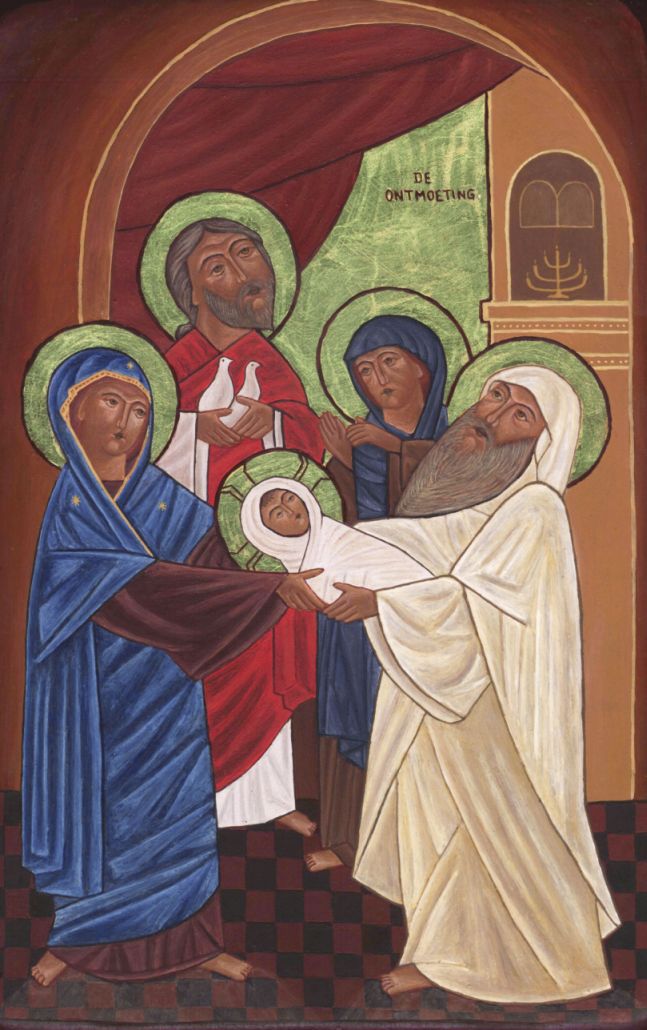
We continue with Luke (2:36-40) in today’s Gospel, here highlighting Anna, the prophetess, who was in the Temple at the same time as Simeon when the Holy Family arrived.

[Anna] was advanced in years,
having lived seven years with her husband after her marriage,
and then as a widow until she was eighty-four.
(vv. 36b-37a)

“Her name Anna (Hannah in Hebrew) recalls Hannah the mother of Samuel…[The excerpt above] suggests that if Mary represents Israel as virgin, Anna represents Israel primarily as widow (‘eighty-four’ equals twelve times seven– i.e., the number of Israel’s tribes times the number of perfection). Isaiah’s prophecy is being fulfilled: ‘The reproach of your widowhood no longer remember. / For your husband is your Maker; / the Lord of hosts is his name, / Your redeemer, the Holy One of Israel’ (Isa 54:4-5; see 62:4-5, 12). Isaiah is portraying the Lord God as Israel’s bridegroom redeemer — that is, the kinsman who redeems a childless widow by marrying her (see Ruth 4;5-6, 14).” (The Gospel of Luke [Catholic Commentary on Sacred Scripture], 72)

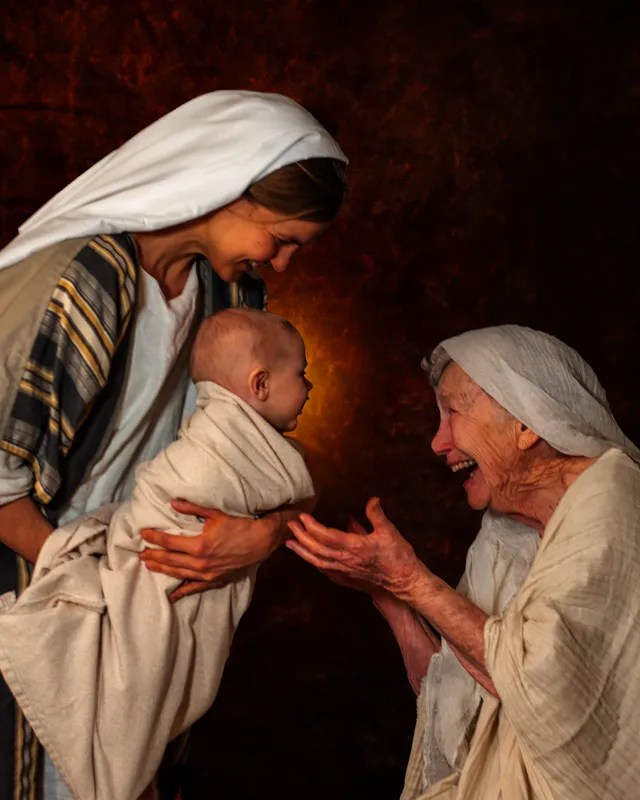
Talk about someone who is detached and focused. Anna devotes her whole life to the Lord and has the keen insight, aided by grace (and Simeon, no doubt), to recognize Him when He comes. Imagine her joy! She must not have stopped speaking of this day for the rest of her days, which I suspect, like Simeon’s, were short. This woman, probably looked on as a bit more than a little eccentric until this day, maybe gained some new found respect. Or not. Nevertheless, a lifetime of prayer, penance, and fasting, yielded the greatest reward for her at the end of this life, and undoubtedly upon this babe’s ultimate Resurrection.

God bless.

The Prophetess Anna Greets the Christ Child (2023 photo) by Lester Yocum

Christmas Day 5: Walk the walk

TODAY’S READINGS

The first reading is from 1 Jn 2:3-11. A challenge and a promise.

The way we may be sure that we know Jesus
is to keep his commandments.
Whoever says, “I know him,” but does not keep his commandments
is a liar, and the truth is not in him.
But whoever keeps his word,
the love of God is truly perfected in him.
This is the way we may know that we are in union with him:
whoever claims to abide in him ought to walk just as he walked.
(v. 3-6)

“For St John, knowing God is not merely an intellectual exercise nor does he mean that the immensity of God can be grasped by man’s limited understanding. It refers to something much simpler and more important: knowing God means being united to him by faith and love — by grace…

“‘Keeping his commandments’ (vv. 3 and 4), ‘Keeping his word’ (v., 5), ‘walking in the same way in which he walked’ (v. 6): keeping the commandments is absolutely necessary, because there is no room for faith without works (cf. 1 Jn 3:17-18; Jas 2:14ff; Gal 5:6). Similarly, one must keep the work of God, that is , accept all revelation docilely (and idea found very often in John : c.f., e.g., Jn 5:38; 8:31, 51; 1 Jn 2;14). But, above all, Christians must identify their life with Christ’s….” (The Navarre Bible: Catholic Epistles, 168)

Christianity does not espouse an “easy believism”: “I’ve accepted Jesus as my Lord and Savior, so my ticket to heaven is stamped.” No, Jesus in the Gospels makes it clear, over and over, that the demands are great and the path is narrow. Our faith is not for the weak of heart or the weak of spirit. The good news, straight from the Lord, in times of temptation:

My grace is sufficient for you, for power is made perfect in weakness. (2 Cor 12:9)

We can do nothing without grace. But grace through faith allows us to move mountains — if only we accept these gifts.

JESUS AND THE DEAD SEA SCROLLS

I just finished Dr. John Bergsma’s book. If the subject of the Dead Sea Scrolls is unfamiliar to you or seems uninteresting to you, this book will enlighten and interest you. The primary importance of these documents for Christians is how they enlighten our understanding of the sacraments and the early Church, being written approximately contemporaneous to the New Testament. Bergsma makes it interesting and accessible to the engaged reader — q worthy effort that I can highly recommend without reservation.

ST. THOMAS BECKET

Article: St. Thomas Becket

Pray for us!

God bless.

Christmas Day 4: Baptism by blood

TODAY’S READINGS

The Gospel reading is from Mt 2:13-18. Taking up when the magi leave, proclaimed is the horrific story of the massacre of children by the maniacal and unstable Herod the Great.

When Herod realized that he had been deceived by the magi,
he became furious.
He ordered the massacre of all the boys in Bethlehem and its vicinity
two years old and under,
in accordance with the time he had ascertained from the magi.
(v. 16)

“Such violence is consistent with other ruthless acts Herod performed near the end of his life, including the murder of his own wife and sons whom he feared were trying to supplant him. Yet, as horrific as the ‘Massacre of the Holy Innocents’ was, it probably was not of the magnitude that is sometimes imagined. Bethlehem in the first century had a maximum of a thousand people, and there were probably only twenty male children under age two dwelling in the village and surrounding district. It is not surprising that other historical works from this period do not mention this event. As tragic as these killings would have been, they remain a smaller scale compare to Herod’s other atrocities.” (The Gospel of Matthew [Catholic Commentary on Sacred Scripture], 56)”

“The Church regards these children as the first martyrs to give their lives for Christ. Martyrdom brought them justification (that is, salvation) and gave them the same grace as Baptism gives; their martyrdom is, in fact, Baptism by blood.

“St Thomas Aquinas comments on this passage in the following way: ‘How can it be said that they died for Christ, since they could not use their freedom?[…] God would not have allowed that massacre if it had not been of benefit to those children. St Augustine says that to doubt that the massacre was of benefit to those children is the same as doubting that Baptism is of use to children. For the Holy Innocents suffered as martyrs and confessed Christ non loquendo, sed moriendo, not by speaking, but by dying’ (Comm. on St Matthew, 2, 16).” (The Navarre Bible: St Matthew, 39)

“[T]he slaughter of the Innocents in the place of Jesus is a prophecy and an anticipation of the slaughter of Jesus in the place of all men…” (Fire of Mercy, Heart of the Word, Vol. 1, 100)

This Gospel passage should be disturbing to our core. Not only that innocent children were killed, but that it could have been prevented. The angel warns the Holy Family to get to safety, but no one else — why not? Better, God could have just prevented the massacre in the first place by thwarting Herod’s plans or not having the magi consult with him in the first place. Or, how about killing off Herod before he could hatch his evil plan? Herod most likely died in 1 B.C. and Jesus was likely born in 3 or 2 B.C. — why not just wait it out? Or have Jesus born a year or two later?

The commentaries I quote from help us out here. These toddlers did not die in vain. We celebrate their feast yearly — this was a guarantee of heavenly bliss for them upon Jesus’ fulfillment of His mission. And don’t think Blessed Mary and Joseph were not praying intently for the grieving families. I wonder if, thirty some years down the road, these same families heard of Jesus and put two and two together (I suppose it is possible that the butchers may have given them some indication of why they were murdering, but who knows?)? What did they make of that?

This passage brings to mind a teacher of mine who said in class, fighting back tears, that he would rather see his young child die immediately if he knew that, instead, he would live long and die in mortal sin. To Aquinas’s point, these children were guaranteed heaven. Obviously, this is not reason to hope for or hasten the demise of anyone (life and death is God’s prerogative), but “We know that all things work for good for those who love God, who are called according to his purpose” (Rom 8:28). God’s purpose here is to fulfill a prophecy and anticipate Jesus’ sacrifice.

Finally, this passage should make us more keenly aware and devastatingly disheartened by the murder of innocents today through abortion and the killing of living children during “botched” abortions. If we are horrified, rightly, of the unjustified killing of a couple dozen young children, what of the tens of millions killed in recent decades through abortion? Disturbing, as well, is the embracing of this “right” by state after state, enshrining it in (human) law. God help us!

God bless you.

La Vierge à l’Enfant entourée des saints Innocents (1618) Pierre Paul Rubens

Christmas Day 2: An endurance test

TODAY’S READINGS

The Gospel reading is from Mt 10:17-22. Jesus promises persecution to His followers who are faithful to Him, but a happy denouement.

You will be hated by all because of my name,
but whoever endures to the end will be saved.
(v. 22)

“Persecution has an end, since it is created by man; salvation has no beginning and no end, because it is a participation in the life of God. ’Salvation’ does not come at the end of a persecution simply as a reward for having withstood the trials now past. ’Salvation’ is a full flowering and sure manifestation of that divine Presence that has been active all along in the believer’s witness. ’Salvation’ is the seed of trust and faith come full term ans yielding the fruit of indefectible glory. The physical mobility of Christians, as they flee persecution from city to city, is in eloquent contrast to their interior stability, grounded as they are in the confession of the one Name.” (Fire of Mercy, Heart of the Word, Vol. I, 570)

“The phrase ‘to the end’ can have different meanings. It might mean to the end of a particular persecution. It might mean to the ends of one’s life (verse 21). It might mean to the end of the present age, when Jesus will return (verse 23). Each of these possible meanings is linked with a corresponding meaning of being saved. If “the end means the end of a persecution, then being saved means surviving it. If the end is the end of one’s life, then being saved means receiving eternal life. If the end is the return of Jesus, then being saved means being rescued from the tribulation that was expected when this age comes to an end (see 24:29). It is not clear which meaning Jesus primarily intended for his listeners. Readers of Matthew’s gospel today might best understand Jesus to be speaking of the end of their days on earth and take his words as a promise of eternal life if they endure in their faith.” (Bringing the Gospel of Matthew to Life, 194)

With the second quote, I can’t help but recall a preacher years ago speaking of those who obsess about when the end of time will occur, scouring Scripture for clues, attempting to read the “signs of the time” and, from that, making predictions. His message: we don’t know when the end of the world is coming but we know for sure that our end is coming, so be prepared! I have long been content with Jesus’ exclamation, further along in Matthew, to those to whom He was speaking regarding His ultimate return:

But of that day and hour no one knows, neither the angels of heaven, nor the Son, but the Father alone…
Therefore, stay awake! For you do not know on which day your Lord will come.
(Mt 24:36, 42)

This reading promises that persecution will be part and parcel of being a faithful follower of Jesus — from the Lord’s own mouth. Fleeing from tribulations because of our faith is a fool’s errand. If we truly believe, we embrace our cross, whatever the cost. Our lives are less than a millisecond in the clock of eternity. May we never compromise our beliefs in the slightest and put our salvation in question. Yes, hostility toward religion in general, Christianity in particular, and Catholicism most specifically, continues to grow. Let us pray to the Holy Spirit for the gift of fortitude to withstand the ongoing persecution, that will continue to grow.

ST. STEPHEN, DEACON AND MARTYR

A good article for reflection. Yesterday we celebrated God’s birth on earth; today we celebrate the first Christian martyr’s birthday into heaven. The entrance of the second made possible by the life, death, resurrection, and ascension of the first.

To learn more about this great saint, check out CatholicOnline, a go to spot for saints’ stories.

And to my deacon friends: being on the front lines, you are bound to experience little martyrdoms often. Pray for the strength to continue your witness despite it all. Who knows? God may use you to turn a misguided Saul into a zealous Paul.

St. Stephen, pray for us.

God bless.

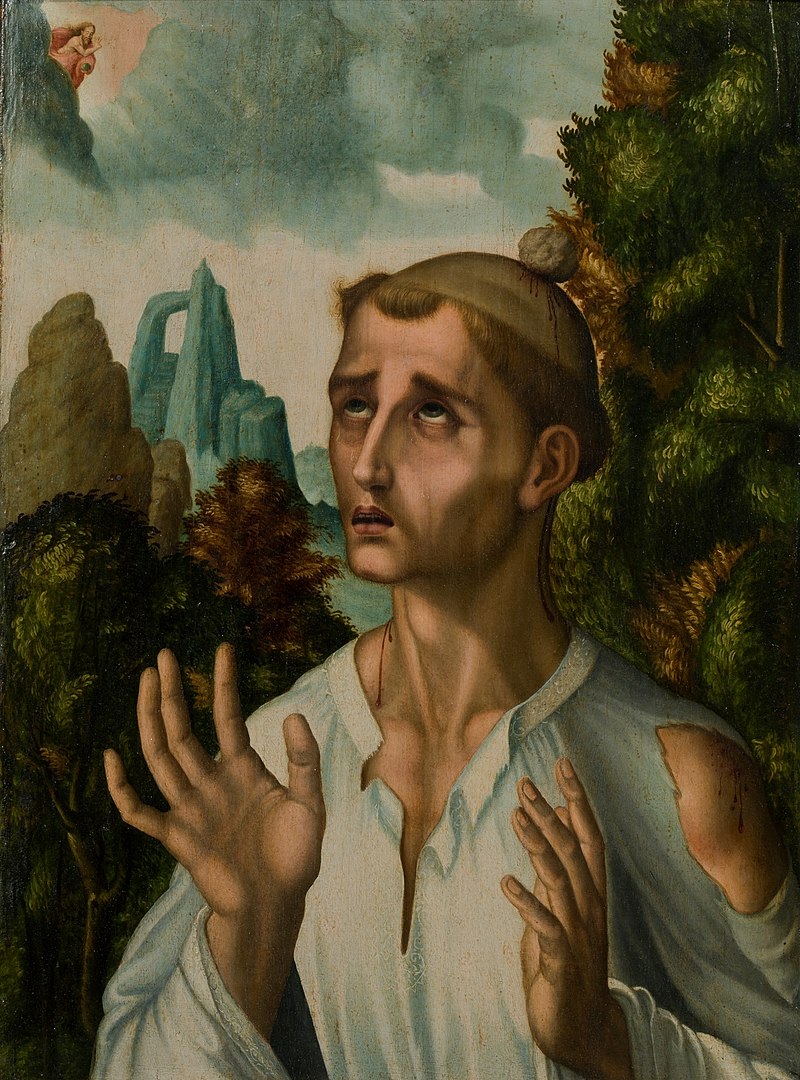
Saint Stephen (c. 1575) by Luis de Morales

Christmas Day 1: Shepherding a Mirrored Heart

TODAY’S READINGS

The Gospel reading is from Lk 2:15-20. I have chosen readings from the Mass at Dawn since it is the Mass I attended. A focus on the shepherds, yes, but one very important line about the Blessed Virgin:

And Mary kept all these things,
reflecting on them in her heart.
(v. 19)

“Mary contemplates Jesus’ birth and childhood, not from a distance, but as a participant in the mystery (1;35, 43; 2:51). Luke’s insight suggests that Mary is either the direct or indirect source of his information, since she alone could relate these hidden details of the story.” (The Gospel of Luke [Ignatius Catholic Study Bible], 24)

“Mary has had nine months to ponder what God is doing through her; the shepherds’ report is one more thing to ponder. Mary is apparently included in the ‘all’ who were ‘amazed’ by the shepherds’ words (verse 18), but her response is more than astonishment. ’Mary kept all these things’: the Greek word ‘kept’ has connotations of preserving something, being concerned about it, treasuring it. Mary treasured the events that had unfolded, ‘reflecting on them in her heart.’ The Greek word for ‘reflecting’ on means putting things together, pondering them. In the biblical view, the heart is the seat of thinking and feeling and willing. Mary takes to heart the amazing things that are happening and tries to fathom their meaning. Mary is a model of treasuring al that God says and does, meditating on his word, pondering his plans for our lives.” (Bringing the Gospel of Luke to Life, 64)

Mary “is a true teacher of prayer. If we imitate her, if we guard and ponder in our hearts what Jesus says to us and what he does in us, we are well on the way to Christian holiness and we shall never lack his doctrine and his grace. Also, by meditating in this way on the teaching Jesus has given us, we shall obtain a deeper understanding of the mystery of Christ, which is how ‘the Tradition that comes from the Apostles makes progress in the the Church, with the help of the Holy Spirit.’ (Vatican II, Dei Verbum, 8)” (The Navarre Bible: The Gospel of Luke, 56)

Not only can we take a lesson from Blessed Mary (did anyone in the human history have more to contemplate than she?), but also from the shepherds. Filled with awe as these events unfolded, do you not think they spent many lonely hours on the job contemplating these things in the depths of their being. We must be more like the shepherds: being awestruck by God and taking the time to ponder all that He has done in history and all He has done for us, specifically.

THREE SONGS

A beautiful Catholic song for the season sung beautifully.

My favorite versions of my two favorite secular songs:

Merry Christmas and God bless.

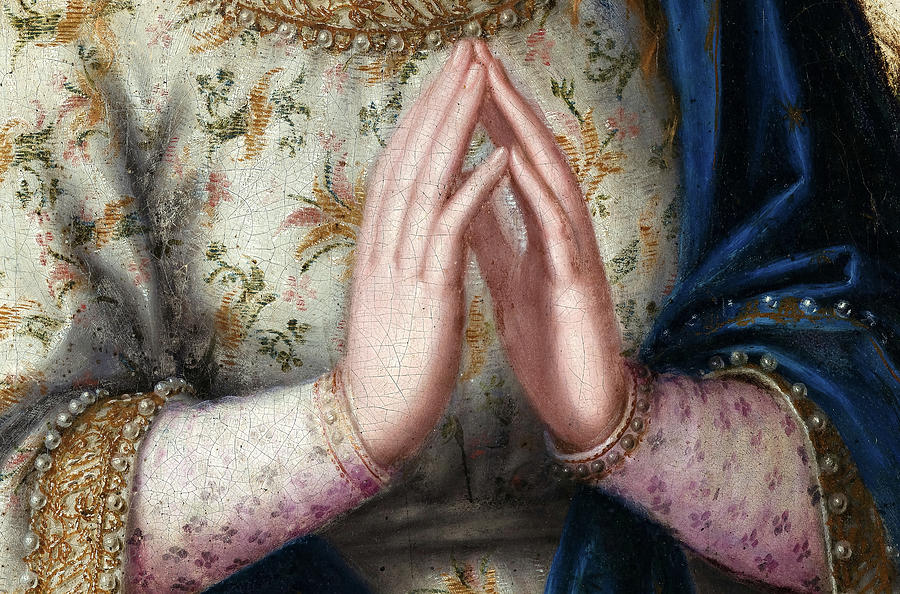
Prayer, Blessed Virgin Mary by Juan Sanchez Cotan (1560-1627)

Advent Day 22: Son of David, Son of Mary, Son of God

TODAY’S READINGS

The first reading is from 2 Sm 7:1-5, 8b-12, 14a, 16. The establishment of the Davidic covenant, the last covenant of the Old Testament. We are given this today in a particular way to show how it is fulfilled in the New Testament. Let us explore this prophecy.

I will raise up your heir after you, sprung from your loins,
and I will make his kingdom firm.
I will be a father to him,
and he shall be a son to me.
Your house and your kingdom shall endure forever before me;
your throne shall stand firm forever.
(vv. 12b, 14a, 16)

“The pledges made to David are provisionally realized in Solomon during the golden age of the united monarchy and, to a lesser extent, in the centuries that the Davidic dynasty ruled in Jerusalem. But definitive fulfillment awaits the coming of Jesus Christ. He is the Messiah grafted into David’s dynastic line (Mt 1:1-16) and the one chosen by God to sit on David’s throne ‘for ever’ (Lk 1:32-33). Like David, Jesus is anointed by the Spirit (1 Sam 16;13; Acts 10:38), and, like Solomon, he offers the wisdom of God to the world (1 Kings 10:1-10; Mt 12:42). The temple he builds is not a stone-and-cedar sanctuary in Jerusalem, but his body, the Church of living believers indwelt by the Spirit (Mt 16;18; Eph 2:19-22; 1 Pet 2:4-5). In the Resurrection, Jesus’ humanity attains the royal adoption promised to David’s offspring (Acts 13;33-34; Rom 1:3-4), and, at his Ascension, he commences his everlasting reign (Lk 1;33) as David’s messianic Lord (Mk 12:335-37). Even now, he holds the key to the kingdom of David (Rev 3:7) and bears the distinction of being ‘King of Israel’ (Jn 1:49) as well as ‘he who rises to rule the Gentiles’ (Rom 15:12). According to the very first Christian sermon, all of this is the fulfillment of Yahweh’s oath to David (Acts 2:29-35).” (The First and Second Books of Samuel [Ignatius Catholic Study Bible], 80)

This should make us appreciate in a special way those times when Jesus is called “Son of David” in the Gospels, considering all that’s implied in that title. For an interesting Bible study, read the passages and context around those times the Lord is addressed in this way (here — note that Jesus is addressed this way only six different times with Matthew giving us all six [Mark and Luke repeat one of the stories, the blind beggar, in Matthew). Exquisite fruit for contemplation.

The Responsorial Psalm is Ps 89:2-3, 4-5, 27, 29. We should be reminded of Mary’s Magnificat. Mary knew her Scriptures — I suspect, being a uniquely bright and holy child, that she was literate, although this is not necessary for her to have this depth of knowledge and interiority of the Bible.

Forever will I confirm your posterity
and establish your throne for all generations.
(v. 4)

Jesus is Son of David and Son of Mary and Son of God. Wow.

The second reading is from Rom 16:25-27. Let us key in on the phrase “obedience of faith.”

…according to my gospel and the proclamation of Jesus Christ,
according to the revelation of the mystery kept secret for long ages…
made known to all nations to bring about the obedience of faith… (vv. 25a, 26)

the obedience of faith: Probably means ‘the obedience that is faith’ or ‘the obedience that springs from faith’. The expression stands like two bookends at the beginning and end of Romans (16:26). It holds the epistle together around the central theme of faith, which is the act of trusting in God and entrusting oneself to God. Faith inspires love (Gal 5:6) and is the indispensable basis for a living relationship with Christ (Rom 1:17; Heb 11:6) (CCC 143, 1814). (The Ignatius Catholic Study Bible: The New Testament (San Francisco: Ignatius Press, 2010), 257.

The gift of faith comes to us with the other theological virtues (hope and love/charity) in Baptism and remains with us as long as we avoid mortal sin (thank the Lord for Confession!). It is a free gift, but it isn’t cheap. A simple statement of belief not followed by a life striving for holiness is certainly the devil’s deceit.

The Gospel gives us the Annunciation (Lk 1:26-38). So much can be said about the seemingly infinite number of aspects of this encounter, but let’s focus on the first words of the angel:

Hail, full of grace! The Lord is with you. (v. 28)

Hail: Or ‘Rejoice!’ It crowns the theme of joy and gladness that punctuates Luke’s Infancy Narrative (1:14, 44, 47, 58; 2:10, 20). ● The call to rejoice echoes OT passages that address Daughter Zion. In the prophets this refers to Mother Jerusalem, whose faithful children will rejoice in the messianic age because God has chosen to dwell in their midst (Joel 2:23–24; Zeph 3:14–17; Zech 9:9). Mary, chosen to be the virgin mother of the Messiah, is greeted with the same summons because she is the embodiment of faithful Israel and the most privileged recipient of Yahweh’s messianic blessings. full of grace: This is the only biblical instance where an angel addresses someone by a title instead of a personal name. Two considerations help to clarify its meaning. (1) The expression full of grace is rooted in Catholic tradition and traced to St. Jerome’s translation of this verse in the Latin Vulgate. Although fundamentally accurate, it lacks some of the depth of the Greek original. Luke could have described her with the words full of grace (Gk. plērēs charitos) as he did of Stephen in Acts 6:8, yet here he uses a different expression (Gk. kecharitōmenē) that is even more revealing than the traditional rendering. It indicates that God has already ‘graced’ Mary previous to this point, making her a vessel who ‘has been’ and ‘is now’ filled with divine life. (2) Alternative translations like ‘favored one’ or ‘highly favored’ are possible but inadequate. Because of the unparalleled role that Mary accepts at this turning point in salvation history, the best translation is the most exalted one. For God endowed Mary with an abundance of grace to prepare her for the vocation of divine motherhood and to make her a sterling example of Christian holiness (CCC 490–93, 722). ● Gabriel’s declaration points in the direction of Mary’s Immaculate Conception. According to Pope Pius IX’s 1854 definition Ineffabilis Deus, Luke’s Annunciation narrative is an important indicator of Mary’s lifelong holiness. God is her ‘Savior’ (1:47) in the most perfect way possible: he sanctified Mary in the first instance of her conception and preserved her entirely from sin and even from the inclination toward sin that we experience. (The Ignatius Catholic Study Bible: The New Testament [San Francisco: Ignatius Press, 2010], 105.)

Faithful Catholics have said the Hail Mary many, many times. How often do we contemplate these first words of the prayer (by the way, the Hail Mary is a biblical prayer!)? Put yourself in Mary’s sandals. This awesome creature surprises you with such a greeting. “Rejoice”! He calls me “full of grace”! What is about to happen? Might I have the inkling, the hope, that the long awaited Messiah is about to come? How will it happen? Will I be involved?

BP BARRON’S SUNDAY SERMON

Focusing on Nathan and David.

SANTA CLAUS

A nice article about Santa Claus and keeping children’s dreams alive: Santa Claus, St. Nicholas, Myths, Fairy Tales and ‘Lies.’

ADVENT ENDS

Today we end the shortest Advent possible. Yes, we must go to Mass again this evening or tomorrow. This shouldn’t be a burden but a joy and a blessing. Honoring the Lord’s first coming and then having him come to us in Holy Communion — who could possibly want to miss it!

God bless.

David and Nathan (1672) by Matthias Scheits

Advent Day 21: What’s in a name?

TODAY’S READINGS

The Gospel reading is from Lk 1:57-66, again picking up where we left off from the previous day. Here, Elizabeth names her newborn son to those gathered round.

When they came on the eighth day to circumcise the child,
they were going to call him Zechariah after his father,
but his mother said in reply,
“No. He will be called John.”
But they answered her,
“There is no one among your relatives who has this name.”
(vv. 59-61)

“[C]ircumcision of Jewish males incorporated them into God’s covenant with his people (Gen 18:9-14; it was ‘the mark of the covenant’ (Gen 17:11). Circumcision was done on the eighth day after birth (Gen 17:12; Lev 12:3). Elizabeth and Zechariah observe all God’s commandments (1:6); their son is circumcised on the proper day. Neighbors and relatives (verse 58) came to celebrate the circumcision…

“The Hebrew name that comes into English as John means ‘God has shown favor’ (using God’s personal name — Yahweh); it was not an unusual name in priestly families (1 Macc 2:1-2). Luke does not explaining the meaning of John’s name, but it is highly appropriate: God has shown favor to Elizabeth and Zechariah and would show favor to his people through their son (see 1:16-17)…

“If a son was not named after his father, it was customary to name him after one of his other relatives. But no one in the families of Elizabeth and Zechariah is named John. Breaking with customary practice in naming John is a sign that he is someone out of the ordinary. His significance will not lie in his family heritage but in who he is an what he will do.” (Bringing the Gospel of Luke to Life, 38-39)

I’ve long wondered why it was so astonishing to those visiting John’s parents that the little boy was not named after his father. I an unaware of any instance in the Bible where a Jewish parent and child had the same name (Abraham Jr., anyone) or even that of a relative (at least mentioned)? I did a bit of research: some speculate that it was because John had a special mission (as mentioned above); others that it was a specifically Levite custom at the time, or still others that Luke got some bad info (which doesn’t square with my understanding of biblical inerrancy). If anyone has come across anything more definitive or explanatory, please let me know in the comments.

Also, check out the article, What’s Your Name?, that gives important scriptural insights and practical application to this Gospel story. Maybe it will inspire you to look up the etymology of your own name (here’s mine).

CATHOLIC COMMENTARY ON SACRED: SCRIPTURE: OLD TESTAMENT!

I had been checking in from time to time on the Catholic Commentary on Sacred Scripture website to find out if, after having published volumes covering the entire New Testament, the Old Testament would be tackled. Well, to my surprise, a suggestion came up yesterday on Amazon about a new commentary on Wisdom from this series (already in my cart)! I checked the site again, but no news there. So I contacted one of the General Editors, Dr. Mary Healy, who tells me, “Yes, we’ve started work on the OT, and Wisdom and Ezekiel will be coming out in 2024! Next will be Sirach and Isaiah, and roughly two volumes every year.”

This is a phenomenal series. I have the entire NT set, and have worked through many of the volumes, even using one to lead a Bible study. Scholarly, but accessible, these are meant for interested and engaged Catholics of all stripes. If you have not seen these yet, I encourage you to pick up at least one (maybe the one that covers your favorite Gospel or epistle) and read it.

CHRISTMAS…HISTORICALLY

Finally, I listened today to one of my more recently adopted favorite podcasters, Catholic Answers apologist Jimmy Akin, who explores what we know, or can reasonably speculate, about the first Christmas. I can assure you, without question, that you will learn something new. For example, there is a decent reason to believe the first Christmas happened on September 11, 3 B.C. — and you’ll be entirely surprised the scriptural warrant for this. Learn this and a lot more in the podcast. And check out the many subjects Jimmy covers in his Mysterious World.

God bless.

The Birth and Naming of Saint John the Baptist (1450-1460) by Sano di Pietro

Advent Day 20: Blessed and never broken

TODAY’S READINGS

The Gospel reading is from Lk 1:46-56, picking up where we left off yesterday. It is her response to Elizabeth, a response for the ages. I will focus on a particular verse (in fact, just the second part):

[The Lord] has looked upon his lowly servant.
From this day all generations will call me blessed.
(v. 48)

“Elizabeth is the first to proclaim Mary blessed because of what God is doing through her and because of her response to God (1:42, 45), but she will not be the last. Mary realizes that ‘from now on will all ages call me blessed.’ Every future generation will look upon Mary as someone specially favored and blessed by God. The words from now on signal a turning point. The conception of Jesus inaugurates a new stage in human and divine history; God has take a decisive step that will affect all ages to come.” (The Gospel of Luke (Catholic Commentary on Sacred Scripture, 33)

“God rewards our Lady’s humility by mankind’s recognition of her greatness: ‘All generations will call me blessed.’ This prophecy is fulfilled every time someone says the Hail Mary, and indeed she is praised on earth continually, without interruption. ’From the earliest times the Blessed Virgin is honoured under the title of Mother of God, under whose protection the faithful take refuge together in prayer in all their perils and needs. Accordingly, following the Council of Ephesus, there was a remarkable growth int the cult of the people of God towards Mary, in veneration and love, in invocation and imitation, according to her own prophetic words: ‘all generations will call me blessed, for he who is mighty has done great things for me'” (Vatican II, Lumen gentium, 66) (The Navarre Bible: The Gospel of Luke, 44)

“Mary…prophesies that ‘all ages’ (literally ‘all generations’) wll pronounce a beatitude by calling here ‘blessed,’ recognizing god’s favor to her, as indeed Elizabeth has just done (Luke 1:45). thus, the person who says ‘Blessed Mary’ or ‘Blessed Virgin Mary’ (see 1:27) is fulfilling the inspired word of Scripture!” (The Gospel of Luke [Catholic Commentary on Sacred Scripture], 52)

This last quote makes a particular impact on me. I will try never to invoke Mary without prefacing that holy name (it means “”) with “Blessed.” The humble, perfect, sinless one, in true humility, acknowledges the favor she has found with God. It has been said, we can never honor Jesus’ mother more than He did (after all who kept all the commandments, including the fourth, better than the Son of God?). But, certainly, the least we can do is honor her in the way she declared she should be invoked.

It saddens me — and how it must sadden the Mother of God — that Blessed Mary is arguably the main point of contention between Catholics and Protestants. The Marian dogmas, so rich, so beautiful, of ancient heritage, and with plenty of scriptural support, are anathema to far too many Christians. 

One last note regarding the title of this post. ”Blessed and broken” is not an uncommon Christian theme. Of course we think of Jesus’ food miracles and the Last Supper. And we, who are broken, need Jesus the Divine Carpenter to fix us. In titling this post as I did, I considered Blessed Mary declaring herself blessed about a week into her pregnancy and thenk think of (as she certainly must have) all that she had to look forward to. Many joys, undoubtedly, along with much suffering, particularly as she observed her Son’s ministry culminating in the Cross. But none of these events were going to break her. I never like to see movie scenes in which Blessed Mary is wailing at the foot of the Cross. Pious tradition has her as Stabat Mater, standing firm while her heart (and His) was torn to shreds. (As an aside, here I’m reminded of how Jackie Kennedy was lauded in the dignified way she handled all the events surrounding her husband’s murder.)

May Our Lady of Unity intercede on behalf of this unbelieving world so that her Son’s prayer will be made manifest:

I pray not only for them, but also for those who will believe in me through their word, so that they may all be one, as you, Father, are in me and I in you, that they also may be in us, that the world may believe that you sent me. (Jn 17:20-21)

ON MARY’S PERPETUAL VIRGINITY

I have become a big fan of Shameless Popery, Catholic Answers apologist Joe Heschmeyer’s podcast. His thoroughgoing defense of Mary’s perpetual virginity on scriptural grounds is outstanding. I certainly have heard a number of these explanations previously, but Joe provides many more I had never been exposed to in an interesting, methodical, and devastating (to unbelievers) way. And he does this in the context of the Christmas Story, so it is timely, as well.

God bless.

Advent Day 19: Make haste!

TODAY’S READINGS

The Gospel reading is from Lk 1:39-45, Mary’s visit to Elizabeth after the joyous news of both their pregnancies. It is the first meeting of cousins John and Jesus. My focus is on the speed in which the Virgin went to visit her relative, as relayed in the very first verse.

Mary set out in those days
and traveled to the hill country in haste
to a town of Judah
(v. 39)

“The village of Ain Karim in the hill country near Jerusalem is the traditional site of the house of Zechariah and Elizabeth. It is located about five miles from the temple, a convenient distance for Zechariah’s trips for priestly duty. For Mary, however, the journey from Nazareth would be about ninety miles, depending on the route, taking several days. There is no mention of Joseph accompanying her, unlike the later journey together to Bethlehem (2:4-5). She goes in haste, indicating her earnestness in following God’s plan.” (The Gospel of Luke (Catholic Commentary on Sacred Scripture, 48)

Luke “notes that she travels ‘in haste’ but does not explain why she is in a hurry…we might speculate that Mary was eager to see this sign for herself. We might also speculate that she was eager to be with Elizabeth because of what they had in common: they were unexpectedly becoming mothers through the favor of God; their sons would play major roles in God’s unfolding plans.” (Bringing the Gospel of Luke to Life, 27-28)

“On learning from the angel that her cousin St Elizabeth is soon to give birth and is need of support, our Lady in her charity hastens to her aid. She has no regard for the difficulties this involves…

“From Mary’s visit to Elizabeth Christians should learn to be caring people. ’If we have filial contact with Mary, we won’t be able to think just about ourselves and our problems. Selfish personal problems will find no place in our mind’ (Bl. J. Escriva, Christ is passing by, 145).” (The Navarre Bible: The Gospel of Luke, 41-42)

“After the Annunciation, Mary could have focused on herself and her own worries and fears about her new condition. Instead, she entrusted herself completely to God. Her thoughts turned to Elizabeth. She got up and went forth, into the world of life and movement. Even though the astonishing message of the angel had caused a seismic shift in her plans, the young Mary did not remain paralyzed, for within her was Jesus, the power of resurrection and new life. Within herself, Mary already bore the Lamb that was slain and yet lives. She arises and sets out, for she is certain that God’s plan is the best plan for her life. Mary becomes a temple of God, an image of the pilgrim Church, a Church that goes forth for service, a Church that brings the good news to all!” (MESSAGE OF HIS HOLINESS POPE FRANCIS FOR THE XXXVII WORLD YOUTH DAY 2022-2023; the whole document is worth reading)

“I’ve always been fascinated by Mary’s ‘haste’ in this story of the Visitation. Upon hearing the message of Gabriel concerning her own pregnancy and that of her cousin, Mary ‘proceeded in haste into the hill country of Judah’ to see Elizabeth.

“Why did she go with such speed and purpose? Because she had found her mission, her role in the theo-drama. We are dominated today by the ego-drama in all of its ramifications and implications. The ego-drama is the play that I’m writing, I’m producing, I’m directing, and I’m starring in. We see this absolutely everywhere in our culture. Freedom of choice reigns supreme: I become the person that I choose to be.

“The theo-drama is the great story being told by God, the great play being directed by God. What makes life thrilling is to discover your role in it. This is precisely what has happened to Mary. She has found her role—indeed, a climactic role—in the theo-drama, and she wants to conspire with Elizabeth, who has also discovered her role in the same drama. Like Mary, we have to find our place in God’s story.” (Bp Robert Barron’s Advent Gospel Reflections [2017]; he also gives this same reflection in his Rosary)

Let us be ever mindful to make haste when doing the work of God, and pump the brakes when it is all about us. And pray that we will recognize and be mindful of the difference