Advent Day 18: A “virgin”? “Emmanuel”?

TODAY’S READINGS

The first reading is from Is 7:10-14. I had hoped to focus on Ahaz’s seemingly humble rejection of the offer of a sign, but my limited resources said little except that, essentially, Ahaz was a scoundrel and his false piety was seen through by Isaiah. I did find, however, an article that expounds specifically on Ahaz’s response offering a contemporary example and a practical reflection.

Additionally, who would not be tempted to comment on the Annunciation, found in today’s Gospel reading? The number of resources I could refer to are legion, so that can be your homework (or prayerwork).

So, I went for the last verse of the first reading. A familiar one that, for Christians, unmistakably points toward Jesus. But is that all there is to it? This gives me the opportunity to highlight a phenomenal book that should be in the reference library of, not only every Catholic, but every person who is serious about knowing and appreciating better the Old Testament.

[T]he Lord himself will give you this sign:
the virgin shall conceive and bear a son,
and shall name him Emmanuel.
(v. 14)

“Theological Issues in Isaiah Is Immanuel

Conceived of a ‘Virgin’ or a ‘Young Woman’?

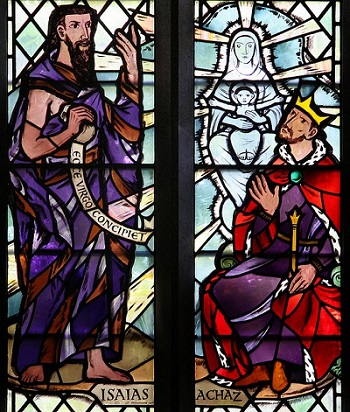
As is well known, this famous oracle is taken as a prophecy of the virginal conception of Christ in the New Testament (Mt 1:23). For centuries, however, there has been a debate over the original meaning of Isaiah’s oracle. On the one hand, most modern interpreters contend that Isaiah is not referring to a virginal conception, since the Hebrew word used by Isaiah is ‘almah, which many feel is best translated as ‘young woman’. Those who favor this position point out that the ordinary Hebrew word for ‘virgin’ (bethulah) is not used in Isaiah 7:14. From this point of view, then, the “sign” given to Ahaz is the birth of his son Hezekiah, who, by the time he reaches the age of reason, will witness the overthrow of the northern kingdom. Indeed, there are aspects of the oracle that seem indisputably to envision an immediate fulfillment in the ending of the Syro-Ephraimite crisis (Is 7:14-17), events that took place in the lifetime of King Hezekiah, son of Ahaz (ca. 732 B.C.).

“On the other hand, other interpreters contend that Isaiah is referring to a miraculous conception and birth. We determine the meaning of the Hebrew word ‘almah ultimately by analyzing the way it is used in the Hebrew text of the Bible: it occurs seven times, and in those cases it is never applied to a married woman: Genesis 24:43; Exodus 2:8; Isaiah 7:14; Psalm 68:26 MT; Proverbs 30:19; Song of Solomon 1:3; 6: 8. Indeed, in some cases ‘almah is used as a synonym for ‘virgin’ (bethulah}, as when Rebekah is referred to both as a ‘maiden/young woman’ (‘almah) and a ‘virgin (bethulah) whom no man had known’ (Gen 24:16, 43). Again, in Song of Solomon 6:8, the category ‘almah is distinguished from the categories ‘queen’ and ‘concubine’ — that is, from those who have already had relations with the king. Perhaps, then, the Hebrew word ‘almah does not denote virginity, but does connote it, like the English word ‘maiden’. Intriguingly, the Jewish translators of the Greek Septuagint usually translated ‘almah with the non-specific expression ‘young woman’ (Greek parthenos}, except in two cases, where the context seems to have implied virginity: the story of Rebekah the virgin (Gen 24:43) and the oracle of the ‘virgin’ (Greek parthenos) who conceives Immanuel (Is 7:14). In this view, the ‘sign’ (Hebrew ‘oth) — which Isaiah uses elsewhere to refer to a miracle of nature (Is 37:30; 38:7) — is the miraculous conception of the child by a virgin. .Again, it is important to remember that the decision to render ‘almah with the Greek parthenos, ‘virgin’, was made by Jewish translators themselves about two hundred years prior to the dawn of the Christian era (see Is 7:14 LXX).

“When evaluating this issue, it is also critical to remember that biblical prophecy can have more than one horizon of fulfillment. In other words, the same prophecy may have both preliminary as well as ultimate fulfillments. In the case of Isaiah 7:14, the preliminary fulfillment of the ‘Immanuel’ child may well have been Hezekiah son of Ahaz, and the ‘almah may have been Abijah, a young bride of Ahaz (2 Chron 29:1), who was probably not yet intimate with the king. Before Hezekiah was a young man, the Syro-Ephraimite threat had evaporated. Yet Hezekiah himself is an important type of the Messiah in the book of Isaiah. For example, in the pivotal historical chapters about the end of Isaiah’s life (Is 36-39), Hezekiah is the righteous yet suffering savior-king, reminiscent of David and anticipating the future Messiah. Indeed, Hezekiah may even have been the immediate referent of the other prophecies of a.royal child (Is 9:1-7 and 11:1-5). However, to the. extent. that these oracles point not only to a new king but to a new kingdom, a new exodus, and a new creation, the birth and life of Hezekiah by no means fulfill them (cf. Is 7:14-16; 9:1-7; 11:1-5}. Instead, Hezekiah’s life leaves these oracles as prophetic words “waiting” for ultimate fulfillment. Hezekiah was born of a: ‘maiden’ ( ‘almah) in the usual manner, but later one would be born of a. mother who remained a maiden before, during, and after his birth. Hezekiah was ‘Immanuel’ (‘God with us’) in a mediated sense: his righteous reign.was a sign of God’s closeness to his people. But later one would be born who was truly ‘God with us’ in a literal sense. Applied to Hezekiah, the poetry and language of these oracles is hyperbolic: complete fulfillment awaits another.” (John Bergsma and Brant Pitre, A Catholic Introduction to the Bible: The Old Testament (San Francisco: Ignatius Press, 2018), 747-749)

I have provided this extended excerpt on the first reading not only because it is particularly interesting, delving into several facets of the prophecy, but also to highlight the extraordinary depth and erudition of the text. And, considering the content (over one thousand pages of brilliant scholarship), not an expensive purchase at all.

O come, O come, Emmanuel!

God bless.
Advent Day 15: Much to rejoice about

TODAY’S READINGS

The first reading is from Is 61:1-2A, 10-11 . A Servant Song of the prophet in the first person.

The spirit of the Lord GOD is upon me,
because the LORD has anointed me
(v. 1a)

“Prophets, priests, and kings were anointed in ancient Israel. The Servant is probably all three. The combination of anointing and the reception of the Spirit calls to mind the figure of David, who was filled with the Spirit when Samuel anointed him in in 1 Samuel 16. David, too, was prophet (2 Sam 23:1-2), priest (Ps 110), and king.” (John Bergsma, The Word of the Lord: Reflections on the Sunday Mass Readings for Year B [Steubenville, OH: Emmaus Road, 2021], 22)

The Responsorial Psalm is from Lk 1:46-48, 49-50, 53-54. Not from the book of Psalms at all, but in the same spirit, the words of Our Lady to Elizabeth (and to the whole world for all time).

He has filled the hungry with good things,
and the rich he has sent away empty.
He has come to the help of his servant Israel
for he has remembered his promise of mercy.
(vv. 53-54)

“Here we see Mary is adopting the attitude and posture of the ‘Servant of the LORD’ in Isaiah 61:1-2. How can she do this? Isn’t the ‘servant of the Lord’ Jesus himself? Yes, but the Blessed Mother has Jesus in her womb. She is the first Christian, the first person to be united as one flesh with Jesus. What is true of Jesus is true of her by extension. She is taken up into the Messianic mission of Christ, to ‘proclaim good news…and liberty’ (Isa 61:1) and to find in God the ‘joy of her soul.’ (Isa 61:10). Mary speaks as if God has already established ‘justice’ (Isa 61:11) through his Messiah: filling the oppressed ‘hungry’ with good things (think of the feeding miracles) and sending the rich oppressors away empty (think of the rich young ruler in Matt 19:22). (ibid, 25)

The second reading is from 1 Thes 5:16-24. It directly addresses the theme for this Third Sunday of Advent: Gaudete! Rejoice!

May the God of peace make you perfectly holy
and may you entirely, spirit, soul, and body,
be preserved blameless for the coming of our Lord Jesus Christ.
(v. 23)

“Following Christ means not just believing but actually being transformed, becoming ‘blameless’ so we can stand at the final judgment. This calls to mind Advent’s dual focus on both the First and Second Coming of Jesus. We want to keep our sight on both horizons. Waiting for the liturgical coming of Christ (Christmas) recalls his First Coming and looks forward to his Second.” (ibid, 27)

Last, but certainly not least, is today’s Gospel. Our preparation for Christmas focuses on the ultimate preparer, John the Baptist.

[The priests and Levites] asked him,
“What are you then? Are you Elijah?”
And he said, “I am not.”
“Are you the Prophet?”
He answered, “No.”
So they said to him,
“Who are you, so we can give an answer to those who sent us?
What do you have to say for yourself?”
He said:
I am the voice of one crying out in the desert,
‘make straight the way of the Lord,’”
as Isaiah the prophet said.”
 (vv. 21-23)

“There were at least three figures the Judeans expected to come at the end of the age:

  1. The Messiah or ‘Anointed One’ predicted by the prophets (see Isa 61, Dan 9, etc.);
  2. Elijah himself, whom Malachi prophesied would return before the ‘day of the LORD’ (Mal 4:5, RSVCE; and
  3. ‘The Prophet,’ that is, the prophet like Moses, whom Moses predicted would come someday (see Deut 18:15-22)…

“‘I’m none of these,’ John says. Who is he, then? ’I am the voice of one crying out in the wilderness…’ This is a quote from Isaiah 40, a famous chapter that serves as an introduction to the long vision of the age of the Messiah that is Isaiah 40-66. So, John is an introduction incarnate, a prologue in person, a foreword in the flesh.” (ibid, 28-29)

You may have noticed that all commentary was taken from Dr. Bergsma’s outstanding series, The Word of the Lord. I worked through Year A for the liturgical year recently completed and am now keeping up with the readings for our current cycle. I have mentioned this set of books previously, here: the four-volume set contains commentary on every Sunday, solemnity, and feast day over the three year cycle of readings implemented after Vatican II. Certainly, this should be in every Christian rectory and religious house or institution. But, also, serious Catholics would do well to have these books handy for weekly preparation and/or follow-up to weekend and holy day Mass.

Today’s exposition was particularly outstanding, so I though it a great time to highlight some of his key insights (there is much more for this Sunday and every Sunday in the book). Yes, we are to rejoice in so great a savior. And we can also rejoice in the faithful witnesses, like John Bergsma, who cooperate with His grace to edify and enlighten the faithful.

Please check out his weekly conversation with Dr. Scott Hahn here (a small fee but definitely worth every penny and more).

BP BARRON SERMON

My big takeaway: Per Jesus, “among those born of women there has been none greater than John the Baptist” (Mt 11:11). Pious tradition has it that John was consecrated in the womb when he leaped there after he and his mother encountered Mary (and Jesus in her womb). Yet, John says in today’s Gospel, “the one who is coming after me [is one] whose sandal strap I am not worthy to untie” (Jn 1:27). If this greatest of human persons puts himself in that position, where does that leave us? Humility must be our default position.

BOOK RECOMMENDATION

Speaking of Dr. John Bergsma, I finally cracked open a book of his that’s been on my shelf probably since it came out four years ago: Jesus and the Dead Sea Scrolls: Revelating the Jewish Roots of Christianity. Bergsma is an expert on the Dead Sea Scrolls and often invokes his knowledge of these famous documents to enlighten his readers and listeners on now the knowledge we get from these works contemporaneous to Jesus give us a better understanding of the times, customs, and biblical figures of the New Testament, particularly John the Baptist. So I felt compelled to dive in today. I have found it difficult to put down. Endlessly fascinating and highly recommended. If our homilists were to consult works like this to enhance their preaching, they would have more than a few congregants riveted. The Bible is exciting and interesting! Would it be that more Christians of all stripes encounter the word of God in this way.

PODCAST RECOMMENDATION

My friend, Dr. Jim Papandrea, has recently taken over The Way of the Fathers from my friend Mike Aquilina. An interesting, informative, and fun way to dive into early Church history. Keep up and/or check out the archives here.

SUBSTACK RECOMMENDATION

I just discovered that my friend, Quanah Jeffries, has started a substack called “Living Theology.” A deeply faithful and erudite man, his insights are always interesting. Check it out here (you can subscribe to substack for free if not already a member).

God bless.

Baptism of Christ by Perugino (1482)

Advent Day 14: John, Elijah, and Jesus

The Gospel reading is from Mt 17:9a, 10-13. The first reading from Sirach (48:1-4, 9-11) prepares us for Jesus words by speaking of the great prophet Elijah. Undoubtedly, Jesus had this passage, and many other related passages, in mind when responding to the question from Peter, James, and John after they had just seen Jesus conversing with the prophet during the Transfiguration.

[T]he disciples asked Jesus,
“Why do the scribes say that Elijah must come first?”
He said in reply, “Elijah will indeed come and restore all things;
but I tell you that Elijah has already come,
and they did not recognize him but did to him whatever they pleased.
(vv. 9a, 10-12)

“‘In popular belief and scribal teaching Elijah was expected to return in some sense in the last days and prepare the way for the Lord (Mal 3:23-23; Sir 48:10). Since Peter, James, and John just saw Elijah speaking with Jesus, they wonder if that expectation has now been fulfilled. Jesus agrees with the popular belief saying, ‘Elijah will indeed come and restore all things,’ a reference to Elijah’s ministry of preparing the people for the Lord by calling them to repentance and mending kingship relationships wounded by sin (Mal 3:23-24). However, Jesus adds the contrasting phrase, ‘but I tell you.’ As in 5;22, these words denote a contrast in which Christ offers something in addition to what was taught previously. While Jesus endorses the scribal expectation of Elijah’s return, he adds that ‘Elijah has already come.’ In other words, the scribes and many other is Israel were righto look for Elijah’s return but, unfortunately, they have missed his coming. The great eschatological reappearance of Elijah has already taken place in the person and ministry of John the Baptist (11:14; 17:13; see 3:4). Like Elijah, John was a great prophet who called the people to repentance and was persecuted by a wicked king (see 14:3-12).” (The Gospel of Matthew [Catholic Commentary on Sacred Scripture], 219-220)

The first thing to comes to mind here is John the Baptist directly addressing whether or not he was Elijah returned in John chapter 1. John denies it. But does Jesus affirm it here? The always helpful Catholic Answers addresses this seeming conundrum. Also check out the brilliant Dr. John Bergsma who grapples with this same question while expounding on different Mass readings (particularly starting at 4:23 but I recommend listening to it all for further context and deeper insights).

For a refresher on Elijah’s exciting story, read 1 Kgs 17-19, 21 and 2 Kgs 1-2.

(The Responsorial Psalm reminds me of the St. Louis Jesuits song based on it, Save Us, O Lord. These men get substantial flak for their music from certain corners, but I very much appreciate at least some of their work. This song is one of my favorites of theirs.)

God bless.

Advent Day 13: Dancing and Mourning

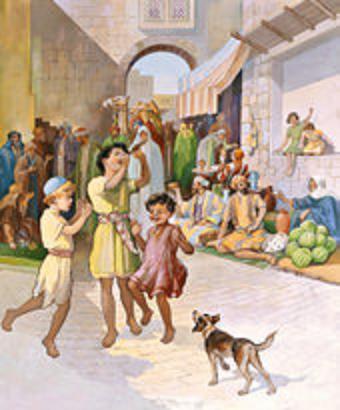
The Gospel reading is from Mt 11:16-19. Today’s passage picks up where yesterday’s left off. And like yesterday, Jesus again says something perplexing. So back to my commentaries for help.

Jesus said to the crowds:
“To what shall I compare this generation?
It is like children who sit in marketplaces and call to one another,
‘We played the flute for you, but you did not dance,
we sang a dirge but you did not mourn.'”
(vv. 16-17)

“‘[A] proverb that alludes to village life in Palestine. According to customs among children, boys invited their companions to dance at weddings and girls sand laments at funerals and invited their friends to mourn. Here, sounding the flute refers to the call of Jesus, who spoke of himself as a bridegroom enjoying the celebration of a wedding feast (9:15). Likewise, the singing of a dirge represents the ascetic witness of John, in particular the fasting he encouraged among his disciples (9:14). And the disagreeable playmates refuse to dance or mourn — these are the crowds that declined both the festive invitation of Jesus as well as the penitential summons of John.” (The Gospel of Matthew [Catholic Commentary on Sacred Scripture], 156)

The refrain “is in the first person plural, as if both of them were engaging in each mode. Once again this stresses the inseparability of the ministries of Jesus and his Forerunner as constituting but one ministry with two modes: lamentation (penance) and exultation (life in the Kingdom).” [To the voices of both men] “most contemporaries gave the same response of utter indifference. Like the children in the comparison, they simply continued sitting idly in the marketplace, whiling away the afternoon and refusing either to “dance” with rejoicing or “beat their breast” in mourning. Sorrow and joy , the deepest emotions known to man and surely the gates of wisdom, are equally closed to them.” (Fire of Mercy, Heart of the Word, Vol. 1, 666)

Certainly these two figures must have presented strikingly different visages to their contemporaries. Yet both are introduced in their ministries by their call to repent. Certainly challenging enough as we are called to sorrow for our past misdeeds and firmly committing to avoid them in the future. Both men forcefully implored their listeners then and throughout the ages to “mourn” for our lack of faithfulness to God, but “dance” for joy in a merciful God who is relentlessly calling us to conversion so that we might be saved.

I am reminded of this stark and graphic line from Revelation:

I know your works; I know that you are neither cold nor hot. I wish you were either cold or hot. So, because you are lukewarm, neither hot nor cold, I will spit you out of my mouth.(Rev 3:15-16)

Lukewarmness leads to rejection by God. Let us not sit idly by as we are presented with the demanding messages of Jesus and John that are a call to action, not only in our own lives, but in how our transformation will impact all with whom we come in contact.

God bless.

Advent Day 12: Violence!

The Gospel reading is from Mt 11:11-15 . Jesus heaps the greatest of praise upon His cousin, John the Baptist. Then Jesus says something that baffles me. I share my research below.

From the days of John the Baptist until now,
the Kingdom of heaven suffers violence,
and the violent are taking it by force.
(v. 12)

“‘What does this mean? In all likelihood, Jesus is talking about the messianic woes of Jewish tradition. Before and during the New Testament period, it was believed that the kingdom of God would make its appearance in the world during a time of intense tribulation. These days would witness savage persecution of the faithful and the apostasy of many. Against this background, ‘violence’ is a reference to the dreadful realities of persecution during the final tribulation, and ‘taking’ means either the plundering of the kingdom of believers by persecutors or the snatching of the kingdom away from those who might be open to embracing it, presumably to those who denounce it (see 23:13)” (The Gospel of Matthew [Catholic Commentary on Sacred Scripture], 155)

“Some interpret the word violence as a reference to asceticism. In this case, it is those who discipline themselves by prayer and fasting who seize hold of the kingdom. From a historical viewpoint, it seems likely that Jesus is referring to the onset of the “messianic woes”. This was the Jewish expectation that the kingdom of God would come during a time of intense tribulation and distress. These days would witness mass apostasy, rampant lawlessness, and a violent persecution of the saints. John the Baptist, executed for his witness to the Messiah (14:10), is the first of the faithful to perish with the arrival of these woeful days. Jesus will suffer the same violence (20:18–19), as will his disciples (10:17–18, 23; 24:9).(Curtis Mitch, “Introduction to the Gospels,” in The Ignatius Catholic Study Bible: The New Testament [San Francisco: Ignatius Press, 2010], 25.0)

“[O]nce John the Baptist announces that the Christ has already come, the powers of hell redouble their desperate assault, which continues right through the lifetime of the Church (cf. Eph 6:12). The situation described here seems to be this: the leaders of the Jewish people and their blind followers, were waiting for the Kingdom of God the way people wait for a rightful legacy to come their way; but while they rest on the laurels of the rights and rewards they thing their race entitles them to, others, the men of violence (literally, attackers) are taking it, as it were, by force, by fighting the enemies of the soul — the world, the flesh and the devil.

“‘This violence is not directed against others. It is a violence used to fight your own weaknesses and miseries, a fortitude, which prevents you from camouflaging your own infidelities, a boldness to own up to the faith even when the environment is hostile’ (Bl. J. Excriva, Christ is passing by, 82).

“This is the attitude of those who fight their passions and do themselves violence, thereby attaining the Kingdom of heaven and becoming one with Christ.” (The Navarre Bible: St. Matthew, 113-114)

“The mysterious formulation…appears to mean that the ‘violence’ or ‘forcefulness’ that God himself is using so as to tear down the barriers that the human heart has erected against the approach of grace must be matched by the decision on the part of individuals to respond just as violently and forcefully in embracing that grace. (Fire of Mercy, Heart of the Word, Vol. I, 660)

“We might understand Jesus’ meaning to be something like the following: John’s baptizing and Jesus’ public ministry mark the first stirrings of God’s reign being established on earth. But God’s reign is meeting resistance; those who are part of the coming of God’s reign experience opposition and violence. John is in prison and will be beheaded (14:3-12); Jesus will also be executed. God’s conquest of evil will be complete only when his reign is as fully established on earth as it is in heaven (6:10).” (Bringing the Gospel of Matthew to Life, 214-215)

Violence has been with us since the first murderer killed his brother, Abel. Violence outside the Church, violence against the Church, violence within the Church, and violence within ourselves. It is only the Prince of Peace that can remedy any and all of these sad realities. With Christmas nearly upon us, it is a most appropriate time to invoke our Lord under that title, as well as His Mother, Our Lady Queen of Peace.

God bless.

Advent Day 7: Help Wanted: Harvesters

TODAY’S READINGS

The Gospel reading is from Mt 9:35–10:1, 5a, 6-8. The verses for our consideration today contain these words of Jesus:

The harvest is abundant but the laborers are few;
so ask the master of the harvest
to send out laborers for his harvest.
(v. 37-38)

“After contemplating the crowds neglected by their shepherds, Jesus uses the image of the harvest to show us that the same crowd is ready to receive the effects of the Redemption: ‘I tell you, lift up your eyes, and see now the fields are already white for harvest’ (Jn 4:35)…In this connexion Paul VI reminds us: ‘the responsibility for spreading the Gospel that saves belongs to everyone — to all those who have received it! The missionary duty concerns the whole body of the Church; in different ways and to different degrees, it is true, but we must all of us be united in carrying out this duty. Now let the conscience of every believer ask himself: Have I carried out my missionary duty? Prayer for the Missions is the first way of fulfilling this duty (Angelus Address, 3 October 1977). (The Navarre Bible: St Matthew, 101)

“Jesus is surely the Worker par excellence whom the Father has sent out. In a real sense there is no other. Unless a man do what Jesus does, as he does it and by virtue of the power that is Jesus’, all human effort and planning are vain daydreams and a useless squandering of energy. Jesus the Worker in the Harvest must, therefore, first communicate to his followers his Heart (his compassion) and his mind (the vision whereby he is able to imagine what he sees in all its deep compelling truth). He invites us to see what he sees as he sees it, and now and then he checks to see if we are still following the logic of his mind and Her by addressing us obliquely: ‘Pray for workers!’ Which is another way of saying: ‘Pray that you yourselves may be transformed into workers!” (Erasmo Leiva-Merikakis, Fire of Mercy, Heart of the Word, Vol. I, 518-519)

The highlighted verses are often invoked in praying for religious vocations — and rightfully so. But both Pope St. Paul VI and Leiva-Merikakis raise awareness to the fact that we are all called to the task of evangelization. We are to prepare ourselves for this mission by prayer, study, reading of Scripture, and above all through a constant conversion of heart that leads to living a radically Christian life — one so radical that others will take notice and long to have what we have.

OUR LADY OF GUADALUPE AND ST. JUAN DIEGO

A great day to ask for Mary’s intercession under the title of Our Lady of Guadalupe and also to invoke poor little Juan Diego. Nearly five hundred years ago, through this nondescript peasant, the Blessed Virgin effected the conversion of millions to the true Faith while the same number of the faithful were being ripped away across the Atlantic through the Protestant Revolt.

Read all about the miracle in Mexico here.

God bless.

The Angelus by Jean-Francois Millet (1857-1859)

Advent Day 5: Lord, Lord!

TODAY’S READINGS

The Gospel reading is from Mt 7:21, 24-27, which closes out the Sermon on the Mount. The key verse contains these words of Jesus:

Not everyone who says to me, ‘Lord, Lord,’
will enter the Kingdom of heaven,
but only the one who does the will of my Father in heaven.
(v. 21)

“To be genuine, prayer must be accompanied by a persevering effort to do God’s will. Similarly, in order to do his will it is not enough to speak about the things of God: there must be a consistency between what one preaches — what one says — and what one does: ‘”‘The kingdom of God does not consist in talk but in power’ (1 Cor 4:20); ‘”‘Be doers of the word, and not hearers only, deceiving yourselves'”‘ (Jas 1:22)…To enter the Kingdom of heaven, to be holy, it is not enough, then, to speak eloquently about holiness. One has to practise what one preaches, to produce fruit which accords with one’s words.” (The Navarre Bible: St Matthew, 84)

“The wishful repetition of the formulaic appeal ‘Lord, Lord!’ here corresponds to the broad and easy way to salvation that in fact leads to perdition. All the hope of such implorers is predicated on the goodwill of the Lord to save them, whereas Jesus says that those will be saved who do God’s goodwill and not merely appeal to it.” (Erasmo Leiva-Merikakis, Fire of Mercy, Heart of the Word. 311)

I can’t conceive how any Christian reading the words in this Gospel passage, particularly considering the emphatic and vivid verses that follow in the reading (inexplicably two verses were excluded that make the message stark and abundantly clear [vv. 22-23]), can possibly espouse “once saved, always saved” or “faith alone” with no works absolutely required. Over and over, Christ emphasizes that what we do here on earth determines our eternal fate (for starters, the sheep and the goats, the wheat and the tares, and the narrow gate and the wide gate). The last example comes just a few verses before today’s reading. The Sermon on the Mount begins with the Beatitudes. It is as if Jesus is providing the capstone to all His teaching in the last three chapters: “Have you been listening? Let me drive it home!”

Peter takes on those who misread Paul, but also those who do the same with the rest of the Bible:

In them there are some things hard to understand that the ignorant and unstable distort to their own destruction, just as they do the other scriptures. (1 Pt 3:16)

Thank God for the Spirit-protected Catholic Church!

SAINT OF THE DAY: AMBROSE

The man who had such an impact on St. Augustine, bringing him into the fullness of the Faith, ultimately giving us one of the greatest theologians of the Christian era. Read him and read all about him here.

PEARL HARBOR DAY

Please pray for the over two thousand Americans who died this day eighty-two years ago on the southern coast of Oahu. Eternal rest grant unto them, O Lord…

God bless.

Advent Day 4: We can get satisfaction!

TODAY’S READINGS

The Gospel reading is from Mt 15:29-37. It ends this way:

They all ate and were satisfied.
They picked up the fragments left over–seven baskets full.
(v. 37)

“It is interesting to note that in both miracles of multiplication of loaves and fish Jesus provides food in abundance but does not allow anything to go to waste. All Jesus’ miracles, in addition to being concrete historical events, are also symbols of supernatural realities. Here abundance of material food also signifies abundance of divine gifts on the level of grace and glory: it refers to spiritual resources and eternal rewards; God gives people more graces than are strictly necessary. This is borne out by Christian experience throughout history. St Paul tells us that ‘where sin increased, grace abounded all the more’ (Rom 5:20); he speaks of ‘the riches of his grace which he lavished upon us’ (Eph 1:8) and tells his disciple Timothy that ‘the grace of our Lord overflowed for me with the faith and love that are in Christ Jesus’ (1 Tim 1:14).” (The Navarre Bible: St Matthew, 148)

It should be difficult for Catholics to not think about the Eucharist with the miracle of the loaves. The insight above reinforces this connection. The ‘supersubstantial‘ bread of the Eucharist presents to us the supernatural gift of grace in superabundance — if we are open and disposed to receive it and digest it.

God bless.

Advent Day 2: We’re not worthy!

TODAY’S READINGS

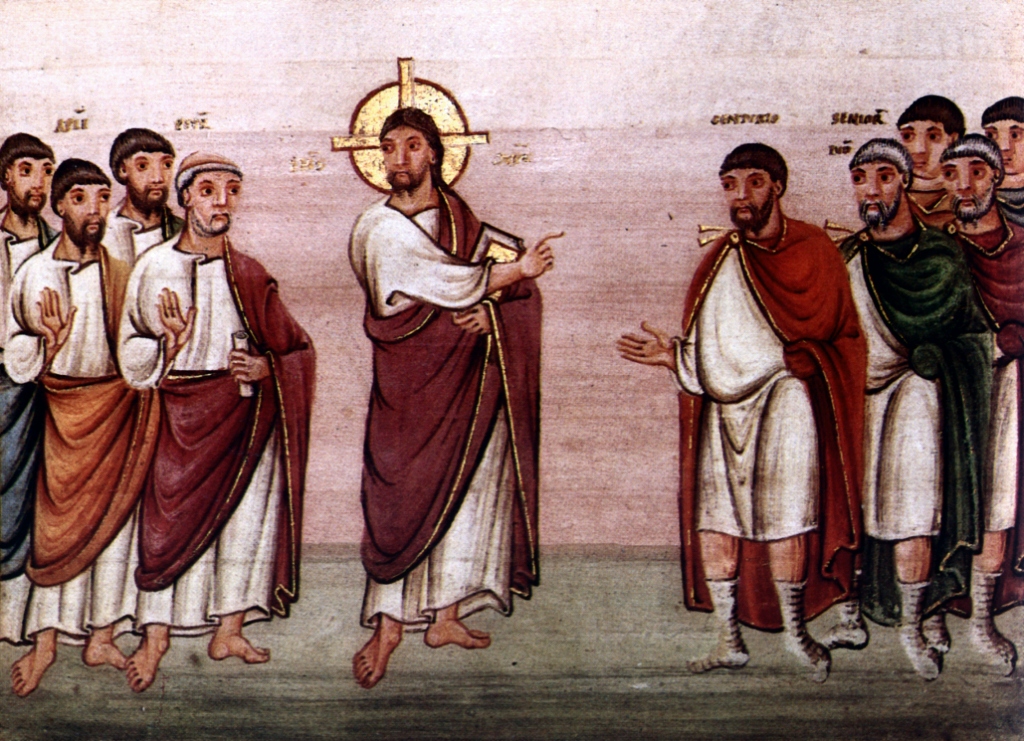
The Gospel is from Mt 8:5-11, the famous passage in which a Roman centurion comes to ask a big favor of Jesus.

Lord, I am not worthy to have you enter under my roof;
only say the word and my servant will be healed.
(v. 8)

“The Jews of this time regarded any Jew who entered a Gentile’s house as contracting legal impurity (cf. Jn 19:28; Acts 11:2-3). This centurion has the deference not to place Jesus in an embarrassing position in the eyes of his fellow Israelites. He shows that he is convinced that Jesus has power over disease and illness; he suggests that if Jesus just says the word, he will do what is needed without having to visit the house; he is reasoning, in a simple, logical way, on the basis of his own professional experience. Jesus avails of this meeting with a Gentile believer to make a solemn prophecy to the effect that his Gospel is addressed to the world at large; all men, of every nation and race, of every age and condition, are called to follow Christ.” (The Navarre Bible: St. Matthew, 88)

“The Son of Man does not have a material resting place. Jesus lays his head instead on the pillow of the centurion’s confession, which has opened wide the doors of his life to the divine presence and activity. The crowds had been listening to Jesus all through the Sermon on the Mount. But this man now offers to Jesus’ ears the balm that alone soothes the stress of all his labor, the response that is the greatest act of thanksgiving possible on the part of man. The Lord does not add a single word to what the centurion says: even the Word cannot improve on those words of faith.” (Leiva-Merikakis, Fire of Mercy, Heart of the Word, Vol. I, 333)

“The centurion who asked Jesus to heal his servant showed great trust in him. To trust is to have hope, to turn one’s heart to God. It means to root one’s life, to ground and center one’s concerns, in God.” (Bp Barron in The Word on Fire Bible: The Gospels, 63)

To close, I would like you to check out my previous posts on this episode, one of very favorites in all of Scripture. Follow the link (and all embedded links and video) below for my past insights:

Also check out its excellent portrayal in Zefferelli’s Jesus of Nazareth.

God bless.

Jesus and the Centurion in Capernaum (Matthew 8:5), miniature, de:Codex Egberti,
Trier, Stadtbibliothek, cod. 24, fol. 22r, detail

Advent Day 1: Watch!

Happy Advent! I’m going to give this a shot again this year. High hopes for working through Advent and Christmas with daily blogs quickly petered out in 2022. Pray that I stay the course this time around — I need it.

TODAY’S READINGS

For these upcoming posts, I plan to use Catholic commentaries and other resources generously to bring light to each day’s readings.

The first reading is from Is 63:16b-17, 19b; 64:2-7.

You, LORD, are our father,
our redeemer you are named forever.
(v. 16b)

“God is rarely addressed this way in the OT, although the appellation occurs three times in this prayer alone…The language of divine paternity in the OT is based on the covenant of kinship that the Lord forged with Israel, his first son.” (Ignatius Catholic Study Bible: Isaiah, 105)

Why do you make us wander, LORD, from your ways,
and harden our hearts so that we do not fear you?
(v. 17a)

“Divine hardening is not an action of God that causes people to sin but a form of judgment in which the Lord allows brazen sinners to defy his will without the restraint of his mercy. This response to sin was first revealed at the time of the Exodus, when god hardened the heart of pharaoh (Ex 9:12; 10:1; 11:10; 14:8). Divine hardening is likewise mentioned in the NT as a spiritual condition of unbelieving Israel that will endure until God’s plan of salvation for the Gentiles is accomplished (Rom 11:25-26). Divine hardening remains a mystery because Scripture also insists on human free choice (Sir 15:11-17) as well as God’s universal desire that all people repent of their sins and be save (1 Tim 2:4; 2 Pet 3:9). Within the broader framework of biblical teaching , then, divine hardening does not override human free will or destroy human responsibility for sin; rather, it is a disciplinary measure \that seeks the conversion of the sinner.” (Ignatius Catholic Study Bible: Isaiah, 105-106)

No ear has ever heard, no eye ever seen, any God but you
doing such deeds for those who wait for him.
(v. 4)

“St. Paul quotes from this verse when writing about the wisdom of God, and his love for those who love him, and the gifts he has in store for man…(1 Cor 2:9). because these gifts will not be fully bestowed until the next life, the verse is often quoted in Christian spirituality to describe the happiness enjoyed in heaven.” (Navarre Bible: Major Prophets, 273)

Finally, a certain line jumped out at me as one frequently used by Protestants against the Catholic understanding of the role and necessity of good works in our lives:

…all our good deeds are like polluted rags… (v. 5a)

Catholic Answers is helpful here: “It does not say that all acts of righteousness are as filthy rags to God, but that those being rendered to him in Isaiah‘s day were…This pertains to a particular historical situation, not to a general condition.” (The whole response is worth reading. Also, check out one of my previous posts.)

The Responsorial Psalm is from Ps 80:2-3, 15-16, 18-19.

The St. Louis Jesuits get a lot of flack in some circles, but I like a lot of their stuff (setting aside whether it is appropriate for Mass or simply for worship). Here is a one of my favorites based on this psalm.

The second reading is from 1 Cor 1:3-9.

I give thanks to my God always on your account
for the grace of God bestowed on you in Christ Jesus…
(v. 4)

Corinth was a pagan town known for all manner of sin and debauchery. About five years earlier Paul established a church there and made significant evangelistic inroads. Hearing rumblings of problems in the Church there, he penned this letter until he could return. Considering all that, these words are a wonderful way to start his letter. Would it be that we would begin all our correspondence this way, even with those persons or situations that challenge us, giving thanks to God in all things, even those that are testing us in order to make us saints.

The Gospel reading is from Mk 13:33-37.

Watch, therefore;
you do not know when the lord of the house is coming,
whether in the evening, or at midnight,
or at cockcrow, or in the morning.
May he not come suddenly and find you sleeping.
(vv. 35-36)

“Jesus is speaking of his sudden and unexpected coming at the end of time, when he will judge his disciples for how they have exercised their authority in the Church. But Mark also links this warning to Jesus’ passion by structuring the passion narrative precisely in terms of these four night watches: evening (Mark 14l17), midnight (implied in 14:32-65_, cockcrow (14:72), and morning (15;1). Jesus warns that he may come suddenly and find them sleeping — which is just what will happen during his agony in Gethsemane (14:37-41). To be asleep signifies spiritual torpor and self-indulgence (Rom 11:9; 1 Thess 5:6-8); to be awake is to be alive in faith (Rm 13:11; Eph 5:14). The trial in Gethsemane is the beginning of the trial that will last throughout the whole age of the Church, in which Jesus’ followers are called to be constantly alert and attentive to the presence of the Lord.” (Catholic Commentary on Sacred Scripture: The Gospel of Mark, 273)

For my part, the following words of Jesus have always been sufficient for me:

But of that day and hour no one knows, neither the angels of heaven, nor the Son,* but the Father alone. (Mt 24:36)

As I heard a wise preacher say once: We don’t know when the last day is coming but we know for sure our last day is coming.

BP BARRON’S SUNDAY SERMON

Always worth a listen: You Can’t Save Yourself

THE WORD OF THE LORD

Worth every penny and more: https://stpaulcenter.com/the-word-of-the-lord/

A great way to take a deep dive into the Sunday readings every week — I try to never miss it. And the companion books are a treasure that will stay on my shelf (I’ve already worked through Year A and Solemnities and Feasts and began Year B today — outstanding!).

ADVENT RESOURCES

ADVENT/CHRISTMAS READING

God bless!