
TODAY’S READINGS
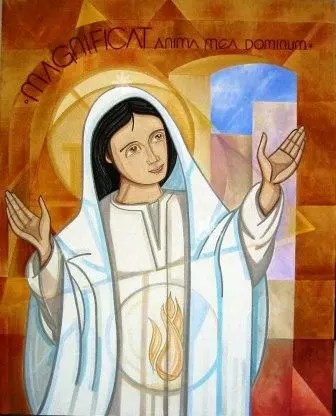
The Gospel reading is from Lk 1:46-56, picking up where we left off yesterday. It is her response to Elizabeth, a response for the ages. I will focus on a particular verse (in fact, just the second part):
[The Lord] has looked upon his lowly servant.
From this day all generations will call me blessed. (v. 48)
“Elizabeth is the first to proclaim Mary blessed because of what God is doing through her and because of her response to God (1:42, 45), but she will not be the last. Mary realizes that ‘from now on will all ages call me blessed.’ Every future generation will look upon Mary as someone specially favored and blessed by God. The words from now on signal a turning point. The conception of Jesus inaugurates a new stage in human and divine history; God has take a decisive step that will affect all ages to come.” (The Gospel of Luke (Catholic Commentary on Sacred Scripture, 33)
“God rewards our Lady’s humility by mankind’s recognition of her greatness: ‘All generations will call me blessed.’ This prophecy is fulfilled every time someone says the Hail Mary, and indeed she is praised on earth continually, without interruption. ’From the earliest times the Blessed Virgin is honoured under the title of Mother of God, under whose protection the faithful take refuge together in prayer in all their perils and needs. Accordingly, following the Council of Ephesus, there was a remarkable growth int the cult of the people of God towards Mary, in veneration and love, in invocation and imitation, according to her own prophetic words: ‘all generations will call me blessed, for he who is mighty has done great things for me'” (Vatican II, Lumen gentium, 66) (The Navarre Bible: The Gospel of Luke, 44)
“Mary…prophesies that ‘all ages’ (literally ‘all generations’) wll pronounce a beatitude by calling here ‘blessed,’ recognizing god’s favor to her, as indeed Elizabeth has just done (Luke 1:45). thus, the person who says ‘Blessed Mary’ or ‘Blessed Virgin Mary’ (see 1:27) is fulfilling the inspired word of Scripture!” (The Gospel of Luke [Catholic Commentary on Sacred Scripture], 52)
This last quote makes a particular impact on me. I will try never to invoke Mary without prefacing that holy name (it means “”) with “Blessed.” The humble, perfect, sinless one, in true humility, acknowledges the favor she has found with God. It has been said, we can never honor Jesus’ mother more than He did (after all who kept all the commandments, including the fourth, better than the Son of God?). But, certainly, the least we can do is honor her in the way she declared she should be invoked.
It saddens me — and how it must sadden the Mother of God — that Blessed Mary is arguably the main point of contention between Catholics and Protestants. The Marian dogmas, so rich, so beautiful, of ancient heritage, and with plenty of scriptural support, are anathema to far too many Christians.
One last note regarding the title of this post. ”Blessed and broken” is not an uncommon Christian theme. Of course we think of Jesus’ food miracles and the Last Supper. And we, who are broken, need Jesus the Divine Carpenter to fix us. In titling this post as I did, I considered Blessed Mary declaring herself blessed about a week into her pregnancy and thenk think of (as she certainly must have) all that she had to look forward to. Many joys, undoubtedly, along with much suffering, particularly as she observed her Son’s ministry culminating in the Cross. But none of these events were going to break her. I never like to see movie scenes in which Blessed Mary is wailing at the foot of the Cross. Pious tradition has her as Stabat Mater, standing firm while her heart (and His) was torn to shreds. (As an aside, here I’m reminded of how Jackie Kennedy was lauded in the dignified way she handled all the events surrounding her husband’s murder.)
May Our Lady of Unity intercede on behalf of this unbelieving world so that her Son’s prayer will be made manifest:
I pray not only for them, but also for those who will believe in me through their word, so that they may all be one, as you, Father, are in me and I in you, that they also may be in us, that the world may believe that you sent me. (Jn 17:20-21)
ON MARY’S PERPETUAL VIRGINITY
I have become a big fan of Shameless Popery, Catholic Answers apologist Joe Heschmeyer’s podcast. His thoroughgoing defense of Mary’s perpetual virginity on scriptural grounds is outstanding. I certainly have heard a number of these explanations previously, but Joe provides many more I had never been exposed to in an interesting, methodical, and devastating (to unbelievers) way. And he does this in the context of the Christmas Story, so it is timely, as well.
God bless.
 Unworthy Servant