Advent Day 8: Straightening up

TODAY’S READINGS

FROM Baruch 5:7 (the full passage is Bar 5:1-9):

God has commanded
that every lofty mountain be made low,
and that the age-old depths and gorges
be filled to level ground

FROM Psalms 126:5 (the full passage is Ps 126:1-2, 2-3, 4-5, 6):

Those who sow in tears
shall reap rejoicing.

From The Navarre Bible: The Psalms and the Song of Solomon, page 422

“[This] simile seems to be built around a popular proverb. ‘The pain of suffering gives rise to holy tears. But the time of weeping is also the time of sowing, because the works of charity that are performed to ease the burden of men’s sins are the seeds of eternal happiness’ (Prosper of Aquitaine, Expositio Psalmorum, 125, 6).”

FROM Philippians 1:4-5 (the full passage is Phil 1:4-6, 8-11)

I pray always with joy in my every prayer for all of you,
because of your partnership for the gospel

From Catholic Commentary on Sacred Scripture: Philippians, Colossians, Philemon, pages 75-76

“‘your partnership for the gospel’: That phrase may seem at first to refer simply to their common faith in the gospel. But for Paul the partnership is more concrete and practical than that. As Paul uses the word, ‘gospel’ can sometimes mean the message of the good news itself (God has definitely entered into history to save us through the death and resurrection of his Son), but at other times ‘gospel’ means the project of sharing that good news. Here, the ‘partnership in the gospel’ for which Paul is grateful seems to refer especially to the financial aid that the Philippians have sent to him through Epaphroditus (see 4:10-20). This aid in partnership in the sense that it is a real contribution to the advance of the gospel.”

FROM Luke 3:4b-5 (the full passage is Lk 3:1-6)

 Every valley shall be filled
        and every mountain and hill shall be made low.
    The winding roads shall be made straight,
        and the rough ways made smooth

From The Word of the Lord (Year C), page 18

“‘Every valley shall be filled’ refers to hope, encouragement, and new life being granted to the poor, the oppressed, the lowly — people who fell they have been forgotten by God or are not worthy of God’s attention.
“‘Every mountain and hill shall be made low’ refers to the humbling of the proud, the repentance that the strong and arrogant must undergo in order to receive God’s salvation.
“The ‘winding roads’ and ‘rough ways’ refer to the twists and turns of the human heart, contorted by sin (Jer 19:9). The human heart needs to be ‘simplified’ or ‘straightened’ by honest and truthful confession of sin.”

MY TAKE

Not only is John the Baptist’s message echoed in Isaiah (Is 40:35), but also in Jeremiah’s scribe, Baruch, as seen in today’s first reading. I can do nothing to improve on Dr. Bergsma’s reflection above in his The Word of the Lord series (a must have — I’m working through the last of the four volumes, as I did the first three, this year), but I will add a thought that came to me as I heard the Gospel proclaimed at Mass.

“Mountains made low” certainly evokes images of the proud being “put in their place.” So, then, if the lofty peak represents the proud, maybe those in a deep valley are folks who are mired in sin and despairing of salvation. The only way out is up and it’s a struggle that may seem overwhelming (or impossible) to undertake. And how easy it is to get to the bottom! I’m a bicyclist so it is impressed upon me what an easy journey it is when going down hill and what a challenge it is to go back up that same hill. Sin can be that way for us, as well. Our transgressions may start out small, but the slippery slope is there to carry us rapidly down if we are not careful and vigilant. Sometimes it is only when a person in the throes of sin or addiction hits “rock bottom” that he comes to his senses and makes the decision to climb out of the abyss. Can we not say that what was “sowed in tears” (the descent into the darkness of sin) can ultimately lead to “rejoicing in the reaping” (in ascending to righteousness)?

Finally, a word on the second reading. By virtue of our Baptism, we are partners in sharing the Gospel. We should do so in word and action at all times. But, as the Catholic Commentary lays out, we should also support ministries, as Paul’s followers did for him, that authentically and faithfully get out the Word. Some of my favorites are my home parish, the St Paul Center, Catholic Answers, and EWTN.

BP BARRON SERMON

FR MIKE SCHMITZ HOMILY

Hurricane Ridge in Olympic National Park

God bless!

Advent Day 6: I see (or do I?)

TODAY’S GOSPEL READING (Mt 9:27-31)

From Matthew 9:28-29:

When he entered the house,
the blind men approached him and Jesus said to them,
“Do you believe that I can do this?”
“Yes, Lord,” they said to him.
Then he touched their eyes and said,
“Let it be done for you according to your faith.”

From Opening the Scriptures: Bringing the Gospel of Matthew to Life, page 175:

“The men want to be able to see and Jesus knows that this is what they want. He asks them whether they believe he can do this. This is the only time in Matthew’s gospel (or in any gospel) that Jesus asks anyone whether they believe that he is able to heal them. ‘”Yes, Lord,” they said to him.’ Calling Jesus ‘Lord” is an acknowledgment of his authority and power to give them sight. Their faith has been demonstrated by their following Jesus and crying out to him, even though he seemed to ignore them.”

From Catholic Commentary on Sacred Scripture: The Gospel of Matthew, page 137:

“[The blind men] call Jesus Son of David — the first time someone addresses him with the royal title that has messianic overtones. ‘Son of David’ also brings to mind David’s heir, King Solomon, who was known in Jewish tradition as a great healer and exorcist.”

From Fire of Mercy, Heart of the Word (Volume I), pages 493-494:

“In the end, this faith [of the blind men] proves to be omnipotent, because it is a whole-hearted embracing of the full reality of the presence of the incarnate Word. Faith rejoices in a natural blindness that is the precondition for the vision of God….Our own native lights need to be extinguished if Jesus is to light his lamp in our souls….Whatever empties itself out of itself in order to receive omnipotence, itself becomes omnipotent, just as only total darkness can receive the uncreated Light (St. John of the Cross, Dark Night of the Soul)….The blind men set no condition to God but rather open themselves up wholly and actively to the divine action.”

My take

Amen, I say to you, if you have faith the size of a mustard seed, you will say to this mountain, ‘Move from here to there,’ and it will move. Nothing will be impossible for you. (Mt 17:20)

Jesus’ words to the blind men in today’s Gospel and His words above, further along in the same Gospel, should be a wake-up call to us, encouraging driving us to deep prayer and contemplation. What can Jesus not do if we place ourselves totally in His hands? Jesus can do any good thing. It is we who dampen or even short-circuit His healing power.

I have for months now been reading, as a spiritual exercise, Abandonment to Divine Providence by Jean-Pierre de Caussade. At first, the radical nature of the good Father’s advice took me aback (and sometimes still does, over 300 pages in). But his admonition to give up our own will and self-concern in favor of whatever the Lord ordains or permits for us, makes total sense. What peace we would have if we simply, “Let go and let God,” as the popular saying goes. Emptying out ourselves, as Father Simeon says in Fire of Mercy, allows in God.

What if we “set no condition to God but rather open [our]selves up wholly and actively to the divine action”? What a radical difference that would make! Lord, make me blind to worldly concerns so that I can be open to truly seeing You.

ADVENT RESOURCES

ADVENT/CHRISTMAS READING

Jesus Healing Two Blind Men (undated) by Patriarchate of Peć by School Serbian

God bless!

Lent Day 37: “I AM”

TODAY’S READINGS

Today’s Gospel reading (Jn 8:51-59) continues Jesus dialogue with the Jewish religious leaders. Jesus makes a startling claim to the Jews inquiry:

“So the Jews said to him…
‘Who do you make yourself out to be?”
Jesus answered,…“Amen, amen, I say to you,
before Abraham came to be, I AM.”
(v. 53b-54a, 58)

“Jesus takes for himself the divine name of Yahweh, ‘I AM’ (Ex 3:14). He thus claims to be one with God (10:30), whose life in eternity has neither beginning nor end. The Pharisees hear this claim loud and clear and, thinking it outrageous, stand ready to stone him for blasphemy (8:59; Lev 24:16) (CCC 590).” (The Gospel of John [Ignatius Catholic Study Bible], 36)

Jesus makes no bones about who He is. It eventually gets Him killed. But He backs up His claim by raising Himself from the dead proving that He is God, having the power over life and death.

Check out this article that does a fine job of running through the many times Jesus uses “I am” to refer to Himself. We hearken back to the burning bush episode (Ex 3) when Moses asks the name of the voice of his interlocutor emanating from this wondrous site.

Are you a believer? I am.

God bless.

Lent Day 31: Obnoxious Jesus

TODAY’S READINGS

Today’s first reading (Wis 2:1a, 12-22) gives us a striking prophecy of the ultimate and perfect “just one,” Jesus Christ. It begins with these troubling words:

“Let us beset the just one, because he is obnoxious to us;
he sets himself against our doings,
Reproaches us for transgressions of the law
and charges us with violations of our training.”
(v. 12)

“The reasoning of the ungodly has progressed from a reflection of the finality of death, to an embrace of hedonism, to a rejection of the weak, and now finally to active persecution of the righteous man precisely because of his righteousness. He is inconvenient because he opposes, reproaches, and accuses the wayward for their sins. While the author is not drawing a direct line of connection, one cannot avoid thinking of the biblical prophets here. Isaiah, Jeremiah, and the other prophets consistently rebuke the nation for their disobedience to God’s law and their straying from his ways. Here, Wisdom highlights two types of moral error: ‘sins against the law’ and ‘sins against our training,’ which perfectly match the priorities of Hellenistic Judaism. On the one hand, ‘sins against the law’ refers to transgressions of the law of Moses, the ancient ancestral law of the Jews. On the other hand, ‘sins against out training [paideia]’ refers to rejecting the lessons learned in the context of family and, more precisely, Greek education. The erring ones have strayed from both the Jewish ideal of law observance and from the Greek educational idea of paideia.” (Wisdom of Solomon [Catholic Commentary on Sacred Scripture], 45)

“Their words are echoed in the insults offered by the scribes and Pharisees to Jesus when he was on the cross (cf. Mt 27:40-43; Mk 15:31-32; Lk 23:35-37). (The Navarre Bible: Wisdom Books , 312)

I immediately think how Jesus is found so “obnoxious” to so many today (even self-proclaimed Christians, including Catholics — some in very high positions in society). The Word of God, who is Jesus, is ignored, spurned, or even deemed “hate speech” when it (He) goes against the “enlightened” “progress” we have purportedly made now well into the twenty-first century. And Scripture says:

“[I]f the light in you is darkness, how great will the darkness be.” (Mt 6:23)

The devil is the black light. We surely can know that when a culture of death predominates and every manner of perversion is hailed as good and proper and normal that the prince of this world is delighting in his influence over weak and stupid mortals.

Let us all work to exorcise Satan and his minions by standing up for the Truth no matter the cost and, above all, praying to Jesus through Mary for deliverance from this pervasive and growing evil. We were promised by the Lord from the very beginning of their ultimate triumph:

“I will put enmity between you and the woman,
and between your offspring and hers;
They will strike at your head,
while you strike at their heel.
” (Gen 3:15)

May it occur soon. Thy kingdom come!

NEW BOOK IN THE CATHOLIC COMMENTARY ON SACRED SCRIPTURE SERIES!

I’m excited to quote above from the first entry in the Old Testament series from the Catholic Commentary on Sacred Scripture series. Check it out!

God bless.

Lent Day 14: Call no man father?

TODAY’S READINGS

In today’s Gospel (Mt 23:1-12), as Jesus death approaches, He really lays into the scribes and Pharisees. One verse that has caused controversy since the Protestant Revolt:

“Call no one on earth your father;
you have but one Father in heaven.”
(v. 9)

“Jesus is stressing that humility is essential for the ministry, lest those who area placed in authority over others think of themselves as superiors rather than servants. No one, after all can compare to the ‘Father’ in heaven…The disciples of Jesus will share in the mission of the Father..through their commission to teach the gospel (28:19-20), but theirs is a derivative participation in something divine. Hence, the title[] in questions appl[ies] absolutely only to the Lord.” (The Gospel of Matthew [Catholic Commentary on Sacred Scripture], 292)

“Jesus uses hyperbole to post a warning that no one should pridefully desire honorific titles. His words are not meant literally. The NT writers elsewhere use father for natural fathers (Heb 12:7–11) and spiritual fathers in the Church (1 Cor 4:15; Philem 10). ● The spiritual fatherhood of New Covenant priests is an extension of its application to Old Covenant priests (Judg 17:10; 18:19).” (Ignatius Catholic Study Bible: The Gospel of Matthew, 57)

Understood properly, using the Bible itself (not to mention Tradition), there can be no question that using “Father” to address our biological fathers and our priests, All these men must acknowledge they are not God — not even close. But, to the extent they emulate the first person of the Trinity, they are true Fathers.

Check here and here on one my favorite Catholic resources, that provides an apologetic for calling certain men “Father.” St. Paul Center (another of my fave organizations) helps with this question here.

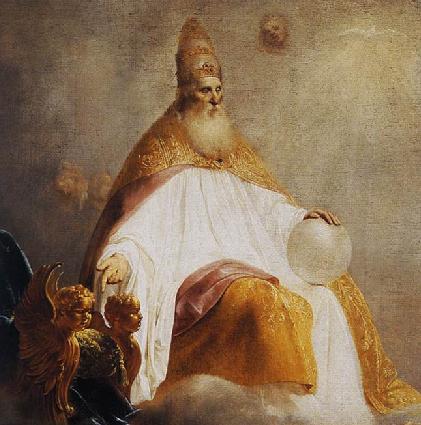
Depiction of God the Father (detail) (1654) by Pieter de Grebber

God bless.

Lent Day 3: Fasting and mourning

TODAY’S READINGS

Matthew’s Gospel (Mt 9:14-15) ends on a somber note from Jesus:

The days will come when the bridegroom is taken away from them,
and then they will fast.
” (v. 15b)

“Similar OT imagery depicts Yahweh as the husband of Old Covenant Israel (Is 54:5; Jer 3:20; Hos 2:14–20). Jesus takes this role upon himself and is now the divine spouse of the New Covenant Church (Jn 3:29; Eph 5:25; Rev 19:7–9; CCC 796).” (The Gospel of Matthew [The Ignatius Catholic Study Bible], 32)

“Jesus describes himself as a bridegroom, thus applying to himself an Old Testament image for God in his relationship to Israel (Isa 62:4-5). A wedding feast is a very joyous occasion, and the mournful tone of fasting would not be fitting as long as the bridegroom is with them. Christ’s disciples will fast, when the bridegroom is taken away from them. This is Christ’s first hint of his passion, echoing Isa 53:8. (The Gospel of Matthew [Catholic Commentary on Sacred Scripture], 135)

“The risen Jesus will assure his disciples that he will always be with them (Mt 28:20), but not visibly present in bodily form. Fasting was inappropriate during his public ministry, but fasting will be adopted as an ongoing practice by the early church (see Acts 13;:2-3; 14:23). The Didache will advise Christians to fast on Wednesdays and Fridays (Didache 8:1).” (Bringing the Gospel of Matthew to Life, 168)

It is unsurprising that fasting comes up as an early theme during Lent. Jesus went away for a short time (three days in the tomb), came back for a short time (for forty days after the Resurrection), and then ascended to heaven. It is rightly pointed out above that Jesus promised to be always with us, and He is no more so really present, than in the Eucharist (see my reminder below). Yet, fasting as a spiritual discipline remains. (For a deep dive, check out the always reliable 1913 Catholic Encyclopedia.) Certainly Ash Wednesday and Good Friday, but consider missing meals more often. Jesus used this discipline for forty days while preparing to begin His public ministry. So, we should consider doing the same when some major life change is about to occur. But, also, skipping a meal here and there for a particular intention is laudable. Our hunger pangs serve to remind us of the cause, help us to appreciate the bounty we have while empathizing (however briefly) with the less fortunate, and move us along in the area of detachment from the goods of this mortal coil, thus drawing us closer to the Almighty.

One thing we don’t want to fast from is the Eucharist, though. This the Lord would be happy to have us consume more frequently, even daily, if possible.

VIDEOS WORTH CHECKING OUT

REMINDER

My daily ten-minute Eucharist for Lent vidcasts continue today, where we explore the CCC on the Eucharist as “the source and summit of the Christian life” (LG 11).

Christ in the Desert (1872) by Ivan Kramskoi

God bless.

Advent Day 20: Blessed and never broken

TODAY’S READINGS

The Gospel reading is from Lk 1:46-56, picking up where we left off yesterday. It is her response to Elizabeth, a response for the ages. I will focus on a particular verse (in fact, just the second part):

[The Lord] has looked upon his lowly servant.
From this day all generations will call me blessed.
(v. 48)

“Elizabeth is the first to proclaim Mary blessed because of what God is doing through her and because of her response to God (1:42, 45), but she will not be the last. Mary realizes that ‘from now on will all ages call me blessed.’ Every future generation will look upon Mary as someone specially favored and blessed by God. The words from now on signal a turning point. The conception of Jesus inaugurates a new stage in human and divine history; God has take a decisive step that will affect all ages to come.” (The Gospel of Luke (Catholic Commentary on Sacred Scripture, 33)

“God rewards our Lady’s humility by mankind’s recognition of her greatness: ‘All generations will call me blessed.’ This prophecy is fulfilled every time someone says the Hail Mary, and indeed she is praised on earth continually, without interruption. ’From the earliest times the Blessed Virgin is honoured under the title of Mother of God, under whose protection the faithful take refuge together in prayer in all their perils and needs. Accordingly, following the Council of Ephesus, there was a remarkable growth int the cult of the people of God towards Mary, in veneration and love, in invocation and imitation, according to her own prophetic words: ‘all generations will call me blessed, for he who is mighty has done great things for me'” (Vatican II, Lumen gentium, 66) (The Navarre Bible: The Gospel of Luke, 44)

“Mary…prophesies that ‘all ages’ (literally ‘all generations’) wll pronounce a beatitude by calling here ‘blessed,’ recognizing god’s favor to her, as indeed Elizabeth has just done (Luke 1:45). thus, the person who says ‘Blessed Mary’ or ‘Blessed Virgin Mary’ (see 1:27) is fulfilling the inspired word of Scripture!” (The Gospel of Luke [Catholic Commentary on Sacred Scripture], 52)

This last quote makes a particular impact on me. I will try never to invoke Mary without prefacing that holy name (it means “”) with “Blessed.” The humble, perfect, sinless one, in true humility, acknowledges the favor she has found with God. It has been said, we can never honor Jesus’ mother more than He did (after all who kept all the commandments, including the fourth, better than the Son of God?). But, certainly, the least we can do is honor her in the way she declared she should be invoked.

It saddens me — and how it must sadden the Mother of God — that Blessed Mary is arguably the main point of contention between Catholics and Protestants. The Marian dogmas, so rich, so beautiful, of ancient heritage, and with plenty of scriptural support, are anathema to far too many Christians. 

One last note regarding the title of this post. ”Blessed and broken” is not an uncommon Christian theme. Of course we think of Jesus’ food miracles and the Last Supper. And we, who are broken, need Jesus the Divine Carpenter to fix us. In titling this post as I did, I considered Blessed Mary declaring herself blessed about a week into her pregnancy and thenk think of (as she certainly must have) all that she had to look forward to. Many joys, undoubtedly, along with much suffering, particularly as she observed her Son’s ministry culminating in the Cross. But none of these events were going to break her. I never like to see movie scenes in which Blessed Mary is wailing at the foot of the Cross. Pious tradition has her as Stabat Mater, standing firm while her heart (and His) was torn to shreds. (As an aside, here I’m reminded of how Jackie Kennedy was lauded in the dignified way she handled all the events surrounding her husband’s murder.)

May Our Lady of Unity intercede on behalf of this unbelieving world so that her Son’s prayer will be made manifest:

I pray not only for them, but also for those who will believe in me through their word, so that they may all be one, as you, Father, are in me and I in you, that they also may be in us, that the world may believe that you sent me. (Jn 17:20-21)

ON MARY’S PERPETUAL VIRGINITY

I have become a big fan of Shameless Popery, Catholic Answers apologist Joe Heschmeyer’s podcast. His thoroughgoing defense of Mary’s perpetual virginity on scriptural grounds is outstanding. I certainly have heard a number of these explanations previously, but Joe provides many more I had never been exposed to in an interesting, methodical, and devastating (to unbelievers) way. And he does this in the context of the Christmas Story, so it is timely, as well.

God bless.

Advent Day 1: Watch!

Happy Advent! I’m going to give this a shot again this year. High hopes for working through Advent and Christmas with daily blogs quickly petered out in 2022. Pray that I stay the course this time around — I need it.

TODAY’S READINGS

For these upcoming posts, I plan to use Catholic commentaries and other resources generously to bring light to each day’s readings.

The first reading is from Is 63:16b-17, 19b; 64:2-7.

You, LORD, are our father,
our redeemer you are named forever.
(v. 16b)

“God is rarely addressed this way in the OT, although the appellation occurs three times in this prayer alone…The language of divine paternity in the OT is based on the covenant of kinship that the Lord forged with Israel, his first son.” (Ignatius Catholic Study Bible: Isaiah, 105)

Why do you make us wander, LORD, from your ways,
and harden our hearts so that we do not fear you?
(v. 17a)

“Divine hardening is not an action of God that causes people to sin but a form of judgment in which the Lord allows brazen sinners to defy his will without the restraint of his mercy. This response to sin was first revealed at the time of the Exodus, when god hardened the heart of pharaoh (Ex 9:12; 10:1; 11:10; 14:8). Divine hardening is likewise mentioned in the NT as a spiritual condition of unbelieving Israel that will endure until God’s plan of salvation for the Gentiles is accomplished (Rom 11:25-26). Divine hardening remains a mystery because Scripture also insists on human free choice (Sir 15:11-17) as well as God’s universal desire that all people repent of their sins and be save (1 Tim 2:4; 2 Pet 3:9). Within the broader framework of biblical teaching , then, divine hardening does not override human free will or destroy human responsibility for sin; rather, it is a disciplinary measure \that seeks the conversion of the sinner.” (Ignatius Catholic Study Bible: Isaiah, 105-106)

No ear has ever heard, no eye ever seen, any God but you
doing such deeds for those who wait for him.
(v. 4)

“St. Paul quotes from this verse when writing about the wisdom of God, and his love for those who love him, and the gifts he has in store for man…(1 Cor 2:9). because these gifts will not be fully bestowed until the next life, the verse is often quoted in Christian spirituality to describe the happiness enjoyed in heaven.” (Navarre Bible: Major Prophets, 273)

Finally, a certain line jumped out at me as one frequently used by Protestants against the Catholic understanding of the role and necessity of good works in our lives:

…all our good deeds are like polluted rags… (v. 5a)

Catholic Answers is helpful here: “It does not say that all acts of righteousness are as filthy rags to God, but that those being rendered to him in Isaiah‘s day were…This pertains to a particular historical situation, not to a general condition.” (The whole response is worth reading. Also, check out one of my previous posts.)

The Responsorial Psalm is from Ps 80:2-3, 15-16, 18-19.

The St. Louis Jesuits get a lot of flack in some circles, but I like a lot of their stuff (setting aside whether it is appropriate for Mass or simply for worship). Here is a one of my favorites based on this psalm.

The second reading is from 1 Cor 1:3-9.

I give thanks to my God always on your account
for the grace of God bestowed on you in Christ Jesus…
(v. 4)

Corinth was a pagan town known for all manner of sin and debauchery. About five years earlier Paul established a church there and made significant evangelistic inroads. Hearing rumblings of problems in the Church there, he penned this letter until he could return. Considering all that, these words are a wonderful way to start his letter. Would it be that we would begin all our correspondence this way, even with those persons or situations that challenge us, giving thanks to God in all things, even those that are testing us in order to make us saints.

The Gospel reading is from Mk 13:33-37.

Watch, therefore;
you do not know when the lord of the house is coming,
whether in the evening, or at midnight,
or at cockcrow, or in the morning.
May he not come suddenly and find you sleeping.
(vv. 35-36)

“Jesus is speaking of his sudden and unexpected coming at the end of time, when he will judge his disciples for how they have exercised their authority in the Church. But Mark also links this warning to Jesus’ passion by structuring the passion narrative precisely in terms of these four night watches: evening (Mark 14l17), midnight (implied in 14:32-65_, cockcrow (14:72), and morning (15;1). Jesus warns that he may come suddenly and find them sleeping — which is just what will happen during his agony in Gethsemane (14:37-41). To be asleep signifies spiritual torpor and self-indulgence (Rom 11:9; 1 Thess 5:6-8); to be awake is to be alive in faith (Rm 13:11; Eph 5:14). The trial in Gethsemane is the beginning of the trial that will last throughout the whole age of the Church, in which Jesus’ followers are called to be constantly alert and attentive to the presence of the Lord.” (Catholic Commentary on Sacred Scripture: The Gospel of Mark, 273)

For my part, the following words of Jesus have always been sufficient for me:

But of that day and hour no one knows, neither the angels of heaven, nor the Son,* but the Father alone. (Mt 24:36)

As I heard a wise preacher say once: We don’t know when the last day is coming but we know for sure our last day is coming.

BP BARRON’S SUNDAY SERMON

Always worth a listen: You Can’t Save Yourself

THE WORD OF THE LORD

Worth every penny and more: https://stpaulcenter.com/the-word-of-the-lord/

A great way to take a deep dive into the Sunday readings every week — I try to never miss it. And the companion books are a treasure that will stay on my shelf (I’ve already worked through Year A and Solemnities and Feasts and began Year B today — outstanding!).

ADVENT RESOURCES

ADVENT/CHRISTMAS READING

God bless!