Lent Day 13: To judge, or not to judge

TODAY’S READINGS

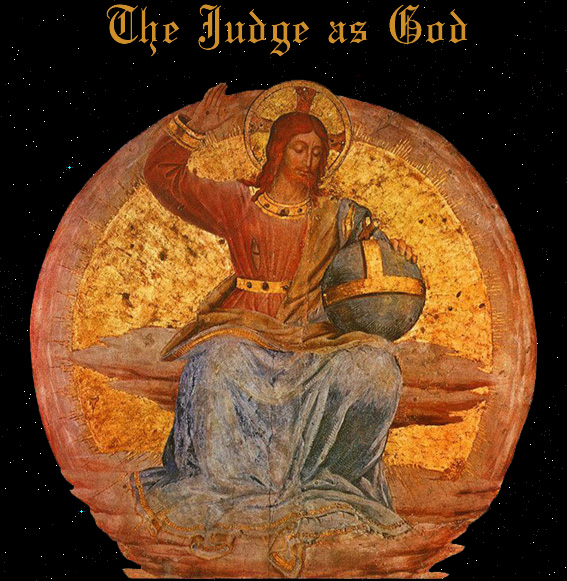
Today’s Gospel (Lk 6:36-38) contains a line that has become quite controversial in the past ten years or so:

“Stop judging and you will not be judged.” (v. 37a)

“The Greek word for judging can mean…to condemn (it is translated ‘condemn’ at 19:22), and what follows indicates that’s its meaning here. God is kind to the wicked (6:35), and disciples of Jesus are to imitate God’s mercy (verse 36) by not being judgmental fault-finders. Jesus tells his disciples that if they do not judge others, ‘you will not be judged’ — judged by God. Jesus does not mean that his disciples will be exempt from the final judgment (referred to at 10:14,; 11:31-320; he means that if they refrain from condemning others, then God will be lenient with them.” (Bringing the Gospel of Luke to Life, 179-80)

We are not to judge the hearts of others — leave that up to God. So, it is wise to attribute the best possible motives, no matter how implausible, to others’ actions. But, this does not mean we cannot make rational judgments about behavior. This we have an obligation today out of love and to avoid scandalizing others.

An excellent resource to hash this out is Ted Sri’s book, Who Am I to Judge? (a video is here). God’s moral law is not to be subject to relativism, lest it continue on its way to dictatorship.

God bless.

Lent Day 9: Rock solid

TODAY’S READINGS

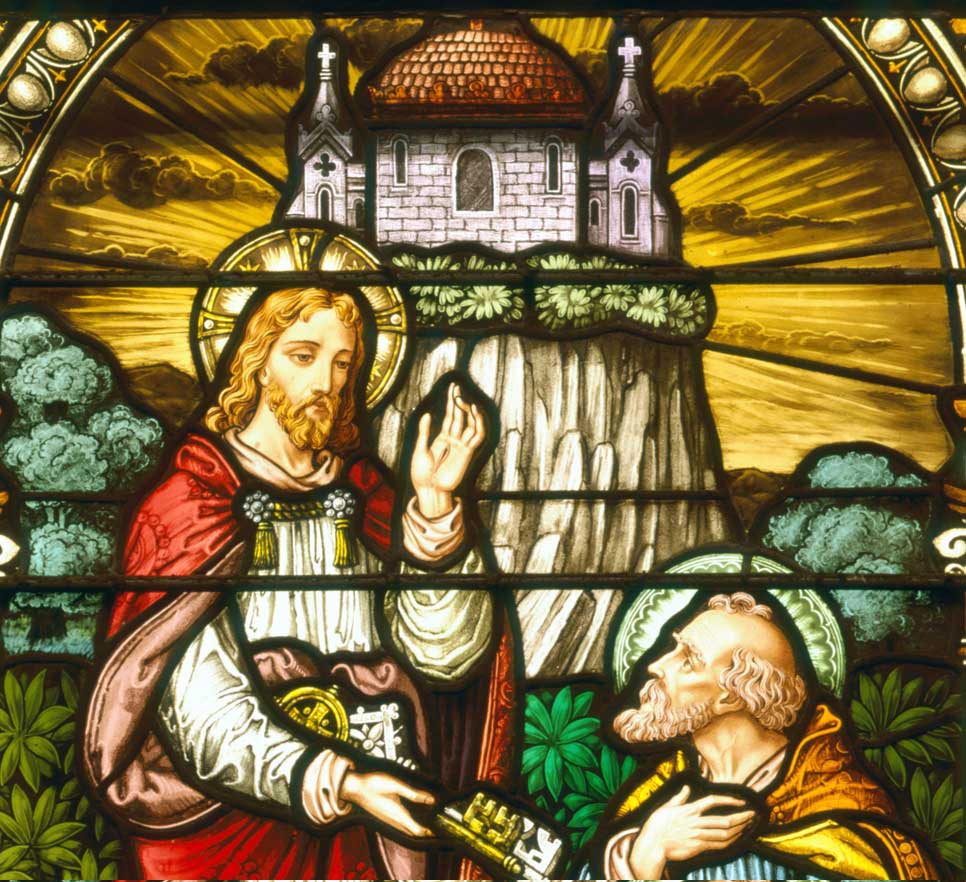
From today’s Gospel (Mt 16:13-19), we celebrate the Feast of the Chair of St. Peter with, what else but, Matthew 16.

“And so I say to you, you are Peter,
and upon this rock I will build my Church,
and the gates of the netherworld shall not prevail against it.”
(v. 18)

I will build: Jesus portrays the Church as a spiritual Temple (cf. 1 Cor 3:16–17; 2 Cor 6:16; Eph 2:19–22; 1 Pet 2:4–8). ● As Solomon was the son of David and the anointed Temple builder in the OT, so Jesus is the Davidic “Son” of God (16:16) and the anointed Messiah who builds the Church in the New. Jesus elsewhere sees himself as both similar and superior to King Solomon (12:42). See note on Mt 7:24. my Church: Among the Gospels, Matthew alone uses the word Church (18:17). The word is used often in the Greek OT for the “congregation” or “assembly” of Israel united to God. Jesus uses it in a similar way for the New Covenant community. the gates of Hades: In the OT, Hades—also called “Sheol” or “the Pit”—is the place of the dead where souls descend through its gates (Ps 9:13, 17; Wis 16:13; Is 38:10; Jon 2:2). It is not hell, but a temporary realm where souls are detained until the Last Judgment (Rev 20:13–15). By extension, Hades is also the habitation of evil forces that bring about death and deception (Rev 6:8; 20:1–3). According to Jewish tradition, the foundation stone (Heb.‘eben shetiyyah) of the Jerusalem Temple capped off and sealed a long shaft leading down to the netherworld (Rev 9:1–2; 20:1–3). The Temple, resting securely on a rock, was thus the center of the cosmos, the junction between heaven and Hades. Drawing from this background, Jesus guarantees that the powers of death and deception will not overcome the Church—i.e., the new Temple built on Peter. He enables Peter (and his successors) to hold error at bay and faithfully proclaim the gospel (CCC 552).” (The Ignatius Catholic Study Bible: The New Testament, 36.)

“The Lord made Simon alone, whom he named Peter, the “rock” of his Church. He gave him the keys of his Church and instituted him shepherd of the whole flock. “The office of binding and loosing which was given to Peter was also assigned to the college of apostles united to its head.” This pastoral office of Peter and the other apostles belongs to the Church’s very foundation and is continued by the bishops under the primacy of the Pope.” (CCC 881)

“In the symbolism of Israel’s theology, the gates of the netherworld were the opening leading down to Hades, also called Sheol, or the Pit, which was the dark and gloomy underworld hidden deep within the bowels of the earth. There the souls of the dead sank down into a shadowy, joyless existence. There also, in Jewish thinking, was the habitation of infernal powers that bring death and deception into the world of the living (see Rev 9:1-6; 11:7; 20:1-3). Later, rabbinic Judaism believed that the foundation stone of the temple capped off the shaft leading down to the underworld. Peter is now given a comparable role in the living temple built by the Messiah. Thanks to the blessing of Jesus on Peter, now made the rock of the new temple, neither death, nor the devil, nor his deceiving spirits shall prevail against the Church.” (The Gospel of Matthew [Catholic Commentary on Sacred Scripture], 208-09)

Thanks be to God for the Rock that our faith can stand firm on. No matter how “rocky” things seem to get in our world or even in our Church, we can be confident that the Church is indefectibly holy because of its head (Christ) and its soul (the Holy Spirit). Hell has no chance. The Church cannot err on matters of faith and morals, so regardless of whatever happens or whatever we hear that concerns us, we can be assured that the age-old teaching of the Church does not waver — so neither should we waver. Jesus promised to stay with us till the end of time and He keeps His promises (and if he wants to hurry back there’ll be no complaints from me).

God bless.

Christmas Day 13 (Bonus!): Christus Victor!

TODAY’S READINGS

While today, January 6, is traditionally Epiphany, since that feast has been moved to Sunday, we get an extra day of the Christmas Season. The first reading is from 1 Jn 5:5-13. This first letter from the beloved disciple is so rich and powerful, it has been a wonderful companion during much of this joyous season.

Who indeed is the victor over the world
but the one who believes that Jesus is the Son of God?
(v. 5)

“This is another case of Johannine shorthand: by ‘faith’ and ‘believes’ John sums up all that comes through this faith — confession of Jesus as the true Son of God, abiding in Christ, the life and witness of the Spirit within, and the power of God through our fellowship with him. It is by our faith that we are enabled to overcome the disordered desires of the world, to proclaim the gospel, to endure persecution, to love our enemies, even to change the world. As Rev 12:11 says, ‘They conquered him by the blood of the Lamb / and by the word of their testimony; / love for life did not deter them from death.” (James, First, Second, and Third John [Catholic Commentary on Sacred Scripture], 226)

Powerful stuff, huh? ”Victor over the world”? The devil’s playground? Yes, we have victory if we believe, and by that is meant not simply faith but faith working through love. Note the commentary above regarding what needs to be done (for starters): overcoming disordered desires, proclaiming the Gospel (through word and deed), enduring persecution, and loving our enemies. Would not we be looking at a very different planet if these traits were overwhelmingly predominant? There are plenty of self-help books on the market, but there is only one Word we need in order to change the world — beginning by changing ourselves.

Christ has conquered the world, the flesh, and the devil through His life, death, Resurrection, and Ascension. He invites us to join Him in taking up our cross to make a difference here and to ultimately inherit eternal life (hopefully bringing many souls with us — see Lk 15:7).

Just a quick note on the last line of the Gospel reading, in which God the Father speaks to God the Son from the heavens upon the latter’s baptism:

“You are my beloved Son; with you I am well pleased.” (Mk 1:11)

All of us who are baptized are children of God. Made, not begotten, it’s true, but really brothers and sisters in Christ. Would not we all love to hear these words from the Father, much less our earthly fathers? Would we actually hear these words based on the state of our lives right now? Maybe for some things and not for others? What is lacking? Worth pondering deeply every day before our judgment day.

God bless.

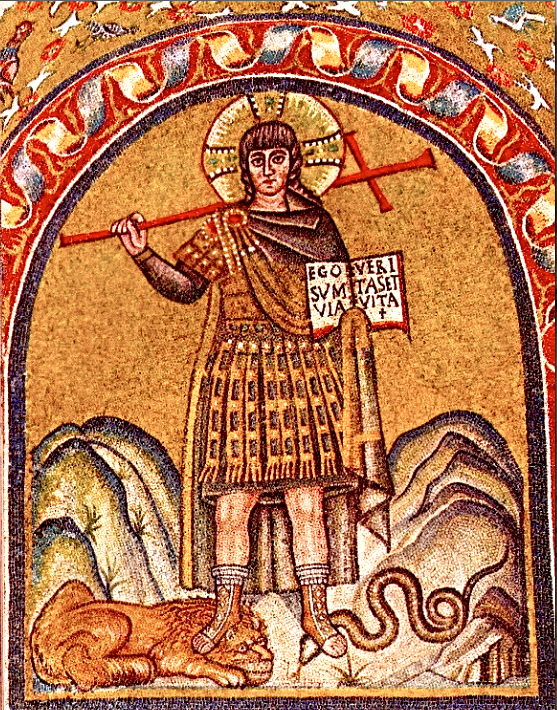
This fifth century mosaic, inspired by Psalm 91, is located in the Archiepiscopal chapel in Ravenna. Christ is represented as a chivarlic Emperor, holding not a sword, but a cross over his shoulders because His kingdom is of an utterly radical life-giving and evil-conquering nature, unlike the kingdoms of the Fallen World System. The book He holds open that reads, “I am the way, the truth and the life.”

Christmas Day 12: Angels and the Son of Man

TODAY’S READINGS

The Gospel reading is from Jn 1:43-51. Jesus continues to accumulate followers, this time picking up Philip and then Nathanael, astonish him after his initial skepticism about Jesus. After an amazing declaration of faith by Nathanael, Jesus tells him and those with him:

“Amen, amen, I say to you,
you will see the sky opened and the angels of God
ascending and descending on the Son of Man.”
(v. 51)

“The mention of angels ascending and descending from heaven upon something alluded to the theophany, or appearance of God, to Jacob at Bethel (Gen 28:10-19). God appeared to Jacob in a dream and extended to him the covenantal promises made to Abraham and Isaac. When he awoke, Jacob said, ‘How awesome this place is! This is nothing else but the house of God, the gateway to heaven!’ (Gen 28:17). Jacob anointed a stone there with oil and name the place ‘Bethel,’ which means ‘the house of God’ (28:18-19).

“Jesus combines two important themes from this Jacob story into his title ‘Son of Man.’ The first is revelation. At Bethel, the Lord revealed himself to Jacob in a dream: now he reveals himself directly and physically in Jesus. The second theme is God’s dwelling place. Jacob referred to the site where the Lord appeared to him as Bethel, ‘the house of God.’ Now, ‘the Word became flesh / and made his dwelling among us’ (1:14). Jesus is the direct, physical dwelling of God among human beings; because God has taken on human nature in Jesus, Jesus reveals God in a new, unsurpassable way. The incarnate Word is the new ‘house of God,’ where the glory of the Lord is present and sensible, and is ‘the gateway to heaven’ (Gen 28:17). The fulfillment of Jesus’ promise — the revelation of God in Jesus who becomes humanity’s gateway to heaven — will be the substance of the rest of the Gospel.”” (The Gospel of John [Catholic Commentary on Sacred Scripture], 51-52)

“Jesus puts himself in the center of this vision, claiming that (1) he is the place where heaven touches down to earth; (2) he is the true house of God; and (3) he is the mediator through whom the angels exercise their ministry.” (The Ignatius Catholic Study Bible: The New Testament (San Francisco: Ignatius Press, 2010), 164)

In the second century, a man names Marcion (possibly a bishop), wanted to disconnect Christianity from Judaism entirely. One significant way to do that was to eliminate the Old Testament as a source of inspired Scripture (there was more to it — see here). Today’s Gospel reading is one of countless examples of why eliminating the OT, or even just having a deficient knowledge of it, is so problematic.

St. Augustine famously said:

The New Testament lies hidden in the Old Testament, and the Old becomes manifest in the New.

How true! Without knowing the story of Jacob’s ladder (Gen 28:10-19), the significance of Jesus’ words would be lost on us (they surely were not lost on his first hearers).

This last month or so, I have been highlighting in these posts the value of good Catholic commentaries. They are invaluable in explicating the sometimes confusing, and sometimes apparently straightforward, texts of the Bible. There is hardly a passage one encounters between the covers of Sacred Scripture that cannot be delved into for deeper meanings on a number of levels (see here regarding the senses of Scripture).

CHRISTMAS IS NEARLY OVER!

It seems fitting on the twelfth day of Christmas to listen to the famous song we all sang at some point growing up. I again turn to Pentatonix, which has a delightfully funky version of the tune.

And what about the meaning of the days? Check out this interesting history.

We are not quite done though. Epiphany will be celebrated Sunday, and then back to Ordinary Time. But, this year, let us appreciate how extraOrdinary it is.

God bless.

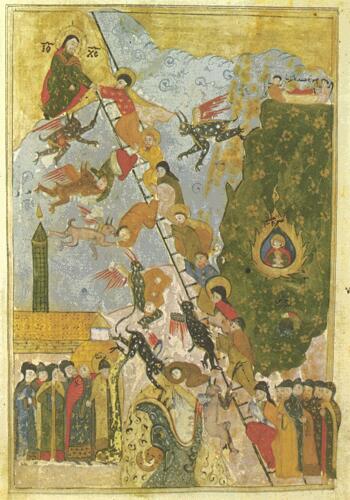
The Ladder of Divine Ascent. SINAI FESTAL ICON.

Christmas Day 10: Unknown children

TODAY’S READINGS

The first reading is from 1 Jn 2:29–3:6, picking up where we left off yesterday. It is incredible news and a sobering note.

See what love the Father has bestowed on us
that we may be called the children of God.
Yet so we are.
The reason the world does not know us is that it did not know him.
(v. 1)

“God the Father has loved us to such an extent that we have the immense privilege of being called his children…We are children of God not in name only or merely as a title of honor. Christians truly have become God’s children in a new way through the saving work of Christ: ‘To all who received him, who believed in his name, he gave power to become children of God, who were born, not of blood or of the will of the flesh or of the will of man, but of God’ (John 1:12-13 NRSV)…

“The fact that we are the children of God explains why the ‘world’ does not recognize us for what we are. Just as those who belong to the world failed to recognize Christ himself and his Father, so they clearly will not know or recognize those who are begotten of God. As children, we are like the Father and the true Son, Jesus Christ, and so we should expect to experience th same rejection that Christ received.” (James, First, Second, and Third John [Catholic Commentary on Sacred Scripture] , 180)

“‘This is the great boldness of the Christian faith — to proclaim the value and dignity of human nature and to affirm that we have been created to obtain the dignity of children of God, through the grace that raises us up to a supernatural level. An incredible boldness it would be, were it not founded on the promise of salvation given us by God the Father, confirmed by the blood of Christ, and reaffirmed and made possible by the constant action of the Holy Spirit’ (Christ is passing by, 33). (The Navarre Bible: Catholic Epistles, 178-179)

What an astounding passage we are highlighting here! That we poor creatures, who would not exist without God and can do nothing good without God, can be made children of God and can choose to ultimately be with this benevolent Father for all eternity. We same creatures whose first parents were gravely disobedient, whose descendants repeatedly spurned God for idols, and who ultimately murdered God, can be reconciled with Him — and more than that — become like God. This is Good News! Like Jeremiah, whom we spoke of a few short days ago, how possibly can we keep this fire inside? And how can we not fail to strive for holiness with the promise of heaven if we live as we profess to believe?

Yet, we can often feel “unknown” when we speak about and live our faith. If our imitation of Christ makes us off-putting to some, so be it. These do not recognize Christ in us, or worse they do and want no part of us/Him. Let us pray that God will use our good example to bring others to Him, that we will make clear to those we encounter the goodness of God and His desire that all persons be saved (see 1 Tim 2:3-4).

God bless, brothers and sisters in Christ (isn’t it wonderful to be related!). I invite you to say an Our Father, recalling our relationship with God and our fellow baptized (all the Communion of Saints).

God bless.

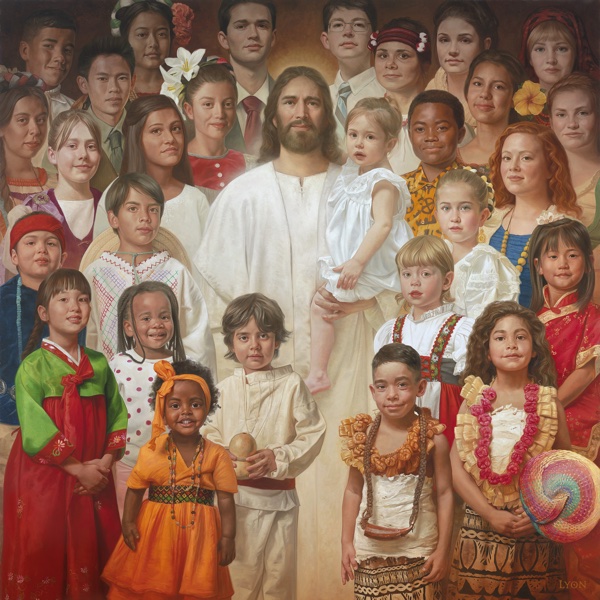
I Am a Child of God (contemporary) by Howard Lyon

Christmas Day 9: LIAR!

TODAY’S READINGS

The first reading is from 1 Jn 2:22-28. We’ve heard quite a lot from John’s first letter in recent days. Today we get a powerful excerpt regarding Jesus’ messiahship and divinity.  I focus here on the first two verses, because they pack such a wallop.

Who is the liar?
Whoever denies that Jesus is the Christ.
Whoever denies the Father and the Son, this is the antichrist.
Anyone who denies the Son does not have the Father,
but whoever confesses the Son has the Father as well.
(vv. 22-23)

“It is evident that John is concerned here for the basic confession of faith regarding the true identity of Jesus Christ.

“But what exactly were these ‘antichrists’ denying? This is not entirely clear, but as we piece together the evidence from the letter, it appears that they were denying that the Son of God (who was ‘in the beginning’ with the Father) actually took flesh and became a human being in the incarnation. They were denying that Jesus truly was the ‘Christ’ — that is, the Messiah or anointed one — who came from the Father for our salvation. ’The Lie par excellence is that which refuses to see the Godhead shine in the human life and death of Jesus’ (F. F. Bruce, The Epistles of John: Introduction, Exposition, and Notes [London: Pickering & Inglis, 1970], 73). For John, this is the core activity of the antichrist: to deny the true incarnation of the Son of God sent from the Father…

“If we deny the truth about the Son, then we lose the Father as well; if we confess and believe in the Son as the faith teaches, then we gain the Father as well. ’Whoever does not honor the Son does not honor the Father who sent him’ (John 5:23).” (James, First, Second, and Third John [Catholic Commentary on Sacred Scripture] , 171, 172)

We know well the devil is a liar, even from the very beginning (see Jn 8:44 and, of course, Gn 3). Who else ultimately inspires a denial of the divinity of Christ and His redemptive mission? 

Now John was likely calling out pseudo-Christians, who, for whatever reason, denied or altered basic doctrine regarding the nature of Christ. They exchanged the truth for a lie, whether wittingly or unwittingly, to deceive or when expressing real (albeit misguided) conviction. Regardless, it is terribly damaging in its potential to lead persons astray.

Consider throughout the ages those who deny Christ is who He says He is. Consider also that this denial gives them no access to the Father of Jesus — no access to God at all! Jesus says to Thomas (and us) during the Last Supper discourse:

“I am the way and the truth and the life. No one comes to the Father except through me.
If you know me, then you will also know my Father. From now on you do know him and have seen him.” (Jn 14:6-7)

Those who follow some other (or no other) religion are perpetuating a lie. Some unknowingly perhaps. Others, in many cases, with strong conviction of their own beliefs. Does God actively will religions outside His Church? Obviously not! Scripture says,

God our savior…
wills everyone to be saved and to come to knowledge of the truth.
For there is one God.
There is also one mediator between God and the human race,
Christ Jesus, himself human,
who gave himself as ransom for all. (1 Tm 2:3-6)

While we are to respect others in their religious choices, if they are following a lesser conception of God than is true, we should love them enough not to leave them there. Jesus’ call to evangelization is absolute (see Mt 28:19). This should not be difficult. If we have good news in our personal affairs we can’t wait to let others know. When we have the Good News (“Gospel”) in our hearts, we shouldn’t be able to hesitate to let others know through word and deed. Lord grant us to be like Jeremiah:

I say I will not mention him,
I will no longer speak in his name.
But then it is as if fire is burning in my heart,
imprisoned in my bones;
I grow weary holding back,
I cannot! (Jer 20:9)

God bless.

Christmas Day 5: Walk the walk

TODAY’S READINGS

The first reading is from 1 Jn 2:3-11. A challenge and a promise.

The way we may be sure that we know Jesus
is to keep his commandments.
Whoever says, “I know him,” but does not keep his commandments
is a liar, and the truth is not in him.
But whoever keeps his word,
the love of God is truly perfected in him.
This is the way we may know that we are in union with him:
whoever claims to abide in him ought to walk just as he walked.
(v. 3-6)

“For St John, knowing God is not merely an intellectual exercise nor does he mean that the immensity of God can be grasped by man’s limited understanding. It refers to something much simpler and more important: knowing God means being united to him by faith and love — by grace…

“‘Keeping his commandments’ (vv. 3 and 4), ‘Keeping his word’ (v., 5), ‘walking in the same way in which he walked’ (v. 6): keeping the commandments is absolutely necessary, because there is no room for faith without works (cf. 1 Jn 3:17-18; Jas 2:14ff; Gal 5:6). Similarly, one must keep the work of God, that is , accept all revelation docilely (and idea found very often in John : c.f., e.g., Jn 5:38; 8:31, 51; 1 Jn 2;14). But, above all, Christians must identify their life with Christ’s….” (The Navarre Bible: Catholic Epistles, 168)

Christianity does not espouse an “easy believism”: “I’ve accepted Jesus as my Lord and Savior, so my ticket to heaven is stamped.” No, Jesus in the Gospels makes it clear, over and over, that the demands are great and the path is narrow. Our faith is not for the weak of heart or the weak of spirit. The good news, straight from the Lord, in times of temptation:

My grace is sufficient for you, for power is made perfect in weakness. (2 Cor 12:9)

We can do nothing without grace. But grace through faith allows us to move mountains — if only we accept these gifts.

JESUS AND THE DEAD SEA SCROLLS

I just finished Dr. John Bergsma’s book. If the subject of the Dead Sea Scrolls is unfamiliar to you or seems uninteresting to you, this book will enlighten and interest you. The primary importance of these documents for Christians is how they enlighten our understanding of the sacraments and the early Church, being written approximately contemporaneous to the New Testament. Bergsma makes it interesting and accessible to the engaged reader — q worthy effort that I can highly recommend without reservation.

ST. THOMAS BECKET

Article: St. Thomas Becket

Pray for us!

God bless.

Christmas Day 3: κοινωνία

TODAY’S READINGS

The first reading is from 1 Jn 1:1-4, the prologue of John’s first letter which echoes the prologue of this same Apostle’s Gospel. Let us focus on a key word, rendered in Greek above:

[W]hat we have seen and heard
we proclaim now to you,
so that you too may have
fellowship with us (v. 3)

“In the New Testament the Greek word koinōnia is translated in a variety of ways: ‘sharing,’ ‘partnership,’ ‘contribution,’ ‘participation,’ ‘communion,’ and ‘fellowship.’ It can refer to the sharing of money and material resources within the Christian community (2 Cor 8:4; 9:13; Heb 13:16). It is used to designate the common life shared by the first Christians in Jerusalem after the outpouring of the Holy Spirit: ‘They devoted themselves to the teaching of the apostles and to the communal life [koinōnia], to the breaking of the bread and to the prayers.’ (Acts 2:42). Koinōnia also applies to our relationship with the persons of the Trinity: we are called to ‘fellowship with Jesus Christ’ (1 Cor 1:9); we jointly share ‘fellowship’ with the Father and the Son (1 John 1:3, 6); and Paul prays for an increase in: ‘communion’ with the Holy Spirit (2 Cor 13:13 NRSV). Paul also speaks of our koinōnia (‘participation,’ ‘communion’) in the body and blood of Christ in the Eucharist (1 Cor 10:16). When we have koinōnia with God, we share in his life and power; when we have koinōnia with one another, we place our lives in common and share our resources as brothers and sisters. In 1 John, koinōnia describes both our fellowship with God and with one another — a rich communion of life and bonds of love that are meant to characterize the faithful.” (James, First, Second, and Third John [Catholic Commentary on Sacred Scripture], 140)

Wow, the term koinōnia encompasses a lot doesn’t it — really, every relationship we have: natural and supernatural. The first sentence in the quote above lists six translations of koinōnia. It seems to me that a good exercise is to consider our relationship with God and our fellow humans by working through each of these possibilities and see how we measure up. What of us do we share with God? Are we willing to share with others? Are we partnering with God in His mission here on earth? Do we consider ourselves partners (“accompaniers”) of our fellow man in leading them to the fullness of truth? You get the picture.

John tells us that he is conveying what he has “seen and heard.” What did he hear? Jesus said, “Love one another as I have loved you” (Jn 13:34). The Apostle John was famous for endlessly repeating to his disciples, especially in his frailty near the end of his life, “My little children: love one another (see 1 Jn 3, as well).” Always, or even often, easy? Certainly not. An absolute requirement of the Christian? Definitely so.

As an interesting aside, what about the “other disciple” in today’s Gospel? Check out this article for a breakdown of the “beloved” and “other” disciple in John’s Gospel — you may be surprised.

I close with a fine article written just for today’s feast.

St John, Apostle and Evangelist, ora pro nobis!

God bless.

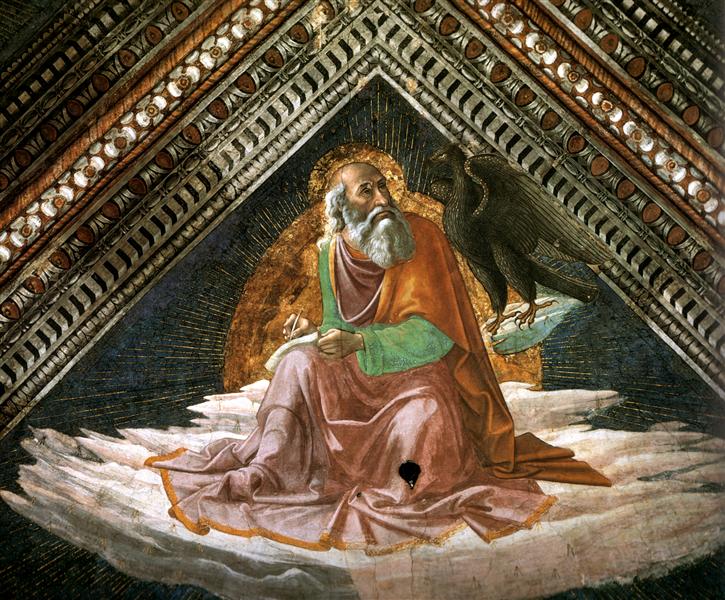
St. John the Evangelist (1486-1490) by Domenico Ghirlandaio

Christmas Day 2: An endurance test

TODAY’S READINGS

The Gospel reading is from Mt 10:17-22. Jesus promises persecution to His followers who are faithful to Him, but a happy denouement.

You will be hated by all because of my name,
but whoever endures to the end will be saved.
(v. 22)

“Persecution has an end, since it is created by man; salvation has no beginning and no end, because it is a participation in the life of God. ’Salvation’ does not come at the end of a persecution simply as a reward for having withstood the trials now past. ’Salvation’ is a full flowering and sure manifestation of that divine Presence that has been active all along in the believer’s witness. ’Salvation’ is the seed of trust and faith come full term ans yielding the fruit of indefectible glory. The physical mobility of Christians, as they flee persecution from city to city, is in eloquent contrast to their interior stability, grounded as they are in the confession of the one Name.” (Fire of Mercy, Heart of the Word, Vol. I, 570)

“The phrase ‘to the end’ can have different meanings. It might mean to the end of a particular persecution. It might mean to the ends of one’s life (verse 21). It might mean to the end of the present age, when Jesus will return (verse 23). Each of these possible meanings is linked with a corresponding meaning of being saved. If “the end means the end of a persecution, then being saved means surviving it. If the end is the end of one’s life, then being saved means receiving eternal life. If the end is the return of Jesus, then being saved means being rescued from the tribulation that was expected when this age comes to an end (see 24:29). It is not clear which meaning Jesus primarily intended for his listeners. Readers of Matthew’s gospel today might best understand Jesus to be speaking of the end of their days on earth and take his words as a promise of eternal life if they endure in their faith.” (Bringing the Gospel of Matthew to Life, 194)

With the second quote, I can’t help but recall a preacher years ago speaking of those who obsess about when the end of time will occur, scouring Scripture for clues, attempting to read the “signs of the time” and, from that, making predictions. His message: we don’t know when the end of the world is coming but we know for sure that our end is coming, so be prepared! I have long been content with Jesus’ exclamation, further along in Matthew, to those to whom He was speaking regarding His ultimate return:

But of that day and hour no one knows, neither the angels of heaven, nor the Son, but the Father alone…
Therefore, stay awake! For you do not know on which day your Lord will come.
(Mt 24:36, 42)

This reading promises that persecution will be part and parcel of being a faithful follower of Jesus — from the Lord’s own mouth. Fleeing from tribulations because of our faith is a fool’s errand. If we truly believe, we embrace our cross, whatever the cost. Our lives are less than a millisecond in the clock of eternity. May we never compromise our beliefs in the slightest and put our salvation in question. Yes, hostility toward religion in general, Christianity in particular, and Catholicism most specifically, continues to grow. Let us pray to the Holy Spirit for the gift of fortitude to withstand the ongoing persecution, that will continue to grow.

ST. STEPHEN, DEACON AND MARTYR

A good article for reflection. Yesterday we celebrated God’s birth on earth; today we celebrate the first Christian martyr’s birthday into heaven. The entrance of the second made possible by the life, death, resurrection, and ascension of the first.

To learn more about this great saint, check out CatholicOnline, a go to spot for saints’ stories.

And to my deacon friends: being on the front lines, you are bound to experience little martyrdoms often. Pray for the strength to continue your witness despite it all. Who knows? God may use you to turn a misguided Saul into a zealous Paul.

St. Stephen, pray for us.

God bless.

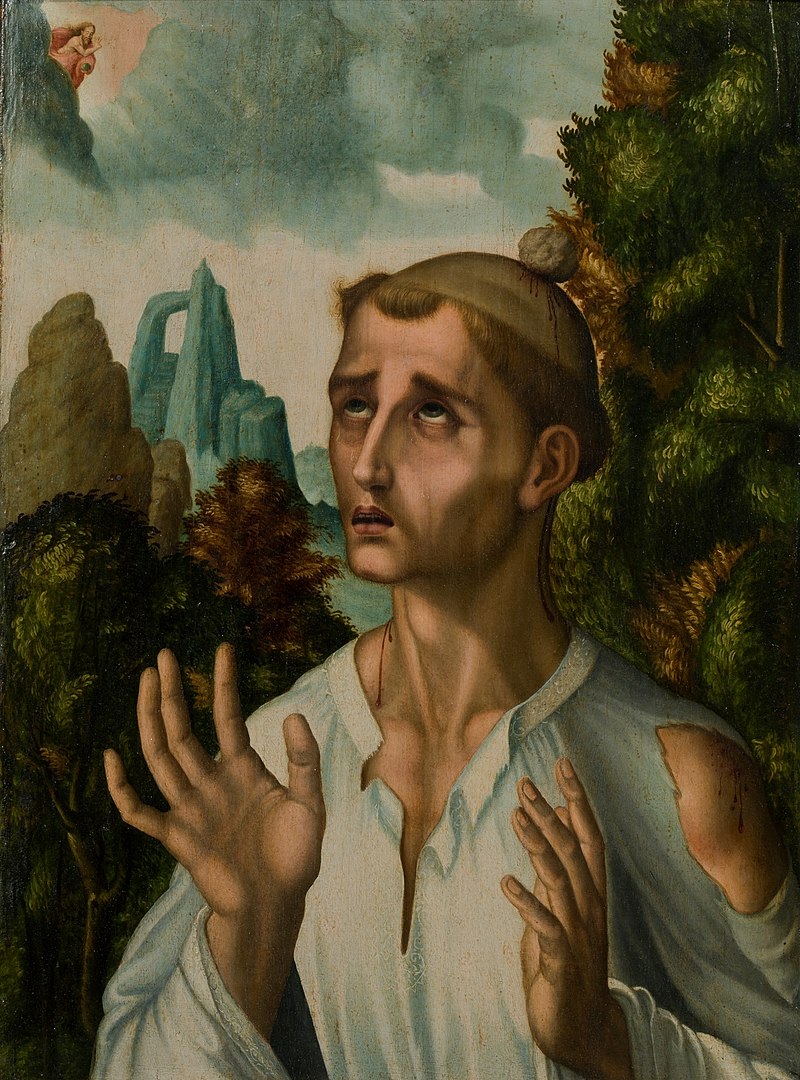
Saint Stephen (c. 1575) by Luis de Morales

Advent Day 3: Come Holy Spirit!

TODAY’S READINGS

The first reading is from Is 11:1-10, the famous passage that gives us the Gifts of the Holy Spirit.

The Spirit of the LORD shall rest upon him:
a Spirit of wisdom and of understanding,
A Spirit of counsel and of strength,
a Spirit of knowledge and of fear of the LORD,
and his delight shall be the fear of the LORD.
(vv. 2-3a)

Refer to this helpful article for Aquinas’s breakdown of these gifts and some additional interesting commentary. Also worth checking out is this video by the good Dominicans at the Thomistic Institute.

“This text is important for the whole pneumatology of the Old Testament, because it constitutes a kind of bridge between the ancient biblical concept of ‘spirit,’ understood primarily as a ‘charismatic breath of wind,’ and the ‘Spirit” as a person and as a gift, a gift for the person. The Messiah of the lineage of David (‘from the stump of Jesse’) is precisely that person upon whom the Spirit of the Lord ‘shall rest.’ It is obvious that in this case one cannot speak of a revelation of the Paraclete. However, with this veiled reference to the figure of the future Messiah there begins, so to speak, the path towards the full revelation of the Holy Spirit in the unity of the Trinitarian mystery, a mystery which will finally be manifested in the New Covenant. (Dominum et Vivificantem, 15)” (The Navarre Bible: Major Prophets, 88-89)

“The way to heaven is opened by the sevenfold grace of the Spirit. Isaiah speaks from the viewpoint of heaven, numbering the steps in descending order: wisdom and understanding, counsel and might, knowledge and piety, and fear of the Lord. Since it is written ‘the fear of the Lord is the beginning of wisdom,’ it is clear that the way ascends from fear to wisdom instead of going down from wisdom to fear. The prophet thus reasons from heavenly things to humbler things. (St Gregory the Great, Homilies on Ezekiel 2, 7, 7).” (Ignatius Catholic Study Bible: Isaiah, 36)

God bless.