Advent Day 20: With God all things are possible

TODAY’S GOSPEL (Lk 1:26-38)

From Luke 1:34:

But Mary said to the angel,
“How can this be,
since I have no relations with a man?”

From Catholic Commentary on Sacred Scripture: The Gospel of Luke, page 44

“Like Zechariah, Mary asks a question of the angel regarding the fulfillment of the message: ‘How can this be?’ A more literal rendering is ‘How will this be?’ At first glance, it seems similar to Zechariah’s question, ‘How shall I know this?’ (Luke 1:18). Beneath the similarity in form, however, lies a greater dissimilarity in attitude. While Zechariah ‘did not believe’ the words of the angel (1:20), Mary instead will be called ‘blessed’ precisely for believing ‘what was spoken’ by the angel (1:45). The difference is that whereas Zechariah ‘wanted proof,’ Mary ‘wants instructions.’
The reason for Mary’s question is that she has ‘no relations with a man.’ Mary’s response is puzzling, since a betrothed woman would normally expect to begin sexual relations after the celebration of the second stage of marriage, when she moved into the home of her husband. One would think that after this delay the angel’s words would be fulfilled, as they were for Zechariah following the delay of his remaining days of ministry (1:23-24). Some interpreters have therefore explained Mary’s response as due to her interpreting the promise as having an immediate fulfillment, while she was still a virgin, although Gabriel’s words do not say this. Another explanation, offered by Church Fathers such as Gregory of Nyssa and Augustine, is that Mary did not plan to have relations with Joseph, but had already dedicated herself to God as a virgin. This idea is often dismissed as anachronistic, imposing a Christian ideal onto a Jewish context, since mainstream Jewish groups such as the Pharisees emphasized marriage. However, this possibility cannot be excluded, given the diversity of views in Judaism at the time (e.g., some Essenes practiced celibacy).”

From The Navarre Bible: St Luke, page 39

“The Blessed Virgin, who received a very special inspiration of the Holy Spirit to practise virginity, is a first-fruit of the New Testament, which will establish the excellence of virginity over marriage while not taking from the holiness of the married state, which it raises to the level of a sacrament (cf. Gaudium et spes, 48).”

From Ignatius Catholic Study Bible: The Gospel of Luke, page 19

“How can this be: Or, better, ‘How will this be …?’”’ Mary is not questioning God’s ability to give her a son, but she is inquiring as to how such a plan will unfold. I have no husband: The Greek text literally reads ‘I do not know man’, which refers to Mary’s virginal status rather than her marital status. Her concern is not that she is unmarried but that she is a virgin at present and that she intends to remain one in the future. The announcement of a miraculous conception (1:31) thus causes Mary to wonder aloud how God will bless her with a son and yet preserve her virginal purity. Her words are inexplicable otherwise. For nothing about the angel’s announcement should have perplexed Mary—whose betrothal to Joseph was already a legally binding marriage—unless she intended to forego ordinary sexual relations even as a married woman. See note on Mt 1:18. ● According to certain Church Fathers, such as St. Gregory of Nyssa and St. Augustine, Mary had previously taken a vow of lifelong virginity.”

My take

We celebrate the Annunciation on March 25, exactly nine months before the birth of Jesus. But it is good to be reminded of that episode just five days before Christmas.

I focused on Mary’s initial response to the angel because it is a source of controversy, particularly between Catholics and Protestants. It is Catholic dogma that Mary was a virgin before, during, and after the birth of Jesus. Protestants, generally, dispute this idea. I find it disappointing they are so invested in the notion that Mary had other children. As detailed in the commentaries presented above, it is simply “inexplicable,” as the Ignatius commentary, specifically, states, that Mary ever intended to remain anything else but a virgin. (For those who have trouble with the “brothers” of Jesus, see here. For those who have trouble with “no relations…until she bore a son,” see here. For those who have trouble with Jesus as “firstborn son,” see here.)

God blessed our Queen Mother and He blessed us by giving her to us. You might say that Mary really does have many children! When I contemplate the last Glorious Mystery, I imagine Jesus saying to His mom, “I’ve got a special mission for you,” and her replying, as echoed by St. Thérèse of Lisieux, the Little Flower:

Yes, I want to spend my heaven in doing good on earth.

And she does.

The Annunciation (1898) by Henry Ossawa Tanner

God bless!
Advent Day 19: Speechless is not so bad

TODAY’S GOSPEL (Lk 1:5-25)

From Luke 1:19b-20:

“I was sent to speak to you and to announce to you this good news.
But now you will be speechless and unable to talk
until the day these things take place,
because you did not believe my words,
which will be fulfilled at their proper time.”

From Catholic Commentary on Sacred Scripture: The Gospel of Luke, page 39

“Gabriel was sent precisely to announce to Zechariah this good news about John. For the first time Luke uses the very euangelizō (‘to announce good news’), which refers throughout Luke-Acts to the preaching of the gospel message (e.g., 4:18; Acts 5:42). The proper response to ‘good news’ is to ‘believe’ (see Acts 8:12). However, Zechariah did not believe and so is punished by becoming temporarily speechless (literally, ‘silent’).”

From Opening the Scriptures: Bringing the Gospel of Luke to Life, page 15-16

“Gabriel has told Zechariah the gospel truth, as it were, but Zechariah would not accept it.

“Zechariah did not understand how he and Elizabeth could have a child in their old age, and he limited what he thought God could do to what he could understand. Nevertheless, the things that Gabriel said would happen ‘will be fulfilled at their proper time’ — in God’s timing. God’s word is always fulfilled. Zechariah will be ‘unable to talk until the day these things take place.’ It is not apparent what ‘day’ Gabriel is referring to, since he has not only spoken of Elizabeth bearing a son who is to be named John (verse 13) but of John carrying on a ministry as an adult (verses 15-17). Zechariah must have been left wondering how long his speechlessness would last and what would have to be fulfilled for him to talk again.”

My take

It is hard to blame Zechariah for being incredulous regarding this whole episode. How many times did he enter the sanctuary previously with nothing unusual happening? Now, out of the blue, so to speak, this awesome figure tells him news he wasn’t expecting and that he finds difficult to believe. Maybe he thought he was hallucinating. How long must he and his wife have prayed for a child before giving up due to biology. Their prayers seemed to go unheeded.

We know that Zechariah and Elizabeth “were righteous in the eyes of God, observing all the commandments and ordinances of the Lord blamelessly” (v. 6), so their faithfulness was finally rewarded. Here is where Zechariah drops the ball. Having conceded that it was not meant for him and his wife to have children, it is no longer on his radar. In the surprise of the presence of the angel, he apparently did not recall episodes in the history of the Chosen People that were comparable, for example, Abraham and Sarah, and, from today’s first reading, Manoah and his barren wife. He pays a price for his doubt, but the end result is glorious.

It occurs to me that it would be wonderful if doubters of God’s Revelation would be struck mute today. Instead of spreading ignorance, criticism, lies, or heresy, they would be taught a lesson for them to consider (silently) and for the rest of the world to see until they came around to the truth. Then, like Zechariah, they would bless God (cf. v. 64) and bring the fear of God to others (cf. v. 65).

May we all be struck dumb instead of speaking ignorantly, falsely, or irreverently about the word of God.

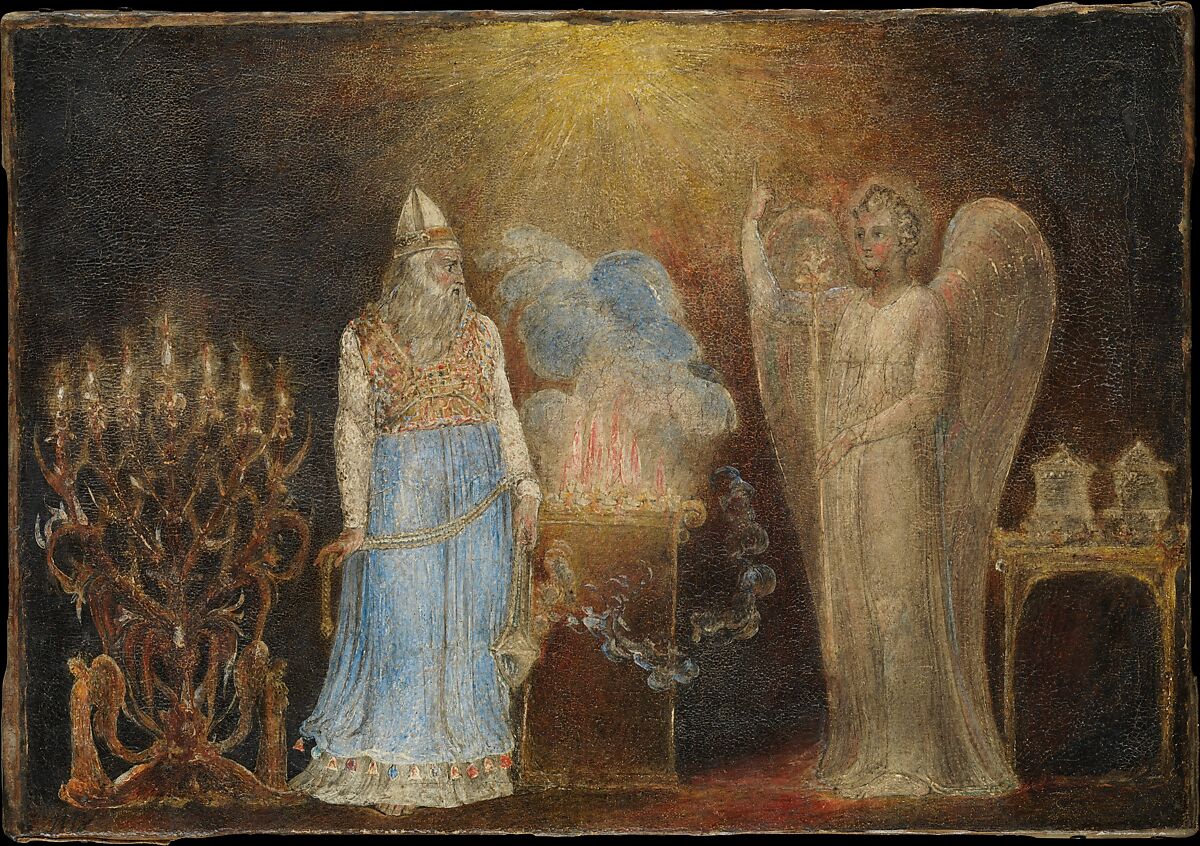
The Angel Appearing to Zacharias (1799–1800) by William Blake

God bless!

Lent Day 35: Joseph the Just

TODAY’S READINGS

Today’s Gospel reading (Mt 1:16, 18-21, 24a) gives us the story of Joseph discovering Mary’s pregnancy. Joseph’s initial reaction:

Joseph her husband, since he was a righteous man,
yet unwilling to expose her to shame,
decided to divorce her quietly.
(v. 19)

just: Or, “righteous”. Joseph is a man of sterling moral character, committed to living by the Mosaic Law (Deut 6:25; Lk 1:6).
put her to shame: The Greek verb does not necessarily have a negative connotation. It simply means “to expose” or “to exhibit”.
“send her away: Catholic tradition proposes three main interpretations to explain why Joseph resolved to end his betrothal with Mary:
“(1) The Suspicion Theory. Some hold that Joseph suspected Mary of adultery when he discovered her pregnancy. Joseph thus intended to pursue a divorce in accord with Deut 24:1–4 until the angel revealed to him the miraculous cause of the conception (1:20). Joseph is said to be righteous because he shuns immorality and directs his life by the Law of God. Proponents of this view include St. Justin Martyr,St. John Chrysostom, and St. Augustine.
“(2) The Perplexity Theory. Others hold that Joseph found the situation of Mary’s pregnancy inexplicable. Divorce seemed to be his only option, and yet he wished to do this quietly, for he could not bring himself to believe that Mary had been unfaithful. Joseph is said to be righteous because he lives by the Law of God and judges Mary’s situation with the utmost charity. The main proponent of this view is St. Jerome, whose exegesis was adopted into the notes of the medieval Bible.
“(3) The Reverence Theory. Still others hold that Joseph knew the miraculous cause of Mary’s pregnancy from the beginning, i.e., he was made aware that the child was conceived “of the Holy Spirit” (1:18). Faced with this, Joseph considered himself unworthy to be involved in the Lord’s work, and his decision to separate quietly from Mary was a discretionary measure to keep secret the mystery within her. On this reading, the angel confirms what Joseph had already known and urges him to set aside pious fears that would lead him away from his vocation to be the legal father of the Messiah (1:20). Joseph is said to be righteous because of his deep humility and reverence for the miraculous works of God. Proponents of this view include St. Bernard of Clairvaux and St. Thomas Aquinas.” (The Gospel of Matthew [Ignatius Catholic Study Bible], 18)

It seems to be commonly held that Joseph was suspicious of Mary, or at least confused, but rarely does one hear about the reverence theory. Thus, I wanted to lay out above a concise but clear explanation of each approach. The more I hear about and consider the last one, the more convinced I am that this is the case. Joseph must have known Mary’s character intimately, so ther seems to be no way he could have even conceived of her sinning. Perplexity makes more sense, especially as it is approached by Jerome, but here I suspect Joseph would have had a deeper insight, especially if, as tradition holds, he never committed a personal sin.

Joseph is a great saint. Let us honor him in a special way today for his faithfulness to Mary and her Child. Let us ask his intercession, so that we may we approach that same faithfulness to the Lord and His mother.

MY FAVORITE ST. JOSEPH BOOK

Combines fascinating insights into the man with a beautiful 33-day consecration to him. Check out the website for more info. Pick it up soon so you can start the consecration!

PRAYER FOR A HAPPY DEATH

Who better to pray to for a happy death than Joseph who died with Jesus and Mary assisting him on his final earthly journey? I pray to him often for this cause. Find several prayers here.

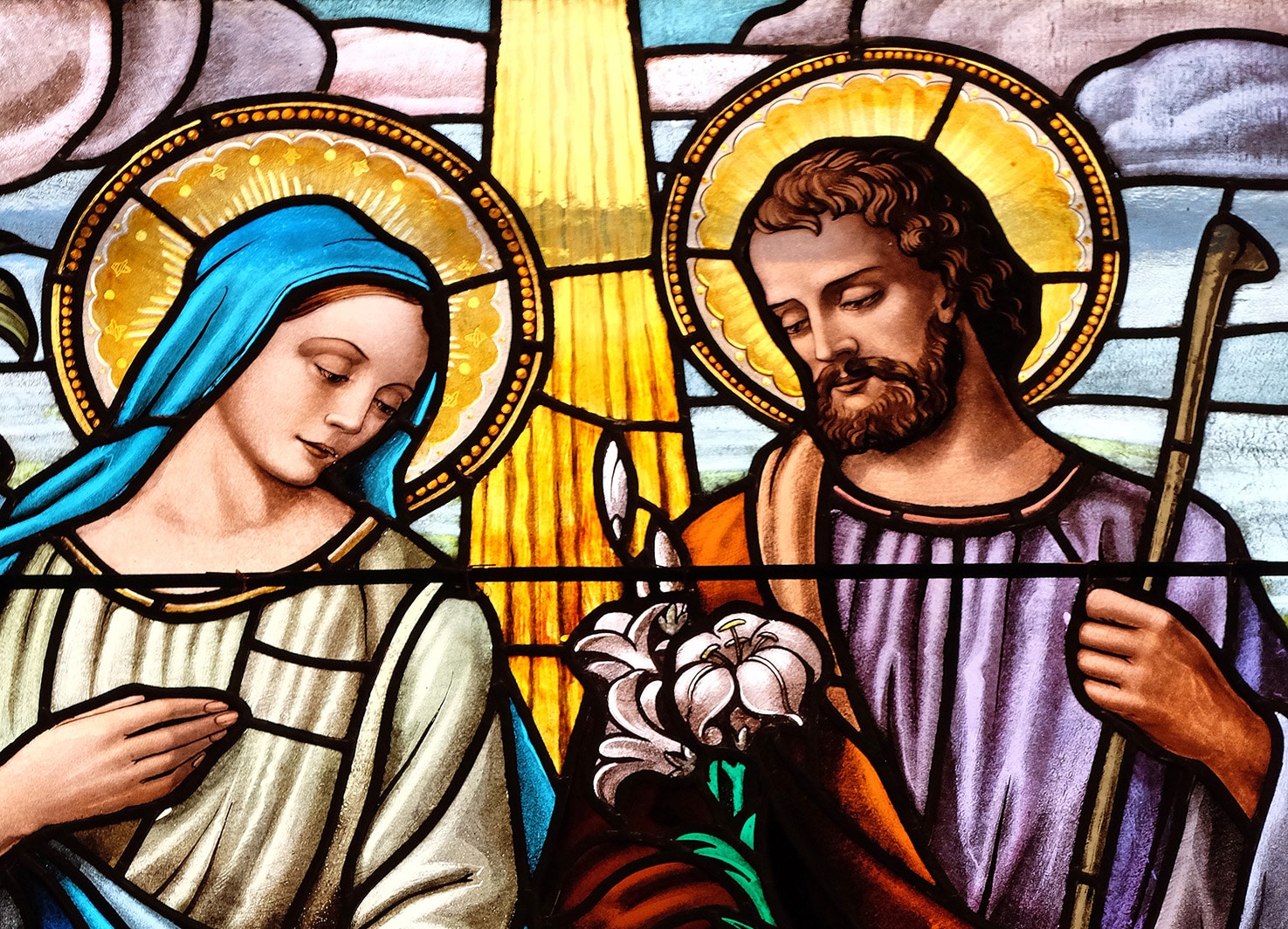
ZAGREB, CROATIA – DECEMBER 28: Holy Family, stained glass window in the Parish Church of the Visitation of the Virgin Mary in Zagreb, Croatia on December 28, 2015.

God bless.

Epiphany: Come let us worship

TODAY’S READINGS

In the U.S., Epiphany is celebrated the Sunday that falls from Jan 2-Jan 8, so today is the day. The Gospel reading is from Mt 2:1-12, in which we read the story of the Magi

[O]n entering the house
they saw the child with Mary his mother.
They prostrated themselves and did him homage.
Then they opened their treasures
and offered him gifts of gold, frankincense, and myrrh.
(v. 11)

“Why did the Magi set off from afar to go to Bethlehem? The answer has to do with the mystery of the ‘star’ which they saw ‘in the East’ and which they recognized as the star of the ‘King of the Jews,’ that is to say, the sign of the birth of the Messiah (Mt 2:2). So their journey was inspired by a powerful hope, strengthened and guided by the star, which led them toward the King of the Jews, toward the kingship of God himself. The Magi set out because of a deep desire which prompted them to leave everything and begin a journey. It was as though they had always been waiting for that star. It was as if the journey had always been a part of their destiny, and was finally about to begin. This is the mystery of God’s call, the mystery of vocation. It is part of the life of every Christian … When the Magi came to Bethlehem, ‘going into the house they saw the child with Mary his Mother, and they fell down and worshiped him’ (Mt 2:11). Here at last was the long awaited moment;, their encounter with Jesus. ‘Going into the house’: this house in some sense represents the Church. In order to find the Savior, one has to enter the house, which is the Church … ‘They fell down and worshiped him … and offered him gifts: gold, frankincense, and myrrh’ (Mt 2:11-12). Here is the culmination of the whole journey: encounter becomes adoration; it blossoms into an act of faith and love which acknowledges in Jesus, born of Mary, the Son of God made man … The secret of holiness is friendship with Christ and faithful obedience to his will.” (Benedictus: Day by Day with Pope Benedict XVI, 20)

I ordered the Benedictus book recently on the recommendation of Scott Hahn. It did not take much convincing to pick up 365 daily inspirations from the beloved pope of happy memory. I will be reading these profound one page meditations daily for all of 2024.

I love the connection Benedict makes of the house the Magi enter with the Church. How can one truly find Jesus without entering the “house” He established? And for Catholics, Jesus is truly present in each of the physical houses in the form of the Eucharist. There we should be falling down in worship, offering the gift of our entire lives in every moment in every aspect.

The final sentence is worth pondering for the rest of our lives: “The secret of holiness is friendship with Christ and faithful obedience to his will.” Are we friends of Christ? What does it mean to be friends with Christ? Christ tells us Himself:

You are my friends if you do what I command you. (Jn 15:14)

And how do we know what Jesus commands? Through His word that comes to us through Scripture and Tradition, safeguarded by the teaching authority of the Church. Pray and study! Repent and believe!

BP BARRON SERMON

TWO ARTICLES FOR THIS DAY

CHRISTMAS IS OVER, BUT LENT IS AROUND THE CORNER

Yes, we had a two day extension, but now we get back into the regular grind. But not for long! Ash Wednesday is on Valentine’s Day this year, fortuitously, I think. A great day to begin intensive preparation for Holy Week! What greater gift of love has there ever been than the Second Person of the Trinity coming down to repair the infinite damage our sins do? In addition, because of the date on which Easter falls, we celebrate the Feast of the Annunciation earlier that holiest of weeks — what a tremendous comparison and contrast for our meditation.

God bless.

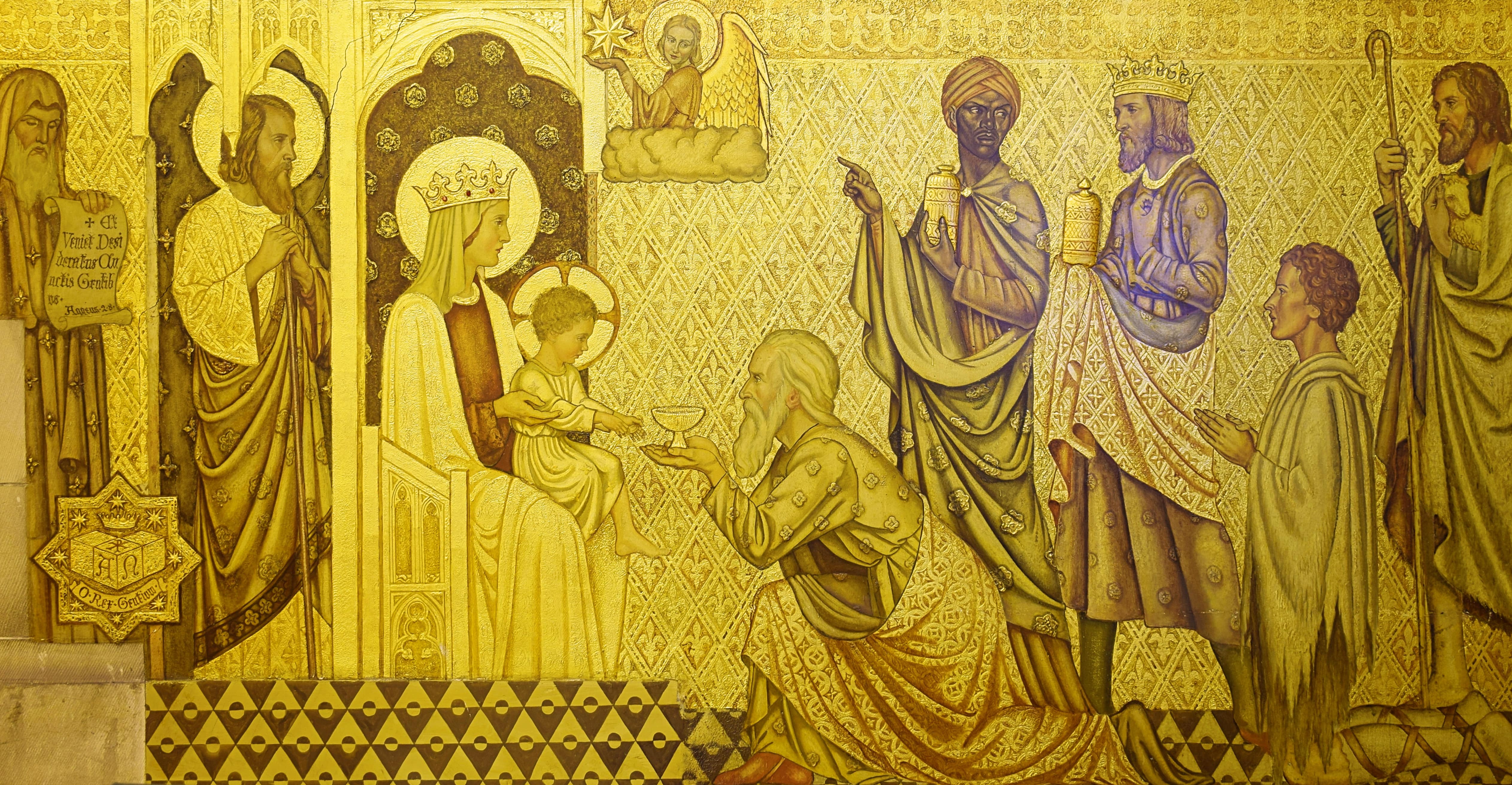
The Adoration of the Magi (1944-1947) by George Duffie

Christmas Day 8: Pondering is not ponderous

TODAY’S READINGS

The Gospel reading from Lk 2:16-21 focuses on Blessed Mary and the infant Jesus — appropriate for the Christmas Season and this day when we consider the baby Messiah as what He was: the Second Person of the Trinity incarnate, making His bearer the Mother of God.

Mary kept all these things,
reflecting on them in her heart.
(v. 19)

“In very few words this verse tells us a great deal about our Lady. We see the serenity with which she contemplates the wonderful things that are coming true with the birth of her divine Son. She studies them, ponders them and stores them in the silence of her heart. She is a true teacher of prayer. If we imitate her, if we guard and ponder in our hearts what Jesus says to us and what he does in us, we are well on the way to Christian holiness and we shall never lack his doctrine and his grace. Also, by meditating in this way on the teaching Jesus has given us, we shall obtain a deeper understanding of the mystery of Christ, which is how ‘the Tradition that comes from the Apostles makes progress in the Church, with the help of the Holy Spirit. There is a growth in insight into the realities and words that are being passed on. This comes about in various ways. It comes through the contemplation and study of believers who ponder these things in their hearts. It comes from the intimate sense of spiritual realities which they experience. And it comes from the preaching of those who have received, along with their right of succession in the episcopate, the sure charism of truth’ (Vatican II, Dei verbum, 8).” (The Navarre Bible: St Luke, 56)

“Mary ‘kept all these things’: the Greek word ‘kept’ has connotations of preserving something, being concerned about it, treasuring it. Mary treasured the events that had unfolded, ‘reflecting on them in her heart.’ The Greek word for ‘reflecting on’ means putting things together, pondering them. In the biblical view, the ‘heart’ is the seat of thinking and feeling and willing. Mary takes to heart to amazing things that are happening and tries to fathom their meaning. ’Mary’ is a model of treasuring all that God says and does, meditating on his word, pondering his plans for our lives.” (Bringing the Gospel of Luke to Life, 64)

We encounter a lot of action words in the two commentaries above: contemplating, pondering, reflecting, meditating, studying, experiencing, storing, guarding, preserving, treasuring, preaching, understanding. A full program for our lives, not only in prayer, but also in action. As a new year begins, it is worth working through each of these aspects of our consideration of Jesus as we imitate His mother. Consider looking up each of these twelve words in a regular dictionary and cycle through them throughout the year. How best do we implement in our own minds and hearts, contemplating Jesus, studying about Jesus, really experiencing Jesus, understanding Jesus’ message to the world and to us, personally, etc. Ask Blessed Mary for her intercession, invoke the same Spirit through whom she conceived a child for guidance, and ask Gabriel and your angel for their prayers; our sincerity in these petitions will certainly be profitable.

RECOMMENDED BOOKS I READ IN 2023

YEAR SCARY

I was disappointed to knock off on twenty-five books last year. Summer got really messed up, so that prime time yielded nearly no results. Of those I read, only a handful stood out, including some great classics. I list them below. You can check out Goodreads where I’ve done short reviews for almost all of these. In no particular order:

YEAR: SCARY

I can’t shake the feeling that, considering the escalating difficulties the world over, we are in for a year that may make 2020 seem like a walk in the park. Challenges: hear and abroad, in the Church or directed at the Church.

Let us pray for all veterans and clergy..

Happy New Year. As today began with much joy amidst the noise, let us hope it at least maintains the whole year through.

God bless.

Christmas Day 6: Now vs. forever

TODAY’S READINGS

The first reading is from 1 Jn 2:12-17. We continue reading John’s first letter where he addresses messages to specific groups.

[T]he world and its enticement are passing away.
But whoever does the will of God remains forever.
(v. 17)

“On the one hand, ‘the world and its enticement are passing away.’ The fallen world with its enticements to sin will not endure, and when Jesus returns, the ‘world’ in this sense will definitively pass away. Paul says the same: ‘the world in its present form is passing away’ (1 Cor 7:31). On the other hand, ‘whoever does the will of God remains forever.’ the one who keeps the commandments of God and walk in the light hes eternal life. John’s point is plain: if we choose to love the world and its ways, we are loving something deceitful that will pass away; if we choose to love the Father and do his will, we will enjoy everlasting life with him.” (James, First, Second, and Third John [Catholic Commentary on Sacred Scripture], 165)

“‘The term ‘world’ has a number of meanings in Sacred Scripture. Here it has the pejorative sense of enemy of God and man, and includes everything that is opposed to God — the kingdom of sin. Following Christ involves a radical choice: ‘No one can serve two masters’ (Mt 6:24; ‘friendship with the world is enmity with God’ (Jas 4:4).”” (The Navarre Bible: Catholic Epistles, 171)

What leaps to mind is the old adage “you can’t take it with you.” What we can take are our sins and ungodly attachments. So, another slogan comes to mind: “you can pay me now or pay me later.” Best if we detach and refocus now on what matters (and all that ultimately matters is love of God and love of neighbor).

We continue with Luke (2:36-40) in today’s Gospel, here highlighting Anna, the prophetess, who was in the Temple at the same time as Simeon when the Holy Family arrived.

[Anna] was advanced in years,
having lived seven years with her husband after her marriage,
and then as a widow until she was eighty-four.
(vv. 36b-37a)

“Her name Anna (Hannah in Hebrew) recalls Hannah the mother of Samuel…[The excerpt above] suggests that if Mary represents Israel as virgin, Anna represents Israel primarily as widow (‘eighty-four’ equals twelve times seven– i.e., the number of Israel’s tribes times the number of perfection). Isaiah’s prophecy is being fulfilled: ‘The reproach of your widowhood no longer remember. / For your husband is your Maker; / the Lord of hosts is his name, / Your redeemer, the Holy One of Israel’ (Isa 54:4-5; see 62:4-5, 12). Isaiah is portraying the Lord God as Israel’s bridegroom redeemer — that is, the kinsman who redeems a childless widow by marrying her (see Ruth 4;5-6, 14).” (The Gospel of Luke [Catholic Commentary on Sacred Scripture], 72)

Talk about someone who is detached and focused. Anna devotes her whole life to the Lord and has the keen insight, aided by grace (and Simeon, no doubt), to recognize Him when He comes. Imagine her joy! She must not have stopped speaking of this day for the rest of her days, which I suspect, like Simeon’s, were short. This woman, probably looked on as a bit more than a little eccentric until this day, maybe gained some new found respect. Or not. Nevertheless, a lifetime of prayer, penance, and fasting, yielded the greatest reward for her at the end of this life, and undoubtedly upon this babe’s ultimate Resurrection.

God bless.

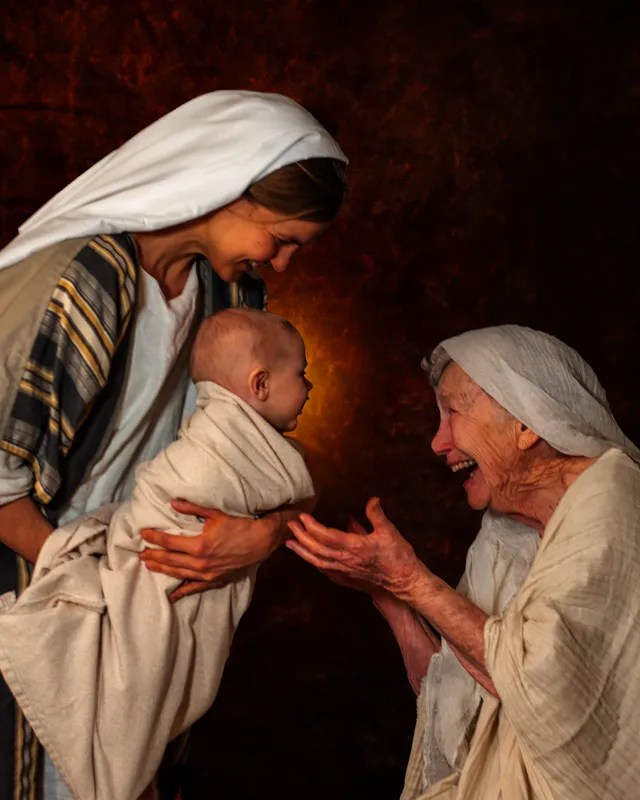
The Prophetess Anna Greets the Christ Child (2023 photo) by Lester Yocum

Christmas Day 4: Baptism by blood

TODAY’S READINGS

The Gospel reading is from Mt 2:13-18. Taking up when the magi leave, proclaimed is the horrific story of the massacre of children by the maniacal and unstable Herod the Great.

When Herod realized that he had been deceived by the magi,
he became furious.
He ordered the massacre of all the boys in Bethlehem and its vicinity
two years old and under,
in accordance with the time he had ascertained from the magi.
(v. 16)

“Such violence is consistent with other ruthless acts Herod performed near the end of his life, including the murder of his own wife and sons whom he feared were trying to supplant him. Yet, as horrific as the ‘Massacre of the Holy Innocents’ was, it probably was not of the magnitude that is sometimes imagined. Bethlehem in the first century had a maximum of a thousand people, and there were probably only twenty male children under age two dwelling in the village and surrounding district. It is not surprising that other historical works from this period do not mention this event. As tragic as these killings would have been, they remain a smaller scale compare to Herod’s other atrocities.” (The Gospel of Matthew [Catholic Commentary on Sacred Scripture], 56)”

“The Church regards these children as the first martyrs to give their lives for Christ. Martyrdom brought them justification (that is, salvation) and gave them the same grace as Baptism gives; their martyrdom is, in fact, Baptism by blood.

“St Thomas Aquinas comments on this passage in the following way: ‘How can it be said that they died for Christ, since they could not use their freedom?[…] God would not have allowed that massacre if it had not been of benefit to those children. St Augustine says that to doubt that the massacre was of benefit to those children is the same as doubting that Baptism is of use to children. For the Holy Innocents suffered as martyrs and confessed Christ non loquendo, sed moriendo, not by speaking, but by dying’ (Comm. on St Matthew, 2, 16).” (The Navarre Bible: St Matthew, 39)

“[T]he slaughter of the Innocents in the place of Jesus is a prophecy and an anticipation of the slaughter of Jesus in the place of all men…” (Fire of Mercy, Heart of the Word, Vol. 1, 100)

This Gospel passage should be disturbing to our core. Not only that innocent children were killed, but that it could have been prevented. The angel warns the Holy Family to get to safety, but no one else — why not? Better, God could have just prevented the massacre in the first place by thwarting Herod’s plans or not having the magi consult with him in the first place. Or, how about killing off Herod before he could hatch his evil plan? Herod most likely died in 1 B.C. and Jesus was likely born in 3 or 2 B.C. — why not just wait it out? Or have Jesus born a year or two later?

The commentaries I quote from help us out here. These toddlers did not die in vain. We celebrate their feast yearly — this was a guarantee of heavenly bliss for them upon Jesus’ fulfillment of His mission. And don’t think Blessed Mary and Joseph were not praying intently for the grieving families. I wonder if, thirty some years down the road, these same families heard of Jesus and put two and two together (I suppose it is possible that the butchers may have given them some indication of why they were murdering, but who knows?)? What did they make of that?

This passage brings to mind a teacher of mine who said in class, fighting back tears, that he would rather see his young child die immediately if he knew that, instead, he would live long and die in mortal sin. To Aquinas’s point, these children were guaranteed heaven. Obviously, this is not reason to hope for or hasten the demise of anyone (life and death is God’s prerogative), but “We know that all things work for good for those who love God, who are called according to his purpose” (Rom 8:28). God’s purpose here is to fulfill a prophecy and anticipate Jesus’ sacrifice.

Finally, this passage should make us more keenly aware and devastatingly disheartened by the murder of innocents today through abortion and the killing of living children during “botched” abortions. If we are horrified, rightly, of the unjustified killing of a couple dozen young children, what of the tens of millions killed in recent decades through abortion? Disturbing, as well, is the embracing of this “right” by state after state, enshrining it in (human) law. God help us!

God bless you.

La Vierge à l’Enfant entourée des saints Innocents (1618) Pierre Paul Rubens

Christmas Day 1: Shepherding a Mirrored Heart

TODAY’S READINGS

The Gospel reading is from Lk 2:15-20. I have chosen readings from the Mass at Dawn since it is the Mass I attended. A focus on the shepherds, yes, but one very important line about the Blessed Virgin:

And Mary kept all these things,
reflecting on them in her heart.
(v. 19)

“Mary contemplates Jesus’ birth and childhood, not from a distance, but as a participant in the mystery (1;35, 43; 2:51). Luke’s insight suggests that Mary is either the direct or indirect source of his information, since she alone could relate these hidden details of the story.” (The Gospel of Luke [Ignatius Catholic Study Bible], 24)

“Mary has had nine months to ponder what God is doing through her; the shepherds’ report is one more thing to ponder. Mary is apparently included in the ‘all’ who were ‘amazed’ by the shepherds’ words (verse 18), but her response is more than astonishment. ’Mary kept all these things’: the Greek word ‘kept’ has connotations of preserving something, being concerned about it, treasuring it. Mary treasured the events that had unfolded, ‘reflecting on them in her heart.’ The Greek word for ‘reflecting’ on means putting things together, pondering them. In the biblical view, the heart is the seat of thinking and feeling and willing. Mary takes to heart the amazing things that are happening and tries to fathom their meaning. Mary is a model of treasuring al that God says and does, meditating on his word, pondering his plans for our lives.” (Bringing the Gospel of Luke to Life, 64)

Mary “is a true teacher of prayer. If we imitate her, if we guard and ponder in our hearts what Jesus says to us and what he does in us, we are well on the way to Christian holiness and we shall never lack his doctrine and his grace. Also, by meditating in this way on the teaching Jesus has given us, we shall obtain a deeper understanding of the mystery of Christ, which is how ‘the Tradition that comes from the Apostles makes progress in the the Church, with the help of the Holy Spirit.’ (Vatican II, Dei Verbum, 8)” (The Navarre Bible: The Gospel of Luke, 56)

Not only can we take a lesson from Blessed Mary (did anyone in the human history have more to contemplate than she?), but also from the shepherds. Filled with awe as these events unfolded, do you not think they spent many lonely hours on the job contemplating these things in the depths of their being. We must be more like the shepherds: being awestruck by God and taking the time to ponder all that He has done in history and all He has done for us, specifically.

THREE SONGS

A beautiful Catholic song for the season sung beautifully.

My favorite versions of my two favorite secular songs:

Merry Christmas and God bless.

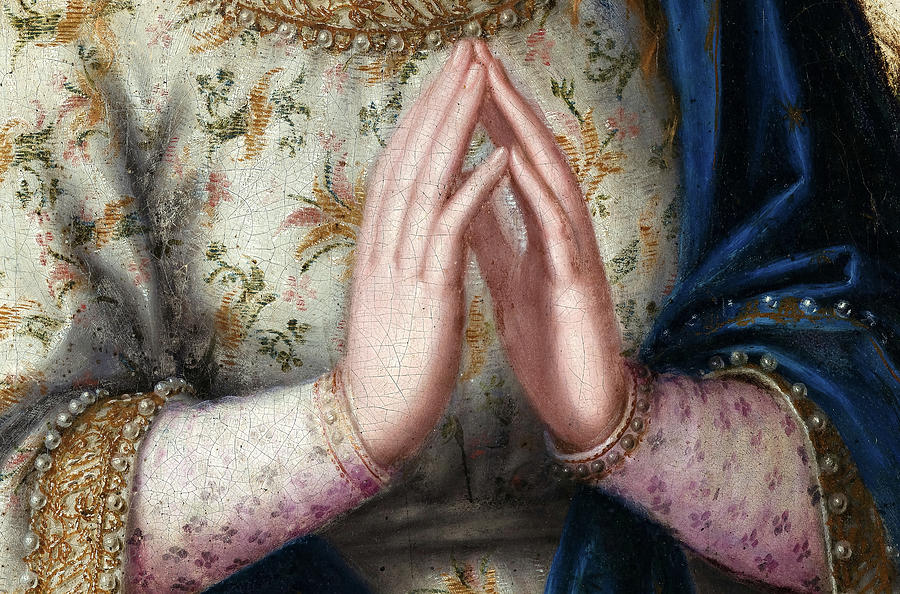
Prayer, Blessed Virgin Mary by Juan Sanchez Cotan (1560-1627)

Advent Day 22: Son of David, Son of Mary, Son of God

TODAY’S READINGS

The first reading is from 2 Sm 7:1-5, 8b-12, 14a, 16. The establishment of the Davidic covenant, the last covenant of the Old Testament. We are given this today in a particular way to show how it is fulfilled in the New Testament. Let us explore this prophecy.

I will raise up your heir after you, sprung from your loins,
and I will make his kingdom firm.
I will be a father to him,
and he shall be a son to me.
Your house and your kingdom shall endure forever before me;
your throne shall stand firm forever.
(vv. 12b, 14a, 16)

“The pledges made to David are provisionally realized in Solomon during the golden age of the united monarchy and, to a lesser extent, in the centuries that the Davidic dynasty ruled in Jerusalem. But definitive fulfillment awaits the coming of Jesus Christ. He is the Messiah grafted into David’s dynastic line (Mt 1:1-16) and the one chosen by God to sit on David’s throne ‘for ever’ (Lk 1:32-33). Like David, Jesus is anointed by the Spirit (1 Sam 16;13; Acts 10:38), and, like Solomon, he offers the wisdom of God to the world (1 Kings 10:1-10; Mt 12:42). The temple he builds is not a stone-and-cedar sanctuary in Jerusalem, but his body, the Church of living believers indwelt by the Spirit (Mt 16;18; Eph 2:19-22; 1 Pet 2:4-5). In the Resurrection, Jesus’ humanity attains the royal adoption promised to David’s offspring (Acts 13;33-34; Rom 1:3-4), and, at his Ascension, he commences his everlasting reign (Lk 1;33) as David’s messianic Lord (Mk 12:335-37). Even now, he holds the key to the kingdom of David (Rev 3:7) and bears the distinction of being ‘King of Israel’ (Jn 1:49) as well as ‘he who rises to rule the Gentiles’ (Rom 15:12). According to the very first Christian sermon, all of this is the fulfillment of Yahweh’s oath to David (Acts 2:29-35).” (The First and Second Books of Samuel [Ignatius Catholic Study Bible], 80)

This should make us appreciate in a special way those times when Jesus is called “Son of David” in the Gospels, considering all that’s implied in that title. For an interesting Bible study, read the passages and context around those times the Lord is addressed in this way (here — note that Jesus is addressed this way only six different times with Matthew giving us all six [Mark and Luke repeat one of the stories, the blind beggar, in Matthew). Exquisite fruit for contemplation.

The Responsorial Psalm is Ps 89:2-3, 4-5, 27, 29. We should be reminded of Mary’s Magnificat. Mary knew her Scriptures — I suspect, being a uniquely bright and holy child, that she was literate, although this is not necessary for her to have this depth of knowledge and interiority of the Bible.

Forever will I confirm your posterity
and establish your throne for all generations.
(v. 4)

Jesus is Son of David and Son of Mary and Son of God. Wow.

The second reading is from Rom 16:25-27. Let us key in on the phrase “obedience of faith.”

…according to my gospel and the proclamation of Jesus Christ,
according to the revelation of the mystery kept secret for long ages…
made known to all nations to bring about the obedience of faith… (vv. 25a, 26)

the obedience of faith: Probably means ‘the obedience that is faith’ or ‘the obedience that springs from faith’. The expression stands like two bookends at the beginning and end of Romans (16:26). It holds the epistle together around the central theme of faith, which is the act of trusting in God and entrusting oneself to God. Faith inspires love (Gal 5:6) and is the indispensable basis for a living relationship with Christ (Rom 1:17; Heb 11:6) (CCC 143, 1814). (The Ignatius Catholic Study Bible: The New Testament (San Francisco: Ignatius Press, 2010), 257.

The gift of faith comes to us with the other theological virtues (hope and love/charity) in Baptism and remains with us as long as we avoid mortal sin (thank the Lord for Confession!). It is a free gift, but it isn’t cheap. A simple statement of belief not followed by a life striving for holiness is certainly the devil’s deceit.

The Gospel gives us the Annunciation (Lk 1:26-38). So much can be said about the seemingly infinite number of aspects of this encounter, but let’s focus on the first words of the angel:

Hail, full of grace! The Lord is with you. (v. 28)

Hail: Or ‘Rejoice!’ It crowns the theme of joy and gladness that punctuates Luke’s Infancy Narrative (1:14, 44, 47, 58; 2:10, 20). ● The call to rejoice echoes OT passages that address Daughter Zion. In the prophets this refers to Mother Jerusalem, whose faithful children will rejoice in the messianic age because God has chosen to dwell in their midst (Joel 2:23–24; Zeph 3:14–17; Zech 9:9). Mary, chosen to be the virgin mother of the Messiah, is greeted with the same summons because she is the embodiment of faithful Israel and the most privileged recipient of Yahweh’s messianic blessings. full of grace: This is the only biblical instance where an angel addresses someone by a title instead of a personal name. Two considerations help to clarify its meaning. (1) The expression full of grace is rooted in Catholic tradition and traced to St. Jerome’s translation of this verse in the Latin Vulgate. Although fundamentally accurate, it lacks some of the depth of the Greek original. Luke could have described her with the words full of grace (Gk. plērēs charitos) as he did of Stephen in Acts 6:8, yet here he uses a different expression (Gk. kecharitōmenē) that is even more revealing than the traditional rendering. It indicates that God has already ‘graced’ Mary previous to this point, making her a vessel who ‘has been’ and ‘is now’ filled with divine life. (2) Alternative translations like ‘favored one’ or ‘highly favored’ are possible but inadequate. Because of the unparalleled role that Mary accepts at this turning point in salvation history, the best translation is the most exalted one. For God endowed Mary with an abundance of grace to prepare her for the vocation of divine motherhood and to make her a sterling example of Christian holiness (CCC 490–93, 722). ● Gabriel’s declaration points in the direction of Mary’s Immaculate Conception. According to Pope Pius IX’s 1854 definition Ineffabilis Deus, Luke’s Annunciation narrative is an important indicator of Mary’s lifelong holiness. God is her ‘Savior’ (1:47) in the most perfect way possible: he sanctified Mary in the first instance of her conception and preserved her entirely from sin and even from the inclination toward sin that we experience. (The Ignatius Catholic Study Bible: The New Testament [San Francisco: Ignatius Press, 2010], 105.)

Faithful Catholics have said the Hail Mary many, many times. How often do we contemplate these first words of the prayer (by the way, the Hail Mary is a biblical prayer!)? Put yourself in Mary’s sandals. This awesome creature surprises you with such a greeting. “Rejoice”! He calls me “full of grace”! What is about to happen? Might I have the inkling, the hope, that the long awaited Messiah is about to come? How will it happen? Will I be involved?

BP BARRON’S SUNDAY SERMON

Focusing on Nathan and David.

SANTA CLAUS

A nice article about Santa Claus and keeping children’s dreams alive: Santa Claus, St. Nicholas, Myths, Fairy Tales and ‘Lies.’

ADVENT ENDS

Today we end the shortest Advent possible. Yes, we must go to Mass again this evening or tomorrow. This shouldn’t be a burden but a joy and a blessing. Honoring the Lord’s first coming and then having him come to us in Holy Communion — who could possibly want to miss it!

God bless.

David and Nathan (1672) by Matthias Scheits

Advent Day 21: What’s in a name?

TODAY’S READINGS

The Gospel reading is from Lk 1:57-66, again picking up where we left off from the previous day. Here, Elizabeth names her newborn son to those gathered round.

When they came on the eighth day to circumcise the child,
they were going to call him Zechariah after his father,
but his mother said in reply,
“No. He will be called John.”
But they answered her,
“There is no one among your relatives who has this name.”
(vv. 59-61)

“[C]ircumcision of Jewish males incorporated them into God’s covenant with his people (Gen 18:9-14; it was ‘the mark of the covenant’ (Gen 17:11). Circumcision was done on the eighth day after birth (Gen 17:12; Lev 12:3). Elizabeth and Zechariah observe all God’s commandments (1:6); their son is circumcised on the proper day. Neighbors and relatives (verse 58) came to celebrate the circumcision…

“The Hebrew name that comes into English as John means ‘God has shown favor’ (using God’s personal name — Yahweh); it was not an unusual name in priestly families (1 Macc 2:1-2). Luke does not explaining the meaning of John’s name, but it is highly appropriate: God has shown favor to Elizabeth and Zechariah and would show favor to his people through their son (see 1:16-17)…

“If a son was not named after his father, it was customary to name him after one of his other relatives. But no one in the families of Elizabeth and Zechariah is named John. Breaking with customary practice in naming John is a sign that he is someone out of the ordinary. His significance will not lie in his family heritage but in who he is an what he will do.” (Bringing the Gospel of Luke to Life, 38-39)

I’ve long wondered why it was so astonishing to those visiting John’s parents that the little boy was not named after his father. I an unaware of any instance in the Bible where a Jewish parent and child had the same name (Abraham Jr., anyone) or even that of a relative (at least mentioned)? I did a bit of research: some speculate that it was because John had a special mission (as mentioned above); others that it was a specifically Levite custom at the time, or still others that Luke got some bad info (which doesn’t square with my understanding of biblical inerrancy). If anyone has come across anything more definitive or explanatory, please let me know in the comments.

Also, check out the article, What’s Your Name?, that gives important scriptural insights and practical application to this Gospel story. Maybe it will inspire you to look up the etymology of your own name (here’s mine).

CATHOLIC COMMENTARY ON SACRED: SCRIPTURE: OLD TESTAMENT!

I had been checking in from time to time on the Catholic Commentary on Sacred Scripture website to find out if, after having published volumes covering the entire New Testament, the Old Testament would be tackled. Well, to my surprise, a suggestion came up yesterday on Amazon about a new commentary on Wisdom from this series (already in my cart)! I checked the site again, but no news there. So I contacted one of the General Editors, Dr. Mary Healy, who tells me, “Yes, we’ve started work on the OT, and Wisdom and Ezekiel will be coming out in 2024! Next will be Sirach and Isaiah, and roughly two volumes every year.”

This is a phenomenal series. I have the entire NT set, and have worked through many of the volumes, even using one to lead a Bible study. Scholarly, but accessible, these are meant for interested and engaged Catholics of all stripes. If you have not seen these yet, I encourage you to pick up at least one (maybe the one that covers your favorite Gospel or epistle) and read it.

CHRISTMAS…HISTORICALLY

Finally, I listened today to one of my more recently adopted favorite podcasters, Catholic Answers apologist Jimmy Akin, who explores what we know, or can reasonably speculate, about the first Christmas. I can assure you, without question, that you will learn something new. For example, there is a decent reason to believe the first Christmas happened on September 11, 3 B.C. — and you’ll be entirely surprised the scriptural warrant for this. Learn this and a lot more in the podcast. And check out the many subjects Jimmy covers in his Mysterious World.

God bless.

The Birth and Naming of Saint John the Baptist (1450-1460) by Sano di Pietro