
The Gospel reading is from Mt 11:16-19. Today’s passage picks up where yesterday’s left off. And like yesterday, Jesus again says something perplexing. So back to my commentaries for help.
Jesus said to the crowds:
“To what shall I compare this generation?
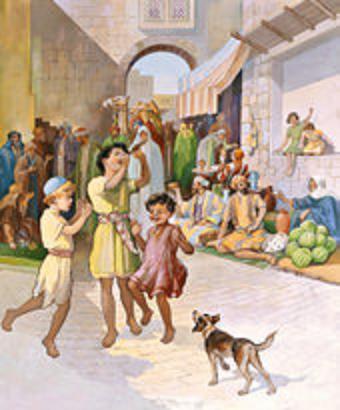
It is like children who sit in marketplaces and call to one another,
‘We played the flute for you, but you did not dance,
we sang a dirge but you did not mourn.'” (vv. 16-17)
“‘[A] proverb that alludes to village life in Palestine. According to customs among children, boys invited their companions to dance at weddings and girls sand laments at funerals and invited their friends to mourn. Here, sounding the flute refers to the call of Jesus, who spoke of himself as a bridegroom enjoying the celebration of a wedding feast (9:15). Likewise, the singing of a dirge represents the ascetic witness of John, in particular the fasting he encouraged among his disciples (9:14). And the disagreeable playmates refuse to dance or mourn — these are the crowds that declined both the festive invitation of Jesus as well as the penitential summons of John.” (The Gospel of Matthew [Catholic Commentary on Sacred Scripture], 156)
The refrain “is in the first person plural, as if both of them were engaging in each mode. Once again this stresses the inseparability of the ministries of Jesus and his Forerunner as constituting but one ministry with two modes: lamentation (penance) and exultation (life in the Kingdom).” [To the voices of both men] “most contemporaries gave the same response of utter indifference. Like the children in the comparison, they simply continued sitting idly in the marketplace, whiling away the afternoon and refusing either to “dance” with rejoicing or “beat their breast” in mourning. Sorrow and joy , the deepest emotions known to man and surely the gates of wisdom, are equally closed to them.” (Fire of Mercy, Heart of the Word, Vol. 1, 666)
Certainly these two figures must have presented strikingly different visages to their contemporaries. Yet both are introduced in their ministries by their call to repent. Certainly challenging enough as we are called to sorrow for our past misdeeds and firmly committing to avoid them in the future. Both men forcefully implored their listeners then and throughout the ages to “mourn” for our lack of faithfulness to God, but “dance” for joy in a merciful God who is relentlessly calling us to conversion so that we might be saved.
I am reminded of this stark and graphic line from Revelation:
I know your works; I know that you are neither cold nor hot. I wish you were either cold or hot. So, because you are lukewarm, neither hot nor cold, I will spit you out of my mouth. (Rev 3:15-16)
Lukewarmness leads to rejection by God. Let us not sit idly by as we are presented with the demanding messages of Jesus and John that are a call to action, not only in our own lives, but in how our transformation will impact all with whom we come in contact.
God bless.
 Unworthy Servant