Advent Day 22: Eternity starts small

TODAY’S READINGS

FROM Micah 5:1 (the full passage is Mi 5:1-4a):

You, Bethlehem-Ephrathah
too small to be among the clans of Judah,
from you shall come forth for me
one who is to be ruler in Israel;
whose origin is from of old,
from ancient times.

From The Word of the Lord (Year C), page 30

“The language of a ‘ruler’ who ‘comes forth’ from ‘Behlehem-Ephrathah’ is a poetic way of describing an heir to the throne of David, a new king who has the Davidic bloodline. This rules is described in provocative ways that suggest divinity. His origin is miqqedem in Hebrew, which can mean both ‘from the east’ and ‘from antiquity.’ Both are suggestive because the east was associated with the abode of the arrival of God — the temple, for example faced east. Likewise, an ancient origin was a divine attribute — that, God the Father, is called ‘the Ancient of Days’ (Dan 7:22 RSV2CE). This concept of ancient origin is reinforced in the next verse of our Micah passage, translated ‘whose origin is from of old,’ but which literally reads ‘his origin is from days of eternity.’ This language of a Davidic ruler who has ‘eternal’ origins could be just poetic hyperbole, but let us note that, much like Isaiah 9:6. the literal sens of this text of Micah describes a king who is both human and divine.”

FROM Psalms 80:2 (the full passage is Ps 80:2-3, 15-16, 18-19):

O shepherd of Israel, hearken,
from your throne upon the cherubim, shine forth.
Rouse your power,
and come to save us.

From The Navarre Bible: The Psalms and the Song of Solomon, page 278

“God, as Shepherd of his people, has his dwelling-place in the temple, above the ark, ‘enthroned upon the cherubim’ (cf. Ex 25:18-22).”

FROM Hebrews 10:10 (the full passage is Heb 10:5-10

[W]e have been consecrated 
through the offering of the body of Jesus Christ once for all.

From Catholic Commentary on Sacred Scripture: Hebrews, page 199

“The Greek word for ‘consecrated’ (hagiazō) would be better translated as ‘sanctified’ or ‘made holy,’ since here it connotes not only being ‘set apart’ for God but coming to share in god’s own holiness. The reason Jesus’ sacrifice has power to sanctify is that he offered no mere substitute but himself, his own human life wholly given over in love. His sacrifice therefore transforms human nature from within; it heals the self-will, pride, rebellion, and unbelief that have deeply wounded human nature ever since the fall. Hebrews emphatically declares that this sanctification is already an accomplished fact, ‘once for all.’ Christ’s passion is the fulcrum of human history, the act that has definitively reconciled humanity to God and given access to God’s own holiness, Yet paradoxically, Hebrews will say in verse 14 that we who believe in Christ ‘are being sanctified’; the accomplished fact must be personally appropriated and lived by every believer (see also 12:10, 14).”

FROM Luke 1:42-43 (the full passage is Lk 1:39-45)

“Blessed are you among women, 
and blessed is the fruit of your womb.
And how does this happen to me, 
that the mother of my Lord should come to me?”

From Ignatius Catholic Study Bible: The Gospel of Luke, page 20

Blessed are you: Elizabeth blesses Mary with words once spoken to Jael and Judith in the OT (Judg 5:24–27; Jud 13:18). ● These women were blessed for their heroic faith and courage in warding off enemy armies hostile to Israel. Victory was assured when both Jael and Judith assassinated the opposing military commanders with a mortal blow to the head. Mary will follow in their footsteps, yet in her case both the enemy destroyed and the victory won will be greater, for she will bear the Savior who crushes the head of sin, death, and the devil underfoot (Gen 3:15; 1 Jn 3:8) (CCC 64, 489).
mother of my Lord: This title reveals the twin mysteries of Jesus’ divinity and Mary’s divine maternity (CCC 449, 495). Note that every occurrence of the word Lord in the immediate (1:45) and surrounding context refers to God (1:28, 32, 38, 46, 58, 68). ● Mary’s divine motherhood was the first Marian dogma expounded by the Church. The Ecumenical Council of Ephesus (A.D. 431) defined her unique relationship to Christ and honored her with the title ‘Mother of God’ (Gk. Theotokos). This was reaffirmed in 1964 at Vatican II (Lumen Gentium, 53).”

From Opening the Scriptures: Bringing the Gospel of Luke to Life, page 29

“In the culture in which Mary lived, a woman’s greatness came from the children she bore (see 11:27). Elizabeth, inspired by the Holy Spirit, perceives the greatness of the child whom Mary is carrying and Mary’s resulting greatness.”

From The Word of the Lord (Year C), page 35

“Elizabeth is a wise woman, learned in history and culture of Israel and Judah. Through the Holy Spirit, she recognizes our Mother Mary as the Queen Mother, as the ‘First Lady’ of the kingdom of Israel, and she treats her as such, showing her all deference and veneration. So if we are ever challenged by non-Catholics concerning the biblical nature of the honor we show Mary within the Church, we should point to this passage of Luke as indication that the custom of venerating the Blessed Mother began in her lifetime, in the very pages of Scripture.”

MY TAKE

The same Gospel two days in a row! Boring? No way! We should be glad this is proclaimed to us again and we could stand to hear it every day. The acknowledgement by Elizabeth of the zygote inside Mary as the Lord of the universe, the one God, is a cause for celebration — the Redeemer promised in Gen 3:15 has finally come. And what a powerful pro-life message, to boot. The developing child is now, a few days after conception, the Messiah. Elizabeth knows that what Micah prophesied, that a ruler whose “origin is from days of eternity,” is finally Emmanuel, that is, God with us (see Is 8:8-10). Her son, John, is to be the precursor to the one who has “come to save us” as the Psalmist tells us today. Just imagine the conversations Mary and Elizabeth had the next three months regarding their two special children. Finally, per Hebrews, Jesus came to consecrate us with that same developing body in the Paschal Mystery and continues to consecrate us until today and on till the end of time in the most Blessed Sacrament.

Is there any question why we call this Good News?

BP BARRON SERMON

FR MIKE SCHMITZ HOMILY

God bless!
Advent Day 21: The ‘ark’ of (salvation) history

TODAY’S GOSPEL (Lk 1:39-45)

From Luke 1:41:

When Elizabeth heard Mary’s greeting,
the infant leaped in her womb,
and Elizabeth, filled with the Holy Spirit…

From Catholic Commentary on Sacred Scripture: The Gospel of Luke, page 48

“Mary’s greeting provokes a reaction as Gabriel’s greeting did before (1:29). The infant John leaped in his mother’s womb, and Elizabeth herself was filled with the holy Spirit. the angel’s words to Zechariah are being fulfilled , as the child is ‘filled with the holy Spirit even from his mother’s womb’ (1:15). the verb ‘leap’ is used in the Septuagint to describe how Esau and Jacob leaped or ‘jostled each other’ in he womb of Rebekah, another once-barren woman (Gen 25:22). She was told that ‘the older will serve the younger’ (Gen 25:22). She was told that ‘the older will serve the younger’ (Gen 25:23), which is the case here as well, as the older John already signal;s his role as precursor of the younger Jesus.”

From Ignatius Catholic Study Bible: The Gospel of Luke, page 21

Mary, Ark of the Covenant

“Luke’s Gospel tells us more about the Mother of Jesus than any other book in the New Testament. Most of this information is packed within his first two chapters, where Luke strings together some of the most beautiful traditions we have about her life and mission. The deeper we delve into Luke’s narrative, the more we appreciate the way in which Luke tells us the story of Mary. One example of this is found in the story of the Visitation. On one level, it tells of a joyous encounter between two expectant mothers; on another, it recalls memorable stories told in the Old Testament about the Ark of the Covenant. By alluding to these ancient traditions, Luke expands the vision of the careful reader considerably. For he leads us to see Mary as the Ark of God’s New Covenant and implies that the sacred Ark of the Old Covenant merely prefigured a more wonderful Ark to come: the Mother of the divine Messiah.
“One tradition that Luke draws upon is from 2 Samuel. He intentionally sets up the subtle but significant parallels between Mary’s Visitation with Elizabeth and David’s effort to bring the Ark of the Covenant to Jerusalem narrated in 2 Sam 6. When Luke tells us that Mary “arose and went” into the Judean hill country to visit her kinswoman (Lk 1:39), he reminds us of how David ‘arose and went’ into the same region centuries earlier to retrieve the Ark (2 Sam 6:2). Upon Mary’s arrival, Elizabeth is struck by the same sense of awe and unworthiness before Mary (Lk 1:43) that David felt standing before the Ark of the Covenant (2 Sam 6:9). Parallels continue as the joy surrounding this great encounter causes the infant John to leap with excitement (Lk 1:41), much as David danced with excitement before the Ark (2 Sam 6:16). Finally, Luke adds that Mary stayed in the ‘house of Zechariah’ for ‘three months’ (Lk 1:40, 56), recalling how the Ark of Covenant was temporarily stationed in the ‘house of Obed-edom’ for a waiting period of ‘three months’ (2 Sam 6:11). Taken together, these parallels show us that Mary now assumes a role in salvation history that was once played by the Ark of the Covenant. Like this golden chest, she is a sacred vessel where the Lord’s presence dwells intimately with his people.
“Luke also draws upon a second tradition from the Books of Chronicles. This time he brings into his story a highly significant expression once connected with the Ark. The term shows up in Lk 1:42, where Elizabeth bursts out with an exuberant cry at the arrival of Mary and her Child. Although the Greek verb translated as ‘exclaimed’ seems ordinary enough, it is hardly ever used in the Bible. In fact, it is found only here in the entire New Testament. Its presence in the Greek Old Testament is likewise sparse, appearing only five times. Why is this important? Because every time the expression is used in the Old Testament, it forms part of the stories surrounding the Ark of the Covenant. In particular, it refers to the melodic sounds made by Levitical singers and musicians when they glorify the Lord in song. It thus describes the ‘exulting’ voice of instruments that were played before the Ark as David carried it in procession to Jerusalem (1 Chron 15:28; 16:4–5) and as Solomon transferred the Ark to its final resting place in the Temple (2 Chron 5:13). Alluding to these episodes, Luke connects this same expression with the melodic cry of another Levitical descendant, the aged Elizabeth (Lk 1:5). She too lifts up her voice in liturgical praise, not before the golden chest, but before Mary. Luke’s remarkable familiarity with these ancient stories enables him to select even a single word that will whisper to his readers that this young Mother of the Messiah is the new Ark of the Covenant.
“For the reader with eyes to see and ears to hear, Luke has given us a vision of the Virgin Mary that becomes ever more glorious the deeper we dig into the Scriptures. Our ability to see Mary as he did depends in part on our knowledge of the Old Testament and in part on our sensitivity to Luke’s skillful use of it. By choosing his words and phrases carefully, he is able to weave various strands of biblical tradition into his narrative, adding beauty and depth to his already elegant prose. Little wonder the Church’s liturgical and theological traditions have so often described Mary as the Ark of the New Covenant. This vision is not merely the fruit of mystical speculation from a later age. It is already embedded within the Infancy Narrative of Luke’s Gospel.”

My take

I could have just extracted the third paragraph above, but, because my favorite title for Mary is “Ark of the Covenant,” I wanted to provide the entire topical essay from the Ignatius Catholic Study Bible. I have little to add, but I would point out how important typology is in the Bible. St. Augustine famously said, per the Catechism of the Catholic Church, 129,

The New Testament lies hidden in the Old and the Old Testament is unveiled in the New.

We can’t fully understand Christ without the entire Bible. An early heresy wanted to discard the Old Testament as inconsistent with its understanding of God and Jesus. With this episode in the Gospel of Luke, not only Mary as Ark, but what is highlighted by the Catholic Commentary regarding Esau and Jacob, we have just one example of many of the unity and importance of the entire Scripture handed down to us faithfully by the Church.

I’ve had the self-published Mary the Ark of the Covenant on my shelf for some time now. I must read it.

God bless!

Advent Day 19: Speechless is not so bad

TODAY’S GOSPEL (Lk 1:5-25)

From Luke 1:19b-20:

“I was sent to speak to you and to announce to you this good news.
But now you will be speechless and unable to talk
until the day these things take place,
because you did not believe my words,
which will be fulfilled at their proper time.”

From Catholic Commentary on Sacred Scripture: The Gospel of Luke, page 39

“Gabriel was sent precisely to announce to Zechariah this good news about John. For the first time Luke uses the very euangelizō (‘to announce good news’), which refers throughout Luke-Acts to the preaching of the gospel message (e.g., 4:18; Acts 5:42). The proper response to ‘good news’ is to ‘believe’ (see Acts 8:12). However, Zechariah did not believe and so is punished by becoming temporarily speechless (literally, ‘silent’).”

From Opening the Scriptures: Bringing the Gospel of Luke to Life, page 15-16

“Gabriel has told Zechariah the gospel truth, as it were, but Zechariah would not accept it.

“Zechariah did not understand how he and Elizabeth could have a child in their old age, and he limited what he thought God could do to what he could understand. Nevertheless, the things that Gabriel said would happen ‘will be fulfilled at their proper time’ — in God’s timing. God’s word is always fulfilled. Zechariah will be ‘unable to talk until the day these things take place.’ It is not apparent what ‘day’ Gabriel is referring to, since he has not only spoken of Elizabeth bearing a son who is to be named John (verse 13) but of John carrying on a ministry as an adult (verses 15-17). Zechariah must have been left wondering how long his speechlessness would last and what would have to be fulfilled for him to talk again.”

My take

It is hard to blame Zechariah for being incredulous regarding this whole episode. How many times did he enter the sanctuary previously with nothing unusual happening? Now, out of the blue, so to speak, this awesome figure tells him news he wasn’t expecting and that he finds difficult to believe. Maybe he thought he was hallucinating. How long must he and his wife have prayed for a child before giving up due to biology. Their prayers seemed to go unheeded.

We know that Zechariah and Elizabeth “were righteous in the eyes of God, observing all the commandments and ordinances of the Lord blamelessly” (v. 6), so their faithfulness was finally rewarded. Here is where Zechariah drops the ball. Having conceded that it was not meant for him and his wife to have children, it is no longer on his radar. In the surprise of the presence of the angel, he apparently did not recall episodes in the history of the Chosen People that were comparable, for example, Abraham and Sarah, and, from today’s first reading, Manoah and his barren wife. He pays a price for his doubt, but the end result is glorious.

It occurs to me that it would be wonderful if doubters of God’s Revelation would be struck mute today. Instead of spreading ignorance, criticism, lies, or heresy, they would be taught a lesson for them to consider (silently) and for the rest of the world to see until they came around to the truth. Then, like Zechariah, they would bless God (cf. v. 64) and bring the fear of God to others (cf. v. 65).

May we all be struck dumb instead of speaking ignorantly, falsely, or irreverently about the word of God.

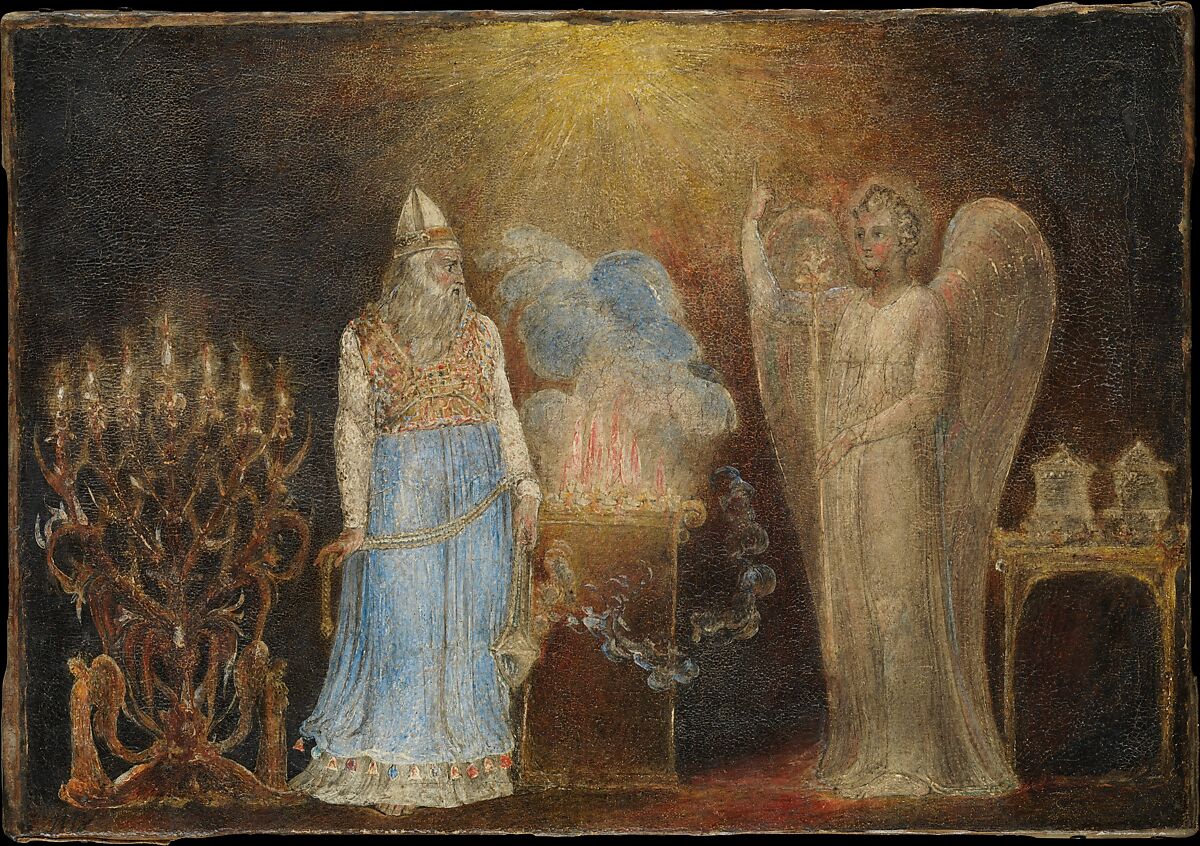
The Angel Appearing to Zacharias (1799–1800) by William Blake

God bless!

Advent Day 21: What’s in a name?

TODAY’S READINGS

The Gospel reading is from Lk 1:57-66, again picking up where we left off from the previous day. Here, Elizabeth names her newborn son to those gathered round.

When they came on the eighth day to circumcise the child,
they were going to call him Zechariah after his father,
but his mother said in reply,
“No. He will be called John.”
But they answered her,
“There is no one among your relatives who has this name.”
(vv. 59-61)

“[C]ircumcision of Jewish males incorporated them into God’s covenant with his people (Gen 18:9-14; it was ‘the mark of the covenant’ (Gen 17:11). Circumcision was done on the eighth day after birth (Gen 17:12; Lev 12:3). Elizabeth and Zechariah observe all God’s commandments (1:6); their son is circumcised on the proper day. Neighbors and relatives (verse 58) came to celebrate the circumcision…

“The Hebrew name that comes into English as John means ‘God has shown favor’ (using God’s personal name — Yahweh); it was not an unusual name in priestly families (1 Macc 2:1-2). Luke does not explaining the meaning of John’s name, but it is highly appropriate: God has shown favor to Elizabeth and Zechariah and would show favor to his people through their son (see 1:16-17)…

“If a son was not named after his father, it was customary to name him after one of his other relatives. But no one in the families of Elizabeth and Zechariah is named John. Breaking with customary practice in naming John is a sign that he is someone out of the ordinary. His significance will not lie in his family heritage but in who he is an what he will do.” (Bringing the Gospel of Luke to Life, 38-39)

I’ve long wondered why it was so astonishing to those visiting John’s parents that the little boy was not named after his father. I an unaware of any instance in the Bible where a Jewish parent and child had the same name (Abraham Jr., anyone) or even that of a relative (at least mentioned)? I did a bit of research: some speculate that it was because John had a special mission (as mentioned above); others that it was a specifically Levite custom at the time, or still others that Luke got some bad info (which doesn’t square with my understanding of biblical inerrancy). If anyone has come across anything more definitive or explanatory, please let me know in the comments.

Also, check out the article, What’s Your Name?, that gives important scriptural insights and practical application to this Gospel story. Maybe it will inspire you to look up the etymology of your own name (here’s mine).

CATHOLIC COMMENTARY ON SACRED: SCRIPTURE: OLD TESTAMENT!

I had been checking in from time to time on the Catholic Commentary on Sacred Scripture website to find out if, after having published volumes covering the entire New Testament, the Old Testament would be tackled. Well, to my surprise, a suggestion came up yesterday on Amazon about a new commentary on Wisdom from this series (already in my cart)! I checked the site again, but no news there. So I contacted one of the General Editors, Dr. Mary Healy, who tells me, “Yes, we’ve started work on the OT, and Wisdom and Ezekiel will be coming out in 2024! Next will be Sirach and Isaiah, and roughly two volumes every year.”

This is a phenomenal series. I have the entire NT set, and have worked through many of the volumes, even using one to lead a Bible study. Scholarly, but accessible, these are meant for interested and engaged Catholics of all stripes. If you have not seen these yet, I encourage you to pick up at least one (maybe the one that covers your favorite Gospel or epistle) and read it.

CHRISTMAS…HISTORICALLY

Finally, I listened today to one of my more recently adopted favorite podcasters, Catholic Answers apologist Jimmy Akin, who explores what we know, or can reasonably speculate, about the first Christmas. I can assure you, without question, that you will learn something new. For example, there is a decent reason to believe the first Christmas happened on September 11, 3 B.C. — and you’ll be entirely surprised the scriptural warrant for this. Learn this and a lot more in the podcast. And check out the many subjects Jimmy covers in his Mysterious World.

God bless.

The Birth and Naming of Saint John the Baptist (1450-1460) by Sano di Pietro

Advent Day 19: Make haste!

TODAY’S READINGS

The Gospel reading is from Lk 1:39-45, Mary’s visit to Elizabeth after the joyous news of both their pregnancies. It is the first meeting of cousins John and Jesus. My focus is on the speed in which the Virgin went to visit her relative, as relayed in the very first verse.

Mary set out in those days
and traveled to the hill country in haste
to a town of Judah
(v. 39)

“The village of Ain Karim in the hill country near Jerusalem is the traditional site of the house of Zechariah and Elizabeth. It is located about five miles from the temple, a convenient distance for Zechariah’s trips for priestly duty. For Mary, however, the journey from Nazareth would be about ninety miles, depending on the route, taking several days. There is no mention of Joseph accompanying her, unlike the later journey together to Bethlehem (2:4-5). She goes in haste, indicating her earnestness in following God’s plan.” (The Gospel of Luke (Catholic Commentary on Sacred Scripture, 48)

Luke “notes that she travels ‘in haste’ but does not explain why she is in a hurry…we might speculate that Mary was eager to see this sign for herself. We might also speculate that she was eager to be with Elizabeth because of what they had in common: they were unexpectedly becoming mothers through the favor of God; their sons would play major roles in God’s unfolding plans.” (Bringing the Gospel of Luke to Life, 27-28)

“On learning from the angel that her cousin St Elizabeth is soon to give birth and is need of support, our Lady in her charity hastens to her aid. She has no regard for the difficulties this involves…

“From Mary’s visit to Elizabeth Christians should learn to be caring people. ’If we have filial contact with Mary, we won’t be able to think just about ourselves and our problems. Selfish personal problems will find no place in our mind’ (Bl. J. Escriva, Christ is passing by, 145).” (The Navarre Bible: The Gospel of Luke, 41-42)

“After the Annunciation, Mary could have focused on herself and her own worries and fears about her new condition. Instead, she entrusted herself completely to God. Her thoughts turned to Elizabeth. She got up and went forth, into the world of life and movement. Even though the astonishing message of the angel had caused a seismic shift in her plans, the young Mary did not remain paralyzed, for within her was Jesus, the power of resurrection and new life. Within herself, Mary already bore the Lamb that was slain and yet lives. She arises and sets out, for she is certain that God’s plan is the best plan for her life. Mary becomes a temple of God, an image of the pilgrim Church, a Church that goes forth for service, a Church that brings the good news to all!” (MESSAGE OF HIS HOLINESS POPE FRANCIS FOR THE XXXVII WORLD YOUTH DAY 2022-2023; the whole document is worth reading)

“I’ve always been fascinated by Mary’s ‘haste’ in this story of the Visitation. Upon hearing the message of Gabriel concerning her own pregnancy and that of her cousin, Mary ‘proceeded in haste into the hill country of Judah’ to see Elizabeth.

“Why did she go with such speed and purpose? Because she had found her mission, her role in the theo-drama. We are dominated today by the ego-drama in all of its ramifications and implications. The ego-drama is the play that I’m writing, I’m producing, I’m directing, and I’m starring in. We see this absolutely everywhere in our culture. Freedom of choice reigns supreme: I become the person that I choose to be.

“The theo-drama is the great story being told by God, the great play being directed by God. What makes life thrilling is to discover your role in it. This is precisely what has happened to Mary. She has found her role—indeed, a climactic role—in the theo-drama, and she wants to conspire with Elizabeth, who has also discovered her role in the same drama. Like Mary, we have to find our place in God’s story.” (Bp Robert Barron’s Advent Gospel Reflections [2017]; he also gives this same reflection in his Rosary)

Let us be ever mindful to make haste when doing the work of God, and pump the brakes when it is all about us. And pray that we will recognize and be mindful of the difference