Advent Day 23: No greater man

TODAY’S GOSPEL (Lk 1:57-66)

From Luke 1:66b:

“What, then, will this child be?
For surely the hand of the Lord was with him.”

From Opening the Scriptures: Bringing the Gospel of Luke to Life, page 41

“Luke concludes his account of the birth and naming of John with his own comment: “For surely the hand of the Lord was with him.” The Old Testament uses the expression “hand of the Lord” to convey the power of God (Joshua 4:24; see Exod 7:4; 13:3; 15:6); the hand of the Lord being with or upon someone means that he is empowered and guided by God (1 Kings 18:46; 1 Chron 28:19; Ezra 7:28; Ezek 1:3; 3:14, 22)/ Surely someone born to a previously barren woman in fulfillment of an angel’s words has been sent by God to carry out a special work, and surely God will empower and guide him to accomplish his mission/ By adding that final comment, Luke invites his readers to join those pondering what this child will be and to share their sense of anticipation.”

My take

“Amen, I say to you, among those born of women there has been none greater than John the Baptist; yet the least in the kingdom of heaven is greater than he.” (Mt 11:11)

We think much of and revere deeply the greatest woman to be born of woman, the Blessed Virgin Mary, but how much do we consider the greatest man born of woman, as declared by Jesus Himself!, John the Baptist? Fittingly, he is the only person in Heaven, aside from Jesus and His mother, whom we honor by celebrating his earthly birth on the liturgical calendar (June 24, appropriately, six months before Christmas).

This man was repeatedly asked if he was the Messiah. How powerful must his preaching have been? Herod wondered if Jesus might be John reincarnated. What sort of impact must John have had on all of Judea? People flocked to him from miles around, confessing their sins and seeking a baptism of repentance. How much weight must his words have carried with the general population? The wife of Herod wanted John shut up for good. What weight must his words have carried with the commonfolk?

My suggestion is to read everything in Scripture about John the Baptist in one sitting (it won’t take very long). I have listed and linked below, all Gospel passages pertaining to John:

  • Lk 1:5-25 (annunciation and conception of John)
  • Lk 3:1-22 (John’s public ministry, his future arrest by Herod, Jesus’ baptism)
  • Mt 3:1-16 (John introduced and the baptism of Jesus)
  • Mk 1:2-11 (John introduced and the baptism of Jesus)
  • Jn 1:6-8, 15 (from the Prologue)
  • Jn 1:19-37, 40 (John’s public ministry, his prophesying about Jesus and the retelling of the Spirit coming upon Jesus, his encouraging his disciples to follow Jesus)
  • Lk 7:18–23 (John sends disciples to Jesus to ask if He is the Messiah)
  • Jn 3:23-30, 4:1-2 (John baptizing and commenting on Jesus baptizing; Jesus’ disciples baptizing)
  • Jn 5:31-36 (Jesus extolling John as a precursor to Him)
  • Lk 7:24-35 (Jesus extolling John to the crowds)
  • Mk 1:14-15 (indicates John’s arrest)
  • Mk 3:18-22 (John’s disciples; on fasting)
  • Mk 6:14-29 (Herod’s suspicions about Jesus; the recounting of John’s imprisonment and death)
  • Lk 9:7-9: (Herod’s suspicions about Jesus and his speaking of John’s death)
  • Mk 8:27-30 (speculation that Jesus is John)
  • Lk 9:18-22 (speculation that Jesus is John)
  • Jn 10:40-41 (the crowds compare Jesus and John)
  • Lk 11:1 (Jesus asked to teach His disciples how to pray as John taught them)
  • Mk 11:27-33 (Jesus’ authority questioned and He invokes John)
  • Lk 16:1 (John invoked by Jesus as the last prophet)
  • Lk 20:1-8 (Jesus’ authority questioned and He invokes John

John’s baptism is also referred to in Acts 1, 10, 11, 13, 18, 19.

John the Baptist, pray for us, that we may join you in the kingdom, even as the “least.”
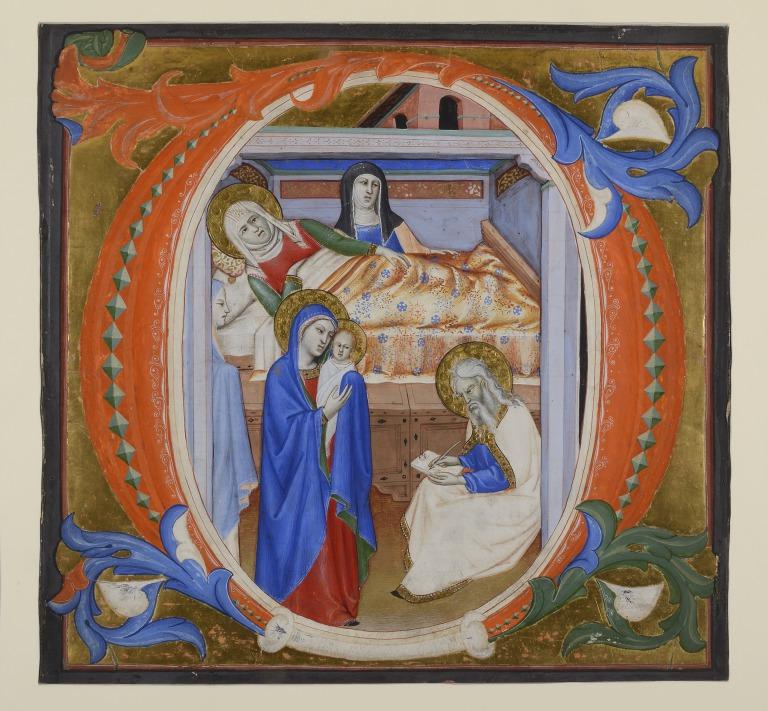
The Birth of St. John the Baptist (1370 – 1371 probably) by Don Silvestro dei Gherarducci

God bless!
Advent Day 19: Speechless is not so bad

TODAY’S GOSPEL (Lk 1:5-25)

From Luke 1:19b-20:

“I was sent to speak to you and to announce to you this good news.
But now you will be speechless and unable to talk
until the day these things take place,
because you did not believe my words,
which will be fulfilled at their proper time.”

From Catholic Commentary on Sacred Scripture: The Gospel of Luke, page 39

“Gabriel was sent precisely to announce to Zechariah this good news about John. For the first time Luke uses the very euangelizō (‘to announce good news’), which refers throughout Luke-Acts to the preaching of the gospel message (e.g., 4:18; Acts 5:42). The proper response to ‘good news’ is to ‘believe’ (see Acts 8:12). However, Zechariah did not believe and so is punished by becoming temporarily speechless (literally, ‘silent’).”

From Opening the Scriptures: Bringing the Gospel of Luke to Life, page 15-16

“Gabriel has told Zechariah the gospel truth, as it were, but Zechariah would not accept it.

“Zechariah did not understand how he and Elizabeth could have a child in their old age, and he limited what he thought God could do to what he could understand. Nevertheless, the things that Gabriel said would happen ‘will be fulfilled at their proper time’ — in God’s timing. God’s word is always fulfilled. Zechariah will be ‘unable to talk until the day these things take place.’ It is not apparent what ‘day’ Gabriel is referring to, since he has not only spoken of Elizabeth bearing a son who is to be named John (verse 13) but of John carrying on a ministry as an adult (verses 15-17). Zechariah must have been left wondering how long his speechlessness would last and what would have to be fulfilled for him to talk again.”

My take

It is hard to blame Zechariah for being incredulous regarding this whole episode. How many times did he enter the sanctuary previously with nothing unusual happening? Now, out of the blue, so to speak, this awesome figure tells him news he wasn’t expecting and that he finds difficult to believe. Maybe he thought he was hallucinating. How long must he and his wife have prayed for a child before giving up due to biology. Their prayers seemed to go unheeded.

We know that Zechariah and Elizabeth “were righteous in the eyes of God, observing all the commandments and ordinances of the Lord blamelessly” (v. 6), so their faithfulness was finally rewarded. Here is where Zechariah drops the ball. Having conceded that it was not meant for him and his wife to have children, it is no longer on his radar. In the surprise of the presence of the angel, he apparently did not recall episodes in the history of the Chosen People that were comparable, for example, Abraham and Sarah, and, from today’s first reading, Manoah and his barren wife. He pays a price for his doubt, but the end result is glorious.

It occurs to me that it would be wonderful if doubters of God’s Revelation would be struck mute today. Instead of spreading ignorance, criticism, lies, or heresy, they would be taught a lesson for them to consider (silently) and for the rest of the world to see until they came around to the truth. Then, like Zechariah, they would bless God (cf. v. 64) and bring the fear of God to others (cf. v. 65).

May we all be struck dumb instead of speaking ignorantly, falsely, or irreverently about the word of God.

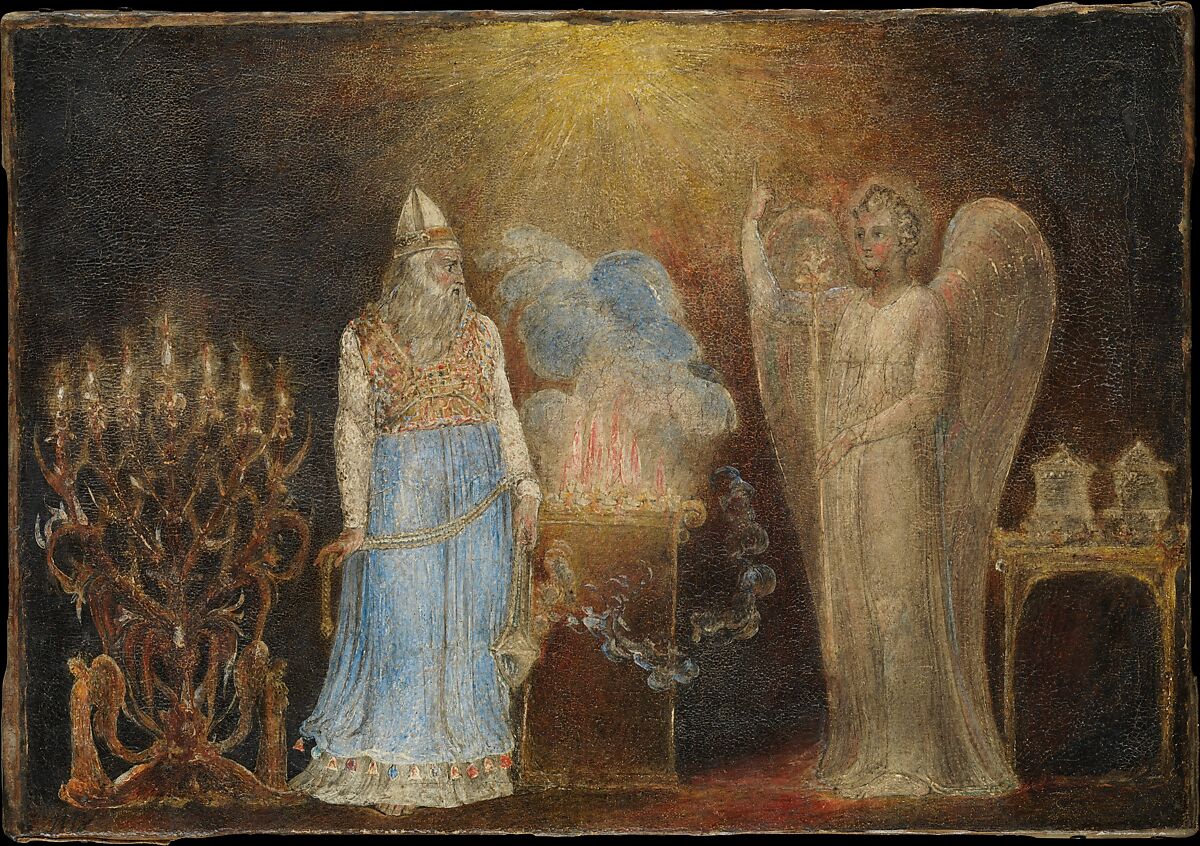
The Angel Appearing to Zacharias (1799–1800) by William Blake

God bless!

Advent Day 17: Generations

TODAY’S GOSPEL (Mt 1:1-17)

From Matthew 1:17:

[T]he total number of generations
from Abraham to David
is fourteen generations;
from David to the Babylonian exile, fourteen generations;
from the Babylonian exile to the Christ,
fourteen generations.

From Ignatius Catholic Study Bible: Old and New Testament, pages 1725-26

fourteen generations: Matthew divides the genealogy into three units of 14. It is not exhaustive, since several OT names are omitted and the divisions cover unequal periods of time. Matthew stresses the number 14 to show Jesus as the new Davidic king: (1) David and Jesus are the only names listed with their respective titles (king, 1:6; Christ, 1:16); (2) David is the 14th name in the list; (3) the numerical value of David’s name (three consonants) in Hebrew equals 14 (D = 4 + V = 6 + D = 4). ● The 42 generations from Abraham to Jesus correspond to the 42 encampments of Israel during its wilderness journey to the Promised Land (cf. Num 33:1–49). These generations bring us to the Messiah, through whom we arrive at the land of promise in heaven (St. Jerome, Letters 78). deportation to Babylon: The Exile of the Jews starting in 586 B.C. under the Babylonian king Nebuchadnezzar. After that time, Israel’s Davidic kingdom collapsed, and no legitimate heir assumed David’s throne. Jesus comes as the awaited Messiah-king (21:4–5; Jn 1:49) to fulfill God’s covenant oath to perfect and establish the Davidic dynasty for all time (cf. Ps 132:11–12; Lk 1:32–33).”

From Opening The Scriptures: Bringing the Gospel of Matthew to Life, page 19

“Matthew sees a pattern in the genealogy, with turning points coming every fourteen generations. God began something new with Abraham, calling him to be the father of a people. The kingship of David was a turning point: descendants of David were to rule over God’s people forever. Yet this seemed to end with the catastrophe of the Babylonian exile, another major turning point. Now, fourteen generations after the last major turning point, God sends the Messiah to his people. Jesus is a new turning point in God’s unfolding plan.
“If a person’s genealogy tells us who a person is, then Jesus is a Jew descended from Abraham and David. Jesus’ past is Israel’s past; Jesus marks the next stage in God’s plan for his people.”

From Fire of Mercy, Heart of the Word (Volume I), page 60

“[I]f the Word of God waited for forty-two generations in order to come ‘when time had taken a downward plunge’ (cursu declivi temporis), as the Advent hymn has it, it is because God, like a good physician, comes when he is most needed: somehow, to be fully rejuvenated, the world first had to grow old utterly and come to the limit of its own foolish hopes. Christ is sent by the Father into the world ‘to liberate the human race from its state of decrepitude’ (Collect, first Saturday of Advent).”

My take

The world waited in breathless anticipation for the promised Messiah. Generation after generation after generation came and went, with some good, but by no means perfect, men, but with more questionable characters (not only the gents, but get a load of the women mentioned in this line). What good can come from these ancestors? A greater Good than could be imagined!

This “anointed one,” explodes all categories. We can certainly call Him a New Abraham: finally the blessing to all nations has arrived (cf. Gen 12:2). We can also call Him the New David, the ultimate Son of David and the real King of Kings. But Christ is so much more. Who knew that God Himself would have to come down to clean up the mess begun with Adam and Eve and exacerbated by their descendants (i.e., all of us)? The experts in the Law, for the most part, didn’t see it (although they should have — the entire Hebrew Scriptures ultimately points toward Christ). But those with open hearts embraced the Lord when He became incarnate. We are invited to open our hearts ever wider to the miracle of the conception of the Son of God in the womb of a humble Jewish girl and its culmination nine months later at Christmas. The First Coming should make us long for the Second Coming (“thy Kingdom come”!) and for His coming into our souls at each Mass.

Maranatha! Come, O Lord!

God bless!

Advent Day 16: Wise and gentle

TODAY’S GOSPEL (Mt 21:23-27)

From Matthew 21:24-25a:

Jesus said to them in reply,
“I shall ask you one question, and if you answer it for me,
then I shall tell you by what authority I do these things.
Where was John’s baptism from?
Was it of heavenly or of human origin?”

From The Navarre Bible: St Matthew, page 183

“Jesus knows that [the chief priests and the elders] are not well-intentioned and he declines to give them a direct answer; he prefers to put a question to them that forces them to make their own attitude clear. He seeks to provoke them into examining their consciences and changing their whole approach.”

From Catholic Commentary on Sacred Scripture: The Gospel of Matthew, page 274-5:

“This counterquestion is not a change of topic. In this question Jesus implies continuity between John’s ministry and his own: just as John’s authority came from God, so does his. At the same time, Jesus’ counterquestion puts the temple authorities in an awkward position. They can either (a) say what they think — that John’s baptism was not from God — and face the anger of the crowds that ‘regard John as a prophet.’ or (b) admit that John’s baptism was from heaven, in which case they would be put to shame for not believing him. To try to save face, they answer, ‘We do not know.'”

From Opening The Scriptures: Bringing the Gospel of Matthew to Life, page 451

“Responding to a question with a counter question was a common debating tactic of the time. If Jesus is to tell the chief priests and elders by what authority he does these things, he will first ask a question to lay the groundwork for his response.”

From Fire of Mercy, Heart of the Word (Volume III), page 448

“[Jesus] responds to [the chief priests and the elders] two questions with one loaded question of his own, a question that induces a crisis in those interrogated by exposing their ‘faith’ as nothing but sly political pragmatism. Jesus’ tactic challenges them to demonstrate by what authority they dare to question his authority in the first place. He has already shown in word and action that his mere presence transforms the world around him into a better place. What has been the fruit of their alleged religious zeal, he wonders? What exactly are their own deepest motivations in relentlessly persecuting him at every turn?

“This move is brilliant because, by his reference to the Baptist, Jesus is suggesting that he himself is not an isolated figure calling for radical reform in contemporary Palestine. He hints that there exists a vibrant , effervescent spirit at present among the Jews in general that is operating outside the establishment and bearing a truly prophetic witness to God’s urgent activity in human hearts.”

My take

This is another case where I’m looking for answers to what, on the face of it, may seem like a diversionary tactic on Jesus’ part. But, it should go without saying that Jesus has no need for such stunts. His words always have purpose. He may be shrewd as a serpent and gentle as a dove, as He urges His apostles to be (cf. Mt 10:16), but He always makes His point, always to the dismay of those who oppose Him.

As always when it comes to Jesus, we should take a lesson from Jesus’ approach. This debate tactic is just as valid today as it was two thousand years ago. Responding to a question with a question can help clarify in your mind, and in your interlocutor’s mind, what he is driving at. We want to make sure we are on the same page — not talking past each other, arguing points our discussion partner is not making. This approach can also help to defuse someone coming in “hot.” When this happens, we must resist the urge to respond in kind, but rather look to dig deeper to (hopefully) discover the root issue.

Christ and the Pharisees (ca. 1880) by Lawrence W. Ladd

God bless!

Advent Day 15: The Savior in our midst

TODAY’S READINGS

FROM Zephaniah 3:17-18a (the full passage is Zep 3:14-18a):

   The LORD, your God, is in your midst,
        a mighty savior;
    he will rejoice over you with gladness,
        and renew you in his love,
    he will sing joyfully because of you,
        as one sings at festivals.

From The Word of the Lord (Year C), page 22

“[T]he Lord is described as a bridegroom. The words ‘rejoice over you,’ ‘renew you in his love,’ ‘sing joyfully because of you,’ describe the behavior of a bridegroom. Many Advent/Christmas texts have nuptial themes because the Incarnation of Christ is the ‘wedding’ of two natures, human and divine. God weds his nature to ours in Christ. Furthermore, Jesus is the promised ‘Bridegroom King’ from the line of David, fulfilling many texts which describe the king from the line of David as the ideal spouse.”

FROM Isaiah 12:2 (the full passage is Is 12:2-3, 4, 5-6):

God indeed is my savior;
I am confident and unafraid.
My strength and my courage is the LORD,
and he has been my savior.

From The Word of the Lord (Year C), page 23

“The joyful theme of this doxology fits the mood of this Mass and ties with the First Reading through the motif of God being ‘in [the] midst’ of his people.”

FROM Philippians 4:5b-6 (the full passage is Phil 4:4-7)

The Lord is near.
Have no anxiety at all, but in everything,
by prayer and petition, with thanksgiving,
make your requests known to God

From The Word of the Lord (Year C), page 24

“St. Paul’s advice in this reading is some of his most intensely practical teaching. He gives some keys to lifestyle of rejoicing: (1) not being anxious, through abandonment to God’s providence, (2) showing kindness to everyone, (3) making constant practice of prayer as an antidote to worry, including intercession, supplication, and especially thanksgiving in our prayer. How often we forget to include thanksgiving, and how important it is for the maintenance of joy on both a psychological and spiritual level!”

FROM Luke 3:18 (the full passage is Lk 3:10-18)

Exhorting them in many other ways,
he preached good news to the people.

From The Word of the Lord (Year C), page 26

“We need to keep reminding ourselves that the good news is not a plan for temporal comfort in this life because it is our tendency to revert to thinking that it is And when we look around and see that things are not comfortable, even after two thousand years, we mistakenly think the good news has not worked.
“The good news is about eternal life with God through Jesus Christ, which starts now but won’t be directly seen until the life in the world to come! The good news really is about heaven and what lies beyond the grave.

“The exhortation to rejoice in the first two readings and psalm are not based on some external reality, but on an interior and eternal reality: that Christ has come and taken up residence in our hearts, giving us communion with God even now and in the life to come. This is truly good news!”

MY TAKE

The Lord is near! The Lord is my savior! The first three Scripture passages pound home these themes. How do we know these proclamations to be true? Because, starting with John the Baptist, the Church has “preached good news to the people” — the news of the Savior in our midst: Jesus Christ.

I can’t help but think of the two primary ways Jesus is tangibly present to us today. In the Eucharist and in the Bible. Jesus, the Word, gives us Himself for our digestion, in Sacrament and in Scripture. Both should be consumed ravenously at every opportunity. But unlike food we eat that we assimilate to sustain us physically, the Food that is Jesus is meant to assimilate us into Him. Let us have frequent recourse to the Holy Spirit, the Lord and giver of life, to breathe life into us through consuming the Word.

BP BARRON SERMON

FR MIKE SCHMITZ HOMILY

God bless!

Advent Day 12: Spoken to and spoken for

TODAY’S GOSPEL (Lk 1:39-47)

From Luke 1:45:

“Blessed are you who believed
that what was spoken to you by the Lord
would be fulfilled.”

From The Navarre Bible: St Luke, page 43

“Joining the chorus of all future generations, Elizabeth, moved by the Holy Spirit, declares the Lord’s Mother to be blessed and praised her faith. No one has ever had faith to compare with Mary’s; she is the model of the attitude a creature should have towards its Creator — complete submission, total attachment. Through her faith, Mary is the instrument chosen by God to bring about the redemptive work of her Son.”

From Catholic Commentary on Sacred Scripture: The Gospel of Luke, page 50:

“Elizabeth concludes her Spirit-filled words by pronouncing the first beatitude in the Gospel: ‘Blessed are you who believed’…Mary ‘believed’ that God’s word ‘spoken’ to her ‘would be fulfilled.’ In this way, she received the privilege of being the mother of the Son of God. She also became a model for all those who ‘hear’ God’s word and accept it (8:21; 11:28). Throughout the Gospel, not only God’s words spoken through an angel but also those written in Scripture will be fulfilled (4:21; 18:31; 22:37; 24:44).”

From Opening The Scriptures: Bringing the Gospel of Luke to Life, page 30

“She is blessed because of her faith that what God said ‘would be fulfilled’ — that she would conceive through the Holy Spirit and bear a son who would be called Son of God and rule over God’s people forever (1:31-33). That is a lot for a young woman to believe!…Mary is a model for hearing the word of God and acting on it (see 8:21; 11:28).”

My take

Mary is very much a model for us. The reason I chose this quote from today’s readings is that the word “spoken” struck me. God speaks to us in myriad ways: in our heart, in our conscience, through others, through events, and, last but not least, through Scripture, which is the Word of God, who is Jesus (cf. John 1:1-18). The Bible is the inerrant revelation of God through the inspiration of the Holy Spirit (I highly recommend reading Vatican II’s Dogmatic Constitution on Divine Revelation [Dei Verbum] and CCC 101-141 to understand the proper approach to Scripture specifically and divine revelation in general).

St Jerome famously said, “Ignorance of Scripture is ignorance of Christ.” So, regular, ideally daily, reading of the Bible, particularly the Gospels, is necessary. But then we encounter this problem:

Some people are troubled by the things in the Bible they can’t understand.
The things that trouble me are the things I can understand. (Attributed to Mark Twain)

Do we hear the Word and accept it? Do we hear the Word and act on it? Are we completely submissive and totally attached to the Word? With apologies to JFK, do we choose to follow the Lord’s commands, not because they are easy, but because they are hard?

The gift of faith is ours through Baptism. Do we exercise it by complete submission to the will of God? Can we truly say we know the will of God for our lives? Mary likely did not know how it was going to all turn out, but she submitted to the Lord. She “let go and let God.”

Are we ready to believe that what the Lord speaks to us will be fulfilled? And are we completely open to being God’s instrument, without counting the cost, in fulfilling our mission?

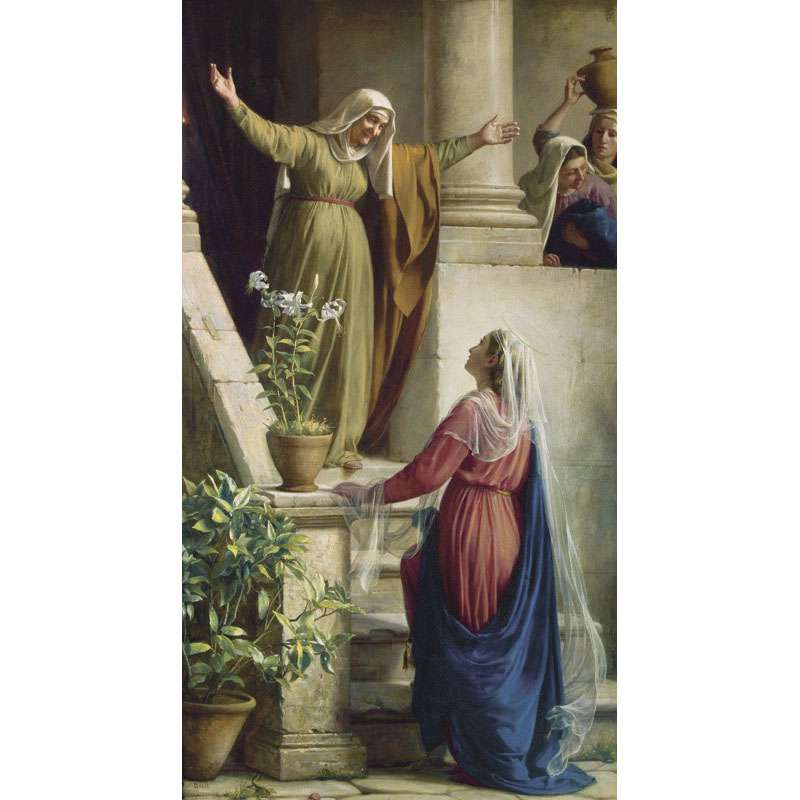
The Meeting of Mary and Elisabeth (1866) by Carl Heinrich Bloch

God bless!

Advent Day 11: Taking a load off

TODAY’S GOSPEL (Mt 11:28-30)

From Matthew 11:28:

“Come to me, all you who labor and are burdened,
and I will give you rest.

From Fire of Mercy, Heart of the Word (Volume I), pages 712, 714:

“[W]e are surely not to limit the scope of Jesus’ magnificent Venite ad me! only to those under the yoke of Pharisaism. For the love of Christ has a much more universal scope and, in Jesus, God is the absolute liberator of man from a legalistic conception of Torah as well as from every burden that keeps him back from fully becoming a child of the infinitely free Father.

“Jesus is the one who, by a divine ‘instinct’, himself bends down to share the lot of all who are burdened beyond their ability to bear it….Rather than denounce the source of the oppression — whether within or outside the person — Jesus simple extends an invitation: ‘Come to me!’ It is crucial that these words be seen as an invitation, because a person must respond to it with perfect freedom. One must oneself in some sense leave behind the oppressive situations and go to Jesus. Although elsewhere Jesus is portrayed as himself searching out the lost sheep, here the appeal is made to the exhausted person’s desire to change his life. He must take the first step himself toward the source of regeneration.”

My take

If you love Scripture, particularly Matthew’s Gospel, I encourage you to invest in Father Simeon’s (formerly Erasmo Leiva-Merikakis) four-volume Fire of Mercy, Heart of the Word series. Over 2,800 pages breaking down Matthew. What a treasure goring verse by verse, phrase by phrase, or word by word through the Gospel. Amazing spiritual insights from these “meditations” will be much food for thought, prayer, and contemplation. The excerpt above is only a tiny portion of the several pages devoted to just this one verse.

Don’t we all need rest from our many burdens? And Jesus offers to be that resting place. He already took the cross off our shoulders. Just as we must freely accept this gift of redemption, so must we freely come to Jesus in our difficulties and challenges. He is always waiting for us.

So, please join me as I endeavor to put my cares and troubles into Jesus’ hands so that I may finally true rest.

Then the peace of God that surpasses all understanding will guard your hearts and minds in Christ Jesus. (Phil 4:7)

The Hard Job of Living… (1922) by Georges Rouault

God bless!

Advent Day 10: Lost and Found

TODAY’S GOSPEL (Mt 18:12-14)

From Matthew 18:14:

“[I]t is not the will of your heavenly Father
that one of these little ones be lost.”

From Fire of Mercy, Heart of the Word (Volume II), page 628:

“‘It is not the will in the sight of your Father who is in heaven that one of these little ones should perish’: The ever-watchful eye of God’s love tirelessly scans the whole horizon of human existence with only one concern: Are all being saved? Are all being brought into life? Are any being lost, even one? For God’s joy is not complete until all are saved! The newness of life that comes about as a result of conversion to Christ — my turning and clinging ardently to Christ after having been sought and found by Christ — is an event that makes the Heart of God dance with joy. Can we not see the Face of the eternal Father glowing with exultation at the recovery of one of his dear children? And that tidal wave of divine joy then reverberates through his creation, since no act of God is without effect in the whole of the created order. Just as the angels of the little one, forever contemplating the face of the heavenly Father, build a bridge connecting childlike innocent and divine glory, so too the greatest exultation among the choirs of angels is reserved for the occasion of a single sinner’s conversion (Lk 15:7, 10).”

My take

Father Simeon’s exposition of the highlighted verse brought to mind immediately two other New Testament passages:

God our savior…wills everyone to be saved and to come to knowledge of the truth. (1 Tim 2:3-4)

“Whoever causes one of these little ones who believe in me to sin, it would be better for him to have a great millstone hung around his neck and to be drowned in the depths of the sea.” (Mt 18:6)

What a stark warning: If we oppose the will of God for all of mankind by leading others into sin directly or by bad example, we would be better off dead. We have an obligation, by virtue of our Baptism, to bring others to Christ, not lure them away or drive them away. If only we were constantly mindful of that. If only we saw the world through the eyes of God we too would desire salvation for all. We are God’s chosen instruments to effect God’s will — what an awesome gift and what an awesome responsibility! We must get close to the Lord and stay close to the Lord through prayer, penance, the Sacraments, and Scripture. Vigilance!

God bless!

Advent Day 8: Straightening up

TODAY’S READINGS

FROM Baruch 5:7 (the full passage is Bar 5:1-9):

God has commanded
that every lofty mountain be made low,
and that the age-old depths and gorges
be filled to level ground

FROM Psalms 126:5 (the full passage is Ps 126:1-2, 2-3, 4-5, 6):

Those who sow in tears
shall reap rejoicing.

From The Navarre Bible: The Psalms and the Song of Solomon, page 422

“[This] simile seems to be built around a popular proverb. ‘The pain of suffering gives rise to holy tears. But the time of weeping is also the time of sowing, because the works of charity that are performed to ease the burden of men’s sins are the seeds of eternal happiness’ (Prosper of Aquitaine, Expositio Psalmorum, 125, 6).”

FROM Philippians 1:4-5 (the full passage is Phil 1:4-6, 8-11)

I pray always with joy in my every prayer for all of you,
because of your partnership for the gospel

From Catholic Commentary on Sacred Scripture: Philippians, Colossians, Philemon, pages 75-76

“‘your partnership for the gospel’: That phrase may seem at first to refer simply to their common faith in the gospel. But for Paul the partnership is more concrete and practical than that. As Paul uses the word, ‘gospel’ can sometimes mean the message of the good news itself (God has definitely entered into history to save us through the death and resurrection of his Son), but at other times ‘gospel’ means the project of sharing that good news. Here, the ‘partnership in the gospel’ for which Paul is grateful seems to refer especially to the financial aid that the Philippians have sent to him through Epaphroditus (see 4:10-20). This aid in partnership in the sense that it is a real contribution to the advance of the gospel.”

FROM Luke 3:4b-5 (the full passage is Lk 3:1-6)

 Every valley shall be filled
        and every mountain and hill shall be made low.
    The winding roads shall be made straight,
        and the rough ways made smooth

From The Word of the Lord (Year C), page 18

“‘Every valley shall be filled’ refers to hope, encouragement, and new life being granted to the poor, the oppressed, the lowly — people who fell they have been forgotten by God or are not worthy of God’s attention.
“‘Every mountain and hill shall be made low’ refers to the humbling of the proud, the repentance that the strong and arrogant must undergo in order to receive God’s salvation.
“The ‘winding roads’ and ‘rough ways’ refer to the twists and turns of the human heart, contorted by sin (Jer 19:9). The human heart needs to be ‘simplified’ or ‘straightened’ by honest and truthful confession of sin.”

MY TAKE

Not only is John the Baptist’s message echoed in Isaiah (Is 40:35), but also in Jeremiah’s scribe, Baruch, as seen in today’s first reading. I can do nothing to improve on Dr. Bergsma’s reflection above in his The Word of the Lord series (a must have — I’m working through the last of the four volumes, as I did the first three, this year), but I will add a thought that came to me as I heard the Gospel proclaimed at Mass.

“Mountains made low” certainly evokes images of the proud being “put in their place.” So, then, if the lofty peak represents the proud, maybe those in a deep valley are folks who are mired in sin and despairing of salvation. The only way out is up and it’s a struggle that may seem overwhelming (or impossible) to undertake. And how easy it is to get to the bottom! I’m a bicyclist so it is impressed upon me what an easy journey it is when going down hill and what a challenge it is to go back up that same hill. Sin can be that way for us, as well. Our transgressions may start out small, but the slippery slope is there to carry us rapidly down if we are not careful and vigilant. Sometimes it is only when a person in the throes of sin or addiction hits “rock bottom” that he comes to his senses and makes the decision to climb out of the abyss. Can we not say that what was “sowed in tears” (the descent into the darkness of sin) can ultimately lead to “rejoicing in the reaping” (in ascending to righteousness)?

Finally, a word on the second reading. By virtue of our Baptism, we are partners in sharing the Gospel. We should do so in word and action at all times. But, as the Catholic Commentary lays out, we should also support ministries, as Paul’s followers did for him, that authentically and faithfully get out the Word. Some of my favorites are my home parish, the St Paul Center, Catholic Answers, and EWTN.

BP BARRON SERMON

FR MIKE SCHMITZ HOMILY

Hurricane Ridge in Olympic National Park

God bless!

Advent Day 6: I see (or do I?)

TODAY’S GOSPEL READING (Mt 9:27-31)

From Matthew 9:28-29:

When he entered the house,
the blind men approached him and Jesus said to them,
“Do you believe that I can do this?”
“Yes, Lord,” they said to him.
Then he touched their eyes and said,
“Let it be done for you according to your faith.”

From Opening the Scriptures: Bringing the Gospel of Matthew to Life, page 175:

“The men want to be able to see and Jesus knows that this is what they want. He asks them whether they believe he can do this. This is the only time in Matthew’s gospel (or in any gospel) that Jesus asks anyone whether they believe that he is able to heal them. ‘”Yes, Lord,” they said to him.’ Calling Jesus ‘Lord” is an acknowledgment of his authority and power to give them sight. Their faith has been demonstrated by their following Jesus and crying out to him, even though he seemed to ignore them.”

From Catholic Commentary on Sacred Scripture: The Gospel of Matthew, page 137:

“[The blind men] call Jesus Son of David — the first time someone addresses him with the royal title that has messianic overtones. ‘Son of David’ also brings to mind David’s heir, King Solomon, who was known in Jewish tradition as a great healer and exorcist.”

From Fire of Mercy, Heart of the Word (Volume I), pages 493-494:

“In the end, this faith [of the blind men] proves to be omnipotent, because it is a whole-hearted embracing of the full reality of the presence of the incarnate Word. Faith rejoices in a natural blindness that is the precondition for the vision of God….Our own native lights need to be extinguished if Jesus is to light his lamp in our souls….Whatever empties itself out of itself in order to receive omnipotence, itself becomes omnipotent, just as only total darkness can receive the uncreated Light (St. John of the Cross, Dark Night of the Soul)….The blind men set no condition to God but rather open themselves up wholly and actively to the divine action.”

My take

Amen, I say to you, if you have faith the size of a mustard seed, you will say to this mountain, ‘Move from here to there,’ and it will move. Nothing will be impossible for you. (Mt 17:20)

Jesus’ words to the blind men in today’s Gospel and His words above, further along in the same Gospel, should be a wake-up call to us, encouraging driving us to deep prayer and contemplation. What can Jesus not do if we place ourselves totally in His hands? Jesus can do any good thing. It is we who dampen or even short-circuit His healing power.

I have for months now been reading, as a spiritual exercise, Abandonment to Divine Providence by Jean-Pierre de Caussade. At first, the radical nature of the good Father’s advice took me aback (and sometimes still does, over 300 pages in). But his admonition to give up our own will and self-concern in favor of whatever the Lord ordains or permits for us, makes total sense. What peace we would have if we simply, “Let go and let God,” as the popular saying goes. Emptying out ourselves, as Father Simeon says in Fire of Mercy, allows in God.

What if we “set no condition to God but rather open [our]selves up wholly and actively to the divine action”? What a radical difference that would make! Lord, make me blind to worldly concerns so that I can be open to truly seeing You.

ADVENT RESOURCES

ADVENT/CHRISTMAS READING

Jesus Healing Two Blind Men (undated) by Patriarchate of Peć by School Serbian

God bless!