Lent Day 11: Is perfection attainable?

TODAY’S READINGS

Today’s Gospel (Mt 5:43-48), again from the Sermon on the Mount, ends with these challenging (to say the least) words of Jesus:

“So be perfect, just as your heavenly Father is perfect.” (v. 48)

“Strictly speaking, it is quite impossible for a created being to be as perfect as God. What our Lord means here is that God’s own perfection should be the model which every Christian tries to follow, even though he realizes that there is an infinite distance between himself and his Creator. However, this does not reduce the force of this commandment; it sheds more light on it. It is a difficult commandment to live up to, but along with this we must take into account the enormous help grace gives us to go so far as to tend towards divine perfection. Certainly, the perfection which we should imitate does not refer to the power and wisdom of God, which are totally beyond our scope; here the context seems to refer primarily to love and mercy. Along the same lines, St Luke quotes these words of our Lord: “Be merciful. even as your Father is merciful” (Lk 6:36).

“Clearly, the ‘universal call to holiness’ is not a recommendation but a commandment of Jesus Christ.” (The Navarre Bible: St Matthew, 69-70)

“Jesus advocates moral righteousness higher than the Old Covenant—it is a standard of mercy. Just as Israel was to imitate God in being ‘holy’ (Lev 19:2), so Jesus calls the Church to imitate God’s perfect compassion (Lk 6:36). The Father is kind and merciful to the good and evil alike, so his children must extend mercy even to their enemies (5:7; Lk 10:29–37; Jas 2:13). See note on Lk 6:36 (CCC 1968, 2842).” (Ignatius Catholic Study Bible: The Gospel of Matthew, 27)

“There is an insurmountable problem in our Lord’s solemn injunction, which concludes this whole section as its summary, as long as we insist on an abstract, essentialist definition of the term ‘perfect’. The being of man, in this sense, can never be perfect in the same way God’s is, and the Lord seems to be enjoining the impossible. Persons have been known to wreck their psychic, physical, and spiritual lives trying to apply this command in an erroneous way. If we apply the literal Greek meaning of the word for ‘perfect; as noted (τέλειος from τέλος = ‘goal’, ‘end’), we will see that what the command intends is, rather. ‘Guide your actions and attitudes by the same intention, the same finality, as your heavenly Father’s.’ Far from implying a head-braking striving for the unattainable, we should rise from our immersion in the business of self-survival and focus our outlook from the divine point of view. (Fire of Mercy, Heart of the Word, Volume I, 241)

“This ‘as’ is not unique in Jesus’ teaching: ‘You, therefore, must be perfect, as your heavenly Father is perfect’; “Be merciful, even as your Father is merciful’; ‘A new commandment I give to you, that you love one another, even as I have loved you, that you also love one another.’ It is impossible to keep the Lord’s commandment by imitating the divine model from outside; there has to be a vital participation, coming from the depths of the heart, in the holiness and the mercy and the love of our God. Only the Spirit by whom we live can make ‘ours’ the same mind that was in Christ Jesus. Then the unity of forgiveness becomes possible and we find ourselves ‘forgiving one another, as God in Christ forgave’ us.” (CCC 2842)

Feel better? I’m reminded of the famous quote attributed to Mark Twain, “Some people are troubled by the things in the Bible they can’t understand. The things that trouble me are the things I can understand.” Well, if the call to perfection does not trouble the hearer, I’m not sure what else in Scripture would. Any even mildly engaged Christian with an ounce of honest introspection, need only a moment, at most, to realize we all are far from perfect. But this declaration of Jesus should compel us to examine our conscience, pray fervently for help, and then frequent the sacraments to get that help.

Hearkening back to yesterday’s post, “You can pay me now or pay me later.” A person does not get into heaven with any imperfections. Best to clean up our act here, discipline ourselves here, detach ourselves here. It’s easy to understand but very difficult to do.
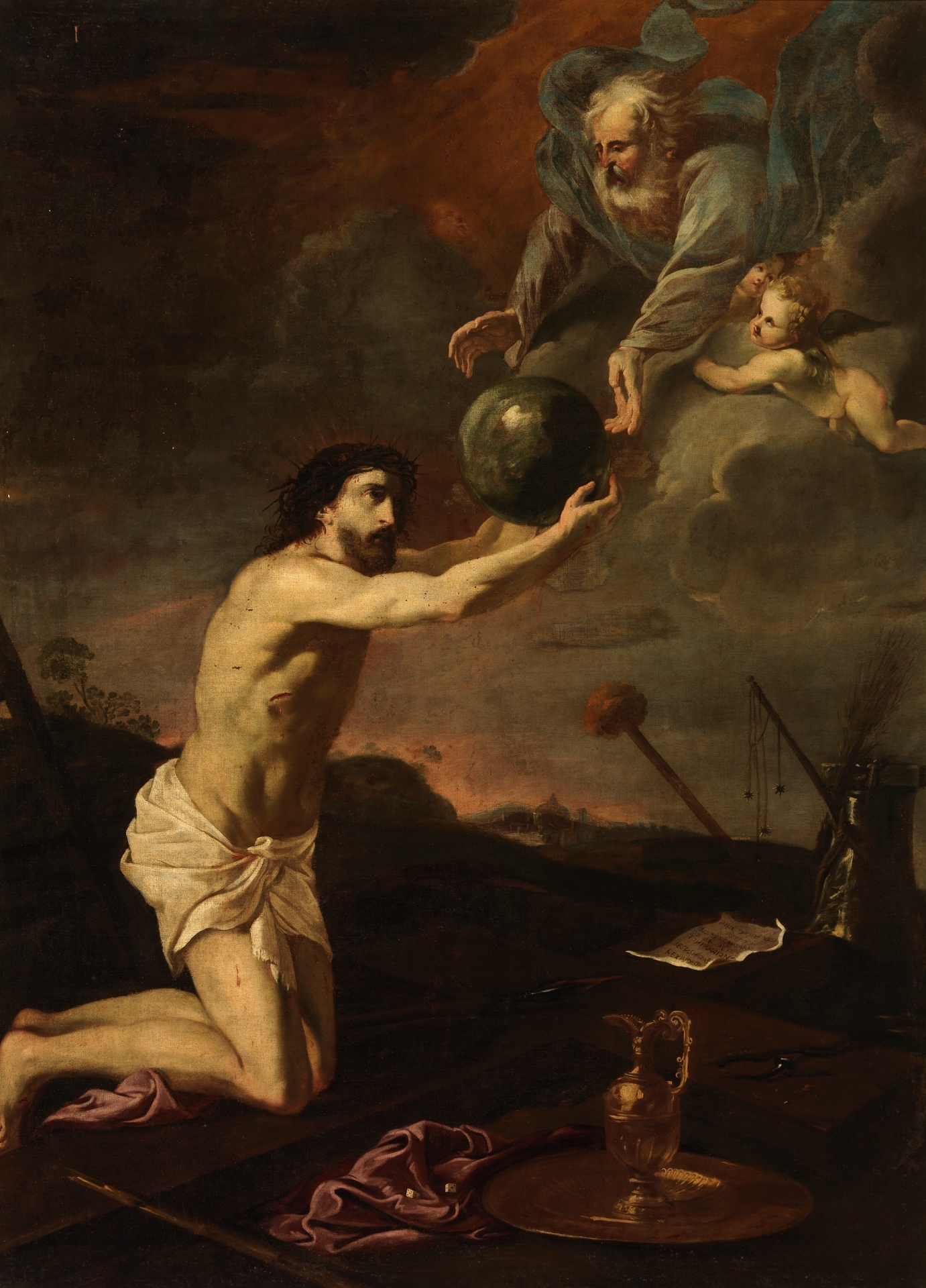
Jesus Receiving the World from God the Father (c. 1657) by Antonio Arnas Fernández

God bless.

Lent Day 10: Save your pennies

TODAY’S READINGS

Today’s Gospel (Mt 5:20-26), from the Sermon on the Mount, ends with these words of Jesus:

“Amen, I say to you,
you will not be released until you have paid the last penny.”
(v. 26)

“Keeping debtors in prison until family or friends paid off the debts was a Roman rather than Old Testament practice. Jesus uses this practice as a comparison for what happens to those who face God’s judgment without having been reconciled with others (see 18:33-35 for another us of this comparison). Being required to pay off debts down to the last penny means being held accountable by God fro all that we do or fail to do. A failure to seek reconciliation with those who have something against us will not go unnoticed when we stand before God’s judgment.” (Bringing the Gospel of Matthew to Life, 87)

I’ve always found this last line in the section about unrighteous anger consoling. It seems quite plain to me that this verse indicates the reality of Purgatory (I encourage you to read this entire post that deals with just this verse and topic). Clearly this entire pericope is speaking of judgment and the consequences of our actions on how we will be judged. Yes, Gehenna is really a possibility (and, no, it’s not empty), as Jesus says, but for those who do not make a complete break with God, but who need some cleaning up, there is the consolation of a place of purgation. Not knowing the pain of this state, and aiming for heaven, we should hearken to the fact, as the old commercial stated, that “you can pay me now, or pay me later.” Take care of penance and reparation here and now.

Let us pray that our anger does not get the best of us here, and if it does, that we make amends quickly and completely, so that our debt owed is not exorbitant, and our time away from God is short.

And let us not forget the poor debtors, exemplified in the drawing below, who have preceded us in death and are begging for our alms (Masses and other prayers) in order to be released soon.

An inmate of ‘the grate’ at Fleet Prison, a debtors’ prison in London, circa 1840. The words ‘Poor Debtor’ are inscribed on the right wall. ‘The grate’ allowed prisoners to beg for charity from passers-by. Published in the Illustrated London News – pub. 14th March 1846 (Photo by Hulton Archive/Getty Images)

God bless.

Lent Day 7: To forgive is divine

TODAY’S READINGS

Jesus reiterates this sentiment immediately after teaching the Our Father (Mt 6:7-15):

“If you forgive men their transgressions,
your heavenly Father will forgive you.
But if you do not forgive men,
neither will your Father forgive your transgressions
.” (vv. 14-15)

“A God who forgives is a wonderful God. But if God, who is thrice-holy, has mercy on the sinner, how much more ought we to forgive others — we sinners, who know from our own experience the wretchedness of sin. No one on earth is perfect. Just as God loves us, even though they have defects, and forgive them. If we wait to love people who have no defects, we shall never love anyone. If we wait until others mend their ways or apologize, we will scarcely ever forgive them. But then we ourselves will never be forgiven. ‘All right: that person has behaved badly towards you. But, haven’t you behaved worse towards God?’ (Bl. J. Escriva, The Way, 686)” (The Navarre Bible: St Matthew, 76)

I was a bit surprised that most of my commentaries either said very little or nothing about these two verses. What has long impressed me about this short passage is that it seems to put an exclamation mark on the Lord’s Prayer that Jesus just taught. The Our Father has seven petitions, but none more challenging than the one having to do with forgiveness. It’s as if Christ, driving home the point, is saying: You heard me right: Forgiveness is mandatory. Do not expect God’s mercy on your judgment day if you were unable to extend mercy to others during the time I gave you on earth..

Consider The Parable of the Unforgiving Servant (Mt 18:21-35). Being “handed…over to the torturers”? Jesus, the Divine Physician, gives us some tough medicine, focusing on where it hurts, to raise our awareness of this tender spot so that we can take care of it and find healing.

If Jesus, the perfectly innocent one, can, from the cross, forgive His creatures of their brutality toward the God-Man, who are we sinners to hold back even under the most difficult circumstances. It is not easy to forgive, particularly when the offense is egregious, but it is what we must do. Let us pray — and never cease praying — to forgive.

God bless.

Christmas Day 13 (Bonus!): Christus Victor!

TODAY’S READINGS

While today, January 6, is traditionally Epiphany, since that feast has been moved to Sunday, we get an extra day of the Christmas Season. The first reading is from 1 Jn 5:5-13. This first letter from the beloved disciple is so rich and powerful, it has been a wonderful companion during much of this joyous season.

Who indeed is the victor over the world
but the one who believes that Jesus is the Son of God?
(v. 5)

“This is another case of Johannine shorthand: by ‘faith’ and ‘believes’ John sums up all that comes through this faith — confession of Jesus as the true Son of God, abiding in Christ, the life and witness of the Spirit within, and the power of God through our fellowship with him. It is by our faith that we are enabled to overcome the disordered desires of the world, to proclaim the gospel, to endure persecution, to love our enemies, even to change the world. As Rev 12:11 says, ‘They conquered him by the blood of the Lamb / and by the word of their testimony; / love for life did not deter them from death.” (James, First, Second, and Third John [Catholic Commentary on Sacred Scripture], 226)

Powerful stuff, huh? ”Victor over the world”? The devil’s playground? Yes, we have victory if we believe, and by that is meant not simply faith but faith working through love. Note the commentary above regarding what needs to be done (for starters): overcoming disordered desires, proclaiming the Gospel (through word and deed), enduring persecution, and loving our enemies. Would not we be looking at a very different planet if these traits were overwhelmingly predominant? There are plenty of self-help books on the market, but there is only one Word we need in order to change the world — beginning by changing ourselves.

Christ has conquered the world, the flesh, and the devil through His life, death, Resurrection, and Ascension. He invites us to join Him in taking up our cross to make a difference here and to ultimately inherit eternal life (hopefully bringing many souls with us — see Lk 15:7).

Just a quick note on the last line of the Gospel reading, in which God the Father speaks to God the Son from the heavens upon the latter’s baptism:

“You are my beloved Son; with you I am well pleased.” (Mk 1:11)

All of us who are baptized are children of God. Made, not begotten, it’s true, but really brothers and sisters in Christ. Would not we all love to hear these words from the Father, much less our earthly fathers? Would we actually hear these words based on the state of our lives right now? Maybe for some things and not for others? What is lacking? Worth pondering deeply every day before our judgment day.

God bless.

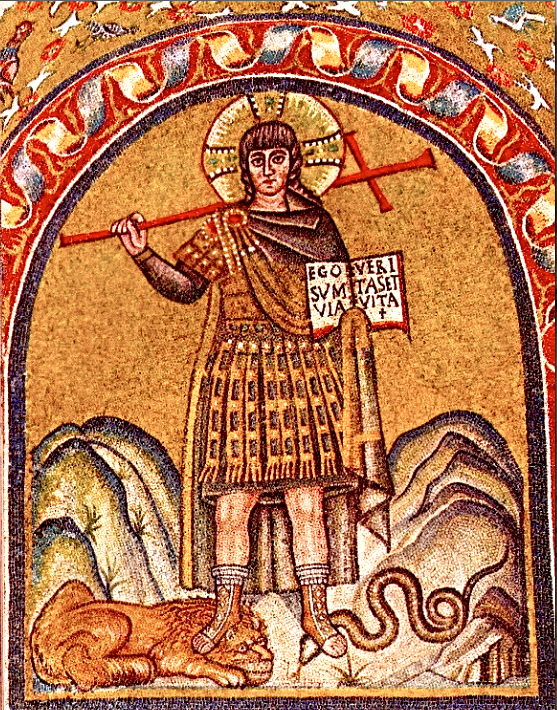
This fifth century mosaic, inspired by Psalm 91, is located in the Archiepiscopal chapel in Ravenna. Christ is represented as a chivarlic Emperor, holding not a sword, but a cross over his shoulders because His kingdom is of an utterly radical life-giving and evil-conquering nature, unlike the kingdoms of the Fallen World System. The book He holds open that reads, “I am the way, the truth and the life.”

Christmas Day 12: Angels and the Son of Man

TODAY’S READINGS

The Gospel reading is from Jn 1:43-51. Jesus continues to accumulate followers, this time picking up Philip and then Nathanael, astonish him after his initial skepticism about Jesus. After an amazing declaration of faith by Nathanael, Jesus tells him and those with him:

“Amen, amen, I say to you,
you will see the sky opened and the angels of God
ascending and descending on the Son of Man.”
(v. 51)

“The mention of angels ascending and descending from heaven upon something alluded to the theophany, or appearance of God, to Jacob at Bethel (Gen 28:10-19). God appeared to Jacob in a dream and extended to him the covenantal promises made to Abraham and Isaac. When he awoke, Jacob said, ‘How awesome this place is! This is nothing else but the house of God, the gateway to heaven!’ (Gen 28:17). Jacob anointed a stone there with oil and name the place ‘Bethel,’ which means ‘the house of God’ (28:18-19).

“Jesus combines two important themes from this Jacob story into his title ‘Son of Man.’ The first is revelation. At Bethel, the Lord revealed himself to Jacob in a dream: now he reveals himself directly and physically in Jesus. The second theme is God’s dwelling place. Jacob referred to the site where the Lord appeared to him as Bethel, ‘the house of God.’ Now, ‘the Word became flesh / and made his dwelling among us’ (1:14). Jesus is the direct, physical dwelling of God among human beings; because God has taken on human nature in Jesus, Jesus reveals God in a new, unsurpassable way. The incarnate Word is the new ‘house of God,’ where the glory of the Lord is present and sensible, and is ‘the gateway to heaven’ (Gen 28:17). The fulfillment of Jesus’ promise — the revelation of God in Jesus who becomes humanity’s gateway to heaven — will be the substance of the rest of the Gospel.”” (The Gospel of John [Catholic Commentary on Sacred Scripture], 51-52)

“Jesus puts himself in the center of this vision, claiming that (1) he is the place where heaven touches down to earth; (2) he is the true house of God; and (3) he is the mediator through whom the angels exercise their ministry.” (The Ignatius Catholic Study Bible: The New Testament (San Francisco: Ignatius Press, 2010), 164)

In the second century, a man names Marcion (possibly a bishop), wanted to disconnect Christianity from Judaism entirely. One significant way to do that was to eliminate the Old Testament as a source of inspired Scripture (there was more to it — see here). Today’s Gospel reading is one of countless examples of why eliminating the OT, or even just having a deficient knowledge of it, is so problematic.

St. Augustine famously said:

The New Testament lies hidden in the Old Testament, and the Old becomes manifest in the New.

How true! Without knowing the story of Jacob’s ladder (Gen 28:10-19), the significance of Jesus’ words would be lost on us (they surely were not lost on his first hearers).

This last month or so, I have been highlighting in these posts the value of good Catholic commentaries. They are invaluable in explicating the sometimes confusing, and sometimes apparently straightforward, texts of the Bible. There is hardly a passage one encounters between the covers of Sacred Scripture that cannot be delved into for deeper meanings on a number of levels (see here regarding the senses of Scripture).

CHRISTMAS IS NEARLY OVER!

It seems fitting on the twelfth day of Christmas to listen to the famous song we all sang at some point growing up. I again turn to Pentatonix, which has a delightfully funky version of the tune.

And what about the meaning of the days? Check out this interesting history.

We are not quite done though. Epiphany will be celebrated Sunday, and then back to Ordinary Time. But, this year, let us appreciate how extraOrdinary it is.

God bless.

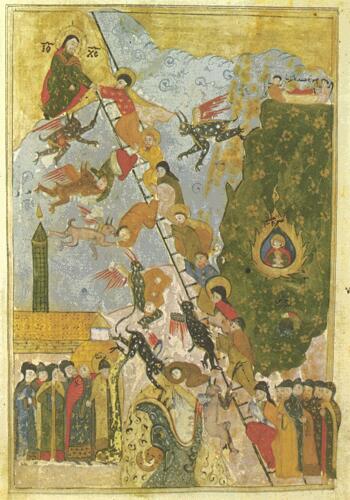
The Ladder of Divine Ascent. SINAI FESTAL ICON.

Christmas Day 11: What are you looking for?

TODAY’S READINGS

The Gospel reading is from Jn 1:35-42. Jesus begins to accumulate followers, the first ones at the prompting of John (he must decrease and Christ must increase). Jesus asks a question and the new apostles ask a question. Both are worth thoughtful consideration.

Jesus turned and saw them following him and said to them,
“What are you looking for?”
They said to him, “Rabbi” (which translated means Teacher),
“where are you staying?”
He said to them, “Come, and you will see.”
So they went and saw where he was staying,
and they stayed with him that day.
(vv. 38-39)

“[I]t is not merely natural curiosity but Christ’s personalty which attracts them. They want to get to know him, to be taught by him, to enjoy his company. ’Come and see’ (1:39; cf. 11:34) — a tender invitation to begin that intimate friendship they were seeking. Time and personal; contact with Christ will be needed to make them more secure in their vocation…

“Christian faith can never be just a matter of intellectual curiosity; it affects one’s whole life: a person cannot understand it unless he really lives it; therefore, our Lord does not at this point tell them in detail about his way of life; he invites them to spend the day with him…what God is (in himself or in grace) can only be understood through experience…” (The Navarre Bible: St John, 55)

“The two disciples of John respond to Jesus’ invitation, setting an example for all whom Jesus will invite to himself…[T]he word for ‘stay’ can also be translated ‘remain’ or ‘abide’ expressing an intimate and lasting personal relationship (see 1:32-33; 6:56; 15:4-7). The disciples ‘stayed with him that day’ as the first step in their becoming united with him, remaining in him and in his love (see 15:9-10).” (Bringing the Gospel of John to Life, 33)

It seems to me that it is always helpful to answer any of Jesus’ questions ourselves. So, “What are you looking for?” What first comes to mind? A (better) job? A new car? Peace in the family? Healing? All good things. All passing things. By looking for Jesus and looking to do His will, we seek a solid foundation for our lives not only in this life, but in the life to come. Consider Jesus words elsewhere in the Gospels:

There is need of only one thing. Mary has chosen the better part and it will not be taken from her. (Lk 10:42)

“Only one thing,” and the rest falls into place. John, in today’s Gospel, encourages the same of his disciples. Surely, he anticipated St. Augustine’s famous line from the first page of his Confessions:

You move us to delight in praising You; for You have made us for Yourself, and our hearts are restless until they rest in You.

As for asking Jesus, “Where are you staying?”, hopefully the first answer is “In my heart.” But it should prompt us to visit Him, really present, in the Blessed Sacrament, even if just for a few moments. What a tremendous privilege of which so few of us take advantage.

Not the same, but here is a live adoration site that I particularly love. Another, closer to (my) home in a church I have visited.

ST ELIZABETH ANN SETON (1774-1821)

The first American-born canonized saint. A wonderful and inspiring story of a woman who truly embraced the universal call to holiness.

I am reminded of my friend, Sr. Elizabeth Ann Brady, who I used to visit in the 1990’s and early 2000’s at a retirement home for religious. She had been an elementary school teacher for some seventy years. One of the kindest and most joyous persons one could hope to meet. She died at 97 almost twenty years ago to the day. I would bet she is hanging out with the other Elizabeth Ann as I type, but I still pray for my friend often.

God bless.

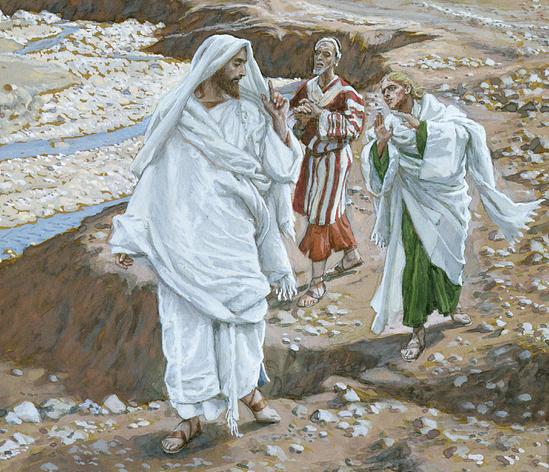
The Calling of Saint John and Saint Andrew (1886-1894) by James Tissot

Christmas Day 10: Unknown children

TODAY’S READINGS

The first reading is from 1 Jn 2:29–3:6, picking up where we left off yesterday. It is incredible news and a sobering note.

See what love the Father has bestowed on us
that we may be called the children of God.
Yet so we are.
The reason the world does not know us is that it did not know him.
(v. 1)

“God the Father has loved us to such an extent that we have the immense privilege of being called his children…We are children of God not in name only or merely as a title of honor. Christians truly have become God’s children in a new way through the saving work of Christ: ‘To all who received him, who believed in his name, he gave power to become children of God, who were born, not of blood or of the will of the flesh or of the will of man, but of God’ (John 1:12-13 NRSV)…

“The fact that we are the children of God explains why the ‘world’ does not recognize us for what we are. Just as those who belong to the world failed to recognize Christ himself and his Father, so they clearly will not know or recognize those who are begotten of God. As children, we are like the Father and the true Son, Jesus Christ, and so we should expect to experience th same rejection that Christ received.” (James, First, Second, and Third John [Catholic Commentary on Sacred Scripture] , 180)

“‘This is the great boldness of the Christian faith — to proclaim the value and dignity of human nature and to affirm that we have been created to obtain the dignity of children of God, through the grace that raises us up to a supernatural level. An incredible boldness it would be, were it not founded on the promise of salvation given us by God the Father, confirmed by the blood of Christ, and reaffirmed and made possible by the constant action of the Holy Spirit’ (Christ is passing by, 33). (The Navarre Bible: Catholic Epistles, 178-179)

What an astounding passage we are highlighting here! That we poor creatures, who would not exist without God and can do nothing good without God, can be made children of God and can choose to ultimately be with this benevolent Father for all eternity. We same creatures whose first parents were gravely disobedient, whose descendants repeatedly spurned God for idols, and who ultimately murdered God, can be reconciled with Him — and more than that — become like God. This is Good News! Like Jeremiah, whom we spoke of a few short days ago, how possibly can we keep this fire inside? And how can we not fail to strive for holiness with the promise of heaven if we live as we profess to believe?

Yet, we can often feel “unknown” when we speak about and live our faith. If our imitation of Christ makes us off-putting to some, so be it. These do not recognize Christ in us, or worse they do and want no part of us/Him. Let us pray that God will use our good example to bring others to Him, that we will make clear to those we encounter the goodness of God and His desire that all persons be saved (see 1 Tim 2:3-4).

God bless, brothers and sisters in Christ (isn’t it wonderful to be related!). I invite you to say an Our Father, recalling our relationship with God and our fellow baptized (all the Communion of Saints).

God bless.

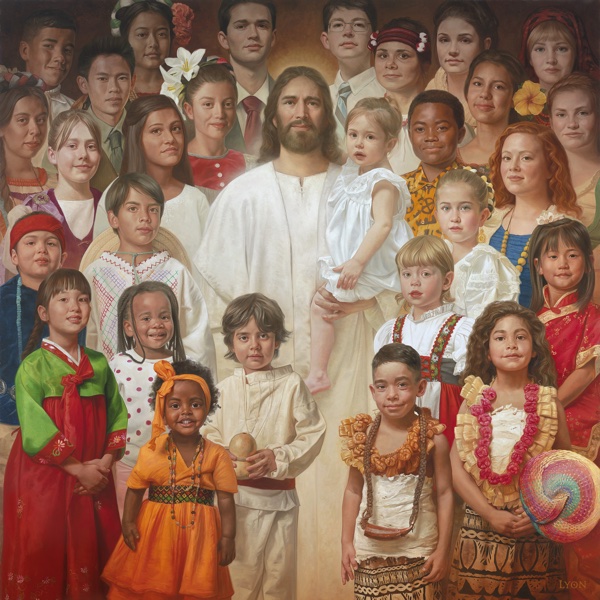
I Am a Child of God (contemporary) by Howard Lyon

Christmas Day 9: LIAR!

TODAY’S READINGS

The first reading is from 1 Jn 2:22-28. We’ve heard quite a lot from John’s first letter in recent days. Today we get a powerful excerpt regarding Jesus’ messiahship and divinity.  I focus here on the first two verses, because they pack such a wallop.

Who is the liar?
Whoever denies that Jesus is the Christ.
Whoever denies the Father and the Son, this is the antichrist.
Anyone who denies the Son does not have the Father,
but whoever confesses the Son has the Father as well.
(vv. 22-23)

“It is evident that John is concerned here for the basic confession of faith regarding the true identity of Jesus Christ.

“But what exactly were these ‘antichrists’ denying? This is not entirely clear, but as we piece together the evidence from the letter, it appears that they were denying that the Son of God (who was ‘in the beginning’ with the Father) actually took flesh and became a human being in the incarnation. They were denying that Jesus truly was the ‘Christ’ — that is, the Messiah or anointed one — who came from the Father for our salvation. ’The Lie par excellence is that which refuses to see the Godhead shine in the human life and death of Jesus’ (F. F. Bruce, The Epistles of John: Introduction, Exposition, and Notes [London: Pickering & Inglis, 1970], 73). For John, this is the core activity of the antichrist: to deny the true incarnation of the Son of God sent from the Father…

“If we deny the truth about the Son, then we lose the Father as well; if we confess and believe in the Son as the faith teaches, then we gain the Father as well. ’Whoever does not honor the Son does not honor the Father who sent him’ (John 5:23).” (James, First, Second, and Third John [Catholic Commentary on Sacred Scripture] , 171, 172)

We know well the devil is a liar, even from the very beginning (see Jn 8:44 and, of course, Gn 3). Who else ultimately inspires a denial of the divinity of Christ and His redemptive mission? 

Now John was likely calling out pseudo-Christians, who, for whatever reason, denied or altered basic doctrine regarding the nature of Christ. They exchanged the truth for a lie, whether wittingly or unwittingly, to deceive or when expressing real (albeit misguided) conviction. Regardless, it is terribly damaging in its potential to lead persons astray.

Consider throughout the ages those who deny Christ is who He says He is. Consider also that this denial gives them no access to the Father of Jesus — no access to God at all! Jesus says to Thomas (and us) during the Last Supper discourse:

“I am the way and the truth and the life. No one comes to the Father except through me.
If you know me, then you will also know my Father. From now on you do know him and have seen him.” (Jn 14:6-7)

Those who follow some other (or no other) religion are perpetuating a lie. Some unknowingly perhaps. Others, in many cases, with strong conviction of their own beliefs. Does God actively will religions outside His Church? Obviously not! Scripture says,

God our savior…
wills everyone to be saved and to come to knowledge of the truth.
For there is one God.
There is also one mediator between God and the human race,
Christ Jesus, himself human,
who gave himself as ransom for all. (1 Tm 2:3-6)

While we are to respect others in their religious choices, if they are following a lesser conception of God than is true, we should love them enough not to leave them there. Jesus’ call to evangelization is absolute (see Mt 28:19). This should not be difficult. If we have good news in our personal affairs we can’t wait to let others know. When we have the Good News (“Gospel”) in our hearts, we shouldn’t be able to hesitate to let others know through word and deed. Lord grant us to be like Jeremiah:

I say I will not mention him,
I will no longer speak in his name.
But then it is as if fire is burning in my heart,
imprisoned in my bones;
I grow weary holding back,
I cannot! (Jer 20:9)

God bless.

Christmas Day 8: Pondering is not ponderous

TODAY’S READINGS

The Gospel reading from Lk 2:16-21 focuses on Blessed Mary and the infant Jesus — appropriate for the Christmas Season and this day when we consider the baby Messiah as what He was: the Second Person of the Trinity incarnate, making His bearer the Mother of God.

Mary kept all these things,
reflecting on them in her heart.
(v. 19)

“In very few words this verse tells us a great deal about our Lady. We see the serenity with which she contemplates the wonderful things that are coming true with the birth of her divine Son. She studies them, ponders them and stores them in the silence of her heart. She is a true teacher of prayer. If we imitate her, if we guard and ponder in our hearts what Jesus says to us and what he does in us, we are well on the way to Christian holiness and we shall never lack his doctrine and his grace. Also, by meditating in this way on the teaching Jesus has given us, we shall obtain a deeper understanding of the mystery of Christ, which is how ‘the Tradition that comes from the Apostles makes progress in the Church, with the help of the Holy Spirit. There is a growth in insight into the realities and words that are being passed on. This comes about in various ways. It comes through the contemplation and study of believers who ponder these things in their hearts. It comes from the intimate sense of spiritual realities which they experience. And it comes from the preaching of those who have received, along with their right of succession in the episcopate, the sure charism of truth’ (Vatican II, Dei verbum, 8).” (The Navarre Bible: St Luke, 56)

“Mary ‘kept all these things’: the Greek word ‘kept’ has connotations of preserving something, being concerned about it, treasuring it. Mary treasured the events that had unfolded, ‘reflecting on them in her heart.’ The Greek word for ‘reflecting on’ means putting things together, pondering them. In the biblical view, the ‘heart’ is the seat of thinking and feeling and willing. Mary takes to heart to amazing things that are happening and tries to fathom their meaning. ’Mary’ is a model of treasuring all that God says and does, meditating on his word, pondering his plans for our lives.” (Bringing the Gospel of Luke to Life, 64)

We encounter a lot of action words in the two commentaries above: contemplating, pondering, reflecting, meditating, studying, experiencing, storing, guarding, preserving, treasuring, preaching, understanding. A full program for our lives, not only in prayer, but also in action. As a new year begins, it is worth working through each of these aspects of our consideration of Jesus as we imitate His mother. Consider looking up each of these twelve words in a regular dictionary and cycle through them throughout the year. How best do we implement in our own minds and hearts, contemplating Jesus, studying about Jesus, really experiencing Jesus, understanding Jesus’ message to the world and to us, personally, etc. Ask Blessed Mary for her intercession, invoke the same Spirit through whom she conceived a child for guidance, and ask Gabriel and your angel for their prayers; our sincerity in these petitions will certainly be profitable.

RECOMMENDED BOOKS I READ IN 2023

YEAR SCARY

I was disappointed to knock off on twenty-five books last year. Summer got really messed up, so that prime time yielded nearly no results. Of those I read, only a handful stood out, including some great classics. I list them below. You can check out Goodreads where I’ve done short reviews for almost all of these. In no particular order:

YEAR: SCARY

I can’t shake the feeling that, considering the escalating difficulties the world over, we are in for a year that may make 2020 seem like a walk in the park. Challenges: hear and abroad, in the Church or directed at the Church.

Let us pray for all veterans and clergy..

Happy New Year. As today began with much joy amidst the noise, let us hope it at least maintains the whole year through.

God bless.

Christmas Day 7: The Righteous brothers

TODAY’S READINGS

The first reading I chose to explore (there are options for each of today’s first two readings and the responsorial psalm) is Gn 15:1-6; 21:1-3, where God’s promise of descendants for Abram and his elderly wife comes to fulfillment.

Abram put his faith in the LORD,
who credited it to him as an act of righteousness.
(v. 6)

“In the light of this passage, St. Paul sees Abraham as the model of how a person becomes righteous in God’s eyes — through faith in his word, the definitive word being the announcement that God saves us through the death and resurrection of Jesus. In this way, Abraham not only becomes the father of the Jewish people according to the flesh, but also the father of those who without being Jews have become members of the new people of God through faith in Jesus: ‘We say that faith was reckoned to Abraham as righteousness. How then was it reckoned to him? Was it before or after he had been circumcised? It was not after, but before he was circumcised. He received circumcision as a sign or seal of the righteousness which he had by faith while he was still uncircumcised. The purpose was to make him the father of all who believe without being circumcised and who thus have righteousness reckoned to them, and likewise the father of the circumcised who are not merely circumcised but also follow the example of the faith which our father Abraham had before he was circumcised’ (Rom 4:9-12).

“Abraham’s faith revealed itself in his obedience to God when he left his homeland (cf. 12:4), and later on when he was ready to sacrifice his son (cf. 22:1-4). This is the aspect of Abraham’s obedience which is given special emphasis in the letter of St. James, inviting Christians to prove the genuineness of their faith with obedience to God and good works: ‘Was not Abraham our father justified by works, when he offered his son Isaac upon the altar? You see that faith was active along with his works, and faith was completed by works, and the scripture was fulfilled which says, “Abraham believed God, and it was reckoned to him as righteousness”; and he was called the friend of God.’ (Jas 2:21-23).” (The Navarre Bible: Pentateuch, 95-96)

Sometimes, in discussions regarding righteousness, Protestants will refer to Romans 4 in defense of sola fide (“faith alone”). But James 2 cannot be ignored or reasoned away. And it certainly cannot be pitted against Paul, as some have tried to do. Here comes into play one of the beauties of Catholic teaching that I often fall back on: “serious attention must be given to the content and unity of the whole of Scripture if the meaning of the sacred texts is to be correctly worked out” (Dei verbum, 12). If anyone ever presents biblical authors contradicting each other on matters of faith and morals, run for the hills! Catholic Answers, as usual, is again helpful here.

The second reading I chose is Heb 11:8, 11-12, 17-19. This gives us another aspect of faithfulness from a different episode in Abraham’s life, at least a dozen or more years after Gen 15.

By faith Abraham, when put to the test, offered up Isaac,
and he who had received the promises was ready to offer
his only son,
of whom it was said,
“Through Isaac descendants shall bear your name.”
He reasoned that God was able to raise even from the dead,
and he received Isaac back as a symbol.
(vv. 17-19)

“That Abraham was willing to carry out this drastic demand, not knowing why or understanding how it could possibly be compatible with God’s sworn word, is the supreme biblical example of obedient faith. [See the James quote above.]

“Abraham ‘reasoned that God was able to raise even from the dead.’ Although Genesis does not say this directly, Hebrews may see it as implied in Abraham’s words to his servants, ‘The boy and I…will worship and then come back to you’ (Gen 22:5). Having experienced God’s faithfulness in the birth of Isaac, Abraham stretched his faith yet further, trusting that God somehow had a solution to this terrible ordeal. And in the very act of sacrifice, when Abraham had totally given up on his son, God intervened and gave back to him that which he surrendered. So ‘he received Isaac back as a symbol.’ Isaac’s restoration to his father is a figure pointing to Christ, the only-begotten Son who was sacrificed not only in intention but in reality, and who was restored in his resurrection from the dead.” (Hebrews [Catholic Commentary on Sacred Scripture], 242)

I recall some years back, a former classmate of mine posting on social media concerns about the Abraham-Isaac episode involving the sacrificing of the latter. He was struggling greatly with how God could demand such a sacrifice and how Abraham could even entertain it, much less carry it out. I related this passage from Hebrews to him. He seemed to find it helpful, although to what extent, I never learned. One other passage from the biblical incident itself I believe is telling: When asked by his son where the sacrifice is, Abraham answered, “God will provide himself the lamb for a burnt offering, my son.” (Gen 22:8, RSV-CE). When Abraham’s hand is stayed, a ram (not a lamb) is offered in his place. But God did provide Himself as a spotless lamb some two thousand years later when the sacrifice was actually carried out.

Finally, in the Gospel (Lk 2:22-40), we read of another righteous, trusting man of God:

This man was righteous and devout,
awaiting the consolation of Israel,
and the Holy Spirit was upon him.
It had been revealed to him by the Holy Spirit
that he should not see death
before he had seen the Christ of the Lord.
He came in the Spirit into the temple…
(vv. 25-27a)

“Being ‘righteous’ means obeying God’s laws (see 1:6); to be ‘devout’ means to revere God and carefully carry out religious duties. Simeon did what God required of him and he hoped for what God promised: he was ‘awaiting the consolation of Israel.’ Many Jews at the time of Jesus had hopes that God would act to restore his people, freeing them from evil and foreign rule, fulfilling promises made through the prophets. Simeon expresses these hopes as God’s ‘consolation of Israel,’ echoing prophecies of Isaiah that speak of God’s consolation, or comfort, for his people (Isaiah 40:1; 49:13; 51:3, 12; 52:9; 57:18; 66:13). Consolation has a note of intimacy, of God comforting his people ‘as a mother comforts her son’ (Isaiah 66:13). ’And the holy Spirit was upon him’; the Holy Spirit who filled Elizabeth and Zechariah and John (1:15, 41, 67) and overshadowed Mary to conceive Jesus (1:35) rests upon Simeon. The following verses tell how the Holy Spirit inspires and guides Simeon.” (Bringing the Gospel of Luke to Life, 69-70)

Two other men in the Gospels are referred to as “righteous”; Joseph and John the Baptist, both of whom pious tradition tells us never personally sinned. I don’t know if that was true for Simeon, but being righteous has its rewards, as Jesus tells us that these will go off to eternal life (see Mt 25:46).

POPE BENEDICT XVI: RIP

One year on, particularly considering the confusion and lack of clarity exacerbated over the intervening period, this holy man is missed more than ever. I hear his private sermons are being published — always good to get more of Benedict

A good website to bookmark: https://www.benedictusxvi.com/pope-em-benedict-xvi

A JOYFUL (AND FUNNY) BISHOP

This YouTube channel came to my attention recently. Check out this video interview (although it hardly is an interview as this prelate needs no prompting). You will be entertained and moved.

I never heard of this man before, and I know nothing else about him, but from what I see here, we need many more like him. Let us pray.

SCREWTAPE

Today I finished C.S. Lewis’s The Screwtape Letters, finally. I’ve been meaning to read if for years, and finally worked through it. A lot of great tidbits, but not as impressive (to me, at least) as I anticipated. But the concluding section (“Screwtape Proposes a Toast”) is worth the price of the book. Written in 1959, it nails our time like you wouldn’t believe. DEI anticipated. See the pdf for free.

Happy New Year! Let’s redouble our prayers for our Church and our country in what promises to be the most eventful year in some time.

God bless.