Lent Day 34: Forgiving and Challenging Jesus

TODAY’S READINGS

Today’s Gospel reading (Jn 8:1-11) is the famous episode in which Jesus is brought the woman caught in the act of adultery. It ends with consoling words and a warning:

“Has no one condemned you?”
She replied, “No one, sir.”
Then Jesus said, “Neither do I condemn you.
Go, and from now on do not sin any more.”
(vv. 10b-11)

“Jesus, who is the Just One, does not condemn the woman; whereas these people are sinners, yet they pass sentence of death. God’s infinite mercy should move us always to have compassion on those who commit sins, because we ourselves are sinners and in need of God’s forgiveness.” (The Navarre Bible: St John, 122)

“Jesus strikes a balance, being merciful to a sinner while abhorring the sin. He gives the woman an opportunity to make a new start, not condemned for her past and free to behave differently in the future.” (Bringing the Gospel of John to Life, 229)

“Jesus offers this woman a fresh start by turning her away from her sins and opening her up to God’s infinite mercy.” (The Gospel of John [Catholic Commentary on Sacred Scripture], 153)

“Jesus’ attitude is striking: we do not hear words of scorn, we do not hear words of condemnation, but only words of love, of mercy, which are an invitation to conversion. ‘Neither do I condemn you; go, and do not sin again’ (v. 11). Ah! Brothers and Sisters, God’s face is the face of a merciful father who is always patient. Have you thought about God’s patience, the patience he has with each one of us? That is his mercy. He always has patience, patience with us, he understands us, he waits for us, he does not tire of forgiving us if we are able to return to him with a contrite heart.” (Pope Francis, “Angelus,” 17 March 2013)

Imagine the relief of this poor sinner when Jesus saved her life and then showed such mercy! Why had she indulged in this sin? Why did she keep indulging in it (I’m guessing her indiscretion was widely known since the Pharisees conveniently found her in the act in order to try to trap Jesus). She was being used twice: first by her illicit lover, then by the Pharisees. Now she escapes the death sentence scot-free. But wait. The ongoing condition is now placed upon her: “do not sin anymore” or maybe a better translation is “stop sinning.”

We don’t know what happened to this woman. One thing for sure: her encounter with the Lord changed her forever. Is she one of the many unnamed saints? I like to think so. Imagine the story she could have told, must have told, of this, in turn, harrowing and blessed encounter, if not immediately then in her golden years.

Jesus provides challenges to us constantly. We all love the forgiveness part — we get it and do nothing to deserve it. Harder is the stop sinning part. Yes, we may have very good intentions, even a firm resolution, to mend our ways — until we try to get out of the crowded parking lot, or when following the slowpoke on the road, or when checking our emails or texts, or when dealing with a family member, or during a tough day at work. The list goes on.

The answer: frequent prayer, regular recourse to the sacraments, self-discipline. Stop sinning? Grace does not make it easy but it does make it possible. Let us open our hearts to the grace God is so willing and desiring to give us in the sacraments and we will see progress.

Christ and the Adulterous Woman (1881) by Rodolpho Bernardelli

God bless.

Lent Day 26: John 3:16

TODAY’S READINGS

Today’s Gospel (Jn 3:14-21) has a listen to the nocturnal encounter between Jesus and an interested Pharisee, Nicodemus. It yields one of the most referred to and quoted lines in all of Scripture:

“For God so loved the world that he gave his only Son,
so that everyone who believes in him might not perish
but might have eternal life.”
(v. 16)

gave his only-begotten Son: The earthly mission of Jesus is part of the heavenly plan of the Father, who displays the depth of his love through the sacrifice of his Son (Rom 5:8; 1 Jn 3:16; CCC 219). This verse marks a transition from the dialogue between Jesus and Nicodemus (3:1–15) to an extended monologue by either Jesus or the evangelist himself (3:16–21). eternal life: The expression refers both to the divine quality of new life in Christ as well as its duration. We receive this gift already on earth in the hope that we will possess it irrevocably in heaven (10:10; 1 Jn 5:13). (Ignatius Catholic Study Bible: The Gospel of John, 23)

“God’s love for Israel is compared to a father’s love for his son. His love for his people is stronger than a mother’s for her children. God loves his people more than a bridegroom his beloved; his love will be victorious over even the worst infidelities and will extend to his most precious gift: ‘God so loved the world that he gave his only Son.'” (CCC 219)

God loves the world. That’s something, isn’t it? We are reminded of Genesis 1 in which God finds all He created good and, culminating with humans, very good. Objectively, there is nothing wrong with the world — God don’t make junk, as used to be a popular saying. It’s humans who caused it to fall, but it is God, through His Son, who redeems it, and who promised a “new heavens and a new earth” at the end of time.

So, believe! And not the easy-believism that says, “I’ve accepted Jesus as my personal Lord and Savior” so now I can do what I want. It means to know Jesus and what He commanded and strive to follow it perfectly. Jesus gives far too many warnings about straying from the narrow path to think any differently.

BP BARRON’S SUNDAY SERMON

God bless.

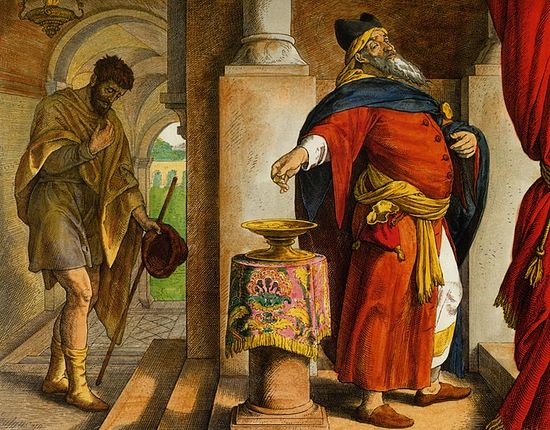
Lent Day 25: ‘O God, be merciful to me a sinner.’

TODAY’S READINGS

Today’s Gospel (Lk 18:9-14) gives us the Parable of the Pharisee and the Tax Collector. Jesus is making few friends with the former group but is giving hope to the latter. The words of the tax collector in prayer are extolled by Jesus:

“‘O God, be merciful to me a sinner.’” (v. 13b)

“[The tax collector] asked God to ‘be merciful’ (hilaskomai) to him. This verb…occurs only once elsewhere in the New Testament, where it means to ‘expiate’ or make atonement for sin (Heb 2:17). Such ‘sacrificial overtones’ fit the parable’s temple setting, all the more so if the prayer occurs at the time of the daily sacrifice.” (The Gospel of Luke [Catholic Commentary on Sacred Scripture], 304)

“‘Prayer is the raising of one’s mind and heart to God or the requesting of good things from God.’ But when we pray, do we speak from the height of our pride and will, or ‘out of the depths’ of a humble and contrite heart? He who humbles himself will be exalted; humility is the foundation of prayer, Only when we humbly acknowledge that ‘we do not know how to pray as we ought,’ are we ready to receive freely the gift of prayer. ‘Man is a beggar before God.'” (CCC 2559)

“With bold confidence, we began praying to our Father. In begging him that his name be hallowed, we were in fact asking him that we ourselves might be always made more holy. But though we are clothed with the baptismal garment, we do not cease to sin, to turn away from God. Now, in this new petition, we return to him like the prodigal son and, like the tax collector, recognize that we are sinners before him. Our petition begins with a ‘confession’ of our wretchedness and his mercy. Our hope is firm because, in his Son, ‘we have redemption, the forgiveness of sins.’ We find the efficacious and undoubted sign of his forgiveness in the sacraments of his Church.” (CCC 2839)

Humility is the gem-casket of all virtues. We are to put the onus on ourselves for our sins, faults, and shortcomings. It is easy to blame others for paving the way toward our own indiscretions, but keeping it simple is the way to go. Acknowledge we’re sinners and beg for the Almighty’s mercy. We know better and yet we fall so many times.

“What I do, I do not understand. For I do not do what I want, but I do what I hate. Now if I do what I do not want, I concur that the law is good. So now it is no longer I who do it, but sin that dwells in me. For I know that good does not dwell in me, that is, in my flesh. The willing is ready at hand, but doing the good is not. For I do not do the good I want, but I do the evil I do not want. Now if [I] do what I do not want, it is no longer I who do it, but sin that dwells in me.” (Rom 7:15-20)

Paul has the right attitude. While a sinner like all of us, he recognizes sin, its source, and its detrimental effects. Half the battle is acknowledging the wrongdoing we do; then resolve to overcome it (with God’s grace of course). I’m reminded of the AA 12-step program: admit our powerlessness and humbly ask God for help.

It seems to me that the words of the publican are worth incorporating into our daily prayer time. Let’s resolve to do so.

THE LITANY OF REPARATION IN THE BLESSED SACRAMENT

A beautiful prayer that acknowledges sins against the Eucharist and our sorrow for these outrages with a desire to make amends. Thanks to Dr. John Bergsma for sharing this in today’s Exodus & Exile episode.

God bless.

Lent Day 21: 77x

TODAY’S READINGS

Today’s Gospel (Mt 18:21-35) gives us the chilling Parable of the Unforgiving Servant; it is prompted by the following interaction:

Peter approached Jesus and asked him,
“Lord, if my brother sins against me,
how often must I forgive him?
As many as seven times?”
Jesus answered, “I say to you, not seven times but seventy-seven times.”
(vv. 21-22)

“Some later rabbis considered three times to be a sufficient cap on forgiving someone for the same offense. If that view was prominent in Jesus’ day, Peter may have understood his suggestion of seven times to be quite generous, reflecting Christ’s emphasis on forgiveness (see 6:12, 14-15).

“Jesus’ response, however, is not seven times but seventy-seven times. This hyperbole is not meant to limit forgiveness to the high level of seventy-seven instances, but to express a boundless willingness to forgive one’s brother. The increase from seven to seventy-seven recalls Lamech, who appears last in the genealogy of Cain’s family, a family that was filled with immorality, murder, and vengeance. Lamech boasts, ‘If Cain is avenged sevenfold, then Lamech seventy-sevenfold’ (Gen 4:24). Just as Cain’s descendants responded to their enemies with unlimited vengeance, so Christians should respond to sins committed against them with limitless forgiveness.” (The Gospel of Matthew [Christian Commentary on Sacred Scripture], 234)

“What we human beings cannot possibly do on our own becomes possible because the incarnate Word infuses into our fallen nature the Father’s eternal capacity and desire to forgive. By his statement ‘I say to you seventy-seven times’, Jesus is communicating to Peter not so much an abstract moral truth as the actual capacity to live that truth. A brother must always be forgiven because he and I are children of the same Father and brothers of the same Jesus, and the children cannot fall beneath the level of the divine Father and Brother; for if they do, what is then the basis of the blood relationship and life they share?” (Fire of Mercy, Heart of the Word, Vol. II ,644)

Being a Christian is not easy! In fact, it is well nigh impossible…without God’s grace, “the capacity to live that truth.” Even one act of forgiveness may take all of our will power to muster. But seven, never mind seventy-seven. I am reminded of the Scripture:

For my thoughts are not your thoughts,

my thoughts higher than your thoughts.

For as the heavens are higher than the earth,

so are my ways higher than your ways,

my thoughts higher than your thoughts. (Is 55:8-9)

God bless.

Lent Day 18: The robe of grace brings the dead to life

TODAY’S READINGS

Today’s Gospel (Lk 15:1-3, 11-32) is arguably the most famous parable in the Gospels, the Prodigal Son; it starts out this way:

“‘Quickly, bring the finest robe and put it on him;
put a ring on his finger and sandals on his feet.
Take the fattened calf and slaughter it.
Then let us celebrate with a feast,
because this son of mine was dead, and has come to life again…”
(v. 22-24a)

“Mercy – as Christ has presented it in the parable of the prodigal son – has the interior form of the love that in the New Testament is called agape. This love is able to reach down to every prodigal son, to every human misery, and above all to every form of moral misery, to sin. When this happens, the person who is the object of mercy does not feel humiliated, but rather found again and restored to value.

“The father first and foremost expresses to him his joy that he has been ‘found again’ and that he has ‘”‘returned to life.’ This joy indicates a good that has remained intact: even if he is a prodigal, a son does not cease to be truly his father’s son; it also indicates a good that has been found again, which in the case of the prodigal son was his return to the truth about himself…

“The parable of the prodigal son expresses in a simple but profound way the reality of conversion. Conversion is the most concrete expression of the working of love and of the presence of mercy in the human world. The true and proper meaning of mercy does not consist only in looking, however penetratingly and compassionately, at moral, physical or material evil: mercy is manifested in its true and proper aspect when it restores to value, promotes and draws good from all the forms of evil existing in the world and in man. Understood in this way, mercy constitutes the fundamental content of the messianic message of Christ and the constitutive power of His mission.” (Dives in Misericordia as quoted in The Word on Fire Bible: The Gospels, 389)

I chose the verses at top because the homilist at today’s Mass inspired me to think of the robe put on the son as a metaphor for God’s grace covering us, bringing us from death to life, when we confess serious sin. The Lord Jesus lived and died and rose so we may have an abundant life here and for all eternity. We must not discard the grace we receive at Baptism, but if we do through mortal sin, the Divine Doctor is ready, waiting, and eager to heal us through His priest in the confessional. No matter how prodigal we’ve been, the Father is always desiring to embrace us, constantly looking down the road to welcome us back into the fold. Remember, whether you are the prodigal or its your brother, Jesus says:

“[T]here will be more joy in heaven over one sinner who repents than over ninety-nine righteous people who have no need of repentance.” (Luke 15:7)

So, if its you, don’t hesitate to come back and make heaven rejoice. And, if its your fellow human, don’t begrudge the fact that he has made the angels sing.

Bp Barron has an extended commentary on this parable in the same book that was quotes above (pp. 392-400); you should know that you can count on excellent exegesis and splendid spiritual insights from His Excellency. I highly recommend The Word on Fire Bible. Three volumes have come out so far: The Pentateuch, The Gospels, and Acts, Letters, and Revelation. Four more volumes are planned.

Finally, several years ago I read Henri Nouwen’s The Return of the Prodigal Son. I highly recommend this book as it looks at the story through the eyes of all three characters in the parable. Very interesting with profound insights.

The Prodigal Son (1989) by Clark Kelley Price

God bless.

Lent Day 10: Save your pennies

TODAY’S READINGS

Today’s Gospel (Mt 5:20-26), from the Sermon on the Mount, ends with these words of Jesus:

“Amen, I say to you,
you will not be released until you have paid the last penny.”
(v. 26)

“Keeping debtors in prison until family or friends paid off the debts was a Roman rather than Old Testament practice. Jesus uses this practice as a comparison for what happens to those who face God’s judgment without having been reconciled with others (see 18:33-35 for another us of this comparison). Being required to pay off debts down to the last penny means being held accountable by God fro all that we do or fail to do. A failure to seek reconciliation with those who have something against us will not go unnoticed when we stand before God’s judgment.” (Bringing the Gospel of Matthew to Life, 87)

I’ve always found this last line in the section about unrighteous anger consoling. It seems quite plain to me that this verse indicates the reality of Purgatory (I encourage you to read this entire post that deals with just this verse and topic). Clearly this entire pericope is speaking of judgment and the consequences of our actions on how we will be judged. Yes, Gehenna is really a possibility (and, no, it’s not empty), as Jesus says, but for those who do not make a complete break with God, but who need some cleaning up, there is the consolation of a place of purgation. Not knowing the pain of this state, and aiming for heaven, we should hearken to the fact, as the old commercial stated, that “you can pay me now, or pay me later.” Take care of penance and reparation here and now.

Let us pray that our anger does not get the best of us here, and if it does, that we make amends quickly and completely, so that our debt owed is not exorbitant, and our time away from God is short.

And let us not forget the poor debtors, exemplified in the drawing below, who have preceded us in death and are begging for our alms (Masses and other prayers) in order to be released soon.

An inmate of ‘the grate’ at Fleet Prison, a debtors’ prison in London, circa 1840. The words ‘Poor Debtor’ are inscribed on the right wall. ‘The grate’ allowed prisoners to beg for charity from passers-by. Published in the Illustrated London News – pub. 14th March 1846 (Photo by Hulton Archive/Getty Images)

God bless.

Lent Day 7: To forgive is divine

TODAY’S READINGS

Jesus reiterates this sentiment immediately after teaching the Our Father (Mt 6:7-15):

“If you forgive men their transgressions,
your heavenly Father will forgive you.
But if you do not forgive men,
neither will your Father forgive your transgressions
.” (vv. 14-15)

“A God who forgives is a wonderful God. But if God, who is thrice-holy, has mercy on the sinner, how much more ought we to forgive others — we sinners, who know from our own experience the wretchedness of sin. No one on earth is perfect. Just as God loves us, even though they have defects, and forgive them. If we wait to love people who have no defects, we shall never love anyone. If we wait until others mend their ways or apologize, we will scarcely ever forgive them. But then we ourselves will never be forgiven. ‘All right: that person has behaved badly towards you. But, haven’t you behaved worse towards God?’ (Bl. J. Escriva, The Way, 686)” (The Navarre Bible: St Matthew, 76)

I was a bit surprised that most of my commentaries either said very little or nothing about these two verses. What has long impressed me about this short passage is that it seems to put an exclamation mark on the Lord’s Prayer that Jesus just taught. The Our Father has seven petitions, but none more challenging than the one having to do with forgiveness. It’s as if Christ, driving home the point, is saying: You heard me right: Forgiveness is mandatory. Do not expect God’s mercy on your judgment day if you were unable to extend mercy to others during the time I gave you on earth..

Consider The Parable of the Unforgiving Servant (Mt 18:21-35). Being “handed…over to the torturers”? Jesus, the Divine Physician, gives us some tough medicine, focusing on where it hurts, to raise our awareness of this tender spot so that we can take care of it and find healing.

If Jesus, the perfectly innocent one, can, from the cross, forgive His creatures of their brutality toward the God-Man, who are we sinners to hold back even under the most difficult circumstances. It is not easy to forgive, particularly when the offense is egregious, but it is what we must do. Let us pray — and never cease praying — to forgive.

God bless.

Advent Day 9: A Faith Stretcher

The Gospel reading is from Lk 5:17-26 . It is the famous episode of a paralyzed man whose friends tear open a roof to in order to lower him down to Jesus hoping for a healing.

When Jesus saw their faith, he said,
“As for you, your sins are forgiven.”
(v. 20)

“Jesus sees their faith manifest in their actions. The paralyzed man and those carrying him have come to Jesus so that he may be healed. They refused to let anything keep them away from Jesus — not the crowd, not even a solid roof. Their determination is a reflection of their faith, their confidence that Jesus will heal the paralyzed man. Jesus responds to those who come to him in faith. He said, ‘As for you, your sins are forgiven.‘ He addresses the paralyzed man, but instead of healing him of his paralysis, he pronounces that his sins have been forgiven.

“Jesus’ words raise questions. Are the man’s sins the cause of his paralysis? Sin can lead to sickness or infirmity (see 1 Cor 11:29-30). but sickness or afflictions are not infallible indicators of sin (see 13:1-5; John 9:2-3). By granting the man forgiveness rather than healing. Jesus indicates that the man’s greatest need is release from the paralysis of sin, but Jesus does not indicate that the man’s sins are the cause of his physical paralysis.” (George Martin, Bringing the Gospel of Luke to Life: Insight & Inspiration, 145)

I am reminded in this episode of Jesus’ talking about faith to move mountains (see Mt 17:20). Well, these guys may not have moved a mountain, but they certainly engaged in a difficult and unorthodox measure to help their friend due to their faith in what the believed Jesus; could do for him. It is edifying what they were willing and able to do to be with Jesus.

Nevertheless, today, so many Catholics cannot be bothered to go in their cozy cars to Mass once a week. And Confession, to hear those glorious words of absolution from a priest who (by God’s grace and due to their ordination, has the charism to act in the person of Christ) “has authority on earth to forgive sins” (see v. 24)? Perish the thought! We are able to encounter Jesus in all the sacraments, yet the faith of many is so weak, that they won’t take advantage of these great gifts, simple, easy, and accessible as they are. Let us pray for their return to the practice of the Faith, so that we all would have this attitude at Mass and in the confessional:

Then astonishment seized them all and they glorified God,
and, struck with awe, they said,
“We have seen incredible things today.”
(v. 26)

God bless.

The Palsied Man Let Down through the Roof (Le paralytique descendu du toit)
by James Tissot (1886-1896)