Advent Day 24: The Davidic Covenant

TODAY’S FIRST READING (2 Sm 7:1-5, 8b-12, 14a, 16)

FROM 2 Samuel 11b-12, 14a, 16:

“‘The LORD also reveals to you
that he will establish a house for you.
And when your time comes and you rest with your ancestors,
I will raise up your heir after you, sprung from your loins,
and I will make his Kingdom firm.
I will be a father to him,
and he shall be a son to me.
Your house and your Kingdom shall endure forever before me;
your throne shall stand firm forever.'”

From Ignatius Catholic Study Bible: Old and New Testament, page 474

The Davidic Covenant

The Davidic covenant is the latest and greatest of the Old Testament covenants. Following the steady buildup of covenants between God and his people over the centuries, beginning with Adam and continuing with Noah, Abraham, and Moses, the divine covenant with David brings the biblical story to a theological highpoint. Each of these ancient covenants helps to prepare the way for messianic times, but Jewish and ­Christian traditions agree that hopes for a coming Messiah are anchored most explicitly in the Lord’s covenant with David.

Nathan’s Oracle

The foundation of the Davidic covenant is Nathan’s oracle in 2 Sam 7.8-16, which responds to David intention to build a sanctuary for Yahweh. Nathan reveals that the king’s desire, although noble, is not part of God’s plan for his life. Instead, something more wonderful is envisioned. What David wants to do for the Lord hardly compares to what the Lord wants to do for David. This divine plan can be summarized under four headings.

1. Dynasty. Yahweh first pledges to build David a “house” (2 Sam 7:11). By this he means a dynasty, a hereditary line of royal successors, so that his kingdom and his throne will be “established for ever” (2 Sam 7:16). The house of David may have to be disciplined as times and circumstances demand, but the house of David will never be fully disowned like the house of Saul was when the Lord abandoned it on account of Saul’s failings (2 Sam 7:14-15). David’s dynasty will exercise an everlasting rule that is guaranteed by God.

2. Temple. Yahweh’s second pledge responds directly to David’s desire to build a Temple (2 Sam 7:2). The king wishes to begin construction on a worthy sanctuary, but, according to Nathan, the privilege a building a “house” for the Lord will fall to David’s royal “offspring” (2 Sam 7:12-13). This is an allusion to David’s son and successor, King Solomon, who pulls together a massive workforce to construct the Jerusalem Temple after his father’s death (1 Kings 6-8). The Temple thus serves as an architectural sign of the Davidic covenant.

3. Adoption. Yahweh’s third pledge is to create a father-son relationship between himself and David’s royal offspring (2 Sam 7:14). It is a promise that the kings of David’s line will be made sons of God by divine adoption. In this way, the covenant of kingship creates an especially close relationship between Yahweh and the anointed successors of David. It is implied in Ps 2:7 that the royal adoption of each king take place on the day of his coronation.

4. Law for Mankind. In response to the oracle, David senses that God, in pledging himself to these grandiose commitments, is initializing a plan to extend his blessings to the human race beyond Israel. What the Lord has revealed to him is nothing less than torat ha-adam, “the law of mankind” (see note on 2 Sam 7:19). The Law of Moses was a gift for Israel alone; but the covenant arrangement promised to David is a gift for Israel and other nations alike. This becomes visible in the days of Solomon, who recruits Gentiles from Phoenicia to assist with building the Temple (1 Kings 5:6, 18), who implores Yahweh to answer the prayers of the Gentiles who direct their pleas toward his Temple (1 Kings 8:41-43), and who instructs inquiring Gentiles from many nations in the fundamentals of godly “wisdom” (1 Kings 4:3- 10:1-10, 24).

Nathan’s oracle is worded as a divine promise, but its terms are guaranteed by divine oath. Whether a formal pledge is made on this occasion or afterward makes little difference. It is clear from other texts that Yahweh makes his commitments to David into a covenant (2 Sam 23:5; Sir 45:25; 47:11) by swearing an oath to David (Ps 89:3-4, 35-37; 132:11-12). And since God alone swears the oath, he alone assumes responsibility for its fulfillment. The Davidic covenant of kingship is an unconditional “grant”, meaning that Yahweh takes upon himself the unilateral obligation to make good on his pledges, regardless of whether or not David’s future line of successors proves worthy of this honor.

New Testament Fulfillment

The pledges made to David are provisionally realized in Solomon during the golden age of the united monarchy and, to a lesser extent, in the centuries that the Davidic dynasty ruled in Jerusalem. But definitive fulfillment awaits the coming of Jesus Christ. He is the Messiah grafted into David’s dynastic line (Mt 1:1-16) and the one chosen by God to sit on David’s throne “for ever” (Lk 1:32-33). Like David, Jesus is anointed by the Spirit (1 Sam 16:13; Acts 10:38), and, like Solomon, he offers the wisdom of God to the world (1 Kings 10:1-10; Mt 12:42). The Temple he builds is not a stone-and-cedar sanctuary in Jerusalem but his body, the Church of living believers indwelt by the Spirit (Mt 16:18; Eph 2:19-22; 1 Pet 2:4-5). In the Resurrection, Jesus’ humanity attains the royal adoption promised to David’s offspring (Acts 13:33-3 Rom 1:3-4), and, at his Ascension, he commences his everlasting reign (Lk 1 :33) as David’s messianic Lord (Mk 12:35-37). Even now, he holds the key to the kingdom of David (Rev 3:7) and bears the distinction of being “King of Israel” (Jn 1 :49) as well as “he who rises to rule the Gentiles” (Rom 15:12). According to the very first Christian sermon, all of this is the fulfillment of Yahweh’s oath to David (Acts 2:29-35).

My take

There is a lot wrapped up in the Davidic covenant, as explicated in the excerpt above from the Ignatius Catholic Study Bible, is there not? It took about one thousand years for this solemn agreement to find its ultimate fulfillment in Jesus Christ. This is why we should pay particular attention to those incidents in the Gospels when Jesus is called Son of David. The persons saying this are not simply calling the Lord by any title — there is a whole depth of meaning behind it. Another word study, this time of “Son of David”:

The term is used eight times in the Old Testament, seven times referring to David’s biological son, Solomon, the other time to David’s son Jerimoth. For Solomon’s story (consider how he is a type [check out here and here] of Jesus — and how he’s not) see 1 Kgs 1-11 and 2 Chr 1-9.

The term is used sixteen times in the New Testament in eight different episodes or contexts, one of those being genealogies, one time referring to Joseph, Jesus’ foster father, one time used by Jesus in referring to David, and the other five times being addressed to Jesus. Note carefully (and use a good commentary), those contexts, especially the last five.

A last note, this on the Gospel reading (Lk 1:67-79). It seems to me that one major takeaway from Zechariah’s exuberant prayer is the value of silence. Zechariah had a lot of time to think, not knowing when — or if — he would ever get his voice back. Silent contemplation, without distraction, can yield great results. Let us take a lesson from this episode by spending much more time listening to the Lord and his mother (I imagine Zechariah heard Mary’s Magnificat and sat by while his wife Elizabeth and Mary were chatting in those three months leading up to the birth of his son) and much less time in idle conversation (yikes!). The results just might be amazing.

Blessed be the Lord, the God of Israel;
for he has come to his people and set them free.
He has raised up for us a mighty Savior,
born of the house of his servant David. (Lk 1:68-69)
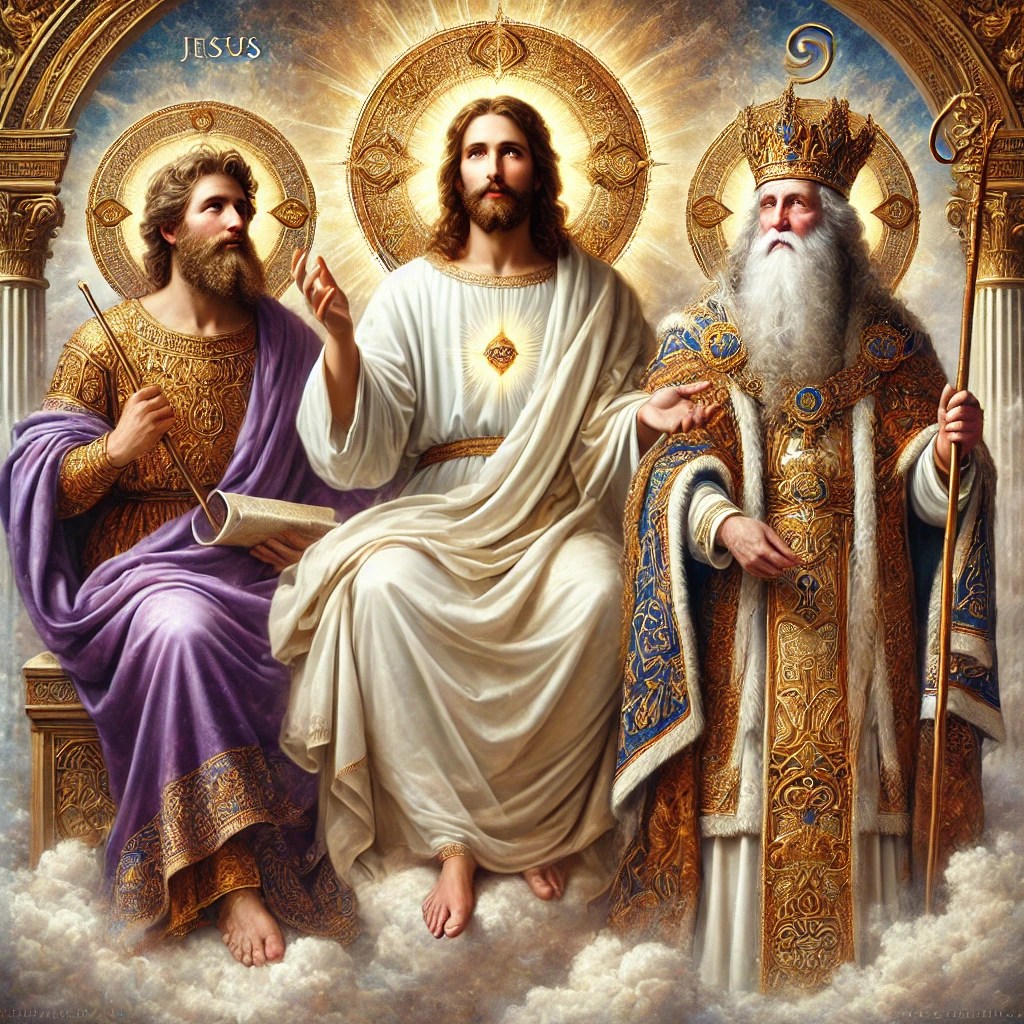
AI generated — I could not find an image with all three figures that wasn’t licensable.

God bless!
Advent Day 23: No greater man

TODAY’S GOSPEL (Lk 1:57-66)

From Luke 1:66b:

“What, then, will this child be?
For surely the hand of the Lord was with him.”

From Opening the Scriptures: Bringing the Gospel of Luke to Life, page 41

“Luke concludes his account of the birth and naming of John with his own comment: “For surely the hand of the Lord was with him.” The Old Testament uses the expression “hand of the Lord” to convey the power of God (Joshua 4:24; see Exod 7:4; 13:3; 15:6); the hand of the Lord being with or upon someone means that he is empowered and guided by God (1 Kings 18:46; 1 Chron 28:19; Ezra 7:28; Ezek 1:3; 3:14, 22)/ Surely someone born to a previously barren woman in fulfillment of an angel’s words has been sent by God to carry out a special work, and surely God will empower and guide him to accomplish his mission/ By adding that final comment, Luke invites his readers to join those pondering what this child will be and to share their sense of anticipation.”

My take

“Amen, I say to you, among those born of women there has been none greater than John the Baptist; yet the least in the kingdom of heaven is greater than he.” (Mt 11:11)

We think much of and revere deeply the greatest woman to be born of woman, the Blessed Virgin Mary, but how much do we consider the greatest man born of woman, as declared by Jesus Himself!, John the Baptist? Fittingly, he is the only person in Heaven, aside from Jesus and His mother, whom we honor by celebrating his earthly birth on the liturgical calendar (June 24, appropriately, six months before Christmas).

This man was repeatedly asked if he was the Messiah. How powerful must his preaching have been? Herod wondered if Jesus might be John reincarnated. What sort of impact must John have had on all of Judea? People flocked to him from miles around, confessing their sins and seeking a baptism of repentance. How much weight must his words have carried with the general population? The wife of Herod wanted John shut up for good. What weight must his words have carried with the commonfolk?

My suggestion is to read everything in Scripture about John the Baptist in one sitting (it won’t take very long). I have listed and linked below, all Gospel passages pertaining to John:

  • Lk 1:5-25 (annunciation and conception of John)
  • Lk 3:1-22 (John’s public ministry, his future arrest by Herod, Jesus’ baptism)
  • Mt 3:1-16 (John introduced and the baptism of Jesus)
  • Mk 1:2-11 (John introduced and the baptism of Jesus)
  • Jn 1:6-8, 15 (from the Prologue)
  • Jn 1:19-37, 40 (John’s public ministry, his prophesying about Jesus and the retelling of the Spirit coming upon Jesus, his encouraging his disciples to follow Jesus)
  • Lk 7:18–23 (John sends disciples to Jesus to ask if He is the Messiah)
  • Jn 3:23-30, 4:1-2 (John baptizing and commenting on Jesus baptizing; Jesus’ disciples baptizing)
  • Jn 5:31-36 (Jesus extolling John as a precursor to Him)
  • Lk 7:24-35 (Jesus extolling John to the crowds)
  • Mk 1:14-15 (indicates John’s arrest)
  • Mk 3:18-22 (John’s disciples; on fasting)
  • Mk 6:14-29 (Herod’s suspicions about Jesus; the recounting of John’s imprisonment and death)
  • Lk 9:7-9: (Herod’s suspicions about Jesus and his speaking of John’s death)
  • Mk 8:27-30 (speculation that Jesus is John)
  • Lk 9:18-22 (speculation that Jesus is John)
  • Jn 10:40-41 (the crowds compare Jesus and John)
  • Lk 11:1 (Jesus asked to teach His disciples how to pray as John taught them)
  • Mk 11:27-33 (Jesus’ authority questioned and He invokes John)
  • Lk 16:1 (John invoked by Jesus as the last prophet)
  • Lk 20:1-8 (Jesus’ authority questioned and He invokes John

John’s baptism is also referred to in Acts 1, 10, 11, 13, 18, 19.

John the Baptist, pray for us, that we may join you in the kingdom, even as the “least.”

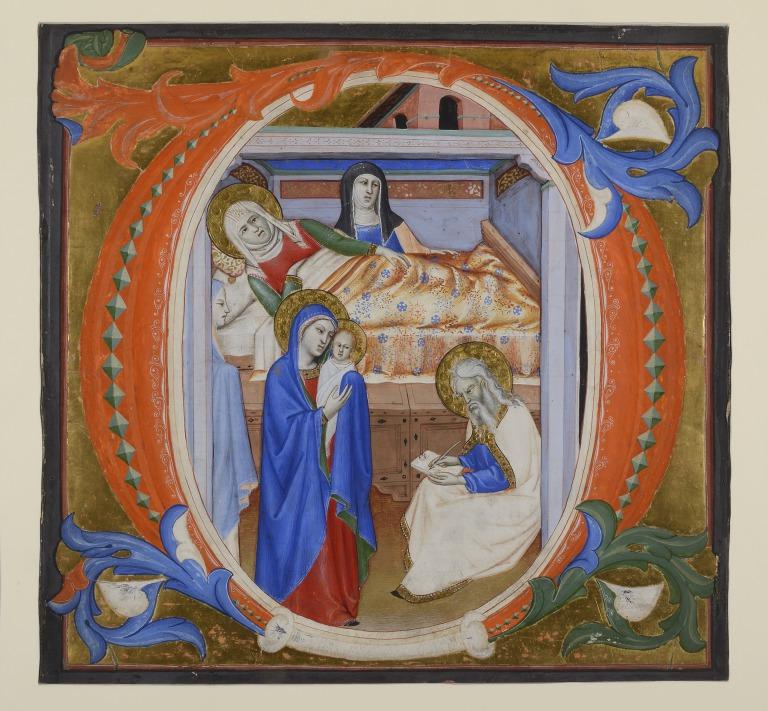
The Birth of St. John the Baptist (1370 – 1371 probably) by Don Silvestro dei Gherarducci

God bless!

Advent Day 17: Generations

TODAY’S GOSPEL (Mt 1:1-17)

From Matthew 1:17:

[T]he total number of generations
from Abraham to David
is fourteen generations;
from David to the Babylonian exile, fourteen generations;
from the Babylonian exile to the Christ,
fourteen generations.

From Ignatius Catholic Study Bible: Old and New Testament, pages 1725-26

fourteen generations: Matthew divides the genealogy into three units of 14. It is not exhaustive, since several OT names are omitted and the divisions cover unequal periods of time. Matthew stresses the number 14 to show Jesus as the new Davidic king: (1) David and Jesus are the only names listed with their respective titles (king, 1:6; Christ, 1:16); (2) David is the 14th name in the list; (3) the numerical value of David’s name (three consonants) in Hebrew equals 14 (D = 4 + V = 6 + D = 4). ● The 42 generations from Abraham to Jesus correspond to the 42 encampments of Israel during its wilderness journey to the Promised Land (cf. Num 33:1–49). These generations bring us to the Messiah, through whom we arrive at the land of promise in heaven (St. Jerome, Letters 78). deportation to Babylon: The Exile of the Jews starting in 586 B.C. under the Babylonian king Nebuchadnezzar. After that time, Israel’s Davidic kingdom collapsed, and no legitimate heir assumed David’s throne. Jesus comes as the awaited Messiah-king (21:4–5; Jn 1:49) to fulfill God’s covenant oath to perfect and establish the Davidic dynasty for all time (cf. Ps 132:11–12; Lk 1:32–33).”

From Opening The Scriptures: Bringing the Gospel of Matthew to Life, page 19

“Matthew sees a pattern in the genealogy, with turning points coming every fourteen generations. God began something new with Abraham, calling him to be the father of a people. The kingship of David was a turning point: descendants of David were to rule over God’s people forever. Yet this seemed to end with the catastrophe of the Babylonian exile, another major turning point. Now, fourteen generations after the last major turning point, God sends the Messiah to his people. Jesus is a new turning point in God’s unfolding plan.
“If a person’s genealogy tells us who a person is, then Jesus is a Jew descended from Abraham and David. Jesus’ past is Israel’s past; Jesus marks the next stage in God’s plan for his people.”

From Fire of Mercy, Heart of the Word (Volume I), page 60

“[I]f the Word of God waited for forty-two generations in order to come ‘when time had taken a downward plunge’ (cursu declivi temporis), as the Advent hymn has it, it is because God, like a good physician, comes when he is most needed: somehow, to be fully rejuvenated, the world first had to grow old utterly and come to the limit of its own foolish hopes. Christ is sent by the Father into the world ‘to liberate the human race from its state of decrepitude’ (Collect, first Saturday of Advent).”

My take

The world waited in breathless anticipation for the promised Messiah. Generation after generation after generation came and went, with some good, but by no means perfect, men, but with more questionable characters (not only the gents, but get a load of the women mentioned in this line). What good can come from these ancestors? A greater Good than could be imagined!

This “anointed one,” explodes all categories. We can certainly call Him a New Abraham: finally the blessing to all nations has arrived (cf. Gen 12:2). We can also call Him the New David, the ultimate Son of David and the real King of Kings. But Christ is so much more. Who knew that God Himself would have to come down to clean up the mess begun with Adam and Eve and exacerbated by their descendants (i.e., all of us)? The experts in the Law, for the most part, didn’t see it (although they should have — the entire Hebrew Scriptures ultimately points toward Christ). But those with open hearts embraced the Lord when He became incarnate. We are invited to open our hearts ever wider to the miracle of the conception of the Son of God in the womb of a humble Jewish girl and its culmination nine months later at Christmas. The First Coming should make us long for the Second Coming (“thy Kingdom come”!) and for His coming into our souls at each Mass.

Maranatha! Come, O Lord!

God bless!

Advent Day 15: The Savior in our midst

TODAY’S READINGS

FROM Zephaniah 3:17-18a (the full passage is Zep 3:14-18a):

   The LORD, your God, is in your midst,
        a mighty savior;
    he will rejoice over you with gladness,
        and renew you in his love,
    he will sing joyfully because of you,
        as one sings at festivals.

From The Word of the Lord (Year C), page 22

“[T]he Lord is described as a bridegroom. The words ‘rejoice over you,’ ‘renew you in his love,’ ‘sing joyfully because of you,’ describe the behavior of a bridegroom. Many Advent/Christmas texts have nuptial themes because the Incarnation of Christ is the ‘wedding’ of two natures, human and divine. God weds his nature to ours in Christ. Furthermore, Jesus is the promised ‘Bridegroom King’ from the line of David, fulfilling many texts which describe the king from the line of David as the ideal spouse.”

FROM Isaiah 12:2 (the full passage is Is 12:2-3, 4, 5-6):

God indeed is my savior;
I am confident and unafraid.
My strength and my courage is the LORD,
and he has been my savior.

From The Word of the Lord (Year C), page 23

“The joyful theme of this doxology fits the mood of this Mass and ties with the First Reading through the motif of God being ‘in [the] midst’ of his people.”

FROM Philippians 4:5b-6 (the full passage is Phil 4:4-7)

The Lord is near.
Have no anxiety at all, but in everything,
by prayer and petition, with thanksgiving,
make your requests known to God

From The Word of the Lord (Year C), page 24

“St. Paul’s advice in this reading is some of his most intensely practical teaching. He gives some keys to lifestyle of rejoicing: (1) not being anxious, through abandonment to God’s providence, (2) showing kindness to everyone, (3) making constant practice of prayer as an antidote to worry, including intercession, supplication, and especially thanksgiving in our prayer. How often we forget to include thanksgiving, and how important it is for the maintenance of joy on both a psychological and spiritual level!”

FROM Luke 3:18 (the full passage is Lk 3:10-18)

Exhorting them in many other ways,
he preached good news to the people.

From The Word of the Lord (Year C), page 26

“We need to keep reminding ourselves that the good news is not a plan for temporal comfort in this life because it is our tendency to revert to thinking that it is And when we look around and see that things are not comfortable, even after two thousand years, we mistakenly think the good news has not worked.
“The good news is about eternal life with God through Jesus Christ, which starts now but won’t be directly seen until the life in the world to come! The good news really is about heaven and what lies beyond the grave.

“The exhortation to rejoice in the first two readings and psalm are not based on some external reality, but on an interior and eternal reality: that Christ has come and taken up residence in our hearts, giving us communion with God even now and in the life to come. This is truly good news!”

MY TAKE

The Lord is near! The Lord is my savior! The first three Scripture passages pound home these themes. How do we know these proclamations to be true? Because, starting with John the Baptist, the Church has “preached good news to the people” — the news of the Savior in our midst: Jesus Christ.

I can’t help but think of the two primary ways Jesus is tangibly present to us today. In the Eucharist and in the Bible. Jesus, the Word, gives us Himself for our digestion, in Sacrament and in Scripture. Both should be consumed ravenously at every opportunity. But unlike food we eat that we assimilate to sustain us physically, the Food that is Jesus is meant to assimilate us into Him. Let us have frequent recourse to the Holy Spirit, the Lord and giver of life, to breathe life into us through consuming the Word.

BP BARRON SERMON

FR MIKE SCHMITZ HOMILY

God bless!

Advent Day 14: Elijah the Prophet

TODAY’S GOSPEL (Mt 17:9a, 10-13)

As they were coming down from the mountain,
the disciples asked Jesus,
“Why do the scribes say that Elijah must come first?”
He said in reply, “Elijah will indeed come and restore all things;
but I tell you that Elijah has already come,
and they did not recognize him but did to him whatever they pleased.
So also will the Son of Man suffer at their hands.”
Then the disciples understood
that he was speaking to them of John the Baptist.

My take

For today, I will simply invite you to get to know Elijah’s story and, while doing so, encourage you to be mindful of John the Baptist as you read through it: 1 Kings 17-19, 21; 2 Kings 1-2. Afterward, use this to examine all New Testament passages referring to the prophet and then dive into the context.

Elijah in the Desert (1543-1547) by Daniele da Volterra

God bless!

Advent Day 12: Spoken to and spoken for

TODAY’S GOSPEL (Lk 1:39-47)

From Luke 1:45:

“Blessed are you who believed
that what was spoken to you by the Lord
would be fulfilled.”

From The Navarre Bible: St Luke, page 43

“Joining the chorus of all future generations, Elizabeth, moved by the Holy Spirit, declares the Lord’s Mother to be blessed and praised her faith. No one has ever had faith to compare with Mary’s; she is the model of the attitude a creature should have towards its Creator — complete submission, total attachment. Through her faith, Mary is the instrument chosen by God to bring about the redemptive work of her Son.”

From Catholic Commentary on Sacred Scripture: The Gospel of Luke, page 50:

“Elizabeth concludes her Spirit-filled words by pronouncing the first beatitude in the Gospel: ‘Blessed are you who believed’…Mary ‘believed’ that God’s word ‘spoken’ to her ‘would be fulfilled.’ In this way, she received the privilege of being the mother of the Son of God. She also became a model for all those who ‘hear’ God’s word and accept it (8:21; 11:28). Throughout the Gospel, not only God’s words spoken through an angel but also those written in Scripture will be fulfilled (4:21; 18:31; 22:37; 24:44).”

From Opening The Scriptures: Bringing the Gospel of Luke to Life, page 30

“She is blessed because of her faith that what God said ‘would be fulfilled’ — that she would conceive through the Holy Spirit and bear a son who would be called Son of God and rule over God’s people forever (1:31-33). That is a lot for a young woman to believe!…Mary is a model for hearing the word of God and acting on it (see 8:21; 11:28).”

My take

Mary is very much a model for us. The reason I chose this quote from today’s readings is that the word “spoken” struck me. God speaks to us in myriad ways: in our heart, in our conscience, through others, through events, and, last but not least, through Scripture, which is the Word of God, who is Jesus (cf. John 1:1-18). The Bible is the inerrant revelation of God through the inspiration of the Holy Spirit (I highly recommend reading Vatican II’s Dogmatic Constitution on Divine Revelation [Dei Verbum] and CCC 101-141 to understand the proper approach to Scripture specifically and divine revelation in general).

St Jerome famously said, “Ignorance of Scripture is ignorance of Christ.” So, regular, ideally daily, reading of the Bible, particularly the Gospels, is necessary. But then we encounter this problem:

Some people are troubled by the things in the Bible they can’t understand.
The things that trouble me are the things I can understand. (Attributed to Mark Twain)

Do we hear the Word and accept it? Do we hear the Word and act on it? Are we completely submissive and totally attached to the Word? With apologies to JFK, do we choose to follow the Lord’s commands, not because they are easy, but because they are hard?

The gift of faith is ours through Baptism. Do we exercise it by complete submission to the will of God? Can we truly say we know the will of God for our lives? Mary likely did not know how it was going to all turn out, but she submitted to the Lord. She “let go and let God.”

Are we ready to believe that what the Lord speaks to us will be fulfilled? And are we completely open to being God’s instrument, without counting the cost, in fulfilling our mission?

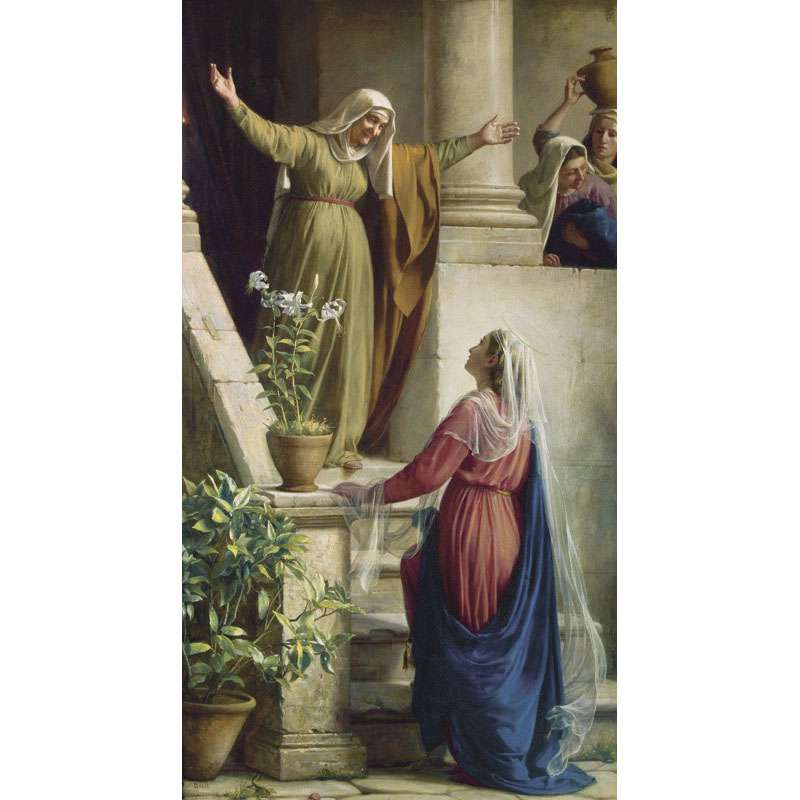
The Meeting of Mary and Elisabeth (1866) by Carl Heinrich Bloch

God bless!

Advent Day 11: Taking a load off

TODAY’S GOSPEL (Mt 11:28-30)

From Matthew 11:28:

“Come to me, all you who labor and are burdened,
and I will give you rest.

From Fire of Mercy, Heart of the Word (Volume I), pages 712, 714:

“[W]e are surely not to limit the scope of Jesus’ magnificent Venite ad me! only to those under the yoke of Pharisaism. For the love of Christ has a much more universal scope and, in Jesus, God is the absolute liberator of man from a legalistic conception of Torah as well as from every burden that keeps him back from fully becoming a child of the infinitely free Father.

“Jesus is the one who, by a divine ‘instinct’, himself bends down to share the lot of all who are burdened beyond their ability to bear it….Rather than denounce the source of the oppression — whether within or outside the person — Jesus simple extends an invitation: ‘Come to me!’ It is crucial that these words be seen as an invitation, because a person must respond to it with perfect freedom. One must oneself in some sense leave behind the oppressive situations and go to Jesus. Although elsewhere Jesus is portrayed as himself searching out the lost sheep, here the appeal is made to the exhausted person’s desire to change his life. He must take the first step himself toward the source of regeneration.”

My take

If you love Scripture, particularly Matthew’s Gospel, I encourage you to invest in Father Simeon’s (formerly Erasmo Leiva-Merikakis) four-volume Fire of Mercy, Heart of the Word series. Over 2,800 pages breaking down Matthew. What a treasure goring verse by verse, phrase by phrase, or word by word through the Gospel. Amazing spiritual insights from these “meditations” will be much food for thought, prayer, and contemplation. The excerpt above is only a tiny portion of the several pages devoted to just this one verse.

Don’t we all need rest from our many burdens? And Jesus offers to be that resting place. He already took the cross off our shoulders. Just as we must freely accept this gift of redemption, so must we freely come to Jesus in our difficulties and challenges. He is always waiting for us.

So, please join me as I endeavor to put my cares and troubles into Jesus’ hands so that I may finally true rest.

Then the peace of God that surpasses all understanding will guard your hearts and minds in Christ Jesus. (Phil 4:7)

The Hard Job of Living… (1922) by Georges Rouault

God bless!

Advent Day 10: Lost and Found

TODAY’S GOSPEL (Mt 18:12-14)

From Matthew 18:14:

“[I]t is not the will of your heavenly Father
that one of these little ones be lost.”

From Fire of Mercy, Heart of the Word (Volume II), page 628:

“‘It is not the will in the sight of your Father who is in heaven that one of these little ones should perish’: The ever-watchful eye of God’s love tirelessly scans the whole horizon of human existence with only one concern: Are all being saved? Are all being brought into life? Are any being lost, even one? For God’s joy is not complete until all are saved! The newness of life that comes about as a result of conversion to Christ — my turning and clinging ardently to Christ after having been sought and found by Christ — is an event that makes the Heart of God dance with joy. Can we not see the Face of the eternal Father glowing with exultation at the recovery of one of his dear children? And that tidal wave of divine joy then reverberates through his creation, since no act of God is without effect in the whole of the created order. Just as the angels of the little one, forever contemplating the face of the heavenly Father, build a bridge connecting childlike innocent and divine glory, so too the greatest exultation among the choirs of angels is reserved for the occasion of a single sinner’s conversion (Lk 15:7, 10).”

My take

Father Simeon’s exposition of the highlighted verse brought to mind immediately two other New Testament passages:

God our savior…wills everyone to be saved and to come to knowledge of the truth. (1 Tim 2:3-4)

“Whoever causes one of these little ones who believe in me to sin, it would be better for him to have a great millstone hung around his neck and to be drowned in the depths of the sea.” (Mt 18:6)

What a stark warning: If we oppose the will of God for all of mankind by leading others into sin directly or by bad example, we would be better off dead. We have an obligation, by virtue of our Baptism, to bring others to Christ, not lure them away or drive them away. If only we were constantly mindful of that. If only we saw the world through the eyes of God we too would desire salvation for all. We are God’s chosen instruments to effect God’s will — what an awesome gift and what an awesome responsibility! We must get close to the Lord and stay close to the Lord through prayer, penance, the Sacraments, and Scripture. Vigilance!

God bless!

Advent Day 6: I see (or do I?)

TODAY’S GOSPEL READING (Mt 9:27-31)

From Matthew 9:28-29:

When he entered the house,
the blind men approached him and Jesus said to them,
“Do you believe that I can do this?”
“Yes, Lord,” they said to him.
Then he touched their eyes and said,
“Let it be done for you according to your faith.”

From Opening the Scriptures: Bringing the Gospel of Matthew to Life, page 175:

“The men want to be able to see and Jesus knows that this is what they want. He asks them whether they believe he can do this. This is the only time in Matthew’s gospel (or in any gospel) that Jesus asks anyone whether they believe that he is able to heal them. ‘”Yes, Lord,” they said to him.’ Calling Jesus ‘Lord” is an acknowledgment of his authority and power to give them sight. Their faith has been demonstrated by their following Jesus and crying out to him, even though he seemed to ignore them.”

From Catholic Commentary on Sacred Scripture: The Gospel of Matthew, page 137:

“[The blind men] call Jesus Son of David — the first time someone addresses him with the royal title that has messianic overtones. ‘Son of David’ also brings to mind David’s heir, King Solomon, who was known in Jewish tradition as a great healer and exorcist.”

From Fire of Mercy, Heart of the Word (Volume I), pages 493-494:

“In the end, this faith [of the blind men] proves to be omnipotent, because it is a whole-hearted embracing of the full reality of the presence of the incarnate Word. Faith rejoices in a natural blindness that is the precondition for the vision of God….Our own native lights need to be extinguished if Jesus is to light his lamp in our souls….Whatever empties itself out of itself in order to receive omnipotence, itself becomes omnipotent, just as only total darkness can receive the uncreated Light (St. John of the Cross, Dark Night of the Soul)….The blind men set no condition to God but rather open themselves up wholly and actively to the divine action.”

My take

Amen, I say to you, if you have faith the size of a mustard seed, you will say to this mountain, ‘Move from here to there,’ and it will move. Nothing will be impossible for you. (Mt 17:20)

Jesus’ words to the blind men in today’s Gospel and His words above, further along in the same Gospel, should be a wake-up call to us, encouraging driving us to deep prayer and contemplation. What can Jesus not do if we place ourselves totally in His hands? Jesus can do any good thing. It is we who dampen or even short-circuit His healing power.

I have for months now been reading, as a spiritual exercise, Abandonment to Divine Providence by Jean-Pierre de Caussade. At first, the radical nature of the good Father’s advice took me aback (and sometimes still does, over 300 pages in). But his admonition to give up our own will and self-concern in favor of whatever the Lord ordains or permits for us, makes total sense. What peace we would have if we simply, “Let go and let God,” as the popular saying goes. Emptying out ourselves, as Father Simeon says in Fire of Mercy, allows in God.

What if we “set no condition to God but rather open [our]selves up wholly and actively to the divine action”? What a radical difference that would make! Lord, make me blind to worldly concerns so that I can be open to truly seeing You.

ADVENT RESOURCES

ADVENT/CHRISTMAS READING

Jesus Healing Two Blind Men (undated) by Patriarchate of Peć by School Serbian

God bless!

Advent Day 3: Get to know the Trinity!

TODAY’S GOSPEL (Lk 10:21-24)

From Luke 10:21-22:

Jesus rejoiced in the Holy Spirit and said,

“No one knows who the Son is except the Father,
and who the Father is except the Son
and anyone to whom the Son wishes to reveal him.”

From The Navarre Bible: St Luke, page 139:

“Here we see Christ as almighty Lord and God, consubstantial with the Father, and the only one capable of revealing who the Father is. At the same time, we can recognize the divine nature of Jesus only if the Father gives us the grace of faith — as he did to St Peter (cf. Mt 16:17).”

From the Ignatius Catholic Study Bible: The Gospel of Luke, pages 42-43:

“The Father, Son, and Spirit are equal in being, and no one of them possesses more of the divine life and knowledge than another. Since the Son is no less perfect than the Father, he is uniquely qualified to reveal the inner life of the Trinity to the world.”

From the Catholic Commentary on Sacred Scripture: The Gospel of Luke, page 208:

“Already at the age of twelve, [Jesus] had expressed awareness of his identity as Son (Lk 2:49). He now expresses it more fully — the words Father and Son occur a total of eight times in verses 21-22 — and he does so in the holy Spirit (v. 21), giving a glimpse of the life of the Trinity. He thus reveals to the larger group of disciples what Peter, John, and James found out on the mountain (Lk 9:35) and Mary had been told by the angel (Lk 1:32, 35).”

From Opening the Scriptures: Bringing the Gospel of Luke to Life, page 296:

“Because Jesus is uniquely the Son of God and has a privileged intimacy with the Father, he can make him known to anyone to whom the Son wishes to reveal him. What Jesus is able to reveal about the Father goes beyond the knowledge that humans can have of God through creation (Rom 1:19-20) or through God’s previous revelations (Heb 1:1-2).”

My take

What a treasure Catholics have in the many wonderful commentaries now available! The excerpts above highlight and provide superb insights into what I myself just discovered when scanning today’s readings in trying to decide what to highlight. What we have in verses 21-22 is a fairly obvious explication of the Holy Trinity. Jesus “rejoice[s] in the Holy Spirit,” the One who enlightens, and then speaks of the intimate relationship between the Father and the Son. It is a lesson for us that we should have devotion to each of the three Persons of the Trinity individually. All one Godhead, yes. But there is a reason that there are three Persons and that this was revealed to us plainly in Holy Writ by Jesus through the inspiration of the Holy Spirit.

Practically, we can and should frequently invoke the three Persons in spontaneous prayer, particularly in group settings. It can go something like this:

“Heavenly Father, we ask you to send your Holy Spirit to send His many gifts to enlighten us in this endeavor [and then expound on it]. We ask this, as we ask all good things, through Jesus Christ, our Lord. Amen.”

That the opening two verses of today’s first reading (Is 11:1-10) provides us a list of the Seven Gifts of the Holy Spirit is a bonus that serves to highlight exactly what the Third Person of the Trinity brings to the table, so to speak.

Finally, I found particularly thought provoking the last commentary that refers to Heb 1:1-2. While all of Scripture is “God-breathed” (cf. 2 Tim 3:16 — think of the Holy Spirit as Holy Breath) and it is all the Word of God, who is Jesus (cf. Jn 1:1, 14), it is only with the Incarnation of the Son of God that the Father’s plan is fully revealed (see also Jn 1:18). All creation had been awaiting the Messiah since Adam and Eve’s fall (cf. Gen 3:15). We had glimpses and foreshadowings and types of Christ, but the reality of the Messiah in the flesh exploded all expectations and marked a new age in salvation history.

Do we really appreciate the gift we have in Jesus, awaited for thousands of years, and now with us (cf. Mt 28:20) until the end of time — and for all eternity if we accept the grace of redemption?

TRINITY RESOURCES

ADVENT RESOURCES

ADVENT/CHRISTMAS READING

The Trinity (early 17th Century) by Circle of Artus Wolffort (1581–1641)

God bless!