Are you “incredulous for joy and…amazed” that “the author of life” is “expiation for our sins and..for those of the whole world”? “O Lord, you put gladness into my heart.”

TODAY’S READINGS

It struck me in hearing the readings proclaimed at Mass that, while Sunday readings are always purposeful in connecting the first reading and the Gospel reading, all four Scriptures fit together in a profound way. Let’s take a closer look at each reading, in particular the phrases in question.

Today’s first reading (Acts 3:13-15, 17-19) has Peter remonstrating his Jewish hearers for what they did to Jesus.

“The author of life you put to death,
but God raised him from the dead; of this we are witnesses.”
(v. 15)

We cooperate with this “author” to make new humans and He provides the soul. He gives the life of grace to that soul in Baptism, gives life back to that soul through Confessions, and strengthens the life of that soul through the Eucharist. This Author writes beautifully, don’t ever forget when you look around and when you look in the mirror.

The Responsorial Psalm (Ps 4:2, 4, 7-8, 9) is overwhelming in its delight of the Lord:

O LORD, let the light of your countenance shine upon us!
You put gladness into my heart.
(vv. 7b-8a)

Wow! When our heart is full in earthly matters, we never want to lose that feeling, but inevitably it fades or is jarred away. But the gladness God brings to the heart can never be taken away if we hold it close. Never let earthly distractions, no matter how severe, disturb your peace, knowing that God is with you when you stay in His good graces.

Then John (1 Jn 2:1-5a) tells us how we honor Jesus Christ for doing the following for us:

He is expiation for our sins,
and not for our sins only but for those of the whole world.
(v. 2)

Thank God! This is truly Good News! This great benefit we have received in knowing Christ and having been initiated into the Catholic faith should be made known to “the whole world.” There is no human that is not a beneficiary of Christ’s sacrifice. We are under obligation to make it known to every soul. What could ever stop us from winning over brothers and sisters to Christ? We must follow the Lord’s commandments and share this requirement with others.

The Gospel has Jesus appearing to the apostles and His Road to Emmaus companions in the Upper Room:

[Jesus] showed them his hands and his feet…
[T]hey were…incredulous for joy and were amazed
… (vv. 40-41a)

When was the last time you were “incredulous for joy and…amazed” at what Jesus has done for you and every person who ever has come into existence or who will be conceived? It is far too easy to become complacent in our faith. Let us renew ourselves in the Lord daily , finding joy and amazement in what He has done for us and for everyone. Let us exude the joy of knowing Jesus and share our amazement in how He saved wretches like us, so more wretches will come to the Faith..

BP BARRON SERMON
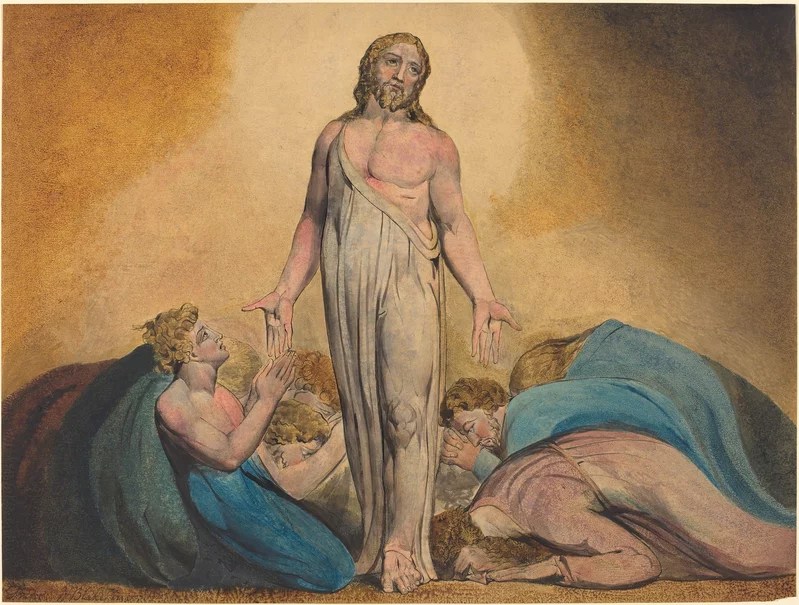
Christ Appearing to His Disciples After the Resurrection (c. 1795) by William Blake

God bless.
Lent Day 44: “The spirit of the Lord God is upon me”

TODAY’S READINGS

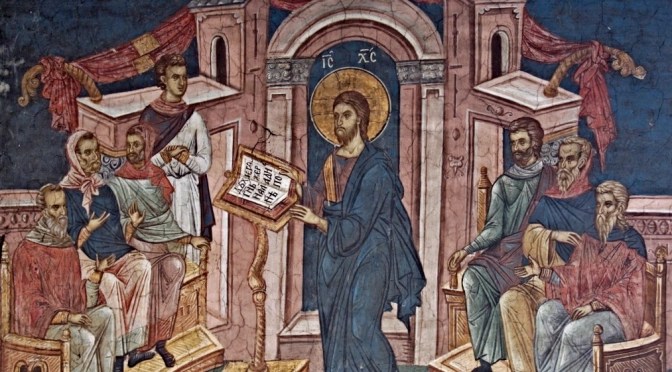
Today’s Gospel reading for the Chrism Mass (Lk 4:16-21) has Jesus returning to His hometown of Nazareth. He stuns His synagogue listeners (undoubtedly including many friends, relatives, and acquaintances) by declaring Himself the fulfillment of Isaiah’s prophecy in chapter 61:

”“Today this Scripture passage is fulfilled in your hearing.” (v. 21)

“Christ’s words…show us the authenticity with which he preached and explained the Scriptures…Jesus teaches that this prophecy, like the other main prophecies of the Old Testament, refers to him and finds its fulfillment in him (cf. Luke 24:44ff). Thus, the Old Testament can be rightly understood only in the light of the New — as the risen Christ showed the Apostles when he opened their minds to understand the Scriptures (cf. Luke 24:45), an understanding which the Holy Spirit perfected on the day of Pentecost (cf. Acts 2:4).” (The Navarre Bible: St Luke, 78)

“Jesus make a bombshell announcement…With Jesus, the time of waiting for the fulfillment of God’s promises in Scriptures is over (see 24:27, 44). The messianic jubilee announced by Isaiah is at hand! ‘Behold, now is the acceptable time’ (2 Cor 6:2 RSV).” (The Gospel of Luke [Catholic Commentary on Sacred Scripture], 100)

“In the Greek of Luke’s Gospel, ‘today’ is emphatic. ‘Today,’ right now, even as you listen, ‘this scripture passage is fulfilled’…Isaiah’s prophecy serves as Jesus’ job description as he begins his ministry. Jesus is the fulfillment of God’s plans, bringing salvation to his people.” (Bringing the Gospel of Luke to Life, 118)

What is the job description, per Isaiah?

[T]o bring glad tidings to the lowly,
to heal the brokenhearted,
To proclaim liberty to the captives
and release to the prisoners,
To announce a year of favor from the LORD
and a day of vindication by our God,
to comfort all who mourn;
To place on those who mourn in Zion
a diadem instead of ashes,
To give them oil of gladness in place of mourning,
a glorious mantle instead of a listless spirit.
(vv. 61:1-3)

Who are the lowly? All of us sinners. The brokenhearted? All of us, at one time or another, sometimes for a long time? Prisoners? Those enslaved to habitual sin and all who place some created thing ahead of the Lord. Mourners? Those who have experienced loss, particularly loss of the grace of God through serious sin. How do these return to gladness? A return to God through Reconciliation.

Thank you Jesus for freeing us from slavery to sin and providing us the Church and the means of salvation through her, namely the Sacraments. Two we commemorate as being instituted today: Holy Orders and the Eucharist. Let us have recourse to the Eucharist and Reconciliation often and never let us spurn these great gifts.

For a dramatization of this episode in the synagogue, watch here.

God bless.

Lent Day 36: What is truth? And can you handle it?

TODAY’S READINGS

Today’s Gospel reading (Jn 8:31-42) continues Jesus dialogue with the Jewish religious leaders. It begins this way:

“If you remain in my word, you will truly be my disciples,
and you will know the truth, and the truth will set you free.”
(vv. 31b-32)

“Jesus embodies divine truth (14:6) and has come to bear witness to the truth (18:37). Acceptance of him liberates us from the slavery of sin, ignorance, and deception (8:12; CCC 2466).” (The Gospel of John [Ignatius Catholic Study Bible], 34)

“In Jesus Christ, the whole of God’s truth has been made manifest. ‘Full of grace and truth,’ he came as the ‘light of the world,’ he is the Truth. ‘Whoever believes in me may not remain in darkness.’ The disciple of Jesus continues in his word so as to know ‘the truth [that] will make you free’ and that sanctifies. To follow Jesus is to live in ‘the Spirit of truth,’ whom the Father sends in his name and who leads ‘into all the truth.’ To his disciples Jesus teaches the unconditional love of truth: ‘Let what you say be simply “Yes or No.”” (CCC 2466)

“The knowledge of the truth which Christ is speaking about is not just intellectual knowledge; it is rather the maturing in the soul of the seed of divine Revelation. That Revelation’s climax is to be found in Christ’s teaching, and it constitutes a genuine communication of supernatural life (cf. Jn 5;24): he who believes in Jesus, and through him in the Father, receives the wonderful gift of eternal life. Knowing the truth is, in the last analysis, knowing Christ himself, God become man to save us; it means realizing that the inaccessible God has become man, our Friend, our Life.

“This is the only kind of knowledge which really sets us free, because it removes us from a position of alienation from God — the state of sin and therefore of slavery to the devil and to all the attachments of our fallen nature — and puts us on the path of friendship with God, the path of grace, of the Kingdom of God. Therefore, the liberation we obtain is not just light which shows the way; it is grace, which empowers us to keep to that way despite our limitations.” (The Navarre Bible: St John, 127-28)

“[N]otice how Jesus says that human freedom follows upon and presupposes knowledge of the truth. In order to be truly free, a person must first know what is true.” (The Gospel of John [Catholic Commentary on Sacred Scripture] , 161)

Two lines come to mind, as I reflect on the highlighted verses of this passage:

1. “What is truth?” (Jn 18:38)

Pilate’s famous words while looking Truth right in the eyes. Echoed today by seemingly millions. Can we really know the truth? Cardinal Ratzinger bemoaned the “dictatorship of relativism” today. Most clear thinking folks nodded their heads in agreement in that homily nearly twenty years ago. Not so many folks would have believed that it didn’t even take twenty years till concepts like “mother,” “marriage,” and “gender” were up for grabs. This twisting of truth and reality itself is the work of the devil, as Jesus tells the Pharisees a little further on in the same interaction we heard proclaimed today:

“You belong to your father the devil and you willingly carry out your father’s desires. He was a murderer from the beginning and does not stand in truth, because there is no truth in him. When he tells a lie, he speaks in character, because he is a liar and the father of lies.” (Jn 8:44)

And what does Satan “inspire” people to do?

They exchanged the truth of God for a lie and revered and worshiped the creature rather than the creator. (Rom 1:25)

Wow. Doesn’t that encapsulate perfectly the state of our world today? With no eternal anchor, the crashing waves of self-focus toss us about. When anything goes, nothing stays firm.

Let us cling to the Rock that is Peter and the Church Christ founded as if our life depended on it (and it does, here and hereafter). A sure “light”house in the stormy weather of our modern confused age.

2. “You can’t handle the truth!” — Col. Nathan R. Jessup

Certainly, the Gospel message is a challenging one. Hearing the truth and living it out can be painful at times. But it is the antidote to what ails us in a time of cultural sickness and even death. It seems that in our day, maybe more than ever, we can’t handle the Truth that is Jesus and His message, preferring “my truth.” To be fully and authentically human, stick with “the Truth.”

God bless.

Lent Day 34: Forgiving and Challenging Jesus

TODAY’S READINGS

Today’s Gospel reading (Jn 8:1-11) is the famous episode in which Jesus is brought the woman caught in the act of adultery. It ends with consoling words and a warning:

“Has no one condemned you?”
She replied, “No one, sir.”
Then Jesus said, “Neither do I condemn you.
Go, and from now on do not sin any more.”
(vv. 10b-11)

“Jesus, who is the Just One, does not condemn the woman; whereas these people are sinners, yet they pass sentence of death. God’s infinite mercy should move us always to have compassion on those who commit sins, because we ourselves are sinners and in need of God’s forgiveness.” (The Navarre Bible: St John, 122)

“Jesus strikes a balance, being merciful to a sinner while abhorring the sin. He gives the woman an opportunity to make a new start, not condemned for her past and free to behave differently in the future.” (Bringing the Gospel of John to Life, 229)

“Jesus offers this woman a fresh start by turning her away from her sins and opening her up to God’s infinite mercy.” (The Gospel of John [Catholic Commentary on Sacred Scripture], 153)

“Jesus’ attitude is striking: we do not hear words of scorn, we do not hear words of condemnation, but only words of love, of mercy, which are an invitation to conversion. ‘Neither do I condemn you; go, and do not sin again’ (v. 11). Ah! Brothers and Sisters, God’s face is the face of a merciful father who is always patient. Have you thought about God’s patience, the patience he has with each one of us? That is his mercy. He always has patience, patience with us, he understands us, he waits for us, he does not tire of forgiving us if we are able to return to him with a contrite heart.” (Pope Francis, “Angelus,” 17 March 2013)

Imagine the relief of this poor sinner when Jesus saved her life and then showed such mercy! Why had she indulged in this sin? Why did she keep indulging in it (I’m guessing her indiscretion was widely known since the Pharisees conveniently found her in the act in order to try to trap Jesus). She was being used twice: first by her illicit lover, then by the Pharisees. Now she escapes the death sentence scot-free. But wait. The ongoing condition is now placed upon her: “do not sin anymore” or maybe a better translation is “stop sinning.”

We don’t know what happened to this woman. One thing for sure: her encounter with the Lord changed her forever. Is she one of the many unnamed saints? I like to think so. Imagine the story she could have told, must have told, of this, in turn, harrowing and blessed encounter, if not immediately then in her golden years.

Jesus provides challenges to us constantly. We all love the forgiveness part — we get it and do nothing to deserve it. Harder is the stop sinning part. Yes, we may have very good intentions, even a firm resolution, to mend our ways — until we try to get out of the crowded parking lot, or when following the slowpoke on the road, or when checking our emails or texts, or when dealing with a family member, or during a tough day at work. The list goes on.

The answer: frequent prayer, regular recourse to the sacraments, self-discipline. Stop sinning? Grace does not make it easy but it does make it possible. Let us open our hearts to the grace God is so willing and desiring to give us in the sacraments and we will see progress.

Christ and the Adulterous Woman (1881) by Rodolpho Bernardelli

God bless.

Lent Day 29: Hear, believe, and live

TODAY’S READINGS

Today’s Gospel (Jn 5:17-30) picks up where yesterday’s left off. Jesus reveals much about Himself and His Father, much to the chagrin of the Pharisees:

“Amen, amen, I say to you, whoever hears my word
and believes in the one who sent me
has eternal life and will not come to condemnation,
but has passed from death to life.”
(v. 24)

“The Father has placed judging and giving life in the hands of his Son, and now Jesus speaks about his carrying out these divine prerogatives. He again prefaces his words with a solemn ‘Amen, amen, I say to you,’ assuring his listeners (and readers of John’s Gospel) of the importance of what he is saying. He proclaims that ‘whoever hears my word and believes in the one who sent me has eternal life.’ The ‘word’ of Jesus is the word of God: ‘the one whom God sent speaks the words of God” (3:34; see also 12:49-50; 14:24; 17:8). When Jesus says ‘hears my word,’ he uses ‘hears’ in its biblical sense of accepting and heeding (see Deut 6:4). We might have expected Jesus to say ‘Whoever hears my word and believes me,’ but he says whoever hears my word ‘and believes in the one who sent me’ — literally, ‘believes the one who sent me.’ Since Jesus speaks the word of God, to accept his word is to believe God (see 12:44).

“Jesus proclaims that whoever hears his word and believes the one who sent him ‘has eternal life.’ ‘Now this is eternal life, that they should know you , the only true God, and the one whom he sent, Jesus Christ’ (17:3). To know God is to experientially know him as Jesus reveals him; accepting his revelation brings union with God and ‘eternal life.’ The one who believes ‘has eternal life and will not come to condemnation, but has passed from death to life.’ For those drawn into union with God through Jesus, ‘eternal life’ begins now, even if its fullness lies in the future (see 6:54). Come to condemnation means being left in the perishable state of humanity, destined for death (see 3:16-18). Whoever receives eternal life ‘has passed from death to life’ — literally, ‘has been transferred out of death to life.’ These united with God through Jesus have been taken from the realm of death into the realm of eternal life. Even if they die physically , they live eternally (see 11:25-26).” (Bringing the Gospel of John to Life, 136-37)

I chose the particular passage I did because I love it when Jesus is very clear what we mortals are called to believe and live out. Martin, in the extended excerpt above, says, ‘When Jesus says ‘hears my word,’ he uses ‘hears’ in its biblical sense of accepting and heeding.’

Yes, we are to hear the Word of God. But more importantly, we must internalize it and live it

Woe unto You, Scribes and Pharisees (1850) by James Tissot

God bless.

Lent Day 26: John 3:16

TODAY’S READINGS

Today’s Gospel (Jn 3:14-21) has a listen to the nocturnal encounter between Jesus and an interested Pharisee, Nicodemus. It yields one of the most referred to and quoted lines in all of Scripture:

“For God so loved the world that he gave his only Son,
so that everyone who believes in him might not perish
but might have eternal life.”
(v. 16)

gave his only-begotten Son: The earthly mission of Jesus is part of the heavenly plan of the Father, who displays the depth of his love through the sacrifice of his Son (Rom 5:8; 1 Jn 3:16; CCC 219). This verse marks a transition from the dialogue between Jesus and Nicodemus (3:1–15) to an extended monologue by either Jesus or the evangelist himself (3:16–21). eternal life: The expression refers both to the divine quality of new life in Christ as well as its duration. We receive this gift already on earth in the hope that we will possess it irrevocably in heaven (10:10; 1 Jn 5:13). (Ignatius Catholic Study Bible: The Gospel of John, 23)

“God’s love for Israel is compared to a father’s love for his son. His love for his people is stronger than a mother’s for her children. God loves his people more than a bridegroom his beloved; his love will be victorious over even the worst infidelities and will extend to his most precious gift: ‘God so loved the world that he gave his only Son.'” (CCC 219)

God loves the world. That’s something, isn’t it? We are reminded of Genesis 1 in which God finds all He created good and, culminating with humans, very good. Objectively, there is nothing wrong with the world — God don’t make junk, as used to be a popular saying. It’s humans who caused it to fall, but it is God, through His Son, who redeems it, and who promised a “new heavens and a new earth” at the end of time.

So, believe! And not the easy-believism that says, “I’ve accepted Jesus as my personal Lord and Savior” so now I can do what I want. It means to know Jesus and what He commanded and strive to follow it perfectly. Jesus gives far too many warnings about straying from the narrow path to think any differently.

BP BARRON’S SUNDAY SERMON

God bless.

Lent Day 23: For or Against?

TODAY’S READINGS

Today’s Gospel (Lk 11:14-23) has Jesus being calumniated even when exorcising demons. He concludes with this:

“Whoever is not with me is against me,
and whoever does not gather with me scatters.”
(v. 23)

“[E]ven if people do not want to recognize it, Jesus Christ has conquered and from now on no one can adopt an attitude of neutrality towards him: he who is not with him is against him.” (The Navarre Bible: St Luke, 147)

“There is no safe neutral corner in the front line of a war…Whoever is not with Jesus in his battle against Satan is by default against him…In the context of the clash between the kingdom of God and the kingdom of Satan each person must side with the one or the other: there are ultimately no other kingdoms…Ultimately one is either gathered to Jesus and brought into the kingdom of God, or cast out and scattered (see 13:28).” (Bringing the Gospel of Luke to Life, 322)

The time for fence sitting is over. In reality, there never has been a time for it. But now, the Lord needs to know where we stand. Will we defend Him, or shirk away? Are we going along to get along or are we counter-culture (of death)? Are we the disciples before Pentecost hiding away in anxiety and fear or are we compelled by tongues of fire to speak out fearlessly whatever may come?

I am reminded of the Book of Revelation’s admonition to a particular church that really is a message to all of us:

“I know your works; I know that you are neither cold nor hot.* I wish you were either cold or hot. So, because you are lukewarm, neither hot nor cold, I will spit you out of my mouth…Whoever has ears ought to hear what the Spirit says to the churches.” (Rev. 3:15-16, 22)

It is a striking image painted for John here in this vision. I certainly don’t want to make the Lord sick to His stomach, do you? Let us be bold and fervent in the Faith we profess, not counting the cost here on earth but building up treasure in heaven (see Mt 6:19-21).

God bless.

Lent Day 22: Old and New

TODAY’S READINGS

Today’s Gospel (Mt 5:17-19) coming almost immediately after Jesus proclaims the Beatitudes, has Him teaching about the Law:

Jesus said to his disciples:
“Do not think that I have come to abolish the law or the prophets.
I have come not to abolish but to fulfill.
Amen, I say to you, until heaven and earth pass away,
not the smallest letter or the smallest part of a letter
will pass from the law,
until all things have taken place.
Therefore, whoever breaks one of the least of these commandments
and teaches others to do so
will be called least in the Kingdom of heaven.
But whoever obeys and teaches these commandments
will be called greatest in the Kingdom of heaven.”
(17-19)

(vv. 21-22)

“In this passage Jesus stresses the perennial value of the Old Testament. It is the word of God; because it has a divine authority it deserves total respect. The Old Law enjoined precepts of a moral, legal and liturgical type. Its moral precepts still hold good in the New Testament because they are for the most part specific divine-positive promulgations of the natural law. However, our Lord gives them greater weight and meaning. But the legal an d liturgical precepts of the Old Law were laid down by God for a specific stage in salvation history, that is, up to the coming of Christ; Christians are not obliged to observe them (cf. Summa theologiae, I-II, q. 108, a. 3 ad 3).

“The law promulgated through Moses and explained by the prophets was God’s gift to his people, a kind of anticipation of the definitive Law which the Christ or Messiah would lay down. Thus as the Council of Trent defined, Jesus not only ‘was given to men as a redeemer in whom they are to trust, but also as a lawgiver whom they are to obey’ (De iustificatione, can. 21).” (The Navarre Bible: St Matthew, 61)

“Jesus completely fulfilled the Mosaic Law and OT prophecies (1:23; 2:6, 15; 4:15–16; Lk 24:44–47). The Greek word translated fulfil means ‘to make complete’. The New Covenant thus includes and concludes the Old Covenant; it both perfects it and transforms it. While sacrificial laws of the OT expired with the sacrifice of Jesus, the moral Law (Ten Commandments, etc.) was retained and refined (5:21, 27, 43; 19:17). In the Christian life, the power of God’s Spirit is necessary if we are to obey the Law and grow in holiness (cf. Rom 8:4; CCC 577–81, 1967).” (Ignatius Catholic Study Bible: The Gospel of Matthew, 25)

Reading this passage, I’m reminded of St. Augustine’s famous saying:

The New Testament lies hidden in the Old and the Old Testament is unveiled in the New.” (from CCC 129, Cf. St. Augustine, Quaest. in Hept. 2,73:PL 34,623; Cf. DV 16)

The Old Testament has many exciting stories and tells of some great adventures. Some of it can be a slog, making readers wonder of the relevancy of certain parts. This is why I always recommend good commentaries that provide both exegesis and theology to bring out the value of the most seemingly mundane, uninteresting, or confusing parts. An indispensable reference is Bergma and Pitre, Introduction to the Bible: Old Testament. Also, having the Navarre Bible is an invaluable resource; my recommendation is to use that Bible if planning to read the entire Old Testament. Finally, read the short but important Vatican II document, Dei Verbum, before beginning any significant Bible study.

By reading the Old Testament in light of the New, and recognizing it all as the God’s Word (that is, Jesus), there will be no danger we fall formally or informally into the heresy of Marcionism.

The Bible is a Great Adventure. Don’t miss out!

God bless.

Lent Day 18: The robe of grace brings the dead to life

TODAY’S READINGS

Today’s Gospel (Lk 15:1-3, 11-32) is arguably the most famous parable in the Gospels, the Prodigal Son; it starts out this way:

“‘Quickly, bring the finest robe and put it on him;
put a ring on his finger and sandals on his feet.
Take the fattened calf and slaughter it.
Then let us celebrate with a feast,
because this son of mine was dead, and has come to life again…”
(v. 22-24a)

“Mercy – as Christ has presented it in the parable of the prodigal son – has the interior form of the love that in the New Testament is called agape. This love is able to reach down to every prodigal son, to every human misery, and above all to every form of moral misery, to sin. When this happens, the person who is the object of mercy does not feel humiliated, but rather found again and restored to value.

“The father first and foremost expresses to him his joy that he has been ‘found again’ and that he has ‘”‘returned to life.’ This joy indicates a good that has remained intact: even if he is a prodigal, a son does not cease to be truly his father’s son; it also indicates a good that has been found again, which in the case of the prodigal son was his return to the truth about himself…

“The parable of the prodigal son expresses in a simple but profound way the reality of conversion. Conversion is the most concrete expression of the working of love and of the presence of mercy in the human world. The true and proper meaning of mercy does not consist only in looking, however penetratingly and compassionately, at moral, physical or material evil: mercy is manifested in its true and proper aspect when it restores to value, promotes and draws good from all the forms of evil existing in the world and in man. Understood in this way, mercy constitutes the fundamental content of the messianic message of Christ and the constitutive power of His mission.” (Dives in Misericordia as quoted in The Word on Fire Bible: The Gospels, 389)

I chose the verses at top because the homilist at today’s Mass inspired me to think of the robe put on the son as a metaphor for God’s grace covering us, bringing us from death to life, when we confess serious sin. The Lord Jesus lived and died and rose so we may have an abundant life here and for all eternity. We must not discard the grace we receive at Baptism, but if we do through mortal sin, the Divine Doctor is ready, waiting, and eager to heal us through His priest in the confessional. No matter how prodigal we’ve been, the Father is always desiring to embrace us, constantly looking down the road to welcome us back into the fold. Remember, whether you are the prodigal or its your brother, Jesus says:

“[T]here will be more joy in heaven over one sinner who repents than over ninety-nine righteous people who have no need of repentance.” (Luke 15:7)

So, if its you, don’t hesitate to come back and make heaven rejoice. And, if its your fellow human, don’t begrudge the fact that he has made the angels sing.

Bp Barron has an extended commentary on this parable in the same book that was quotes above (pp. 392-400); you should know that you can count on excellent exegesis and splendid spiritual insights from His Excellency. I highly recommend The Word on Fire Bible. Three volumes have come out so far: The Pentateuch, The Gospels, and Acts, Letters, and Revelation. Four more volumes are planned.

Finally, several years ago I read Henri Nouwen’s The Return of the Prodigal Son. I highly recommend this book as it looks at the story through the eyes of all three characters in the parable. Very interesting with profound insights.

The Prodigal Son (1989) by Clark Kelley Price

God bless.

Lent Day 15: Master and Servant

TODAY’S READINGS

In today’s Gospel (Mt 20:17-28), as Jesus death approaches, He really lays into the scribes and Pharisees. One verse that has caused controversy since the Protestant Revolt:

“[W]hoever wishes to be great among you shall be your servant;
whoever wishes to be first among you shall be your slave.”
(vv. 26-27)

“Jesus stresses that Christians ought to be servants and slaves to one another. This is, in practice, a more difficult proposition than being servants and slaves to God. once we have accepted the reality of God as Master of the Universe, it is easy to perform the gesture of self-subordination to him. In fact, in such a gesture there always lurks the temptation of a certain exhibitionism and even self-aggrandizement by my association with the Lord of all. Jesus’ invitation here, in fact, abolishes all verticality that could be construed as a ladder of social ascent, even with ‘God’ at the top.” (Fire of Mercy, Heart of the Word, Volume III, 289)

“Vatican II puts a marked emphasis on this service which the Church offers to the world and which Christians should show as proof of their Christian identity: ‘[T]his sacred synod, proclaiming the noble destiny of man and championing the Godlike seed which has been sown in him, offers to mankind the honest assistance of the Church in fostering that brotherhood of all men which corresponds to this destiny of theirs. Inspired by no earthly ambition, the Church seeks but a solitary goal: to carry forward the work of Christ under the lead of the befriending Spirit. And Christ entered this world to give witness to the truth, to rescue and not to sit in judgment, to serve and not to be served.’ [(Gaudium et spes, 3, taken from vatican.va)[” (The Navarre Bible: St Matthew, 177)

Jesus says this to James and John after their mother advocated for them to have a special place in the Lord’s kingdom, upsetting the other ten apostles. The takeaway for all the Twelve were the words of Jesus highlighted here. The idea of being a servant, and even more so, a slave, is repugnant to modern man, especially when the one we are asked to be subordinate to has a low standing in our eyes. And since we are to act this way toward everyone, the number of “undesirables” in our estimation will be a high number.

So, the thing for us to remember is this:

Jesus said, “Amen, amen, I say to you, no slave is greater than his master nor any messenger greater than the one who sent him.” (Jn 13:16)

God proves his love for us in that while we were still sinners Christ died for us. (Rom 5:8)

God bless.