Lent Day 13: To judge, or not to judge

TODAY’S READINGS

Today’s Gospel (Lk 6:36-38) contains a line that has become quite controversial in the past ten years or so:

“Stop judging and you will not be judged.” (v. 37a)

“The Greek word for judging can mean…to condemn (it is translated ‘condemn’ at 19:22), and what follows indicates that’s its meaning here. God is kind to the wicked (6:35), and disciples of Jesus are to imitate God’s mercy (verse 36) by not being judgmental fault-finders. Jesus tells his disciples that if they do not judge others, ‘you will not be judged’ — judged by God. Jesus does not mean that his disciples will be exempt from the final judgment (referred to at 10:14,; 11:31-320; he means that if they refrain from condemning others, then God will be lenient with them.” (Bringing the Gospel of Luke to Life, 179-80)

We are not to judge the hearts of others — leave that up to God. So, it is wise to attribute the best possible motives, no matter how implausible, to others’ actions. But, this does not mean we cannot make rational judgments about behavior. This we have an obligation today out of love and to avoid scandalizing others.

An excellent resource to hash this out is Ted Sri’s book, Who Am I to Judge? (a video is here). God’s moral law is not to be subject to relativism, lest it continue on its way to dictatorship.

God bless.

Lent Day 9: Rock solid

TODAY’S READINGS

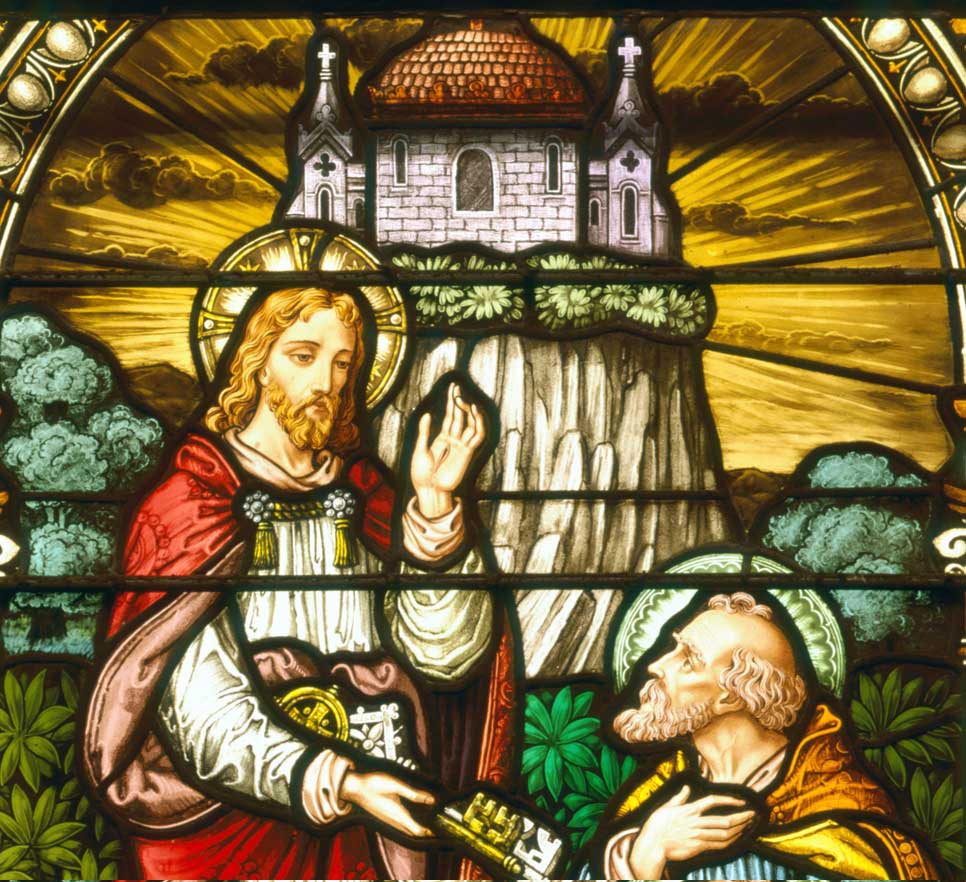
From today’s Gospel (Mt 16:13-19), we celebrate the Feast of the Chair of St. Peter with, what else but, Matthew 16.

“And so I say to you, you are Peter,
and upon this rock I will build my Church,
and the gates of the netherworld shall not prevail against it.”
(v. 18)

I will build: Jesus portrays the Church as a spiritual Temple (cf. 1 Cor 3:16–17; 2 Cor 6:16; Eph 2:19–22; 1 Pet 2:4–8). ● As Solomon was the son of David and the anointed Temple builder in the OT, so Jesus is the Davidic “Son” of God (16:16) and the anointed Messiah who builds the Church in the New. Jesus elsewhere sees himself as both similar and superior to King Solomon (12:42). See note on Mt 7:24. my Church: Among the Gospels, Matthew alone uses the word Church (18:17). The word is used often in the Greek OT for the “congregation” or “assembly” of Israel united to God. Jesus uses it in a similar way for the New Covenant community. the gates of Hades: In the OT, Hades—also called “Sheol” or “the Pit”—is the place of the dead where souls descend through its gates (Ps 9:13, 17; Wis 16:13; Is 38:10; Jon 2:2). It is not hell, but a temporary realm where souls are detained until the Last Judgment (Rev 20:13–15). By extension, Hades is also the habitation of evil forces that bring about death and deception (Rev 6:8; 20:1–3). According to Jewish tradition, the foundation stone (Heb.‘eben shetiyyah) of the Jerusalem Temple capped off and sealed a long shaft leading down to the netherworld (Rev 9:1–2; 20:1–3). The Temple, resting securely on a rock, was thus the center of the cosmos, the junction between heaven and Hades. Drawing from this background, Jesus guarantees that the powers of death and deception will not overcome the Church—i.e., the new Temple built on Peter. He enables Peter (and his successors) to hold error at bay and faithfully proclaim the gospel (CCC 552).” (The Ignatius Catholic Study Bible: The New Testament, 36.)

“The Lord made Simon alone, whom he named Peter, the “rock” of his Church. He gave him the keys of his Church and instituted him shepherd of the whole flock. “The office of binding and loosing which was given to Peter was also assigned to the college of apostles united to its head.” This pastoral office of Peter and the other apostles belongs to the Church’s very foundation and is continued by the bishops under the primacy of the Pope.” (CCC 881)

“In the symbolism of Israel’s theology, the gates of the netherworld were the opening leading down to Hades, also called Sheol, or the Pit, which was the dark and gloomy underworld hidden deep within the bowels of the earth. There the souls of the dead sank down into a shadowy, joyless existence. There also, in Jewish thinking, was the habitation of infernal powers that bring death and deception into the world of the living (see Rev 9:1-6; 11:7; 20:1-3). Later, rabbinic Judaism believed that the foundation stone of the temple capped off the shaft leading down to the underworld. Peter is now given a comparable role in the living temple built by the Messiah. Thanks to the blessing of Jesus on Peter, now made the rock of the new temple, neither death, nor the devil, nor his deceiving spirits shall prevail against the Church.” (The Gospel of Matthew [Catholic Commentary on Sacred Scripture], 208-09)

Thanks be to God for the Rock that our faith can stand firm on. No matter how “rocky” things seem to get in our world or even in our Church, we can be confident that the Church is indefectibly holy because of its head (Christ) and its soul (the Holy Spirit). Hell has no chance. The Church cannot err on matters of faith and morals, so regardless of whatever happens or whatever we hear that concerns us, we can be assured that the age-old teaching of the Church does not waver — so neither should we waver. Jesus promised to stay with us till the end of time and He keeps His promises (and if he wants to hurry back there’ll be no complaints from me).

God bless.

Lent Day 8: Signs, signs

TODAY’S READINGS

From today’s Gospel (Lk 11:29-32), hitting a chord:

“This generation is an evil generation;
it seeks a sign, but no sign will be given it,
except the sign of Jonah.”
(v. 29)

“Seeking a sign is an indication that ‘this generation is an evil generation.’ The phrase likens the Israelites of his day who reject him (see 17:25) to the evil generation that wandered in the wilderness and failed to enter the promised land (Num 32:13; Deut 1:35). Earlier, Jesus had criticized ‘this generation’ of his contemporaries for failing to respond to him and John (Luke 7:31; see 9:41). Here Jesus speaks six times against ‘this generation’ (11:29-32, 50-51). Because he is being rejected, Jesus frequently warns ‘this generation’ about the coming judgment (see 10:13-14; 11:19), when others will join together to condemn it for failing to hear and repent.” (The Gospel of Luke (Catholic Commentary on Sacred Scripture, 228)

“The expression ‘this generation’ can simply refer to those who are alive at the time of Jesus (see 21:32), but it often has the connotation of those who respond negatively to him (see 7:31-34; 17:25), as is the case here. This generation is ‘an evil generation’ because ‘it seeks a sign.’ After seeing Jesus free a man from a demon, some ‘to test him, asked him for a sign from heaven’ (11:160 to prove that he expelled demons by the power of God. It should be evident that Jesus is on God’s side, if he frees men and women from the grip of evil. It should also be evident that God has endowed Jesus with power, if he is overcoming the forces of Satan and healing afflictions. To demand anything more to authenticate Jesus reveals a hostile skepticism, a refusal to believe.” (Bringing the Gospel of Luke to Life, 325-26)

An evil generation may demand a sign, but maybe more evil is the current generation that is not even interested in a sign, since an exponentially growing number of persons do not believe in God, anyway. Who is the Jonah today that will convince our world to repent of its evil ways (see Jonah 3)? Unfortunately for many, repentance requires hearing, and so many of us are tuned out. Would we even notice the sign or hear the Word?

Let us pray fervently that God will send the sort of prophet who, like Jonah, in one sentence, softens hearts and has their owners cry bitter tears of repentance.

Jonah Preaches to the Ninevites (17th c.) by Andrea Vaccaro

God bless.

Lent Day 7: To forgive is divine

TODAY’S READINGS

Jesus reiterates this sentiment immediately after teaching the Our Father (Mt 6:7-15):

“If you forgive men their transgressions,
your heavenly Father will forgive you.
But if you do not forgive men,
neither will your Father forgive your transgressions
.” (vv. 14-15)

“A God who forgives is a wonderful God. But if God, who is thrice-holy, has mercy on the sinner, how much more ought we to forgive others — we sinners, who know from our own experience the wretchedness of sin. No one on earth is perfect. Just as God loves us, even though they have defects, and forgive them. If we wait to love people who have no defects, we shall never love anyone. If we wait until others mend their ways or apologize, we will scarcely ever forgive them. But then we ourselves will never be forgiven. ‘All right: that person has behaved badly towards you. But, haven’t you behaved worse towards God?’ (Bl. J. Escriva, The Way, 686)” (The Navarre Bible: St Matthew, 76)

I was a bit surprised that most of my commentaries either said very little or nothing about these two verses. What has long impressed me about this short passage is that it seems to put an exclamation mark on the Lord’s Prayer that Jesus just taught. The Our Father has seven petitions, but none more challenging than the one having to do with forgiveness. It’s as if Christ, driving home the point, is saying: You heard me right: Forgiveness is mandatory. Do not expect God’s mercy on your judgment day if you were unable to extend mercy to others during the time I gave you on earth..

Consider The Parable of the Unforgiving Servant (Mt 18:21-35). Being “handed…over to the torturers”? Jesus, the Divine Physician, gives us some tough medicine, focusing on where it hurts, to raise our awareness of this tender spot so that we can take care of it and find healing.

If Jesus, the perfectly innocent one, can, from the cross, forgive His creatures of their brutality toward the God-Man, who are we sinners to hold back even under the most difficult circumstances. It is not easy to forgive, particularly when the offense is egregious, but it is what we must do. Let us pray — and never cease praying — to forgive.

God bless.

Lent Day 6: To others = to Jesus

TODAY’S READINGS

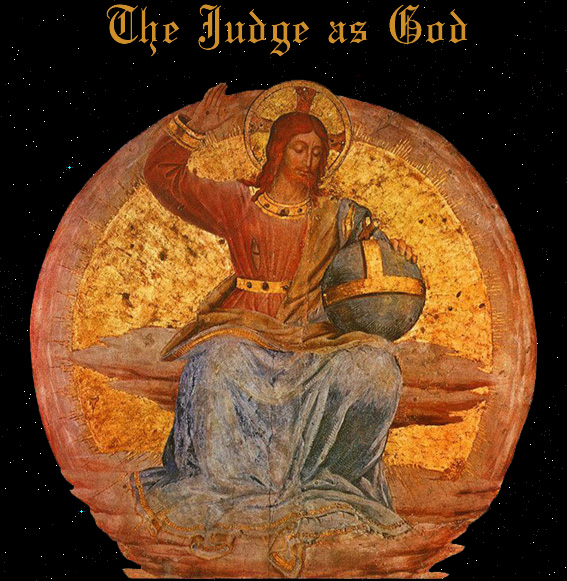
A glimpse at the Last Judgment (Mt 25:31-46) with Jesus’ words. Am I thrilled or am I terrified?

Amen, I say to you, whatever you did
for one of these least brothers of mine, you did for me.”
(v. 40)

“St Teresa of Avila writes: ‘Here the Lord asks only two things of us: live for his Majesty and love for our neighbour. It is these two virtues that we must strive, and if we attain them perfectly we are doing his will […]. The surest sign that we are keeping these two commandments is, I think, that we should really be loving our neighbour; for we cannot be sure if we are loving God, although we may have good reasons for believing that we are, but we can know quite well if we are loving our neighbour. And be certain that, the farther advanced you find you are in this, the greater the love you will have for God; for so dearly does his Majesty love us that he will reward our love for our neighbour by increasing the love which we beat to himself, and that in a thousand ways: this I cannot doubt (Interior Castle, V, 3)” (The Navarre Bible: St Matthew, 213-14)

“It seems likely that the ‘least brothers’ refers to Christians, perhaps to those missionaries who faced numerous hardships for their efforts to evangelize the world. The reason is that these words of Jesus recall earlier descriptions of the disciples in Matthew (10:42; 12:49-50; 18:6, 10). Likewise, ‘all the nations’ assembled for judgment appear to represent all the non-believing Gentiles of the world who are called to account for their treatment of Jesus’ followers. Certainly the Greek term for ‘nations (v. 32) often means ‘Gentiles,’ or ‘pagans,’ in Matthew (see e.g., 4:15; 6:32; 10:5; 12:18).” (The Gospel of Matthew [Christian Commentary on Sacred Scripture], 326-27)

“Jesus’ prophesy of the Last Judgment unfolds at two historical levels. (1) He initially foretells the judgment of Old Covenant Israel. This involves his “coming” to Jerusalem (A.D. 70) as the Shepherd who separates the faithful sheep of Israel from the wicked goats (10:23; 16:27–28; cf. Ezek 34:17–22). (2) He ultimately foretells the General Judgment at the end of history. This will involve Christ’s Second Coming and the general resurrection of all people before his throne to be blessed (25:34) or cursed (25:41) according to their deeds (Jn 5:25–29; Rev 20:11–12; CCC 1038–39).” (Ignatius Catholic Study Bible: The Gospel of Matthew, 63)

If anyone believes that works we do in this life have no bearing on our eternal fate in the next life, these words of Jesus should disabuse that person of this notion. I am reminded of time, talent, and treasure: Everyone has something to offer, from the busiest worker with the big salary and the well-funded retirement accounts to the homebound person barely scraping by. Monetary donations, assisting at the parish or soup kitchen, conducting a Bible study, a Rosary, or all of the above. We have all been given much, regardless of our circumstances. So, “[m]uch will be required of the person entrusted with much, and still more will be demanded of the person entrusted with more” (Lk 12:48).

God bless.

Lent Day 2: Cross-bearers

TODAY’S READINGS

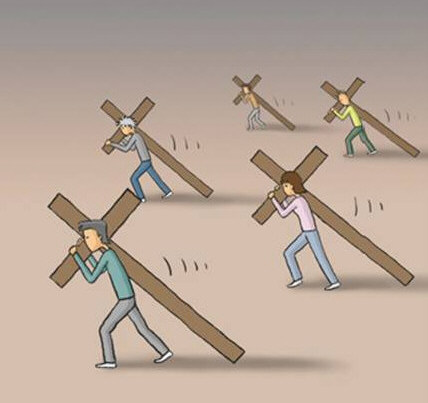
From Luke’s Gospel (Lk 9:22-25) we read the familiar utterance of Jesus to those who are paying attention:

If anyone wishes to come after me, he must deny himself
and take up his cross daily and follow me.” (v. 23)

“There is no doubt about it: a person who loves pleasure, who seeks comfort, who flies from anything that might spell suffering, who is over-anxious, who complains, who blames and who become impatient at the least little thing which does not go his way — a person like that is Christian only in name; he is only a dishonour to his religion, for Jesus Christ has said so…” (St John Mary Vianney, Selected Sermons, Ash Wednesday) (The Navarre Bible: St Luke, 124-125)

“Conversion is accomplished in daily life by gestures of reconciliation, concern for the poor, the exercise and defense of justice and right, by the admission of faults to one’s brethren, fraternal correction, revision of life, examination of conscience, spiritual direction, acceptance of suffering, endurance of persecution for the sake of righteousness. Taking up one’s cross each day and following Jesus is the surest way of penance.” (CCC 1435)

“In the first century, to take up a cross meant one was on the way to crucifixion and hence in the final hours of one’s life. To take up a cross daily can mean to live each day as if it is one’s last, focusing on the most important thing to do in one’s remaining hours: unite oneself with Jesus as his follower.” (Bringing the Gospel of Luke to Life, 261)

We hear this verse often quoted, but do you ever really stop to think about its practical implications? Consider the quote directly above. Living each day as if it was one’s last (and one day it will be!) surely would make us measure every thought, word, and action very carefully. And, if followed faithfully, would make us initially consider our entire lives and what penance and reparation would be required for past faults against God and others. I need to get busy.

And get a load of the list from the Catechism of challenges that lead to conversion! Admission of faults, fraternal correction, acceptance of suffering, endurance of persecution, and on and on. A tall order. Being a disciple of Jesus is no mean feat. The Lord is a demanding God, teacher, brother, and friend. Am i up to it?

Last but not least, the first excerpt, from The Navarre Bible was especially hard hitting for me; I see many of my habitual shortcomings in that list. A CINO (Christian In Name Only), a dishonor to Catholicism? I don’t like the sound of that. So what am I going to do about it? I have much to consider, to pray about, to change.

NEW BOOK!

I was very excited to receive on Tuesday, the day it was released, Wisdom of Solomon by Mark Giszczak. I have been waiting for a few years now, hoping that the Catholic Commentary on Sacred Scripture series, which had completed its entire New Testament set of books, would expand to the Old Testament. Well, it’s finally here! Diving in will have to wait till after Easter — I can’t wait!

REMINDER

My daily ten-minute Eucharist for Lent vidcasts continue today with a breaking open of the Catechism of the Catholic Church.

A FINAL NOTE

The superb Opening the Scriptures series from Our Sunday Visitor includes the Bringing the Gospel of Luke commentary quoted above. Note that they have both this volume and the entry on Matthew available for $10 (just click on the link after the quote). A wise buy if you can swing it.

God bless.

Christmas Day 13 (Bonus!): Christus Victor!

TODAY’S READINGS

While today, January 6, is traditionally Epiphany, since that feast has been moved to Sunday, we get an extra day of the Christmas Season. The first reading is from 1 Jn 5:5-13. This first letter from the beloved disciple is so rich and powerful, it has been a wonderful companion during much of this joyous season.

Who indeed is the victor over the world
but the one who believes that Jesus is the Son of God?
(v. 5)

“This is another case of Johannine shorthand: by ‘faith’ and ‘believes’ John sums up all that comes through this faith — confession of Jesus as the true Son of God, abiding in Christ, the life and witness of the Spirit within, and the power of God through our fellowship with him. It is by our faith that we are enabled to overcome the disordered desires of the world, to proclaim the gospel, to endure persecution, to love our enemies, even to change the world. As Rev 12:11 says, ‘They conquered him by the blood of the Lamb / and by the word of their testimony; / love for life did not deter them from death.” (James, First, Second, and Third John [Catholic Commentary on Sacred Scripture], 226)

Powerful stuff, huh? ”Victor over the world”? The devil’s playground? Yes, we have victory if we believe, and by that is meant not simply faith but faith working through love. Note the commentary above regarding what needs to be done (for starters): overcoming disordered desires, proclaiming the Gospel (through word and deed), enduring persecution, and loving our enemies. Would not we be looking at a very different planet if these traits were overwhelmingly predominant? There are plenty of self-help books on the market, but there is only one Word we need in order to change the world — beginning by changing ourselves.

Christ has conquered the world, the flesh, and the devil through His life, death, Resurrection, and Ascension. He invites us to join Him in taking up our cross to make a difference here and to ultimately inherit eternal life (hopefully bringing many souls with us — see Lk 15:7).

Just a quick note on the last line of the Gospel reading, in which God the Father speaks to God the Son from the heavens upon the latter’s baptism:

“You are my beloved Son; with you I am well pleased.” (Mk 1:11)

All of us who are baptized are children of God. Made, not begotten, it’s true, but really brothers and sisters in Christ. Would not we all love to hear these words from the Father, much less our earthly fathers? Would we actually hear these words based on the state of our lives right now? Maybe for some things and not for others? What is lacking? Worth pondering deeply every day before our judgment day.

God bless.

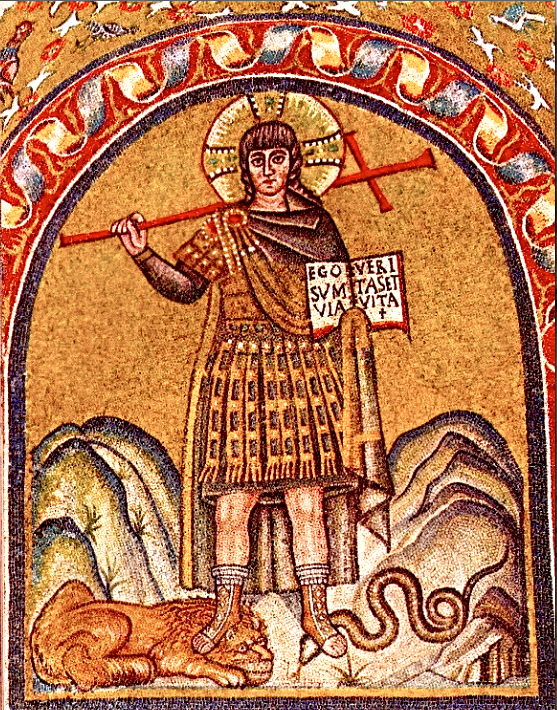
This fifth century mosaic, inspired by Psalm 91, is located in the Archiepiscopal chapel in Ravenna. Christ is represented as a chivarlic Emperor, holding not a sword, but a cross over his shoulders because His kingdom is of an utterly radical life-giving and evil-conquering nature, unlike the kingdoms of the Fallen World System. The book He holds open that reads, “I am the way, the truth and the life.”

Christmas Day 12: Angels and the Son of Man

TODAY’S READINGS

The Gospel reading is from Jn 1:43-51. Jesus continues to accumulate followers, this time picking up Philip and then Nathanael, astonish him after his initial skepticism about Jesus. After an amazing declaration of faith by Nathanael, Jesus tells him and those with him:

“Amen, amen, I say to you,
you will see the sky opened and the angels of God
ascending and descending on the Son of Man.”
(v. 51)

“The mention of angels ascending and descending from heaven upon something alluded to the theophany, or appearance of God, to Jacob at Bethel (Gen 28:10-19). God appeared to Jacob in a dream and extended to him the covenantal promises made to Abraham and Isaac. When he awoke, Jacob said, ‘How awesome this place is! This is nothing else but the house of God, the gateway to heaven!’ (Gen 28:17). Jacob anointed a stone there with oil and name the place ‘Bethel,’ which means ‘the house of God’ (28:18-19).

“Jesus combines two important themes from this Jacob story into his title ‘Son of Man.’ The first is revelation. At Bethel, the Lord revealed himself to Jacob in a dream: now he reveals himself directly and physically in Jesus. The second theme is God’s dwelling place. Jacob referred to the site where the Lord appeared to him as Bethel, ‘the house of God.’ Now, ‘the Word became flesh / and made his dwelling among us’ (1:14). Jesus is the direct, physical dwelling of God among human beings; because God has taken on human nature in Jesus, Jesus reveals God in a new, unsurpassable way. The incarnate Word is the new ‘house of God,’ where the glory of the Lord is present and sensible, and is ‘the gateway to heaven’ (Gen 28:17). The fulfillment of Jesus’ promise — the revelation of God in Jesus who becomes humanity’s gateway to heaven — will be the substance of the rest of the Gospel.”” (The Gospel of John [Catholic Commentary on Sacred Scripture], 51-52)

“Jesus puts himself in the center of this vision, claiming that (1) he is the place where heaven touches down to earth; (2) he is the true house of God; and (3) he is the mediator through whom the angels exercise their ministry.” (The Ignatius Catholic Study Bible: The New Testament (San Francisco: Ignatius Press, 2010), 164)

In the second century, a man names Marcion (possibly a bishop), wanted to disconnect Christianity from Judaism entirely. One significant way to do that was to eliminate the Old Testament as a source of inspired Scripture (there was more to it — see here). Today’s Gospel reading is one of countless examples of why eliminating the OT, or even just having a deficient knowledge of it, is so problematic.

St. Augustine famously said:

The New Testament lies hidden in the Old Testament, and the Old becomes manifest in the New.

How true! Without knowing the story of Jacob’s ladder (Gen 28:10-19), the significance of Jesus’ words would be lost on us (they surely were not lost on his first hearers).

This last month or so, I have been highlighting in these posts the value of good Catholic commentaries. They are invaluable in explicating the sometimes confusing, and sometimes apparently straightforward, texts of the Bible. There is hardly a passage one encounters between the covers of Sacred Scripture that cannot be delved into for deeper meanings on a number of levels (see here regarding the senses of Scripture).

CHRISTMAS IS NEARLY OVER!

It seems fitting on the twelfth day of Christmas to listen to the famous song we all sang at some point growing up. I again turn to Pentatonix, which has a delightfully funky version of the tune.

And what about the meaning of the days? Check out this interesting history.

We are not quite done though. Epiphany will be celebrated Sunday, and then back to Ordinary Time. But, this year, let us appreciate how extraOrdinary it is.

God bless.

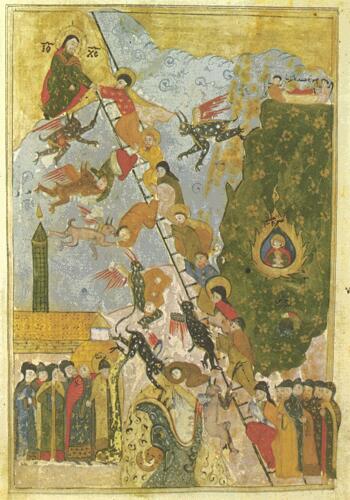
The Ladder of Divine Ascent. SINAI FESTAL ICON.

Christmas Day 10: Unknown children

TODAY’S READINGS

The first reading is from 1 Jn 2:29–3:6, picking up where we left off yesterday. It is incredible news and a sobering note.

See what love the Father has bestowed on us
that we may be called the children of God.
Yet so we are.
The reason the world does not know us is that it did not know him.
(v. 1)

“God the Father has loved us to such an extent that we have the immense privilege of being called his children…We are children of God not in name only or merely as a title of honor. Christians truly have become God’s children in a new way through the saving work of Christ: ‘To all who received him, who believed in his name, he gave power to become children of God, who were born, not of blood or of the will of the flesh or of the will of man, but of God’ (John 1:12-13 NRSV)…

“The fact that we are the children of God explains why the ‘world’ does not recognize us for what we are. Just as those who belong to the world failed to recognize Christ himself and his Father, so they clearly will not know or recognize those who are begotten of God. As children, we are like the Father and the true Son, Jesus Christ, and so we should expect to experience th same rejection that Christ received.” (James, First, Second, and Third John [Catholic Commentary on Sacred Scripture] , 180)

“‘This is the great boldness of the Christian faith — to proclaim the value and dignity of human nature and to affirm that we have been created to obtain the dignity of children of God, through the grace that raises us up to a supernatural level. An incredible boldness it would be, were it not founded on the promise of salvation given us by God the Father, confirmed by the blood of Christ, and reaffirmed and made possible by the constant action of the Holy Spirit’ (Christ is passing by, 33). (The Navarre Bible: Catholic Epistles, 178-179)

What an astounding passage we are highlighting here! That we poor creatures, who would not exist without God and can do nothing good without God, can be made children of God and can choose to ultimately be with this benevolent Father for all eternity. We same creatures whose first parents were gravely disobedient, whose descendants repeatedly spurned God for idols, and who ultimately murdered God, can be reconciled with Him — and more than that — become like God. This is Good News! Like Jeremiah, whom we spoke of a few short days ago, how possibly can we keep this fire inside? And how can we not fail to strive for holiness with the promise of heaven if we live as we profess to believe?

Yet, we can often feel “unknown” when we speak about and live our faith. If our imitation of Christ makes us off-putting to some, so be it. These do not recognize Christ in us, or worse they do and want no part of us/Him. Let us pray that God will use our good example to bring others to Him, that we will make clear to those we encounter the goodness of God and His desire that all persons be saved (see 1 Tim 2:3-4).

God bless, brothers and sisters in Christ (isn’t it wonderful to be related!). I invite you to say an Our Father, recalling our relationship with God and our fellow baptized (all the Communion of Saints).

God bless.

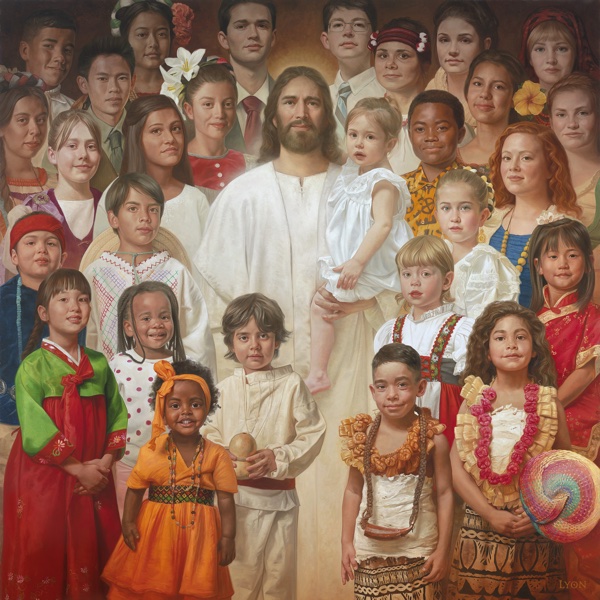
I Am a Child of God (contemporary) by Howard Lyon

Christmas Day 9: LIAR!

TODAY’S READINGS

The first reading is from 1 Jn 2:22-28. We’ve heard quite a lot from John’s first letter in recent days. Today we get a powerful excerpt regarding Jesus’ messiahship and divinity.  I focus here on the first two verses, because they pack such a wallop.

Who is the liar?
Whoever denies that Jesus is the Christ.
Whoever denies the Father and the Son, this is the antichrist.
Anyone who denies the Son does not have the Father,
but whoever confesses the Son has the Father as well.
(vv. 22-23)

“It is evident that John is concerned here for the basic confession of faith regarding the true identity of Jesus Christ.

“But what exactly were these ‘antichrists’ denying? This is not entirely clear, but as we piece together the evidence from the letter, it appears that they were denying that the Son of God (who was ‘in the beginning’ with the Father) actually took flesh and became a human being in the incarnation. They were denying that Jesus truly was the ‘Christ’ — that is, the Messiah or anointed one — who came from the Father for our salvation. ’The Lie par excellence is that which refuses to see the Godhead shine in the human life and death of Jesus’ (F. F. Bruce, The Epistles of John: Introduction, Exposition, and Notes [London: Pickering & Inglis, 1970], 73). For John, this is the core activity of the antichrist: to deny the true incarnation of the Son of God sent from the Father…

“If we deny the truth about the Son, then we lose the Father as well; if we confess and believe in the Son as the faith teaches, then we gain the Father as well. ’Whoever does not honor the Son does not honor the Father who sent him’ (John 5:23).” (James, First, Second, and Third John [Catholic Commentary on Sacred Scripture] , 171, 172)

We know well the devil is a liar, even from the very beginning (see Jn 8:44 and, of course, Gn 3). Who else ultimately inspires a denial of the divinity of Christ and His redemptive mission? 

Now John was likely calling out pseudo-Christians, who, for whatever reason, denied or altered basic doctrine regarding the nature of Christ. They exchanged the truth for a lie, whether wittingly or unwittingly, to deceive or when expressing real (albeit misguided) conviction. Regardless, it is terribly damaging in its potential to lead persons astray.

Consider throughout the ages those who deny Christ is who He says He is. Consider also that this denial gives them no access to the Father of Jesus — no access to God at all! Jesus says to Thomas (and us) during the Last Supper discourse:

“I am the way and the truth and the life. No one comes to the Father except through me.
If you know me, then you will also know my Father. From now on you do know him and have seen him.” (Jn 14:6-7)

Those who follow some other (or no other) religion are perpetuating a lie. Some unknowingly perhaps. Others, in many cases, with strong conviction of their own beliefs. Does God actively will religions outside His Church? Obviously not! Scripture says,

God our savior…
wills everyone to be saved and to come to knowledge of the truth.
For there is one God.
There is also one mediator between God and the human race,
Christ Jesus, himself human,
who gave himself as ransom for all. (1 Tm 2:3-6)

While we are to respect others in their religious choices, if they are following a lesser conception of God than is true, we should love them enough not to leave them there. Jesus’ call to evangelization is absolute (see Mt 28:19). This should not be difficult. If we have good news in our personal affairs we can’t wait to let others know. When we have the Good News (“Gospel”) in our hearts, we shouldn’t be able to hesitate to let others know through word and deed. Lord grant us to be like Jeremiah:

I say I will not mention him,
I will no longer speak in his name.
But then it is as if fire is burning in my heart,
imprisoned in my bones;
I grow weary holding back,
I cannot! (Jer 20:9)

God bless.