Christmas Day 5: Walk the walk

TODAY’S READINGS

The first reading is from 1 Jn 2:3-11. A challenge and a promise.

The way we may be sure that we know Jesus
is to keep his commandments.
Whoever says, “I know him,” but does not keep his commandments
is a liar, and the truth is not in him.
But whoever keeps his word,
the love of God is truly perfected in him.
This is the way we may know that we are in union with him:
whoever claims to abide in him ought to walk just as he walked.
(v. 3-6)

“For St John, knowing God is not merely an intellectual exercise nor does he mean that the immensity of God can be grasped by man’s limited understanding. It refers to something much simpler and more important: knowing God means being united to him by faith and love — by grace…

“‘Keeping his commandments’ (vv. 3 and 4), ‘Keeping his word’ (v., 5), ‘walking in the same way in which he walked’ (v. 6): keeping the commandments is absolutely necessary, because there is no room for faith without works (cf. 1 Jn 3:17-18; Jas 2:14ff; Gal 5:6). Similarly, one must keep the work of God, that is , accept all revelation docilely (and idea found very often in John : c.f., e.g., Jn 5:38; 8:31, 51; 1 Jn 2;14). But, above all, Christians must identify their life with Christ’s….” (The Navarre Bible: Catholic Epistles, 168)

Christianity does not espouse an “easy believism”: “I’ve accepted Jesus as my Lord and Savior, so my ticket to heaven is stamped.” No, Jesus in the Gospels makes it clear, over and over, that the demands are great and the path is narrow. Our faith is not for the weak of heart or the weak of spirit. The good news, straight from the Lord, in times of temptation:

My grace is sufficient for you, for power is made perfect in weakness. (2 Cor 12:9)

We can do nothing without grace. But grace through faith allows us to move mountains — if only we accept these gifts.

JESUS AND THE DEAD SEA SCROLLS

I just finished Dr. John Bergsma’s book. If the subject of the Dead Sea Scrolls is unfamiliar to you or seems uninteresting to you, this book will enlighten and interest you. The primary importance of these documents for Christians is how they enlighten our understanding of the sacraments and the early Church, being written approximately contemporaneous to the New Testament. Bergsma makes it interesting and accessible to the engaged reader — q worthy effort that I can highly recommend without reservation.

ST. THOMAS BECKET

Article: St. Thomas Becket

Pray for us!

God bless.

Christmas Day 3: κοινωνία

TODAY’S READINGS

The first reading is from 1 Jn 1:1-4, the prologue of John’s first letter which echoes the prologue of this same Apostle’s Gospel. Let us focus on a key word, rendered in Greek above:

[W]hat we have seen and heard
we proclaim now to you,
so that you too may have
fellowship with us (v. 3)

“In the New Testament the Greek word koinōnia is translated in a variety of ways: ‘sharing,’ ‘partnership,’ ‘contribution,’ ‘participation,’ ‘communion,’ and ‘fellowship.’ It can refer to the sharing of money and material resources within the Christian community (2 Cor 8:4; 9:13; Heb 13:16). It is used to designate the common life shared by the first Christians in Jerusalem after the outpouring of the Holy Spirit: ‘They devoted themselves to the teaching of the apostles and to the communal life [koinōnia], to the breaking of the bread and to the prayers.’ (Acts 2:42). Koinōnia also applies to our relationship with the persons of the Trinity: we are called to ‘fellowship with Jesus Christ’ (1 Cor 1:9); we jointly share ‘fellowship’ with the Father and the Son (1 John 1:3, 6); and Paul prays for an increase in: ‘communion’ with the Holy Spirit (2 Cor 13:13 NRSV). Paul also speaks of our koinōnia (‘participation,’ ‘communion’) in the body and blood of Christ in the Eucharist (1 Cor 10:16). When we have koinōnia with God, we share in his life and power; when we have koinōnia with one another, we place our lives in common and share our resources as brothers and sisters. In 1 John, koinōnia describes both our fellowship with God and with one another — a rich communion of life and bonds of love that are meant to characterize the faithful.” (James, First, Second, and Third John [Catholic Commentary on Sacred Scripture], 140)

Wow, the term koinōnia encompasses a lot doesn’t it — really, every relationship we have: natural and supernatural. The first sentence in the quote above lists six translations of koinōnia. It seems to me that a good exercise is to consider our relationship with God and our fellow humans by working through each of these possibilities and see how we measure up. What of us do we share with God? Are we willing to share with others? Are we partnering with God in His mission here on earth? Do we consider ourselves partners (“accompaniers”) of our fellow man in leading them to the fullness of truth? You get the picture.

John tells us that he is conveying what he has “seen and heard.” What did he hear? Jesus said, “Love one another as I have loved you” (Jn 13:34). The Apostle John was famous for endlessly repeating to his disciples, especially in his frailty near the end of his life, “My little children: love one another (see 1 Jn 3, as well).” Always, or even often, easy? Certainly not. An absolute requirement of the Christian? Definitely so.

As an interesting aside, what about the “other disciple” in today’s Gospel? Check out this article for a breakdown of the “beloved” and “other” disciple in John’s Gospel — you may be surprised.

I close with a fine article written just for today’s feast.

St John, Apostle and Evangelist, ora pro nobis!

God bless.

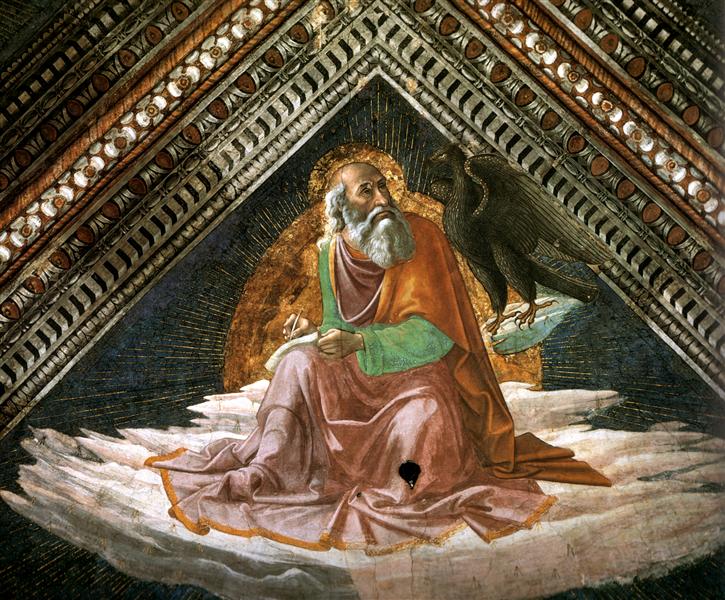
St. John the Evangelist (1486-1490) by Domenico Ghirlandaio

Advent Day 4: We can get satisfaction!

TODAY’S READINGS

The Gospel reading is from Mt 15:29-37. It ends this way:

They all ate and were satisfied.
They picked up the fragments left over–seven baskets full.
(v. 37)

“It is interesting to note that in both miracles of multiplication of loaves and fish Jesus provides food in abundance but does not allow anything to go to waste. All Jesus’ miracles, in addition to being concrete historical events, are also symbols of supernatural realities. Here abundance of material food also signifies abundance of divine gifts on the level of grace and glory: it refers to spiritual resources and eternal rewards; God gives people more graces than are strictly necessary. This is borne out by Christian experience throughout history. St Paul tells us that ‘where sin increased, grace abounded all the more’ (Rom 5:20); he speaks of ‘the riches of his grace which he lavished upon us’ (Eph 1:8) and tells his disciple Timothy that ‘the grace of our Lord overflowed for me with the faith and love that are in Christ Jesus’ (1 Tim 1:14).” (The Navarre Bible: St Matthew, 148)

It should be difficult for Catholics to not think about the Eucharist with the miracle of the loaves. The insight above reinforces this connection. The ‘supersubstantial‘ bread of the Eucharist presents to us the supernatural gift of grace in superabundance — if we are open and disposed to receive it and digest it.

God bless.

Advent Day 3: Come Holy Spirit!

TODAY’S READINGS

The first reading is from Is 11:1-10, the famous passage that gives us the Gifts of the Holy Spirit.

The Spirit of the LORD shall rest upon him:
a Spirit of wisdom and of understanding,
A Spirit of counsel and of strength,
a Spirit of knowledge and of fear of the LORD,
and his delight shall be the fear of the LORD.
(vv. 2-3a)

Refer to this helpful article for Aquinas’s breakdown of these gifts and some additional interesting commentary. Also worth checking out is this video by the good Dominicans at the Thomistic Institute.

“This text is important for the whole pneumatology of the Old Testament, because it constitutes a kind of bridge between the ancient biblical concept of ‘spirit,’ understood primarily as a ‘charismatic breath of wind,’ and the ‘Spirit” as a person and as a gift, a gift for the person. The Messiah of the lineage of David (‘from the stump of Jesse’) is precisely that person upon whom the Spirit of the Lord ‘shall rest.’ It is obvious that in this case one cannot speak of a revelation of the Paraclete. However, with this veiled reference to the figure of the future Messiah there begins, so to speak, the path towards the full revelation of the Holy Spirit in the unity of the Trinitarian mystery, a mystery which will finally be manifested in the New Covenant. (Dominum et Vivificantem, 15)” (The Navarre Bible: Major Prophets, 88-89)

“The way to heaven is opened by the sevenfold grace of the Spirit. Isaiah speaks from the viewpoint of heaven, numbering the steps in descending order: wisdom and understanding, counsel and might, knowledge and piety, and fear of the Lord. Since it is written ‘the fear of the Lord is the beginning of wisdom,’ it is clear that the way ascends from fear to wisdom instead of going down from wisdom to fear. The prophet thus reasons from heavenly things to humbler things. (St Gregory the Great, Homilies on Ezekiel 2, 7, 7).” (Ignatius Catholic Study Bible: Isaiah, 36)

God bless.