Advent Day 14: Elijah the Prophet

TODAY’S GOSPEL (Mt 17:9a, 10-13)

As they were coming down from the mountain,
the disciples asked Jesus,
“Why do the scribes say that Elijah must come first?”
He said in reply, “Elijah will indeed come and restore all things;
but I tell you that Elijah has already come,
and they did not recognize him but did to him whatever they pleased.
So also will the Son of Man suffer at their hands.”
Then the disciples understood
that he was speaking to them of John the Baptist.

My take

For today, I will simply invite you to get to know Elijah’s story and, while doing so, encourage you to be mindful of John the Baptist as you read through it: 1 Kings 17-19, 21; 2 Kings 1-2. Afterward, use this to examine all New Testament passages referring to the prophet and then dive into the context.

Elijah in the Desert (1543-1547) by Daniele da Volterra

God bless!

Advent Day 8: Straightening up

TODAY’S READINGS

FROM Baruch 5:7 (the full passage is Bar 5:1-9):

God has commanded
that every lofty mountain be made low,
and that the age-old depths and gorges
be filled to level ground

FROM Psalms 126:5 (the full passage is Ps 126:1-2, 2-3, 4-5, 6):

Those who sow in tears
shall reap rejoicing.

From The Navarre Bible: The Psalms and the Song of Solomon, page 422

“[This] simile seems to be built around a popular proverb. ‘The pain of suffering gives rise to holy tears. But the time of weeping is also the time of sowing, because the works of charity that are performed to ease the burden of men’s sins are the seeds of eternal happiness’ (Prosper of Aquitaine, Expositio Psalmorum, 125, 6).”

FROM Philippians 1:4-5 (the full passage is Phil 1:4-6, 8-11)

I pray always with joy in my every prayer for all of you,
because of your partnership for the gospel

From Catholic Commentary on Sacred Scripture: Philippians, Colossians, Philemon, pages 75-76

“‘your partnership for the gospel’: That phrase may seem at first to refer simply to their common faith in the gospel. But for Paul the partnership is more concrete and practical than that. As Paul uses the word, ‘gospel’ can sometimes mean the message of the good news itself (God has definitely entered into history to save us through the death and resurrection of his Son), but at other times ‘gospel’ means the project of sharing that good news. Here, the ‘partnership in the gospel’ for which Paul is grateful seems to refer especially to the financial aid that the Philippians have sent to him through Epaphroditus (see 4:10-20). This aid in partnership in the sense that it is a real contribution to the advance of the gospel.”

FROM Luke 3:4b-5 (the full passage is Lk 3:1-6)

 Every valley shall be filled
        and every mountain and hill shall be made low.
    The winding roads shall be made straight,
        and the rough ways made smooth

From The Word of the Lord (Year C), page 18

“‘Every valley shall be filled’ refers to hope, encouragement, and new life being granted to the poor, the oppressed, the lowly — people who fell they have been forgotten by God or are not worthy of God’s attention.
“‘Every mountain and hill shall be made low’ refers to the humbling of the proud, the repentance that the strong and arrogant must undergo in order to receive God’s salvation.
“The ‘winding roads’ and ‘rough ways’ refer to the twists and turns of the human heart, contorted by sin (Jer 19:9). The human heart needs to be ‘simplified’ or ‘straightened’ by honest and truthful confession of sin.”

MY TAKE

Not only is John the Baptist’s message echoed in Isaiah (Is 40:35), but also in Jeremiah’s scribe, Baruch, as seen in today’s first reading. I can do nothing to improve on Dr. Bergsma’s reflection above in his The Word of the Lord series (a must have — I’m working through the last of the four volumes, as I did the first three, this year), but I will add a thought that came to me as I heard the Gospel proclaimed at Mass.

“Mountains made low” certainly evokes images of the proud being “put in their place.” So, then, if the lofty peak represents the proud, maybe those in a deep valley are folks who are mired in sin and despairing of salvation. The only way out is up and it’s a struggle that may seem overwhelming (or impossible) to undertake. And how easy it is to get to the bottom! I’m a bicyclist so it is impressed upon me what an easy journey it is when going down hill and what a challenge it is to go back up that same hill. Sin can be that way for us, as well. Our transgressions may start out small, but the slippery slope is there to carry us rapidly down if we are not careful and vigilant. Sometimes it is only when a person in the throes of sin or addiction hits “rock bottom” that he comes to his senses and makes the decision to climb out of the abyss. Can we not say that what was “sowed in tears” (the descent into the darkness of sin) can ultimately lead to “rejoicing in the reaping” (in ascending to righteousness)?

Finally, a word on the second reading. By virtue of our Baptism, we are partners in sharing the Gospel. We should do so in word and action at all times. But, as the Catholic Commentary lays out, we should also support ministries, as Paul’s followers did for him, that authentically and faithfully get out the Word. Some of my favorites are my home parish, the St Paul Center, Catholic Answers, and EWTN.

BP BARRON SERMON

FR MIKE SCHMITZ HOMILY

Hurricane Ridge in Olympic National Park

God bless!

Lent Day 43: Annihilation is preferable

TODAY’S READINGS

Today’s Gospel reading (Mt 26:14-25) again has us at the table with Jesus and His Apostles at the Last Supper. The focus again is on the betrayer, Judas, on the day we call in his “honor,” Spy Wednesday. Jesus says of the traitor:

“The Son of Man indeed goes, as it is written of him,
but woe to that man by whom the Son of Man is betrayed.
It would be better for that man if he had never been born.”
(v. 24)

“Jesus is referring to the fact that he will give himself up freely to suffering and death. In so doing he would fulfill the will of God, as proclaimed centuries before (cf. Ps 41:10; Is 53:7). Although our Lord goes to his death voluntarily, this does not reduce the seriousness of Judas’ treachery.” (The Navarre Bible: St Matthew, 219)

“Instead of identifying the man, Jesus warns of the dreadful fate that the betrayer is choosing for himself. For what is about to transpire is a concurrence of divine will and human decision. The destiny of the Son of Man is determined by God and announced in the writings of the Old Testament. But the actions of the “man by whom the Son of Man is betrayed” are fully and freely his own. Judas is not a puppet with someone else pulling the strings. He has chosen to misuse his free will, and should he follow through with this treachery, he will come to wish “he had never been born.” (The Gospel of Matthew [Catholic Commentary on Sacred Scripture], 335)

“Jesus does not spell out what fate awaits [Judas] but indicates that it will be horrible…Jesus is now giving Judas a last-minute warning. Even though Jesus knows what will happen, Judas is nevertheless free to change his mind and take a different course.” (Bringing the Gospel of Matthew to Life, 578)

While the Church canonizes many persons as saints, it never declares anyone definitively in Hell. This spurs many conversations regarding the population of Hell. But the verse under consideration has long convinced me that there is one inhabitant of Gehenna (and I think, many, many more). The only persons who could possibly wish they’d never been born must be those in Hell. Heaven is what we were made for. Hell is the complete, utter, total, and permanent state of existing where we were never meant to be (remember: God desires all men to be saved [1 Tim 2:4]). I imagine souls in Hell cursing God, cursing their parents, and wishing they had never come into existence while knowing they can never go out of existence.

God forbid that any of us hear the words said to Judas being said to us on our judgment day because we betrayed our Savior

A wonderful talk supporting (and, frankly, influencing) my position on Judas’ ultimate fate can be found here.

Judas Iscariot, Saint Peter, John the Apostle, The Last Supper (c. 1520) by Giampietrino
after Leonardo da Vinci

God bless.

Lent Day 33: Lifted Jesus

TODAY’S READINGS

Today’s Gospel reading (Jn 12:20-33) has Jesus approached by Gentiles interested in Him. Now Jesus’ hour has come. He ends His short discourse on this matter this way, with an explanation from John:

“And when I am lifted up from the earth,
I will draw everyone to myself.”
He said this indicating the kind of death he would die.
(vv. 32-33)

“Like the crowds who are ‘amazed’ at Jesus’ teaching (7:15) and miracles (7:21), the guards are awed at his teaching: there is something unprecedented about Jesus.” (The Gospel of John [Catholic Commentary on Sacred Scripture], 45)

when I am lifted up: Refers primarily to the Crucifixion of Christ, as indicated in the next verse, but also hints at his Resurrection and Ascension (CCC 662). See note on Jn 3:14. ● The expression recalls the opening line of Isaiah’s fourth Servant Song, which runs from Is 52:13 to 53:12. The whole song is a prophetic depiction of the suffering of the Messiah, who will be exalted and lifted up in the sight of the nations, but only after he is cast down by his own people. Isaiah interprets the humiliation and death of this Servant as a redemptive sacrifice for sin. draw all men to myself: Points to the worldwide acceptance of the gospel (Mt 28:18–20; Acts 1:8). ● As Isaiah envisioned the Davidic Messiah as an “ensign” posted for the ingathering of the “nations” and the “outcasts of Israel” (Is 11:10–12), so Jesus sees the world gathering around the “sign” of the Cross (CCC 542). (The Gospel of John [Ignatius Catholic Study Bible], 42)

“‘And I, when I am lifted up from the earth, will draw all men to myself.’ The lifting up of Jesus on the cross signifies and announces his lifting up by his Ascension into heaven, and indeed begins it. Jesus Christ, the one priest of the new and eternal Covenant, ‘entered, not into a sanctuary made by human hands. . . but into heaven itself, now to appear in the presence of God on our behalf.’ There Christ permanently exercises his priesthood, for he ‘always lives to make intercession’ for ‘those who draw near to God through him’. As ‘high priest of the good things to come’ he is the center and the principal actor of the liturgy that honors the Father in heaven. (CCC 662)

Christ stands at the heart of this gathering of men into the ‘family of God’. By his word, through signs that manifest the reign of God, and by sending out his disciples, Jesus calls all people to come together around him. But above all in the great Paschal mystery – his death on the cross and his Resurrection – he would accomplish the coming of his kingdom. ‘And I, when I am lifted up from the earth, will draw all men to myself.’ Into this union with Christ all men are called. (CCC 542)

Knowing how the story ends, or might I rather say, how the story continues, we might think that Jesus is referring to His Ascension when He speaks about being “lifted up.” John quickly disabuses us of this notion. While, as the commentary above says, we can see hints of the Ascension, it is unmistakable that there is no Ascension, no Resurrection, without the Crucifixion. As Jesus says earlier in today’s reading, “it was for this purpose that I came to this hour” (v. 27). He calls us to “hate” our life here so that we “will preserve it for eternal life” (v. 25).

We, too, are called to be drawn to the Cross, that is, to suffering. Not wishing for it — we’re not called to be masochists — but accepting it when it comes (because it always does). I invite you to join me in praying that when pain and suffering come, large and small, that we will have the grace to offer it up for the forgiveness of sins (starting with our own) and the redemption of souls. I will mention, as have before in these posts, the blessing of our faith that informs us of the value of suffering when it is redemptive. For the faithful it is not only a promise, but a requirement:

Then Jesus said to his disciples, “Whoever wishes to come after me must deny himself,* take up his cross, and follow me.
For whoever wishes to save his life will lose it, but whoever loses his life for my sake will find it. (Mt 16:24-25)

The second verse echoes what Jesus says in today’s reading. So we ask ourselves: What wouldn’t you endure in the brief moment we traverse this valley of tears for eternal bliss?

Easy? No. Possible? “[F]or God all things are possible” (Mt 19:26). The Lord puts His stamp on this when speaking to Paul:

“My grace is sufficient for you, for power is made perfect in weakness.” (1 Cor 12:9)

Let us pray, and pray some more, for the grace of perseverance in trials and tribulation.

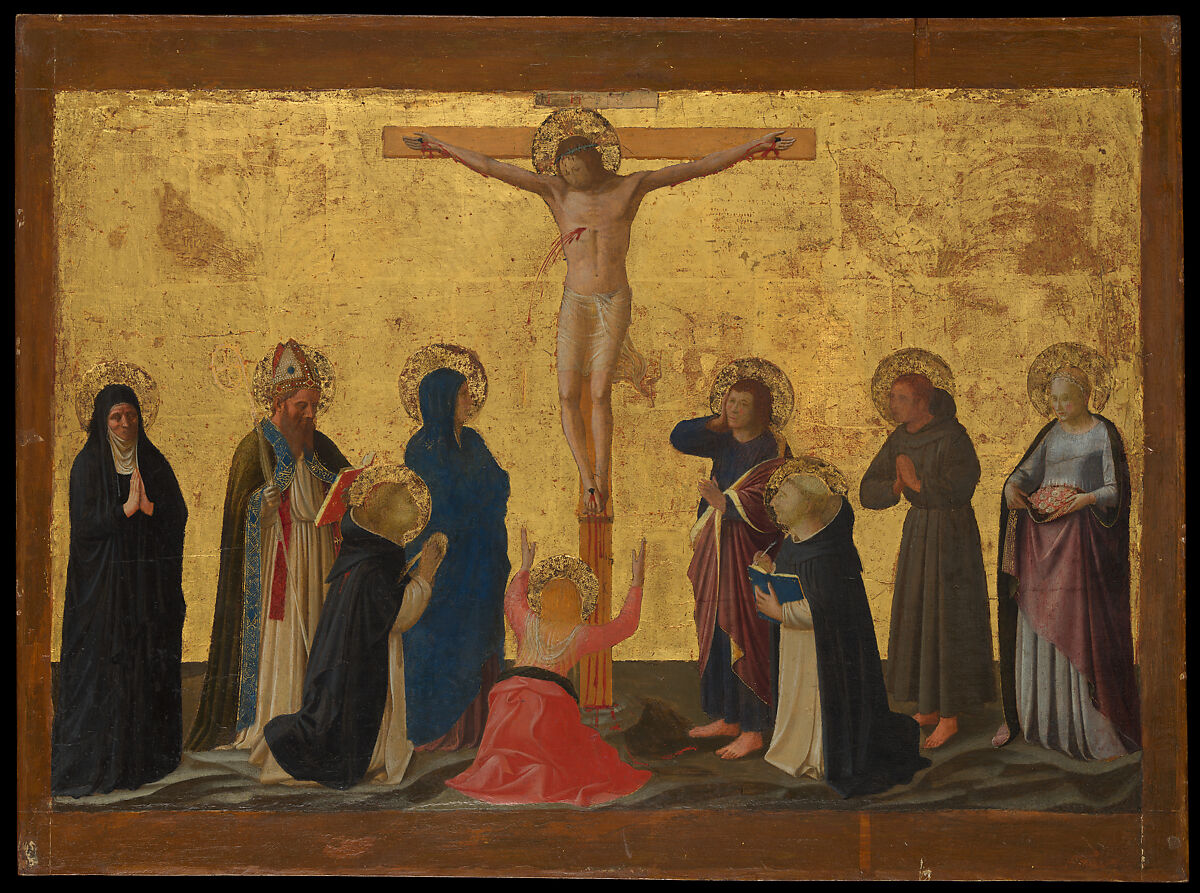
The painting below represents to me “everyone” coming to Jesus. We especially think of John, the loan apostle to return to Jesus in His moment of torture, as a representative for all of us when Jesus entrusts His mother to him. Ask for Blessed Mary’s intercession frequently, as she knows suffering as well as anyone.

BP BARRON’S SERMON

Check out today’s sermon from the good bishop who takes a deep dive into Jeremiah 31:31 — the promise of a New Covenant which Jesus gives us at the Last Supper. Super important to understand the New Covenant and the Old Covenant(s).

The Crucifixion (c. 1440) by Fra Angelico

God bless.

Lent Day 30: Moses and Jesus

TODAY’S READINGS

Today’s Gospel (Jn 5:31-47) picks up where yesterday’s left off. Jesus here provides deep theology and a pointed accusation at the Pharisees. He closes with these devastating words:

“Do not think that I will accuse you before the Father:
the one who will accuse you is Moses,
in whom you have placed your hope.
For if you had believed Moses,
you would have believed me,
because he wrote about me.
But if you do not believe his writings,
how will you believe my words?”
(vv. 45-47)

he wrote of me: Jesus follows the Jewish tradition that Moses authored the Pentateuch (Gen-Deut). Moses thus described the Messiah as a Redeemer (Gen 3:15), a universal King (Gen 49:10), and a Prophet like himself (Deut 18:15–19).” (The Gospel of John [Ignatius Catholic Study Bible], 28)

“The authorities appealed to the authority of Moses (‘in whom you have placed your hope’) and the Torah to accuse Jesus (see 5:11-18). Yet since the Scriptures are a witness to Jesus (Moses ‘wrote about me’), both the Scriptures and Moses stand on Jesus’ side against his accusers. Scripture bears witness to Jesus, and faith in Jesus opens the way to see this testimony. But on account of their unbelief, the authorities do not fully understand Moses and the Scriptures because they do no see how they bear witness to Jesus. Thus, Jesus concludes, ‘If you do not believe his writings, how will you believe my words?'” (The Gospel of John [Catholic Commentary on Sacred Scripture], 111-12)

“Failure to understand the true import of Scripture is an obstacle to believing in Jesus and coming to him to have life (5:40).” (Bringing the Gospel of John to Life, 150)

I think of typology and the importance of the entire Bible here. It is true, as St. Augustine said, that, “In the Old Testament the New is concealed, in the New the Old is revealed.” We miss so much if we read the New Testament, especially the Gospels, in isolation. Jesus berates the self-described experts in the Law, as missing all the Torah was pointing to: namely Him. Had they seen Jesus as the New Moses, the fulfillment of the Mosaic (and all Old Testament) covenants, they would have put Him on a throne of gold instead of a throne of wood.

God bless.

Lent Day 28: Suffering is not the worst

TODAY’S READINGS

Today’s Gospel (Jn 5:1-16) picks up where yesterday’s left off. Jesus heals a man ill for thirty-eight years…on the sabbath. Jesus last words to the man:

“Look, you are well; do not sin any more,
so that nothing worse may happen to you.” (v. 14)

“Jesus’ remark here can mean that sin causes something worse to a person than physical illness: spiritual illness that can be eternally fatal.” (The Gospel of John [Catholic Commentary on Sacred Scripture], 100)

“The Bible reveals a link between sin and suffering, with the former being the cause of the latter (Ps 107:17). This general truth, however, does not extend to every individual case (9:3).” (The Gospel of John [The Ignatius Catholic Study Bible], 27

“The man may have come to the temple to thank God for his cure. Jesus goes over and reminds him that the health of the soul is more important physical health.

“Our Lord uses holy fear of God as motivation in the struggle against sin: ‘Sin no more, that nothing worse befall you’. This holy fear is born out of respect for God our Father; it is perfectly compatible with love. Just as children love and respect their parents and try to avoid annoying them partly because they are afraid of being punished, so we should fight against sin firstly because it is an offence against God, but also because we can be punished in this life and, above all, in the next.” (The Navarre Bible: St John, 89)

“This statement accomplishes three things. First, it teaches than bodily sickness is an image of sin in the soul. Second, it teaches that it is much more important to avoid sin than avoid sickness. Third, it tells us to look at the healing as a parable: the sick people lying under the porticoes stand for sinners; getting into the baths stands for baptism; getting cured from sickness stands for having sins washed away; the question of whether the man wanted to be cured stands for the question of whether we really want to be free from our sins. If the man had grasped all three of these things, he would have wanted to become a follower of Christ and asked to be baptized.” (Mary’s Voice in the Gospel According to John, 61-62)

Suffering is an interesting thing (maybe not so much so when one is in the midst of terrible pain, but…). Suffering may come out of the blue through no fault of our own. Suffering may come due to bad habits, carelessness, or recklessness. Suffering may come due to our sinful behavior. But, as terrible as it is to suffer, nobody deals with it better than the Catholic Church. The possibility of suffering being redemptive, no matter the reason it comes our way, has had the faithful endure the most horrible physical and mental torments that they united with Christ’s Passion for the forgiveness of sins and the redemption of souls. After all, Jesus said:

In the world you will have trouble, but take courage, I have conquered the world. (Jn 16:33)

The Greek for “trouble” (θλίψιν) has also been translated as “tribulation,” “affliction,” and “distress.” If the servant is no better than his Master, and God Himself suffered the pain and humiliation of the cross, do we sinful persons dare to think we should get off scot-free?

So, let no suffering go to waste. The Lord can use it to heal our souls and those of many others. Consider the greeting we will get in heaven from those who we helped by and through sufferings we laid at the foot of the Cross while on this mortal coil.

BOOK RECOMMENDATION

Note the last commentary I cite is the first time I’ve used it here. Michael Pakaluk’s Mary’s Voice in the Gospel According to John is an outstanding book that I can heartily recommend. He also has a commentary on Mark. Hopefully he will get to the other Gospels, as well. Clearly a man who loves the Lord and His word and has imbibed deeply of it.

God bless.

Lent Day 27: Homecoming

TODAY’S READINGS

Today’s Gospel (Jn 4:43-54) has us jumping to the next chapter in John. Here Jesus returns to Galilee with quite a reputation earned in Jerusalem:

Jesus himself testified
that a prophet has no honor in his native place.
(v. 44)

“The Gospel author makes a comment, and while its meaning is clear, the reason the author makes the comment is not immediately evident. It was proverbial in the ancient world that a prophet or other significant person ‘has no honor in his native place.’ Familiarity can breed disrespect, even contempt. In the other Gospels, Jesus makes this observation after he experiences rejection in Nazareth (Matt 13:54-57; Mark 6:1-4; Luke 4: 16-30). John’s Gospel, however, does not present the occasion on which Jesus made the observation; it only recounts what he at some point said, citing it as an explanation for why he went to Galilee (verse 43). As such, it is a puzzling explanation, for Jesus will be welcomed by Galileans upon his arrival (verse 45). Scholars suggest various explanations for the comment. One suggestion is that Jesus suspended his highly popular ministry in Judea (3:26) and went to Galilee in order to avoid confrontations with religious authorities (4:1-3), expecting to receive less attention in Galilee since ‘a prophet has no honor in his native place.’ In this interpretation, Jesus wished to keep a relatively lower profile for a while.” (Bringing the Gospel of John to Life, 114-15)

The last explanation above makes a lot of sense. “Hometown boy makes good” is acknowledged at first, but it likely won’t be long when Jesus becomes rather uninteresting, and folks are reminded that this is the same nondescript child of nondescript parents they had known for decades. Also, maybe they think he has become “too big for his britches” and they’ll knock Him down a peg or two. And we shouldn’t discount envy as a motivating factor either — who is this young ‘so-and-so’ to gain all these accolades while the rest of us live and toil in an obscure backwater with no hope for fame?

So, don’t feel too bad if at times it seems like the respect you get is only at the workplace or public gatherings while at home you are ignored, trampled on, and taken advantage of. Jesus has no pride, so this wasn’t an issue for Him. But humility, he has in spades. Just remember he knows through first-hand experience what it means to be humble (starting with the Incarnation). For our part, getting knocked down a few notches can be good for the soul.

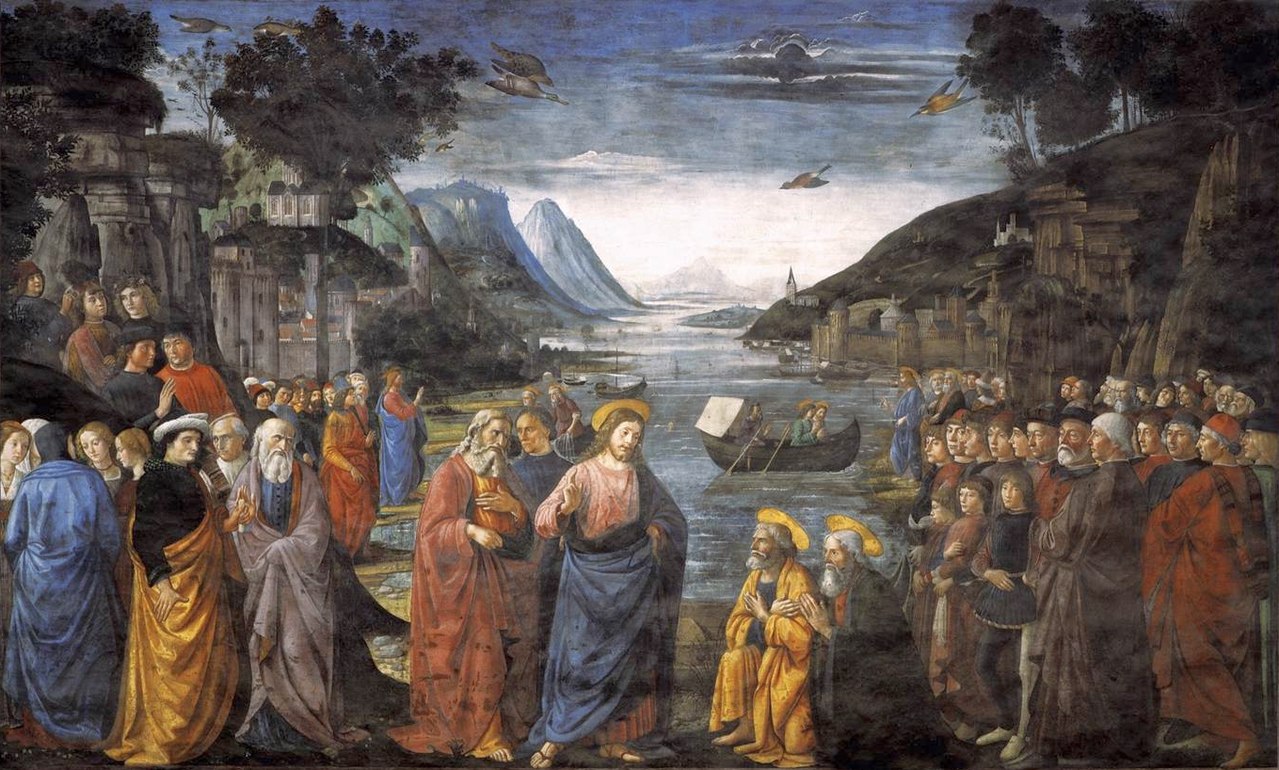
Vocation of the Apostles (1481) by Domenico Ghirlandaio

God bless.

Lent Day 24: Questions?

TODAY’S READINGS

Today’s Gospel (Mk 12:28-34) has Jesus being questioned by a scribe about what His opinion is of the greatest commandment and the scribe’s affirming response. The episode closes this way:

“Jesus said to him,
‘You are not far from the Kingdom of God.’
And no one dared to ask him any more questions.”
(v. 34)

“Jesus was God’s agent in establishing the reign of God on earth. After announcing that the kingdom of God was at hand (1:15), Jesus began to call men and women to be his disciples (1:16-20). Those who became the new family of Jesus (3:34-35) were coming into the reign of God. This scribe was ‘not far from the kingdom of God’: he is not a disciple of Jesus, but he grasps what is at the heart of living under the reign of God. Jesus’ new family is made up of those who do the will of God (3:35); this scribe understands what God expects.

“Jesus has been challenged and questioned by various parties but he has met the challenges and answered the questions (11:27-12:31). His opponents have been reduced to silence but have hardly been eliminated as opponents.” (Bringing the Gospel of Mark to Life, 328-29)

The scribe does not actually realized how close to the Kingdom of God He is. Jesus embodies the Kingdom by bringing heaven to earth in the incarnation. Don’t forget Jesus’ first words of His public ministry:

“This is the time of fulfillment. The kingdom of God is at hand. Repent, and believe in the gospel.” (Mk 1:15)

Judgment comes upon the world and God judges it redeemable, but at what a cost! His own beloved Son. Yet, just before He died, anticipating the awful fate in store for Him in just a few hours, Jesus invited us to share in the Kingdom through the Eucharist instituted at the Last Supper. The Mass as Heaven on Earth, indeed. And we have the privilege in taking part in it every day if we are able.

As for the scribe who inquired, it seems to me that He was an honest seeker, based on a not unusual question from a rabbi or for a rabbi and an irenic and affirmative response. So why did no one “dare” to ask any more questions? It is true that prior to this episode, in the same chapter as well as earlier, the religious leaders’ attempt to trap Jesus using His own word fell flat, thus the growing vengeance that would soon consume them. Futility maybe caused abandonment of questioning by His enemies in favor of a more permanent solution to the Jesus Problem. But for the honest seeker, it seems Jesus would always be open to dialogue. Maybe Jesus was a bit intimidating here — not in demeanor but in His profundity and decisiveness (see Mt 7:28-29). A bit mysterious to me.

God bless.

Lent Day 14: Call no man father?

TODAY’S READINGS

In today’s Gospel (Mt 23:1-12), as Jesus death approaches, He really lays into the scribes and Pharisees. One verse that has caused controversy since the Protestant Revolt:

“Call no one on earth your father;
you have but one Father in heaven.”
(v. 9)

“Jesus is stressing that humility is essential for the ministry, lest those who area placed in authority over others think of themselves as superiors rather than servants. No one, after all can compare to the ‘Father’ in heaven…The disciples of Jesus will share in the mission of the Father..through their commission to teach the gospel (28:19-20), but theirs is a derivative participation in something divine. Hence, the title[] in questions appl[ies] absolutely only to the Lord.” (The Gospel of Matthew [Catholic Commentary on Sacred Scripture], 292)

“Jesus uses hyperbole to post a warning that no one should pridefully desire honorific titles. His words are not meant literally. The NT writers elsewhere use father for natural fathers (Heb 12:7–11) and spiritual fathers in the Church (1 Cor 4:15; Philem 10). ● The spiritual fatherhood of New Covenant priests is an extension of its application to Old Covenant priests (Judg 17:10; 18:19).” (Ignatius Catholic Study Bible: The Gospel of Matthew, 57)

Understood properly, using the Bible itself (not to mention Tradition), there can be no question that using “Father” to address our biological fathers and our priests, All these men must acknowledge they are not God — not even close. But, to the extent they emulate the first person of the Trinity, they are true Fathers.

Check here and here on one my favorite Catholic resources, that provides an apologetic for calling certain men “Father.” St. Paul Center (another of my fave organizations) helps with this question here.

Depiction of God the Father (detail) (1654) by Pieter de Grebber

God bless.

Lent Day 2: Cross-bearers

TODAY’S READINGS

From Luke’s Gospel (Lk 9:22-25) we read the familiar utterance of Jesus to those who are paying attention:

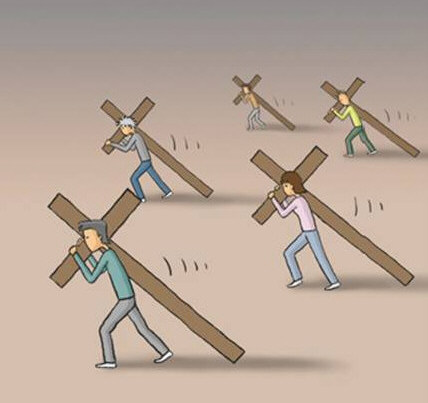
If anyone wishes to come after me, he must deny himself
and take up his cross daily and follow me.” (v. 23)

“There is no doubt about it: a person who loves pleasure, who seeks comfort, who flies from anything that might spell suffering, who is over-anxious, who complains, who blames and who become impatient at the least little thing which does not go his way — a person like that is Christian only in name; he is only a dishonour to his religion, for Jesus Christ has said so…” (St John Mary Vianney, Selected Sermons, Ash Wednesday) (The Navarre Bible: St Luke, 124-125)

“Conversion is accomplished in daily life by gestures of reconciliation, concern for the poor, the exercise and defense of justice and right, by the admission of faults to one’s brethren, fraternal correction, revision of life, examination of conscience, spiritual direction, acceptance of suffering, endurance of persecution for the sake of righteousness. Taking up one’s cross each day and following Jesus is the surest way of penance.” (CCC 1435)

“In the first century, to take up a cross meant one was on the way to crucifixion and hence in the final hours of one’s life. To take up a cross daily can mean to live each day as if it is one’s last, focusing on the most important thing to do in one’s remaining hours: unite oneself with Jesus as his follower.” (Bringing the Gospel of Luke to Life, 261)

We hear this verse often quoted, but do you ever really stop to think about its practical implications? Consider the quote directly above. Living each day as if it was one’s last (and one day it will be!) surely would make us measure every thought, word, and action very carefully. And, if followed faithfully, would make us initially consider our entire lives and what penance and reparation would be required for past faults against God and others. I need to get busy.

And get a load of the list from the Catechism of challenges that lead to conversion! Admission of faults, fraternal correction, acceptance of suffering, endurance of persecution, and on and on. A tall order. Being a disciple of Jesus is no mean feat. The Lord is a demanding God, teacher, brother, and friend. Am i up to it?

Last but not least, the first excerpt, from The Navarre Bible was especially hard hitting for me; I see many of my habitual shortcomings in that list. A CINO (Christian In Name Only), a dishonor to Catholicism? I don’t like the sound of that. So what am I going to do about it? I have much to consider, to pray about, to change.

NEW BOOK!

I was very excited to receive on Tuesday, the day it was released, Wisdom of Solomon by Mark Giszczak. I have been waiting for a few years now, hoping that the Catholic Commentary on Sacred Scripture series, which had completed its entire New Testament set of books, would expand to the Old Testament. Well, it’s finally here! Diving in will have to wait till after Easter — I can’t wait!

REMINDER

My daily ten-minute Eucharist for Lent vidcasts continue today with a breaking open of the Catechism of the Catholic Church.

A FINAL NOTE

The superb Opening the Scriptures series from Our Sunday Visitor includes the Bringing the Gospel of Luke commentary quoted above. Note that they have both this volume and the entry on Matthew available for $10 (just click on the link after the quote). A wise buy if you can swing it.

God bless.