
TODAY’S READINGS
The Gospel reading is from Lk 1:26-38, which closes out the Sermon on the Mount. The key verse contains these words of Jesus:
But Mary said to the angel,
“How can this be,
since I have no relations with a man?” (v. 34)
“Mary believed the archangel’s words absolutely; she did not doubt as Zechariah had done (cf. 1:18). Her question, ‘How can this be?’, expresses her readiness to obey the will of God even thought at first sight it implied a contradiction: on the one hand, she was convinced that god wished her to remain a virgin; on the other, here was God also announcing that she would become a mother. The archangel announces God’s mysterious design, and what had seemed impossible, according to the laws of nature, is explained by a unique intervention on the part of God…The Blessed Virgin, who received a very special inspiration of the Holy Spirit to practise virginity, is a first-fruit of the New Testament, which will establish the excellence of virginity over marriage while not taking from the holiness of the married state, which it raises to the level of a sacrament (cf. Gaudium et spes, 48). (The Navarre Bible: St Luke, 84)
“The reason for Mary’s question is that she has no relations with a man. Mary’s response is puzzling, since a betrothed woman would normally expect to begin sexual relations after the celebration of the second stage of marriage, when she moved into the home of her husband. One would think that after this delay the angel’s words to her would be fulfilled, as they were for Zechariah following the delay of his remaining days of ministry (1:23-24). Some interpreters have therefore explained Mary’s response as due to her interpreting the promise as having an immediate fulfillment, while she was still a virgin, although Gabriel’s words do not say this. Another explanation, offered by Church Fathers such as Gregory of Nyssa and Augustine, is that Mary did not plan to have relations with Joseph, but had already dedicated herself to God as a virgin. This idea is often dismissed as anachronistic, imposing a Christian ideal onto a Jewish context, since mainstream Jewish groups such as the Pharisees emphasized marriage. However, this possibility cannot be excluded, given the diversity of views in Judaism at the time (e.g., some Essenes practiced celibacy).” (Pablo Gadenz, Catholic Commentary on Sacred Scripture: The Gospel of Luke, 44)
There is no question in my mind that Gregory and Augustine were on to something — it seems quite clear from the text. This is backed up by the dogma of Mary’s perpetual virginity (a dogma of the Church is something a Catholic is bound to believe). Her womb was holy, that is, set aside. The new Ark of the Covenant. No other child was worthy to enter this space.
Finally, check out one of my previous posts for more.
THE IMMACULATE CONCEPTION
Did you know that the United States was dedicated to Mary under her title of the Immaculate Conception? Read all about it here or listen to it detailed in a great series here! It shows how far away we’ve gotten from God and His mother that the scourge of abortion and the anger and vehemence of its proponents are so pronounced.
Read the full dogma itself here. Read it all or scroll down to “The Definition.”
And check out this famous scene from one of my all-time fave flicks, The Song of Bernadette.
God bless.
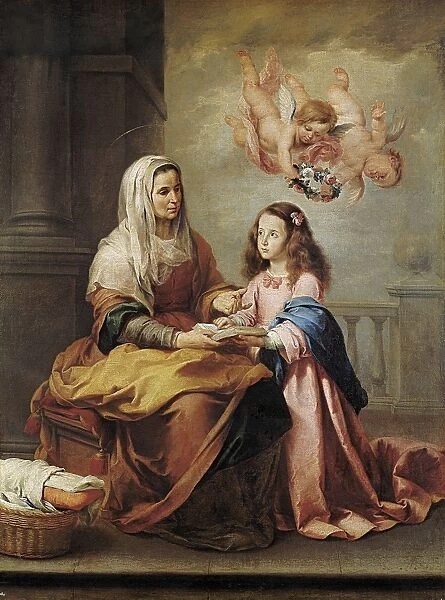
The Virgin and St. Anne. Bartolome Esteban Murillo (1617-1682). Oil on canvas. ca. 1674
 Unworthy Servant