TODAY’S READINGS
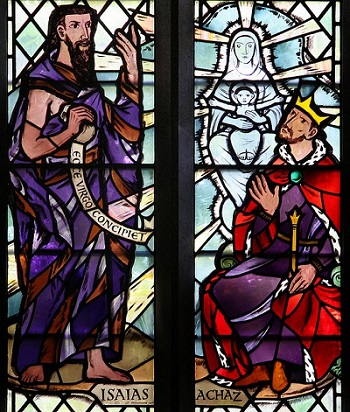
The first reading is from Is 7:10-14. I had hoped to focus on Ahaz’s seemingly humble rejection of the offer of a sign, but my limited resources said little except that, essentially, Ahaz was a scoundrel and his false piety was seen through by Isaiah. I did find, however, an article that expounds specifically on Ahaz’s response offering a contemporary example and a practical reflection.
Additionally, who would not be tempted to comment on the Annunciation, found in today’s Gospel reading? The number of resources I could refer to are legion, so that can be your homework (or prayerwork).
So, I went for the last verse of the first reading. A familiar one that, for Christians, unmistakably points toward Jesus. But is that all there is to it? This gives me the opportunity to highlight a phenomenal book that should be in the reference library of, not only every Catholic, but every person who is serious about knowing and appreciating better the Old Testament.
[T]he Lord himself will give you this sign:
the virgin shall conceive and bear a son,
and shall name him Emmanuel. (v. 14)
“Theological Issues in Isaiah Is Immanuel
Conceived of a ‘Virgin’ or a ‘Young Woman’?
As is well known, this famous oracle is taken as a prophecy of the virginal conception of Christ in the New Testament (Mt 1:23). For centuries, however, there has been a debate over the original meaning of Isaiah’s oracle. On the one hand, most modern interpreters contend that Isaiah is not referring to a virginal conception, since the Hebrew word used by Isaiah is ‘almah, which many feel is best translated as ‘young woman’. Those who favor this position point out that the ordinary Hebrew word for ‘virgin’ (bethulah) is not used in Isaiah 7:14. From this point of view, then, the “sign” given to Ahaz is the birth of his son Hezekiah, who, by the time he reaches the age of reason, will witness the overthrow of the northern kingdom. Indeed, there are aspects of the oracle that seem indisputably to envision an immediate fulfillment in the ending of the Syro-Ephraimite crisis (Is 7:14-17), events that took place in the lifetime of King Hezekiah, son of Ahaz (ca. 732 B.C.).
“On the other hand, other interpreters contend that Isaiah is referring to a miraculous conception and birth. We determine the meaning of the Hebrew word ‘almah ultimately by analyzing the way it is used in the Hebrew text of the Bible: it occurs seven times, and in those cases it is never applied to a married woman: Genesis 24:43; Exodus 2:8; Isaiah 7:14; Psalm 68:26 MT; Proverbs 30:19; Song of Solomon 1:3; 6: 8. Indeed, in some cases ‘almah is used as a synonym for ‘virgin’ (bethulah}, as when Rebekah is referred to both as a ‘maiden/young woman’ (‘almah) and a ‘virgin (bethulah) whom no man had known’ (Gen 24:16, 43). Again, in Song of Solomon 6:8, the category ‘almah is distinguished from the categories ‘queen’ and ‘concubine’ — that is, from those who have already had relations with the king. Perhaps, then, the Hebrew word ‘almah does not denote virginity, but does connote it, like the English word ‘maiden’. Intriguingly, the Jewish translators of the Greek Septuagint usually translated ‘almah with the non-specific expression ‘young woman’ (Greek parthenos}, except in two cases, where the context seems to have implied virginity: the story of Rebekah the virgin (Gen 24:43) and the oracle of the ‘virgin’ (Greek parthenos) who conceives Immanuel (Is 7:14). In this view, the ‘sign’ (Hebrew ‘oth) — which Isaiah uses elsewhere to refer to a miracle of nature (Is 37:30; 38:7) — is the miraculous conception of the child by a virgin. .Again, it is important to remember that the decision to render ‘almah with the Greek parthenos, ‘virgin’, was made by Jewish translators themselves about two hundred years prior to the dawn of the Christian era (see Is 7:14 LXX).
“When evaluating this issue, it is also critical to remember that biblical prophecy can have more than one horizon of fulfillment. In other words, the same prophecy may have both preliminary as well as ultimate fulfillments. In the case of Isaiah 7:14, the preliminary fulfillment of the ‘Immanuel’ child may well have been Hezekiah son of Ahaz, and the ‘almah may have been Abijah, a young bride of Ahaz (2 Chron 29:1), who was probably not yet intimate with the king. Before Hezekiah was a young man, the Syro-Ephraimite threat had evaporated. Yet Hezekiah himself is an important type of the Messiah in the book of Isaiah. For example, in the pivotal historical chapters about the end of Isaiah’s life (Is 36-39), Hezekiah is the righteous yet suffering savior-king, reminiscent of David and anticipating the future Messiah. Indeed, Hezekiah may even have been the immediate referent of the other prophecies of a.royal child (Is 9:1-7 and 11:1-5). However, to the. extent. that these oracles point not only to a new king but to a new kingdom, a new exodus, and a new creation, the birth and life of Hezekiah by no means fulfill them (cf. Is 7:14-16; 9:1-7; 11:1-5}. Instead, Hezekiah’s life leaves these oracles as prophetic words “waiting” for ultimate fulfillment. Hezekiah was born of a: ‘maiden’ ( ‘almah) in the usual manner, but later one would be born of a. mother who remained a maiden before, during, and after his birth. Hezekiah was ‘Immanuel’ (‘God with us’) in a mediated sense: his righteous reign.was a sign of God’s closeness to his people. But later one would be born who was truly ‘God with us’ in a literal sense. Applied to Hezekiah, the poetry and language of these oracles is hyperbolic: complete fulfillment awaits another.” (John Bergsma and Brant Pitre, A Catholic Introduction to the Bible: The Old Testament (San Francisco: Ignatius Press, 2018), 747-749)
I have provided this extended excerpt on the first reading not only because it is particularly interesting, delving into several facets of the prophecy, but also to highlight the extraordinary depth and erudition of the text. And, considering the content (over one thousand pages of brilliant scholarship), not an expensive purchase at all.
O come, O come, Emmanuel!
God bless.

 Unworthy Servant