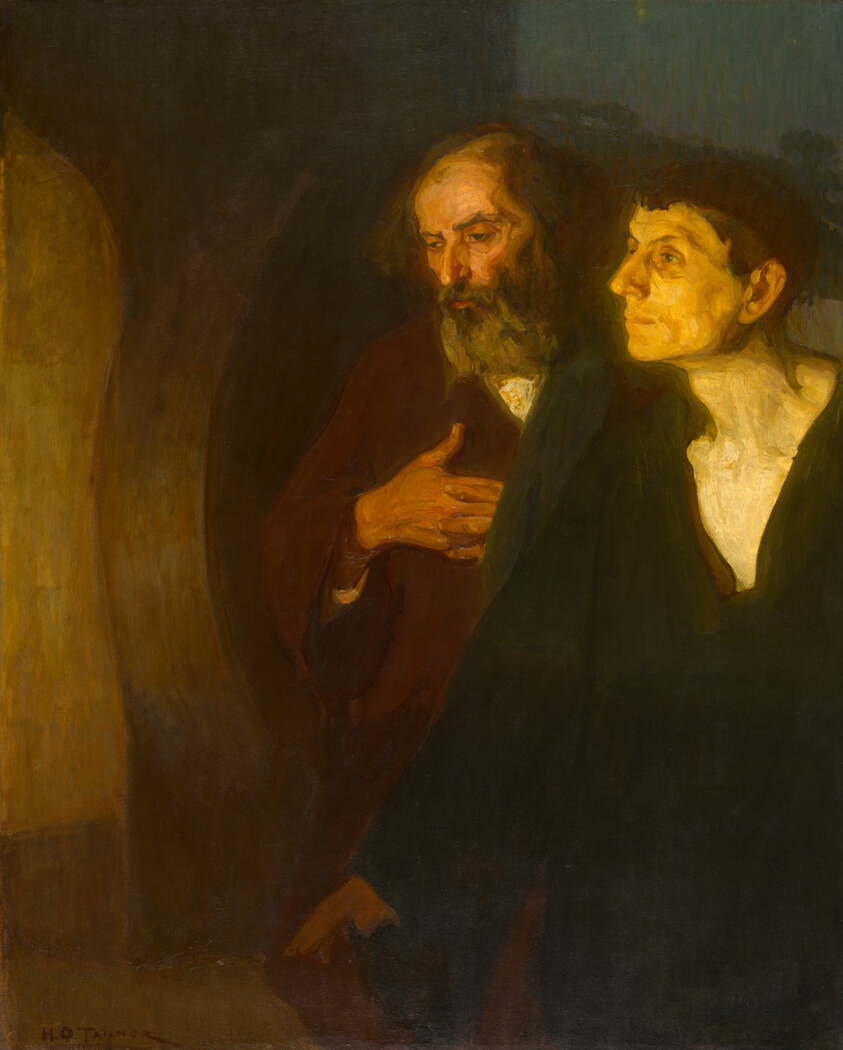
Today’s Gospel reading for Easter (Jn 20:1-9) gives us John’s version of the scene at Jesus’ tomb. Peter and John race to the tomb after Mary Magdalene’s witness:
“When Simon Peter arrived after him, he went into the tomb and saw the burial cloths there, and the cloth that had covered his head, not with the burial cloths but rolled up in a separate place. Then the other disciple also went in, the one who had arrived at the tomb first, and he saw and believed.” (vv. 6-8)
“The disciple whom Jesus loved followed Peter into the tomb ‘and he saw and believed.’ What did he see, and what did he believe? He saw that the body of Jesus was not in the tomb, and he saw the cloths that he had been buried in. If his mind worked quickly, he might have deduced that whatever had happened, it was not the work of robbers. But simply seeing that Jesus was no longer in the tomb and that his burial cloths had been left behind could have in itself triggered a surge of faith, a joyful conviction that Jesus had somehow triumphed over death. He did not understand yet how Jesus had done so (verse 9), but he believed with all his heart that Jesus was alive. Perhaps words of Jesus popped into his mind, words about having the power to take up his life again (10:18) or about his going ahead of them to prepare a place for them (14:2-3). Perhaps, though, his belief was not something he could easily have put into words but was nevertheless an unshakable faith that Jesus had broken the hold of death.” (Bringing the Gospel of John to Life, 551)
Or, as some speculate, John may have noted something unusual about the wrapping. There is much on the internet about the shroud but let me direct you to a podcast that I found particularly interesting (here).
Of course, no one then, or today, actually witnessed Jesus arising. I recall the words of Jesus to Thomas a little further on in this chapter:
“Blessed are those who have not seen and have believed.” (Jn 20:29b)
As yesterday’s post laid out, no resurrection -> faith unwarranted. But since we are blessed with so wonderful a Savior, we have hope to go along with faith if we remain in God’s love.
BP BARRON’S HOMILY
A FINAL NOTE
Happy Easter! May this holy season be especially blessed for you and your loved ones.
The Two Disciples at the Tomb (c. 1906) by Henry Ossawa Tanner
Today’s Gospel reading for the Easter Vigil (Mark 16:1-7) gives us Mark’s version of the scene at Jesus’ tomb. An angel speaks to the women:
“You seek Jesus of Nazareth, the crucified. He has been raised; he is not here.” (v. 6)
“‘Jesus of Nazareth, who was crucified’: the same name as written on the inscription of the cross is used by the angel to proclaim the glorious victory of the resurrection. In this way St Mark bears witness explicitly to the crucified man and the resurrected man being one and the same. Jesus’ body, which was treated so cruelly, now has immortal life.
“‘He has risen: the glorious resurrection of Jesus is the central mystery of our faith. ‘If Christ has not been raised, then our preaching is in vain and your faith is in vain (1 Cor 15:14). It is also the basis of our hope: ‘if Christ has not been raised, your faith is futile and you are still in your sins…. If for this life only we have hoped in Christ, we are of all men most to be pitied’ (1 Cor 15:17 and 19). The Resurrection means that Jesus has overcome death, sin, pain and the power of the devil.” (The Navarre Bible: St Mark, 197)
Catholics are sometimes accused of keeping Christ on the cross because of our displaying crucifixes. I’ve never had a problem explaining the veneration of the crucifix using the apostle Paul’s words:
For I resolved to know nothing while I was with you except Jesus Christ, and him crucified. (1 Cor 2:2)
It seems to me a good thing to remember the brutality and ignominy Christ endured for my sake and the sake of all mankind from Adam till the end of time. Our sins do incalculable damage to the Body of Christ. It also helps us to realize that Jesus understands our suffering because He has been there.
But we also know now that suffering and death do not have the final word. Yes, there is no Easter Sunday without Good Friday. But for those faithful till the end, no amount of troubles in this life will compare to the glory the Lord won for us for the next life.
So, keep the faith. The Crucified One actually is here — and He retains the scars to prove it.
ARTICLE
An article I came across regarding Holy Saturday. The first two points are of most interest to me because they speak of what Jesus did on that first Holy Saturday when His Body was sealed in the tomb.
A FINAL NOTE
Holy Saturday is a good day to keep noise and talking to a minimum, it seems to me. Recall the silence of the tomb. I am looking forward to reading The Power of Silence which undoubtedly will be a good corrective for our noisy lives.
The Holy Women at the Tomb (1890) by William Bouguereau
Today’s Gospel reading for Good Friday of the Lord’s Passion (Jn 18:1—19:42) gives us John’s account of the Passion, death, and burial of Jesus. It ends featuring two members of the Sanhedrin:
“After this, Joseph of Arimathea, secretly a disciple of Jesus for fear of the Jews, asked Pilate if he could remove the body of Jesus. And Pilate permitted it. So he came and took his body. Nicodemus, the one who had first come to him at night, also came bringing a mixture of myrrh and aloes weighing about one hundred pounds. They took the body of Jesus and bound it with burial cloths along with the spices, according to the Jewish burial custom. Now in the place where he had been crucified there was a garden, and in the garden a new tomb, in which no one had yet been buried. So they laid Jesus there because of the Jewish preparation day; for the tomb was close by.” (vv. 19:38-42)
“Our Lord’s sacrifice produces its firstfruits: people who were previously afraid now boldly confess themselves disciples of Christ and attend to his dead Body with exquisite refinement and generosity. The evangelist mentions that Joseph of Arimathea and Nicodemus used a mixture of myrrh and aloes in lavish amount. Myrrh is a very expensive aromatic resin, and aloes a juice extracted from the leaves of certain plants. They were used as an expression of veneration for the dead.” (The Navarre Bible: St John, 237)
“Up till now [Joseph of Arimathea and Nicodemus] had not made their discipleship public because they were afraid of the other religious authorities who strongly opposed Jesus (see 12:43-44)…By burying his body, Joseph and Nicodemus perform a culturally significant act of respect and faithfulness to Jesus. Burying the dead was an important service of love in Jewish piety (Tob 1;16-20; 4:3-4)…Through this public act of piety, Joseph and Nicodemus make known their relationship with Jesus.” (The Gospel of John [Catholic Commentary on Sacred Scripture], 329-30)
“The Gospel earlier noted that ‘even among the authorities’ many believed in Jesus, but out of fear for what would happen to them ‘they did not acknowledge it openly’ (12:42; see also 7:13; 9:22)…
“[Asking Pilate for Jesus’ body] would hardly remain a secret and would manifest that he was a follower of Jesus. He may have previously kept his discipleship a secret to maintain a good relationship with his fellow leaders (see 12:43), but he now casts that aside, identifying with Jesus in his death as had not during his life….
“Pilate may have known, or known of, Joseph of Arimathea as a member of the Sanhedrin; Pilate would not have known that he was a disciple of Jesus. Thus Pilate might have understood that Joseph was finishing off what other Jewish leaders wanted done…
“When [the leaders of the Sanhedrin] wanted Jesus arrested (7:32, 45), Nicodemus invoked the law of Moses to defend him: ‘Does our law condemn a person before it first hears him and finds out what he is doing?’ (7:51). This was hardly a profession of belief in Jesus, but it did indicate to other leaders tat Nicodemus was sympathetic to Jesus (see 7:52). Now by participating in the burial of Jesus, Nicodemus makes his allegiance public, as does Joseph of Arimathea. Jesus said, ‘When I am lifted up from the earth, I will draw everyone to myself’ (12:32). Joseph and Nicodemus are the first of them.” (Bringing the Gospel of John to Life, “544-45)
“Joseph figured in New Testament apocryphal writings (e.g., the apocryphal Aces of Pilate and Gospel of Nicodemus) and was later given a preeminent place in medieval legend as the first keeper of the Holy Grail. His feast day is March 17…
“Tradition says that Nicodemus eventually became a member of the Christian community.” (Catholic Bible Dictionary, 474, 649)
I find it interesting to speculate on minor characters, or those only briefly mentioned in encounters with Jesus. Thus, the research reflected above. As the last resource above mentions, tradition has these men to go on to be Christians. This makes perfect sense, particularly once the Resurrection came to light. How long did they remain in the Sanhedrin? Not long I imagine (whether voluntarily or involuntarily). Did they try to evangelize their fellows after the Resurrection? I wonder. Might they have been pillars of the early Christian community? Seems likely. Could they possibly have provided the Gospel writers with inside information on the workings of the Sanhedrin?. I believe there is no question. How powerful must have been their witness to all these events!
These men prove it is never too late to change and find courage in the truth. And that, instead of giving in to worldly status and demands or just plain despair, their minds and hearts turn to things of heaven and they become men of conviction and action.
Monastery Church: Altar of the crucifixion, Mecklenburg | Gaston Lenthe | (Longinus, Joseph of Arimathea, and Nicodemus)
Today’s Gospel reading for the Chrism Mass (Lk 4:16-21) has Jesus returning to His hometown of Nazareth. He stuns His synagogue listeners (undoubtedly including many friends, relatives, and acquaintances) by declaring Himself the fulfillment of Isaiah’s prophecy in chapter 61:
”“Today this Scripture passage is fulfilled in your hearing.” (v. 21)
“Christ’s words…show us the authenticity with which he preached and explained the Scriptures…Jesus teaches that this prophecy, like the other main prophecies of the Old Testament, refers to him and finds its fulfillment in him (cf. Luke 24:44ff). Thus, the Old Testament can be rightly understood only in the light of the New — as the risen Christ showed the Apostles when he opened their minds to understand the Scriptures (cf. Luke 24:45), an understanding which the Holy Spirit perfected on the day of Pentecost (cf. Acts 2:4).” (The Navarre Bible: St Luke, 78)
“Jesus make a bombshell announcement…With Jesus, the time of waiting for the fulfillment of God’s promises in Scriptures is over (see 24:27, 44). The messianic jubilee announced by Isaiah is at hand! ‘Behold, now is the acceptable time’ (2 Cor 6:2 RSV).” (The Gospel of Luke [Catholic Commentary on Sacred Scripture], 100)
“In the Greek of Luke’s Gospel, ‘today’ is emphatic. ‘Today,’ right now, even as you listen, ‘this scripture passage is fulfilled’…Isaiah’s prophecy serves as Jesus’ job description as he begins his ministry. Jesus is the fulfillment of God’s plans, bringing salvation to his people.” (Bringing the Gospel of Luke to Life, 118)
What is the job description, per Isaiah?
[T]o bring glad tidings to the lowly, to heal the brokenhearted, To proclaim liberty to the captives and release to the prisoners, To announce a year of favor from the LORD and a day of vindication by our God, to comfort all who mourn; To place on those who mourn in Zion a diadem instead of ashes, To give them oil of gladness in place of mourning, a glorious mantle instead of a listless spirit. (vv. 61:1-3)
Who are the lowly? All of us sinners. The brokenhearted? All of us, at one time or another, sometimes for a long time? Prisoners? Those enslaved to habitual sin and all who place some created thing ahead of the Lord. Mourners? Those who have experienced loss, particularly loss of the grace of God through serious sin. How do these return to gladness? A return to God through Reconciliation.
Thank you Jesus for freeing us from slavery to sin and providing us the Church and the means of salvation through her, namely the Sacraments. Two we commemorate as being instituted today: Holy Orders and the Eucharist. Let us have recourse to the Eucharist and Reconciliation often and never let us spurn these great gifts.
For a dramatization of this episode in the synagogue, watch here.
Today’s Gospel reading (Mt 26:14-25) again has us at the table with Jesus and His Apostles at the Last Supper. The focus again is on the betrayer, Judas, on the day we call in his “honor,” Spy Wednesday. Jesus says of the traitor:
“The Son of Man indeed goes, as it is written of him, but woe to that man by whom the Son of Man is betrayed. It would be better for that man if he had never been born.” (v. 24)
“Jesus is referring to the fact that he will give himself up freely to suffering and death. In so doing he would fulfill the will of God, as proclaimed centuries before (cf. Ps 41:10; Is 53:7). Although our Lord goes to his death voluntarily, this does not reduce the seriousness of Judas’ treachery.” (The Navarre Bible: St Matthew, 219)
“Instead of identifying the man, Jesus warns of the dreadful fate that the betrayer is choosing for himself. For what is about to transpire is a concurrence of divine will and human decision. The destiny of the Son of Man is determined by God and announced in the writings of the Old Testament. But the actions of the “man by whom the Son of Man is betrayed” are fully and freely his own. Judas is not a puppet with someone else pulling the strings. He has chosen to misuse his free will, and should he follow through with this treachery, he will come to wish “he had never been born.” (The Gospel of Matthew [Catholic Commentary on Sacred Scripture], 335)
“Jesus does not spell out what fate awaits [Judas] but indicates that it will be horrible…Jesus is now giving Judas a last-minute warning. Even though Jesus knows what will happen, Judas is nevertheless free to change his mind and take a different course.” (Bringing the Gospel of Matthew to Life, 578)
While the Church canonizes many persons as saints, it never declares anyone definitively in Hell. This spurs many conversations regarding the population of Hell. But the verse under consideration has long convinced me that there is one inhabitant of Gehenna (and I think, many, many more). The only persons who could possibly wish they’d never been born must be those in Hell. Heaven is what we were made for. Hell is the complete, utter, total, and permanent state of existing where we were never meant to be (remember: God desires all men to be saved [1 Tim 2:4]). I imagine souls in Hell cursing God, cursing their parents, and wishing they had never come into existence while knowing they can never go out of existence.
God forbid that any of us hear the words said to Judas being said to us on our judgment day because we betrayed our Savior
A wonderful talk supporting (and, frankly, influencing) my position on Judas’ ultimate fate can be found here.
Judas Iscariot, Saint Peter, John the Apostle, The Last Supper (c. 1520) by Giampietrino after Leonardo da Vinci
Today’s Gospel reading (Jn 13:21-33, 36-38) puts us at the table with Jesus and His Apostles at the Last Supper. Judas, the traitor, rears his ugly head at the distribution of the Eucharist.
So Judas took the morsel and left at once. And it was night. (v. 30)
“Judas goes out into the darkness, turning away from the light of the world (8:12). Earlier in his Gospel the author observed that ‘the light came into the world, but people preferred darkness to light, because their works were evil’ (3:19). Judas chose darkness.” (Bringing the Gospel of John to Life, 396)
“The indication that ‘it was night’ is not just a reference to the time of day but to darkness as an image of sin, an image of the powers of darkness whose hour was beginning at that very moment (cf. Lk 22:53). The contrast between light and darkness, the opposition of good and evil, is frequently met with in the Bible, especially in the Fourth Gospel: even in the prologue we are told that Christ is the true Light and the darkness has not overcome it (cf. Jn 1:5).” (The Navarre Bible: St John, 180)
A cowardly act from a cowardly man. He had problems with Jesus at least going back to the Bread of Life discourse (Jn 6:70-71), but did not have the guts to leave then or anytime else before this sacred moment. His receiving the Eucharist in a state of grave sin did not sanctify Him but made him more prone to the devil’s wiles. Maybe he believed the dark obscures him from God, but the light of the Lord overpowers not only physical darkness but spiritual darkness — but Judas did not allow it to move him. This soon leads to despair and suicide. With repentance in his heart who could have witnessed the Resurrection, yet he chose eternal death. A stark example for all times and places on how not to treat the Lord
Judas Leaves the Cenacle (Judas quitte le Cénacle) (1886-1894) by James Tissot
Today’s Gospel reading (Jn 12:1-11) continues our journey through John as we near the time of the Last Supper. Famously, Mary, the sister of Lazarus and Martha, slathers Jesus feet with costly perfume. Judas objects and Jesus responds :
Jesus said, “Leave her alone. Let her keep this for the day of my burial. You always have the poor with you, but you do not always have me.” (vv. 7-8)
“The poor: Jesus is not indifferent toward the poor. Elsewhere he promotes almsgiving in no uncertain terms (Mt 6:2–4; Lk 6:30; 12:33). ● The words of Jesus echo the words of Deut 15:11, which states that the unceasing presence of the poor offers countless opportunities to give generously to less fortunate neighbors. The disciples, too, will have plenty of chances to give alms, but only a brief time remains to be generous toward Jesus while he remains among them (CCC 2449).” (The Gospel of John [Ignatius Catholic Study Bible], 41)
“A literal translation of Jesus’ words is, ‘in order that she may keep it for the day of preparation for my burial,’ with ‘in order that’ indicating purpose. The interpretation which makes the most sense is that the purpose of the nard was that it was to be kept for the day of preparation for Jesus’ burial, which was that very day…Mary has symbolically prepared the body of Jesus for burial. anointing it as a corpse was anointed before being buried. Jesus does not say that Mary understood this deeper significance of her act; she may have simply anointed him out of love and gratitude. But Jesus knows that the hour for his going to his father is near. His raising of Lazarus to life — the cause of Mary’s gratitude — means that he lives under a sentence of death (11:53). Mary’s anointing has prepared him for the sentence being carried out.” (Bringing the Gospel of John to Life, 347)
What strikes me first and foremost about this passage is that, while true that Jesus will soon be dead, buried, rise, and ascend, He is still with us. Of course, He remains with us in a real and substantial way in the Eucharist. But that’s not the only way. Here’s Mother Teresa tying together the Eucharist and the poor:
“If we recognize [Jesus] under the appearance of bread, we will have no difficulty recognizing him in the disguise of the suffering poor.” (see article here)
Which invokes Jesus’ own words about the downtrodden, that He spoke immediately before the woman anoints His feet in Matthew, and how we should view them:
“For I was hungry and you gave me food, I was thirsty and you gave me drink, a stranger and you welcomed me, naked and you clothed me, ill and you cared for me, in prison and you visited me.” (Mt 26:35-36)
Yes, Jesus left us in the familiar form the apostles came to know. But He invites us to see Him and serve Him in everyone we meet, particularly the poor. Being faithful in this way we prepare ourselves for the day of our burial.
Today’s Gospel reading (Jn 11:45-56), coming immediately after the astonishing event of Jesus resuscitating Lazarus, shows the extremely heightened concerns of the Jewish religious leaders about Jesus and His popularity are significantly ramping up, so much so that the whole Sanhedrin convenes to discuss what to do about the situation. The high priest, Caiaphas, speaks:
“You know nothing, nor do you consider that it is better for you that one man should die instead of the people, so that the whole nation may not perish.” (vv. 49-50)
“Caiaphas unwittingly announces that Jesus will die for the salvation of the nation. This is not his own insight, but the grace of prophecy speaking through him in virtue of his priestly office and position as chief teacher of Israel.” (The Gospel of John [Ignatius Catholic Study Bible], 40)
“Here Caiaphas’ words have a dual meaning: one, Caiaphas’ meaning, is that he wants to put Christ to death, on the pretext that that will ensure the political peace and survival of Israel; the other, the meaning intended by the Holy Spirit, is the announcement of the foundation of the new Israel, the Church, through the death of Christ on the cross (Caiaphas is unaware of this meaning). And so it happens that the last high priest of the Old Alliance prophesies the investiture of the High Priest of the New Alliance, which will be sealed in his own blood.” (The Navarre Bible: St John. 160)
Caiaphas did not realize the half of it. In his position as high priest, given to him by God, he could declare prophetic utterances, even if he did not understand their full import. Recall Jesus saying:
Therefore, do and observe all things whatsoever they tell you, but do not follow their example. (Mt 23:3b)
I wonder if Caiaphas realized how soon they would meet again (see Jn 18:14, 24, 28) and how he will be instrumental in seeing through his prophetic words (Mt 26: 57-68).
Yes, one man would die for the nation…and all nations and peoples for all time. Even a despicable man like this high priest can be used by God for good (Friday).
Today’s Gospel reading (Jn 8:51-59) continues Jesus dialogue with the Jewish religious leaders. Jesus makes a startling claim to the Jews inquiry:
“So the Jews said to him… ‘Who do you make yourself out to be?” Jesus answered,…“Amen, amen, I say to you, before Abraham came to be, I AM.” (v. 53b-54a, 58)
“Jesus takes for himself the divine name of Yahweh, ‘I AM’ (Ex 3:14). He thus claims to be one with God (10:30), whose life in eternity has neither beginning nor end. The Pharisees hear this claim loud and clear and, thinking it outrageous, stand ready to stone him for blasphemy (8:59; Lev 24:16) (CCC 590).” (The Gospel of John [Ignatius Catholic Study Bible], 36)
Jesus makes no bones about who He is. It eventually gets Him killed. But He backs up His claim by raising Himself from the dead proving that He is God, having the power over life and death.
Check out this article that does a fine job of running through the many times Jesus uses “I am” to refer to Himself. We hearken back to the burning bush episode (Ex 3) when Moses asks the name of the voice of his interlocutor emanating from this wondrous site.
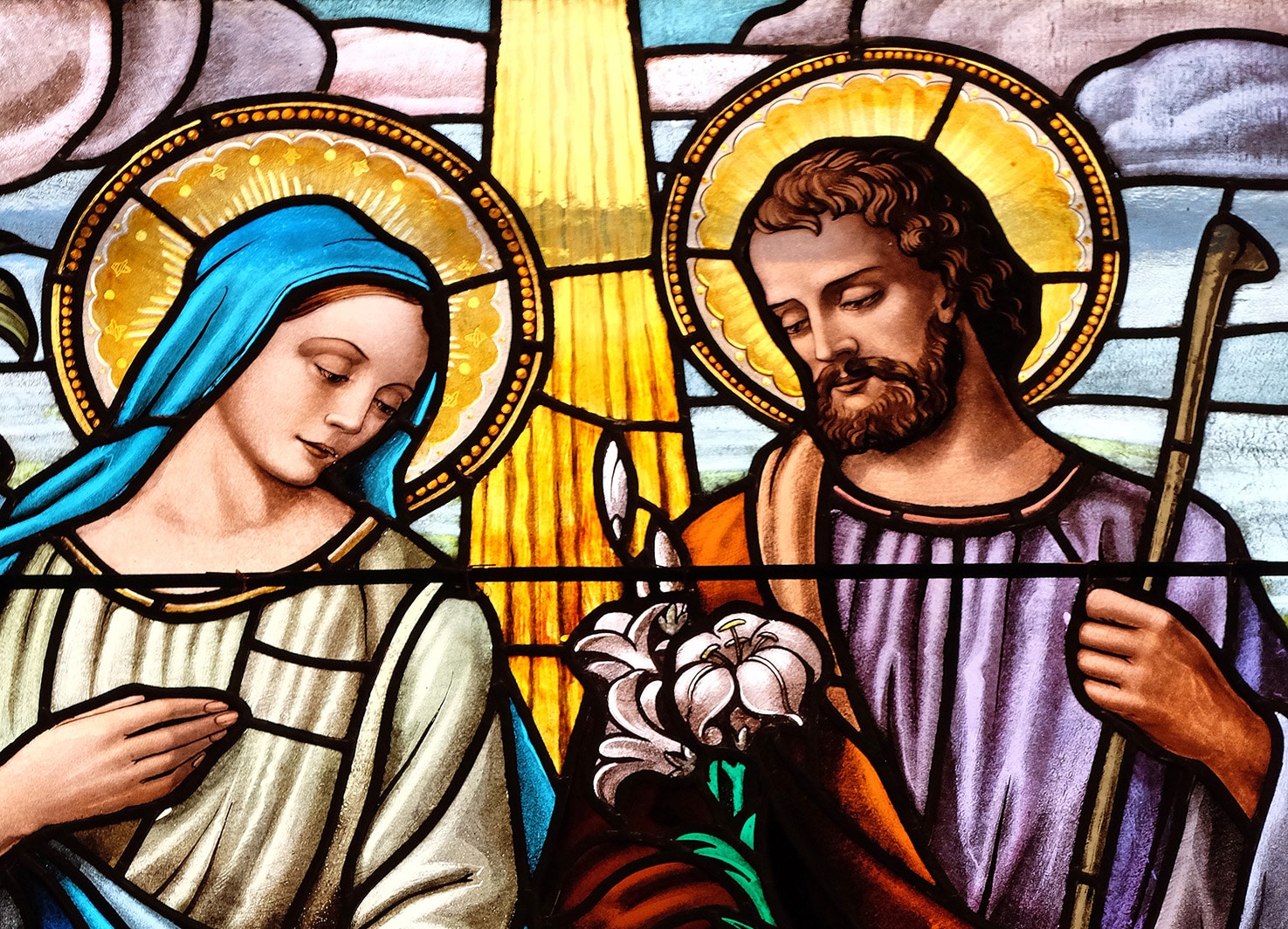
Today’s Gospel reading (Mt 1:16, 18-21, 24a) gives us the story of Joseph discovering Mary’s pregnancy. Joseph’s initial reaction:
Joseph her husband, since he was a righteous man, yet unwilling to expose her to shame, decided to divorce her quietly. (v. 19)
“just: Or, “righteous”. Joseph is a man of sterling moral character, committed to living by the Mosaic Law (Deut 6:25; Lk 1:6). “put her to shame: The Greek verb does not necessarily have a negative connotation. It simply means “to expose” or “to exhibit”. “send her away: Catholic tradition proposes three main interpretations to explain why Joseph resolved to end his betrothal with Mary: “(1) The Suspicion Theory. Some hold that Joseph suspected Mary of adultery when he discovered her pregnancy. Joseph thus intended to pursue a divorce in accord with Deut 24:1–4 until the angel revealed to him the miraculous cause of the conception (1:20). Joseph is said to be righteous because he shuns immorality and directs his life by the Law of God. Proponents of this view include St. Justin Martyr,St. John Chrysostom, and St. Augustine. “(2) The Perplexity Theory. Others hold that Joseph found the situation of Mary’s pregnancy inexplicable. Divorce seemed to be his only option, and yet he wished to do this quietly, for he could not bring himself to believe that Mary had been unfaithful. Joseph is said to be righteous because he lives by the Law of God and judges Mary’s situation with the utmost charity. The main proponent of this view is St. Jerome, whose exegesis was adopted into the notes of the medieval Bible. “(3) The Reverence Theory. Still others hold that Joseph knew the miraculous cause of Mary’s pregnancy from the beginning, i.e., he was made aware that the child was conceived “of the Holy Spirit” (1:18). Faced with this, Joseph considered himself unworthy to be involved in the Lord’s work, and his decision to separate quietly from Mary was a discretionary measure to keep secret the mystery within her. On this reading, the angel confirms what Joseph had already known and urges him to set aside pious fears that would lead him away from his vocation to be the legal father of the Messiah (1:20). Joseph is said to be righteous because of his deep humility and reverence for the miraculous works of God. Proponents of this view include St. Bernard of Clairvaux and St. Thomas Aquinas.” (The Gospel of Matthew [Ignatius Catholic Study Bible], 18)
It seems to be commonly held that Joseph was suspicious of Mary, or at least confused, but rarely does one hear about the reverence theory. Thus, I wanted to lay out above a concise but clear explanation of each approach. The more I hear about and consider the last one, the more convinced I am that this is the case. Joseph must have known Mary’s character intimately, so ther seems to be no way he could have even conceived of her sinning. Perplexity makes more sense, especially as it is approached by Jerome, but here I suspect Joseph would have had a deeper insight, especially if, as tradition holds, he never committed a personal sin.
Joseph is a great saint. Let us honor him in a special way today for his faithfulness to Mary and her Child. Let us ask his intercession, so that we may we approach that same faithfulness to the Lord and His mother.
MY FAVORITE ST. JOSEPH BOOK
Combines fascinating insights into the man with a beautiful 33-day consecration to him. Check out the website for more info. Pick it up soon so you can start the consecration!
PRAYER FOR A HAPPY DEATH
Who better to pray to for a happy death than Joseph who died with Jesus and Mary assisting him on his final earthly journey? I pray to him often for this cause. Find several prayers here.
ZAGREB, CROATIA – DECEMBER 28: Holy Family, stained glass window in the Parish Church of the Visitation of the Virgin Mary in Zagreb, Croatia on December 28, 2015.






 Unworthy Servant