Lent Day 3: Fasting and mourning

TODAY’S READINGS

Matthew’s Gospel (Mt 9:14-15) ends on a somber note from Jesus:

The days will come when the bridegroom is taken away from them,
and then they will fast.
” (v. 15b)

“Similar OT imagery depicts Yahweh as the husband of Old Covenant Israel (Is 54:5; Jer 3:20; Hos 2:14–20). Jesus takes this role upon himself and is now the divine spouse of the New Covenant Church (Jn 3:29; Eph 5:25; Rev 19:7–9; CCC 796).” (The Gospel of Matthew [The Ignatius Catholic Study Bible], 32)

“Jesus describes himself as a bridegroom, thus applying to himself an Old Testament image for God in his relationship to Israel (Isa 62:4-5). A wedding feast is a very joyous occasion, and the mournful tone of fasting would not be fitting as long as the bridegroom is with them. Christ’s disciples will fast, when the bridegroom is taken away from them. This is Christ’s first hint of his passion, echoing Isa 53:8. (The Gospel of Matthew [Catholic Commentary on Sacred Scripture], 135)

“The risen Jesus will assure his disciples that he will always be with them (Mt 28:20), but not visibly present in bodily form. Fasting was inappropriate during his public ministry, but fasting will be adopted as an ongoing practice by the early church (see Acts 13;:2-3; 14:23). The Didache will advise Christians to fast on Wednesdays and Fridays (Didache 8:1).” (Bringing the Gospel of Matthew to Life, 168)

It is unsurprising that fasting comes up as an early theme during Lent. Jesus went away for a short time (three days in the tomb), came back for a short time (for forty days after the Resurrection), and then ascended to heaven. It is rightly pointed out above that Jesus promised to be always with us, and He is no more so really present, than in the Eucharist (see my reminder below). Yet, fasting as a spiritual discipline remains. (For a deep dive, check out the always reliable 1913 Catholic Encyclopedia.) Certainly Ash Wednesday and Good Friday, but consider missing meals more often. Jesus used this discipline for forty days while preparing to begin His public ministry. So, we should consider doing the same when some major life change is about to occur. But, also, skipping a meal here and there for a particular intention is laudable. Our hunger pangs serve to remind us of the cause, help us to appreciate the bounty we have while empathizing (however briefly) with the less fortunate, and move us along in the area of detachment from the goods of this mortal coil, thus drawing us closer to the Almighty.

One thing we don’t want to fast from is the Eucharist, though. This the Lord would be happy to have us consume more frequently, even daily, if possible.

VIDEOS WORTH CHECKING OUT

REMINDER

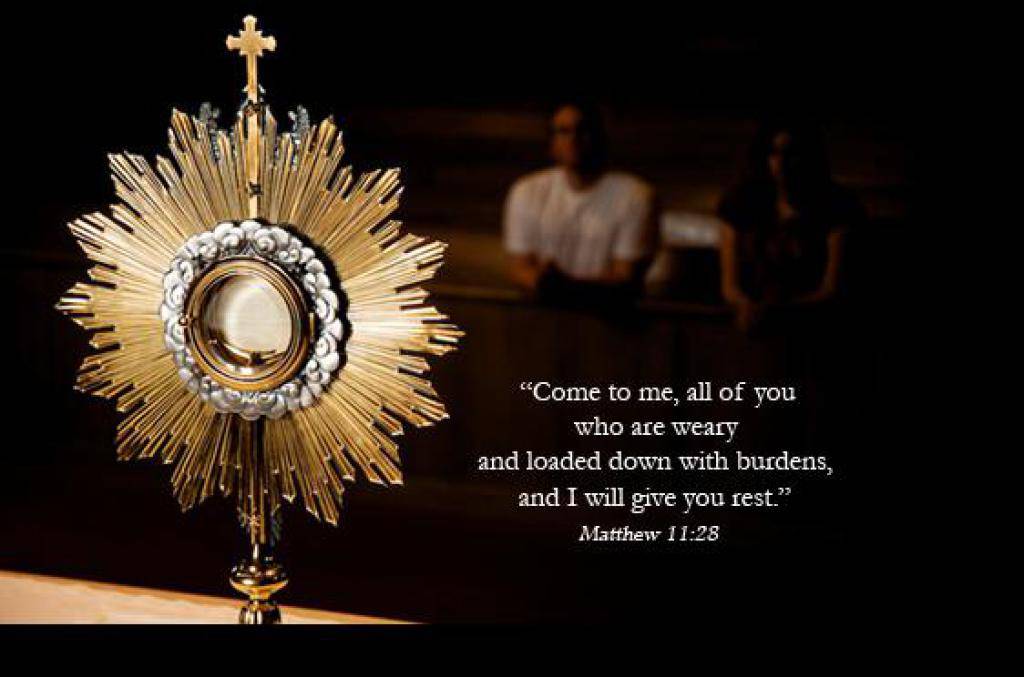
My daily ten-minute Eucharist for Lent vidcasts continue today, where we explore the CCC on the Eucharist as “the source and summit of the Christian life” (LG 11).

Christ in the Desert (1872) by Ivan Kramskoi

God bless.
Lent Day 2: Cross-bearers

TODAY’S READINGS

From Luke’s Gospel (Lk 9:22-25) we read the familiar utterance of Jesus to those who are paying attention:

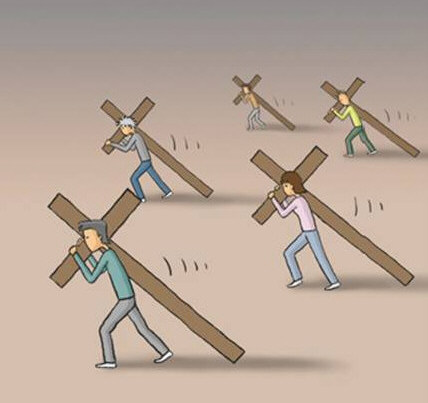
If anyone wishes to come after me, he must deny himself
and take up his cross daily and follow me.” (v. 23)

“There is no doubt about it: a person who loves pleasure, who seeks comfort, who flies from anything that might spell suffering, who is over-anxious, who complains, who blames and who become impatient at the least little thing which does not go his way — a person like that is Christian only in name; he is only a dishonour to his religion, for Jesus Christ has said so…” (St John Mary Vianney, Selected Sermons, Ash Wednesday) (The Navarre Bible: St Luke, 124-125)

“Conversion is accomplished in daily life by gestures of reconciliation, concern for the poor, the exercise and defense of justice and right, by the admission of faults to one’s brethren, fraternal correction, revision of life, examination of conscience, spiritual direction, acceptance of suffering, endurance of persecution for the sake of righteousness. Taking up one’s cross each day and following Jesus is the surest way of penance.” (CCC 1435)

“In the first century, to take up a cross meant one was on the way to crucifixion and hence in the final hours of one’s life. To take up a cross daily can mean to live each day as if it is one’s last, focusing on the most important thing to do in one’s remaining hours: unite oneself with Jesus as his follower.” (Bringing the Gospel of Luke to Life, 261)

We hear this verse often quoted, but do you ever really stop to think about its practical implications? Consider the quote directly above. Living each day as if it was one’s last (and one day it will be!) surely would make us measure every thought, word, and action very carefully. And, if followed faithfully, would make us initially consider our entire lives and what penance and reparation would be required for past faults against God and others. I need to get busy.

And get a load of the list from the Catechism of challenges that lead to conversion! Admission of faults, fraternal correction, acceptance of suffering, endurance of persecution, and on and on. A tall order. Being a disciple of Jesus is no mean feat. The Lord is a demanding God, teacher, brother, and friend. Am i up to it?

Last but not least, the first excerpt, from The Navarre Bible was especially hard hitting for me; I see many of my habitual shortcomings in that list. A CINO (Christian In Name Only), a dishonor to Catholicism? I don’t like the sound of that. So what am I going to do about it? I have much to consider, to pray about, to change.

NEW BOOK!

I was very excited to receive on Tuesday, the day it was released, Wisdom of Solomon by Mark Giszczak. I have been waiting for a few years now, hoping that the Catholic Commentary on Sacred Scripture series, which had completed its entire New Testament set of books, would expand to the Old Testament. Well, it’s finally here! Diving in will have to wait till after Easter — I can’t wait!

REMINDER

My daily ten-minute Eucharist for Lent vidcasts continue today with a breaking open of the Catechism of the Catholic Church.

A FINAL NOTE

The superb Opening the Scriptures series from Our Sunday Visitor includes the Bringing the Gospel of Luke commentary quoted above. Note that they have both this volume and the entry on Matthew available for $10 (just click on the link after the quote). A wise buy if you can swing it.

God bless.

Lent Day 1: A New Venture: The Eucharist for Lent

Happy Lent!

I will keep my first post for this penitential season very short. I just want to introduce my foray into YouTube vidcasting. Each day from now until Easter I will be posting videos focusing on the Eucharist in light of the forthcoming culmination of the National Eucharistic Revival of the United States Conference of Catholic Bishops in July (see here). Recent articles and videos, the Catechism, Church documents, apologetics, my own musings, and — of course — Scripture are all fair game for discussion.

These short videos (I will usually keep them to a length of around ten minutes, maybe a bit longer on Sundays) are meant to deepen our appreciation of the great gift that is Jesus’ Real Presence as we prepare for the Easter Triduum that begins with the institution of the Eucharist at the Last Supper.

Check out my channel here. Day 0, posted yesterday, is an introduction I recommend you check out, but today Day 1 was posted.

Like, subscribe, and share if you believe my efforts are a worthy endeavor. And thank you for bearing with me as I develop my skills using YouTube and ScreenPal — it will be smoother sailing over time.

Have a blessed Lent!

Epiphany: Come let us worship

TODAY’S READINGS

In the U.S., Epiphany is celebrated the Sunday that falls from Jan 2-Jan 8, so today is the day. The Gospel reading is from Mt 2:1-12, in which we read the story of the Magi

[O]n entering the house
they saw the child with Mary his mother.
They prostrated themselves and did him homage.
Then they opened their treasures
and offered him gifts of gold, frankincense, and myrrh.
(v. 11)

“Why did the Magi set off from afar to go to Bethlehem? The answer has to do with the mystery of the ‘star’ which they saw ‘in the East’ and which they recognized as the star of the ‘King of the Jews,’ that is to say, the sign of the birth of the Messiah (Mt 2:2). So their journey was inspired by a powerful hope, strengthened and guided by the star, which led them toward the King of the Jews, toward the kingship of God himself. The Magi set out because of a deep desire which prompted them to leave everything and begin a journey. It was as though they had always been waiting for that star. It was as if the journey had always been a part of their destiny, and was finally about to begin. This is the mystery of God’s call, the mystery of vocation. It is part of the life of every Christian … When the Magi came to Bethlehem, ‘going into the house they saw the child with Mary his Mother, and they fell down and worshiped him’ (Mt 2:11). Here at last was the long awaited moment;, their encounter with Jesus. ‘Going into the house’: this house in some sense represents the Church. In order to find the Savior, one has to enter the house, which is the Church … ‘They fell down and worshiped him … and offered him gifts: gold, frankincense, and myrrh’ (Mt 2:11-12). Here is the culmination of the whole journey: encounter becomes adoration; it blossoms into an act of faith and love which acknowledges in Jesus, born of Mary, the Son of God made man … The secret of holiness is friendship with Christ and faithful obedience to his will.” (Benedictus: Day by Day with Pope Benedict XVI, 20)

I ordered the Benedictus book recently on the recommendation of Scott Hahn. It did not take much convincing to pick up 365 daily inspirations from the beloved pope of happy memory. I will be reading these profound one page meditations daily for all of 2024.

I love the connection Benedict makes of the house the Magi enter with the Church. How can one truly find Jesus without entering the “house” He established? And for Catholics, Jesus is truly present in each of the physical houses in the form of the Eucharist. There we should be falling down in worship, offering the gift of our entire lives in every moment in every aspect.

The final sentence is worth pondering for the rest of our lives: “The secret of holiness is friendship with Christ and faithful obedience to his will.” Are we friends of Christ? What does it mean to be friends with Christ? Christ tells us Himself:

You are my friends if you do what I command you. (Jn 15:14)

And how do we know what Jesus commands? Through His word that comes to us through Scripture and Tradition, safeguarded by the teaching authority of the Church. Pray and study! Repent and believe!

BP BARRON SERMON

TWO ARTICLES FOR THIS DAY

CHRISTMAS IS OVER, BUT LENT IS AROUND THE CORNER

Yes, we had a two day extension, but now we get back into the regular grind. But not for long! Ash Wednesday is on Valentine’s Day this year, fortuitously, I think. A great day to begin intensive preparation for Holy Week! What greater gift of love has there ever been than the Second Person of the Trinity coming down to repair the infinite damage our sins do? In addition, because of the date on which Easter falls, we celebrate the Feast of the Annunciation earlier that holiest of weeks — what a tremendous comparison and contrast for our meditation.

God bless.

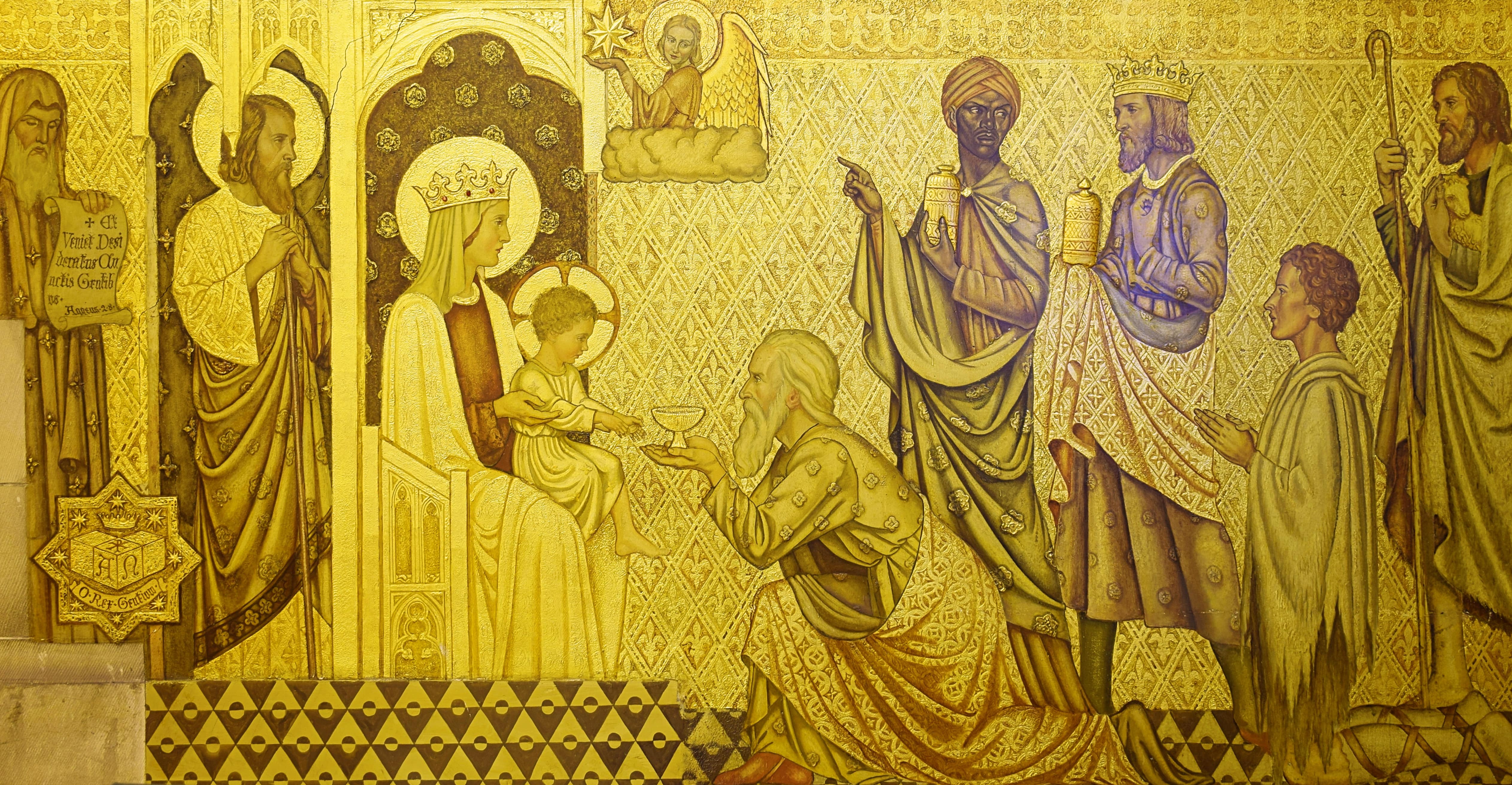
The Adoration of the Magi (1944-1947) by George Duffie

Christmas Day 13 (Bonus!): Christus Victor!

TODAY’S READINGS

While today, January 6, is traditionally Epiphany, since that feast has been moved to Sunday, we get an extra day of the Christmas Season. The first reading is from 1 Jn 5:5-13. This first letter from the beloved disciple is so rich and powerful, it has been a wonderful companion during much of this joyous season.

Who indeed is the victor over the world
but the one who believes that Jesus is the Son of God?
(v. 5)

“This is another case of Johannine shorthand: by ‘faith’ and ‘believes’ John sums up all that comes through this faith — confession of Jesus as the true Son of God, abiding in Christ, the life and witness of the Spirit within, and the power of God through our fellowship with him. It is by our faith that we are enabled to overcome the disordered desires of the world, to proclaim the gospel, to endure persecution, to love our enemies, even to change the world. As Rev 12:11 says, ‘They conquered him by the blood of the Lamb / and by the word of their testimony; / love for life did not deter them from death.” (James, First, Second, and Third John [Catholic Commentary on Sacred Scripture], 226)

Powerful stuff, huh? ”Victor over the world”? The devil’s playground? Yes, we have victory if we believe, and by that is meant not simply faith but faith working through love. Note the commentary above regarding what needs to be done (for starters): overcoming disordered desires, proclaiming the Gospel (through word and deed), enduring persecution, and loving our enemies. Would not we be looking at a very different planet if these traits were overwhelmingly predominant? There are plenty of self-help books on the market, but there is only one Word we need in order to change the world — beginning by changing ourselves.

Christ has conquered the world, the flesh, and the devil through His life, death, Resurrection, and Ascension. He invites us to join Him in taking up our cross to make a difference here and to ultimately inherit eternal life (hopefully bringing many souls with us — see Lk 15:7).

Just a quick note on the last line of the Gospel reading, in which God the Father speaks to God the Son from the heavens upon the latter’s baptism:

“You are my beloved Son; with you I am well pleased.” (Mk 1:11)

All of us who are baptized are children of God. Made, not begotten, it’s true, but really brothers and sisters in Christ. Would not we all love to hear these words from the Father, much less our earthly fathers? Would we actually hear these words based on the state of our lives right now? Maybe for some things and not for others? What is lacking? Worth pondering deeply every day before our judgment day.

God bless.

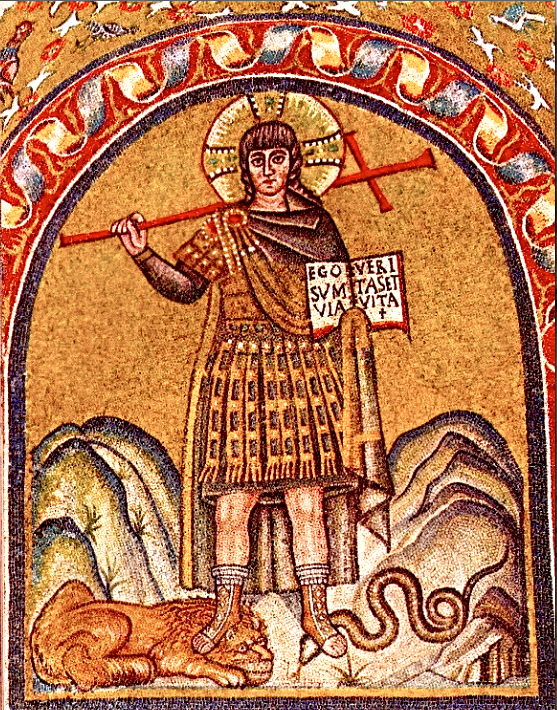
This fifth century mosaic, inspired by Psalm 91, is located in the Archiepiscopal chapel in Ravenna. Christ is represented as a chivarlic Emperor, holding not a sword, but a cross over his shoulders because His kingdom is of an utterly radical life-giving and evil-conquering nature, unlike the kingdoms of the Fallen World System. The book He holds open that reads, “I am the way, the truth and the life.”

Christmas Day 12: Angels and the Son of Man

TODAY’S READINGS

The Gospel reading is from Jn 1:43-51. Jesus continues to accumulate followers, this time picking up Philip and then Nathanael, astonish him after his initial skepticism about Jesus. After an amazing declaration of faith by Nathanael, Jesus tells him and those with him:

“Amen, amen, I say to you,
you will see the sky opened and the angels of God
ascending and descending on the Son of Man.”
(v. 51)

“The mention of angels ascending and descending from heaven upon something alluded to the theophany, or appearance of God, to Jacob at Bethel (Gen 28:10-19). God appeared to Jacob in a dream and extended to him the covenantal promises made to Abraham and Isaac. When he awoke, Jacob said, ‘How awesome this place is! This is nothing else but the house of God, the gateway to heaven!’ (Gen 28:17). Jacob anointed a stone there with oil and name the place ‘Bethel,’ which means ‘the house of God’ (28:18-19).

“Jesus combines two important themes from this Jacob story into his title ‘Son of Man.’ The first is revelation. At Bethel, the Lord revealed himself to Jacob in a dream: now he reveals himself directly and physically in Jesus. The second theme is God’s dwelling place. Jacob referred to the site where the Lord appeared to him as Bethel, ‘the house of God.’ Now, ‘the Word became flesh / and made his dwelling among us’ (1:14). Jesus is the direct, physical dwelling of God among human beings; because God has taken on human nature in Jesus, Jesus reveals God in a new, unsurpassable way. The incarnate Word is the new ‘house of God,’ where the glory of the Lord is present and sensible, and is ‘the gateway to heaven’ (Gen 28:17). The fulfillment of Jesus’ promise — the revelation of God in Jesus who becomes humanity’s gateway to heaven — will be the substance of the rest of the Gospel.”” (The Gospel of John [Catholic Commentary on Sacred Scripture], 51-52)

“Jesus puts himself in the center of this vision, claiming that (1) he is the place where heaven touches down to earth; (2) he is the true house of God; and (3) he is the mediator through whom the angels exercise their ministry.” (The Ignatius Catholic Study Bible: The New Testament (San Francisco: Ignatius Press, 2010), 164)

In the second century, a man names Marcion (possibly a bishop), wanted to disconnect Christianity from Judaism entirely. One significant way to do that was to eliminate the Old Testament as a source of inspired Scripture (there was more to it — see here). Today’s Gospel reading is one of countless examples of why eliminating the OT, or even just having a deficient knowledge of it, is so problematic.

St. Augustine famously said:

The New Testament lies hidden in the Old Testament, and the Old becomes manifest in the New.

How true! Without knowing the story of Jacob’s ladder (Gen 28:10-19), the significance of Jesus’ words would be lost on us (they surely were not lost on his first hearers).

This last month or so, I have been highlighting in these posts the value of good Catholic commentaries. They are invaluable in explicating the sometimes confusing, and sometimes apparently straightforward, texts of the Bible. There is hardly a passage one encounters between the covers of Sacred Scripture that cannot be delved into for deeper meanings on a number of levels (see here regarding the senses of Scripture).

CHRISTMAS IS NEARLY OVER!

It seems fitting on the twelfth day of Christmas to listen to the famous song we all sang at some point growing up. I again turn to Pentatonix, which has a delightfully funky version of the tune.

And what about the meaning of the days? Check out this interesting history.

We are not quite done though. Epiphany will be celebrated Sunday, and then back to Ordinary Time. But, this year, let us appreciate how extraOrdinary it is.

God bless.

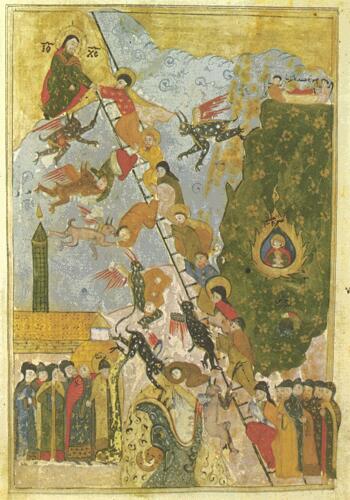
The Ladder of Divine Ascent. SINAI FESTAL ICON.

Christmas Day 11: What are you looking for?

TODAY’S READINGS

The Gospel reading is from Jn 1:35-42. Jesus begins to accumulate followers, the first ones at the prompting of John (he must decrease and Christ must increase). Jesus asks a question and the new apostles ask a question. Both are worth thoughtful consideration.

Jesus turned and saw them following him and said to them,
“What are you looking for?”
They said to him, “Rabbi” (which translated means Teacher),
“where are you staying?”
He said to them, “Come, and you will see.”
So they went and saw where he was staying,
and they stayed with him that day.
(vv. 38-39)

“[I]t is not merely natural curiosity but Christ’s personalty which attracts them. They want to get to know him, to be taught by him, to enjoy his company. ’Come and see’ (1:39; cf. 11:34) — a tender invitation to begin that intimate friendship they were seeking. Time and personal; contact with Christ will be needed to make them more secure in their vocation…

“Christian faith can never be just a matter of intellectual curiosity; it affects one’s whole life: a person cannot understand it unless he really lives it; therefore, our Lord does not at this point tell them in detail about his way of life; he invites them to spend the day with him…what God is (in himself or in grace) can only be understood through experience…” (The Navarre Bible: St John, 55)

“The two disciples of John respond to Jesus’ invitation, setting an example for all whom Jesus will invite to himself…[T]he word for ‘stay’ can also be translated ‘remain’ or ‘abide’ expressing an intimate and lasting personal relationship (see 1:32-33; 6:56; 15:4-7). The disciples ‘stayed with him that day’ as the first step in their becoming united with him, remaining in him and in his love (see 15:9-10).” (Bringing the Gospel of John to Life, 33)

It seems to me that it is always helpful to answer any of Jesus’ questions ourselves. So, “What are you looking for?” What first comes to mind? A (better) job? A new car? Peace in the family? Healing? All good things. All passing things. By looking for Jesus and looking to do His will, we seek a solid foundation for our lives not only in this life, but in the life to come. Consider Jesus words elsewhere in the Gospels:

There is need of only one thing. Mary has chosen the better part and it will not be taken from her. (Lk 10:42)

“Only one thing,” and the rest falls into place. John, in today’s Gospel, encourages the same of his disciples. Surely, he anticipated St. Augustine’s famous line from the first page of his Confessions:

You move us to delight in praising You; for You have made us for Yourself, and our hearts are restless until they rest in You.

As for asking Jesus, “Where are you staying?”, hopefully the first answer is “In my heart.” But it should prompt us to visit Him, really present, in the Blessed Sacrament, even if just for a few moments. What a tremendous privilege of which so few of us take advantage.

Not the same, but here is a live adoration site that I particularly love. Another, closer to (my) home in a church I have visited.

ST ELIZABETH ANN SETON (1774-1821)

The first American-born canonized saint. A wonderful and inspiring story of a woman who truly embraced the universal call to holiness.

I am reminded of my friend, Sr. Elizabeth Ann Brady, who I used to visit in the 1990’s and early 2000’s at a retirement home for religious. She had been an elementary school teacher for some seventy years. One of the kindest and most joyous persons one could hope to meet. She died at 97 almost twenty years ago to the day. I would bet she is hanging out with the other Elizabeth Ann as I type, but I still pray for my friend often.

God bless.

The Calling of Saint John and Saint Andrew (1886-1894) by James Tissot

Christmas Day 10: Unknown children

TODAY’S READINGS

The first reading is from 1 Jn 2:29–3:6, picking up where we left off yesterday. It is incredible news and a sobering note.

See what love the Father has bestowed on us
that we may be called the children of God.
Yet so we are.
The reason the world does not know us is that it did not know him.
(v. 1)

“God the Father has loved us to such an extent that we have the immense privilege of being called his children…We are children of God not in name only or merely as a title of honor. Christians truly have become God’s children in a new way through the saving work of Christ: ‘To all who received him, who believed in his name, he gave power to become children of God, who were born, not of blood or of the will of the flesh or of the will of man, but of God’ (John 1:12-13 NRSV)…

“The fact that we are the children of God explains why the ‘world’ does not recognize us for what we are. Just as those who belong to the world failed to recognize Christ himself and his Father, so they clearly will not know or recognize those who are begotten of God. As children, we are like the Father and the true Son, Jesus Christ, and so we should expect to experience th same rejection that Christ received.” (James, First, Second, and Third John [Catholic Commentary on Sacred Scripture] , 180)

“‘This is the great boldness of the Christian faith — to proclaim the value and dignity of human nature and to affirm that we have been created to obtain the dignity of children of God, through the grace that raises us up to a supernatural level. An incredible boldness it would be, were it not founded on the promise of salvation given us by God the Father, confirmed by the blood of Christ, and reaffirmed and made possible by the constant action of the Holy Spirit’ (Christ is passing by, 33). (The Navarre Bible: Catholic Epistles, 178-179)

What an astounding passage we are highlighting here! That we poor creatures, who would not exist without God and can do nothing good without God, can be made children of God and can choose to ultimately be with this benevolent Father for all eternity. We same creatures whose first parents were gravely disobedient, whose descendants repeatedly spurned God for idols, and who ultimately murdered God, can be reconciled with Him — and more than that — become like God. This is Good News! Like Jeremiah, whom we spoke of a few short days ago, how possibly can we keep this fire inside? And how can we not fail to strive for holiness with the promise of heaven if we live as we profess to believe?

Yet, we can often feel “unknown” when we speak about and live our faith. If our imitation of Christ makes us off-putting to some, so be it. These do not recognize Christ in us, or worse they do and want no part of us/Him. Let us pray that God will use our good example to bring others to Him, that we will make clear to those we encounter the goodness of God and His desire that all persons be saved (see 1 Tim 2:3-4).

God bless, brothers and sisters in Christ (isn’t it wonderful to be related!). I invite you to say an Our Father, recalling our relationship with God and our fellow baptized (all the Communion of Saints).

God bless.

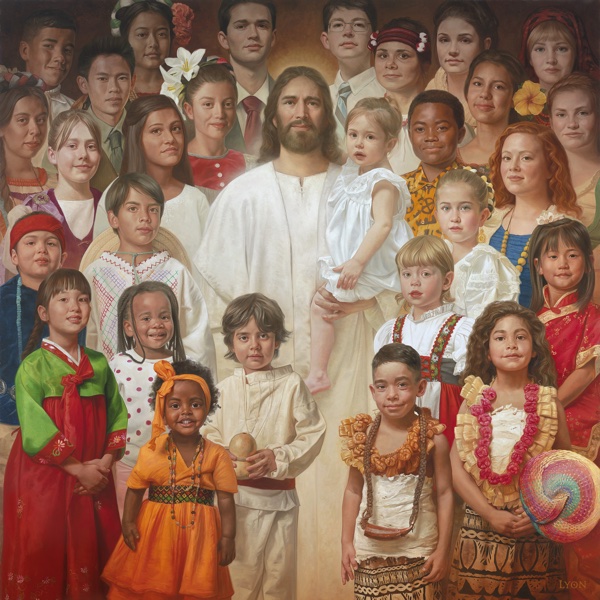
I Am a Child of God (contemporary) by Howard Lyon

Christmas Day 9: LIAR!

TODAY’S READINGS

The first reading is from 1 Jn 2:22-28. We’ve heard quite a lot from John’s first letter in recent days. Today we get a powerful excerpt regarding Jesus’ messiahship and divinity.  I focus here on the first two verses, because they pack such a wallop.

Who is the liar?
Whoever denies that Jesus is the Christ.
Whoever denies the Father and the Son, this is the antichrist.
Anyone who denies the Son does not have the Father,
but whoever confesses the Son has the Father as well.
(vv. 22-23)

“It is evident that John is concerned here for the basic confession of faith regarding the true identity of Jesus Christ.

“But what exactly were these ‘antichrists’ denying? This is not entirely clear, but as we piece together the evidence from the letter, it appears that they were denying that the Son of God (who was ‘in the beginning’ with the Father) actually took flesh and became a human being in the incarnation. They were denying that Jesus truly was the ‘Christ’ — that is, the Messiah or anointed one — who came from the Father for our salvation. ’The Lie par excellence is that which refuses to see the Godhead shine in the human life and death of Jesus’ (F. F. Bruce, The Epistles of John: Introduction, Exposition, and Notes [London: Pickering & Inglis, 1970], 73). For John, this is the core activity of the antichrist: to deny the true incarnation of the Son of God sent from the Father…

“If we deny the truth about the Son, then we lose the Father as well; if we confess and believe in the Son as the faith teaches, then we gain the Father as well. ’Whoever does not honor the Son does not honor the Father who sent him’ (John 5:23).” (James, First, Second, and Third John [Catholic Commentary on Sacred Scripture] , 171, 172)

We know well the devil is a liar, even from the very beginning (see Jn 8:44 and, of course, Gn 3). Who else ultimately inspires a denial of the divinity of Christ and His redemptive mission? 

Now John was likely calling out pseudo-Christians, who, for whatever reason, denied or altered basic doctrine regarding the nature of Christ. They exchanged the truth for a lie, whether wittingly or unwittingly, to deceive or when expressing real (albeit misguided) conviction. Regardless, it is terribly damaging in its potential to lead persons astray.

Consider throughout the ages those who deny Christ is who He says He is. Consider also that this denial gives them no access to the Father of Jesus — no access to God at all! Jesus says to Thomas (and us) during the Last Supper discourse:

“I am the way and the truth and the life. No one comes to the Father except through me.
If you know me, then you will also know my Father. From now on you do know him and have seen him.” (Jn 14:6-7)

Those who follow some other (or no other) religion are perpetuating a lie. Some unknowingly perhaps. Others, in many cases, with strong conviction of their own beliefs. Does God actively will religions outside His Church? Obviously not! Scripture says,

God our savior…
wills everyone to be saved and to come to knowledge of the truth.
For there is one God.
There is also one mediator between God and the human race,
Christ Jesus, himself human,
who gave himself as ransom for all. (1 Tm 2:3-6)

While we are to respect others in their religious choices, if they are following a lesser conception of God than is true, we should love them enough not to leave them there. Jesus’ call to evangelization is absolute (see Mt 28:19). This should not be difficult. If we have good news in our personal affairs we can’t wait to let others know. When we have the Good News (“Gospel”) in our hearts, we shouldn’t be able to hesitate to let others know through word and deed. Lord grant us to be like Jeremiah:

I say I will not mention him,
I will no longer speak in his name.
But then it is as if fire is burning in my heart,
imprisoned in my bones;
I grow weary holding back,
I cannot! (Jer 20:9)

God bless.

Christmas Day 8: Pondering is not ponderous

TODAY’S READINGS

The Gospel reading from Lk 2:16-21 focuses on Blessed Mary and the infant Jesus — appropriate for the Christmas Season and this day when we consider the baby Messiah as what He was: the Second Person of the Trinity incarnate, making His bearer the Mother of God.

Mary kept all these things,
reflecting on them in her heart.
(v. 19)

“In very few words this verse tells us a great deal about our Lady. We see the serenity with which she contemplates the wonderful things that are coming true with the birth of her divine Son. She studies them, ponders them and stores them in the silence of her heart. She is a true teacher of prayer. If we imitate her, if we guard and ponder in our hearts what Jesus says to us and what he does in us, we are well on the way to Christian holiness and we shall never lack his doctrine and his grace. Also, by meditating in this way on the teaching Jesus has given us, we shall obtain a deeper understanding of the mystery of Christ, which is how ‘the Tradition that comes from the Apostles makes progress in the Church, with the help of the Holy Spirit. There is a growth in insight into the realities and words that are being passed on. This comes about in various ways. It comes through the contemplation and study of believers who ponder these things in their hearts. It comes from the intimate sense of spiritual realities which they experience. And it comes from the preaching of those who have received, along with their right of succession in the episcopate, the sure charism of truth’ (Vatican II, Dei verbum, 8).” (The Navarre Bible: St Luke, 56)

“Mary ‘kept all these things’: the Greek word ‘kept’ has connotations of preserving something, being concerned about it, treasuring it. Mary treasured the events that had unfolded, ‘reflecting on them in her heart.’ The Greek word for ‘reflecting on’ means putting things together, pondering them. In the biblical view, the ‘heart’ is the seat of thinking and feeling and willing. Mary takes to heart to amazing things that are happening and tries to fathom their meaning. ’Mary’ is a model of treasuring all that God says and does, meditating on his word, pondering his plans for our lives.” (Bringing the Gospel of Luke to Life, 64)

We encounter a lot of action words in the two commentaries above: contemplating, pondering, reflecting, meditating, studying, experiencing, storing, guarding, preserving, treasuring, preaching, understanding. A full program for our lives, not only in prayer, but also in action. As a new year begins, it is worth working through each of these aspects of our consideration of Jesus as we imitate His mother. Consider looking up each of these twelve words in a regular dictionary and cycle through them throughout the year. How best do we implement in our own minds and hearts, contemplating Jesus, studying about Jesus, really experiencing Jesus, understanding Jesus’ message to the world and to us, personally, etc. Ask Blessed Mary for her intercession, invoke the same Spirit through whom she conceived a child for guidance, and ask Gabriel and your angel for their prayers; our sincerity in these petitions will certainly be profitable.

RECOMMENDED BOOKS I READ IN 2023

YEAR SCARY

I was disappointed to knock off on twenty-five books last year. Summer got really messed up, so that prime time yielded nearly no results. Of those I read, only a handful stood out, including some great classics. I list them below. You can check out Goodreads where I’ve done short reviews for almost all of these. In no particular order:

YEAR: SCARY

I can’t shake the feeling that, considering the escalating difficulties the world over, we are in for a year that may make 2020 seem like a walk in the park. Challenges: hear and abroad, in the Church or directed at the Church.

Let us pray for all veterans and clergy..

Happy New Year. As today began with much joy amidst the noise, let us hope it at least maintains the whole year through.

God bless.