Lent Day 45: Joseph and Nicodemus

TODAY’S READINGS

Today’s Gospel reading for Good Friday of the Lord’s Passion (Jn 18:1—19:42) gives us John’s account of the Passion, death, and burial of Jesus. It ends featuring two members of the Sanhedrin:

“After this, Joseph of Arimathea,
secretly a disciple of Jesus for fear of the Jews,
asked Pilate if he could remove the body of Jesus.
And Pilate permitted it.
So he came and took his body.
Nicodemus, the one who had first come to him at night,
also came bringing a mixture of myrrh and aloes
weighing about one hundred pounds.
They took the body of Jesus
and bound it with burial cloths along with the spices,
according to the Jewish burial custom.
Now in the place where he had been crucified there was a garden,
and in the garden a new tomb, in which no one had yet been buried.
So they laid Jesus there because of the Jewish preparation day;
for the tomb was close by.”
(vv. 19:38-42)

“Our Lord’s sacrifice produces its firstfruits: people who were previously afraid now boldly confess themselves disciples of Christ and attend to his dead Body with exquisite refinement and generosity. The evangelist mentions that Joseph of Arimathea and Nicodemus used a mixture of myrrh and aloes in lavish amount. Myrrh is a very expensive aromatic resin, and aloes a juice extracted from the leaves of certain plants. They were used as an expression of veneration for the dead.” (The Navarre Bible: St John, 237)

“Up till now [Joseph of Arimathea and Nicodemus] had not made their discipleship public because they were afraid of the other religious authorities who strongly opposed Jesus (see 12:43-44)…By burying his body, Joseph and Nicodemus perform a culturally significant act of respect and faithfulness to Jesus. Burying the dead was an important service of love in Jewish piety (Tob 1;16-20; 4:3-4)…Through this public act of piety, Joseph and Nicodemus make known their relationship with Jesus.” (The Gospel of John [Catholic Commentary on Sacred Scripture], 329-30)

“The Gospel earlier noted that ‘even among the authorities’ many believed in Jesus, but out of fear for what would happen to them ‘they did not acknowledge it openly’ (12:42; see also 7:13; 9:22)…

“[Asking Pilate for Jesus’ body] would hardly remain a secret and would manifest that he was a follower of Jesus. He may have previously kept his discipleship a secret to maintain a good relationship with his fellow leaders (see 12:43), but he now casts that aside, identifying with Jesus in his death as had not during his life….

“Pilate may have known, or known of, Joseph of Arimathea as a member of the Sanhedrin; Pilate would not have known that he was a disciple of Jesus. Thus Pilate might have understood that Joseph was finishing off what other Jewish leaders wanted done…

“When [the leaders of the Sanhedrin] wanted Jesus arrested (7:32, 45), Nicodemus invoked the law of Moses to defend him: ‘Does our law condemn a person before it first hears him and finds out what he is doing?’ (7:51). This was hardly a profession of belief in Jesus, but it did indicate to other leaders tat Nicodemus was sympathetic to Jesus (see 7:52). Now by participating in the burial of Jesus, Nicodemus makes his allegiance public, as does Joseph of Arimathea. Jesus said, ‘When I am lifted up from the earth, I will draw everyone to myself’ (12:32). Joseph and Nicodemus are the first of them.” (Bringing the Gospel of John to Life, “544-45)

“Joseph figured in New Testament apocryphal writings (e.g., the apocryphal Aces of Pilate and Gospel of Nicodemus) and was later given a preeminent place in medieval legend as the first keeper of the Holy Grail. His feast day is March 17…

“Tradition says that Nicodemus eventually became a member of the Christian community.” (Catholic Bible Dictionary, 474, 649)

I find it interesting to speculate on minor characters, or those only briefly mentioned in encounters with Jesus. Thus, the research reflected above. As the last resource above mentions, tradition has these men to go on to be Christians. This makes perfect sense, particularly once the Resurrection came to light. How long did they remain in the Sanhedrin? Not long I imagine (whether voluntarily or involuntarily). Did they try to evangelize their fellows after the Resurrection? I wonder. Might they have been pillars of the early Christian community? Seems likely. Could they possibly have provided the Gospel writers with inside information on the workings of the Sanhedrin?. I believe there is no question. How powerful must have been their witness to all these events!

These men prove it is never too late to change and find courage in the truth. And that, instead of giving in to worldly status and demands or just plain despair, their minds and hearts turn to things of heaven and they become men of conviction and action.

Monastery Church: Altar of the crucifixion, Mecklenburg | Gaston Lenthe |
(Longinus, Joseph of Arimathea, and Nicodemus)

God bless.
Lent Day 39: None for one and one for all

TODAY’S READINGS

Today’s Gospel reading (Jn 11:45-56), coming immediately after the astonishing event of Jesus resuscitating Lazarus, shows the extremely heightened concerns of the Jewish religious leaders about Jesus and His popularity are significantly ramping up, so much so that the whole Sanhedrin convenes to discuss what to do about the situation. The high priest, Caiaphas, speaks:

“You know nothing,
nor do you consider that it is better for you
that one man should die instead of the people,
so that the whole nation may not perish.”
(vv. 49-50)

“Caiaphas unwittingly announces that Jesus will die for the salvation of the nation. This is not his own insight, but the grace of prophecy speaking through him in virtue of his priestly office and position as chief teacher of Israel.” (The Gospel of John [Ignatius Catholic Study Bible], 40)

“Here Caiaphas’ words have a dual meaning: one, Caiaphas’ meaning, is that he wants to put Christ to death, on the pretext that that will ensure the political peace and survival of Israel; the other, the meaning intended by the Holy Spirit, is the announcement of the foundation of the new Israel, the Church, through the death of Christ on the cross (Caiaphas is unaware of this meaning). And so it happens that the last high priest of the Old Alliance prophesies the investiture of the High Priest of the New Alliance, which will be sealed in his own blood.” (The Navarre Bible: St John. 160)

Caiaphas did not realize the half of it. In his position as high priest, given to him by God, he could declare prophetic utterances, even if he did not understand their full import. Recall Jesus saying:

Therefore, do and observe all things whatsoever they tell you, but do not follow their example. (Mt 23:3b)

I wonder if Caiaphas realized how soon they would meet again (see Jn 18:14, 24, 28) and how he will be instrumental in seeing through his prophetic words (Mt 26: 57-68).

Yes, one man would die for the nation…and all nations and peoples for all time. Even a despicable man like this high priest can be used by God for good (Friday).

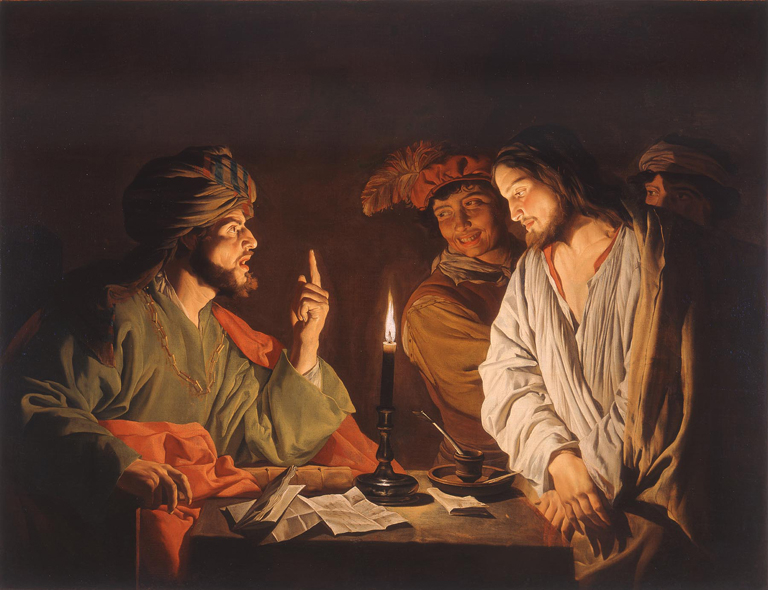
Christ Before Caiaphas (1630) by Matthias Stom

God bless.

Lent Day 33: Lifted Jesus

TODAY’S READINGS

Today’s Gospel reading (Jn 12:20-33) has Jesus approached by Gentiles interested in Him. Now Jesus’ hour has come. He ends His short discourse on this matter this way, with an explanation from John:

“And when I am lifted up from the earth,
I will draw everyone to myself.”
He said this indicating the kind of death he would die.
(vv. 32-33)

“Like the crowds who are ‘amazed’ at Jesus’ teaching (7:15) and miracles (7:21), the guards are awed at his teaching: there is something unprecedented about Jesus.” (The Gospel of John [Catholic Commentary on Sacred Scripture], 45)

when I am lifted up: Refers primarily to the Crucifixion of Christ, as indicated in the next verse, but also hints at his Resurrection and Ascension (CCC 662). See note on Jn 3:14. ● The expression recalls the opening line of Isaiah’s fourth Servant Song, which runs from Is 52:13 to 53:12. The whole song is a prophetic depiction of the suffering of the Messiah, who will be exalted and lifted up in the sight of the nations, but only after he is cast down by his own people. Isaiah interprets the humiliation and death of this Servant as a redemptive sacrifice for sin. draw all men to myself: Points to the worldwide acceptance of the gospel (Mt 28:18–20; Acts 1:8). ● As Isaiah envisioned the Davidic Messiah as an “ensign” posted for the ingathering of the “nations” and the “outcasts of Israel” (Is 11:10–12), so Jesus sees the world gathering around the “sign” of the Cross (CCC 542). (The Gospel of John [Ignatius Catholic Study Bible], 42)

“‘And I, when I am lifted up from the earth, will draw all men to myself.’ The lifting up of Jesus on the cross signifies and announces his lifting up by his Ascension into heaven, and indeed begins it. Jesus Christ, the one priest of the new and eternal Covenant, ‘entered, not into a sanctuary made by human hands. . . but into heaven itself, now to appear in the presence of God on our behalf.’ There Christ permanently exercises his priesthood, for he ‘always lives to make intercession’ for ‘those who draw near to God through him’. As ‘high priest of the good things to come’ he is the center and the principal actor of the liturgy that honors the Father in heaven. (CCC 662)

Christ stands at the heart of this gathering of men into the ‘family of God’. By his word, through signs that manifest the reign of God, and by sending out his disciples, Jesus calls all people to come together around him. But above all in the great Paschal mystery – his death on the cross and his Resurrection – he would accomplish the coming of his kingdom. ‘And I, when I am lifted up from the earth, will draw all men to myself.’ Into this union with Christ all men are called. (CCC 542)

Knowing how the story ends, or might I rather say, how the story continues, we might think that Jesus is referring to His Ascension when He speaks about being “lifted up.” John quickly disabuses us of this notion. While, as the commentary above says, we can see hints of the Ascension, it is unmistakable that there is no Ascension, no Resurrection, without the Crucifixion. As Jesus says earlier in today’s reading, “it was for this purpose that I came to this hour” (v. 27). He calls us to “hate” our life here so that we “will preserve it for eternal life” (v. 25).

We, too, are called to be drawn to the Cross, that is, to suffering. Not wishing for it — we’re not called to be masochists — but accepting it when it comes (because it always does). I invite you to join me in praying that when pain and suffering come, large and small, that we will have the grace to offer it up for the forgiveness of sins (starting with our own) and the redemption of souls. I will mention, as have before in these posts, the blessing of our faith that informs us of the value of suffering when it is redemptive. For the faithful it is not only a promise, but a requirement:

Then Jesus said to his disciples, “Whoever wishes to come after me must deny himself,* take up his cross, and follow me.
For whoever wishes to save his life will lose it, but whoever loses his life for my sake will find it. (Mt 16:24-25)

The second verse echoes what Jesus says in today’s reading. So we ask ourselves: What wouldn’t you endure in the brief moment we traverse this valley of tears for eternal bliss?

Easy? No. Possible? “[F]or God all things are possible” (Mt 19:26). The Lord puts His stamp on this when speaking to Paul:

“My grace is sufficient for you, for power is made perfect in weakness.” (1 Cor 12:9)

Let us pray, and pray some more, for the grace of perseverance in trials and tribulation.

The painting below represents to me “everyone” coming to Jesus. We especially think of John, the loan apostle to return to Jesus in His moment of torture, as a representative for all of us when Jesus entrusts His mother to him. Ask for Blessed Mary’s intercession frequently, as she knows suffering as well as anyone.

BP BARRON’S SERMON

Check out today’s sermon from the good bishop who takes a deep dive into Jeremiah 31:31 — the promise of a New Covenant which Jesus gives us at the Last Supper. Super important to understand the New Covenant and the Old Covenant(s).

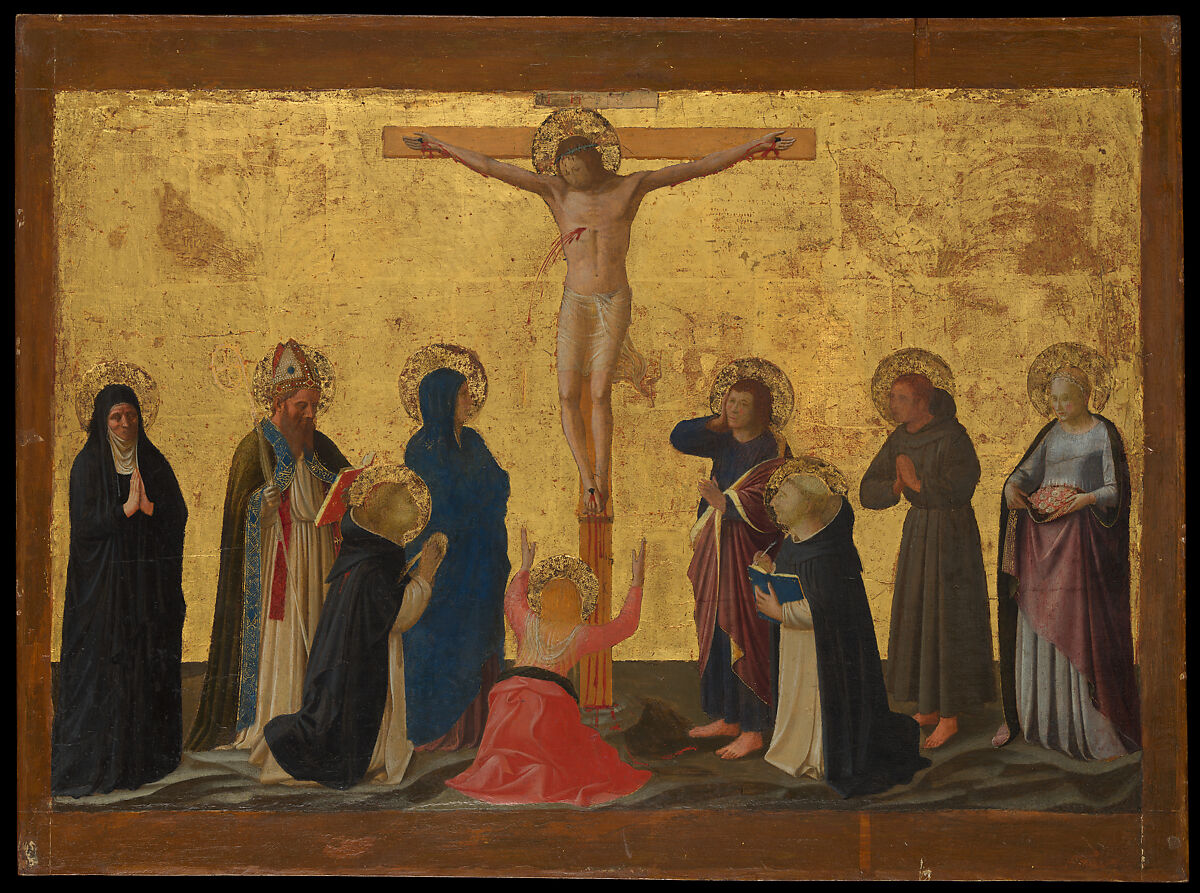
The Crucifixion (c. 1440) by Fra Angelico

God bless.

Lent Day 30: Moses and Jesus

TODAY’S READINGS

Today’s Gospel (Jn 5:31-47) picks up where yesterday’s left off. Jesus here provides deep theology and a pointed accusation at the Pharisees. He closes with these devastating words:

“Do not think that I will accuse you before the Father:
the one who will accuse you is Moses,
in whom you have placed your hope.
For if you had believed Moses,
you would have believed me,
because he wrote about me.
But if you do not believe his writings,
how will you believe my words?”
(vv. 45-47)

he wrote of me: Jesus follows the Jewish tradition that Moses authored the Pentateuch (Gen-Deut). Moses thus described the Messiah as a Redeemer (Gen 3:15), a universal King (Gen 49:10), and a Prophet like himself (Deut 18:15–19).” (The Gospel of John [Ignatius Catholic Study Bible], 28)

“The authorities appealed to the authority of Moses (‘in whom you have placed your hope’) and the Torah to accuse Jesus (see 5:11-18). Yet since the Scriptures are a witness to Jesus (Moses ‘wrote about me’), both the Scriptures and Moses stand on Jesus’ side against his accusers. Scripture bears witness to Jesus, and faith in Jesus opens the way to see this testimony. But on account of their unbelief, the authorities do not fully understand Moses and the Scriptures because they do no see how they bear witness to Jesus. Thus, Jesus concludes, ‘If you do not believe his writings, how will you believe my words?'” (The Gospel of John [Catholic Commentary on Sacred Scripture], 111-12)

“Failure to understand the true import of Scripture is an obstacle to believing in Jesus and coming to him to have life (5:40).” (Bringing the Gospel of John to Life, 150)

I think of typology and the importance of the entire Bible here. It is true, as St. Augustine said, that, “In the Old Testament the New is concealed, in the New the Old is revealed.” We miss so much if we read the New Testament, especially the Gospels, in isolation. Jesus berates the self-described experts in the Law, as missing all the Torah was pointing to: namely Him. Had they seen Jesus as the New Moses, the fulfillment of the Mosaic (and all Old Testament) covenants, they would have put Him on a throne of gold instead of a throne of wood.

God bless.

Christmas Day 11: What are you looking for?

TODAY’S READINGS

The Gospel reading is from Jn 1:35-42. Jesus begins to accumulate followers, the first ones at the prompting of John (he must decrease and Christ must increase). Jesus asks a question and the new apostles ask a question. Both are worth thoughtful consideration.

Jesus turned and saw them following him and said to them,
“What are you looking for?”
They said to him, “Rabbi” (which translated means Teacher),
“where are you staying?”
He said to them, “Come, and you will see.”
So they went and saw where he was staying,
and they stayed with him that day.
(vv. 38-39)

“[I]t is not merely natural curiosity but Christ’s personalty which attracts them. They want to get to know him, to be taught by him, to enjoy his company. ’Come and see’ (1:39; cf. 11:34) — a tender invitation to begin that intimate friendship they were seeking. Time and personal; contact with Christ will be needed to make them more secure in their vocation…

“Christian faith can never be just a matter of intellectual curiosity; it affects one’s whole life: a person cannot understand it unless he really lives it; therefore, our Lord does not at this point tell them in detail about his way of life; he invites them to spend the day with him…what God is (in himself or in grace) can only be understood through experience…” (The Navarre Bible: St John, 55)

“The two disciples of John respond to Jesus’ invitation, setting an example for all whom Jesus will invite to himself…[T]he word for ‘stay’ can also be translated ‘remain’ or ‘abide’ expressing an intimate and lasting personal relationship (see 1:32-33; 6:56; 15:4-7). The disciples ‘stayed with him that day’ as the first step in their becoming united with him, remaining in him and in his love (see 15:9-10).” (Bringing the Gospel of John to Life, 33)

It seems to me that it is always helpful to answer any of Jesus’ questions ourselves. So, “What are you looking for?” What first comes to mind? A (better) job? A new car? Peace in the family? Healing? All good things. All passing things. By looking for Jesus and looking to do His will, we seek a solid foundation for our lives not only in this life, but in the life to come. Consider Jesus words elsewhere in the Gospels:

There is need of only one thing. Mary has chosen the better part and it will not be taken from her. (Lk 10:42)

“Only one thing,” and the rest falls into place. John, in today’s Gospel, encourages the same of his disciples. Surely, he anticipated St. Augustine’s famous line from the first page of his Confessions:

You move us to delight in praising You; for You have made us for Yourself, and our hearts are restless until they rest in You.

As for asking Jesus, “Where are you staying?”, hopefully the first answer is “In my heart.” But it should prompt us to visit Him, really present, in the Blessed Sacrament, even if just for a few moments. What a tremendous privilege of which so few of us take advantage.

Not the same, but here is a live adoration site that I particularly love. Another, closer to (my) home in a church I have visited.

ST ELIZABETH ANN SETON (1774-1821)

The first American-born canonized saint. A wonderful and inspiring story of a woman who truly embraced the universal call to holiness.

I am reminded of my friend, Sr. Elizabeth Ann Brady, who I used to visit in the 1990’s and early 2000’s at a retirement home for religious. She had been an elementary school teacher for some seventy years. One of the kindest and most joyous persons one could hope to meet. She died at 97 almost twenty years ago to the day. I would bet she is hanging out with the other Elizabeth Ann as I type, but I still pray for my friend often.

God bless.

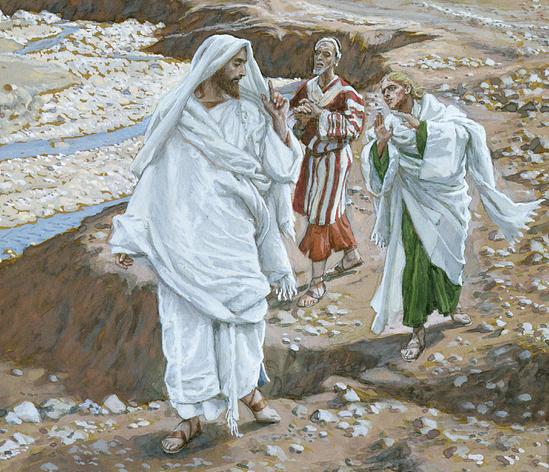
The Calling of Saint John and Saint Andrew (1886-1894) by James Tissot