Lent Day 26: John 3:16

TODAY’S READINGS

Today’s Gospel (Jn 3:14-21) has a listen to the nocturnal encounter between Jesus and an interested Pharisee, Nicodemus. It yields one of the most referred to and quoted lines in all of Scripture:

“For God so loved the world that he gave his only Son,
so that everyone who believes in him might not perish
but might have eternal life.”
(v. 16)

gave his only-begotten Son: The earthly mission of Jesus is part of the heavenly plan of the Father, who displays the depth of his love through the sacrifice of his Son (Rom 5:8; 1 Jn 3:16; CCC 219). This verse marks a transition from the dialogue between Jesus and Nicodemus (3:1–15) to an extended monologue by either Jesus or the evangelist himself (3:16–21). eternal life: The expression refers both to the divine quality of new life in Christ as well as its duration. We receive this gift already on earth in the hope that we will possess it irrevocably in heaven (10:10; 1 Jn 5:13). (Ignatius Catholic Study Bible: The Gospel of John, 23)

“God’s love for Israel is compared to a father’s love for his son. His love for his people is stronger than a mother’s for her children. God loves his people more than a bridegroom his beloved; his love will be victorious over even the worst infidelities and will extend to his most precious gift: ‘God so loved the world that he gave his only Son.'” (CCC 219)

God loves the world. That’s something, isn’t it? We are reminded of Genesis 1 in which God finds all He created good and, culminating with humans, very good. Objectively, there is nothing wrong with the world — God don’t make junk, as used to be a popular saying. It’s humans who caused it to fall, but it is God, through His Son, who redeems it, and who promised a “new heavens and a new earth” at the end of time.

So, believe! And not the easy-believism that says, “I’ve accepted Jesus as my personal Lord and Savior” so now I can do what I want. It means to know Jesus and what He commanded and strive to follow it perfectly. Jesus gives far too many warnings about straying from the narrow path to think any differently.

BP BARRON’S SUNDAY SERMON

God bless.

Lent Day 21: 77x

TODAY’S READINGS

Today’s Gospel (Mt 18:21-35) gives us the chilling Parable of the Unforgiving Servant; it is prompted by the following interaction:

Peter approached Jesus and asked him,
“Lord, if my brother sins against me,
how often must I forgive him?
As many as seven times?”
Jesus answered, “I say to you, not seven times but seventy-seven times.”
(vv. 21-22)

“Some later rabbis considered three times to be a sufficient cap on forgiving someone for the same offense. If that view was prominent in Jesus’ day, Peter may have understood his suggestion of seven times to be quite generous, reflecting Christ’s emphasis on forgiveness (see 6:12, 14-15).

“Jesus’ response, however, is not seven times but seventy-seven times. This hyperbole is not meant to limit forgiveness to the high level of seventy-seven instances, but to express a boundless willingness to forgive one’s brother. The increase from seven to seventy-seven recalls Lamech, who appears last in the genealogy of Cain’s family, a family that was filled with immorality, murder, and vengeance. Lamech boasts, ‘If Cain is avenged sevenfold, then Lamech seventy-sevenfold’ (Gen 4:24). Just as Cain’s descendants responded to their enemies with unlimited vengeance, so Christians should respond to sins committed against them with limitless forgiveness.” (The Gospel of Matthew [Christian Commentary on Sacred Scripture], 234)

“What we human beings cannot possibly do on our own becomes possible because the incarnate Word infuses into our fallen nature the Father’s eternal capacity and desire to forgive. By his statement ‘I say to you seventy-seven times’, Jesus is communicating to Peter not so much an abstract moral truth as the actual capacity to live that truth. A brother must always be forgiven because he and I are children of the same Father and brothers of the same Jesus, and the children cannot fall beneath the level of the divine Father and Brother; for if they do, what is then the basis of the blood relationship and life they share?” (Fire of Mercy, Heart of the Word, Vol. II ,644)

Being a Christian is not easy! In fact, it is well nigh impossible…without God’s grace, “the capacity to live that truth.” Even one act of forgiveness may take all of our will power to muster. But seven, never mind seventy-seven. I am reminded of the Scripture:

For my thoughts are not your thoughts,

my thoughts higher than your thoughts.

For as the heavens are higher than the earth,

so are my ways higher than your ways,

my thoughts higher than your thoughts. (Is 55:8-9)

God bless.

Lent Day 11: Is perfection attainable?

TODAY’S READINGS

Today’s Gospel (Mt 5:43-48), again from the Sermon on the Mount, ends with these challenging (to say the least) words of Jesus:

“So be perfect, just as your heavenly Father is perfect.” (v. 48)

“Strictly speaking, it is quite impossible for a created being to be as perfect as God. What our Lord means here is that God’s own perfection should be the model which every Christian tries to follow, even though he realizes that there is an infinite distance between himself and his Creator. However, this does not reduce the force of this commandment; it sheds more light on it. It is a difficult commandment to live up to, but along with this we must take into account the enormous help grace gives us to go so far as to tend towards divine perfection. Certainly, the perfection which we should imitate does not refer to the power and wisdom of God, which are totally beyond our scope; here the context seems to refer primarily to love and mercy. Along the same lines, St Luke quotes these words of our Lord: “Be merciful. even as your Father is merciful” (Lk 6:36).

“Clearly, the ‘universal call to holiness’ is not a recommendation but a commandment of Jesus Christ.” (The Navarre Bible: St Matthew, 69-70)

“Jesus advocates moral righteousness higher than the Old Covenant—it is a standard of mercy. Just as Israel was to imitate God in being ‘holy’ (Lev 19:2), so Jesus calls the Church to imitate God’s perfect compassion (Lk 6:36). The Father is kind and merciful to the good and evil alike, so his children must extend mercy even to their enemies (5:7; Lk 10:29–37; Jas 2:13). See note on Lk 6:36 (CCC 1968, 2842).” (Ignatius Catholic Study Bible: The Gospel of Matthew, 27)

“There is an insurmountable problem in our Lord’s solemn injunction, which concludes this whole section as its summary, as long as we insist on an abstract, essentialist definition of the term ‘perfect’. The being of man, in this sense, can never be perfect in the same way God’s is, and the Lord seems to be enjoining the impossible. Persons have been known to wreck their psychic, physical, and spiritual lives trying to apply this command in an erroneous way. If we apply the literal Greek meaning of the word for ‘perfect; as noted (τέλειος from τέλος = ‘goal’, ‘end’), we will see that what the command intends is, rather. ‘Guide your actions and attitudes by the same intention, the same finality, as your heavenly Father’s.’ Far from implying a head-braking striving for the unattainable, we should rise from our immersion in the business of self-survival and focus our outlook from the divine point of view. (Fire of Mercy, Heart of the Word, Volume I, 241)

“This ‘as’ is not unique in Jesus’ teaching: ‘You, therefore, must be perfect, as your heavenly Father is perfect’; “Be merciful, even as your Father is merciful’; ‘A new commandment I give to you, that you love one another, even as I have loved you, that you also love one another.’ It is impossible to keep the Lord’s commandment by imitating the divine model from outside; there has to be a vital participation, coming from the depths of the heart, in the holiness and the mercy and the love of our God. Only the Spirit by whom we live can make ‘ours’ the same mind that was in Christ Jesus. Then the unity of forgiveness becomes possible and we find ourselves ‘forgiving one another, as God in Christ forgave’ us.” (CCC 2842)

Feel better? I’m reminded of the famous quote attributed to Mark Twain, “Some people are troubled by the things in the Bible they can’t understand. The things that trouble me are the things I can understand.” Well, if the call to perfection does not trouble the hearer, I’m not sure what else in Scripture would. Any even mildly engaged Christian with an ounce of honest introspection, need only a moment, at most, to realize we all are far from perfect. But this declaration of Jesus should compel us to examine our conscience, pray fervently for help, and then frequent the sacraments to get that help.

Hearkening back to yesterday’s post, “You can pay me now or pay me later.” A person does not get into heaven with any imperfections. Best to clean up our act here, discipline ourselves here, detach ourselves here. It’s easy to understand but very difficult to do.

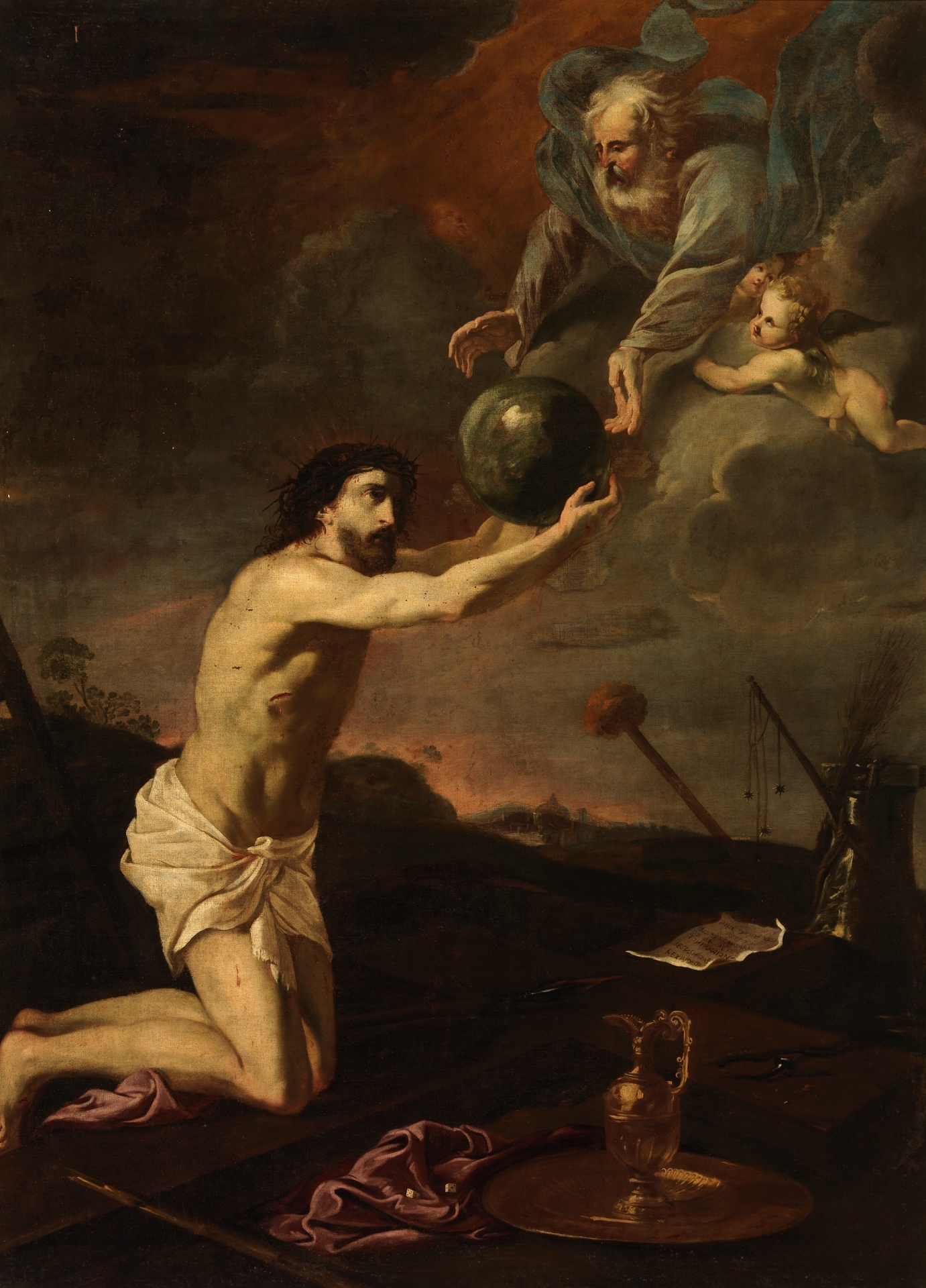
Jesus Receiving the World from God the Father (c. 1657) by Antonio Arnas Fernández

God bless.

Lent Day 6: To others = to Jesus

TODAY’S READINGS

A glimpse at the Last Judgment (Mt 25:31-46) with Jesus’ words. Am I thrilled or am I terrified?

Amen, I say to you, whatever you did
for one of these least brothers of mine, you did for me.”
(v. 40)

“St Teresa of Avila writes: ‘Here the Lord asks only two things of us: live for his Majesty and love for our neighbour. It is these two virtues that we must strive, and if we attain them perfectly we are doing his will […]. The surest sign that we are keeping these two commandments is, I think, that we should really be loving our neighbour; for we cannot be sure if we are loving God, although we may have good reasons for believing that we are, but we can know quite well if we are loving our neighbour. And be certain that, the farther advanced you find you are in this, the greater the love you will have for God; for so dearly does his Majesty love us that he will reward our love for our neighbour by increasing the love which we beat to himself, and that in a thousand ways: this I cannot doubt (Interior Castle, V, 3)” (The Navarre Bible: St Matthew, 213-14)

“It seems likely that the ‘least brothers’ refers to Christians, perhaps to those missionaries who faced numerous hardships for their efforts to evangelize the world. The reason is that these words of Jesus recall earlier descriptions of the disciples in Matthew (10:42; 12:49-50; 18:6, 10). Likewise, ‘all the nations’ assembled for judgment appear to represent all the non-believing Gentiles of the world who are called to account for their treatment of Jesus’ followers. Certainly the Greek term for ‘nations (v. 32) often means ‘Gentiles,’ or ‘pagans,’ in Matthew (see e.g., 4:15; 6:32; 10:5; 12:18).” (The Gospel of Matthew [Christian Commentary on Sacred Scripture], 326-27)

“Jesus’ prophesy of the Last Judgment unfolds at two historical levels. (1) He initially foretells the judgment of Old Covenant Israel. This involves his “coming” to Jerusalem (A.D. 70) as the Shepherd who separates the faithful sheep of Israel from the wicked goats (10:23; 16:27–28; cf. Ezek 34:17–22). (2) He ultimately foretells the General Judgment at the end of history. This will involve Christ’s Second Coming and the general resurrection of all people before his throne to be blessed (25:34) or cursed (25:41) according to their deeds (Jn 5:25–29; Rev 20:11–12; CCC 1038–39).” (Ignatius Catholic Study Bible: The Gospel of Matthew, 63)

If anyone believes that works we do in this life have no bearing on our eternal fate in the next life, these words of Jesus should disabuse that person of this notion. I am reminded of time, talent, and treasure: Everyone has something to offer, from the busiest worker with the big salary and the well-funded retirement accounts to the homebound person barely scraping by. Monetary donations, assisting at the parish or soup kitchen, conducting a Bible study, a Rosary, or all of the above. We have all been given much, regardless of our circumstances. So, “[m]uch will be required of the person entrusted with much, and still more will be demanded of the person entrusted with more” (Lk 12:48).

God bless.