
TODAY’S READINGS
FROM Micah 5:1 (the full passage is Mi 5:1-4a):
You, Bethlehem-Ephrathah
too small to be among the clans of Judah,
from you shall come forth for me
one who is to be ruler in Israel;
whose origin is from of old,
from ancient times.
From The Word of the Lord (Year C), page 30
“The language of a ‘ruler’ who ‘comes forth’ from ‘Behlehem-Ephrathah’ is a poetic way of describing an heir to the throne of David, a new king who has the Davidic bloodline. This rules is described in provocative ways that suggest divinity. His origin is miqqedem in Hebrew, which can mean both ‘from the east’ and ‘from antiquity.’ Both are suggestive because the east was associated with the abode of the arrival of God — the temple, for example faced east. Likewise, an ancient origin was a divine attribute — that, God the Father, is called ‘the Ancient of Days’ (Dan 7:22 RSV2CE). This concept of ancient origin is reinforced in the next verse of our Micah passage, translated ‘whose origin is from of old,’ but which literally reads ‘his origin is from days of eternity.’ This language of a Davidic ruler who has ‘eternal’ origins could be just poetic hyperbole, but let us note that, much like Isaiah 9:6. the literal sens of this text of Micah describes a king who is both human and divine.”
FROM Psalms 80:2 (the full passage is Ps 80:2-3, 15-16, 18-19):
O shepherd of Israel, hearken,
from your throne upon the cherubim, shine forth.
Rouse your power,
and come to save us.
From The Navarre Bible: The Psalms and the Song of Solomon, page 278
“God, as Shepherd of his people, has his dwelling-place in the temple, above the ark, ‘enthroned upon the cherubim’ (cf. Ex 25:18-22).”
FROM Hebrews 10:10 (the full passage is Heb 10:5-10
[W]e have been consecrated
through the offering of the body of Jesus Christ once for all.
From Catholic Commentary on Sacred Scripture: Hebrews, page 199
“The Greek word for ‘consecrated’ (hagiazō) would be better translated as ‘sanctified’ or ‘made holy,’ since here it connotes not only being ‘set apart’ for God but coming to share in god’s own holiness. The reason Jesus’ sacrifice has power to sanctify is that he offered no mere substitute but himself, his own human life wholly given over in love. His sacrifice therefore transforms human nature from within; it heals the self-will, pride, rebellion, and unbelief that have deeply wounded human nature ever since the fall. Hebrews emphatically declares that this sanctification is already an accomplished fact, ‘once for all.’ Christ’s passion is the fulcrum of human history, the act that has definitively reconciled humanity to God and given access to God’s own holiness, Yet paradoxically, Hebrews will say in verse 14 that we who believe in Christ ‘are being sanctified’; the accomplished fact must be personally appropriated and lived by every believer (see also 12:10, 14).”
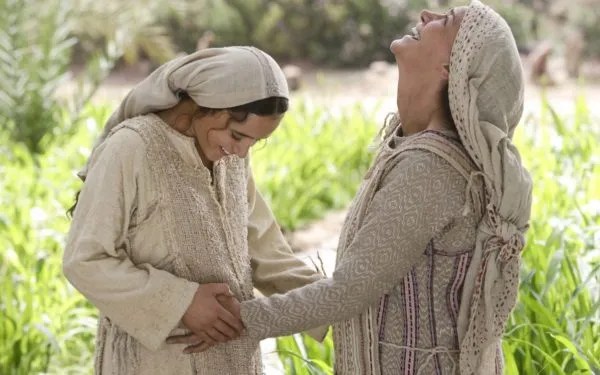
FROM Luke 1:42-43 (the full passage is Lk 1:39-45)
“Blessed are you among women,
and blessed is the fruit of your womb.
And how does this happen to me,
that the mother of my Lord should come to me?”
From Ignatius Catholic Study Bible: The Gospel of Luke, page 20
“Blessed are you: Elizabeth blesses Mary with words once spoken to Jael and Judith in the OT (Judg 5:24–27; Jud 13:18). ● These women were blessed for their heroic faith and courage in warding off enemy armies hostile to Israel. Victory was assured when both Jael and Judith assassinated the opposing military commanders with a mortal blow to the head. Mary will follow in their footsteps, yet in her case both the enemy destroyed and the victory won will be greater, for she will bear the Savior who crushes the head of sin, death, and the devil underfoot (Gen 3:15; 1 Jn 3:8) (CCC 64, 489).
mother of my Lord: This title reveals the twin mysteries of Jesus’ divinity and Mary’s divine maternity (CCC 449, 495). Note that every occurrence of the word Lord in the immediate (1:45) and surrounding context refers to God (1:28, 32, 38, 46, 58, 68). ● Mary’s divine motherhood was the first Marian dogma expounded by the Church. The Ecumenical Council of Ephesus (A.D. 431) defined her unique relationship to Christ and honored her with the title ‘Mother of God’ (Gk. Theotokos). This was reaffirmed in 1964 at Vatican II (Lumen Gentium, 53).”
From Opening the Scriptures: Bringing the Gospel of Luke to Life, page 29
“In the culture in which Mary lived, a woman’s greatness came from the children she bore (see 11:27). Elizabeth, inspired by the Holy Spirit, perceives the greatness of the child whom Mary is carrying and Mary’s resulting greatness.”
From The Word of the Lord (Year C), page 35
“Elizabeth is a wise woman, learned in history and culture of Israel and Judah. Through the Holy Spirit, she recognizes our Mother Mary as the Queen Mother, as the ‘First Lady’ of the kingdom of Israel, and she treats her as such, showing her all deference and veneration. So if we are ever challenged by non-Catholics concerning the biblical nature of the honor we show Mary within the Church, we should point to this passage of Luke as indication that the custom of venerating the Blessed Mother began in her lifetime, in the very pages of Scripture.”
MY TAKE
The same Gospel two days in a row! Boring? No way! We should be glad this is proclaimed to us again and we could stand to hear it every day. The acknowledgement by Elizabeth of the zygote inside Mary as the Lord of the universe, the one God, is a cause for celebration — the Redeemer promised in Gen 3:15 has finally come. And what a powerful pro-life message, to boot. The developing child is now, a few days after conception, the Messiah. Elizabeth knows that what Micah prophesied, that a ruler whose “origin is from days of eternity,” is finally Emmanuel, that is, God with us (see Is 8:8-10). Her son, John, is to be the precursor to the one who has “come to save us” as the Psalmist tells us today. Just imagine the conversations Mary and Elizabeth had the next three months regarding their two special children. Finally, per Hebrews, Jesus came to consecrate us with that same developing body in the Paschal Mystery and continues to consecrate us until today and on till the end of time in the most Blessed Sacrament.
Is there any question why we call this Good News?
BP BARRON SERMON
FR MIKE SCHMITZ HOMILY

God bless!




 Unworthy Servant