Lent Day 17: What about our tenancy?

TODAY’S READINGS

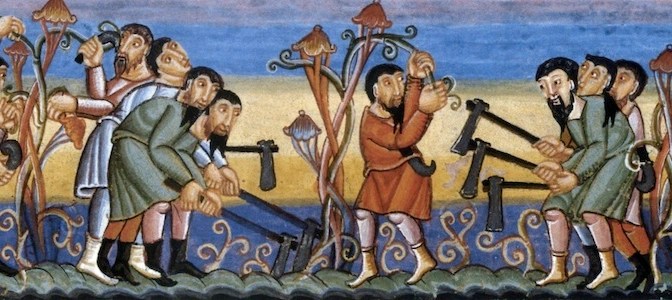
Today’s Gospel (Mt 21:33-43, 45-46) is the Parable of the Wicked Tenants; it starts out this way:

“There was a landowner who planted a vineyard,
put a hedge around it,
dug a wine press in it, and built a tower.
Then he leased it to tenants and went on a journey.”
(v. 33)

“Just before his Passion and death, Jesus tells the striking story of the landowner who planted a vineyard. The fertile vineyard stands for Israel, his chosen people. But it could be broadened out to include the world. What do we learn from this beautiful image? That God has made for his people a place where they can find rest, enjoyment, and good work.

“We — Israel, the Church, the world — are not the owners of this vineyard; we are tenants. One of the most fundamental spiritual mistakes we can make is to think that we own the world. We are tenants, entrusted with the responsibility of caring for it, but everything that we have and are is on loan. Our lives are not about us.

“Christ is God’s judgment. We are all under his judgment. In the measure that we reject him or refuse to listen to him, we place our tenancy in jeopardy. And so the great question that arises from this reading: How am I using the gifts that God gave me for God’s purposes? My money? My time? My talents? My creativity? My relationships? All is for God, and thus all is under God’s judgment.” (The Word on Fire Bible: The Gospels, 131)

Bishop Barron makes an excellent point: How good stewards are we of all that God has given us? We will be accountable for all we do (and all we neglect to do). What inheritance can we hope for if we abuse our free will time and again, ultimately killing the life of the Son within us?

Time, talent, and treasure. If we don’t have all three, we may have two, and certainly have one.

“[Y]our light must shine before others, that they may see your good deeds and glorify your heavenly Father.” (Mt 5:16)

Let us reflect the Light of the World (see John 8:12) in our own selves, thus bringing light and life to others.

A MILESTONE!

This is my 1000th post on WordPress! An auto-generated post when I signed up in 2009 is followed up by my first post in 2012, introducing myself. The third post is the first with substantial content. Links for all three allow for a dash into the past:

Thanks for reading!

God bless.

Lent Day 9: Rock solid

TODAY’S READINGS

From today’s Gospel (Mt 16:13-19), we celebrate the Feast of the Chair of St. Peter with, what else but, Matthew 16.

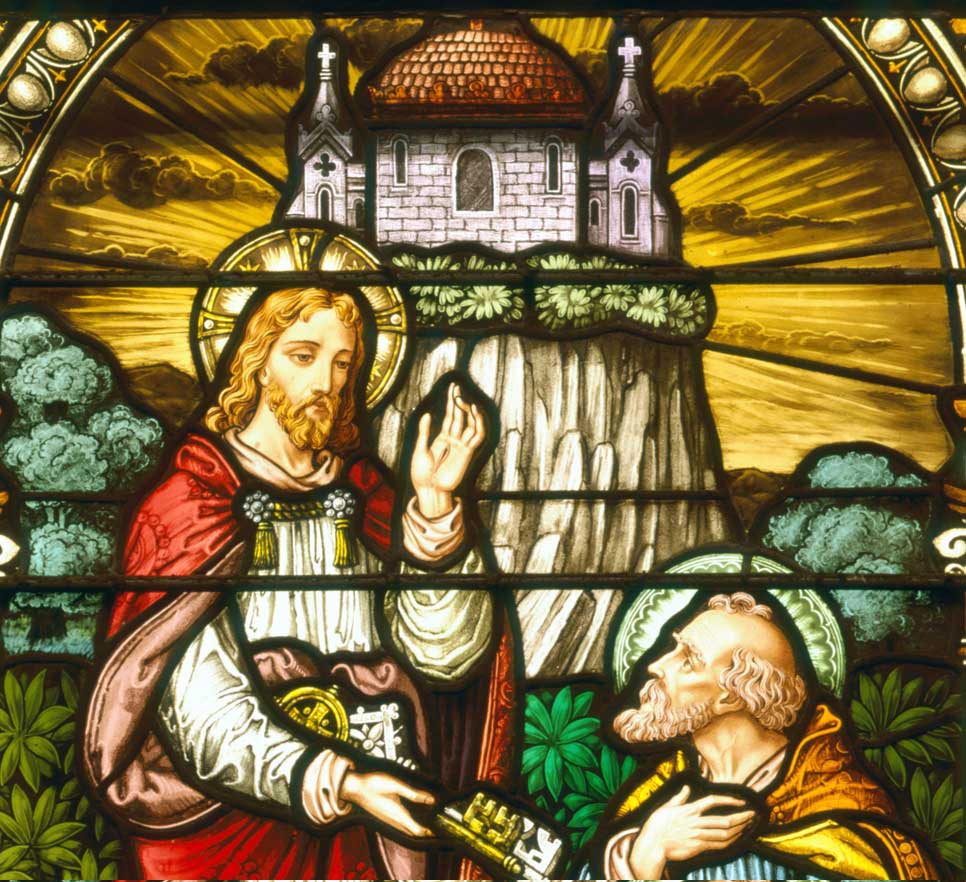
“And so I say to you, you are Peter,
and upon this rock I will build my Church,
and the gates of the netherworld shall not prevail against it.”
(v. 18)

I will build: Jesus portrays the Church as a spiritual Temple (cf. 1 Cor 3:16–17; 2 Cor 6:16; Eph 2:19–22; 1 Pet 2:4–8). ● As Solomon was the son of David and the anointed Temple builder in the OT, so Jesus is the Davidic “Son” of God (16:16) and the anointed Messiah who builds the Church in the New. Jesus elsewhere sees himself as both similar and superior to King Solomon (12:42). See note on Mt 7:24. my Church: Among the Gospels, Matthew alone uses the word Church (18:17). The word is used often in the Greek OT for the “congregation” or “assembly” of Israel united to God. Jesus uses it in a similar way for the New Covenant community. the gates of Hades: In the OT, Hades—also called “Sheol” or “the Pit”—is the place of the dead where souls descend through its gates (Ps 9:13, 17; Wis 16:13; Is 38:10; Jon 2:2). It is not hell, but a temporary realm where souls are detained until the Last Judgment (Rev 20:13–15). By extension, Hades is also the habitation of evil forces that bring about death and deception (Rev 6:8; 20:1–3). According to Jewish tradition, the foundation stone (Heb.‘eben shetiyyah) of the Jerusalem Temple capped off and sealed a long shaft leading down to the netherworld (Rev 9:1–2; 20:1–3). The Temple, resting securely on a rock, was thus the center of the cosmos, the junction between heaven and Hades. Drawing from this background, Jesus guarantees that the powers of death and deception will not overcome the Church—i.e., the new Temple built on Peter. He enables Peter (and his successors) to hold error at bay and faithfully proclaim the gospel (CCC 552).” (The Ignatius Catholic Study Bible: The New Testament, 36.)

“The Lord made Simon alone, whom he named Peter, the “rock” of his Church. He gave him the keys of his Church and instituted him shepherd of the whole flock. “The office of binding and loosing which was given to Peter was also assigned to the college of apostles united to its head.” This pastoral office of Peter and the other apostles belongs to the Church’s very foundation and is continued by the bishops under the primacy of the Pope.” (CCC 881)

“In the symbolism of Israel’s theology, the gates of the netherworld were the opening leading down to Hades, also called Sheol, or the Pit, which was the dark and gloomy underworld hidden deep within the bowels of the earth. There the souls of the dead sank down into a shadowy, joyless existence. There also, in Jewish thinking, was the habitation of infernal powers that bring death and deception into the world of the living (see Rev 9:1-6; 11:7; 20:1-3). Later, rabbinic Judaism believed that the foundation stone of the temple capped off the shaft leading down to the underworld. Peter is now given a comparable role in the living temple built by the Messiah. Thanks to the blessing of Jesus on Peter, now made the rock of the new temple, neither death, nor the devil, nor his deceiving spirits shall prevail against the Church.” (The Gospel of Matthew [Catholic Commentary on Sacred Scripture], 208-09)

Thanks be to God for the Rock that our faith can stand firm on. No matter how “rocky” things seem to get in our world or even in our Church, we can be confident that the Church is indefectibly holy because of its head (Christ) and its soul (the Holy Spirit). Hell has no chance. The Church cannot err on matters of faith and morals, so regardless of whatever happens or whatever we hear that concerns us, we can be assured that the age-old teaching of the Church does not waver — so neither should we waver. Jesus promised to stay with us till the end of time and He keeps His promises (and if he wants to hurry back there’ll be no complaints from me).

God bless.